
Reports
The Global Industrial Catalysts Market was valued at USD 2,463.0 Million in 2025 and is anticipated to reach a value of USD 3,494.6 Million by 2033 expanding at a CAGR of 4.47% between 2026 and 2033. Increasing refinery modernization, stringent industrial emission standards, expansion of petrochemical production, and growing deployment of advanced catalysts for low-carbon hydrogen, renewable fuels, and chemical processing are driving market growth.
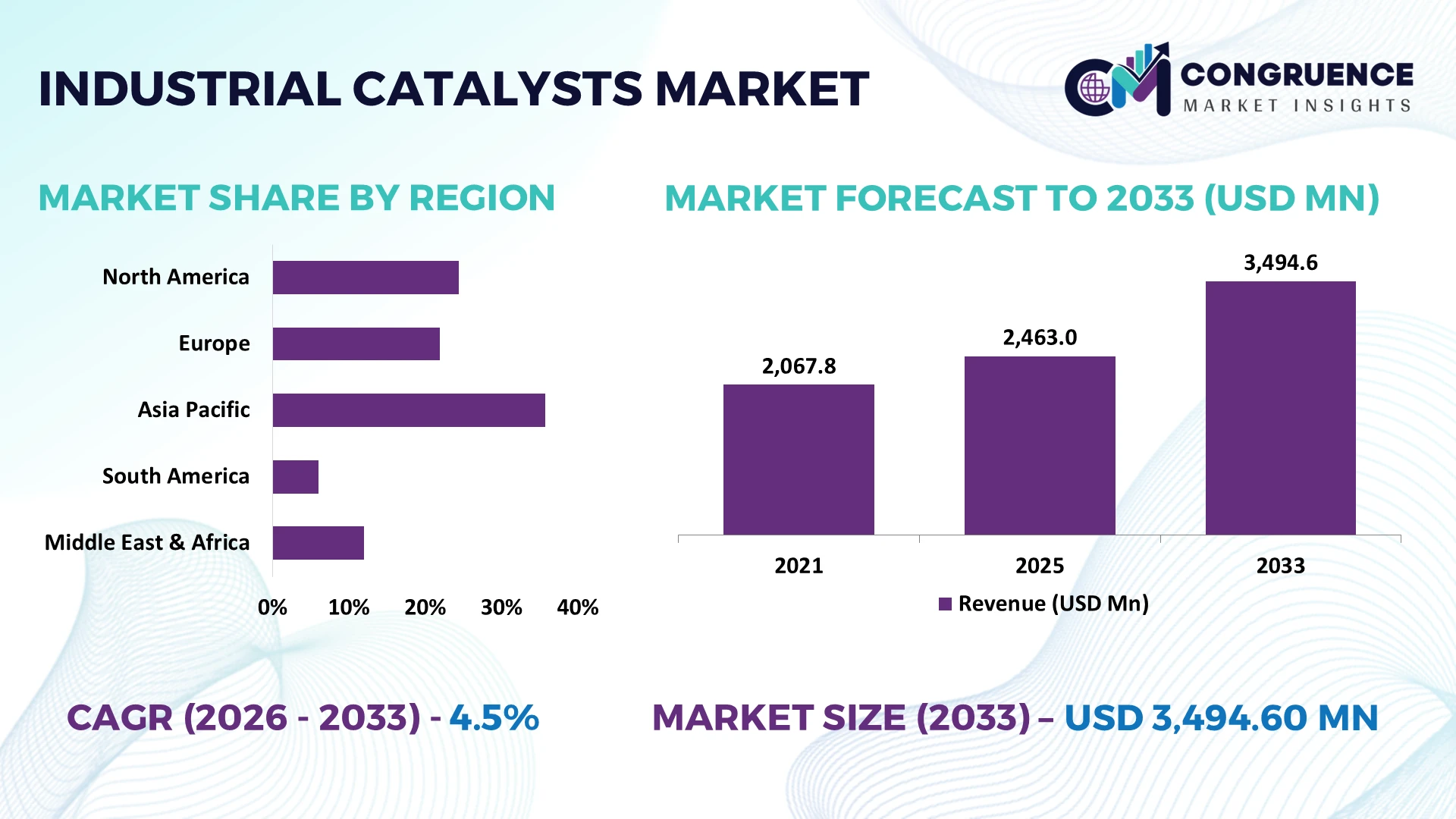
China represents the dominant country-level industrial catalyst market, supported by its extensive petroleum refining, petrochemical, and chemical manufacturing infrastructure. The country accounted for a substantial portion of global petroleum refining catalyst consumption, with Asia-Pacific representing 35.67% of the broader industrial catalysts market in 2025. China's 10 ppm sulfur fuel standards and large-scale integrated refinery investments reinforce demand for high-selectivity hydroprocessing and fluid catalytic cracking catalysts. Compared with China's manufacturing scale, Germany emphasizes advanced catalyst engineering, process efficiency, and emissions-control technologies.
Strategically, manufacturers should prioritize high-performance catalyst formulations, localized supply chains, and partnerships with integrated refinery and chemical producers to strengthen their competitive positioning.
Market Size & Growth: The global industrial catalysts market increases from USD 2,463.0 million in 2025 to USD 3,494.6 million by 2033, at a 4.47% CAGR, supported by refinery modernization, petrochemical expansion, and advanced hydroprocessing technologies.
Top Growth Drivers: Refinery and petrochemical expansion contributes an estimated 1.5% growth impact, tightening fuel and industrial emission standards 1.1%, and process intensification and catalyst selectivity 0.8%.
Short-Term Forecast: By 2028, AI-assisted catalyst discovery is positioned to accelerate experimental throughput by up to 5,500%, reducing research cycles from months to weeks.
Emerging Technologies: AI-driven catalyst discovery, metal-organic frameworks (MOFs), nanostructured catalysts, and digitally monitored catalytic reactors are transforming formulation development and industrial process optimization.
Regional Leaders: Asia-Pacific held 35.67% of the market in 2025, supported by Chinese refining and Indian petrochemical investments. North America benefits from low-carbon hydrogen projects, while Europe prioritizes emissions-control catalysts and circular chemical processing.
Consumer/End-User Trends: Petroleum refining represented 50.12% of industrial catalyst application demand in 2025, reflecting sustained requirements for hydrocracking, fluid catalytic cracking, and sulfur-removal processes.
Pilot/Case Example: In 2025, an autonomous catalyst discovery platform demonstrated up to 5,500% higher experimental throughput, approximately 56 times conventional weekly output, while reducing experimental costs from USD 2,000 to below USD 300.
Competitive Landscape: BASF, Johnson Matthey, Clariant, Honeywell UOP, and Shell Catalysts & Technologies compete through catalyst selectivity, proprietary formulations, regeneration services, and integrated process technologies.
Regulatory & ESG Impact: China's 10 ppm sulfur fuel standards and the IMO's 0.50% global marine fuel sulfur limit reinforce demand for hydrodesulfurization, hydrotreating, and emissions-control catalysts.
Investment & Funding: Industrial investment is increasingly directed toward low-carbon hydrogen, renewable fuels, catalyst regeneration, and integrated petrochemical facilities, with strategic partnerships supporting technology commercialization.
Innovation & Future Outlook: Next-generation catalysts combining AI-assisted formulation, lower precious-metal loading, improved selectivity, and circular feedstock compatibility are shifting competition toward lifecycle efficiency and performance-based service models.
The industrial catalysts market is evolving through increasing demand for high-selectivity refining catalysts, polymerization catalysts, chemical synthesis catalysts, and environmental catalysts. Petroleum refining accounts for approximately 50.12% of application demand, while AI-assisted discovery is accelerating formulation development and reducing experimental expenditure. The transition toward renewable feedstocks, low-carbon hydrogen, and stricter sulfur specifications is encouraging manufacturers to redesign catalyst portfolios. Supply-chain diversification and greater emphasis on precious-metal recovery are also reshaping procurement strategies, creating opportunities for technology-led suppliers.
Industrial catalysts are becoming strategic assets in global manufacturing because they directly influence production economics, product quality, energy consumption, and environmental compliance. Their importance extends beyond conventional refining into specialty chemicals, renewable fuels, hydrogen production, and advanced materials. The shift toward integrated petrochemical facilities and cleaner industrial processes is encouraging manufacturers to prioritize catalyst performance, supply reliability, and long-term technology partnerships.
Technology differentiation is increasingly measurable. AI-enabled autonomous catalyst discovery combines robotics, simulation, and machine learning to accelerate experimentation, achieving up to 56 times the conventional weekly experimental throughput in a demonstrated industrial research platform. Traditional laboratory-led development, by comparison, relies heavily on manual experimentation and longer formulation cycles. This improvement strengthens the business case for digital research infrastructure and faster commercialization.
Regional strategies differ considerably. China and India prioritize production scale and refinery integration, while Germany and the United States emphasize advanced formulations, process optimization, and lower-emission technologies. Over the next 2–3 years, companies will increasingly invest in catalyst regeneration, digital performance monitoring, and alternative feedstock compatibility. Practical deployments in hydrotreating and hydrocracking demonstrate how tailored formulations improve product yields while supporting cleaner fuel specifications.
Consequently, competitive advantage will increasingly depend on proprietary catalyst chemistry, application-specific engineering, reliable raw-material sourcing, and the ability to deliver measurable operating improvements rather than competing exclusively on catalyst prices.
Expansion of integrated refining and petrochemical infrastructure is strengthening demand for fluid catalytic cracking, hydrocracking, and hydrotreating catalysts. Petroleum refining accounted for approximately 50.12% of industrial catalyst application demand in 2025, while Asia-Pacific represented 35.67% of the global market. China's transition toward cleaner transportation fuels, including its 10 ppm sulfur specifications, increases the need for advanced hydrodesulfurization formulations. Simultaneously, heavier crude processing and higher-value chemical production require improved catalyst selectivity. Manufacturers are responding through localized production, refinery technology agreements, and customized catalyst formulations. A non-obvious advantage is the recurring replacement and regeneration business generated after initial refinery commissioning, creating long-term customer relationships beyond initial catalyst installations.
Volatility in platinum-group metals, palladium, nickel, and other catalyst inputs creates substantial cost-management pressure for industrial catalyst manufacturers. Precious-metal exposure increases procurement sensitivity, particularly when geopolitical tensions and trade restrictions affect concentrated mining and refining supply chains. Catalyst poisoning from sulfur, nitrogen, metals, and contaminants in variable feedstocks further reduces operating efficiency and increases regeneration requirements. For certain specialty formulations, raw-material substitution is constrained by activity, selectivity, and thermal-stability requirements. These limitations increase inventory costs and complicate customer pricing agreements. Manufacturers are addressing exposure through metal recovery, alternative formulations, diversified sourcing, and long-term procurement contracts. The critical commercial distinction is that reducing precious-metal loading without compromising catalyst lifetime offers greater value than simply negotiating lower initial material prices.
AI-assisted formulation development presents a significant opportunity to shorten research cycles and commercialize advanced catalysts more efficiently. A demonstrated autonomous discovery platform achieved up to 5,500% higher experimental throughput and reduced individual experiment costs from USD 2,000 to below USD 300. Meanwhile, renewable diesel, sustainable aviation fuel, plastic pyrolysis oils, and bio-based chemical feedstocks are creating opportunities for specialized hydroprocessing and contaminant-resistant catalysts. The expansion of low-carbon hydrogen and ammonia projects further increases the importance of catalytic process engineering. Manufacturers are positioning through automated laboratories, university partnerships, and application-specific R&D. An emerging opportunity lies in catalyst formulations that tolerate inconsistent recycled feedstocks, allowing chemical producers to improve circular-material utilization without requiring complete process-plant replacement.
Translating laboratory catalyst performance into continuous industrial operation remains a significant technical challenge. Industrial reactors experience variations in temperature, pressure, feedstock composition, and contaminant concentrations that can alter catalyst activity and selectivity. The challenge is particularly pronounced when processing renewable feedstocks and plastic-derived pyrolysis oils, which introduce contaminants requiring specialized pretreatment. Refinery operators also face qualification requirements before introducing new catalyst formulations into established reactor systems. These conditions increase pilot-testing expenditure, commissioning complexity, and operational uncertainty. Companies must strengthen pilot-to-commercial validation, develop predictive catalyst monitoring, and establish application-specific testing partnerships. A critical strategic requirement is demonstrating consistent performance across complete operating cycles, rather than relying on short-duration laboratory efficiency results.
Digital Catalyst Performance Monitoring: Refiners are shifting from periodic laboratory testing toward continuous catalyst-health monitoring using process analytics, predictive modelling, and automated alerts. Digital platforms integrate feed quality, reactor temperature, catalyst activity, and hydrogen consumption data, improving operational visibility and shortening troubleshooting cycles. BASF, Grace, and Topsoe are strengthening connected technical-service platforms, enabling refiners to optimize catalyst replacement schedules and reduce unplanned operating interruptions. The non-obvious shift is that catalyst suppliers increasingly compete through operational intelligence and customer data integration rather than formulation performance alone.
Regeneration and Metal Recovery Expansion: Industrial operators are increasing catalyst regeneration and precious-metal recovery to manage raw-material exposure and spent-catalyst disposal requirements. Ex-situ processing represented approximately 72.6% of the catalyst regeneration market in 2025, demonstrating the importance of established recovery infrastructure. Axens' acquisition of Eurecat in 2026 strengthened its regeneration, rejuvenation, and recycling capabilities. Manufacturers are integrating recovery services with catalyst supply agreements, improving material utilization and creating recurring service relationships with refinery customers.
Renewable Feedstock Compatibility: European and Asian chemical producers are adapting catalytic processes to accommodate bio-based oils, plastic pyrolysis oils, and alternative hydrocarbon feedstocks. The International Air Transport Association reported that sustainable aviation fuel production doubled between 2023 and 2024, reinforcing investment in compatible hydroprocessing technologies. Companies are developing contaminant-tolerant catalysts, improving pretreatment systems, and collaborating with renewable-fuel developers. This transition is also increasing the importance of catalyst stability under variable feedstock conditions.
Refinery Integration and Portfolio Restructuring: Refinery closures across parts of Europe and the United States are coinciding with capacity additions in China, India, and the Middle East. Approximately 794,000 barrels per day of new global refining capacity entered the 2025 development pipeline, while integrated refinery-petrochemical projects increasingly prioritize propylene and higher-value chemical output. Catalyst suppliers are restructuring regional service networks, expanding technical support near new facilities, and prioritizing integrated licensing agreements. This shift favors suppliers capable of supporting multiple catalytic processes within a single industrial complex.
Heterogeneous catalysts dominate the industrial catalysts market, accounting for approximately 73.56% of global market share in 2025. Their solid-phase structure, separation efficiency, thermal stability, and compatibility with continuous processing make them essential for petroleum refining, chemical synthesis, and environmental applications. Metal-supported and zeolite-based formulations strengthen their position in high-volume industrial reactors. Homogeneous catalysts serve specialized chemical reactions requiring precise selectivity, while biocatalysts support enzyme-driven synthesis and lower-temperature processing. These established and emerging technologies address different operating requirements rather than competing directly across all applications.
Homogeneous catalysts represent an important innovation segment, particularly for selective chemical transformations and specialty chemical production, while biocatalysts are gaining relevance in pharmaceutical synthesis and environmentally conscious manufacturing. Companies are strengthening heterogeneous catalyst portfolios while increasing research investment in selective homogeneous formulations and enzyme-based technologies. The commercial implication is a gradual shift toward application-specific catalyst portfolios, where operational selectivity and lifecycle performance determine investment priorities.
Petroleum refining accounted for approximately 50.12% of industrial catalysts application demand in 2025, making it the leading application segment. Hydrocracking, fluid catalytic cracking, reforming, and hydrotreating require substantial catalyst utilization to improve fuel yields, remove impurities, and process heavier hydrocarbon feedstocks. Chemical synthesis and polymer catalysis support specialty chemicals, intermediate production, and polyolefin manufacturing, while environmental catalysis addresses industrial emissions and pollution-control requirements. These established applications continue to benefit from large-scale processing infrastructure and recurring catalyst replacement cycles.
Environmental catalysis represents a particularly important emerging application, supported by stricter industrial emission requirements and growing deployment of catalytic pollution-control systems. Its approximately 5.92% projected growth rate in the referenced 2025–2031 industry assessment indicates stronger expansion momentum than conventional refining applications. Companies are responding with improved emissions-control formulations, selective catalytic reduction systems, and specialized oxidation catalysts. The business implication is a gradual broadening of investment beyond fuel conversion toward industrial compliance, emissions reduction, and sustainable process engineering.
Oil and gas companies represent the leading end-user group in the industrial catalysts market because refining, hydrocarbon conversion, fuel upgrading, and gas processing require extensive catalyst deployment. Their purchasing requirements are driven by refinery throughput, catalyst replacement cycles, sulfur-removal specifications, and process reliability. Chemical manufacturers represent another major customer group, purchasing catalysts for chemical synthesis, polymer production, and intermediate processing. Automotive manufacturers use specialized catalysts for exhaust-emission treatment, while pharmaceutical companies require selective catalytic and biocatalytic solutions for complex chemical synthesis. Other industrial users contribute through specialized processing and environmental applications.
Pharmaceutical companies represent an emerging high-growth end-user category as manufacturers increasingly adopt selective catalytic synthesis, enzyme-based processing, and advanced reaction technologies. Compared with oil and gas procurement, which emphasizes large-volume supply and operating stability, pharmaceutical purchasing prioritizes reaction selectivity, purity, and process consistency. Catalyst suppliers are expanding customized formulations, technical partnerships, and application-specific service agreements. The strategic opportunity lies in developing specialized products for smaller but technically demanding customers while retaining long-term supply relationships with large industrial operators.
Asia-Pacific accounted for the largest market share at 35.7% in 2025, however, North America is expected to register the fastest growth, expanding at a CAGR of 5.8% between 2026 and 2033.
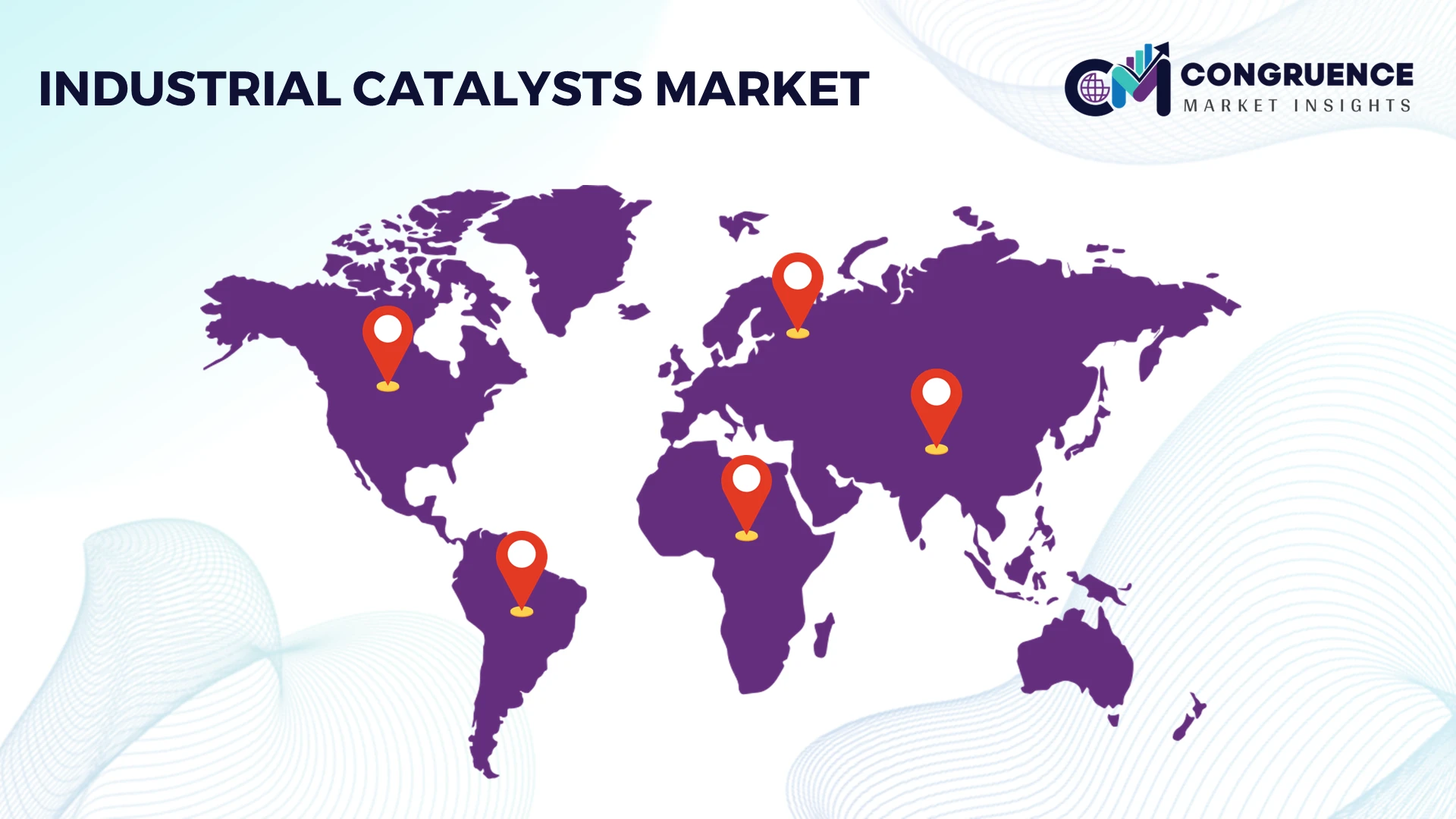
North America accounted for approximately 24.4% of the global industrial catalysts market in 2025, supported by sophisticated refining infrastructure, established chemical manufacturing clusters, and stringent environmental compliance requirements. The United States remains a major consumption center for hydrocracking, fluid catalytic cracking, hydrotreating, and emissions-control catalysts. Refinery operators are increasingly prioritizing catalyst formulations that improve conversion efficiency, extend operating cycles, and accommodate renewable feedstocks. The commissioning of Mexico's 340,000-barrel-per-day Dos Bocas refinery adds another source of regional catalyst demand. Meanwhile, investments in renewable diesel, hydrogen processing, and refinery integration are broadening procurement requirements. Catalyst manufacturers are strengthening technical-service networks and developing specialized formulations for complex refinery configurations, making operational performance and regeneration capabilities important competitive differentiators.
United States Market Outlook: The United States dominates North American industrial catalyst consumption through its extensive refining, petrochemical, and specialty chemical infrastructure. Gulf Coast industrial clusters provide concentrated demand for hydroprocessing, polymerization, and catalytic cracking technologies. The conversion of Phillips 66's Rodeo refinery into a 50,000-barrel-per-day renewable fuels facility demonstrates the growing importance of catalysts compatible with alternative feedstocks. Domestic manufacturers are prioritizing process optimization, catalyst regeneration, and lower-emission industrial technologies.
Europe represented approximately 21.9% of the global industrial catalysts market in 2025, supported by advanced chemical manufacturing, established refining infrastructure, and stringent industrial environmental standards. Germany, France, the Netherlands, and Italy maintain important catalyst consumption clusters through specialty chemicals, polymer manufacturing, and industrial emissions treatment. The European Green Deal and industrial decarbonization initiatives are encouraging investments in catalytic technologies that improve energy efficiency and reduce process emissions. However, refinery closures and high industrial energy costs are shifting procurement toward higher-value catalyst formulations rather than conventional capacity expansion. Manufacturers are strengthening partnerships with chemical producers, developing recyclable catalyst materials, and expanding technical services. The region's competitive advantage increasingly rests on formulation sophistication, regulatory compliance, and process engineering capabilities.
Germany Market Outlook: Germany represents Europe's strategically important industrial catalyst market through its integrated chemical manufacturing ecosystem and advanced catalyst research capabilities. Companies such as BASF and Evonik support domestic technological leadership across chemical synthesis, polymerization, and environmental catalysis. The country's chemical industry generates approximately 200 billion euros in annual sales, providing a substantial industrial foundation for catalyst applications. Investments in low-carbon hydrogen, electrified chemical processes, and industrial emissions reduction are strengthening demand for advanced catalytic formulations.
Asia-Pacific commanded approximately 35.7% of the global industrial catalysts market in 2025, making it the largest regional market. China, India, Japan, and South Korea contribute significantly through refining, petrochemical manufacturing, polymer production, and industrial chemical processing. The region benefits from extensive integrated refinery complexes and expanding downstream manufacturing infrastructure. China's large-scale chemical production and India's refinery modernization programs are increasing requirements for fluid catalytic cracking, hydrocracking, and hydrotreating catalysts. The International Energy Agency estimated that approximately 1.1 million barrels per day of new refining capacity would enter operation globally in 2025, primarily in China and India. Manufacturers are expanding regional production capabilities, establishing technical partnerships, and localizing catalyst supply to support large industrial customers.
China Market Outlook: China maintains the strongest country-level industrial catalyst position in Asia-Pacific through its extensive refining, petrochemical, and chemical manufacturing infrastructure. Its refining system supports substantial consumption of hydroprocessing, catalytic cracking, reforming, and polymerization catalysts. The Fujian Petrochemical Complex combines 300,000 barrels per day of refining capacity with 1.8 million tonnes of annual ethylene production capacity. Domestic catalyst manufacturers are strengthening production capabilities and developing advanced formulations to reduce dependence on imported technologies.
South America accounted for approximately 6.0% of the global industrial catalysts market in 2025, with Brazil representing the principal consumption center. Regional demand is concentrated in petroleum refining, fertilizer production, petrochemicals, biofuels, and industrial chemical processing. Brazil's extensive ethanol industry and growing renewable diesel initiatives create additional requirements for catalysts compatible with alternative feedstocks. Argentina also contributes through hydrocarbon processing and petrochemical development associated with the Vaca Muerta shale formation. However, financing constraints, uneven refinery modernization, and dependence on imported specialty catalyst formulations restrict broader deployment. Manufacturers are responding through local distribution partnerships, technical-service agreements, and application-specific product portfolios. Opportunities are particularly strong in upgrading existing refining infrastructure rather than relying exclusively on new industrial capacity.
Brazil Market Outlook: Brazil leads South America's industrial catalyst demand through its petroleum refining, petrochemical, fertilizer, and biofuel industries. Petrobras operates a substantial refining network, while the country's established sugarcane ethanol industry supports demand for specialized catalytic processing technologies. The expansion of renewable fuels and investment in refinery modernization are increasing requirements for hydroprocessing and chemical conversion catalysts. Suppliers focusing on renewable feedstock compatibility, localized technical support, and catalyst regeneration are positioned to strengthen their presence.
The Middle East & Africa region accounted for approximately 12.0% of the global industrial catalysts market in 2025, supported by petroleum refining, gas processing, petrochemical expansion, and industrial diversification. Saudi Arabia, the United Arab Emirates, and Qatar are important demand centers, with investments increasingly concentrated in integrated refining and chemical manufacturing facilities. Africa presents additional opportunities through refinery modernization and expanding domestic hydrocarbon-processing capabilities. Saudi Arabia's petrochemical ecosystem and the UAE's industrial diversification programs are increasing requirements for catalytic cracking, reforming, hydrotreating, and chemical synthesis technologies. The region's substantial hydrocarbon resources provide feedstock advantages, although technology dependence and uneven industrial infrastructure remain constraints. Catalyst suppliers are pursuing licensing agreements, localized technical partnerships, and long-term supply contracts to secure participation in large downstream projects.
Saudi Arabia Market Outlook: Saudi Arabia leads the Middle East industrial catalyst market through its integrated petroleum refining and petrochemical infrastructure. The country's industrial strategy emphasizes downstream value addition, specialty chemical manufacturing, and advanced hydrocarbon processing. Saudi Aramco's refining and petrochemical operations create sustained requirements for hydrocracking, catalytic reforming, and hydrotreating formulations. The approximately USD 7 billion petrochemical investment associated with the SOCAR Türkiye project also illustrates the broader regional emphasis on downstream integration. Domestic industrial expansion and technology partnerships are strengthening demand for high-performance catalyst systems.
Industrial catalyst competition is led by BASF, Honeywell UOP, Clariant, Shell Catalysts & Technologies, and Topsoe, with regional producers competing on price and localized service. Honeywell competes with BASF and Topsoe in integrated process licensing, while Clariant differentiates through specialty and emissions-control formulations. The market remains fragmented; the top-five combined share is approximately 35%, an estimate rather than an audited figure. Competition centers on catalyst activity, selectivity, operating life, regeneration, and delivery reliability. Buyers increasingly reward performance: 25–30% longer cycle life in renewable-feedstock catalysts reduces shutdown frequency and replacement costs. Leading suppliers expand through acquisitions, pilot facilities, refinery partnerships, and customized formulations. Honeywell’s acquisition of Johnson Matthey’s Catalyst Technologies business consolidates process licensing, catalysts, and digital automation; BASF is scaling 3D-printed catalyst production. Entry barriers include proprietary chemistry, reactor qualification, safety validation, and global technical support. Winners will pair proven performance with dependable supply, lifecycle services, and measurable plant-level economics.
BASF SE
Honeywell UOP
Clariant AG
Shell Catalysts & Technologies
Topsoe A/S
W. R. Grace & Co.
Axens
Evonik Industries AG
Albemarle Corporation
Dorf Ketal
Lummus Technology
JGC Catalysts and Chemicals Ltd.
Industrial catalyst technology is shifting from conventional pellet and extrudate designs toward engineered geometries, digitally optimized formulations, and materials. BASF’s X3D additive-manufactured catalysts use open structures to reduce reactor pressure drop and increase active surface area; compared with conventional shapes, the design improves throughput and lowers energy use, although no universal percentage gain is published. Three-dimensional shaping benefits suppliers with advanced manufacturing and customer-specific engineering.
AI-assisted formulation, high-throughput experimentation, and computational materials modelling are shortening screening workflows. Automated experimentation tests more compositions than manual laboratory routines, while machine-learning models prioritize promising formulations and reduce repeated trials. Digital twins and online reactor analytics connect catalyst activity with temperature, feed quality, pressure drop, and product yield. Adoption remains concentrated among chemical producers and technically advanced refiners; gains depend on process integration and data quality.
For 2026–2028, catalyst regeneration, precious-metal recovery, silicon and phosphorus guard materials, and catalysts tolerant of renewable or recycled feedstocks will gain operational importance. Topsoe’s renewable-feedstock catalyst series reports 25–30% longer cycle life, illustrating how improved contaminant capture extends run length. Companies should act now by qualifying new geometries and digital monitoring in units, securing specialist manufacturing capacity, and partnering with licensors before equipment and feedstock specifications become locked.
March 2026 — BASF started the world’s first industrial-scale X3D 3D-printed catalyst plant in Ludwigshafen. Open geometries reduce reactor pressure drop and increase active surface area, giving chemical producers a route to higher throughput and lower energy use at scale. Source: basf.com
July 2026 — Honeywell completed its £1.325 billion acquisition of Johnson Matthey’s Catalyst Technologies business. The deal adds catalyst and process-licensing capabilities across refining, petrochemicals, and renewable fuels, strengthening integrated offerings with Honeywell’s automation and digital platforms for customers globally. Source: honeywell.com
May 2026 — Clariant reported that its catalysts helped customers avoid 45 million tons of CO2-equivalent emissions during 2025. The quantified impact strengthens the commercial case for emissions-control and process catalysts in nitric acid, ironmaking, refinery-gas, and syngas operations worldwide. Source: clariant.com
November 2025 — Topsoe’s renewable-feedstock TK-3000 catalyst series reported 25–30% longer cycle life, while PhosTrap captured four to six times more phosphorus than previous guard catalysts. The performance supports longer operating runs and lower replacement frequency for renewable-fuel processors globally. Source: topsoe.com
The report evaluates the global industrial catalysts market across heterogeneous, homogeneous, and biocatalyst technologies, examining their roles in petroleum refining, chemical synthesis, and environmental applications. End-user coverage includes oil and gas companies, chemical manufacturers, automotive manufacturers, pharmaceutical companies, and other industrial buyers. The analysis compares catalyst performance requirements, feedstock compatibility, regeneration needs, and procurement priorities across established and emerging applications.
Geographic coverage spans North America, Europe, Asia-Pacific, South America, and the Middle East & Africa, with country-level assessment of manufacturing concentration, refinery infrastructure, regulatory pressures, and investment activity. Technology coverage includes hydroprocessing, catalytic cracking, emissions control, additive manufacturing, AI-assisted formulation, and catalyst recycling. Competitive profiling of 10–14 influential suppliers supports benchmarking of product portfolios and strategic positioning. The report helps decision-makers assess expansion opportunities, supplier risks, technology investments, and market-entry priorities through 2033.
| Report Attribute / Metric | Details |
|---|---|
| Market Revenue (2025) | USD 2,463.0 Million |
| Market Revenue (2033) | USD 3,494.6 Million |
| CAGR (2026–2033) | 4.47% |
| Base Year | 2025 |
| Forecast Period | 2026–2033 |
| Historic Period | 2021–2025 |
| Segments Covered |
By Type
By Application
By End-User
|
| Key Report Deliverables | Revenue Forecast; Market Trends; Growth Drivers & Restraints; Technology Insights; Segmentation Analysis; Regional Insights; Competitive Landscape; Regulatory & ESG Overview; Recent Developments |
| Regions Covered | North America; Europe; Asia-Pacific; South America; Middle East & Africa |
| Key Players Analyzed | BASF SE; Honeywell UOP; Clariant AG; Shell Catalysts & Technologies; Topsoe A/S; W. R. Grace & Co.; Axens; Evonik Industries AG; Albemarle Corporation; Dorf Ketal; Lummus Technology; JGC Catalysts and Chemicals Ltd. |
| Customization & Pricing | Available on Request (10% Customization Free) |




