
Reports
The Global Industrial Boiler Market was valued at USD 1,710.0 Million in 2025 and is anticipated to reach a value of USD 2,286.8 Million by 2033 expanding at a CAGR of 3.7% between 2026 and 2033. Growth is primarily driven by industrial boiler modernization, rising adoption of high-efficiency steam generation systems, waste-heat recovery integration, and stricter industrial emission-control requirements.
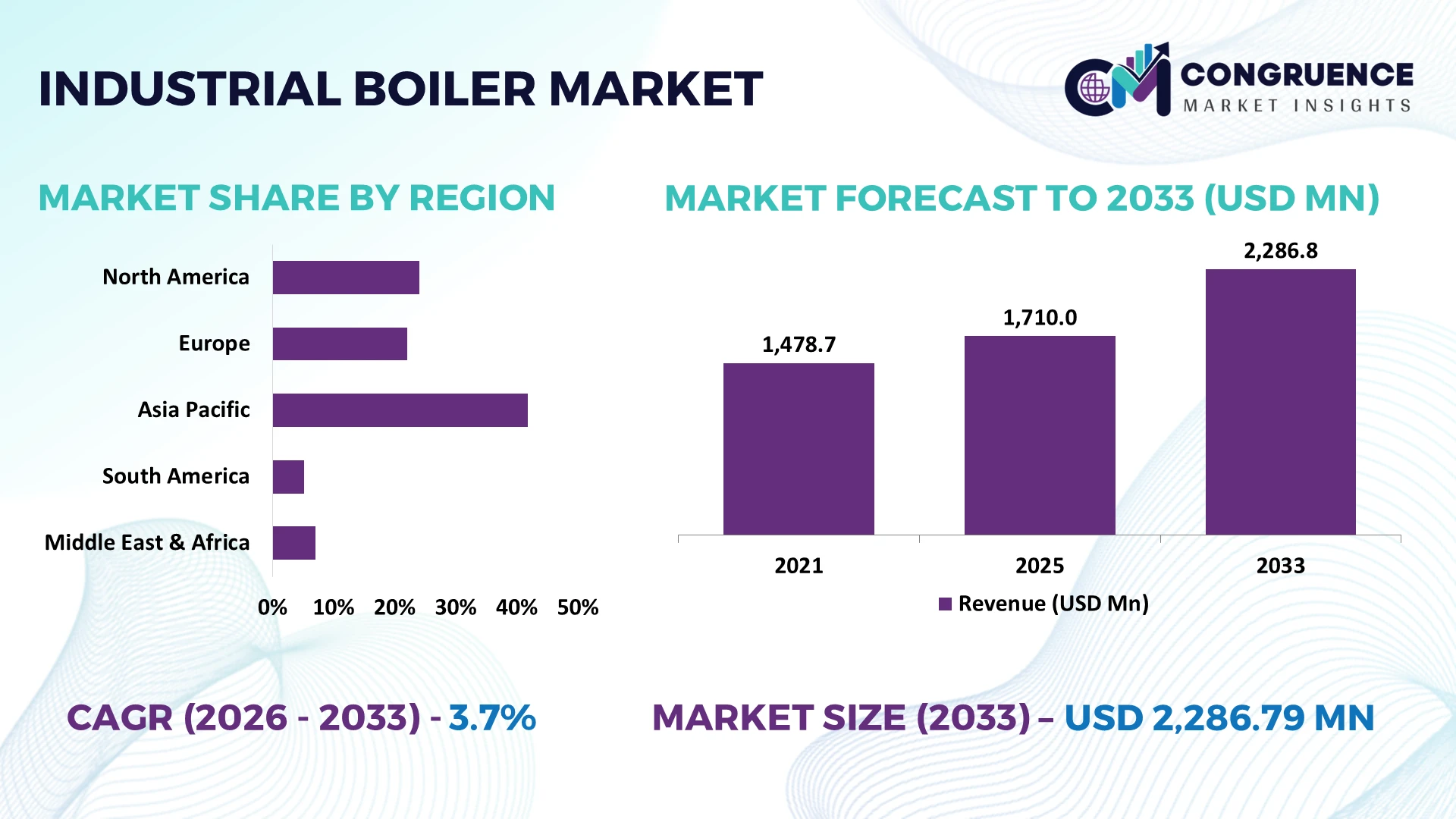
China dominates the global industrial boiler landscape, supported by its extensive chemicals, petrochemicals, steel, and manufacturing industries. Asia Pacific accounted for approximately 41.8% of the broader industrial boiler market in 2025, with China maintaining the largest country-level position. India's expanding pharmaceutical and textile manufacturing base is strengthening regional equipment demand, while China's transition away from inefficient coal-fired installations is accelerating advanced boiler adoption. Geopolitical supply-chain diversification is further encouraging domestic manufacturing investments.
Manufacturers should prioritize energy-efficient equipment, localized production, and digitally monitored boiler systems to strengthen competitiveness and capture replacement-driven industrial investment.
Market Size & Growth: USD 1,710.0 Million in 2025 to USD 2,286.8 Million by 2033, at 3.7% CAGR, supported by industrial boiler modernization and high-efficiency steam generation.
Top Growth Drivers: Natural gas boilers (39.8%), chemicals and petrochemicals applications (33.4%), and package boilers (64.2%) represent major market demand indicators.
Short-Term Forecast: By 2028, digital combustion monitoring and automated blowdown optimization will strengthen boiler performance, with efficiency improvements of 3–6% targeted in retrofit installations.
Emerging Technologies: AI-enabled predictive maintenance, hydrogen-ready combustion systems, and advanced condensing economizers are transforming industrial steam generation and emissions management.
Regional Leaders: Asia Pacific is projected to reach approximately USD 956.0 Million by 2033, Europe USD 572.0 Million, and North America USD 480.0 Million, reflecting industrial modernization and cleaner-fuel adoption. These are indicative regional allocations.
Consumer/End-User Trends: Industrial operators increasingly prioritize modular boiler configurations, automated load management, and lifecycle servicing to reduce fuel consumption and unplanned downtime.
Pilot/Case Example: In 2025, a Rajasthan textile manufacturer implemented Forbes Marshall's EverSense digital boiler monitoring solution, targeting an improvement from 79% to 84% boiler efficiency, equivalent to a 6.3% relative improvement.
Competitive Landscape: Bosch Industriekessel held approximately 9.5% of the broader industrial boiler market in 2025. Mitsubishi Heavy Industries, Thermax, Babcock & Wilcox, and Cleaver-Brooks strengthen global competition.
Regulatory & ESG Impact: European emissions requirements and industrial decarbonization programs are accelerating high-efficiency boiler installations, waste-heat recovery, and alternative-fuel integration.
Investment & Funding: Industrial equipment manufacturers are prioritizing investments in manufacturing expansion, digital service platforms, biomass-compatible systems, and strategic technology partnerships.
Innovation & Future Outlook: Hydrogen-compatible burners, electrified steam generation, intelligent combustion controls, and modular boiler systems are positioning manufacturers for the next phase of industrial energy transformation.
The industrial boiler market is increasingly shifting toward digitally controlled, energy-efficient steam generation, particularly across chemicals, pharmaceuticals, food processing, and textile manufacturing. Advanced condensing economizers can improve net boiler thermal efficiency by at least 9 percentage points under qualifying operating conditions. Manufacturers are also introducing hydrogen-ready burners, automated combustion controls, and predictive maintenance platforms. China's industrial equipment modernization and Europe's emissions regulations are accelerating this transition, making retrofit compatibility and fuel flexibility important purchasing considerations.
Industrial boilers are becoming strategically important as manufacturers reassess process-heat reliability, energy costs, and environmental compliance. Steam-intensive industries increasingly view boiler modernization as an operational investment rather than a routine equipment replacement. China's industrial restructuring, Europe's tightening emissions requirements, and India's manufacturing expansion are reshaping procurement priorities toward efficient, flexible, and digitally integrated boiler systems.
Technology differentiation is strengthening competitive positioning. Conventional boiler systems typically operate around 80–85% efficiency, whereas advanced configurations incorporating condensing economizers can achieve improvements of at least 9 percentage points under suitable operating conditions. European manufacturers are emphasizing low-emission combustion and alternative fuels, while Chinese and Indian suppliers are strengthening manufacturing scale, modular configurations, and cost competitiveness.
Over the next two to three years, investment priorities will increasingly favor automated combustion management, real-time steam monitoring, and predictive maintenance. For example, a 2025 textile manufacturing deployment in Rajasthan demonstrated a targeted efficiency improvement from 79% to 84% through digital boiler monitoring. Manufacturers are responding through technology partnerships, localized production, and integrated service offerings. Ultimately, competitive advantage will depend on delivering measurable fuel savings, reliable steam output, and adaptable equipment that supports industrial decarbonization without compromising production economics.
Industrial modernization is accelerating replacement of inefficient boilers across chemicals, pharmaceuticals, food processing, and textile manufacturing. Chemicals and petrochemicals accounted for approximately 33.4% of the broader industrial boiler application market, highlighting the importance of continuous process-steam availability. Advanced condensing economizers can improve net thermal efficiency by at least 9 percentage points under qualifying conditions, strengthening the economics of equipment upgrades. China's retirement of inefficient industrial installations and India's expanding manufacturing capacity reinforce this transition. Manufacturers are responding through modular boiler development, automated combustion systems, and waste-heat recovery partnerships. An important strategic shift is that replacement decisions increasingly prioritize lifecycle fuel savings and steam reliability over initial equipment acquisition costs.
High equipment acquisition costs, installation complexity, and fuel-price volatility restrict industrial boiler modernization, particularly among small and medium-sized manufacturers. Advanced combustion controls, economizers, emissions-monitoring equipment, and specialized pressure components increase initial project expenditure compared with conventional installations. Natural gas infrastructure availability also remains uneven across industrial locations, limiting the commercial attractiveness of gas-fired alternatives. International supply-chain disruptions affecting specialized components and control systems further complicate procurement schedules. These conditions pressure project profitability and extend equipment replacement decisions. Manufacturers are reducing exposure through localized component sourcing, long-term service agreements, modular boiler configurations, and diversified fuel compatibility. The non-obvious constraint is that even efficient boilers struggle to deliver attractive returns when industrial steam loads remain inconsistent.
Hydrogen-compatible combustion, biomass-fired boilers, electrified steam generation, and industrial waste-heat recovery present significant technology opportunities. European decarbonization initiatives are encouraging equipment suppliers to develop flexible combustion platforms capable of accommodating changing fuel requirements. Condensing economizers offering at least 9 percentage points of additional thermal efficiency under suitable conditions create attractive retrofit opportunities for existing industrial facilities. In India, pharmaceutical, textile, and food-processing manufacturers represent promising applications for digitally optimized steam systems. Equipment manufacturers are expanding R&D investments, developing hydrogen-ready burner assemblies, and establishing partnerships with industrial energy-management providers. A particularly attractive opportunity lies in retrofitting existing boiler installations with digital monitoring rather than replacing entire systems, enabling incremental efficiency improvements with lower capital requirements.
Integrating advanced industrial boilers into established manufacturing infrastructure remains a significant execution challenge. Legacy steam distribution networks, incompatible control architectures, and inconsistent instrumentation complicate the deployment of intelligent combustion and predictive maintenance systems. Industrial facilities also face growing cybersecurity exposure as boiler controls become connected to centralized operational technology platforms. Maintaining stable combustion performance across varying production loads requires specialized engineering capabilities and continuous calibration. India's industrial manufacturing clusters face additional workforce requirements for digital instrumentation, pressure-system maintenance, and emissions monitoring. Manufacturers must strengthen cybersecurity architecture, interoperable control platforms, technical training, and commissioning support. The critical strategic challenge is ensuring that digital modernization improves plant-wide steam reliability rather than creating isolated automation systems that cannot communicate effectively with existing industrial infrastructure.
Intelligent Boiler Monitoring Expansion: Industrial operators are accelerating deployment of connected boiler-management systems, with digital monitoring capable of improving operational efficiency by approximately 3–6% and reducing unplanned maintenance requirements by 10–15%. Manufacturers are integrating IoT sensors, automated combustion controls, and predictive diagnostics into existing installations. China's manufacturing modernization and India's industrial automation investments are encouraging suppliers to expand digital service capabilities. An important shift is the growing preference for performance-based maintenance contracts rather than standalone equipment servicing.
Low-Emission Combustion Adoption: Stricter industrial emissions requirements are reshaping boiler procurement, particularly in Germany, China, and India. Low-NOx burners and advanced flue-gas treatment configurations are increasingly incorporated into new installations, targeting NOx reductions of 30–50% compared with conventional combustion arrangements. Manufacturers are redesigning burner assemblies, improving combustion control, and partnering with emissions-control technology providers. This transition is also changing retrofit economics, as emissions compliance increasingly influences equipment selection alongside fuel consumption.
Modular Boiler Deployment Growth: Industrial facilities are increasingly adopting modular and packaged boiler configurations to improve installation flexibility and match steam output with fluctuating production requirements. Modular deployment can reduce installation timelines by approximately 20–30% compared with conventional site-intensive configurations. Food processing, pharmaceuticals, and specialty chemicals are important adoption areas. Manufacturers are expanding standardized product portfolios and localized assembly capabilities. The non-obvious shift is that modularization also reduces exposure to prolonged plant shutdowns during capacity expansion.
Fuel-Flexible System Development: Industrial boiler manufacturers are accelerating development of biomass-compatible, hydrogen-ready, and multi-fuel combustion platforms as fuel procurement strategies change. Fuel-flexible configurations can support operational adjustments across different energy inputs, while advanced combustion controls improve load management by approximately 5–10% in suitable applications. European decarbonization policies and global fuel-supply uncertainty are strengthening this trend. Companies are investing in adaptable burner technologies and strategic fuel partnerships, prioritizing equipment capable of accommodating future energy transitions without complete boiler replacement.
Package boilers dominated the market with approximately 64.2% share in 2025, supported by factory-assembled construction, lower installation complexity, shorter commissioning periods, and suitability for small and medium-sized industrial facilities. Their standardized configurations provide cost and maintenance advantages across food processing, pharmaceuticals, and general manufacturing. Field-erected boilers represent the fastest-growing type, driven by large-scale petrochemical complexes, power generation facilities, and industrial plants requiring customized high-pressure steam capacity. Unlike standardized package installations, field-erected systems accommodate complex engineering specifications, larger output requirements, and specialized fuel configurations. Manufacturers are strengthening package boiler portfolios through automation and modular engineering while expanding customized field-erected solutions for large industrial projects. This creates a two-track investment landscape: standardized equipment supports replacement demand, whereas field-erected installations capture infrastructure-intensive industrial expansion.
Chemicals and petrochemicals dominated the application segment with approximately 33.4% market share in 2025, reflecting continuous steam requirements for distillation, refining, chemical reactions, fertilizer production, and process heating. High operating temperatures and uninterrupted production cycles strengthen demand for reliable, high-capacity boiler installations. Food and beverages represent an important high-growth application, supported by increasing requirements for sterilization, pasteurization, drying, cooking, and cleaning operations. Food manufacturers are increasingly prioritizing compact boiler configurations, automated steam controls, and fuel-efficient equipment to manage operating costs and hygiene requirements. Paper and pulp facilities continue to require substantial thermal energy for pulping and drying, while metals and mining operations depend on specialized steam and process-heating applications. Manufacturers are adapting product configurations to application-specific pressure, capacity, and fuel requirements, with investment increasingly directed toward food-processing installations and large chemical-processing facilities.
The chemical and petrochemical industry represents the leading end-user group, accounting for approximately 33.4% of market demand when measured against the corresponding chemical and petrochemical application classification in 2025. Continuous steam requirements for refining, chemical synthesis, fertilizer production, and petrochemical processing support large-scale boiler procurement. Food processing represents a faster-expanding end-user group, supported by sterilization, pasteurization, drying, and packaged-food manufacturing requirements. Paper and pulp facilities prioritize high-volume steam generation, while metals and mining operators require dependable thermal systems for specialized industrial processes. Power generation buyers emphasize high-capacity water-tube installations, whereas other manufacturing industries increasingly prefer compact, automated systems. Manufacturers are responding through application-specific boiler engineering, flexible capacity configurations, and long-term maintenance partnerships. Competitive positioning is shifting toward customized steam solutions that address differences in production intensity, energy costs, and operational reliability.
Asia Pacific accounted for the largest market share at 41.8% in 2025 however, Middle East & Africa is expected to register the fastest growth, expanding at an estimated CAGR of 5.2% between 2026 and 2033.

North America accounted for approximately 24.0% of the global industrial boiler market in 2025, supported by established chemical processing, petroleum refining, food manufacturing, and pharmaceutical production infrastructure. The United States represents the largest demand center, where aging industrial equipment is creating replacement opportunities for high-efficiency steam-generation systems. Manufacturers are prioritizing low-NOx combustion, automated burner management, and advanced heat-recovery configurations to address operational efficiency and emissions requirements. Canada's energy-intensive industries and Mexico's expanding automotive and manufacturing clusters provide additional equipment demand. Nearly 47% of industrial boiler capacity in an older U.S. Department of Energy industrial inventory was at least 40 years old, illustrating the scale of replacement potential. Suppliers are strengthening retrofit services and regional technical support to capture modernization contracts.
United States Market Outlook: The United States leads North American industrial boiler demand through its extensive refining, chemicals, food processing, and industrial manufacturing infrastructure. Gulf Coast petrochemical facilities represent an important concentration of high-capacity steam requirements. Industrial operators are increasingly investing in combustion optimization, emissions-control equipment, and automated boiler management. The country's established engineering ecosystem and domestic equipment manufacturing capabilities support customized installations, maintenance services, and technology upgrades.
Europe represented approximately 22.0% of the global industrial boiler market in 2025, supported by Germany, the United Kingdom, France, and Italy's established chemical, pharmaceutical, food-processing, and manufacturing industries. The region's procurement priorities are shifting toward low-emission combustion, biomass-compatible systems, electric boilers, and advanced heat-recovery installations. The EU Emissions Trading System and energy-security concerns following the Russia–Ukraine conflict have accelerated industrial efforts to reduce fossil-fuel exposure. Electric industrial heat is gaining attention, with Fraunhofer-related analysis indicating that heat pumps can reduce food and beverage operating costs by approximately 20% compared with gas-based alternatives under specified energy-price conditions. Equipment suppliers are responding through electrification partnerships, burner modernization, and integrated emissions-management solutions.
Germany Market Outlook: Germany represents a strategically important European market because of its extensive chemicals, automotive, pharmaceutical, and industrial engineering base. The country's energy-intensive chemical manufacturing sector creates substantial requirements for dependable process steam and high-temperature heat. Industrial operators are increasingly evaluating electric steam generation, waste-heat integration, and high-efficiency boiler replacements. German equipment manufacturers benefit from advanced engineering capabilities, established industrial automation ecosystems, and strong technical certification infrastructure.
Asia Pacific dominated the global industrial boiler market with approximately 41.8% share in 2025, supported by China's manufacturing concentration and expanding industrial activity in India, Japan, South Korea, and Southeast Asia. Chemical processing, textiles, food manufacturing, paper production, and metals industries collectively generate substantial requirements for industrial steam systems. China leads regional equipment demand through its extensive manufacturing infrastructure, while India is strengthening domestic boiler manufacturing and industrial modernization. The replacement of inefficient small coal-fired installations is encouraging procurement of advanced combustion and automated boiler configurations. Regional suppliers are also benefiting from established component-manufacturing networks and shorter equipment delivery cycles. Increasing investment in industrial parks, pharmaceutical production, and manufacturing facilities is strengthening demand for standardized package boilers and customized high-capacity systems.
China Market Outlook: China maintains the strongest country-level position in the global industrial boiler industry through its extensive chemicals, petrochemicals, steel, food processing, and manufacturing infrastructure. The country recorded approximately 293,300 registered boilers at the end of 2025, reflecting a substantial installed equipment base. Industrial modernization, boiler safety supervision, and replacement of inefficient installations are encouraging manufacturers to prioritize advanced combustion systems, automated controls, and improved thermal performance.
South America accounted for approximately 5.2% of the global industrial boiler market in 2025, with Brazil representing the principal demand center, followed by Argentina, Chile, and other industrial economies. Chemical processing, food manufacturing, sugar production, pulp and paper, and mining operations support regional boiler installations. Brazil's sugar and ethanol industry provides an important application base for biomass-compatible steam generation, while its expanding food-processing and chemical industries sustain demand for conventional industrial boilers. Equipment procurement remains closely connected to manufacturing investment cycles, financing availability, and local infrastructure development. Suppliers are emphasizing fuel flexibility, locally accessible maintenance services, and equipment configurations suited to industrial operating conditions. The region's opportunity lies in combining agricultural biomass availability with industrial steam requirements, although uneven infrastructure and capital constraints continue to influence project deployment.
Brazil Market Outlook: Brazil leads South America's industrial boiler industry through its diversified manufacturing base, large food-processing sector, sugar and ethanol production, chemicals, and pulp and paper facilities. Its industrial boiler market represented approximately 4.9% of global market value in 2025. Biomass-fired steam generation offers an important competitive advantage because of the country's established agricultural residue supply chains. Manufacturers are targeting sugar mills, chemical facilities, and paper producers with fuel-flexible and high-capacity boiler configurations.
Middle East & Africa represented approximately 7.0% of the global industrial boiler market in 2025, with demand concentrated in Saudi Arabia, the United Arab Emirates, South Africa, and other industrializing economies. Refining, petrochemicals, fertilizers, food processing, mining, and industrial infrastructure projects support regional equipment procurement. Saudi Arabia's industrial diversification strategy is strengthening investment in petrochemical complexes and manufacturing facilities, while the UAE continues to expand industrial and energy-processing infrastructure. South Africa's mining and food-processing industries provide additional demand for dependable steam-generation systems. Industrial operators increasingly prioritize high-capacity water-tube boilers, automated combustion management, and equipment capable of operating under demanding industrial conditions. Manufacturers are strengthening regional distribution, engineering partnerships, and after-sales support to improve project execution. The region's relatively smaller installed manufacturing base creates opportunities for suppliers offering integrated equipment, commissioning, and maintenance services.
Saudi Arabia Market Outlook: Saudi Arabia represents the strategically significant industrial boiler market in the Middle East through its extensive petroleum refining, petrochemical, fertilizer, and industrial manufacturing infrastructure. The country's Vision 2030 diversification program is supporting the development of industrial cities and downstream processing facilities. Large-scale projects associated with Jubail and Yanbu create requirements for reliable high-pressure steam generation, process heating, and customized boiler installations. Manufacturers are positioning themselves through engineering partnerships, localized service capabilities, and advanced combustion technologies that support industrial efficiency and operational reliability.
The market pits global engineered-system leaders Mitsubishi Heavy Industries, Babcock & Wilcox and IHI against packaged-boiler specialists Bosch Industriekessel, Cleaver-Brooks and Miura, while Thermax and Forbes Marshall compete strongly through localized engineering and service networks. The five leading suppliers—Mitsubishi Heavy Industries, Babcock & Wilcox, Thermax, Bosch and Cleaver-Brooks—held an estimated 36% combined share in 2025, leaving the balance to regional OEMs and niche manufacturers. Competition turns on lifecycle efficiency, emissions compliance, delivery reliability and customization: advanced electric boilers reach up to 99.6% conversion efficiency, while modular systems reduce installation complexity and support faster commissioning. In practice, OEMs are expanding retrofit contracts, integrating controls, and partnering with local EPC firms to secure projects and aftermarket revenue. The competitive shift is from equipment-only sales toward fuel-flexible, digitally monitored steam solutions. High-pressure engineering certification, installed-base references and service coverage remain entry barriers. Winners will pair thermal performance with local execution and lifecycle support.
Mitsubishi Heavy Industries, Ltd.
Babcock & Wilcox Enterprises, Inc.
Thermax Limited
Bosch Industriekessel GmbH
Cleaver-Brooks
IHI Corporation
Miura Co., Ltd.
Forbes Marshall
Bharat Heavy Electricals Limited
Doosan Enerbility
Hurst Boiler & Welding Company
Clayton Industries
Industrial boiler technology is shifting from conventional fixed-fuel, manually tuned systems toward connected, high-efficiency and fuel-flexible platforms across chemicals, food processing and pulp-and-paper operations. Advanced combustion management, oxygen-trim controls and economizers improve heat utilization; modern electric boilers achieve up to 99.6% conversion efficiency, compared with roughly 90% for well-tuned fuel-fired units. That difference favors electrification where low-cost renewable power and grid capacity are available, while economizer retrofits remain practical for existing plants.
Digital controls, IoT sensors and predictive diagnostics connect burner management, feedwater treatment and steam-load data. Miura’s monitoring platform now accommodates smaller boiler rooms, including retrofit configurations with up to seven connected devices, signaling adoption beyond large enterprise installations. Automated monitoring can reduce avoidable downtime and improve maintenance scheduling; OEMs with service networks and interoperable controls gain recurring service relationships and stronger installed-base retention.
Hydrogen-ready burners, biomass co-firing and hybrid electric-fuel systems are the disruptive layer for 2026–2028. A 100-tonne-per-hour refinery boiler converted to 100% hydrogen demonstrates technical feasibility at industrial scale, although fuel availability and NOx control remain constraints. Bosch, Mitsubishi Power and specialist regional manufacturers benefit from early engineering experience. Buyers should prioritize retrofit compatibility, fuel-switching readiness and digital integration now, rather than procure isolated efficiency upgrades.
The report evaluates the global industrial boiler market across package and field-erected systems, with application coverage spanning chemicals and petrochemicals, paper and pulp, food and beverages, metals and mining, and other industrial processes. End-user analysis distinguishes chemical and petrochemical facilities, food processors, paper manufacturers, metals and mining operators, power generation facilities, and other manufacturing industries. Regional coverage includes North America, Europe, Asia Pacific, South America, and the Middle East & Africa, with country-level assessment of major industrial markets.
The study examines combustion controls, economizers, modular boiler architecture, electric steam generation, hydrogen-ready systems, biomass compatibility, and digital monitoring. Competitive assessment profiles major OEMs and evaluates installed-base positioning, retrofit activity, technology differentiation, and service strategies. These insights support investment planning, geographic expansion, procurement decisions, competitive benchmarking, and technology prioritization throughout 2026–2033.
| Report Attribute / Metric | Details |
|---|---|
| Market Revenue (2025) | USD 1,710.0 Million |
| Market Revenue (2033) | USD 2,286.8 Million |
| CAGR (2026–2033) | 3.7% |
| Base Year | 2025 |
| Forecast Period | 2026–2033 |
| Historic Period | 2021–2025 |
| Segments Covered |
By Type
By Application
By End-User
|
| Key Report Deliverables | Revenue Forecast; Market Trends; Growth Drivers & Restraints; Technology Insights; Segmentation Analysis; Regional Insights; Competitive Landscape; Regulatory & ESG Overview; Recent Developments |
| Regions Covered | North America; Europe; Asia-Pacific; South America; Middle East & Africa |
| Key Players Analyzed | Mitsubishi Heavy Industries, Ltd.; Babcock & Wilcox Enterprises, Inc.; Thermax Limited; Bosch Industriekessel GmbH; Cleaver-Brooks; IHI Corporation; Miura Co., Ltd.; Forbes Marshall; Bharat Heavy Electricals Limited; Doosan Enerbility; Hurst Boiler & Welding Company; Clayton Industries |
| Customization & Pricing | Available on Request (10% Customization Free) |




