
Reports
The Global Industrial Air Filtration Market was valued at USD 686.0 Million in 2025 and is anticipated to reach a value of USD 1,101.7 Million by 2033 expanding at a CAGR of 6.1% between 2026 and 2033. Tightening emission enforcement across heavy industry and the retrofit cycle for aging dust collection infrastructure anchor near-term demand.
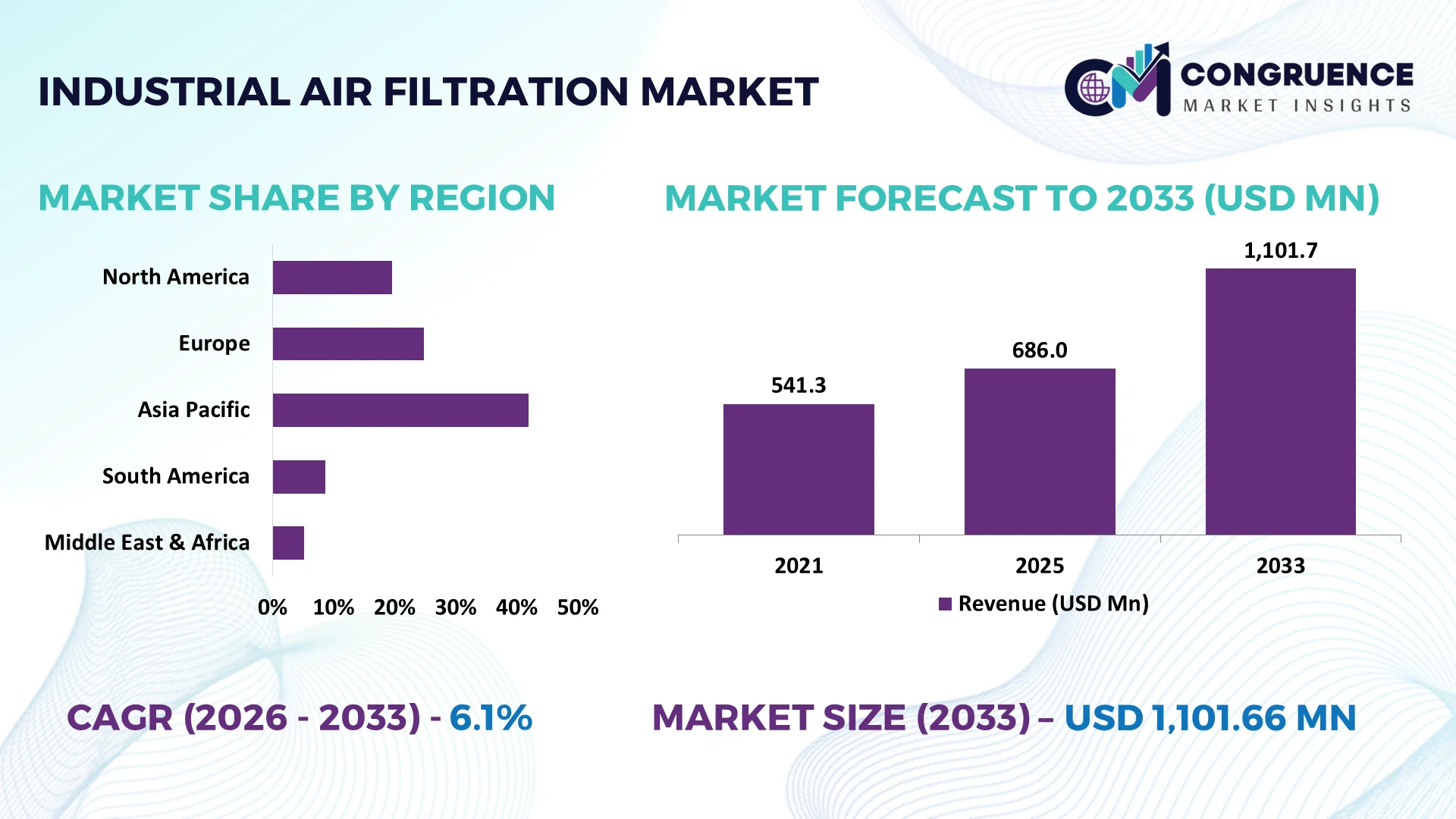
Asia-Pacific commands 41.9% of global market share, led by China’s cement and steel retrofit activity and India’s National Clean Air Programme, while North America’s installed base skews toward connected monitoring and predictive maintenance adoption at roughly double the global retrofit rate.
This divergence signals that suppliers must prioritize service-network density in Asia while monetizing software-enabled aftermarket models in mature Western facilities.
Market Size & Growth: Valued at USD 686.0 million in 2025, reaching USD 1,101.7 million by 2033, driven by nanofiber media adoption at 9.6% growth as operators trade conventional filter life for lower pressure-drop economics .
Top Growth Drivers: Regulatory emission tightening (41.9% Asia-Pacific share base), cleanroom demand from semiconductor/pharma (11.8% HEPA revenue), and aftermarket replacement cycles (78.8% channel dominance) .
Short-Term Forecast: By 2028, IoT-enabled pulse-jet cleaning reduces compressed air consumption by 25–30% in cement and metal processing, cutting filtration energy overhead per production line .
Emerging Technologies: AI-driven predictive maintenance, nanofiber-coated media with measurable efficiency gains over fiberglass, and modular baghouse designs enabling filter swaps without production shutdown .
Regional Leaders: Asia-Pacific at 41.93% share; North America prioritizing connected monitoring retrofit; Europe advancing PFAS-free and EPD-certified media under regulatory pressure .
Consumer/End-User Trends: Aftermarket replacement captures 78.8% of channel activity as enterprises shift from capex-heavy new installs toward lifecycle service contracts and performance-guaranteed retrofits .
Pilot/Case Example: Camfil’s May 2026 14,400 m² Malaysia manufacturing expansion directly targets Southeast Asian cement and electronics cleanroom demand, shortening regional lead times .
Competitive Landscape: Top five players hold approximately 12% combined share; Parker Hannifin, Donaldson, Camfil, MANN+HUMMEL, and AAF lead, with local players commanding 70% of fragmented regional markets .
Regulatory & ESG Impact: EU Industrial Emissions Directive revisions compress voluntary upgrade budgets at smaller European facilities while mandating pollution-control capex on larger installations .
Investment & Funding: Parker’s USD 9.25 billion Filtration Group acquisition and Atmus’s USD 450 million Koch Filter deal signal consolidation toward full-portfolio, recurring-revenue filtration platforms .
Innovation & Future Outlook: Nanofiber media projected at USD 2.14 billion by 2035; strategic shift favors integrated “equipment + service + monitoring” bundles over standalone collector sales .
The industrial air filtration market is pivoting from component sales to validated performance systems, with nanofiber-coated media delivering measurable pressure-drop advantages over conventional synthetics and HEPA-grade filtration becoming process-critical in semiconductor and pharmaceutical cleanrooms. Approximately 42% of demand now originates in Asia-Pacific, where emission enforcement intensity outpaces local supplier service capacity. This mismatch creates a near-term opening for operators offering bundled equipment-plus-monitoring contracts, setting the stage for the strategic differentiation discussed below.
Industrial air filtration has shifted from a compliance cost center to a competitive lever as emission enforcement tightens and energy volatility punishes inefficient pressure-drop performance. Enterprises that treat filtration as serviceable infrastructure—rather than disposable equipment—capture operational advantages across maintenance intervals and regulatory audits. The EU’s revised industrial-emissions framework exemplifies this shift: it forces capital allocation toward pollution controls even as it compresses discretionary spending at smaller facilities, rewarding suppliers who can demonstrate total cost of ownership rather than sticker price alone .
Nanofiber-coated media now delivers 7.28% annual growth by enabling higher particle capture at lower pressure drop than legacy fiberglass, directly reducing blower energy consumption and extending replacement intervals. Regionally, Asia-Pacific’s 41.93% share reflects China’s enforcement-driven retrofit cycle, while North America leads in connected monitoring adoption because its aging refinery and chemical plant base demands predictive rather than reactive maintenance . Camfil’s 2026 Malaysia plant expansion illustrates the operational response: localized manufacturing near cement and electronics clusters shortens lead times and positions service teams within hours of high-dust facilities .
Companies are reallocating investment from greenfield collector purchases toward retrofit kits, IoT sensor packages, and performance-guaranteed service contracts that shift maintenance risk to suppliers. Parker’s USD 9.25 billion acquisition of Filtration Group underscores the strategic premium on installed-base access and recurring replacement revenue. Competitive positioning now hinges on validated efficiency documentation, regional service density, and the ability to bundle media, monitoring, and compliance reporting into a single operational agreement.
Tightening particulate limits across Chinese cement and steel corridors, combined with India’s non-attainment city mandates, is converting regulatory pressure into capital allocation. Roughly 42% of global demand now concentrates in Asia-Pacific, where enforcement intensity directly drives baghouse and cartridge collector upgrades . Nanofiber media adoption at 7.28% growth reflects buyers prioritizing pressure-drop reduction over initial media cost, as energy savings offset premium pricing within two replacement cycles. Donaldson’s EMEA filtration services expansion—deploying on-site integrity testing and calibration—shows suppliers responding with service infrastructure rather than product-only sales, locking in aftermarket relationships before competitors establish local presence .
Integrating modern collectors into aging ductwork, legacy controls, and constrained plant layouts introduces engineering scope that extends project timelines and inflates installation costs beyond equipment budgets. European facilities face added compression from revised emissions directives that mandate pollution controls but simultaneously erode discretionary capex at smaller sites, delaying voluntary upgrades without immediate compliance triggers. Fiberglass media’s share erosion—from 28.0% in 2025 to a projected 23.5% by 2035—reflects buyers deferring material transitions where shutdown windows are narrow. Suppliers are responding with modular baghouse designs and compartmentalized replacement configurations that permit filter swaps without full production stops, reducing the operational friction that stalls retrofit approvals .
IoT-enabled pulse-jet optimization and predictive maintenance packages represent an underpenetrated revenue stream, particularly in North America where industrial automation is established but filtration monitoring remains fragmented. Intelligent cleaning systems reduce compressed air consumption by 25–30% in heavy-dust environments, creating a measurable operational savings case that supports subscription-style service contracts. In India, the National Clean Air Programme’s non-attainment city focus opens demand for modular, lower-capital filtration retrofits targeting small and mid-sized cement and metal processors that larger suppliers historically underserved. Companies positioning early with remote diagnostics and guaranteed uptime agreements can capture aftermarket share before equipment commoditization compresses margins.
Deploying connected filtration systems requires plant-level expertise in sensor calibration, data interpretation, and predictive maintenance workflows that many industrial facilities lack. Approximately 70% of the market remains served by local and regional players, many without the engineering depth to support digital service models. Cybersecurity exposure grows as collectors integrate with plant networks, introducing operational technology vulnerabilities that neither filter manufacturers nor plant IT teams fully own. PFAS-free material transitions under European REACH tightening add formulation complexity, particularly for high-temperature applications where alternative chemistries underperform established fluoropolymer media. Companies must invest in technician training and partner with automation specialists rather than treating connectivity as a bolt-on feature.
Nanofiber Media Displaces Fiberglass: Nanofiber-coated media is advancing at 7.28% growth as cement and metal processors prioritize lower pressure drop over acquisition cost . MANN+HUMMEL’s 2026 launch of nanofiber commercial-vehicle filters at 99.98% separation efficiency demonstrates the technology’s migration from premium to mainstream industrial applications. Suppliers investing in in-house nanofiber coating capacity position for specification wins where energy consumption is audited.
Modular Baghouse Retrofit Uptake: Compartmentalized baghouse designs that permit filter replacement without full production shutdowns are gaining traction in Chinese cement corridors and Indian steel plants. This configuration reduces retrofit downtime by enabling phased changeouts across production zones, directly addressing the shutdown-window constraint that delays capital approvals. Equipment suppliers integrating modular designs into standard offerings can shorten sales cycles in facilities where production continuity outweighs unit-price sensitivity .
PFAS-Free Compliance Reshapes European Procurement: REACH tightening and Environmental Product Declaration requirements are accelerating material substitution in Germany and France, where cleanroom and pharmaceutical operators demand documented chemical safety . European buyers increasingly weight lifecycle environmental data alongside filtration efficiency, creating specification barriers for suppliers without validated PFAS-free alternatives. Media manufacturers investing in bio-based and fluoropolymer-free formulations gain preferred-vendor status in regulated procurement frameworks.
Predictive Maintenance Shifts Aftermarket Economics: IoT-enabled pressure-drop and temperature monitoring is converting filter replacement from calendar-based to condition-based scheduling in North American refineries and chemical plants. Intelligent pulse-jet systems reduce compressed air consumption by 25–30%, creating measurable utility savings that justify sensor investment within single maintenance cycles. Suppliers bundling sensors with media contracts lock in data access and replacement revenue while differentiating on operational outcomes rather than unit pricing.
Dust collection filters command the largest product-type position at approximately 32.47% share, underpinned by continuous replacement demand across cement, steel, chemical, and food-processing facilities where particulate capture is inseparable from production continuity . The scale advantage is structural: these systems operate in high-dust-load environments that force predictable media turnover, creating a recurring aftermarket base that insulates suppliers from capital-spending cyclicality. HEPA and ULPA filters represent the fastest-adoption tier, with semiconductor cleanroom requirements for ultra-low penetration air filtration expanding at a pace that outpaces general industrial dust control.
Electrostatic and nanofiber-enhanced media are gaining specification preference where pressure-drop economics outweigh first-cost sensitivity, while conventional fiberglass media cedes ground in applications demanding extended service intervals. Suppliers are responding by localizing media production near industrial clusters and bundling filter sales with integrity-testing services, shifting investment priorities from collector manufacturing toward consumable supply-chain proximity and validated performance documentation.
Pharmaceutical and biotechnology applications are advancing at 8.32% annual growth, driven by cleanroom requirements in advanced biopharmaceutical manufacturing where validated air quality directly determines batch release and regulatory approval . This segment’s demand concentration reflects a structural reality: sterile fill-finish suites, biologics production suites, and cell-and-gene therapy facilities cannot operate without documented HEPA/ULPA performance, making filtration a qualification-critical system rather than a discretionary utility. Food and beverage processing retains the largest installed application base at approximately 41% share, anchored by HACCP and FSMA compliance mandates that specify controlled airborne contamination levels across bakery, confectionery, and dried-ingredient operations.
The distinction matters for capital allocation: food-sector demand is volume-driven and replacement-cycle dependent, while pharmaceutical demand is validation-driven and commands premium pricing for documentation and service depth. Suppliers are adapting by embedding regulatory-compliance reporting into filter contracts and expanding local technical service teams near pharmaceutical clusters in Ireland, Singapore, and Puerto Rico.
Chemical and petrochemical operators constitute the leading end-user group by operational intensity, where filtration systems manage corrosive particulate streams and volatile organic compound capture across continuous-process facilities that cannot tolerate unplanned collector downtime. Demand concentration here is infrastructure-dependent: refinery and chemical complex expansions in the U.S. Gulf Coast and Middle East drive baseline replacement volume, while emissions enforcement compresses upgrade timelines. Pharmaceutical and biotechnology end-users represent the fastest-expanding buying group, with cleanroom-dependent manufacturing capacity investments in Ireland, Singapore, and China creating specification demand for validated HEPA/ULPA systems with full documentation packages.
Cement and metals buyers remain substantial but are shifting toward retrofit configurations that minimize production interruption, while food processing end-users prioritize explosion-hazard-compliant collection systems under NFPA standards. Companies are positioning through vertical-specific service contracts: pharmaceutical clients receive validation-ready documentation and calibration support, while chemical operators gain remote pressure-drop diagnostics and guaranteed replacement intervals tied to process uptime commitments.
Asia-Pacific accounted for the largest market share at 41.9% in 2025 however, North America is expected to register the fastest growth, expanding at a CAGR of 7.0% between 2026 and 2033.

North America’s 19.5% share reflects a filtration installed base built over decades across refineries, chemical complexes, and manufacturing corridors, where replacement demand and regulatory compliance sustain baseline volume. The region’s competitive character differs from emerging markets: direct-sales channels hold roughly 61% share because engineered retrofit projects demand technical specification support rather than catalog purchasing. Parker Hannifin, CECO Environmental, Camfil, Donaldson, and AAF collectively command approximately 24.4% of regional revenue, with differentiation increasingly tied to digital monitoring and field-service depth rather than media pricing alone.
United States Market Outlook: The U.S. anchors regional demand through its density of refinery, petrochemical, and semiconductor fabrication capacity, where filtration performance ties directly to process yield and emissions compliance. The country also leads in connected filtration adoption, with enterprise buyers prioritizing predictive maintenance platforms that reduce unplanned collector downtime and compressed-air waste. Suppliers with established field-service networks and validation documentation capabilities hold specification advantage over price-focused competitors.
Europe holds an estimated 24.8% share of the global market, making it the second-largest regional pool behind North America. Demand is being restructured by chemical regulation rather than volume expansion: REACH restrictions on PFAS chemistries and the Industrial Emissions Directive’s revised pollutant limits are forcing media substitution across German, French, and Italian facilities, with buyers weighting lifecycle environmental documentation alongside filtration efficiency. The region’s cleanroom-dependent pharmaceutical clusters in Ireland and Germany sustain premium HEPA/ULPA specification demand, while general industrial dust collection remains replacement-driven.
Germany Market Outlook: Germany’s filtration demand concentrates in automotive, chemical, and pharmaceutical manufacturing, where emissions compliance and cleanroom validation requirements are enforced with technical rigor. The country’s engineering-intensive procurement culture favors suppliers who provide documented performance verification and local technical service depth. German operators are also early adopters of energy-optimized filtration configurations that reduce pressure-drop losses across continuous-process facilities.
Asia-Pacific accounts for an estimated 41.9% of global filtration value, a share that understates its strategic weight given the region’s 7.0% growth trajectory. Chinese cement and steel corridors face particulate limits that mandate baghouse and cartridge collector upgrades, while India’s non-attainment city program extends compliance pressure to mid-sized industrial processors. The region’s challenge is not demand generation but service delivery: local and regional suppliers command approximately 70% of fragmented market activity, many without the engineering depth to support connected monitoring or validated performance documentation.
China Market Outlook: China drives regional filtration volume through the scale of its cement, steel, and chemical production base, where provincial enforcement intensity directly correlates with retrofit activity. Domestic suppliers dominate volume segments, but multinationals retain advantage in high-specification applications requiring nanofiber media, validated efficiency data, and integrated monitoring. The country’s semiconductor fabrication expansion also creates a parallel demand stream for HEPA/ULPA systems with full documentation packages.
South America holds an estimated 8.6% share of global filtration value, concentrated in Brazil’s mining, cement, and agricultural processing sectors where particulate control is operationally necessary but capital availability constrains upgrade velocity. The region’s challenge is structural: industrial facilities often operate aging collectors that require retrofit rather than replacement, and import-dependent supply chains for specialized media extend lead times and inflate project costs. Local suppliers retain advantage in standard dust collection configurations, while multinationals compete for high-specification projects in mining and food processing.
Brazil Market Outlook: Brazil’s filtration demand tracks mining and agricultural commodity throughput, with cement and food processing facilities requiring dust and fume control across dispersed geographic locations. The country’s domestic manufacturing base for standard filter media reduces import dependence in volume segments, but high-efficiency and nanofiber media remain import-reliant. Service network density is a decisive competitive factor given the distance between industrial clusters and supplier technical support.
The Middle East and Africa account for an estimated 5.2% of global filtration value, shaped by two divergent dynamics: Gulf Cooperation Council states investing in refinery, petrochemical, and power infrastructure modernization, and Sub-Saharan African markets where basic industrial dust control remains underpenetrated. Saudi Arabia and the UAE account for concentrated demand in high-specification filtration for oil and gas processing, where corrosive particulate streams demand durable media and documented performance under extreme operating conditions. Supplier engagement with EPC contractors is a prerequisite for specification access.
Saudi Arabia Market Outlook: Saudi Arabia’s filtration demand is anchored in oil and gas processing, petrochemical expansion, and power generation infrastructure tied to Vision 2030 industrial diversification. Projects specify high-durability media and validated performance under high-temperature, corrosive operating conditions. Suppliers with established EPC relationships and local service capability gain specification advantage, while import-dependent competitors face longer qualification cycles and logistical friction.
Parker Hannifin, Donaldson, Camfil, MANN+HUMMEL, and AAF International form the global leadership tier, competing on engineered retrofit capability, service-network density, and validated performance documentation. These multinationals confront fragmented regional suppliers that control roughly 70% of volume segments on price and local responsiveness. Top five players hold approximately 12% combined share, confirming a structurally fragmented market where consolidation remains incomplete. Competition pivots on supply-chain proximity and technology differentiation. Camfil’s 14,400-square-metre Malaysia expansion and Donaldson’s on-site integrity-testing rollout in France, Germany, and Austria demonstrate service localization as the decisive battleground . Nanofiber media adoption at 7.28% growth rewards manufacturers with in-house coating capability—MANN+HUMMEL’s exclusive nanofiber layer achieving 99.98% separation efficiency illustrates the performance premium . Parker’s USD 9.25 billion Filtration Group acquisition signals consolidation pressure, yet regulatory qualification cycles and installed-base relationships remain formidable entry barriers. Winning requires localized production, documented efficiency validation, and recurring service contracts—not media pricing alone.
Parker Hannifin Corporation
Donaldson Company, Inc.
Camfil AB
MANN+HUMMEL International GmbH & Co. KG
AAF International (Daikin Group)
CECO Environmental Corp.
Nederman Holding AB
Freudenberg Filtration Technologies SE
Pall Corporation (Danaher)
Hengst SE
Air Filters, Inc.
Koch Filter Corporation (Atmus Filtration)
Troy Filters Ltd.
Spectrum Filtration Pvt. Ltd.
Nanofiber-coated media represents the current performance benchmark, delivering separation efficiency up to 99.98% versus approximately 40% for uncoated cellulose base material . Adoption is accelerating across cement and metal processing where pressure-drop economics determine blower energy consumption. Manufacturers with in-house nanofiber production capture specification advantage, while buyers lacking validated efficiency documentation face exclusion from regulated procurement.
IoT-enabled pulse-jet optimization and predictive maintenance constitute the emerging integration layer. Intelligent cleaning systems reduce compressed air consumption by 25–30% in heavy-dust environments, converting filter replacement from calendar-based to condition-based scheduling. North American refinery and chemical operators lead deployment, bundling sensor packages with media contracts to lock in aftermarket revenue and operational outcome guarantees.
Disruptive potential lies in PFAS-free media chemistry, where European REACH restrictions force substitution of established fluoropolymer formulations. Suppliers investing in bio-based and alternative high-temperature media gain preferred-vendor positioning before compliance deadlines compress. Between 2026 and 2028, competitive advantage will accrue to suppliers who pair validated nanofiber performance with connected monitoring and documented chemical compliance—treating filtration as a serviceable, data-verified system rather than a consumable commodity.
November 2025 – Parker Hannifin: Completed the USD 9.25 billion acquisition of Filtration Group, adding USD 2 billion in filtration revenue and expanding industrial air and process filtration portfolio depth. The deal consolidates Parker’s position against Donaldson and Camfil in engineered retrofit segments. Source: mergr.com
May 2026 – Camfil: Broke ground on a 14,400-square-metre expansion at its Batu Gajah, Malaysia manufacturing hub, its third land purchase at the site. The capacity addition targets Southeast Asian cement, electronics, and cleanroom demand, shortening regional lead times and strengthening supply stability. Source: filtsep.com
March 2025 – Donaldson: Launched on-site filtration services across France, Germany, and Austria for food and beverage manufacturers, covering sterile air integrity testing, ISO 8573 compressed air measurement, and filter lifecycle management. The rollout leverages Donaldson’s global network of over 1,000 technical specialists. Source: dairyfoods.com
July 2026 – MANN+HUMMEL: Launched MANN-FILTER commercial vehicle air filters with in-house developed nanofiber media achieving 99.98% separation efficiency, versus roughly 40% for uncoated base material. The exclusive media is deployed on Mercedes-Benz Actros II and DAF XF/XG platforms. Source: mann-hummel.com
The report covers product segmentation across dust collection, cartridge, baghouse, HEPA, mist, and fume filtration systems, with distribution channel analysis spanning OEM and aftermarket. Application coverage includes cement, food and beverage, metal, power, pharmaceutical, chemical and petrochemical, and paper and wood processing. End-user analysis examines demand concentration across chemical, pharmaceutical, cement, and food processing facilities, where replacement cycles and validation requirements differ materially.
Regional assessment spans North America, Europe, Asia-Pacific, South America, and the Middle East and Africa, with country-level emphasis on the United States, Germany, China, Brazil, and Saudi Arabia. Technology coverage addresses nanofiber media, IoT-enabled monitoring, and PFAS-free formulations. The report supports investment planning through installed-base replacement economics, expansion prioritization via service-network gaps, and competitive positioning against consolidation trends. Strategic direction for 2026–2033 emphasizes validated performance documentation, localized production, and recurring service-contract models over standalone equipment sales.
| Report Attribute / Metric | Details |
|---|---|
| Market Revenue (2025) | USD 686.0 Million |
| Market Revenue (2033) | USD 1,101.7 Million |
| CAGR (2026–2033) | 6.1% |
| Base Year | 2025 |
| Forecast Period | 2026–2033 |
| Historic Period | 2021–2025 |
| Segments Covered |
By Type
By Application
By End-User
|
| Key Report Deliverables | Revenue Forecast; Market Trends; Growth Drivers & Restraints; Technology Insights; Segmentation Analysis; Regional Insights; Competitive Landscape; Regulatory & ESG Overview; Recent Developments |
| Regions Covered | North America; Europe; Asia-Pacific; South America; Middle East & Africa |
| Key Players Analyzed | Parker Hannifin Corporation; Donaldson Company, Inc.; Camfil AB; MANN+HUMMEL International GmbH & Co. KG; AAF International (Daikin Group); CECO Environmental Corp.; Nederman Holding AB; Freudenberg Filtration Technologies SE; Pall Corporation (Danaher); Hengst SE; Air Filters, Inc.; Koch Filter Corporation (Atmus Filtration); Troy Filters Ltd.; Spectrum Filtration Pvt. Ltd. |
| Customization & Pricing | Available on Request (10% Customization Free) |




