
Reports
The Global Industrial AI Product Engineering Simulation Market was valued at USD 1,037.0 Million in 2025 and is anticipated to reach a value of USD 2,623.1 Million by 2033 expanding at a CAGR of 12.3% between 2026 and 2033, according to an analysis by Congruence Market Insights. This growth is primarily driven by the increasing integration of AI-driven simulation tools to enhance product lifecycle efficiency, reduce prototyping costs, and accelerate innovation cycles across industrial sectors.
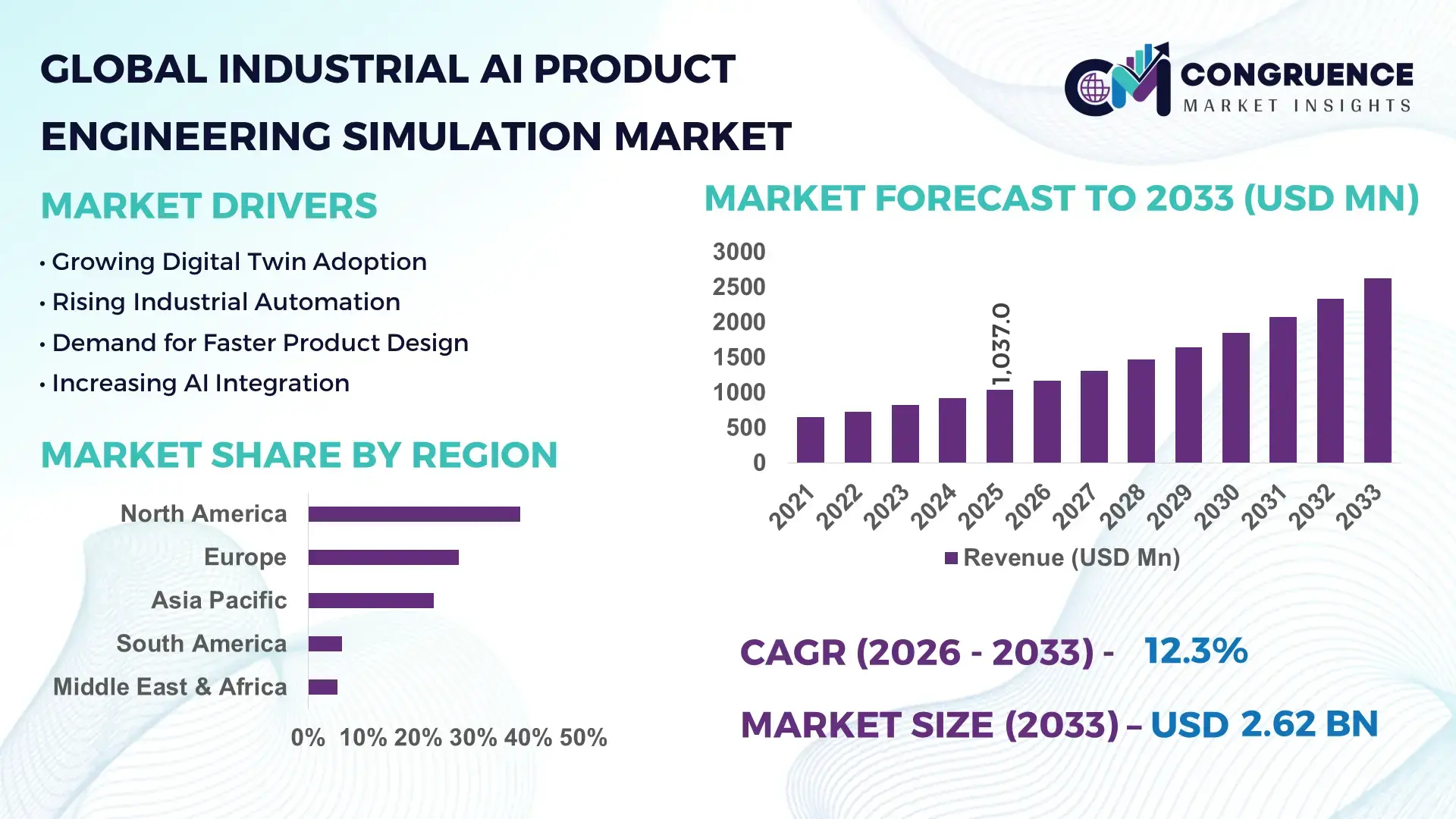
The United States stands at the forefront of the Industrial AI Product Engineering Simulation Market, supported by advanced digital engineering ecosystems and strong industrial automation adoption. Over 68% of large-scale manufacturing enterprises in the U.S. have implemented AI-enabled simulation platforms within their product development workflows. The country accounts for more than 40% of global high-performance computing (HPC) infrastructure used in engineering simulations, enabling complex, real-time modeling. Key industries such as aerospace, automotive, and defense utilize simulation tools in over 75% of design validation processes. Additionally, annual investments in industrial AI technologies in the U.S. exceeded USD 18 billion in 2024, with simulation-focused platforms receiving a growing share. Adoption of digital twins in engineering simulation has reached approximately 52% among Fortune 500 manufacturers, further strengthening technological advancement.
Market Size & Growth: Valued at USD 1,037.0 Million in 2025 and projected to reach USD 2,623.1 Million by 2033, expanding at a CAGR of 12.3% due to rising demand for faster, cost-efficient product design cycles.
Top Growth Drivers: AI-driven automation adoption (~64%), reduction in physical prototyping costs (~45%), and increased demand for predictive engineering analytics (~58%).
Short-Term Forecast: By 2028, simulation-driven engineering workflows are expected to reduce product development costs by up to 30% while improving time-to-market by 25%.
Emerging Technologies: Integration of digital twins, generative AI-based design systems, and cloud-based simulation platforms transforming engineering processes.
Regional Leaders: North America projected at USD 980 Million by 2033 with high enterprise adoption; Europe at USD 720 Million driven by automotive simulation demand; Asia-Pacific at USD 650 Million with rapid industrial digitization.
Consumer/End-User Trends: Manufacturing and automotive sectors account for over 60% usage, with increasing adoption in energy and electronics industries for predictive modeling.
Pilot or Case Example: In 2024, a global automotive OEM achieved 28% reduction in design validation time using AI-driven simulation platforms integrated with digital twin systems.
Competitive Landscape: Market leader holds approximately 22% share, followed by key players such as Siemens, Dassault Systèmes, Ansys, PTC, and Altair.
Regulatory & ESG Impact: Compliance with energy efficiency standards and carbon reduction mandates is driving adoption of simulation tools that optimize material usage by up to 20%.
Investment & Funding Patterns: Over USD 6 billion invested globally in industrial AI and simulation startups between 2023–2025, with strong venture capital inflow into cloud simulation platforms.
Innovation & Future Outlook: Increasing convergence of AI, IoT, and simulation technologies is expected to enable autonomous product engineering ecosystems and real-time optimization capabilities.
Industrial AI Product Engineering Simulation Market is shaped by strong contributions from automotive (32%), aerospace (21%), and industrial manufacturing (27%) sectors. AI-enabled digital twin innovations and cloud-native simulation tools are enhancing scalability and accuracy. Regulatory pressure for sustainable production is accelerating adoption, while Asia-Pacific shows rapid consumption growth. Emerging trends include real-time simulation, generative design, and integration with IoT ecosystems, positioning the market for continued technological evolution.
The Industrial AI Product Engineering Simulation Market holds critical strategic importance as industries increasingly transition toward digital-first engineering frameworks. Organizations are leveraging AI-powered simulation to replace traditional trial-and-error prototyping with data-driven predictive modeling, significantly improving efficiency and reducing operational risk. For instance, AI-enabled simulation platforms deliver up to 35% improvement in design accuracy compared to conventional CAD-based iterative testing methods. This shift enables faster innovation cycles, particularly in high-value industries such as aerospace, automotive, and energy.
From a regional perspective, North America dominates in volume due to established industrial infrastructure, while Europe leads in adoption with over 62% of enterprises integrating AI-driven simulation tools into engineering workflows. Asia-Pacific is rapidly expanding due to increasing investments in smart manufacturing and Industry 4.0 initiatives. By 2028, generative AI-based engineering simulation is expected to reduce product failure rates by approximately 28% while improving overall system performance efficiency by 22%.
Sustainability and ESG commitments are also shaping the market’s trajectory. Firms are committing to reducing material waste by up to 30% and energy consumption in product design processes by 25% by 2030 through simulation-driven optimization. In 2024, a leading German automotive manufacturer achieved a 26% reduction in prototyping costs and a 19% decrease in material usage through AI-integrated digital twin simulation systems, demonstrating measurable impact.
Looking ahead, the Industrial AI Product Engineering Simulation Market is positioned as a cornerstone for resilient and sustainable industrial transformation. Its integration with cloud computing, IoT, and real-time analytics will enable autonomous engineering ecosystems, reinforcing its role in driving innovation, compliance, and long-term operational efficiency.
The Industrial AI Product Engineering Simulation Market is influenced by rapid advancements in artificial intelligence, increasing demand for digital engineering solutions, and the shift toward data-driven product development processes. Industries are prioritizing simulation technologies to reduce physical testing requirements, optimize performance, and accelerate innovation cycles. The integration of high-performance computing and cloud-based platforms has significantly enhanced the scalability and accessibility of simulation tools, enabling enterprises of all sizes to adopt these solutions. Additionally, the rise of digital twins and real-time analytics is transforming traditional engineering practices by enabling predictive and prescriptive insights. Growing emphasis on sustainability, cost optimization, and regulatory compliance further drives demand for simulation-based design. However, challenges such as high implementation complexity, skill shortages, and integration issues with legacy systems continue to shape market behavior.
The growing need to shorten product development timelines is a major driver of the Industrial AI Product Engineering Simulation Market. Companies are increasingly adopting AI-driven simulation tools to eliminate repetitive physical testing and reduce design iterations. Studies indicate that simulation-based engineering can reduce product development time by up to 40% while improving design efficiency by nearly 30%. In industries such as automotive and aerospace, over 70% of design validation processes now rely on simulation rather than physical prototypes. Additionally, AI integration enables predictive failure analysis, reducing unexpected design errors by approximately 25%. This capability allows organizations to bring products to market faster while maintaining high-quality standards, making simulation a critical component of modern engineering workflows.
The complexity associated with implementing AI-driven simulation platforms presents a significant restraint for the market. These systems require integration with existing engineering software, high-performance computing infrastructure, and skilled personnel, which can be resource-intensive. Approximately 48% of small and mid-sized enterprises report challenges in adopting advanced simulation tools due to lack of expertise and infrastructure limitations. Additionally, interoperability issues between legacy systems and modern AI platforms hinder seamless deployment. Training engineers to effectively use AI-powered simulation tools can take several months, further slowing adoption. Data security concerns and the need for large datasets to train AI models also add to the complexity, making it difficult for organizations to fully leverage these technologies.
The rapid expansion of digital twin technology offers significant growth opportunities for the Industrial AI Product Engineering Simulation Market. Digital twins enable real-time replication of physical systems, allowing engineers to simulate performance under various conditions. Adoption of digital twins has increased by over 50% in manufacturing industries, enabling predictive maintenance and performance optimization. These technologies can reduce equipment downtime by up to 35% and improve operational efficiency by approximately 20%. The integration of AI with digital twins further enhances predictive capabilities, enabling proactive decision-making. Industries such as energy, healthcare, and smart infrastructure are increasingly utilizing digital twins, creating new avenues for simulation platforms to expand beyond traditional engineering applications.
Managing large volumes of data and meeting computational requirements pose significant challenges for the Industrial AI Product Engineering Simulation Market. AI-driven simulations require extensive datasets and high computational power, often necessitating advanced HPC systems. Approximately 60% of organizations report difficulties in handling simulation data due to storage and processing limitations. Real-time simulation demands low-latency computing, which can strain existing IT infrastructure. Additionally, ensuring data accuracy and consistency across multiple simulation models is complex and resource-intensive. The cost of maintaining high-performance computing environments and cloud infrastructure further adds to operational challenges. These factors can limit scalability and slow down adoption, particularly for smaller enterprises.
Surge in Digital Twin Adoption Across Industries: Over 52% of large manufacturing enterprises have integrated digital twin technologies into simulation workflows, enabling real-time monitoring and predictive analysis. This has resulted in up to 30% improvement in operational efficiency and a 25% reduction in unexpected system failures across industrial applications.
Expansion of Cloud-Based Simulation Platforms: Approximately 61% of organizations are shifting toward cloud-based simulation environments to enhance scalability and collaboration. Cloud deployment has reduced infrastructure costs by nearly 35% and improved cross-functional engineering collaboration efficiency by 28%.
Integration of Generative AI in Engineering Design: Around 47% of engineering teams are adopting generative AI tools to automate design optimization, resulting in 22% faster design iterations and up to 18% improvement in product performance metrics.
Increased Use of High-Performance Computing (HPC): More than 58% of simulation workloads now rely on HPC systems, enabling complex multi-physics simulations. This has accelerated computation speeds by over 40%, allowing engineers to conduct more detailed analyses within shorter timeframes.
The Industrial AI Product Engineering Simulation Market is segmented based on type, application, and end-user, reflecting diverse adoption patterns across industries. Simulation software and platforms dominate due to their widespread use in engineering design and testing, while services are gaining traction for implementation and integration support. Applications span across product design, testing, predictive maintenance, and digital twin modeling, with increasing adoption in real-time analytics. End-users include automotive, aerospace, manufacturing, and energy sectors, each leveraging simulation tools for efficiency and innovation. The segmentation highlights a growing shift toward AI-integrated, cloud-based solutions that enable scalable and data-driven engineering processes.
The market includes software platforms, services, and integrated AI simulation solutions. Software platforms currently lead with approximately 55% share due to their widespread adoption in engineering design and testing workflows. Services account for around 25%, driven by demand for system integration, customization, and training support. Integrated AI simulation solutions represent the fastest-growing segment, expanding at an estimated CAGR of 15.8%, fueled by increasing demand for automation and predictive analytics in engineering processes. These solutions enable real-time simulation and optimization, significantly enhancing efficiency. The remaining segments collectively contribute nearly 20%, including niche tools for specific industrial applications.
In 2025, a major aerospace organization deployed AI-integrated simulation software to optimize aircraft component design, reducing structural testing requirements by 32% and improving safety validation processes.
Product design and development dominate the application segment with approximately 38% share, as simulation tools are widely used to optimize design processes and reduce prototyping needs. Testing and validation account for around 27%, while predictive maintenance and digital twin applications are the fastest-growing segments, expanding at an estimated CAGR of 16.5%. These applications enable real-time monitoring and predictive insights, improving system reliability. Other applications collectively contribute about 35%, including process optimization and performance analysis. In 2025, over 42% of enterprises globally reported adopting AI simulation tools for product lifecycle management, highlighting strong adoption trends.
In 2025, AI-powered simulation tools were deployed across over 150 industrial facilities globally, improving early-stage defect detection rates by more than 30%.
Automotive industry leads the end-user segment with approximately 34% share, driven by extensive use of simulation in vehicle design and testing. Aerospace follows with around 22%, while manufacturing and energy sectors are the fastest-growing, expanding at an estimated CAGR of 14.9% due to increasing adoption of digital twins and predictive maintenance solutions. Other industries collectively contribute about 44%, including electronics and healthcare. In 2025, over 60% of large enterprises reported integrating AI simulation tools into their engineering workflows, indicating strong adoption across industries.
In 2025, a leading automotive manufacturer implemented AI-driven simulation systems, achieving a 27% reduction in development time and improving product reliability metrics by 18%.
North America accounted for the largest market share at 38.5% in 2025 however, Asia-Pacific is expected to register the fastest growth, expanding at a CAGR of 14.2% between 2026 and 2033.
North America’s dominance is supported by over 68% enterprise-level adoption of AI-enabled simulation tools and more than 40% of global high-performance computing capacity dedicated to engineering applications. Europe follows with approximately 27.3% share, driven by strong automotive and aerospace engineering sectors, where over 70% of product validation processes rely on simulation technologies. Asia-Pacific holds nearly 22.8% share, with China, Japan, and India collectively contributing over 65% of regional demand, fueled by rapid industrial automation and smart manufacturing investments exceeding USD 25 billion annually. South America accounts for 6.1%, primarily led by Brazil and Argentina with increasing adoption in energy and infrastructure sectors. The Middle East & Africa contributes around 5.3%, supported by digital transformation initiatives in oil & gas and construction industries, with over 35% of large enterprises adopting simulation-driven engineering tools.
North America holds approximately 38.5% of the Industrial AI Product Engineering Simulation Market, driven by high adoption across aerospace, automotive, and defense sectors. Over 72% of large enterprises in the region utilize AI-powered simulation tools for product development and validation. Government initiatives supporting digital manufacturing and Industry 4.0 adoption have increased funding for advanced engineering technologies by over 20% in recent years. The region benefits from strong regulatory frameworks promoting innovation and data security compliance. Technological advancements such as cloud-based simulation and digital twins are widely adopted, with over 55% of manufacturers integrating these solutions. A notable example is Ansys, which continues to expand AI-driven simulation capabilities, enabling faster multi-physics analysis. Consumer behavior shows higher enterprise adoption in sectors like healthcare, automotive, and financial services, where precision engineering and risk reduction are critical.
Europe accounts for approximately 27.3% of the global Industrial AI Product Engineering Simulation Market, with key markets including Germany, the UK, and France contributing over 60% of regional demand. The region’s strong automotive and aerospace industries drive extensive use of simulation technologies, with more than 65% of engineering processes incorporating AI-based simulation tools. Regulatory bodies emphasize sustainability and energy efficiency, leading to increased demand for simulation platforms that reduce material waste by up to 25%. Adoption of emerging technologies such as digital twins and generative design is rising, with over 48% of enterprises implementing these solutions. A notable player, Dassault Systèmes, активно develops advanced simulation platforms for sustainable product design. Consumer behavior reflects strong demand for explainable and compliant AI systems, influenced by strict regulatory standards.
Asia-Pacific represents approximately 22.8% of the Industrial AI Product Engineering Simulation Market and ranks as the fastest-growing region in terms of adoption. China, Japan, and India collectively account for over 65% of regional consumption, supported by large-scale manufacturing and infrastructure expansion. Industrial automation investments in the region exceed USD 25 billion annually, with over 58% of manufacturers integrating AI-driven simulation into production workflows. The region is witnessing rapid growth in smart factories, with more than 45% of industrial facilities adopting digital engineering tools. Key players such as Siemens are expanding operations to support local demand for simulation technologies. Consumer behavior indicates strong growth driven by manufacturing digitization, e-commerce expansion, and mobile-enabled industrial applications.
South America holds approximately 6.1% of the Industrial AI Product Engineering Simulation Market, with Brazil and Argentina being the primary contributors. The region’s demand is driven by energy, mining, and infrastructure sectors, where simulation tools are increasingly used for predictive maintenance and operational optimization. Over 40% of large industrial enterprises in Brazil have adopted AI-based simulation platforms to improve efficiency and reduce downtime. Government incentives promoting industrial modernization and foreign investments are supporting market growth. Technological adoption remains moderate, with around 32% of companies integrating digital engineering solutions. A regional example includes Petrobras leveraging simulation tools for offshore exploration optimization. Consumer behavior highlights demand tied to localized industrial needs and language-specific software customization.
The Middle East & Africa region accounts for approximately 5.3% of the Industrial AI Product Engineering Simulation Market, driven by demand from oil & gas, construction, and energy sectors. Countries such as the UAE and South Africa are leading adoption, with over 37% of large enterprises implementing simulation-based engineering tools. Technological modernization initiatives, including smart city projects and digital oilfield programs, are accelerating adoption of AI-driven simulation platforms. Regional governments are investing heavily in infrastructure, with over USD 15 billion allocated annually to digital transformation projects. Companies like Saudi Aramco are utilizing simulation technologies to optimize production processes and reduce operational risks. Consumer behavior reflects growing interest in advanced engineering solutions to improve efficiency and sustainability.
United States – 34.2% Market share: Strong industrial base, high adoption of AI-driven engineering tools, and advanced HPC infrastructure support large-scale simulation deployment.
Germany – 18.6% Market share: Leading automotive and manufacturing sectors with extensive integration of digital twins and simulation technologies for product optimization.
The Industrial AI Product Engineering Simulation Market is moderately consolidated, with the top five companies accounting for approximately 55% of the total market share. The competitive landscape is characterized by the presence of over 40 active global and regional players, ranging from established engineering software providers to emerging AI-driven simulation startups. Leading companies focus heavily on product innovation, with more than 60% of firms investing in AI integration and cloud-based simulation capabilities. Strategic partnerships and collaborations are prominent, with over 35% of key players engaging in joint ventures to enhance technological offerings and expand market reach. Mergers and acquisitions have increased by approximately 18% in the past two years, reflecting consolidation trends and the pursuit of advanced capabilities. Companies are also prioritizing digital twin integration, generative design, and real-time analytics, which have become critical differentiators. The market is witnessing intense competition in terms of pricing, performance, and scalability, with cloud-based subscription models gaining traction among enterprises. Additionally, regional players are focusing on localized solutions and customization to compete with global leaders, further intensifying market dynamics.
Dassault Systèmes
Ansys
PTC
Altair Engineering
Autodesk
Hexagon AB
Bentley Systems
MSC Software
ESI Group
COMSOL
MathWorks
SAP
Oracle
The Industrial AI Product Engineering Simulation Market is undergoing rapid transformation driven by advanced technologies such as artificial intelligence, high-performance computing (HPC), cloud computing, and digital twin systems. AI algorithms are increasingly used to automate simulation processes, enabling predictive modeling and real-time optimization. Over 58% of simulation workloads now rely on HPC systems, significantly enhancing computational speed and enabling complex multi-physics simulations. Cloud-based platforms are gaining widespread adoption, with approximately 61% of enterprises utilizing cloud environments for scalable and collaborative simulation workflows, reducing infrastructure costs by nearly 35%.
Digital twin technology has emerged as a critical innovation, with over 52% of large manufacturers implementing virtual replicas of physical systems to monitor performance and predict failures. Generative AI is also playing a significant role, with around 47% of engineering teams adopting AI-driven design tools to optimize product structures and improve efficiency by up to 22%. Integration with IoT devices allows real-time data collection and analysis, further enhancing simulation accuracy.
Additionally, advancements in edge computing are enabling low-latency simulation capabilities, particularly in manufacturing and energy sectors. Machine learning models are being used to analyze large datasets, improving decision-making and reducing errors by approximately 25%. These technological advancements are enabling organizations to transition toward autonomous engineering ecosystems, where simulation-driven insights guide product development processes, ensuring efficiency, sustainability, and innovation.
• In July 2025, Ansys announced its 2025 R2 release, introducing AI-powered capabilities across multiple simulation products, including the Engineering Copilot virtual assistant and AI+ features embedded in seven tools. These enhancements improve workflow automation and significantly shorten engineering time-to-market. Source: www.ansys.com
• In October 2025, Ansys reported that its SimAI platform enabled Sumitomo Riko to accelerate simulation speed by over 10x, allowing rapid prediction of mechanical, thermal, and chemical behavior in automotive component design and improving overall product lifecycle efficiency.
• In February 2025, Ansys introduced updates in its 2025 R1 release, enhancing cloud-enabled SimAI capabilities with expanded training datasets and improved data processing tools, enabling more accurate post-processing insights and better system-level engineering collaboration.
• In August 2025, Ansys announced integration with NVIDIA Omniverse, enabling immersive digital twin environments within simulation workflows. This collaboration enhances real-time 3D simulation and visualization capabilities, supporting more advanced product engineering and virtual testing environments.
The Industrial AI Product Engineering Simulation Market Report provides a comprehensive analysis of key segments, technologies, and regional dynamics shaping the industry. The report covers multiple product types, including software platforms, integrated AI simulation solutions, and engineering services, offering insights into their adoption across industries. Applications analyzed in the report include product design, testing and validation, predictive maintenance, and digital twin modeling, highlighting their role in improving engineering efficiency and reducing operational risks.
Geographically, the report examines major regions such as North America, Europe, Asia-Pacific, South America, and the Middle East & Africa, providing detailed insights into regional adoption patterns, industrial infrastructure, and technological advancements. The report also explores key end-user industries, including automotive, aerospace, manufacturing, energy, and electronics, which collectively account for over 80% of market demand.
In addition, the scope includes an in-depth evaluation of emerging technologies such as generative AI, cloud-based simulation, IoT integration, and high-performance computing, which are transforming the market landscape. The report highlights industry trends, innovation strategies, and competitive positioning, offering valuable insights for decision-makers. It also addresses regulatory frameworks, sustainability initiatives, and digital transformation trends that influence market growth. Overall, the report serves as a strategic resource for stakeholders seeking to understand market opportunities, technological developments, and future growth pathways in the Industrial AI Product Engineering Simulation Market.
| Report Attribute / Metric | Details |
|---|---|
| Market Revenue (2025) | USD 1,037.0 Million |
| Market Revenue (2033) | USD 2,623.1 Million |
| CAGR (2026–2033) | 12.3% |
| Base Year | 2025 |
| Forecast Period | 2026–2033 |
| Historic Period | 2021–2025 |
| Segments Covered |
By Type
By Application
By End-User Insights
|
| Key Report Deliverables | Revenue Forecast; Market Trends; Growth Drivers & Restraints; Technology Insights; Segmentation Analysis; Regional Insights; Competitive Landscape; Regulatory & ESG Overview; Recent Developments |
| Regions Covered | North America; Europe; Asia-Pacific; South America; Middle East & Africa |
| Key Players Analyzed | Siemens; Dassault Systèmes; Ansys; PTC; Altair Engineering; Autodesk; Hexagon AB; Bentley Systems; MSC Software; ESI Group; COMSOL; MathWorks; SAP; Oracle |
| Customization & Pricing | Available on Request (10% Customization Free) |




