
Reports
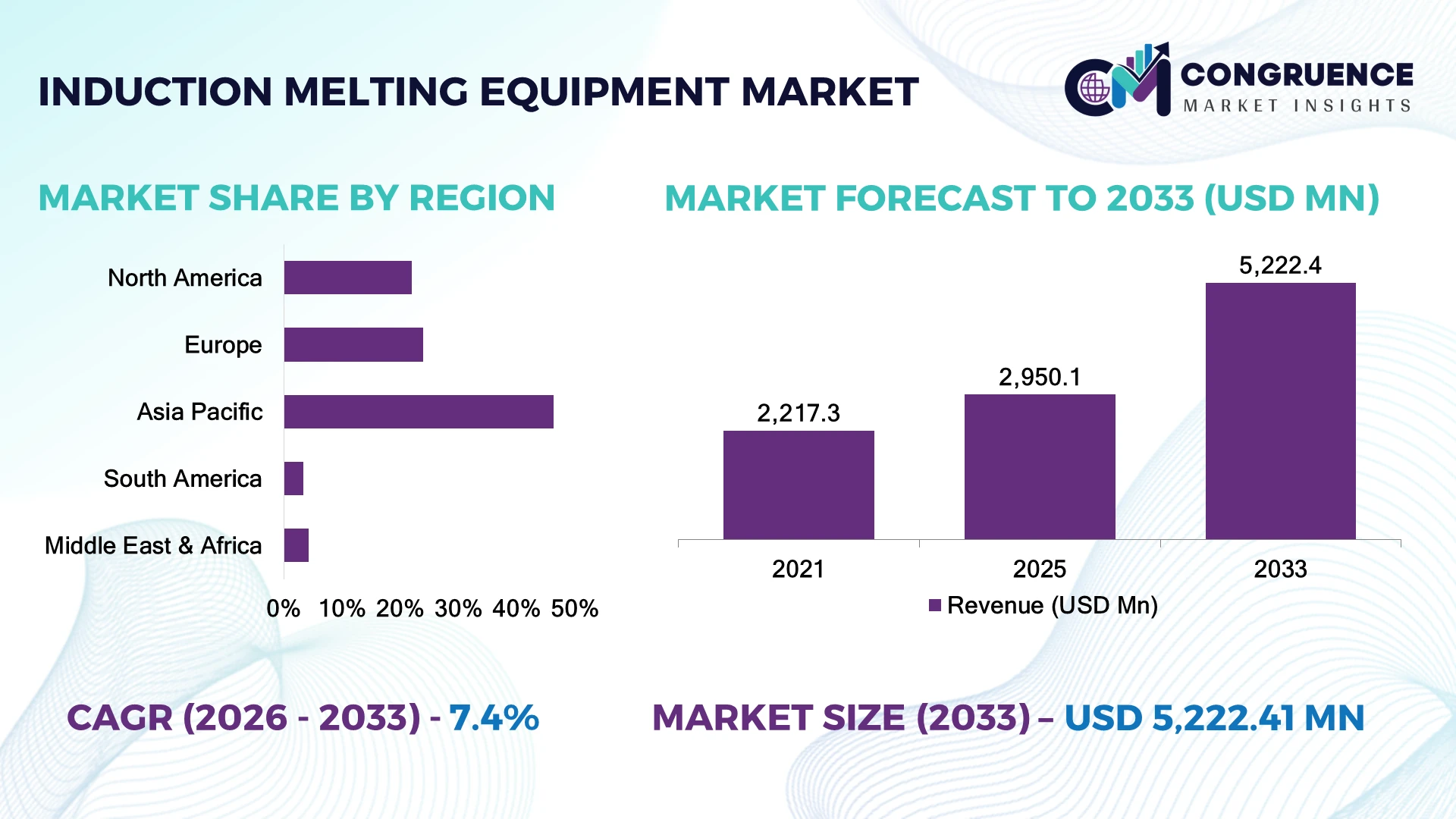
The Global Induction Melting Equipment Market was valued at USD 2,950.1 Million in 2025 and is anticipated to reach a value of USD 5,222.4 Million by 2033 expanding at a CAGR of 7.4% between 2026 and 2033. Growth is driven by foundry automation, increasing recycled metal utilization, stricter energy efficiency standards, and expanding demand for precision melting across steel, aluminum, and specialty alloy production.
China dominates the global induction melting equipment market with approximately 38% of installed melting capacity, supported by annual industrial modernization investments exceeding USD 35 billion and rapid adoption of intelligent foundry technologies. Compared with Germany, China deploys significantly more medium-frequency induction furnaces, while automated process control integration exceeds 60% across large metal processing facilities. Supply-chain restructuring following the Russia–Ukraine conflict has further accelerated localized equipment manufacturing and procurement.
Manufacturers investing in energy-efficient induction technologies and digital process automation are strengthening long-term competitiveness across global metal processing industries.
Market Size & Growth: USD 2,950.1 million (2025) to USD 5,222.4 million (2033) at 7.4% CAGR, driven by foundry automation and recycled metal processing.
Top Growth Drivers: Scrap recycling (+31%), industrial automation (+27%), energy-efficient melting (+24%).
Short-Term Forecast: By 2028, melting energy consumption declines by 18% while production efficiency improves by 22%.
Emerging Technologies: AI process control, IoT monitoring, and predictive maintenance improve furnace productivity by nearly 25%.
Regional Leaders: Asia-Pacific (~USD 2.4 billion), Europe (~USD 1.2 billion), North America (~USD 950 million), supported by advanced manufacturing investments.
Consumer/End-User Trends: More than 65% of large foundries prioritize digitally controlled induction melting systems.
Pilot/Case Example: A 2026 smart foundry upgrade reduced melting cycle time by 20% through automated furnace optimization.
Competitive Landscape: Top five suppliers control approximately 48% market share, led by Inductotherm, ABP Induction, OTTO JUNKER, Electrotherm, and EFD Induction.
Regulatory & ESG Impact: Energy-efficient induction furnaces reduce emissions by nearly 30% compared with conventional melting systems.
Investment & Funding: More than USD 8 billion supports foundry modernization, plant expansion, and smart manufacturing integration.
Innovation & Future Outlook: Digital melting platforms and high-frequency induction technologies are redefining precision metal processing.
Induction melting equipment is witnessing stronger demand across steel recycling, precision casting, automotive components, aerospace alloys, and non-ferrous metal production. Intelligent furnace controls and real-time monitoring systems improve process stability while reducing energy consumption by nearly 20%. Expanding circular manufacturing initiatives and industrial decarbonization policies are accelerating equipment modernization, creating a strong foundation for the strategic market assessment below.
The induction melting equipment market has become strategically important as manufacturers modernize foundries, improve energy efficiency, and increase the use of recycled metals. Competitive advantage increasingly depends on process automation, precision temperature control, and operational flexibility rather than furnace capacity alone. Industrial decarbonization initiatives and supply-chain localization are accelerating replacement of conventional melting technologies with digitally controlled induction systems across global manufacturing facilities.
Modern induction melting equipment improves energy efficiency by approximately 20% compared with conventional fuel-fired furnaces while reducing melting losses by nearly 15% through precise electromagnetic heating and automated process control. Asia-Pacific leads large-scale equipment deployment through extensive steel and non-ferrous metal production, whereas Europe emphasizes advanced automation, emission reduction, and specialty alloy manufacturing. Over the next two to three years, digital process monitoring and predictive maintenance are expected to be incorporated into more than 55% of newly installed industrial induction furnaces.
Metal producers are integrating induction melting equipment with automated charging systems, production analytics, and intelligent quality control platforms to optimize plant performance. Equipment manufacturers are expanding regional production, strengthening engineering partnerships, and investing in AI-enabled furnace management technologies. Companies combining energy-efficient melting systems with digital process intelligence and comprehensive lifecycle support will achieve stronger competitive positioning as precision manufacturing and sustainable metal processing become increasingly important.
Industrial foundries are replacing conventional fuel-fired furnaces with induction melting equipment to improve energy efficiency, process consistency, and metallurgical quality. More than 62% of newly commissioned medium-capacity foundries now prioritize induction melting technology, while automated furnace control improves melting efficiency by approximately 22% and reduces metal loss by nearly 15%. India and China continue expanding electric foundry capacity as industrial decarbonization policies encourage cleaner production technologies. This transition is increasing demand for digitally controlled induction systems capable of handling diverse ferrous and non-ferrous alloys. Equipment manufacturers are expanding regional manufacturing facilities, investing in intelligent power control technologies, and strengthening engineering partnerships to deliver customized melting solutions with lower operating costs and higher production flexibility.
Power semiconductors, copper coils, refractory materials, and high-frequency power electronics remain vulnerable to procurement volatility, increasing manufacturing complexity. Prices for copper-based components fluctuate by nearly 18% across procurement cycles, while imported electronic components represent approximately 35% of system value for advanced induction furnaces. Export restrictions affecting selected electronic components and transformer materials have extended equipment lead times for several industrial manufacturers. These conditions complicate project scheduling, reduce production predictability, and pressure supplier margins. Companies are responding by localizing component sourcing, qualifying multiple suppliers, redesigning electronic assemblies, and securing long-term procurement contracts to improve manufacturing resilience and delivery reliability.
Connected induction melting platforms integrated with AI, industrial IoT, and digital production analytics are creating opportunities beyond conventional melting operations. Smart furnace management reduces unplanned downtime by approximately 24%, while predictive maintenance lowers servicing costs by nearly 18%. Germany is accelerating smart foundry adoption through Industry 4.0 manufacturing initiatives, encouraging wider deployment of intelligent melting equipment across precision engineering facilities. Equipment manufacturers are expanding software development capabilities, collaborating with industrial automation companies, and introducing cloud-enabled monitoring platforms. The most valuable opportunity lies in recurring digital service revenues generated through remote diagnostics, performance optimization, and lifecycle monitoring rather than hardware sales alone.
Integrating advanced induction melting equipment with aging factory automation infrastructure remains a significant execution challenge. Nearly 30% of traditional foundries continue operating legacy production systems that require customized interfaces, while integration activities increase commissioning timelines by approximately 16%. Japan and several European manufacturing hubs are modernizing long-established production facilities where interoperability between legacy control systems and modern digital furnaces remains limited. These challenges influence operational scalability, maintenance consistency, and cybersecurity readiness rather than equipment capability. Manufacturers must strengthen industrial software compatibility, workforce training, digital security, and strategic automation partnerships to ensure reliable deployment across mixed-generation manufacturing environments.
Advanced Power Control Systems: Intelligent inverter-based power supplies are replacing conventional control architectures, improving energy utilization by nearly 20% while reducing melting cycle variations by approximately 18%. Rising electricity optimization initiatives are accelerating adoption. Manufacturers are integrating adaptive power management and automated process control to improve operational efficiency and alloy consistency.
Closed-Loop Process Automation: Foundries are increasingly linking induction furnaces with automated charging, temperature monitoring, and casting systems. Integrated production workflows improve throughput by approximately 22% while reducing operator intervention by nearly 30%. Labor shortages are encouraging greater automation, prompting equipment suppliers to expand digital control platforms and collaborative automation partnerships.
Localized Equipment Manufacturing: Manufacturers are regionalizing production of induction furnace systems and critical assemblies to reduce logistics exposure. Local sourcing has shortened average equipment delivery times by approximately 15%, while domestic component utilization has increased by nearly 20% in several manufacturing markets. Companies are expanding assembly operations and strengthening supplier ecosystems to improve responsiveness and production continuity.
High-Purity Alloy Processing: Precision industries are increasing adoption of induction melting equipment for specialty steels, aerospace alloys, and recycled non-ferrous metals. Modern furnace configurations improve melt purity by approximately 17% while reducing oxidation losses by nearly 14%. Equipment suppliers are investing in advanced refractory designs, real-time process monitoring, and application-specific furnace configurations to support higher-value metallurgical production.
Medium Frequency (MF) induction melting equipment remains the leading product type, accounting for approximately 47% of the global market due to its versatility, energy efficiency, and suitability for steel, cast iron, and non-ferrous metal processing. Its ability to deliver rapid melting cycles with stable metallurgical quality makes it the preferred solution for foundries and precision casting facilities. Power Frequency induction systems continue serving heavy-duty, large-capacity melting operations where continuous production is essential, while High Frequency systems maintain strategic importance for specialty alloy production requiring precise thermal control and superior melt quality.
High Frequency induction melting equipment is the fastest-growing segment as manufacturers increase production of aerospace alloys, medical-grade metals, and precision engineering components. Adoption of digitally controlled high-frequency furnaces has increased by nearly 26% over the past two years, while intelligent power management improves energy utilization by approximately 18%. Equipment suppliers are expanding high-frequency product portfolios, strengthening automation partnerships, and investing in advanced inverter technologies to support higher-value metallurgical applications. Investment priorities are steadily shifting toward precision melting systems capable of supporting automated smart foundries.
Industry findings published during 2026 by the World Foundry Organization indicate that digitally controlled medium- and high-frequency induction furnaces continue replacing conventional melting technologies across modern foundry expansion projects to improve process efficiency and metal quality.
Steel manufacturing represents the largest application segment, contributing approximately 49% of global demand because of extensive induction melting requirements for recycled steel processing, specialty steel production, and foundry operations. Induction furnaces provide precise temperature control, improved alloy consistency, and lower oxidation losses, making them operationally critical for modern steel plants. Iron casting continues to represent a mature application supported by automotive and industrial component production, while copper and aluminum processing maintain strong demand for efficient non-ferrous metal melting systems.
Specialty alloy production is the fastest-growing application as aerospace, defense, and medical manufacturers require superior metallurgical quality and tighter process control. Intelligent furnace deployment has increased by nearly 24%, while automated melting control reduces alloy composition variability by approximately 16%. Equipment manufacturers are responding through AI-enabled process automation, integrated monitoring platforms, and customized furnace configurations for advanced alloy production. Demand is steadily shifting toward high-value melting applications where precision, repeatability, and digital process optimization directly influence production quality.
A 2025 industrial assessment released by the World Foundry Organization highlighted continued expansion of induction melting technologies across steel recycling and precision casting operations as manufacturers prioritize energy-efficient metal processing.
Foundries represent the largest end-user segment, accounting for approximately 54% of global demand because of continuous melting requirements for steel, iron, aluminum, and specialty alloy production. High equipment utilization, increasing scrap recycling, and ongoing process modernization continue driving investment in advanced induction melting systems. Metal recycling companies remain important purchasers as circular manufacturing expands, while automotive component manufacturers steadily increase procurement of precision melting equipment for lightweight alloy production and high-volume casting operations.
Aerospace and specialty manufacturing companies are emerging as the fastest-growing end-user group as demand rises for high-performance alloys and precision metallurgical processing. Deployment of digitally controlled induction furnaces has increased by nearly 23%, while automated process monitoring exceeds 45% across newly commissioned specialty alloy production facilities. Equipment manufacturers are expanding application-specific product offerings, strengthening technical partnerships, and providing customized digital service packages that improve process consistency and long-term operational performance.
A 2026 industry review published by the World Foundry Organization highlighted that modern foundries are accelerating adoption of digitally controlled induction melting systems to improve energy efficiency, metallurgical consistency, and production flexibility across ferrous and non-ferrous metal operations.
Asia-Pacific accounted for the largest market share at 46.3% in 2025 however, Middle East & Africa is expected to register the fastest growth, expanding at a CAGR of 8.1% between 2026 and 2033.
Smart Foundry Upgrades Drive Equipment Modernization
North America accounts for approximately 22% of the global induction melting equipment market, supported by modernization of steel mini-mills, specialty alloy production, and expanding metal recycling operations. Industrial manufacturers are replacing conventional melting technologies with digitally controlled induction systems to improve energy efficiency and process stability. More than 58% of newly commissioned melting installations incorporate intelligent power control and automated process monitoring, strengthening operational consistency. Investments in electric foundries, aerospace component manufacturing, and recycled metal processing continue supporting demand for advanced induction furnaces. Equipment suppliers are expanding engineering services, digital maintenance platforms, and localized manufacturing capabilities to strengthen customer support and improve lifecycle performance.
United States Market Outlook: The United States dominates the regional market through its extensive steel recycling industry, advanced aerospace manufacturing base, and widespread deployment of electric foundries. More than 70 million metric tons of ferrous scrap are processed annually, creating sustained demand for high-efficiency induction melting systems. Manufacturers continue integrating AI-enabled furnace controls, predictive maintenance platforms, and automated charging systems to improve production efficiency while strengthening partnerships with automotive, defense, and precision engineering companies.
Energy Efficiency Reshapes Metal Processing
Europe represents approximately 24% of the global market as manufacturers prioritize electrified melting technologies to improve productivity and reduce industrial emissions. Modern foundries increasingly adopt digitally integrated induction furnaces for specialty steel, precision casting, and non-ferrous alloy production. More than 45% of newly installed industrial melting systems now incorporate automated energy management and process optimization functions. Equipment suppliers continue strengthening technology partnerships, expanding intelligent furnace portfolios, and supporting sustainable manufacturing initiatives across advanced metal processing industries.
Germany Market Outlook: Germany leads the European market through its highly automated foundry sector, precision engineering expertise, and advanced machinery manufacturing ecosystem. Industrial facilities increasingly deploy intelligent induction melting equipment for automotive, machinery, and specialty alloy production. Digital process integration and Industry 4.0 initiatives continue driving investments in smart furnace technologies that improve melting consistency, production flexibility, and operational efficiency across high-value manufacturing operations.
Manufacturing Scale Strengthens Global Leadership
Asia-Pacific leads the global induction melting equipment market with approximately 46.3% share, supported by extensive steel production, foundry expansion, and rapid industrial automation across China, India, Japan, and Southeast Asia. Continuous investments in electric furnace capacity and recycled metal processing sustain strong equipment demand. More than 65% of newly established medium-capacity foundries in the region deploy digitally controlled induction melting systems to improve production quality and energy efficiency. Equipment manufacturers continue expanding regional production facilities, engineering centers, and localized supply chains to support accelerating industrial demand.
China Market Outlook: China remains the world's largest induction melting equipment market due to its dominant steel production, integrated manufacturing ecosystem, and continuous foundry modernization. Intelligent induction furnaces are increasingly deployed across automotive, machinery, renewable energy, and infrastructure manufacturing facilities. Domestic equipment manufacturers continue investing in advanced inverter technologies, automation software, and high-efficiency furnace systems while expanding export capabilities to strengthen international competitiveness.
Industrial Recycling Supports Equipment Demand
South America continues strengthening demand through expanding steel recycling, mining equipment manufacturing, and industrial casting activities. Brazil and Argentina remain the primary markets as manufacturers modernize foundries to improve productivity and energy efficiency. Deployment of digitally controlled induction furnaces has increased by approximately 19% across major metal processing facilities, supporting higher-quality alloy production and lower operating costs. Equipment suppliers are expanding technical service networks, localized assembly operations, and engineering partnerships while balancing infrastructure limitations and industrial investment cycles across the region.
Brazil Market Outlook: Brazil leads the regional market through its established steel industry, growing scrap recycling ecosystem, and diversified industrial manufacturing base. Modern foundries continue replacing aging melting systems with energy-efficient induction furnaces to improve production flexibility and metallurgical quality. Equipment suppliers are strengthening local engineering support, expanding aftermarket services, and collaborating with steel producers and industrial manufacturers to accelerate modernization across domestic metal processing operations.
Industrial Diversification Expands Electric Melting Capacity
The Middle East & Africa is emerging as the fastest-growing regional market as governments accelerate industrial diversification, downstream metal processing, and manufacturing localization. Expansion of steel plants, aluminum processing facilities, and industrial fabrication projects continues increasing demand for advanced induction melting technologies. More than 35% of recently commissioned metal processing facilities incorporate energy-efficient induction melting systems designed to improve operational productivity and reduce energy intensity. Manufacturers are strengthening regional partnerships, establishing technical support centers, and expanding localized equipment servicing to support long-term industrial development.
Saudi Arabia Market Outlook: Saudi Arabia is the region's leading market due to sustained investments in industrial manufacturing, steel processing, and economic diversification initiatives. New industrial clusters continue adopting advanced induction melting equipment for precision metal production and downstream manufacturing applications. Equipment suppliers are expanding regional engineering capabilities, strengthening partnerships with industrial project developers, and delivering digitally integrated furnace technologies that support efficient, high-quality metal processing across the Kingdom's growing industrial sector.
The market remains moderately consolidated, with the top five manufacturers accounting for approximately 48% of global demand. Inductotherm, ABP Induction Systems, OTTO JUNKER, Electrotherm, and EFD Induction compete through advanced automation and premium engineering, while regional manufacturers challenge them with lower-cost systems and faster customization. Competition increasingly centers on energy efficiency, digital controls, and lifecycle support rather than furnace capacity alone. AI-enabled process optimization improves operating efficiency by nearly 20%, modular furnace designs reduce installation time by approximately 18%, and localized manufacturing lowers delivery lead times by around 15%. Leading companies are expanding regional production, strengthening automation partnerships, integrating predictive maintenance platforms, and increasing vertical integration across power electronics and control systems. The competitive landscape is shifting toward intelligent melting ecosystems and digital service capabilities. High capital requirements, technical validation, and long equipment qualification cycles remain major entry barriers. Sustainable success depends on automation leadership, engineering expertise, reliable service networks, and energy-efficient furnace innovation.
Inductotherm Group
ABP Induction Systems GmbH
OTTO JUNKER GmbH
Electrotherm (India) Limited
EFD Induction
Ajax TOCCO Magnethermic Corporation
Megatherm Electronics Pvt. Ltd.
Indotherm Equipment Corporation
ECM Technologies
ULVAC, Inc.
Ningbo Haishun Electric Co., Ltd.
Ningbo Shenguang Electric Furnace Co., Ltd.
Induction melting equipment is evolving through intelligent power electronics, digital inverter technology, and AI-driven process automation. Modern medium-frequency inverter systems improve energy efficiency by approximately 20% while reducing melting cycle variation by nearly 18% compared with conventional SCR-controlled systems. More than 60% of newly installed industrial furnaces now incorporate PLC-based automation, remote diagnostics, and digital power regulation, enabling higher process consistency and lower operating costs. Manufacturers offering integrated hardware and software platforms gain stronger differentiation through lifecycle optimization rather than equipment capacity alone.
Emerging technologies include predictive maintenance, Industrial IoT connectivity, digital twin simulation, and adaptive power control. AI-enabled furnace monitoring reduces unexpected downtime by approximately 24%, while automated charging and temperature optimization improve alloy consistency by nearly 16%. Compared with traditional standalone furnaces, digitally integrated melting systems improve production efficiency by approximately 22% through synchronized process control and real-time analytics. Global technology leaders benefit from increasing demand for intelligent foundries capable of supporting precision alloy production and lower energy consumption.
Between 2026 and 2028, cloud-connected furnace management, advanced semiconductor power modules, and autonomous process optimization will become central competitive differentiators. More than 55% of newly commissioned high-capacity induction melting systems are expected to integrate predictive analytics and remote performance monitoring. Equipment suppliers investing in software ecosystems, intelligent controls, and digital service platforms will secure stronger aftermarket opportunities, faster customer retention, and greater participation in smart manufacturing transformation as industrial metal processing becomes increasingly automated.
September 2025: Electrotherm announced execution of a 60-ton/32 MW next-generation induction melting furnace integrating AI-enabled diagnostics, FPGA-based digital controls, and predictive monitoring for advanced steel production. The project strengthens high-capacity smart furnace deployment for sustainable steel manufacturing. Source: Electrotherm
August 2025: OTTO JUNKER commissioned its modular JUPITER BOXLine induction melting plant in Poland, delivering 1,200 kg/hour melting capacity with a specific energy consumption of 549 kWh per tonne for steel. The installation reinforces modular furnace adoption and energy-efficient foundry modernization. Source: OTTO JUNKER
January 2026: Inductotherm Group announced the expansion of Consarc Corporation's manufacturing facility to strengthen production capacity for advanced thermal processing technologies serving industrial metal processing markets. The expansion improves manufacturing capability and supports growing demand for high-performance induction-based equipment. Source: Inductotherm Group
December 2025: OTTO JUNKER supported Eisengießerei Th. Schultz in replacing a conventional cupola furnace with an induction melting system for lower-carbon metal production, advancing industrial electrification and improving energy-efficient foundry operations. Source: OTTO JUNKER News. (Otto Junker)
This report provides a comprehensive assessment of the global induction melting equipment market across product types, industrial applications, end-user industries, and major geographic regions. The analysis covers medium-, high-, and power-frequency induction melting systems used in steel manufacturing, iron casting, non-ferrous metal processing, specialty alloy production, and precision engineering. It evaluates market performance across North America, Europe, Asia-Pacific, South America, and the Middle East & Africa while assessing technology deployment, automation adoption, and competitive positioning across more than 12 leading equipment manufacturers.
The report examines intelligent furnace technologies, AI-enabled process control, predictive maintenance, Industrial IoT integration, and energy-efficient melting innovations shaping industrial investment between 2026 and 2033. It delivers detailed segmentation analysis, regional operational insights, technology benchmarking, and competitive evaluation while highlighting deployment trends, smart foundry transformation, recycled metal processing, and emerging specialty alloy opportunities. The findings support strategic investment planning, product portfolio optimization, capacity expansion, competitive positioning, partnership evaluation, and long-term decision-making across the global metal processing industry.
| Report Attribute/Metric | Report Details |
|---|---|
|
Market Revenue in 2025 |
USD 2,950.1 Million |
|
Market Revenue in 2033 |
USD 5,222.4 Million |
|
CAGR (2026 - 2033) |
7.4% |
|
Base Year |
2025 |
|
Forecast Period |
2026 - 2033 |
|
Historic Period |
2021 - 2025 |
|
Segments Covered |
By Type
By Application
By End-User
|
|
Key Report Deliverable |
Revenue Forecast, Growth Trends, Market Dynamics, Segmental Overview, Regional and Country-wise Analysis, Competition Landscape |
|
Region Covered |
North America, Europe, Asia-Pacific, South America, Middle East, Africa |
|
Key Players Analyzed |
Inductotherm Group, ABP Induction Systems GmbH, OTTO JUNKER GmbH, Electrotherm (India) Limited, EFD Induction, Ajax TOCCO Magnethermic Corporation, Megatherm Electronics Pvt. Ltd., Indotherm Equipment Corporation, ECM Technologies, ULVAC, Inc., Ningbo Haishun Electric Co., Ltd., Ningbo Shenguang Electric Furnace Co., Ltd. |
|
Customization & Pricing |
Available on Request (10% Customization is Free) |




