
Reports
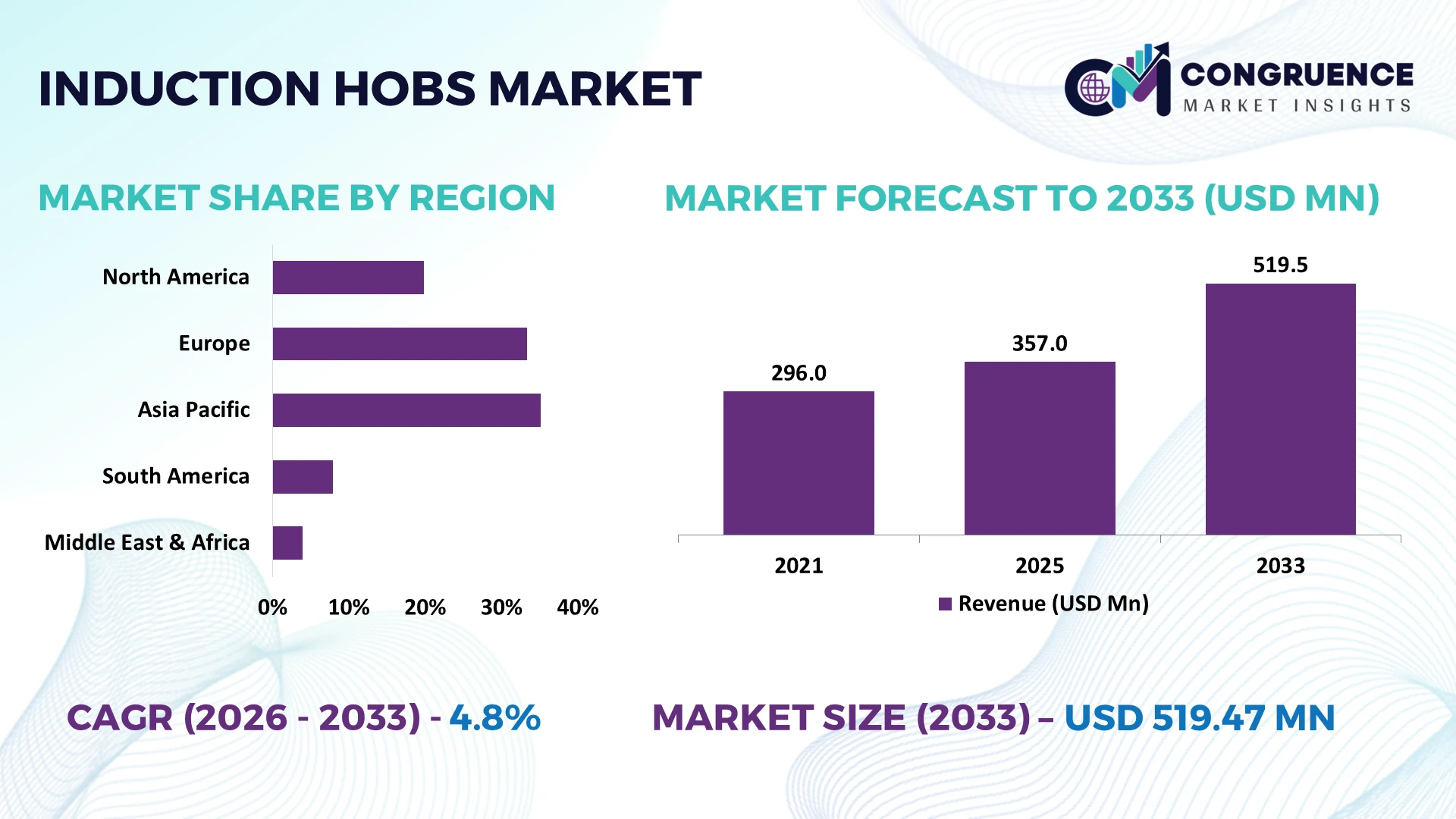
The Global Induction Hobs Market was valued at USD 357.0 Million in 2025 and is anticipated to reach a value of USD 519.5 Million by 2033 expanding at a CAGR of 4.8% between 2026 and 2033. Growth is driven by the transition from gas cooking to high-efficiency electric appliances, smart temperature-control systems, compact multi-zone hob designs, and government-backed building electrification initiatives.
China maintains a dominant manufacturing position through its extensive appliance, electronic-component, and ceramic-glass supply chains, while India is emerging as a high-growth consumption and manufacturing market. India's induction cooktop sales have increased to approximately 1.05 million units monthly, compared with around 0.5 million units before recent LPG supply disruptions. This shift highlights how geopolitical energy-supply uncertainty is accelerating household electrification. Manufacturers are prioritizing localized component production, affordable appliance configurations, and stronger domestic distribution networks.
Strategically, companies that combine manufacturing localization with energy-efficient product innovation are better positioned to capture demand across established and emerging appliance markets.
Market Size & Growth: USD 357.0 million in 2025, reaching USD 519.5 million by 2033 at 4.8% CAGR, supported by residential electrification and advanced induction technology.
Top Growth Drivers: Energy efficiency improvement of up to 90%, cooking-time reductions of 20–40%, and more than 100% growth in India's monthly induction cooktop sales.
Short-Term Forecast: By 2028, manufacturers are targeting 20–30% improvements in production throughput through automated assembly, component standardization, and localized sourcing.
Emerging Technologies: AI-assisted temperature regulation, inverter-based power management, and connected multi-zone cooking systems are strengthening premium product differentiation.
Regional Leaders: Europe represents approximately USD 124.95 million in 2025, Asia Pacific USD 114.24 million, and North America USD 70.00 million, reflecting replacement demand, manufacturing expansion, and residential electrification.
Consumer/End-User Trends: Built-in induction cooktops accounted for 62.3% of the broader induction cooktop market in 2025, demonstrating strong preference for integrated kitchen installations.
Pilot/Case Example: A 2019 residential cooktop performance study measured 85.2–86.1% induction efficiency against 31.9% for gas, demonstrating substantially better cooking-energy utilization.
Competitive Landscape: Bosch, Samsung, LG, Miele, and Whirlpool compete through product innovation, pricing, distribution, and premium built-in configurations. Bosch held approximately 13.6% of the built-in induction cooktop segment in 2025.
Regulatory & ESG Impact: European Ecodesign Regulation 66/2014 establishes minimum efficiency and performance requirements, strengthening the commercial position of efficient electric cooking appliances.
Investment & Funding: Stove Kraft's planned monthly production expansion from 200,000 to 300,000 units represents a 50% capacity increase, highlighting investment in manufacturing scale and domestic supply.
Innovation & Future Outlook: Flexible cooking zones, automatic pan recognition, improved thermal sensors, and recyclable electronic components are shifting competition toward intelligent, energy-efficient kitchen ecosystems.
Residential kitchen modernization, commercial food-service installations, and the replacement of conventional gas burners represent important demand areas. Manufacturers are introducing flexible cooking zones, automatic cookware detection, touch-sensitive interfaces, and integrated ventilation systems. Induction technology achieves approximately 80–90% thermal efficiency, strengthening its appeal in energy-conscious households. However, geopolitical disruptions affecting LPG availability and imported electronic components are reshaping purchasing priorities and manufacturing strategies. This transition places greater importance on localized sourcing, compatible cookware, and reliable electricity infrastructure, creating a stronger strategic connection between appliance innovation and energy security.
The induction hobs market is becoming strategically important as appliance manufacturers compete to align kitchen electrification, energy efficiency, and intelligent cooking technologies with changing household and commercial infrastructure. The transition from gas-based cooking is strengthening the role of induction systems in residential construction, premium kitchen renovations, hospitality, and institutional food-service operations. Energy-security concerns, particularly disruptions affecting LPG shipments through the Strait of Hormuz, have further accelerated interest in alternative cooking technologies.
Technology differentiation is increasingly measurable. Induction hobs achieve approximately 80–90% thermal efficiency, compared with around 30–60% for gas cooking systems, while reducing cooking times through direct electromagnetic heating. Europe leads in mature built-in appliance adoption, whereas India and China offer manufacturing scale, expanding household applications, and opportunities for affordable portable products.
Over the next 2–3 years, manufacturers will prioritize inverter-based power control, automatic cookware recognition, and modular multi-zone configurations. For example, Stove Kraft is expanding monthly induction cooktop production capacity from 200,000 to 300,000 units at its Karnataka facility. Companies are also strengthening supplier relationships and domestic component sourcing. Competitive advantage will increasingly depend on balancing intelligent functionality, manufacturing economics, and dependable component availability.
The transition toward electric cooking is strengthening induction hob adoption as households and commercial kitchens prioritize lower energy losses and faster temperature control. Induction technology delivers approximately 80–90% thermal efficiency, compared with roughly 30–60% for gas-based cooking. India's monthly induction cooktop sales increased from approximately 500,000 to 1.05 million units during the 2026 LPG supply disruption. This structural shift is encouraging manufacturers to expand production, introduce affordable portable models, and improve distribution. Stove Kraft's planned 50% monthly capacity expansion demonstrates how manufacturers are converting energy-security concerns into manufacturing opportunities. An important competitive advantage lies in positioning induction as a practical secondary cooking system before it becomes a complete replacement for conventional cooking appliances.
Dependence on imported electronic components and specialized materials restricts manufacturing flexibility and exposes induction hob producers to procurement volatility. Indian manufacturers face significant exposure to imported printed circuit boards, microcrystalline glass, and electronic control modules, with certain industry estimates placing imported component content at 60–70% of production costs. During 2026 supply disruptions, ceramic glass, induction coils, and printed circuit board prices increased by approximately 15–25%, while component lead times extended from two weeks to four or five weeks. These pressures affect inventory turnover, pricing flexibility, and gross margins. Manufacturers are responding through backward integration, multi-country sourcing, quarterly supplier contracts, and domestic component development. The critical restraint is not appliance assembly capacity but reliable access to specialized inputs.
Smart induction platforms present opportunities beyond conventional residential replacement demand. Manufacturers are developing automatic pan recognition, flexible cooking zones, precision temperature sensors, and connected power-management systems to improve cooking consistency. With induction thermal efficiency reaching 90%, commercial kitchens can target lower energy consumption and faster preparation cycles. India's expanding institutional electrification initiatives create additional opportunities across hospitals, educational facilities, hotels, and workplace canteens. European manufacturers are also integrating ventilation and intelligent controls into built-in kitchen configurations. Companies can capture these opportunities through partnerships with modular kitchen developers, hospitality equipment suppliers, and building contractors. A particularly attractive opportunity lies in supplying induction-compatible cookware alongside appliances, reducing adoption friction and creating complementary revenue streams.
Scaling induction hob adoption requires coordinated improvements in household electrical infrastructure, cookware compatibility, and appliance installation capabilities. High-powered multi-zone hobs typically require dedicated electrical circuits, with some configurations demanding connections rated around 32–40 amperes. Existing residential wiring and distribution boards in older buildings frequently require upgrades before installation. Additionally, conventional aluminium and non-magnetic cookware cannot operate directly on standard induction surfaces, creating replacement costs and consumer inconvenience. Smart connectivity introduces further requirements for reliable controls, software reliability, and cybersecurity protection. Manufacturers must address these barriers through lower-power configurations, universal installation support, improved cookware compatibility guidance, and technician training. The long-term competitive challenge is delivering consistent performance across different housing conditions without compromising product safety or affordability.
Smart Controls Reshape Product Design: Manufacturers are integrating automatic pan detection, touch interfaces, power-level memory, and precision temperature sensors into advanced induction hobs. Smart appliance connectivity is expanding, with connected-device penetration in leading European markets exceeding 30% of new premium appliance installations. Bosch, Samsung, and LG are emphasizing integrated controls and multi-zone configurations to strengthen product differentiation and improve cooking precision.
Manufacturing Automation Gains Momentum: Appliance producers are upgrading automated glass-panel processing, induction-coil assembly, and electronic testing to improve manufacturing consistency. Automation initiatives targeting 15–20% reductions in assembly time are encouraging investments in robotic handling and quality inspection. Indian manufacturers are increasingly combining domestic assembly with imported semiconductor components, improving production flexibility while reducing exposure to extended international procurement cycles.
Flexible Cooking Surfaces Expand: Bridge zones, full-surface induction, and multi-pan recognition are changing premium hob configurations. Flexible cooking technologies are gaining traction in European built-in kitchens, where integrated kitchen installations account for a substantial proportion of premium appliance purchases. Manufacturers are investing in modular coil arrangements and advanced electromagnetic controls, enabling more versatile cookware placement while improving usable cooking-area efficiency by approximately 10–15%.
Repairability Influences Purchasing Decisions: European ecodesign and energy-labelling requirements are increasing attention to appliance efficiency, spare-parts availability, and product durability. Manufacturers are targeting 10–15% reductions in standby electricity consumption through improved power electronics and control software. A less obvious shift is emerging toward modular electronic assemblies, allowing component replacement without discarding complete appliances and improving lifecycle economics for retailers and service networks.
Built-in induction hobs represent the leading product category, accounting for approximately 74.2% of global market sales in 2025. Their dominance reflects integration with modular kitchens, premium residential construction, countertop optimization, and multi-zone cooking capabilities. These systems benefit from higher average selling prices and stronger specification through kitchen designers and property developers. Portable and freestanding induction hobs represent the complementary segment, attracting consumers seeking affordability, mobility, and supplementary cooking facilities. Manufacturers are prioritizing built-in configurations through flexible cooking zones, integrated extraction, and touch-sensitive controls, while maintaining cost-competitive portable product portfolios.
Portable induction hobs represent an important growth opportunity as fuel-price uncertainty, compact housing, and temporary cooking requirements encourage flexible purchasing. Their relatively lower installation requirements support penetration in India and other emerging markets. The distinction is increasingly commercial: built-in products strengthen premium margins, whereas portable products expand unit volumes and household penetration. Manufacturers are therefore balancing premium product engineering with simplified electronics and standardized components for entry-level configurations.
Residential applications represent the leading category, accounting for approximately 63.7% of the market in the available 2025 segment estimate. Demand is concentrated in household kitchen modernization, modular housing developments, apartment construction, and replacement of conventional cooking appliances. Built-in systems are particularly attractive in newly constructed and renovated properties, while portable models address smaller households and supplementary cooking requirements. Manufacturers are responding with compact dimensions, child-safety locks, automatic pan detection, and differentiated power configurations to address varying household budgets and electrical infrastructure.
Commercial applications represent an important expansion category, particularly across restaurants, catering operations, hotels, and institutional kitchens. These establishments prioritize rapid heating, precise temperature regulation, reduced ambient heat, and consistent cooking performance. Commercial buyers increasingly favor heavy-duty multi-zone configurations and simplified cleaning systems. Industrial and specialized food-service applications remain comparatively selective, with adoption dependent on operating requirements and electrical infrastructure. Companies are strengthening commercial distribution partnerships and developing higher-duty-cycle appliances to capture institutional procurement opportunities.
Households constitute the leading end-user category, representing approximately 63.7% of market demand on an indicative application-aligned basis. Purchasing is concentrated among urban homeowners, apartment residents, and consumers upgrading conventional kitchens. Household adoption is supported by improved cooking safety, precise heat adjustment, reduced surface heating, and compatibility with contemporary kitchen designs. Approximately 74.2% of global sales being attributed to built-in configurations further demonstrates the importance of integrated residential installations. Manufacturers are targeting this segment through multiple price tiers, compact designs, extended warranties, and smart cooking interfaces.
Restaurants and catering businesses represent a high-potential commercial buyer group, while hotels and institutional kitchens provide additional opportunities through standardized kitchen installations and centralized procurement. Commercial operators place greater emphasis on continuous operating performance, serviceability, and temperature consistency than residential purchasers. Hotels increasingly prioritize integrated premium appliances, whereas restaurants favor practical configurations suited to intensive cooking schedules. Manufacturers are responding through customized power ratings, commercial distribution partnerships, and dedicated after-sales support. Future competitive positioning will depend on serving both high-volume household replacement demand and specialized commercial equipment requirements.
Asia-Pacific accounted for the largest market share at 35.1% in 2025, however, North America is expected to register the fastest growth, expanding at a CAGR of 6.1% between 2026 and 2033.

North America accounted for 19.8% of the global induction hobs market in 2025, supported by premium appliance replacement, residential renovation, and increasing electrification of kitchen infrastructure. The United States represents the principal demand center, with Canada contributing through energy-efficient housing and modern kitchen installations. Consumer preference is shifting toward integrated induction ranges, multi-zone cooking surfaces, and smart temperature-control systems. Building electrification initiatives and changing residential construction specifications are strengthening manufacturer interest in induction-compatible kitchen packages. Manufacturers are expanding partnerships with homebuilders, kitchen designers, and appliance retailers while improving product availability through online distribution. The strategic opportunity lies in combining premium appliance functionality with installation-ready electrical configurations, particularly in urban renovation projects.
United States Market Outlook: The United States leads North American demand through its established appliance distribution network, premium housing segment, and expanding electric-building initiatives. Federal and state-level electrification programs are encouraging manufacturers to develop induction-compatible product portfolios for residential construction and renovation. The country's established appliance manufacturing and technology ecosystem also supports advanced control systems, connected kitchen products, and product testing. Manufacturers are prioritizing partnerships with builders and retailers to improve installation accessibility and capture replacement demand.
Europe held the largest regional position, accounting for 33.3% of global induction hobs demand in 2025. Germany, France, the United Kingdom, and Italy represent important consumption and premium appliance markets. Established modular kitchen infrastructure, renovation activity, and stringent energy-efficiency requirements support the transition toward advanced induction systems. European Ecodesign requirements and appliance energy-labelling standards reinforce product differentiation through efficient power management and improved standby performance. Germany recorded approximately 2.1 million cooktop unit sales in 2025, while built-in appliance volumes increased 13%, highlighting the importance of replacement and renovation demand. Manufacturers are prioritizing integrated ventilation, connected controls, and durable glass-ceramic surfaces. The region's competitive advantage increasingly rests on regulatory compliance, engineering quality, and premium product positioning.
Germany Market Outlook: Germany represents a strategically important market because of its established kitchen appliance manufacturers, engineering capabilities, and extensive built-in kitchen ecosystem. Strong renovation activity supports replacement of conventional cooking appliances with integrated induction systems. Approximately 2.1 million cooktop units were sold in the country during 2025, demonstrating substantial appliance demand. Manufacturers are emphasizing precision power electronics, installation compatibility, and premium glass-ceramic configurations to strengthen their competitive positioning in domestic and export markets.
Asia-Pacific represented 35.1% of the global induction hobs market in 2025, supported by China's manufacturing ecosystem, India's expanding household appliance market, and rising urban residential construction. China remains central to global production through its established induction coils, electronic control systems, glass-ceramic components, and finished appliance supply chains. India is emerging as an important consumption market as LPG supply uncertainty and household electrification encourage alternative cooking solutions. Manufacturers are expanding domestic assembly, strengthening component sourcing, and introducing affordable portable and multi-zone products. The region's manufacturing advantage also supports competitive export pricing and faster product customization. Companies are increasingly prioritizing localized production and distribution partnerships to serve different household purchasing capacities and electrical infrastructure conditions.
China Market Outlook: China holds a strategic advantage through its extensive appliance manufacturing clusters, electronic component suppliers, and established export infrastructure. Domestic manufacturers benefit from integrated production capabilities covering induction coils, semiconductor controls, glass-ceramic surfaces, and finished cooking appliances. The country's large-scale manufacturing ecosystem supports cost optimization, rapid product development, and supply-chain coordination. Companies are increasingly investing in intelligent cooking interfaces, automated assembly, and energy-efficient power electronics to strengthen domestic competitiveness and international market penetration.
South America accounted for 7.9% of global induction hobs demand in 2025, with Brazil representing the most strategically significant national market. Urban housing modernization, expanding organized appliance retail, and rising interest in contemporary kitchen installations are supporting adoption. Brazil and Argentina offer opportunities for built-in products in premium residential developments, while portable induction appliances address affordability and space constraints. However, uneven household purchasing power, electricity costs, and differences in residential electrical infrastructure influence purchasing decisions. Manufacturers are responding through entry-level product portfolios, distributor partnerships, and expanded e-commerce availability. The market also offers opportunities for regional assembly and localized product configurations. Competitive success depends on balancing imported component costs with accessible retail pricing and reliable after-sales service.
Brazil Market Outlook: Brazil represents the principal South American opportunity because of its comparatively large consumer appliance market, established retail networks, and concentration of urban residential developments. The country's manufacturing base and industrial capabilities offer opportunities for local assembly, component distribution, and appliance customization. Manufacturers are targeting metropolitan markets such as São Paulo and Rio de Janeiro through premium built-in models and affordable portable cooktops. Strengthening service coverage and adapting products to local household electrical requirements remain important competitive priorities.
The Middle East & Africa accounted for 3.9% of the global induction hobs market in 2025. Demand is concentrated in the UAE, Saudi Arabia, South Africa, and selected North African urban centers, where premium residential construction, hospitality investments, and modern kitchen installations are strengthening appliance procurement. Saudi Arabia's Vision 2030 development program and large-scale hospitality projects are creating opportunities for integrated kitchen equipment suppliers. High-end hotels and serviced residences increasingly prioritize precise temperature control, easy cleaning, and compact cooking configurations. However, electricity tariffs, import dependence, and uneven distribution infrastructure influence adoption outside established urban markets. Manufacturers are strengthening partnerships with hospitality developers, appliance distributors, and kitchen contractors while expanding product availability through premium retail channels.
United Arab Emirates Market Outlook: The UAE offers a strategically attractive market through its premium residential developments, hospitality infrastructure, and established international appliance distribution networks. Dubai and Abu Dhabi provide important demand centers for integrated induction hobs across luxury apartments, hotels, and serviced residences. The country's position as a regional trading and logistics hub supports access to imported appliance technologies and components. Manufacturers are focusing on premium built-in configurations, installation partnerships, and responsive after-sales services to serve developers and hospitality procurement companies.
The market pits appliance groups against cost leaders and specialists. BSH, Whirlpool, Electrolux, Samsung and LG compete on integrated kitchens and retail reach; Midea and Haier challenge through manufacturing scale and pricing, while Miele targets premium buyers. A 2025 residential-hob estimate places the top five at 42% combined share, indicating concentration and regional-brand opportunities. Competition turns on price, glass-ceramic durability, inverter performance and service coverage. North American induction adoption rose about 62% since 2018, encouraging Whirlpool and BORA to integrate downdraft extraction into JennAir and KitchenAid products. Miele’s sensor-linked system claims energy reductions of up to 30% when cooking with a lid, raising the technology benchmark. Players expand portfolios, partner with kitchen designers and distributors, and improve component sourcing. Competition is shifting toward connected cooking-and-ventilation systems. Entry barriers include electronics expertise, safety certification and component supply. Winners combine competitive pricing with proven performance, durable surfaces and dependable installation support.
BSH Home Appliances
Whirlpool Corporation
Electrolux Group
Samsung Electronics
LG Electronics
Midea Group
Haier Smart Home
Panasonic Corporation
Miele & Cie. KG
Arçelik A.Ş.
SMEG S.p.A.
Elica S.p.A.
TTK Prestige Limited
Groupe SEB
Modern induction hobs use resonant inverter power stages, IGBT or silicon-carbide switching devices and temperature sensors to regulate electromagnetic heating. Compared with resistive electric cooking, induction transfers energy directly into compatible cookware; hob-to-pan efficiency reaches about 85–90%, versus 70–75% for electric resistance. This reduces wasted heat and supports faster response, while switching improves power modulation and temperature stability.
Emerging systems add flexible full-surface coils, automatic pan recognition, integrated downdraft extraction, wireless probes and app-connected cooking guidance. Miele’s M Sense platform links cookware sensors to hob controls and reports up to 30% lower energy use when cooking with a lid. Samsung’s Flex Zone Plus uses four coils per zone, while integrated extractors remove the need for overhead ventilation. These features strengthen premium differentiation and installation flexibility.
During 2026–2028, adoption will favor sensor-assisted controls, modular power electronics and durable low-fingerprint glass surfaces. ENERGY STAR certification of 11 Samsung induction cooking products in 2024 signals efficiency scrutiny in North America. Bosch, Samsung, Miele and Electrolux benefit from engineering scale; Asian manufacturers gain through component integration and cost control. Suppliers investing now in efficient semiconductors, thermal sensing, software reliability and serviceable modules can reduce warranty exposure and defend margins as connected cooking becomes common.
February 2024 Whirlpool and BORA announced an exclusive North American downdraft-induction collaboration for JennAir and KitchenAid, targeting 2025 launches; induction had grown 62% since 2018. The partnership adds integrated extraction, expanding premium kitchen-design options without overhead ventilation requirements. Source: whirlpoolcorp.com.
April 2024 Electrolux introduced SaphirMatt scratch-resistant glass for induction hobs; the finish later earned a 4.9/5 consumer rating on AEG SaphirMatt models. The surface reduces visible marks and cleaning effort, strengthening premium differentiation and design-led product positioning. Source: electroluxgroup.com.
August 2025 Samsung unveiled its Extractor Induction Hob with integrated ventilation and Flex Zone Plus, using four coils per zone. The design combines flexible cookware placement with built-in extraction, strengthening its premium European kitchen proposition and installation flexibility. Source: news.samsung.com.
April 2026 Miele launched its KM 8000 induction hobs with M Sense cookware, automatically regulating power through temperature sensors. Full-surface induction accommodates up to six pots or pans, advancing flexible cooking and strengthening premium product differentiation in Europe. Source: miele.de.
The Induction Hobs Market Report evaluates competitive and commercial developments across built-in and freestanding/portable induction hobs, with application coverage spanning residential, commercial and industrial use and end-user analysis covering households, restaurants, hotels and institutional kitchens. It examines product positioning by installation format, cooking-zone configuration, power-control architecture, smart features, integrated ventilation and cookware compatibility.
Geographic coverage includes Asia-Pacific, Europe, North America, South America, and the Middle East & Africa, with country-level assessment of manufacturing concentration, electrification, retail access and infrastructure readiness. Technology coverage includes inverter power electronics, sensor-assisted temperature control, flexible cooking surfaces, connected interfaces and energy-efficiency improvements. The analysis benchmarks leading manufacturers, supply-chain exposure and product differentiation, helping investors and businesses prioritize capacity, partnerships, market entry, pricing and competitive positioning throughout 2026–2033.
| Report Attribute / Metric | Details |
|---|---|
| Market Revenue (2025) | USD 357.0 Million |
| Market Revenue (2033) | USD 519.5 Million |
| CAGR (2026–2033) | 4.8% |
| Base Year | 2025 |
| Forecast Period | 2026–2033 |
| Historic Period | 2021–2025 |
| Segments Covered |
By Type
By Application
By End-User
|
| Key Report Deliverables | Revenue Forecast; Market Trends; Growth Drivers & Restraints; Technology Insights; Segmentation Analysis; Regional Insights; Competitive Landscape; Regulatory & ESG Overview; Recent Developments |
| Regions Covered | North America; Europe; Asia-Pacific; South America; Middle East & Africa |
| Key Players Analyzed | BSH Home Appliances; Whirlpool Corporation; Electrolux Group; Samsung Electronics; LG Electronics; Midea Group; Haier Smart Home; Panasonic Corporation; Miele & Cie. KG; Arçelik A.Ş.; SMEG S.p.A.; Elica S.p.A.; TTK Prestige Limited; Groupe SEB |
| Customization & Pricing | Available on Request (10% Customization Free) |




