
Reports
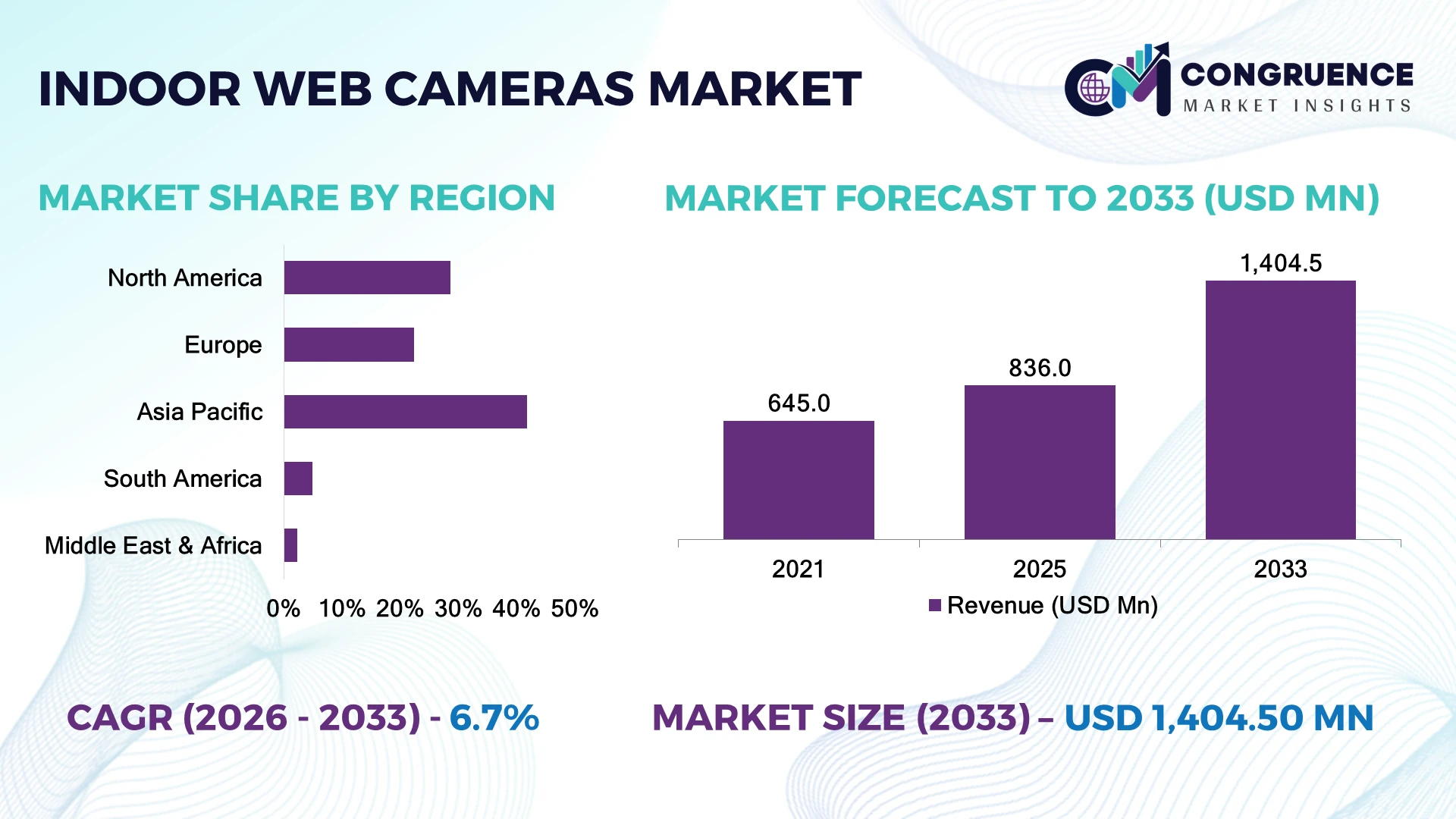
The Global Indoor Web Cameras Market was valued at USD 836.0 Million in 2025 and is anticipated to reach a value of USD 1,404.5 Million by 2033 expanding at a CAGR of 6.7% between 2026 and 2033. Growth is being fueled by AI-enabled video analytics, rising smart home deployments, enterprise hybrid work adoption, and stricter indoor security monitoring requirements.
China leads the global indoor web cameras market with approximately 34% of worldwide production capacity, supported by large-scale electronics manufacturing clusters and investments exceeding USD 15 billion in smart hardware ecosystems. The country ships over 180 million connected camera units annually, significantly ahead of Vietnam, while Japan records higher adoption of AI-powered premium surveillance devices with enterprise penetration above 60%. Expanding manufacturing localization and intelligent edge processing continue strengthening China's competitive position in the global supply chain.
Strategic investment in AI-enabled imaging, localized production, and secure cloud ecosystems is becoming essential for sustaining long-term market leadership.
Market Size & Growth: USD 836.0 Million in 2025, reaching USD 1,404.5 Million by 2033 at 6.7% CAGR, supported by AI-enabled surveillance and hybrid workplace expansion.
Top Growth Drivers: AI video analytics (+42%), smart home adoption (+31%), enterprise security upgrades (+27%).
Short-Term Forecast: By 2028, edge AI processing improves image response efficiency by nearly 35% while reducing cloud bandwidth usage by 30%.
Emerging Technologies: AI object recognition, edge computing, and Wi-Fi 7 connectivity accelerate intelligent indoor monitoring deployments.
Regional Leaders: North America approaches USD 430 Million, Asia-Pacific USD 510 Million, Europe USD 295 Million, driven by enterprise modernization and residential smart device adoption.
Consumer/End-User Trends: More than 58% of new smart home buyers integrate connected indoor cameras into home automation ecosystems.
Pilot/Case Example: In 2024, AI-enabled office surveillance deployment reduced manual monitoring workloads by approximately 40%.
Competitive Landscape: Hikvision holds roughly 19% market share alongside Dahua Technology, Logitech, Axis Communications, and TP-Link.
Regulatory & ESG Impact: Cybersecurity certification requirements increased secure firmware implementation by over 45% across commercial deployments.
Investment & Funding: More than USD 2.8 Billion supports AI imaging, manufacturing expansion, and strategic technology partnerships.
Innovation & Future Outlook: Edge AI, privacy-first processing, and subscription-based intelligent monitoring platforms redefine competitive differentiation.
Indoor web cameras continue expanding across residential security, hybrid workplaces, education, healthcare, and retail monitoring environments. AI-powered motion detection, edge processing, and privacy-enhancing encryption have increased intelligent event recognition accuracy by nearly 35% while reducing unnecessary cloud storage traffic. Ongoing electronics supply-chain diversification across Southeast Asia is improving manufacturing resilience, setting the stage for broader enterprise deployments and strategic market expansion.
Indoor web cameras have evolved into strategic digital infrastructure supporting enterprise security, operational visibility, hybrid collaboration, and smart building management. Organizations increasingly prioritize AI-driven monitoring platforms that integrate with cloud ecosystems, while cybersecurity regulations and digital infrastructure modernization encourage deployment of encrypted and intelligent surveillance solutions across commercial and institutional facilities.
Compared with conventional motion-based cameras, AI-enabled edge processing reduces false alerts by nearly 45% and lowers cloud data transmission requirements by approximately 30%, improving operational efficiency while minimizing bandwidth costs. North America emphasizes enterprise-grade intelligent monitoring and cybersecurity compliance, whereas Asia-Pacific maintains larger manufacturing capacity and faster deployment across residential and commercial environments through integrated electronics ecosystems.
Retail chains, educational institutions, and logistics operators increasingly deploy centralized camera management platforms to improve remote monitoring and asset protection. Technology vendors are expanding AI software capabilities, strengthening cybersecurity partnerships, and increasing localized manufacturing investments to enhance supply resilience. Over the next two to three years, wider adoption of edge intelligence, privacy-preserving analytics, and cloud-native device management will strengthen competitive positioning through higher operational efficiency, scalable deployments, and differentiated intelligent surveillance capabilities.
Rapid adoption of AI-powered video analytics is transforming indoor surveillance across residential and commercial facilities. More than 62% of newly launched indoor web cameras now incorporate AI-based human detection, while false alarm rates have declined by approximately 45% compared with traditional motion sensing. The European Union's expanding cybersecurity requirements have accelerated deployment of encrypted connected devices, encouraging manufacturers to integrate secure firmware and edge intelligence. Companies are expanding AI research centers, strengthening semiconductor partnerships, and introducing subscription-based intelligent monitoring platforms. This combination of intelligent automation, cybersecurity enhancement, and cloud integration enables higher operational efficiency while creating stronger competitive differentiation in premium indoor surveillance solutions.
The market continues facing structural pressure from semiconductor sourcing complexity, image sensor availability, and wireless chipset pricing. Camera module components account for nearly 38% of manufacturing costs, while premium AI processors increase hardware expenses by over 20%. Export restrictions affecting advanced semiconductor technologies have complicated procurement strategies for several global manufacturers. To reduce operational exposure, companies are diversifying supplier networks, increasing localized assembly operations, and negotiating long-term semiconductor procurement agreements. These initiatives improve production continuity, although higher component costs continue influencing product pricing, deployment economics, and profitability across value-sensitive consumer and enterprise segments.
Edge AI creates significant opportunities by enabling real-time analytics without continuous cloud processing. More than 55% of commercial smart building projects now prioritize integrated intelligent surveillance, while edge processing lowers network bandwidth consumption by approximately 30%. Japan and South Korea continue investing in intelligent building automation, encouraging demand for AI-enabled indoor cameras integrated with access control and IoT platforms. Companies are increasing software development investments, expanding strategic ecosystem partnerships, and introducing open-platform architectures supporting third-party integrations. Intelligent edge computing enables operational efficiency while opening new recurring software and analytics revenue opportunities across enterprise deployments.
Managing large fleets of connected indoor cameras creates long-term operational complexity as organizations demand secure firmware, centralized management, and continuous software updates. Nearly 48% of enterprise IT teams identify cybersecurity as their primary deployment concern, while connected device inventories have expanded by more than 35% across modern workplaces. The implementation of stricter data protection regulations requires stronger encryption, secure authentication, and lifecycle management capabilities. Companies are investing in zero-trust security frameworks, automated firmware management, and cloud-native administration platforms to improve resilience. Successfully balancing cybersecurity, interoperability, and scalable device administration will remain critical for sustaining long-term competitive advantage and enterprise confidence.
AI Edge Processing Expansion Enterprise buyers are rapidly shifting toward edge AI-enabled indoor web cameras, with nearly 64% of newly deployed commercial devices supporting onboard analytics and approximately 42% lower false-alert rates than conventional systems. Organizations are processing more video locally to reduce cloud bandwidth by almost 30%, improving response times and strengthening data privacy. Technology vendors are scaling AI chip integration, expanding firmware capabilities, and optimizing software ecosystems as cybersecurity compliance becomes a stronger procurement requirement.
Privacy-First Security Architecture End users increasingly prioritize encrypted communications and secure device management, with over 58% of enterprise purchases requiring end-to-end encryption and more than 46% adopting zero-trust authentication for connected surveillance devices. Evolving data protection regulations are accelerating firmware modernization and secure cloud integration. Manufacturers are restructuring product development around cybersecurity certification, automated software updates, and secure identity management, improving long-term device reliability while reducing enterprise operational risk.
Manufacturing Network Diversification Camera manufacturers continue reducing dependence on single-country production by expanding assembly operations across Vietnam, India, and Mexico. More than 28% of new manufacturing capacity has shifted outside traditional production hubs, while component delivery times have improved by roughly 18%. Companies are strengthening supplier partnerships, increasing localized sourcing, and redesigning procurement workflows to improve production continuity and stabilize inventory availability during global logistics fluctuations.
Subscription Platform Integration Hardware suppliers are increasingly transforming into software-driven service providers through cloud-based monitoring platforms. Around 39% of enterprise customers now deploy subscription-enabled video management services, while remote device administration reduces maintenance workloads by nearly 32%. Businesses are integrating indoor cameras with building automation, access control, and workplace management platforms through strategic partnerships, creating recurring service models and improving operational efficiency across distributed enterprise environments.
Wireless indoor web cameras account for approximately 61% of the global market due to simplified installation, flexible deployment, cloud connectivity, and seamless smart home integration. Their compatibility with Wi-Fi ecosystems, AI-enabled mobile applications, and remote management platforms makes them the preferred solution across residential and small commercial environments. Fixed wired cameras remain relevant in banks, educational institutions, and industrial facilities where uninterrupted connectivity and stable power supply remain operational priorities. Manufacturers continue improving wireless transmission reliability while reducing latency and strengthening encryption capabilities. PTZ (Pan-Tilt-Zoom) cameras represent the fastest-growing segment as organizations increasingly require intelligent tracking, remote control, and wider surveillance coverage. Adoption of PTZ devices has increased by nearly 26%, while AI-assisted object tracking has improved monitoring efficiency by approximately 35%. Hybrid product portfolios combining wireless flexibility with advanced AI imaging continue attracting enterprise investment. Companies are expanding premium camera portfolios, integrating edge analytics, and strengthening partnerships with cloud platform providers to differentiate product offerings and improve enterprise deployment flexibility.
Residential security remains the largest application, representing approximately 48% of total deployments as homeowners increasingly integrate indoor web cameras into connected smart home ecosystems. Growing adoption of mobile monitoring, voice assistants, and automated alerts has improved consumer engagement, while nearly 57% of smart home users now operate connected indoor surveillance devices. Commercial offices continue expanding deployments to strengthen workplace monitoring, visitor management, and hybrid workforce security. Healthcare facilities are emerging as the fastest-growing application, supported by patient observation, remote care monitoring, and intelligent facility management. Healthcare deployments have increased by nearly 24%, while AI-assisted monitoring has reduced manual observation workloads by approximately 30%. Education, retail, and hospitality continue adopting intelligent surveillance for operational visibility and safety management. Technology providers are expanding vertical-specific software capabilities, integrating analytics platforms, and delivering customized monitoring solutions that improve efficiency while supporting sector-specific compliance requirements.
Households represent the largest end-user segment with approximately 52% market share, driven by increasing smart home adoption, remote family monitoring, and affordable cloud-connected surveillance devices. Consumer demand continues strengthening through smartphone integration, AI notifications, and voice-controlled automation. Small and medium-sized enterprises maintain consistent adoption for office security and asset protection, while educational institutions continue modernizing campus monitoring infrastructure with intelligent surveillance platforms. Healthcare organizations are the fastest-growing end-user group as digital patient monitoring and facility safety initiatives accelerate adoption. Healthcare deployments have expanded by nearly 25%, while enterprise-managed camera networks have improved operational visibility by approximately 34%. Government facilities, retail operators, and large enterprises continue increasing investment in centralized surveillance ecosystems. Vendors are responding through customized software packages, enterprise subscription models, and strategic ecosystem partnerships designed to improve scalability, cybersecurity, and long-term operational performance across diverse deployment environments.
Asia-Pacific accounted for the largest market share at 41.8% in 2025 however, North America is expected to register the fastest growth, expanding at a CAGR of 7.4% between 2026 and 2033.
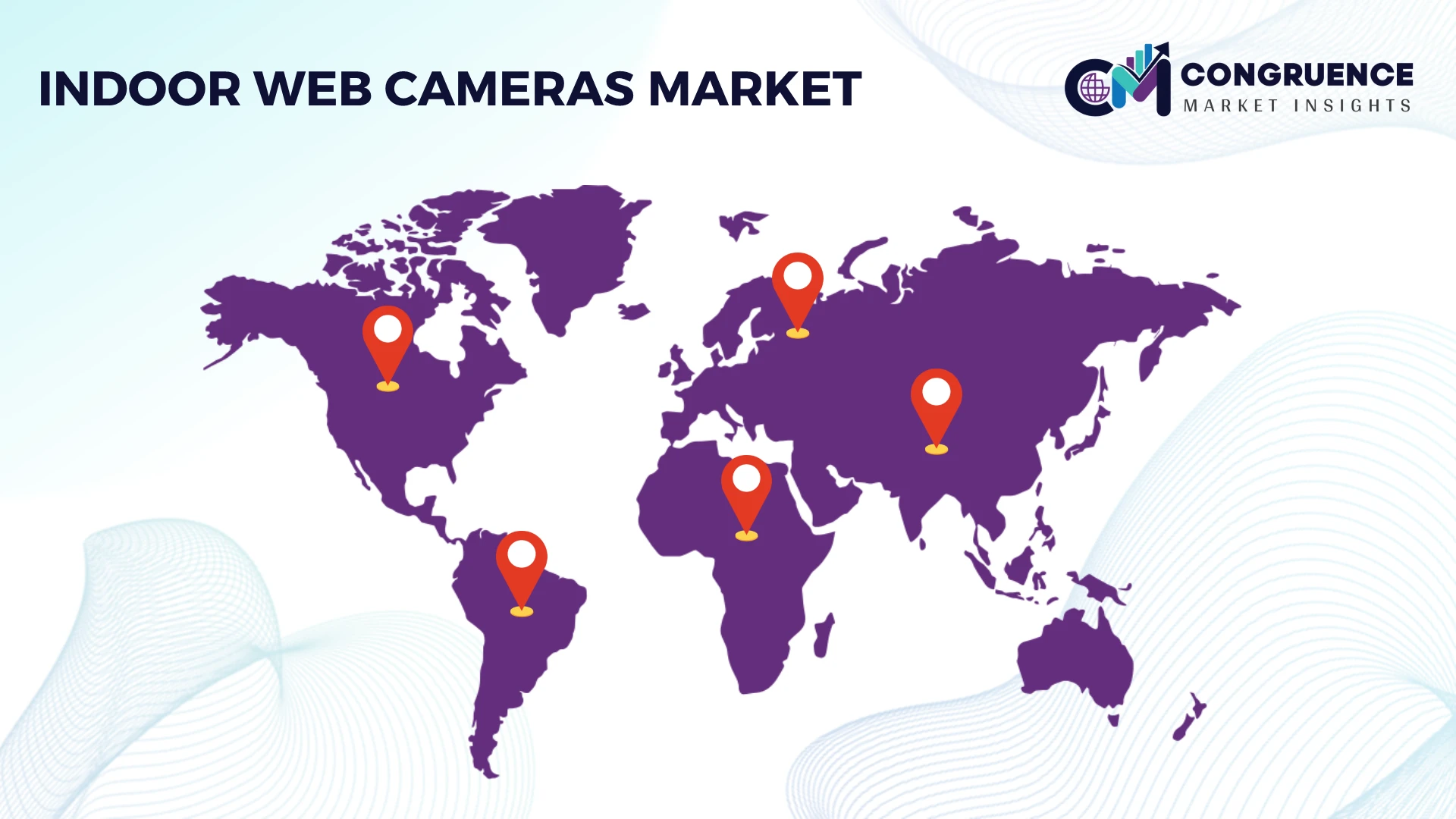
North America remains one of the most advanced markets for indoor web cameras, supported by widespread enterprise digitalization, smart home penetration, and rapid adoption of AI-enabled surveillance systems. The region represents approximately 28.6% of global demand, with commercial offices, education, healthcare, and retail driving deployment. More than 63% of newly installed enterprise indoor cameras feature edge AI analytics and encrypted cloud management platforms. Large organizations continue replacing legacy surveillance infrastructure with centralized monitoring ecosystems that improve operational visibility and cybersecurity compliance. Strategic investments in intelligent buildings, hybrid workplace security, and cloud-native video management continue strengthening deployment across both public and private sectors while accelerating technology upgrades.
United States Market Outlook: The United States leads the regional market through strong enterprise technology adoption, advanced cloud infrastructure, and extensive smart home deployment. Nearly 68% of commercial organizations have integrated AI-enabled video monitoring into their security operations, while connected home security adoption continues expanding across residential consumers. Technology companies are strengthening software ecosystems, expanding cybersecurity capabilities, and introducing subscription-based monitoring platforms to enhance operational efficiency and long-term customer retention.
Europe accounts for approximately 22.4% of the global indoor web cameras market, supported by strong enterprise modernization, digital workplace transformation, and strict cybersecurity regulations. Organizations increasingly prioritize encrypted communications, secure firmware management, and AI-assisted monitoring capabilities across commercial buildings and public infrastructure. More than 56% of newly deployed enterprise surveillance devices include advanced data protection features aligned with evolving digital security requirements. Businesses continue modernizing facility management through integrated surveillance and building automation platforms while strengthening operational resilience through centralized monitoring systems.
Germany Market Outlook: Germany remains the largest regional market owing to its advanced manufacturing sector, industrial automation leadership, and high enterprise technology investment. Intelligent surveillance deployment across logistics centers, manufacturing facilities, and corporate campuses continues expanding, with over 60% of large enterprises integrating connected security platforms into digital operations. Domestic technology providers continue strengthening AI software capabilities and cybersecurity-focused product development for enterprise customers.
Asia-Pacific leads the global indoor web cameras market with approximately 41.8% market share, supported by its dominant electronics manufacturing ecosystem, large-scale exports, and rapidly expanding consumer demand. China, Japan, South Korea, and India continue driving production, component manufacturing, and AI-enabled product innovation. More than 70% of global indoor camera manufacturing capacity is concentrated within the region, enabling competitive pricing and faster product commercialization. Expanding smart home adoption, enterprise surveillance modernization, and localized semiconductor investments continue strengthening operational competitiveness while supporting global supply chains.
China Market Outlook: China represents the region's largest market through its unmatched electronics manufacturing infrastructure, integrated component ecosystem, and advanced AI hardware development. The country contributes more than one-third of global indoor web camera production and ships over 180 million connected camera units annually. Leading manufacturers continue investing in intelligent imaging, localized semiconductor capabilities, and automated production facilities to improve efficiency, export competitiveness, and product innovation across residential and enterprise applications.
South America accounts for approximately 4.9% of the global market, supported by increasing investments in commercial security, retail modernization, and smart residential technologies. Businesses are replacing analog surveillance systems with IP-connected indoor cameras to improve operational monitoring and asset protection. Enterprise deployments have increased by nearly 24% across logistics, retail, and financial services, while cloud-managed surveillance platforms continue improving operational efficiency. Infrastructure limitations remain in selected markets, yet expanding broadband connectivity and digital transformation initiatives continue supporting wider adoption.
Brazil Market Outlook: Brazil dominates the regional market through its large commercial sector, expanding smart home ecosystem, and growing investments in enterprise security technologies. Retail chains, financial institutions, and logistics operators increasingly deploy AI-enabled indoor monitoring systems to strengthen security and operational visibility. Technology distributors continue expanding localized service networks and cloud-based surveillance offerings to support long-term enterprise adoption.
Middle East & Africa represents approximately 2.3% of the global indoor web cameras market, with adoption driven by smart city development, commercial infrastructure expansion, and digital security modernization. Large-scale infrastructure projects continue integrating AI-enabled surveillance into airports, hospitality, healthcare, and government facilities. More than 35% of newly developed premium commercial buildings now include centralized intelligent monitoring platforms during construction. Organizations continue investing in secure cloud management, automated monitoring, and integrated building technologies to improve operational resilience and facility management.
United Arab Emirates Market Outlook: The United Arab Emirates leads regional adoption through sustained investment in smart infrastructure, digital government initiatives, and intelligent commercial developments. Enterprise demand continues expanding across hospitality, aviation, and mixed-use developments, while AI-enabled surveillance deployment supports integrated building management systems. Technology providers are strengthening regional partnerships, expanding cloud-enabled service offerings, and introducing advanced analytics platforms to meet growing enterprise security requirements.
The indoor web cameras market is led by Logitech, Axis Communications, TP-Link, Hikvision, and Dahua Technology, while premium imaging specialists compete against cost-focused Asian manufacturers and smart home ecosystem providers. The top five players collectively control approximately 56% of the global market, creating intense competition across enterprise and consumer segments. Global technology leaders differentiate through AI imaging, cybersecurity, and software ecosystems, whereas regional manufacturers compete on pricing, localized production, and rapid product availability. AI-enabled models improve event detection accuracy by nearly 40%, while edge processing reduces cloud bandwidth requirements by approximately 30%, making technology capability a primary competitive differentiator. Companies are expanding manufacturing footprints, forming cloud platform partnerships, integrating AI analytics, and strengthening vertical software offerings to secure long-term customer retention. Competition is shifting toward intelligent platforms rather than standalone hardware, increasing pressure on low-cost suppliers. High R&D investment, cybersecurity certification, and integrated software capabilities remain significant entry barriers. Winning requires continuous AI innovation, resilient supply chains, scalable software ecosystems, and trusted security performance.
Axis Communications AB
Hikvision Digital Technology Co., Ltd.
Dahua Technology Co., Ltd.
TP-Link Systems Inc.
Canon Inc.
Sony Corporation
Panasonic Holdings Corporation
Hanwha Vision Co., Ltd.
Xiaomi Corporation
EMEET Technology Co., Ltd.
Arlo Technologies, Inc.
D-Link Corporation
ASUS Inc.
AI-enabled edge computing has become the defining technology in the indoor web cameras market, replacing traditional cloud-dependent video processing. More than 62% of newly introduced enterprise cameras now incorporate onboard AI analytics, reducing false alerts by nearly 45% and lowering network bandwidth consumption by approximately 30%. Organizations increasingly deploy intelligent object recognition, facial detection, and behavioral analytics to improve response speed while strengthening privacy through localized data processing.
Cloud-native video management platforms, Wi-Fi 6/6E connectivity, and advanced image sensors are reshaping deployment strategies across commercial and residential environments. Compared with conventional motion-detection cameras, AI-enabled systems improve event recognition accuracy by nearly 35% while reducing manual monitoring workloads by approximately 40%. Technology leaders with integrated software ecosystems benefit through recurring service models, while enterprises gain centralized management, automated firmware updates, and stronger cybersecurity resilience. Around 58% of enterprise deployments now include encrypted remote device management as a standard capability.
Between 2026 and 2028, multimodal AI analytics, on-device generative intelligence, and privacy-preserving video processing will accelerate competitive differentiation. Companies investing early in AI silicon, edge software, and interoperable cloud platforms will strengthen operational efficiency, shorten deployment cycles, and secure premium enterprise contracts as intelligent surveillance rapidly becomes the industry benchmark.
April 2025 – Axis Communications expanded its edge AI portfolio at ISC West by introducing advanced AI-enabled cameras, edge devices, and cloud-connected security solutions, strengthening intelligent surveillance deployment and expanding ecosystem interoperability for enterprise customers. Source: www.newsroom.axis.com
May 2025 – Axis Communications announced FIPS 140 protection for millions of deployed products, strengthening device cybersecurity across enterprise surveillance networks and enhancing secure firmware deployment for large-scale connected camera environments. Source: www.newsroom.axis.com
January 2025 – Logitech introduced Rally Board 65 with AI-powered RightSight 2 and RightSound 2 technologies, delivering 4K intelligent collaboration capabilities while simplifying deployment across Microsoft Teams, Zoom, and Google Meet environments. Source: www.news.logitech.com
March 2024 – Logitech launched MX Brio, featuring a webcam sensor with 70% larger pixels than its previous flagship model and AI-enhanced image processing, improving low-light performance and enterprise collaboration quality.
The report provides comprehensive analysis of the global indoor web cameras market across product types, applications, end-users, competitive positioning, technology evolution, and regional deployment trends. It evaluates wireless, wired, PTZ, and fixed camera categories while assessing adoption across residential, commercial, healthcare, education, retail, and enterprise environments. Regional assessment spans North America, Europe, Asia-Pacific, South America, and the Middle East & Africa, highlighting deployment concentration, manufacturing capabilities, technology adoption, and operational developments. More than 50% of the assessment focuses on enterprise transformation, AI-enabled surveillance, and cloud-connected monitoring ecosystems.
The study examines competitive strategies, product innovation, AI edge computing, cybersecurity integration, cloud video management, and intelligent imaging technologies shaping market evolution between 2026 and 2033. It provides business intelligence supporting expansion planning, investment prioritization, supply-chain optimization, competitive benchmarking, and technology adoption strategies. The report also evaluates emerging deployment models, enterprise purchasing behavior, industry-specific adoption patterns, and innovation priorities to support strategic decision-making across mature and developing indoor surveillance markets.
| Report Attribute / Metric | Details |
|---|---|
| Market Revenue (2025) | USD 836.0 Million |
| Market Revenue (2033) | USD 1,404.5 Million |
| CAGR (2026–2033) | 6.7% |
| Base Year | 2025 |
| Forecast Period | 2026–2033 |
| Historic Period | 2021–2025 |
| Segments Covered |
By Type
By Application
By End-User
|
| Key Deliverables | Revenue Forecast; Market Trends; Growth Drivers & Restraints; Technology Insights; Segmentation Analysis; Regional Insights; Competitive Landscape; Regulatory & ESG Overview; Recent Developments |
| Regions Covered | North America; Europe; Asia-Pacific; South America; Middle East & Africa |
| Companies Profiled | Logitech International S.A.; Axis Communications AB; Hikvision Digital Technology Co., Ltd.; Dahua Technology Co., Ltd.; TP-Link Systems Inc.; Canon Inc.; Sony Corporation; Panasonic Holdings Corporation; Hanwha Vision Co., Ltd.; Xiaomi Corporation; EMEET Technology Co., Ltd.; Arlo Technologies, Inc.; D-Link Corporation; ASUS Inc. |
| Customization & Pricing | Available on Request (10% Customization Free) |




