
Reports
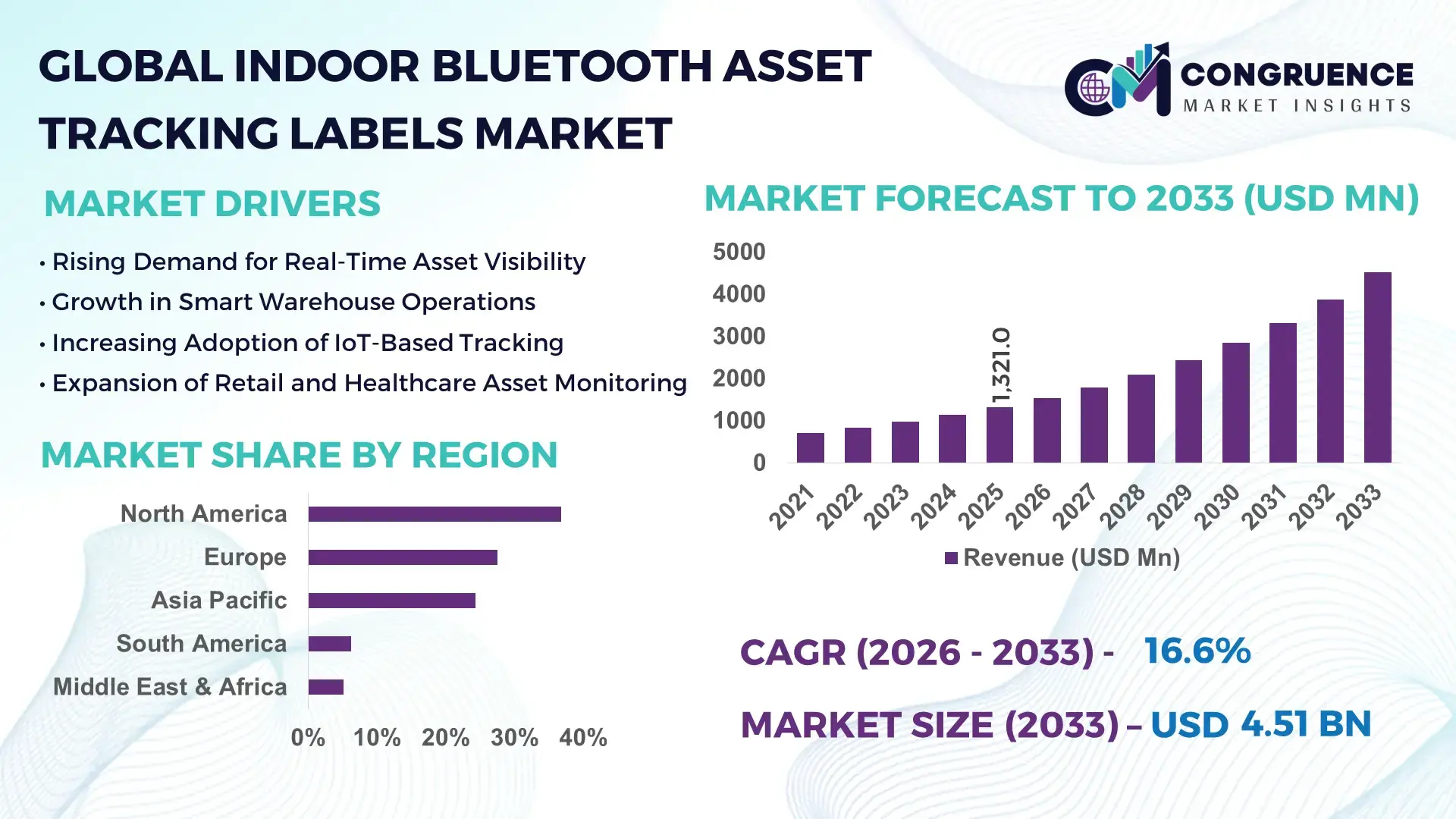
The Global Indoor Bluetooth Asset Tracking Labels Market was valued at USD 1,321.0 Million in 2025 and is anticipated to reach a value of USD 4,513.3 Million by 2033 expanding at a CAGR of 16.6% between 2026 and 2033, according to an analysis by Congruence Market Insights. The growth is primarily driven by increasing enterprise adoption of Bluetooth Low Energy (BLE) tracking technologies for real-time asset visibility, operational automation, and supply-chain digitization across industrial environments.
The United States plays a central role in the Indoor Bluetooth Asset Tracking Labels Market due to its strong industrial IoT ecosystem and high enterprise technology adoption. The country hosts more than 3,500 active IoT solution providers, many specializing in BLE-based asset tracking technologies. In logistics and warehouse operations, over 62% of large distribution centers in the U.S. have integrated indoor asset-tracking infrastructure to improve inventory visibility and reduce asset misplacement. Healthcare is another major application area, where more than 45% of large hospitals have adopted Bluetooth-enabled asset labels to monitor medical equipment such as infusion pumps, wheelchairs, and diagnostic devices. Manufacturing facilities in the U.S. are increasingly using Bluetooth asset tags for tool tracking and production-line monitoring, with approximately 28% of smart factories implementing BLE-based indoor tracking solutions. In addition, the country has seen increasing venture capital investment in asset-tracking startups, with over USD 900 million invested in industrial IoT and asset tracking technologies between 2022 and 2025, accelerating innovations in low-power Bluetooth chips, sensor-embedded labels, and AI-enabled location analytics platforms.
Market Size & Growth: The market was valued at USD 1,321.0 Million in 2025 and is projected to reach USD 4,513.3 Million by 2033, expanding at a CAGR of 16.6%, driven by increasing demand for real-time asset visibility and automated inventory tracking across logistics, healthcare, and manufacturing sectors.
Top Growth Drivers: Industrial IoT deployment expanding by 41%, warehouse automation improving operational efficiency by 35%, and healthcare asset tracking reducing equipment loss by 28%.
Short-Term Forecast: By 2028, large warehouse operators are expected to reduce misplaced asset incidents by nearly 40% through widespread deployment of Bluetooth tracking labels integrated with automated inventory management platforms.
Emerging Technologies: AI-enabled location analytics, Bluetooth Low Energy 5.3 beacon technology, and digital twin integration are enhancing indoor positioning accuracy and predictive asset monitoring capabilities.
Regional Leaders: North America projected to reach USD 1.8 Billion by 2033 driven by advanced logistics automation; Europe expected to approach USD 1.2 Billion with strong adoption in manufacturing facilities; Asia-Pacific forecast to exceed USD 1.0 Billion due to rapid industrial digitalization and smart factory investments.
Consumer/End-User Trends: Enterprises are prioritizing real-time visibility and predictive maintenance, with more than 55% of logistics operators integrating Bluetooth asset labels with warehouse management systems for automated tracking and analytics.
Pilot or Case Example: In 2024, a large hospital network implemented Bluetooth asset labels across 12 facilities, reducing equipment search time by 34% and improving asset utilization rates by 22%.
Competitive Landscape: The market leader holds approximately 18% share, followed by major participants such as Zebra Technologies, Kontakt.io, HID Global, Wiliot, and Minew, focusing on BLE innovation and enterprise IoT integration.
Regulatory & ESG Impact: Organizations are adopting low-energy Bluetooth technologies that reduce device power consumption by up to 60%, supporting sustainability initiatives and reducing electronic waste across enterprise infrastructure.
Investment & Funding Patterns: Over USD 1.5 Billion in investments have been directed toward indoor location technologies and IoT asset-tracking startups since 2022, supporting development of energy-efficient tracking labels and AI-powered analytics platforms.
Innovation & Future Outlook: Integration of AI-driven predictive analytics, ultra-low-power Bluetooth chips, and cloud-connected tracking platforms is expected to enable real-time digital asset mapping across factories, hospitals, and logistics hubs.
Industrial logistics accounts for nearly 38% of deployment, followed by healthcare at 27% and manufacturing at 21%, reflecting strong demand for real-time equipment monitoring. Recent innovations include battery-free Bluetooth tracking labels and sensor-embedded smart tags capable of monitoring temperature, vibration, and movement. Regulatory pressure for supply-chain transparency and growing smart-warehouse adoption across North America and Asia-Pacific are accelerating deployment, while AI-enabled analytics platforms are shaping the next generation of asset-tracking infrastructure.
The Indoor Bluetooth Asset Tracking Labels Market has become strategically important as enterprises increasingly prioritize real-time asset visibility, operational transparency, and supply-chain efficiency. Bluetooth Low Energy (BLE) asset labels enable organizations to monitor the movement, utilization, and condition of equipment across complex indoor environments such as warehouses, hospitals, airports, and manufacturing facilities. With over 65% of large logistics companies deploying indoor tracking systems, the technology is rapidly evolving into a critical component of digital infrastructure supporting Industry 4.0 and smart facility management.
Technological innovation continues to redefine the strategic value of indoor tracking solutions. For example, AI-based indoor location analytics delivers nearly 45% improvement in asset utilization efficiency compared to traditional barcode-based tracking systems, which rely heavily on manual scanning and static data capture. Bluetooth beacon networks and IoT gateways enable continuous location monitoring with accuracy levels reaching 1–3 meters, significantly enhancing operational decision-making and predictive asset maintenance.
From a regional perspective, North America dominates in deployment volume, supported by strong enterprise technology investments and advanced logistics infrastructure. Meanwhile, Asia-Pacific leads in adoption growth, where more than 52% of manufacturing enterprises are actively integrating smart-factory tracking systems to improve operational visibility and production efficiency. Governments and industrial organizations across the region are investing heavily in industrial IoT connectivity and automation technologies.
In the short term, the market is expected to witness rapid improvements in analytics and automation capabilities. By 2028, AI-driven asset tracking platforms are projected to improve warehouse inventory accuracy by nearly 35% while reducing equipment search time across large facilities. Companies are also aligning asset-tracking technologies with environmental sustainability goals. Many organizations are committing to reducing electronic device waste by 30% by 2030 through adoption of ultra-low-power Bluetooth chips and battery-free tracking labels.
A practical example of this transformation occurred in 2024, when a European logistics operator implemented AI-enabled BLE tracking labels across eight automated distribution centers, achieving a 29% reduction in misplaced assets and improving warehouse operational throughput. As enterprises increasingly integrate indoor tracking with AI analytics, robotics, and digital twins, the Indoor Bluetooth Asset Tracking Labels Market is positioned as a key pillar supporting operational resilience, regulatory compliance, and sustainable digital transformation across modern industrial ecosystems.
The Indoor Bluetooth Asset Tracking Labels Market is shaped by a combination of technological innovation, increasing enterprise digitalization, and the growing need for real-time operational intelligence. Organizations across logistics, healthcare, manufacturing, and retail sectors are deploying Bluetooth Low Energy asset labels to monitor equipment movement, inventory levels, and facility operations within complex indoor environments. Unlike traditional barcode or RFID-based tracking, Bluetooth labels enable continuous location monitoring with significantly lower power consumption and wider network coverage. The proliferation of industrial IoT platforms has further accelerated adoption, as enterprises seek integrated systems capable of linking asset-tracking data with warehouse management, predictive maintenance, and analytics platforms. Improvements in Bluetooth chip efficiency and sensor miniaturization are allowing asset labels to operate for 3–5 years on a single battery, reducing maintenance costs and increasing scalability. Additionally, the increasing adoption of smart warehouses and automated manufacturing facilities is creating a strong need for real-time location intelligence. As digital transformation strategies expand across industrial sectors, Bluetooth-based indoor asset tracking is emerging as a foundational technology enabling operational transparency and efficient asset lifecycle management.
Enterprises are increasingly prioritizing real-time asset visibility to reduce operational inefficiencies and asset losses across complex facilities. Large warehouses and manufacturing plants often manage thousands of mobile assets such as pallets, tools, medical devices, and transport containers, making manual tracking systems ineffective. Bluetooth asset tracking labels provide continuous monitoring capabilities with location accuracy typically ranging between 1 and 5 meters, enabling organizations to quickly locate critical equipment. In healthcare environments alone, studies indicate that hospital staff spend nearly 20–25% of their working time searching for mobile medical equipment, which significantly affects operational efficiency. Bluetooth-based tracking systems help eliminate these inefficiencies by enabling automated asset identification and location tracking through networked gateways and analytics software. Additionally, the rapid expansion of e-commerce has driven the development of large automated distribution centers where real-time tracking of pallets, containers, and forklifts is essential for operational coordination. With more than 60% of large logistics facilities implementing smart warehouse technologies, the demand for scalable and low-power indoor tracking labels is rising rapidly, strengthening the overall growth trajectory of the Indoor Bluetooth Asset Tracking Labels Market.
Despite strong technological advantages, the deployment of indoor Bluetooth asset tracking systems often requires complex infrastructure integration, which can slow adoption across certain industries. Establishing a reliable indoor positioning network typically requires installing Bluetooth gateways, receivers, and network management platforms across entire facilities. For large industrial complexes, this may involve hundreds of gateway devices and extensive wireless calibration processes to ensure accurate asset localization. Additionally, facility layouts with dense equipment, metallic structures, and electromagnetic interference can affect Bluetooth signal propagation, requiring additional calibration and system adjustments. Small and medium-sized enterprises may face operational and technical challenges in integrating these systems with existing enterprise resource planning (ERP) and warehouse management systems. Furthermore, concerns around cybersecurity and data protection are growing as asset-tracking networks become connected to cloud platforms. Organizations must implement robust data-security frameworks and network monitoring protocols, which increases deployment complexity and operational costs. These technical and integration challenges can delay implementation timelines, particularly in facilities that rely on legacy operational infrastructure.
The rapid expansion of smart warehouses and automated logistics facilities is creating substantial opportunities for the Indoor Bluetooth Asset Tracking Labels Market. Modern distribution centers increasingly rely on robotics, automated guided vehicles (AGVs), and advanced warehouse management systems to optimize operational efficiency. Bluetooth asset tracking labels provide a critical data layer enabling real-time visibility into asset movement and warehouse workflows. In large fulfillment centers, thousands of pallets, containers, and transport equipment move simultaneously, making automated location tracking essential for efficient operations. Bluetooth labels allow organizations to monitor asset movement continuously while integrating with analytics platforms that optimize warehouse workflows and inventory management. The global growth of e-commerce has accelerated the construction of large automated logistics hubs, many exceeding 500,000 square feet in operational space. These facilities require advanced tracking systems to maintain operational coordination across thousands of assets and mobile units. Furthermore, integration with artificial intelligence platforms allows asset-tracking data to support predictive maintenance, automated asset allocation, and workflow optimization. As warehouse automation continues to expand globally, Bluetooth-enabled asset tracking solutions are positioned to become an essential component of digital logistics infrastructure.
One of the most significant challenges facing the Indoor Bluetooth Asset Tracking Labels Market is the lack of universal interoperability standards across asset-tracking platforms and industrial IoT ecosystems. Enterprises often deploy multiple technologies such as RFID, Wi-Fi positioning, ultra-wideband tracking, and Bluetooth beacons within the same facility. Integrating these technologies into a unified asset-tracking architecture can be technically complex and require customized software interfaces. Many asset-tracking vendors use proprietary communication protocols and data platforms, which can limit compatibility with third-party systems. As a result, organizations implementing indoor tracking systems may face difficulties integrating data streams into centralized operational dashboards or analytics platforms. Additionally, differences in Bluetooth device specifications, firmware versions, and signal-calibration methods can affect system reliability when multiple vendors’ hardware is deployed within a facility. Industrial organizations are increasingly demanding open standards and interoperable platforms to support scalable IoT deployments. However, until broader industry-wide standardization frameworks are established, interoperability challenges may continue to limit seamless adoption across large multi-vendor enterprise environments.
Rapid adoption of AI-driven indoor location analytics: Enterprises are increasingly integrating AI-based analytics platforms with Bluetooth tracking networks to process location data in real time. Advanced analytics systems can analyze movement patterns of more than 50,000 tracked assets simultaneously, enabling predictive asset utilization and automated workflow optimization. In large warehouses, AI-driven asset tracking has reduced equipment idle time by nearly 32%, while predictive maintenance alerts have lowered unexpected equipment failures by approximately 24%.
Expansion of battery-free Bluetooth tracking labels: Energy-harvesting technologies are enabling the development of battery-free Bluetooth asset labels that operate using ambient radio frequency or light energy. These solutions can operate for 10+ years without battery replacement, reducing maintenance costs and electronic waste. Industrial facilities deploying these labels have reported up to 60% lower device maintenance requirements and nearly 45% reduction in asset-tracking infrastructure servicing costs.
Integration with digital twin and smart factory platforms: Manufacturers are increasingly connecting Bluetooth asset labels with digital twin platforms to create real-time digital representations of factory operations. In smart factories, over 35% of production assets are now linked to digital twin monitoring systems. This integration allows companies to simulate workflow changes, optimize asset utilization, and reduce production delays by up to 28%.
Increasing deployment in healthcare infrastructure: Hospitals and healthcare networks are expanding the use of Bluetooth asset labels to track medical devices and patient support equipment. Large hospitals manage more than 15,000 mobile assets, including infusion pumps, diagnostic tools, and emergency equipment. Bluetooth tracking deployments have helped healthcare providers reduce equipment search time by 30% and improve asset utilization rates by nearly 26%, significantly enhancing hospital operational efficiency.
The Indoor Bluetooth Asset Tracking Labels Market is segmented based on type, application, and end-user industries, reflecting the diverse operational environments where indoor location tracking is required. Bluetooth asset tracking labels vary in design, connectivity, and sensing capabilities, enabling deployment across logistics warehouses, healthcare facilities, manufacturing plants, and retail environments. Technological advancements in Bluetooth Low Energy chips, sensor integration, and cloud-based analytics have expanded the functionality of asset labels beyond simple location tracking to include condition monitoring and workflow optimization. Application demand is particularly strong in industries where real-time visibility of mobile equipment, tools, and inventory is essential for operational continuity. As organizations adopt Industry 4.0 and smart-facility strategies, asset-tracking systems are becoming integrated with enterprise management platforms, robotics systems, and predictive maintenance solutions. End-user demand patterns indicate strong adoption among logistics operators, healthcare institutions, and industrial manufacturers, where operational efficiency and asset utilization are key performance indicators.
Bluetooth asset tracking labels are available in several product types including battery-powered BLE labels, battery-free energy-harvesting labels, and sensor-integrated Bluetooth labels. Battery-powered Bluetooth labels currently represent the leading segment, accounting for approximately 54% of total adoption, as they offer reliable signal transmission, long operational lifespan, and compatibility with most indoor positioning systems. These labels typically operate for 3–5 years on a single battery, making them widely used in warehouses, hospitals, and manufacturing facilities. Battery-free Bluetooth asset labels are emerging as the fastest-growing segment with an expected adoption growth rate of approximately 19% annually. These labels utilize ambient radio signals, light energy, or NFC-based power harvesting to operate without traditional batteries. Their maintenance-free design is attracting large logistics operators and healthcare institutions aiming to reduce device servicing requirements and environmental impact. Sensor-integrated Bluetooth labels, which include temperature, motion, and vibration monitoring sensors, represent around 21% of deployments and are widely used for sensitive equipment and high-value asset monitoring. These labels allow organizations to monitor environmental conditions in addition to location tracking, enabling predictive maintenance and asset condition analysis.
• In 2025, a large international airport deployed over 20,000 Bluetooth asset tracking labels to monitor ground-handling equipment and baggage carts, significantly improving equipment allocation efficiency across terminal operations.
Indoor Bluetooth asset tracking labels are widely used across several operational applications including inventory tracking, equipment monitoring, workflow optimization, and security asset monitoring. Inventory tracking currently accounts for the largest application segment, representing approximately 43% of deployments, as logistics operators rely heavily on Bluetooth labels to track pallets, containers, and mobile warehouse assets. Real-time visibility enables warehouse managers to reduce misplaced inventory incidents and improve fulfillment efficiency. Equipment monitoring is the fastest-growing application area with an estimated growth rate of approximately 18% annually, driven by demand in healthcare facilities and manufacturing plants. Hospitals use Bluetooth labels to track infusion pumps, patient beds, and diagnostic devices, ensuring that medical equipment is available when needed and reducing staff search time. Workflow optimization applications account for about 25% of market usage, particularly in automated manufacturing facilities where asset tracking data is integrated with production management platforms. Security and loss-prevention applications represent the remaining 17% share, focusing on protecting high-value assets in airports, data centers, and research laboratories. In 2025, more than 40% of global logistics operators reported deploying Bluetooth-based asset tracking systems within warehouse operations to improve inventory accuracy and asset utilization. Additionally, nearly 36% of hospitals in developed economies are testing Bluetooth tracking systems for medical equipment management.
• In 2024, a national healthcare network implemented Bluetooth asset tracking across multiple hospitals, improving equipment availability tracking across more than 8,000 medical devices.
The Indoor Bluetooth Asset Tracking Labels Market serves a wide range of end-users including logistics and supply-chain operators, healthcare institutions, manufacturing companies, retail organizations, and transportation infrastructure operators. Logistics and supply-chain companies represent the leading end-user segment with approximately 37% adoption, as large distribution centers rely on real-time tracking of pallets, containers, and transport equipment to maintain operational efficiency. Healthcare institutions represent the fastest-growing end-user segment with estimated adoption growth of around 20% annually, driven by the need to track medical equipment, patient transport assets, and diagnostic devices. Hospitals often manage thousands of mobile devices, and Bluetooth tracking systems help reduce equipment search time while improving asset utilization rates. Manufacturing companies account for approximately 24% of deployments, using Bluetooth labels to monitor tools, production equipment, and mobile assets within smart factories. Retail and transportation infrastructure sectors collectively represent around 18% of the market, focusing on inventory visibility, asset security, and operational monitoring. In 2025, more than 48% of large enterprises globally reported piloting indoor asset-tracking systems as part of their digital transformation strategies. Additionally, approximately 33% of smart manufacturing facilities are integrating Bluetooth tracking systems into their industrial IoT platforms.
• In 2025, a major logistics operator deployed Bluetooth asset tracking across 15 distribution centers, monitoring more than 50,000 mobile assets and improving asset utilization efficiency across warehouse networks.
North America accounted for the largest market share at 36.8% in 2025 however, Asia-Pacific is expected to register the fastest growth, expanding at a CAGR of 18.4% between 2026 and 2033.
North America’s strong position is supported by extensive deployment of industrial IoT infrastructure and high enterprise investment in indoor location technologies across logistics, healthcare, and manufacturing sectors. More than 62% of large distribution centers in the United States have already deployed indoor asset tracking infrastructure, while over 45% of hospitals across the region use Bluetooth-enabled asset labels to monitor medical equipment such as infusion pumps and diagnostic devices. Europe accounted for approximately 27.5% of global adoption, supported by digital manufacturing initiatives and strict supply-chain transparency regulations across Germany, the United Kingdom, and France. Meanwhile, Asia-Pacific represented around 24.3% of installations in 2025, with rapid industrial automation and smart-factory expansion across China, Japan, and South Korea driving demand. Emerging markets in South America and the Middle East & Africa collectively accounted for nearly 11.4% of global deployments, supported by growing investments in logistics infrastructure, large airport modernization programs, and digital transformation in oil & gas and transportation sectors.
North America holds approximately 36.8% of global installations of indoor Bluetooth asset tracking labels, making it the most mature regional market. Adoption is strongly driven by logistics, healthcare, manufacturing, and aviation sectors where large facilities manage thousands of movable assets daily. In the United States alone, more than 2,000 large warehouses exceeding 200,000 square feet have implemented indoor asset tracking systems integrated with warehouse management platforms. Hospitals across the region manage an average of 10,000–15,000 mobile medical devices per facility, encouraging adoption of Bluetooth labels for automated equipment monitoring. Government initiatives promoting Industry 4.0 and smart manufacturing are further strengthening demand for IoT-based asset tracking infrastructure. Technologies such as Bluetooth 5.3 beacons, AI-based indoor analytics, and digital twin monitoring platforms are being widely deployed to improve asset visibility. A notable example includes Zebra Technologies, which has expanded its BLE-enabled tracking solutions for warehouse and healthcare environments, enabling organizations to monitor thousands of mobile assets in real time. Regional consumer behavior also reflects higher enterprise adoption in healthcare, finance, and logistics sectors where operational transparency and automation are critical performance metrics.
Europe represents nearly 27.5% of the global Indoor Bluetooth Asset Tracking Labels Market, with strong demand across Germany, the United Kingdom, France, and the Netherlands. Germany leads industrial deployments due to its extensive smart manufacturing ecosystem, where over 35% of advanced factories utilize indoor tracking technologies to manage production assets and tool inventories. The United Kingdom and France have also expanded adoption within healthcare networks and transportation infrastructure. European regulatory bodies increasingly emphasize supply-chain transparency and environmental sustainability, encouraging the use of low-power tracking devices and recyclable electronic components. EU digital transformation initiatives are accelerating adoption of IoT infrastructure, with more than 40% of large industrial companies investing in smart-factory automation technologies. Emerging technologies such as battery-free Bluetooth labels, AI-driven location analytics, and edge computing platforms are gaining traction across industrial facilities. Local technology companies such as Kontakt.io are actively expanding their BLE-based asset tracking platforms across hospitals and manufacturing sites, enabling organizations to monitor medical equipment, facility assets, and workforce movement. Regional consumer behavior reflects a strong emphasis on regulatory compliance and sustainable digital infrastructure.
Asia-Pacific ranks as the second-largest regional market by installation volume, accounting for roughly 24.3% of global deployments of indoor Bluetooth asset tracking labels. China, Japan, and South Korea represent the largest consuming countries, supported by strong manufacturing ecosystems and large-scale smart factory investments. China alone operates more than 15,000 automated manufacturing facilities, many of which are integrating asset tracking technologies into production management systems. Japan’s advanced robotics sector has also accelerated the adoption of indoor location technologies to track tools, robotic components, and manufacturing equipment. India is emerging as a growing market due to rapid warehouse construction driven by the e-commerce sector, with over 50 new logistics parks exceeding 500,000 square feet developed in recent years. Regional innovation hubs in Shenzhen, Tokyo, and Seoul are leading research into energy-efficient Bluetooth chips, AI-based asset analytics, and sensor-enabled tracking labels. Companies such as Minew Technologies are expanding production of BLE tracking devices used across manufacturing and logistics environments. Consumer behavior across the region indicates strong demand driven by e-commerce fulfillment networks and mobile IoT platforms supporting real-time asset visibility.
South America accounts for approximately 6.3% of global indoor Bluetooth asset tracking label installations, with Brazil and Argentina representing the largest markets in the region. Brazil alone hosts more than 400 large distribution centers supporting its rapidly expanding e-commerce and retail sectors, creating strong demand for automated asset monitoring systems. Logistics and transportation companies are increasingly implementing Bluetooth-based tracking technologies to monitor cargo equipment, pallets, and warehouse assets. The region is also witnessing modernization in the energy and mining sectors, where asset tracking systems help monitor tools and equipment across large industrial facilities. Government initiatives supporting digital transformation and trade infrastructure upgrades have further encouraged adoption of IoT-based asset management systems. For example, logistics technology providers are deploying Bluetooth tracking solutions across major ports and airport cargo hubs to improve asset visibility. Regional consumer behavior shows that enterprises prioritize cost-effective tracking solutions integrated with cloud-based management platforms, particularly in logistics and retail supply chains where operational efficiency and inventory visibility are critical.
The Middle East & Africa region represents roughly 5.1% of global deployments of indoor Bluetooth asset tracking labels, with increasing adoption across oil & gas, logistics, and airport infrastructure sectors. Countries such as the United Arab Emirates, Saudi Arabia, and South Africa are investing heavily in smart infrastructure and industrial automation technologies. Large logistics hubs and airport cargo terminals in the UAE handle millions of cargo units annually, encouraging adoption of indoor asset monitoring technologies to track equipment, containers, and ground-handling vehicles. The oil and gas industry is another key demand driver, where asset tracking solutions help monitor drilling equipment and maintenance tools across large facilities. Governments across the region are implementing digital transformation strategies aimed at improving industrial productivity and operational transparency. Technology companies are increasingly introducing Bluetooth tracking platforms integrated with IoT gateways and AI analytics for industrial asset monitoring. Regional consumer behavior shows strong demand for tracking technologies in logistics hubs, airport facilities, and energy infrastructure projects where large numbers of mobile assets require real-time visibility.
United States – 31.2% Market Share: Strong industrial IoT ecosystem, advanced warehouse automation infrastructure, and widespread enterprise adoption of real-time asset visibility platforms.
China – 18.7% Market Share: Large manufacturing base and rapid deployment of smart factories integrating Bluetooth-enabled asset tracking systems for production and logistics monitoring.
The Indoor Bluetooth Asset Tracking Labels Market is characterized by a moderately fragmented competitive landscape, with more than 80 active technology providers globally offering asset tracking hardware, IoT platforms, and analytics solutions. The top five companies collectively account for nearly 38–42% of global deployments, indicating a competitive but innovation-driven market structure. Leading players compete through advanced Bluetooth Low Energy technologies, integrated IoT platforms, and enterprise software ecosystems designed for logistics, healthcare, and manufacturing applications.
Competition is strongly driven by product innovation, technological integration, and strategic partnerships. Many vendors are focusing on battery-free Bluetooth tracking labels, AI-enabled location analytics, and digital twin integration to differentiate their offerings. Hardware manufacturers are also investing heavily in ultra-low-power chipsets capable of extending device lifespans beyond 5 years of continuous operation, significantly reducing maintenance costs for enterprise customers.
Strategic partnerships between asset-tracking vendors and enterprise software providers are increasing. Several vendors are integrating their tracking platforms with warehouse management systems, ERP software, and industrial IoT dashboards, enabling organizations to monitor thousands of assets across large facilities in real time. Product launches are another major competitive strategy, with companies introducing new BLE tags capable of tracking temperature, motion, vibration, and location simultaneously.
The market is also witnessing increasing collaboration between hardware manufacturers and cloud technology providers to develop scalable analytics platforms capable of managing 50,000+ connected assets within a single facility. These innovations are intensifying competition while accelerating technological advancement across the Indoor Bluetooth Asset Tracking Labels Market.
HID Global
Wiliot
Minew Technologies
Estimote
BlueCats
Gimbal
Quuppa
Aruba Networks
Impinj
Savi Technology
Ubisense
Identiv
The Indoor Bluetooth Asset Tracking Labels Market is undergoing rapid technological transformation driven by advancements in Bluetooth Low Energy (BLE) chipsets, AI-powered analytics, and IoT integration platforms. BLE technology remains the core communication protocol for indoor asset tracking due to its ability to deliver low-power connectivity with coverage ranges exceeding 70–100 meters indoors while maintaining minimal battery consumption. Modern Bluetooth 5.3 chipsets have significantly improved signal stability and energy efficiency, enabling asset tracking labels to operate for up to five years on a single battery.
Another important technological development is the emergence of battery-free Bluetooth tracking labels powered through radio frequency energy harvesting or light-based power sources. These devices eliminate the need for battery replacement and can function for 10 years or more, reducing electronic waste and maintenance requirements. Large logistics operators managing tens of thousands of assets are increasingly adopting these technologies to improve sustainability and reduce operational costs.
Artificial intelligence and machine learning are also transforming the functionality of asset tracking systems. AI-driven analytics platforms analyze large volumes of asset movement data to identify workflow inefficiencies and predict equipment usage patterns. Facilities using AI-enabled asset monitoring systems have reported over 30% improvements in equipment utilization rates and significant reductions in time spent searching for misplaced equipment.
Another emerging technology trend is the integration of asset tracking data with digital twin platforms. Digital twins allow organizations to create real-time virtual models of warehouses, factories, and hospitals where asset movement can be simulated and optimized. In advanced smart factories, more than 40% of mobile production assets are already connected to digital twin monitoring systems. Additionally, sensor-enabled Bluetooth labels capable of monitoring temperature, vibration, humidity, and motion are gaining popularity in sectors such as healthcare, pharmaceuticals, and electronics manufacturing where environmental monitoring is critical.
Edge computing technologies are also being integrated with Bluetooth tracking systems, enabling real-time data processing directly within facility infrastructure. This reduces latency and allows organizations to process asset movement data instantly, supporting applications such as automated warehouse robotics, real-time safety monitoring, and predictive maintenance systems.
• In March 2024, Zebra Technologies was recognized as a Leader in the Gartner Magic Quadrant for Indoor Location Services for the fifth consecutive year, highlighting the company’s MotionWorks location solutions that use technologies such as Bluetooth Low Energy, RFID, and Wi-Fi to enable real-time tracking of assets and operational visibility across industries like healthcare, manufacturing, and retail. Source: www.zebra.com
• In September 2024, Kontakt.io introduced the Sticker Tag, an ultra-thin adhesive Bluetooth Low Energy asset tag designed for large-scale enterprise tracking. The paper-thin BLE tag enables organizations to monitor small assets and generate location data for AI analytics while supporting scalable deployments across hospitals, workplaces, and logistics environments.
• In February 2025, Kontakt.io launched the Rapid Room Turnover solution, which uses BLE tags and RTLS technology to detect patient discharge events automatically in hospitals. The system can reduce idle hospital room time by up to 50%, allowing a typical 200-bed hospital to treat approximately 760 additional patients per year while improving operational efficiency.
• In January 2026, Wiliot introduced the Gen3 IoT Pixel, a battery-free Bluetooth sensor tag designed to provide continuous visibility into asset location and environmental conditions across supply chains. The postage-stamp-sized device harvests ambient energy and broadcasts encrypted BLE signals to enable real-time tracking and AI-driven analytics in logistics and retail operations.
The Indoor Bluetooth Asset Tracking Labels Market Report provides a comprehensive analysis of technologies, deployment environments, and industry applications shaping the global asset tracking ecosystem. The report evaluates multiple market segments including product type, application, end-user industries, and regional adoption patterns across North America, Europe, Asia-Pacific, South America, and the Middle East & Africa.
From a product perspective, the report examines various tracking label technologies such as battery-powered BLE labels, battery-free energy-harvesting tags, and sensor-enabled smart labels capable of monitoring environmental conditions like temperature, vibration, and humidity. These technologies are analyzed in the context of their operational capabilities, deployment scalability, and integration with enterprise IoT systems.
Application analysis covers major operational uses including inventory tracking, equipment monitoring, workflow optimization, and asset security management. These applications are critical in environments where thousands of mobile assets must be monitored simultaneously across large facilities such as warehouses, hospitals, airports, and manufacturing plants. The report also evaluates the role of Bluetooth tracking technologies in emerging applications such as digital twin monitoring, predictive maintenance platforms, and automated warehouse robotics systems.
The study further examines key end-user sectors including logistics and supply chain, healthcare, manufacturing, retail, aviation infrastructure, and industrial facilities. These sectors collectively operate millions of movable assets that require real-time location monitoring and operational transparency. Regional analysis explores deployment trends across more than 20 major countries, highlighting variations in industrial digitalization, smart-factory investments, and logistics infrastructure development.
Additionally, the report explores technological innovation trends such as AI-driven location analytics, ultra-low-power Bluetooth chipsets, battery-free tracking labels, and IoT-enabled analytics platforms capable of managing tens of thousands of connected assets within a single facility. The scope also includes evaluation of emerging industry use cases, sustainability initiatives aimed at reducing electronic waste, and the integration of indoor tracking technologies with enterprise digital transformation strategies.
| Report Attribute / Metric | Details |
|---|---|
| Market Revenue (2025) | USD 1,321.0 Million |
| Market Revenue (2033) | USD 4,513.3 Million |
| CAGR (2026–2033) | 16.6% |
| Base Year | 2025 |
| Forecast Period | 2026–2033 |
| Historic Period | 2021–2025 |
| Segments Covered |
By Type
By Application
By End-User Insights
|
| Key Report Deliverables | Revenue Forecast; Market Trends; Growth Drivers & Restraints; Technology Insights; Segmentation Analysis; Regional Insights; Competitive Landscape; Regulatory & ESG Overview; Recent Developments |
| Regions Covered | North America; Europe; Asia-Pacific; South America; Middle East & Africa |
| Key Players Analyzed | Zebra Technologies; Kontakt.io; HID Global; Wiliot; Minew Technologies; Estimote; BlueCats; Gimbal; Quuppa; Aruba Networks; Impinj; Savi Technology; Ubisense; Identiv |
| Customization & Pricing | Available on Request (10% Customization Free) |




