
Reports
The Global Indium Market was valued at USD 350.7 Million in 2025 and is anticipated to reach a value of USD 526.1 Million by 2033 expanding at a CAGR of 5.2% between 2026 and 2033. Growth is driven by indium-tin-oxide demand for advanced displays, indium phosphide substrates for optical communications and AI data centers, and tighter strategic stockpiling amid supply-chain controls.
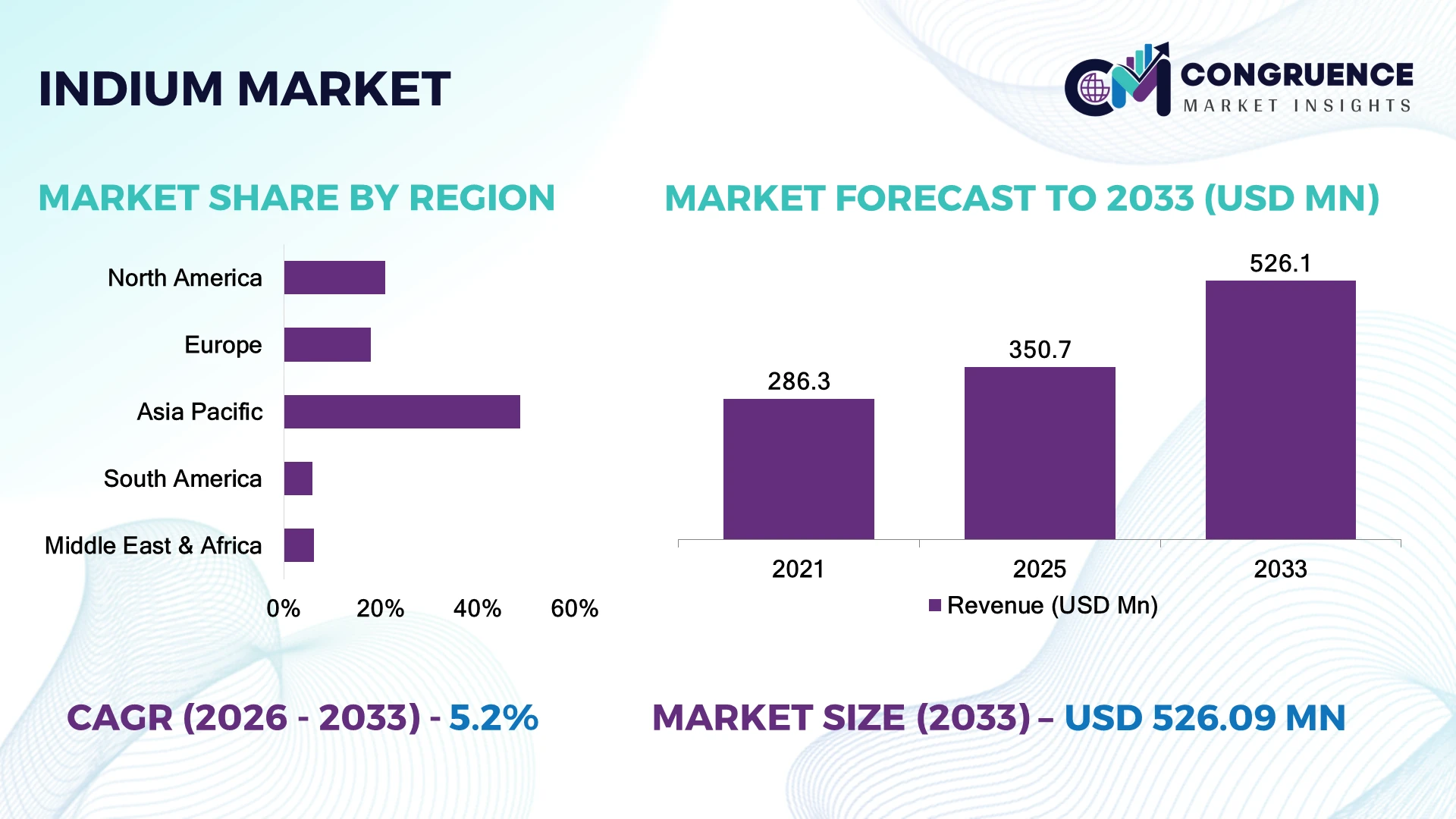
China dominates refined indium supply with about 70% of global output, versus roughly 17% for South Korea and 6% for Japan; global refined production is only about 1,080 tonnes annually. China’s 2025 export controls and tighter 2026 customs scrutiny are elevating procurement risk, while high-purity recycling can recover more than 95% of indium from selected ITO streams.
Strategically, buyers should secure diversified refining, recycling, and high-purity InP supply rather than depend on spot procurement.
Market Size & Growth: USD 350.7 Million in 2025 to USD 526.1 Million by 2033 at 5.2% CAGR, driven by InP optics and advanced ITO applications.
Top Growth Drivers: ITO displays 55%, semiconductors 18%, solders and alloys 12%.
Short-Term Forecast: By 2028, closed-loop ITO recovery can lift usable secondary indium supply by 10–15% and reduce primary-material exposure.
Emerging Technologies: InP photonics, advanced ITO targets, AI-assisted refining, and low-temperature hydrometallurgical recycling are reshaping supply economics.
Regional Leaders: Asia-Pacific approaches USD 320 Million with electronics scale; North America USD 105 Million with photonics investment; Europe USD 70 Million with circular-material adoption.
Consumer/End-User Trends: More than 60% of high-tech buyers increasingly prioritize qualified supply continuity for indium-containing semiconductor and display materials.
Pilot/Case Example: 2025 hydrometallurgical ITO recovery research achieved about 97% indium recovery, strengthening the economics of secondary supply.
Competitive Landscape: China holds about 70% refined output; Korea, Japan, Umicore, Dowa, and specialty semiconductor suppliers compete through refining and high-purity materials.
Regulatory & ESG Impact: China's 2025 export controls cover specified indium-related items, accelerating diversification, traceability, and recycling programs across strategic supply chains.
Investment & Funding: The U.S. is preparing to stockpile up to 403 tonnes over three years, signaling stronger strategic-mineral procurement and inventory investment.
Innovation & Future Outlook: 2026–2028 priorities center on InP photonics, indium recycling, higher-purity targets, regional stockpiles, and vertically integrated supply chains.
Indium demand is concentrated in ITO coatings, semiconductor substrates, optical communications, solders, and thin-film photovoltaics, with InP gaining importance in AI data-center interconnects. Advanced recycling can recover about 97% of indium from selected ITO waste streams. In 2026, tighter Chinese customs scrutiny is encouraging buyers to strengthen qualified inventories, secondary sourcing, and traceable recovery programs.
Indium is becoming strategically important because a very small metal market now sits inside high-value display, semiconductor, photonics, and AI infrastructure supply chains. China supplies about 70% of refined indium, creating concentration risk as export controls and tighter customs scrutiny reshape procurement. The February 2025 controls on specified indium-related items have pushed buyers toward qualified alternatives, inventories, and recycling.
Technology economics are also changing. Conventional primary supply depends on zinc-refining by-products, while hydrometallurgical ITO recovery can reach roughly 97% recovery under optimized conditions, improving material utilization and reducing dependence on fresh feedstock. Asia-Pacific leads production and electronics deployment, whereas North America is strengthening strategic inventories and photonics capacity. Europe is emphasizing circular-material recovery and resilient sourcing.
Over the next 2–3 years, companies will prioritize closed-loop ITO recycling, high-purity InP substrates, regional stockpiles, and multi-source qualification. A practical deployment model pairs recovered ITO feedstock with controlled purification and semiconductor-grade quality testing. The strongest competitive position will belong to suppliers combining secure upstream access, recovery technology, traceable high-purity materials, and geographically diversified partnerships.
Indium phosphide and indium-based materials are gaining importance in optical communications and advanced semiconductor manufacturing, with photonics applications estimated to represent more than 15% of high-purity indium demand. AI data-center expansion is increasing requirements for high-speed optical components, while InP devices can deliver bandwidth advantages over conventional silicon-only architectures. China, Japan, and the United States are expanding compound-semiconductor capabilities, with high-purity materials accounting for more than 30% of specialty indium applications. Producers are responding through InP substrate investment, purification upgrades, and semiconductor partnerships. The non-obvious advantage is that photonics demand shifts indium consumption toward higher-value applications where purity and qualification matter more than tonnage.
China accounts for approximately 70% of refined indium production, while secondary recovery contributes less than 30% of global supply, creating substantial procurement concentration. Indium is primarily recovered as a by-product of zinc processing, limiting the ability of producers to increase output independently of base-metal operations. Export controls introduced in 2025 further complicated qualification and logistics for international buyers. Companies in Japan, South Korea, Europe, and the United States are responding with strategic inventories, recycled-feedstock programs, and diversified refining contracts. The critical operational constraint is limited primary-supply elasticity: even a 10% demand increase cannot be matched quickly without additional zinc-processing activity or secondary recovery, making supply security more important than spot-price optimization.
ITO recycling presents an underutilized opportunity as electronics manufacturers generate recoverable indium from sputtering targets, display scrap, and production residues. Advanced hydrometallurgical systems can achieve approximately 95–97% recovery, while closed-loop programs can reduce primary-indium requirements by 10–15% at suitable facilities. Japan and South Korea are particularly attractive because of concentrated display and semiconductor manufacturing ecosystems. Companies are investing in selective leaching, solvent extraction, automated purification, and partnerships with electronics producers. The strategic opportunity extends beyond recycling economics: recovered indium provides a traceable domestic feedstock that reduces exposure to export restrictions and imported concentrates. Suppliers integrating recovery with high-purity refining can therefore capture both sustainability value and supply-security premiums.
High-purity indium production requires stringent control of metallic impurities, oxygen exposure, contamination, and material handling, creating significant scaling complexity. Semiconductor and photonics applications can require purity levels exceeding 99.999%, while contamination thresholds are often measured in parts per million. Yield losses of 5–10% can emerge when purification stages are not tightly synchronized, increasing production cost and qualification time. U.S., Japanese, and European processors are strengthening analytical laboratories, automated process controls, and clean-material handling. The long-term challenge is maintaining identical purity specifications as production scales from laboratory batches to commercial volumes. Companies that combine purification expertise with certified quality systems and customer-specific qualification will protect margins and reduce rejection risk in demanding semiconductor supply chains.
Export Controls Reshape Procurement: China’s 2025 controls on indium-related items are prompting buyers to increase qualified inventories and alternative sourcing, with strategic stock levels rising 10–15% at selected high-tech manufacturers. Japan, South Korea, and U.S. companies are strengthening supplier qualification and documentation, shifting procurement from spot purchasing toward contracted, traceable supply.
Display Recycling Gains Traction: Electronics manufacturers are increasing recovery of indium from ITO sputtering targets and production residues, with optimized hydrometallurgical processes achieving 95–97% recovery. Japanese and Korean processors are integrating recycling into manufacturing workflows, reducing disposal volumes while creating secondary feedstock that partially offsets dependence on newly refined indium.
Photonics Qualification Is Intensifying: InP-based optical components are moving deeper into AI and high-speed data-center architectures, increasing demand for semiconductor-grade indium materials. High-purity applications increasingly require 99.999%+ material specifications, encouraging suppliers to expand analytical testing, substrate qualification, and technical partnerships rather than compete solely through refined-metal volume.
Inventory Traceability Becomes Strategic: High-tech buyers are strengthening chain-of-custody documentation for indium as geopolitical controls increase compliance requirements. Digital material tracking can improve procurement visibility by 20–30% across multi-stage supply chains, while refiners are linking batch certificates with customer qualification records. This is turning traceability into a commercial differentiator for suppliers serving semiconductor and display manufacturers.
Primary indium remains the leading type, accounting for approximately 68% of supply, because zinc-smelting residues provide the established industrial feedstock for refined metal and high-purity compounds. Its mature processing infrastructure supports consistent volumes for ITO targets, solders, and semiconductor materials. Secondary or recycled indium represents roughly 32% but is expanding faster as electronics manufacturers seek supply resilience and lower dependence on zinc-linked production. Recovery technologies can achieve more than 95% extraction from selected ITO waste streams, improving the commercial case for circular sourcing.
The structural shift is particularly relevant in China, Japan, South Korea, and the United States, where display and semiconductor ecosystems generate concentrated recoverable material. Companies are investing in hydrometallurgical recovery, purification, and closed-loop partnerships rather than relying exclusively on primary procurement. Primary supply retains the scalability advantage, while secondary indium offers stronger supply-security and ESG value. Investment priorities are therefore moving toward integrated refining-and-recycling systems that can stabilize high-purity material availability.
USGS reported that a domestic semiconductor substrate company recorded a 67% year-on-year increase in InP revenue, highlighting accelerating demand for high-purity indium materials used in optical and advanced semiconductor applications.
Displays represent the leading application, accounting for approximately 57% of indium demand, supported by ITO use in LCD, OLED, touchscreen, and automotive display architectures. Semiconductor materials follow at roughly 20%, while solders, alloys, electronics, and specialty chemical uses form important secondary markets. Display demand remains highly scalable because ITO combines optical transparency with electrical conductivity, although thinner films and material-efficiency improvements are reducing indium intensity per device.
Semiconductor materials are the fastest-shifting application as InP gains importance in optical communications and AI data-center infrastructure. High-speed optical components increasingly require semiconductor-grade indium, with 800G and 1.6T architectures strengthening demand for InP substrates and epitaxial materials. Companies are reallocating R&D toward high-purity compounds, advanced sputtering targets, and photonics partnerships. This creates a widening value distinction: displays provide volume stability, while photonics and semiconductor applications generate greater technical qualification requirements and strategic supply value.
USGS identified InP-based substrates as critical to 5G fiber-optic networks and reported that AI is increasing demand for specialized InP materials used in high-speed optical components and advanced computing.
Electronics and semiconductor manufacturers form the leading end-user group, accounting for approximately 71% of indium consumption because ITO displays, compound semiconductors, optical components, and specialized electronic materials require controlled indium inputs. Consumer electronics remain volume-intensive, while semiconductor and photonics manufacturers impose substantially tighter purity and qualification requirements. Energy-related users represent a smaller base but are gaining relevance through thin-film photovoltaic technologies and advanced solar architectures.
The fastest-changing demand comes from semiconductor and photonics producers as AI infrastructure expands high-speed optical connectivity. InP wafer and device requirements are increasing alongside 800G and 1.6T optical deployments, encouraging longer-term material contracts and supplier qualification. Companies serving electronics are therefore broadening beyond commodity indium toward 5N–7N materials, customized targets, and application-specific compounds. Automotive electronics, advanced displays, and photovoltaics provide additional diversification, while strategic buyers increasingly favor suppliers combining purity assurance, recycling capability, and traceable supply.
A 2026 industry analysis reported that electronics and semiconductors represented 70.67% of indium end-user demand in 2025, confirming their dominant position while energy applications emerge as a faster-expanding niche.
Asia Pacific accounted for the largest market share at 48.66% in 2025 moreover, Asia Pacific is also expected to register the fastest growth, expanding at a CAGR of 7.43% between 2026 and 2033.
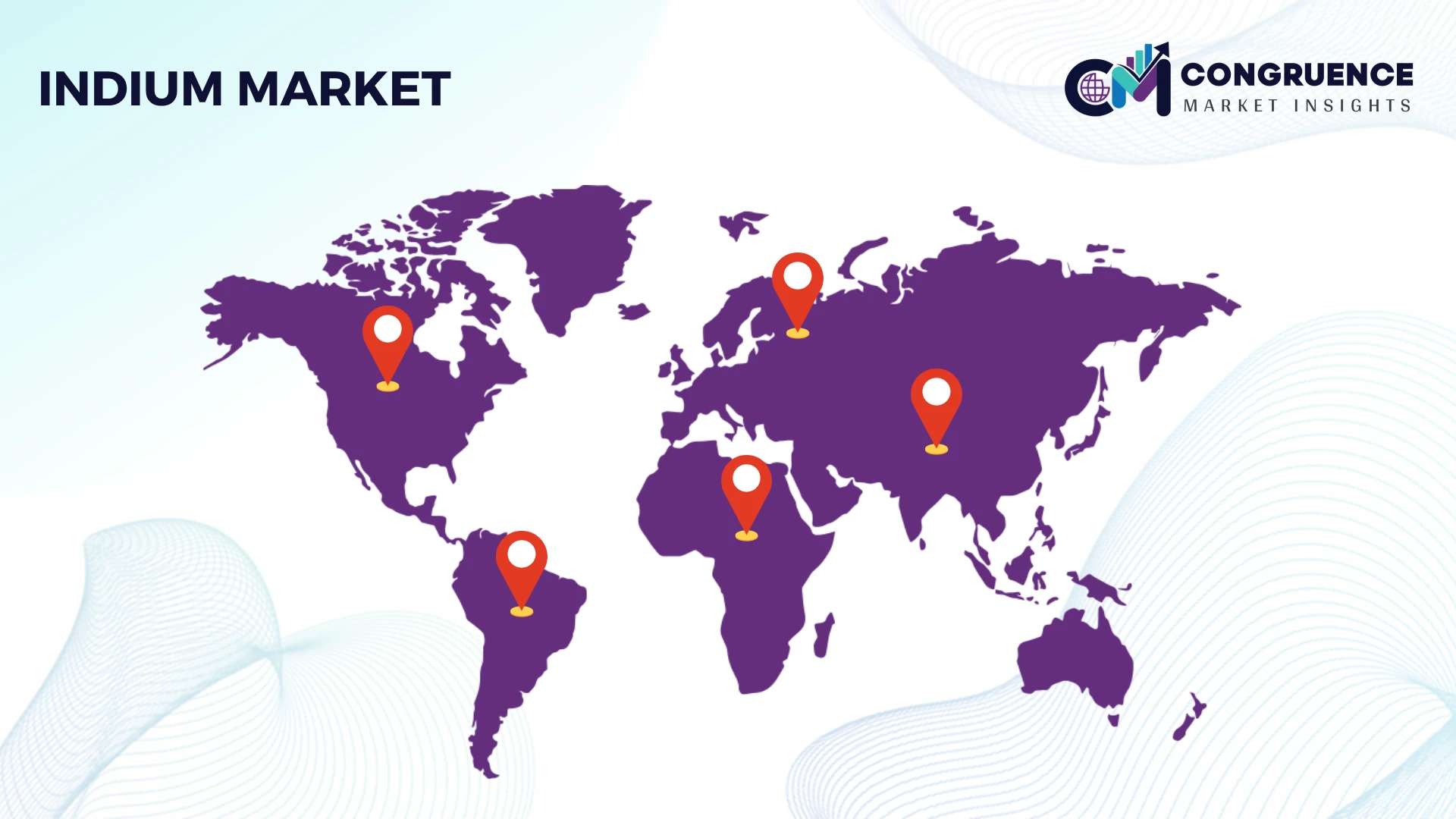
Strategic stockpiling and domestic photonics capacity reshape supply security
North America represents approximately 19–22% of global indium demand, with the United States accounting for most regional consumption. Demand is concentrated in semiconductor manufacturing, optical communications, advanced displays, and defense electronics, while domestic supply remains constrained. The region is shifting from import dependence toward strategic sourcing, recycling, and high-purity material qualification. U.S. policy has strengthened this transition as buyers face tighter controls on Chinese indium-related materials. The Defense Logistics Agency's planned stockpile of up to 403 tonnes over three years represents a major supply-security intervention. Companies are responding through alternative-origin qualification, recycling partnerships, and investments in compound-semiconductor materials. The operational advantage increasingly lies in securing qualified material before production bottlenecks emerge.
United States Market Outlook: The United States is the region's strategic demand center because of semiconductor, photonics, aerospace, defense, and data-center infrastructure. InP-based optical components are becoming increasingly important for high-speed communications, while strategic stockpiling is strengthening procurement resilience. The planned 403-tonne government reserve materially exceeds annual U.S. consumption requirements for several specialty applications, demonstrating the priority assigned to supply continuity.
Circular recovery and critical-material resilience gain policy priority
Europe accounts for approximately 16–20% of global indium demand, with Germany, France, Belgium, and the Netherlands providing important electronics and specialty-material manufacturing bases. European procurement is increasingly shaped by critical-material resilience, recycling, and traceability rather than primary supply alone. The EU's Critical Raw Materials framework is encouraging domestic processing and recovery capabilities, while 2026 implementing measures specifically identify waste streams with relevant critical-material recovery potential. France and Belgium remain notable regional refining locations, together producing about 40 tonnes of indium in 2025. Companies are therefore prioritizing secondary recovery, long-term supply agreements, and high-purity processing to reduce exposure to Asian supply concentration.
Germany Market Outlook: Germany is Europe's most strategically significant industrial market because of its semiconductor, automotive electronics, display, and advanced manufacturing base. The country's technology ecosystem supports demand for high-purity indium compounds and ITO-related materials, while automotive electrification increases electronic-content intensity. German manufacturers are strengthening supplier qualification and material traceability, with circular sourcing becoming increasingly important for maintaining production continuity amid critical-mineral procurement pressure.
Refining scale and electronics integration reinforce supply-chain dominance
Asia-Pacific holds approximately 48.66% of the global indium market, supported by China's dominant refining position and dense electronics, display, semiconductor, and optical-component manufacturing networks. China produced approximately 760 tonnes of refined indium in 2025, while South Korea produced about 180 tonnes and Japan 65 tonnes, giving the three countries a combined position of roughly 91% of reported Asian output. China's export controls introduced in 2025 have encouraged regional buyers to strengthen inventories and qualification programs. Japanese and Korean producers are increasingly emphasizing recycled indium and high-purity materials, creating a two-track market where China leads primary scale while neighboring economies compete through processing quality and supply diversification.
China Market Outlook: China is the world's dominant indium supply base, producing approximately 760 tonnes in 2025, or around 70% of global refinery output. Its advantage comes from integrated zinc-smelting, refining, ITO-material production, and electronics manufacturing. Export licensing introduced in 2025 has increased the strategic value of domestic downstream integration, while international buyers increasingly seek alternative sources and recycled material to reduce exposure to Chinese supply controls.
Import dependence creates selective opportunities in high-value electronics
South America represents a relatively small share of global indium consumption, with demand concentrated in Brazil's electronics, telecommunications, solar, specialty chemicals, and advanced manufacturing industries. The region has limited primary indium refining compared with China, South Korea, Japan, and Canada, making high-purity material largely dependent on international supply chains. Brazil's expanding electronics and renewable-energy manufacturing base provides the strongest regional demand platform, while localized recycling remains underdeveloped. Companies are responding through distributor agreements, inventory buffers, and direct qualification of multiple international refiners. The commercial opportunity is concentrated in high-value compounds and application-specific materials rather than bulk indium. Supply diversification is particularly important because longer import cycles can disrupt semiconductor and display-material procurement.
Brazil Market Outlook: Brazil is South America's most strategically relevant market because of its broad electronics manufacturing base, telecommunications infrastructure, photovoltaic deployment, and industrial research ecosystem. The country benefits from a diversified downstream economy but lacks the primary refining scale of major Asian producers. Companies serving Brazilian customers therefore gain an advantage through local warehousing, multi-origin sourcing, and technical support for high-purity indium compounds and ITO-related materials.
Advanced electronics investment creates an emerging specialty-material demand base
Middle East & Africa remains a smaller indium market, with consumption concentrated in electronics, telecommunications, specialty coatings, photovoltaics, and emerging semiconductor-related investments. Gulf economies are creating the strongest commercial opportunities through technology localization, data-center infrastructure, and advanced manufacturing initiatives. Saudi Arabia and the UAE are particularly important because their industrial-development programs are increasing demand for high-performance electronic materials. However, the region remains dependent on imported refined indium and compounds, making inventory planning and qualified supplier networks critical. Companies are responding through regional distribution partnerships and application-specific sourcing rather than establishing standalone primary refining operations. The near-term opportunity is therefore downstream: supplying high-purity indium materials to emerging electronics and photonics ecosystems.
Saudi Arabia Market Outlook: Saudi Arabia offers the strongest strategic opportunity in the region through its expanding semiconductor, telecommunications, data-center, and advanced-manufacturing agenda. Large technology infrastructure investments are increasing the relevance of specialty electronic materials, although indium supply remains import dependent. Suppliers with regional inventories, reliable customs execution, and high-purity qualification capabilities can secure an advantage as electronics production and digital infrastructure expand.
DOWA Holdings, Korea Zinc, Nyrstar, Umicore, and Guangxi Debang Technology compete across refined indium, high-purity materials, and recycling, with integrated Asian refiners challenging European recyclers and specialty-material suppliers. The top five players are estimated to control about 45% of global supply. Competition centers on feedstock access, purity, recovery yield, and delivery security; advanced recycling can recover 95–97% of indium from selected ITO residues, while 99.999% purity supports semiconductor qualification. Korea Zinc leverages zinc-smelter integration, Umicore and Nyrstar emphasize recovery, and DOWA combines refining with electronics materials. Companies are expanding closed-loop recycling, signing long-term offtake agreements, improving leaching systems, and integrating refining with downstream compounds. China’s export controls are shifting rivalry toward supply security and regional diversification. Entry barriers include scarce feedstock, purification expertise, qualification requirements, and capital-intensive recovery infrastructure. Winners will combine secure raw materials, high-purity processing, recycling capability, traceability, and contracted supply to outperform incumbent producers globally.
DOWA Holdings Co., Ltd.
Korea Zinc Co., Ltd.
Nyrstar
Umicore
Guangxi Debang Technology Co., Ltd.
Indium Corporation
5N Plus Inc.
Teck Resources Limited
Vital Materials Co., Ltd.
Yunnan Tin Company Group Limited
Mitsui Mining & Smelting Co., Ltd.
Mitsubishi Materials Corporation
Rasa Industries, Ltd.
Zhuzhou Keneng New Material Co., Ltd.
Indium technology is moving from conventional zinc-residue refining toward closed-loop recovery, high-purity purification, and compound-semiconductor integration. Hydrometallurgical ITO recycling can achieve 95–97% indium recovery, while automated separation reduces process losses by roughly 5–10%. Adoption is strongest among electronics, display, and semiconductor manufacturers seeking lower primary-material exposure and traceable feedstock.
Emerging systems combine selective leaching, solvent extraction, electrorefining, sensor analytics, and automated controls. Compared with less selective legacy recovery, optimized closed-loop processing improves recoverable metal yield by approximately 10–15% and can reduce waste-treatment requirements by 8–12%. InP substrate production is also expanding, with high-purity materials requiring 99.999% or greater purity. Integrated refiners and specialty suppliers benefit because they can convert recovered indium directly into qualified targets, compounds, and semiconductor materials.
During 2026–2028, AI-assisted process optimization, automated impurity monitoring, advanced ITO target recycling, and InP photonics manufacturing will gain importance. Digital controls can improve process consistency by 5–8%, while recycling reduces dependence on primary supply. Korea Zinc benefits from integrated smelting and recovery; Umicore and 5N Plus gain from circular refining and specialty materials. Acting now matters because export controls, AI-data-center demand, and tighter qualification requirements are making purity, recovery efficiency, and supply traceability competitive factors.
February 2025 Korea Zinc strengthened indium supply after China introduced export controls, reporting 99.999% purity capability at Onsan. The move strengthens alternative sourcing for U.S. buyers and positions Korean refining as a strategic buffer against concentrated Chinese supply chains globally. Source: koreazinc.co.kr
April 2025 Indium Corporation expanded recycling initiatives covering indium and gallium from sputtering targets and InP wafer off-cuts. Its program targets broader material volumes, strengthening closed-loop recovery, reducing virgin-feedstock exposure, and improving supply resilience for electronics and semiconductor customers globally. Source: indium.com
March 2026 Metallium’s U.S. subsidiary signed a long-term offtake agreement with Indium Corporation for recovered metals including indium from U.S. recycling operations. The partnership strengthens domestic secondary supply and provides diversified recovered feedstock amid tighter critical-mineral controls worldwide today. Source: metallium.com.au
July 2026 Vital Materials announced a new InP and GaAs wafer facility in Quzhou, China, planned for 6 million wafers annually. The expansion strengthens downstream semiconductor-material integration, increases high-purity indium demand exposure, and supports localized supply for photonics applications globally. Source: vitalchem.com
The Indium Market Report covers primary and recycled indium, high-purity grades, indium compounds, and application-specific materials across displays, ITO coatings, semiconductors, InP photonics, solders, alloys, photovoltaics, and specialty electronics. End-user coverage includes display manufacturers, semiconductor producers, electronics companies, photovoltaic manufacturers, and specialty-material processors. Regional analysis spans North America, Europe, Asia-Pacific, South America, and Middle East & Africa.
The report evaluates hydrometallurgical recovery, closed-loop ITO recycling, high-purity refining, InP substrate production, automated purification, and traceability systems. Asia-Pacific represents approximately 49% of market activity, while secondary recovery can achieve 95–97% extraction in optimized processes. Competitive assessment covers integrated refiners, specialty-material producers, and recycling-focused suppliers, supporting investment planning, expansion strategy, supply-chain diversification, technology selection, partnership development, and competitive positioning through 2026–2033.
| Report Attribute/Metric | Report Details |
|---|---|
|
Market Revenue in 2025 |
USD 350.7 Million |
|
Market Revenue in 2033 |
USD 526.1 Million |
|
CAGR (2026 - 2033) |
5.2% |
|
Base Year |
2025 |
|
Forecast Period |
2026 - 2033 |
|
Historic Period |
2021 - 2025 |
|
Segments Covered |
By Type
By Application
By End-User
|
|
Key Report Deliverable |
Revenue Forecast, Growth Trends, Market Dynamics, Segmental Overview, Regional and Country-wise Analysis, Competition Landscape |
|
Region Covered |
North America, Europe, Asia-Pacific, South America, Middle East, Africa |
|
Key Players Analyzed |
DOWA Holdings Co., Ltd., Korea Zinc Co., Ltd., Nyrstar, Umicore, Guangxi Debang Technology Co., Ltd., Indium Corporation, 5N Plus Inc., Teck Resources Limited, Vital Materials Co., Ltd., Yunnan Tin Company Group Limited, Mitsui Mining & Smelting Co., Ltd., Mitsubishi Materials Corporation, Rasa Industries, Ltd., Zhuzhou Keneng New Material Co., Ltd. |
|
Customization & Pricing |
Available on Request (10% Customization is Free) |




