
Reports
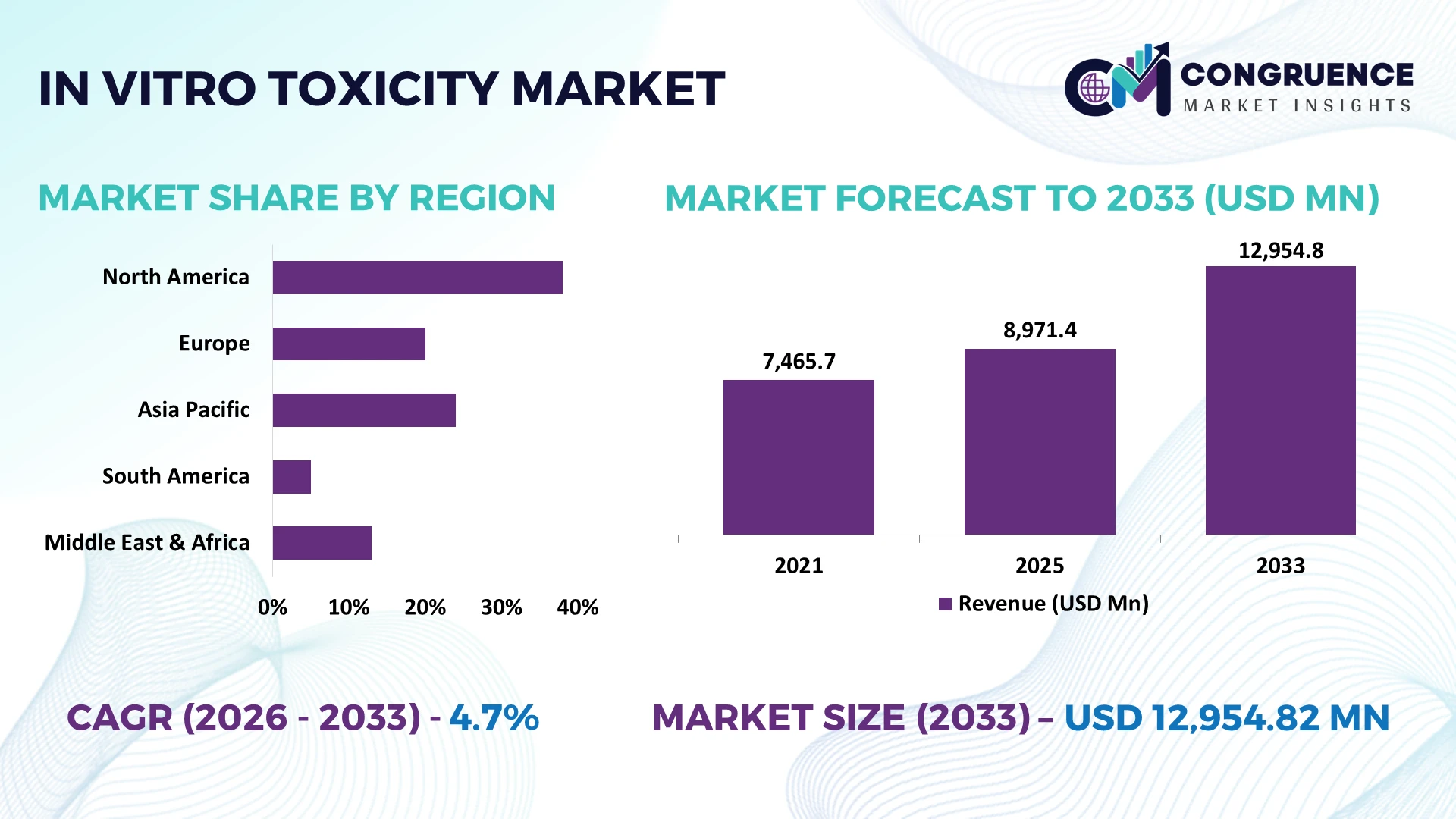
The Global In Vitro Toxicity Market was valued at USD 8971.35 Million in 2025 and is anticipated to reach a value of USD 12954.82 Million by 2033 expanding at a CAGR of 4.7% between 2026 and 2033. Growth is driven by regulatory adoption of New Approach Methodologies, human-cell-based assays, organoids, organ-on-chip platforms, and computational toxicology as pharmaceutical and chemical companies reduce reliance on conventional animal testing.
The United States accounts for an estimated 35–40% of global in vitro toxicity testing activity, supported by its pharmaceutical, biotechnology, chemicals, cosmetics, and contract research industries. The FDA’s 2025–2026 push toward validated non-animal testing methods is accelerating deployment of human-cell models, organoids, and computational toxicology. More than 90% of drug candidates that pass animal-based preclinical testing historically fail during subsequent clinical development, strengthening the business case for human-relevant models. Europe remains comparatively regulation-led, with REACH emphasizing alternative methods and animal testing as a last resort.
Strategically, assay developers and testing laboratories with validated human-relevant platforms, automated workflows, and regulatory-ready data packages are positioned to capture testing programs migrating from animal-based toxicology toward integrated in vitro evidence.
Market Size & Growth: USD 8,971.35 million in 2025 is projected to reach USD 12,954.82 million by 2033 at 4.7% CAGR, supported by increasing deployment of human-relevant toxicology platforms.
Top Growth Drivers: NAM adoption at approximately 35–40%, high-throughput screening penetration near 25–30%, and advanced organoid and microphysiological model adoption around 15–20% are accelerating laboratory workflow transformation.
Short-Term Forecast: By 2028, automated screening and integrated data analysis can reduce assay turnaround time by approximately 20–30%, enabling laboratories to process larger compound libraries without proportional staffing increases.
Emerging Technologies: AI-based toxicity prediction, 3D organoids, and organ-on-chip platforms are targeting 20–40% improvements in screening efficiency compared with labor-intensive conventional workflows.
Regional Leaders: North America is positioned above USD 4 billion, Europe around USD 3 billion, and Asia-Pacific above USD 2.5 billion by 2033, with automation, NAM implementation, and pharmaceutical R&D expansion supporting adoption.
Consumer/End-User Trends: Pharmaceutical and biotechnology organizations represent an estimated 40–45% of testing demand as developers increasingly integrate early-stage cytotoxicity, genotoxicity, hepatotoxicity, and cardiotoxicity screening.
Pilot/Case Example: In 2025, expanded regulatory programs around organ-on-chip and computational toxicology targeted substantial reductions in animal use while increasing the availability of human-relevant mechanistic evidence during preclinical assessment.
Competitive Landscape: The leading supplier group represents an estimated 30–35% of commercial activity, with Thermo Fisher Scientific, Charles River Laboratories, Eurofins Scientific, Merck KGaA, and Laboratory Corporation competing across assays and testing services.
Regulatory & ESG Impact: EU chemicals regulation and the FDA’s NAM initiatives are pushing laboratories toward non-animal methods, with validated alternative workflows capable of reducing animal-dependent testing requirements by 20–50% in suitable applications.
Investment & Funding: More than USD 100 million in combined public, private, and collaborative funding has flowed into organ-on-chip, computational toxicology, and advanced human-cell-model programs, strengthening commercialization and validation activity.
Innovation & Future Outlook: 3D tissues, multi-organ chips, AI toxicology, and automated high-content imaging are moving advanced testing toward integrated platforms capable of improving predictive screening productivity by approximately 25–40%.
The In Vitro Toxicity Market is increasingly concentrated around pharmaceutical safety assessment, chemicals testing, cosmetics, food ingredients, and biotechnology research. Demand is shifting toward 3D cell cultures, organoids, high-content imaging, microphysiological systems, and AI-assisted toxicity prediction, with advanced automated workflows delivering approximately 20–30% faster screening in suitable laboratory environments. Regulatory momentum toward New Approach Methodologies is also changing procurement priorities, particularly across the United States and Europe. This transition is pushing testing providers toward human-relevant, scalable platforms and establishes the foundation for evaluating the market’s strategic relevance and competitive direction.
In vitro toxicity testing is becoming strategically important as pharmaceutical, chemical, cosmetics, and biotechnology companies redesign safety assessment around human-relevant evidence and reduced animal dependence. Regulatory adoption of New Approach Methodologies is shifting investment toward 3D tissues, organoids, high-content imaging, and microphysiological systems. With roughly 90% of clinical drug candidates ultimately failing, earlier identification of human-specific toxicity increasingly influences portfolio productivity and development economics.
Automated high-content screening can process thousands of cellular measurements per experiment, while conventional manual assays require substantially greater technician intervention; integrated automation can shorten suitable screening workflows by approximately 20–30%. The United States leads commercial deployment through pharmaceutical R&D and regulatory NAM programs, while Germany, France, and the Netherlands benefit from Europe’s stronger regulatory emphasis on animal-testing alternatives. China is expanding capacity alongside domestic biopharmaceutical research and laboratory modernization.
Through 2026–2028, adoption will increasingly center on validated combinations of human-cell assays, computational models, and mechanistic endpoints rather than single replacement technologies. A practical deployment involves automated hepatotoxicity screening combining 3D liver models with image analytics before animal studies. Suppliers are consequently investing in assay validation, laboratory automation, partnerships, and organ-specific platforms. Competitive advantage will increasingly depend on delivering reproducible human-relevant evidence at industrial screening scale.
Regulatory acceptance of New Approach Methodologies is structurally increasing demand for cell-based toxicity assays, computational models, and microphysiological systems. Approximately 90% of drug candidates entering clinical development ultimately fail, while toxicity contributes materially to development attrition, strengthening demand for earlier human-relevant screening. Automated in vitro workflows can reduce selected assay turnaround times by 20–30%, while high-content platforms generate hundreds to thousands of cellular measurements per sample. The U.S. FDA’s recent initiative to reduce animal testing in drug development represents a concrete regulatory shift toward organoids, organ-on-chip technologies, and computational evidence. Assay manufacturers and contract laboratories are responding through validation programs, automation investments, pharmaceutical partnerships, and expanded organ-specific testing portfolios, making regulatory readiness a competitive capability rather than solely a compliance requirement.
Commercial scaling remains constrained by validation expense, laboratory-to-laboratory variability, and incomplete standardization across advanced human-cell models. Primary cells and complex 3D cultures can cost several times more per assay than basic 2D cell systems, while biological variability can produce 10–30% differences across batches depending on cell source and protocol. Organ-on-chip workflows also require specialized instrumentation and technical expertise that remain unevenly available across testing laboratories. In the United States, sponsors must demonstrate that alternative methods are fit for specific regulatory contexts rather than assuming universal acceptance. This increases validation workload and delays laboratory standardization. Providers are mitigating exposure through standardized cell banks, reference compounds, automated quality control, multi-site validation, and partnerships with regulators and pharmaceutical companies. Reproducibility, rather than assay novelty, therefore remains the critical commercialization constraint.
The strongest opportunity lies in combining AI toxicology, organoids, high-content imaging, and multi-organ microphysiological systems into integrated predictive platforms. Automated image analysis can reduce manual interpretation workloads by 30–50% in suitable high-content workflows, while 3D models can maintain tissue-relevant functions substantially longer than conventional short-duration monolayer cultures. In the United States, expanding regulatory attention to computational and human-based methodologies creates a commercialization pathway for platforms connecting molecular signatures with cellular and organ-level toxicity. India and China provide an additional opportunity through expanding pharmaceutical research, biosimilars, chemicals testing, and contract research capacity. Technology suppliers are increasing R&D around predictive algorithms, standardized organ models, cloud-based analytics, and pharmaceutical collaborations. A non-obvious opportunity is longitudinal toxicity measurement, where reusable microphysiological systems can generate repeated observations without proportionally increasing biological material consumption.
Long-term competitiveness depends on converting sophisticated biological models into reproducible, high-throughput industrial workflows. Complex organoids can require weeks of maturation, while differences in cell donors, culture media, extracellular matrices, and laboratory handling can generate variability exceeding 20% for selected biological endpoints. Advanced systems also produce substantially larger imaging and multi-omics datasets than conventional cytotoxicity assays, creating integration and bioinformatics requirements that many laboratories were not designed to manage. U.S. and European pharmaceutical organizations increasingly need evidence that models remain reproducible across sites, instruments, and operators before incorporating them into development decisions. Companies must therefore invest in automated culture systems, interoperable data architectures, standardized reference materials, workforce training, and multi-laboratory qualification. The strategic challenge is not simply building more realistic biology; it is making biological complexity repeatable enough for regulated, scalable decision-making.
Regulatory Workflows Enter Production: U.S. toxicology programs are moving NAMs from exploratory studies into submission-oriented workflows following the FDA’s 2025–2026 modernization measures. The agency has more than 16 innovative-method qualification submissions active, while streamlined approaches can eliminate six-month primate studies for qualifying monoclonal antibodies. Laboratories are consequently reorganizing study design around weight-of-evidence packages, increasing demand for validated cell-based assays, standardized reporting, and interoperable toxicology datasets.
Standardized Organoids Gain Investment: Organoid development is shifting from customized academic protocols toward reproducible industrial platforms. In 2025, NIH established its Standardized Organoid Modeling Center with USD 87 million committed over three years, specifically targeting protocol consistency and patient-relevant models. Suppliers are standardizing culture media, matrices, imaging endpoints, and quality controls, reducing batch variability and making organoids more practical for pharmaceutical screening partnerships and multi-site testing programs.
High-Content Data Becomes Operational: Toxicology laboratories are integrating automated microscopy, multiparametric imaging, and machine-learning analytics rather than relying on single-endpoint cytotoxicity measurements. Advanced systems capture hundreds to thousands of cellular features per experiment, while automation can reduce selected manual analysis workloads by roughly 30–50%. Platform vendors are connecting imaging instruments with cloud analytics and laboratory informatics, allowing teams to identify mechanistic toxicity signatures earlier and prioritize compounds with fewer repetitive experiments.
Human-Relevant Liver Models Advance: Hepatotoxicity screening is becoming an important proving ground for sophisticated microphysiological systems. A human Liver-Chip validation cited by the FDA correctly identified 87% of drugs associated with clinical liver injury. This predictive performance is pushing developers beyond static hepatocyte cultures toward perfused multicellular models. Technology providers are expanding liver-chip partnerships and assay portfolios, while pharmaceutical teams increasingly position these systems between early cellular screening and resource-intensive confirmatory studies.
Cell-Based Assays represent the leading type, accounting for approximately 40–45% of testing activity because they combine established protocols, scalable plate formats, broad endpoint coverage, and compatibility with automated screening equipment. Their mature infrastructure supports cytotoxicity, genotoxicity, hepatotoxicity, cardiotoxicity, and immunotoxicity workflows. Biochemical Assays retain an estimated 15–20% position where enzyme activity, receptor interactions, and molecular mechanisms require rapid, relatively economical measurement. In Silico Toxicology increasingly complements both segments by prioritizing compounds before wet-laboratory testing and reducing unnecessary experimental workloads.
Organ-on-Chip Models are the fastest-growing type as microfluidics, tissue engineering, and human-derived cells provide physiological conditions unavailable in conventional monolayer cultures. 3D Tissue Models are similarly gaining strategic relevance for repeated-dose, barrier, skin, liver, and organ-specific toxicity assessment. Advanced Liver-Chip validation has demonstrated 87% identification of clinically hepatotoxic drugs, illustrating the predictive value supporting investment. Companies are consequently shifting R&D toward integrated portfolios combining scalable Cell-Based Assays with 3D Tissue Models, Organ-on-Chip Models, and In Silico Toxicology rather than treating emerging platforms as standalone replacements.
Drug Development is the leading application, representing an estimated 45–50% of in vitro toxicity activity because pharmaceutical pipelines require repeated safety screening from candidate selection through nonclinical development. Cytotoxicity, hepatotoxicity, cardiotoxicity, genotoxicity, and immunotoxicity assays increasingly operate alongside computational evidence and human-relevant models. Chemical Safety Testing represents roughly 20–25% of demand, supported by industrial chemicals, agrochemicals, and materials assessment. Cosmetics Testing maintains established usage where non-animal approaches are embedded in product safety programs, particularly for skin and ocular endpoints.
Environmental Toxicology is positioned as the fastest-growing application as high-throughput methods enable laboratories to evaluate larger chemical inventories, mixtures, and environmental exposures without proportionally expanding animal studies. Food Safety Testing remains strategically relevant for additives, contaminants, ingredients, and packaging-related exposure assessment. Companies are responding by automating plate-based workflows, integrating mechanistic endpoints, and building multi-application testing platforms capable of serving pharmaceutical and industrial customers. The operational shift favors laboratories that can connect early screening results with increasingly complex human-relevant evidence without creating disconnected testing systems.
Pharmaceutical Companies are the dominant end-user group, accounting for approximately 45–50% of market demand because compound libraries, regulatory submissions, biologics development, and repeated safety assessments require substantial toxicology infrastructure. Large drug developers increasingly combine internal automated laboratories with outsourced specialist testing to manage variable pipeline volumes. Biotechnology Companies represent approximately 15–20% and are the fastest-growing buyer group as biologics, cell therapies, antibodies, and precision medicines create demand for specialized human-relevant safety models that conventional standardized assays cannot fully address.
Chemical Manufacturers remain significant purchasers of Cell-Based Assays and In Silico Toxicology for substance prioritization and hazard characterization, while Cosmetics Companies emphasize reconstructed tissue and non-animal safety systems. Food and Beverage Companies primarily deploy targeted testing around ingredients, additives, contaminants, and packaging interactions. Academic Research Institutions remain important early adopters of Organ-on-Chip Models and 3D Tissue Models, frequently supporting technology validation before commercial scaling. Suppliers are targeting these distinct buyers through modular platforms, CRO partnerships, application-specific assay packages, and integrated software ecosystems rather than uniform product portfolios.
North America accounted for the largest market share at approximately 38% in 2025 however, Asia-Pacific is expected to register the fastest growth, expanding at a CAGR of approximately 6.2% between 2026 and 2033.
Regulatory Modernization Accelerates Human-Relevant Testing
North America holds approximately 38% of global market activity, anchored by U.S. pharmaceutical R&D, CRO infrastructure, automated screening laboratories, and advanced cell-model developers. The operating environment shifted materially in 2025–2026 as the FDA expanded acceptance pathways for New Approach Methodologies, including human-cell assays, organoids, organ-on-chip systems, and computational models. In September 2026, the agency further updated nonclinical-testing regulations and launched a database containing 25 practical NAM examples. Pharmaceutical laboratories are consequently integrating automated high-content imaging and human-derived models earlier in candidate selection. Canada contributes through academic toxicology networks, biotechnology research, and chemicals assessment. Suppliers are prioritizing assay validation, laboratory automation, and pharmaceutical partnerships because regulatory-grade reproducibility now carries greater commercial value than expanding standalone assay menus.
United States Market Outlook: The United States leads deployment through its concentration of pharmaceutical developers, contract laboratories, technology suppliers, and federal research infrastructure. FDA data indicate that more than 90% of compounds historically clearing animal studies ultimately fail to receive approval, intensifying investment in translational models. The commercial advantage increasingly lies with platforms capable of combining mechanistic cellular endpoints, computational analysis, and standardized regulatory documentation.
Chemical Regulation Reshapes Testing Infrastructure
Europe represents approximately 27% of global in vitro toxicity activity, with Germany, the United Kingdom, France, the Netherlands, and Switzerland forming important pharmaceutical, chemicals, and life-sciences testing clusters. The structural catalyst is regulatory: the European Commission adopted its roadmap toward phasing out animal testing for chemical safety assessments in June 2026, establishing more than 30 recommendations covering industrial chemicals, pharmaceuticals, and food additives. This is shifting laboratory investment toward validated cell-based methods, reconstructed tissues, computational toxicology, and mechanistic evidence integration. Cosmetics safety requirements provide an established commercial base for alternative methods, while REACH-related chemical assessment broadens potential deployment. CROs and assay suppliers are strengthening cross-border validation programs and regulator-industry partnerships, creating demand for standardized platforms that produce comparable results across laboratories rather than customized research-only workflows.
Germany Market Outlook: Germany combines a major chemicals industry with pharmaceutical manufacturing, toxicology institutes, and sophisticated laboratory infrastructure. Industrial demand extends beyond medicines into specialty chemicals, materials, consumer products, and environmental assessment. German laboratories increasingly benefit from EU-wide method harmonization, while suppliers offering OECD-aligned assays and automated cellular analysis gain an operational advantage in multi-market regulatory testing.
Pharmaceutical Scale Drives Laboratory Modernization
Asia-Pacific accounts for approximately 23% of global activity and is shifting from conventional outsourced toxicology toward higher-value human-cell testing, computational analysis, and automated screening. China, Japan, South Korea, India, and Singapore concentrate pharmaceutical manufacturing, biotechnology investment, CRO capacity, and academic research infrastructure. China’s expanding innovative-drug pipeline is increasing requirements for early hepatotoxicity, cardiotoxicity, and genotoxicity assessment, while India’s large generic and contract-development ecosystem supports scalable assay demand. Japan provides established alternative-method expertise and high-quality laboratory standards. Automated plate handling and high-content imaging are increasingly deployed to process hundreds to thousands of cellular measurements per experiment, improving laboratory throughput. International suppliers are responding through local technical support, distributor networks, application laboratories, and partnerships with CROs, reducing dependence on imported testing services while improving access to sophisticated toxicity platforms.
China Market Outlook: China provides the strongest scale advantage through its expanding biotechnology ecosystem, domestic pharmaceutical pipelines, chemicals sector, and contract research capacity. Large laboratories are moving beyond basic 2D cytotoxicity toward 3D cultures and high-content screening. This creates a competitive opening for suppliers that localize instruments, consumables, technical training, and assay-validation capabilities rather than relying solely on imported premium platforms.
Brazil Anchors Alternative Testing Adoption
South America represents approximately 5% of global market activity, with Brazil accounting for the largest concentration of pharmaceutical, cosmetics, chemicals, academic, and contract-testing demand. Brazil’s regulatory ecosystem formally recognizes alternative methods through CONCEA, supporting wider use of non-animal approaches across applicable research and safety workflows. Cosmetics manufacturers provide an important adoption channel for reconstructed skin, irritation, and cytotoxicity testing, while pharmaceutical laboratories are expanding cell-based screening and analytical automation. Argentina, Chile, and Colombia contribute smaller biotechnology and academic testing networks, but access to advanced organ-on-chip equipment, standardized human cells, and specialist technical expertise remains uneven. Suppliers are therefore building distributor partnerships, localized training, and modular laboratory platforms. The operational opportunity favors systems that deliver regulatory-grade performance without requiring the capital intensity of fully integrated high-throughput laboratories.
Brazil Market Outlook: Brazil combines the region’s strongest pharmaceutical and cosmetics manufacturing base with established universities and regulatory toxicology capabilities. CONCEA maintains recognized alternative-method frameworks, strengthening institutional adoption. Domestic laboratories increasingly require scalable cell-based testing, creating room for international suppliers that provide local technical service, assay transfer, validation support, and reliable consumables availability.
Life-Science Investment Builds Testing Capacity
Middle East & Africa represents approximately 7% of global activity, with adoption concentrated in Saudi Arabia, the United Arab Emirates, Israel, South Africa, and selected academic medical centers. Demand is tied to pharmaceutical localization, biotechnology research, chemicals safety, food testing, and expanding precision-medicine infrastructure rather than broad high-throughput toxicology deployment. Saudi Arabia and the UAE are building life-science ecosystems that encourage laboratory modernization, while Israel provides strong biotechnology and computational biology capabilities. South Africa contributes established academic and pharmaceutical research infrastructure but faces equipment-cost and specialist-workforce constraints. Testing providers are responding with modular automation, centralized laboratories, international research partnerships, and cloud-enabled analysis rather than replicating capital-intensive Western laboratory models. This centralized approach can raise instrument utilization and accelerate access to sophisticated cellular and computational toxicology capabilities.
Saudi Arabia Market Outlook: Saudi Arabia is emerging as a strategic deployment center as biotechnology localization becomes part of national industrial diversification. Investment in pharmaceutical manufacturing, genomics, research facilities, and clinical-development infrastructure is increasing requirements for modern safety-assessment capabilities. Vendors able to integrate automated cell analysis, training, technical support, and laboratory informatics are positioned more strongly than equipment-only suppliers.
Thermo Fisher Scientific, Charles River Laboratories, Eurofins Scientific, Merck KGaA, and Labcorp compete across assays, instruments, reagents, and outsourced toxicology, while Emulate and specialized technology developers challenge incumbents through organ-on-chip platforms. The top five suppliers collectively represent approximately 30–35% of commercial activity, leaving substantial demand distributed across specialist CROs and assay developers. Competition increasingly centers on predictive accuracy, workflow automation, and regulatory validation rather than assay price alone. Automated platforms can reduce selected manual processing requirements by 20–30%, while advanced human-cell models target materially stronger translational relevance than conventional monolayer assays. Leaders are expanding through CRO partnerships, integrated reagent-instrument ecosystems, computational toxicology, and organ-specific model development. The competitive shift favors platforms connecting cell biology, imaging, and analytics within validated workflows. High validation costs, biological reproducibility, and regulatory qualification remain significant entry barriers. Winning requires scalable human-relevant models, standardized performance, automation compatibility, regulatory credibility, and application-specific technical support.
Thermo Fisher Scientific
Charles River Laboratories
Eurofins Scientific
Merck KGaA
Labcorp
Bio-Rad Laboratories
Promega Corporation
Sartorius
Agilent Technologies
Lonza Group
Evotec
Inotiv
Emulate
Creative Bioarray
Current platforms combine automated high-content imaging, human primary cells, 3D tissues, and multiparametric assays to detect cytotoxicity, hepatotoxicity, genotoxicity, and cardiotoxicity earlier. Automation can cut manual analysis workloads by 30–50%, while high-content systems capture hundreds of cellular features per experiment. Cell-based assays remain broadly deployed because plate-based workflows integrate readily with robotic handling, imaging, and laboratory informatics, giving large pharmaceutical laboratories higher throughput and standardized compound prioritization.
Emerging microphysiological systems, organoids, and AI-enabled toxicology models are improving human relevance. Emulate’s Liver-Chip identified 87% of tested drugs associated with clinical liver injury while delivering 100% specificity in its validation dataset. Compared with previous Organ-Chip systems, newer high-throughput platforms can halve laboratory labor and reduce consumable costs by 75%. Integration with transcriptomics and machine-learning analysis enables mechanistic interpretation alongside conventional viability endpoints, benefiting CROs and drug developers managing complex safety programs.
Disruptive workflows increasingly connect in silico prediction, stem-cell-derived models, organ-on-chip testing, and regulatory-grade data pipelines. Between 2026 and 2028, deployment will shift from isolated pilots toward standardized multi-model screening, particularly for liver, kidney, lung, and developmental toxicity. Suppliers that combine scalable biology, automation, reproducibility, and interoperable analytics gain the strongest competitive advantage as human-relevant evidence becomes operationally usable across development pipelines.
September 2024 – Emulate’s Liver-Chip S1 entered FDA’s ISTAND pilot program, becoming the first Organ-on-Chip technology accepted for this pathway. Validation involved 870 Liver-Chips, three human donors, and 27 drugs, strengthening regulatory applicability for human-relevant drug-induced liver injury assessment. Source: Cell
September 2024 – Admescope launched DILIscope, expanding its in vitro toxicology portfolio with pooled primary human hepatocytes and automated high-content imaging. The service evaluates four major areas: cell stress, steatosis, phospholipidosis, and lysosomal trapping, strengthening early drug-induced liver injury screening. Source: Admescope
June 2025 – Emulate commercially launched AVA, a high-throughput system culturing, incubating, and imaging 96 independent Organ-Chip samples per run. The platform cuts consumable costs four-fold and laboratory labor by 50%, materially improving scalability of human-relevant toxicology workflows for pharmaceutical laboratories. Source: SelectScience
July 2026 – Toxys and IIVS expanded their partnership, making IIVS the exclusive North American distributor of ToxTracker kits and renewing U.S. assay licensing. IIVS additionally provides GLP-compliant studies, extending OECD 446A-aligned mechanistic genotoxicity testing into regulatory submission workflows. Source: IIVS
The report evaluates the In Vitro Toxicity Market across Cell-Based Assays, Biochemical Assays, Organ-on-Chip Models, 3D Tissue Models, and In Silico Toxicology, with Cell-Based Assays representing approximately 40–45% of current activity. Application coverage includes Drug Development, Chemical Safety Testing, Cosmetics Testing, Food Safety Testing, and Environmental Toxicology, alongside demand from pharmaceutical, biotechnology, chemical, cosmetics, food and beverage, and academic organizations.
Regional assessment covers North America, Europe, Asia-Pacific, South America, and Middle East & Africa, examining regulatory adoption, laboratory infrastructure, deployment concentration, and technology localization. Strategic analysis tracks high-content imaging, AI toxicology, organoids, microphysiological systems, automation, and computational modeling through 2026–2033. The report supports investment planning, geographic expansion, technology partnerships, portfolio prioritization, and competitive positioning by identifying where human-relevant testing, regulatory modernization, and integrated digital workflows are reshaping commercial opportunities.
| Report Attribute/Metric | Report Details |
|---|---|
Market Revenue in 2025 | USD 8971.35 Million |
Market Revenue in 2033 | USD 12954.82 Million |
CAGR (2026 - 2033) | 4.7% |
Base Year | 2025 |
Forecast Period | 2026 - 2033 |
Historic Period | 2021 - 2025 |
Segments Covered | By Type
By Application
By End-User
|
Key Report Deliverable | Revenue Forecast, Growth Trends, Market Dynamics, Segmental Overview, Regional and Country-wise Analysis, Competition Landscape |
Region Covered | North America, Europe, Asia-Pacific, South America, Middle East, Africa |
Key Players Analyzed | Thermo Fisher Scientific, Charles River Laboratories, Eurofins Scientific, Merck KGaA, Labcorp, Bio-Rad Laboratories, Promega Corporation, Sartorius, Agilent Technologies, Lonza Group, Evotec, Inotiv, Emulate, Creative Bioarray |
Customization & Pricing | Available on Request (10% Customization is Free) |




