Global In-building Wireless Market Report Overview
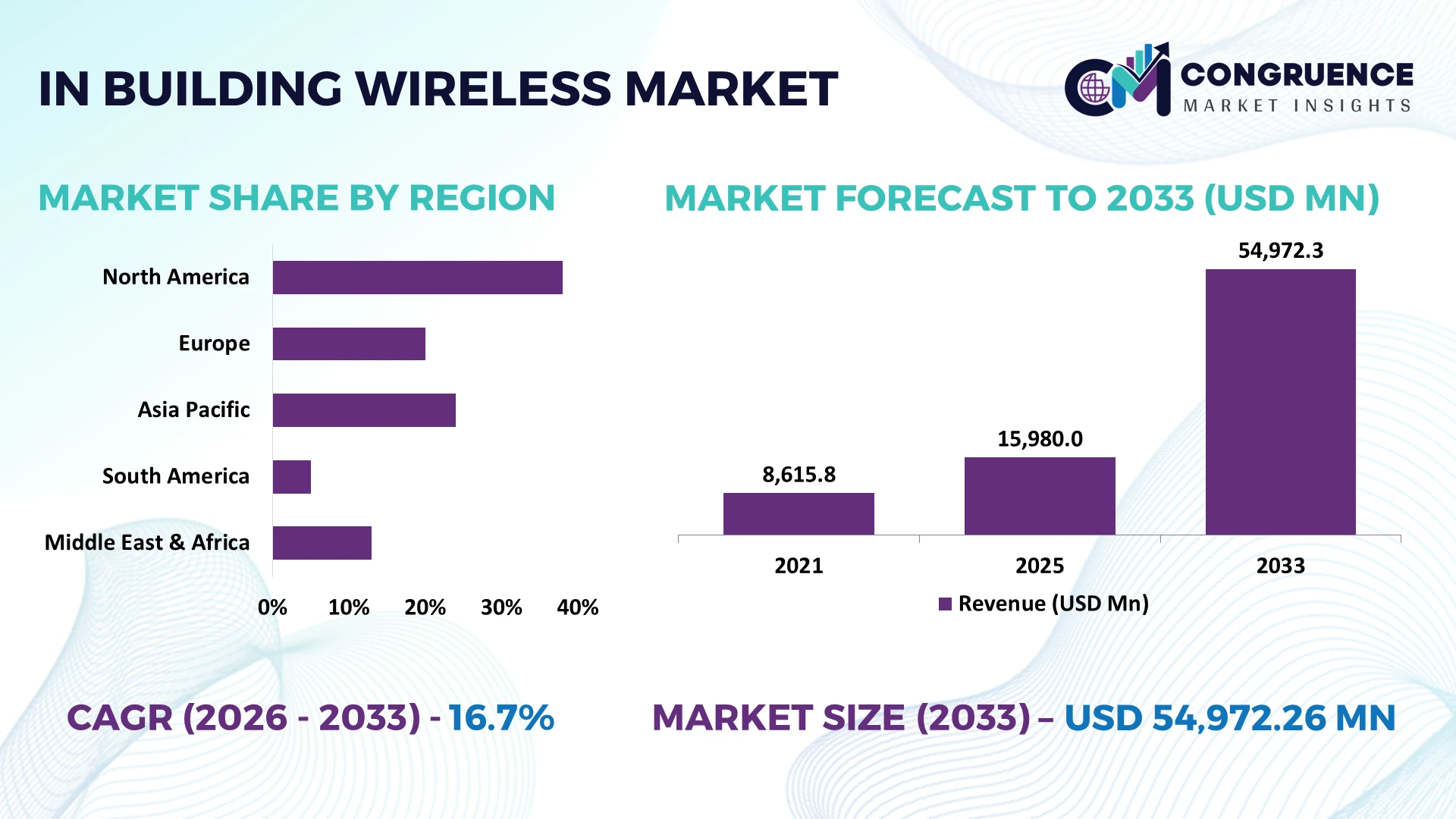
The Global In-building Wireless Market was valued at USD 15980 Million in 2025 and is anticipated to reach a value of USD 54972.26 Million by 2033 expanding at a CAGR of 16.7% between 2026 and 2033. Growth is driven by 5G indoor coverage gaps, rising enterprise private network deployments, neutral-host distributed antenna systems, and modernization of wireless connectivity across airports, hospitals, commercial buildings, and industrial facilities.
China represents a major deployment center for in-building wireless infrastructure, supported by extensive 5G network investment, large commercial property portfolios, and industrial digitalization. The country had approximately 4.25 million 5G base stations by the end of 2024, compared with India's approximately 464,000 installed 5G base transceiver stations in early 2025. China's telecommunications operators are extending indoor distributed antenna systems and small-cell coverage across transportation hubs, factories, hospitals, and commercial complexes. Government-backed 5G industrial internet initiatives strengthen enterprise wireless deployment and infrastructure integration.
Infrastructure providers should prioritize multi-operator indoor coverage, cost-efficient fiber distribution, and scalable private 5G architectures to secure enterprise contracts and strengthen long-term network monetization.
Key Highlights of the Global In-building Wireless Market
-
Market Size & Growth: USD 15,980 million in 2025, reaching USD 54,972.26 million by 2033 at 16.7% CAGR, supported by enterprise 5G modernization.
-
Top Growth Drivers: Three priorities dominate: 5G indoor coverage expansion, 100% building-wide connectivity objectives, and increasing enterprise network automation.
-
Short-Term Forecast: By 2028, advanced indoor wireless platforms will prioritize 99.9% service availability through redundant network architectures and automated performance monitoring.
-
Emerging Technologies: Three technologies—Open RAN small cells, AI-based radio optimization, and neutral-host 5G infrastructure—are transforming indoor wireless deployments.
-
Regional Leaders: Asia-Pacific, North America, and Europe lead deployment; China's 4.25 million 5G base stations support extensive indoor network integration.
-
Consumer/End-User Trends: Enterprise users increasingly require connectivity across 3 environments: offices, industrial facilities, and high-density public venues.
-
Pilot/Case Example: India's 2024 5G expansion surpassed 400,000 base stations, strengthening network availability for enterprise and indoor connectivity applications.
-
Competitive Landscape: CommScope, Corning, Ericsson, Nokia, and Huawei compete across 3 infrastructure layers: distributed antenna systems, small cells, and radio management.
-
Regulatory & ESG Impact: Energy-efficient radio systems target lower power consumption, while shared infrastructure can support 2 or more mobile network operators.
-
Investment & Funding: India's BharatNet program carries an approved outlay of approximately USD 16.9 billion, supporting broadband infrastructure expansion and fiber connectivity.
-
Innovation & Future Outlook: 5G Advanced and AI-assisted radio optimization support 2 strategic priorities: improved indoor network performance and reduced operating complexity.
The In-building Wireless Market is increasingly shaped by enterprise digitalization, dense indoor data traffic, and demand for uninterrupted cellular connectivity across complex buildings. Distributed antenna systems, private 5G networks, and Open RAN small cells are enabling flexible coverage architectures for hospitals, airports, industrial facilities, and commercial properties. China's deployment of approximately 4.25 million 5G base stations by the end of 2024 demonstrates the infrastructure scale supporting indoor connectivity expansion. Neutral-host models are also gaining importance as property owners seek multi-operator coverage without duplicating equipment. These developments place network interoperability, installation economics, and lifecycle management at the center of strategic investment decisions.
What Is the Strategic Relevance and Future Pathways of the In-building Wireless Market?
In-building wireless infrastructure is becoming strategically important as enterprises treat indoor cellular coverage as essential operating infrastructure rather than an optional connectivity service. Hospitals, airports, manufacturing facilities, and commercial property operators require dependable communications for connected equipment, workforce mobility, and digital services. China's deployment of approximately 4.25 million 5G base stations by December 2024 illustrates the scale of national network modernization, while neutral-host infrastructure is changing how building owners and telecommunications operators allocate deployment responsibilities.
Compared with separate single-operator installations, shared distributed antenna systems support multiple carriers through common cabling and antenna infrastructure, reducing equipment duplication. A three-operator deployment can share one antenna distribution network instead of installing three independent systems. China emphasizes extensive 5G infrastructure integration, whereas the United States prioritizes enterprise private networks and neutral-host commercial models. Ericsson, Nokia, and Corning are developing modular indoor connectivity platforms suited to these different requirements.
Between 2026 and 2028, investment priorities will shift toward 5G Advanced, automated radio optimization, and integrated indoor positioning. Airport deployments illustrate the operational value of coordinated coverage across terminals, underground areas, and passenger facilities. Suppliers are strengthening partnerships with property owners and systems integrators to accelerate installations. Competitive advantage will depend on deployment economics, reliable multi-operator service, and manageable network operating costs.
In-building Wireless Market Dynamics
DRIVER:
Enterprise Connectivity Modernization and Indoor 5G Expansion
Enterprise digitalization is increasing demand for dependable indoor wireless coverage across manufacturing plants, hospitals, airports, and commercial properties. China's approximately 4.25 million 5G base stations by the end of 2024 demonstrate the infrastructure scale supporting advanced connectivity deployment. India surpassed 400,000 installed 5G base stations during 2024, strengthening the foundation for enterprise network expansion. Indoor wireless systems support industrial automation, connected medical equipment, and high-density mobile traffic where outdoor macro networks face building penetration limitations. Ericsson, Nokia, and Huawei are expanding indoor radio portfolios and enterprise connectivity partnerships. Shared infrastructure also allows multiple mobile operators to use common antenna networks, improving installation economics. The commercial advantage lies in delivering reliable cellular service without duplicating building-wide distribution infrastructure.
RESTRAINT:
Installation Complexity and Building Infrastructure Constraints
Indoor wireless deployment remains constrained by building construction, fiber availability, installation access, and operator coordination. Reinforced concrete, low-emissivity glazing, and metal structures weaken outdoor cellular signals, increasing dependence on dedicated indoor radio infrastructure. A conventional distributed antenna system requires multiple interconnected components, including radio sources, distribution equipment, and antennas, raising installation and maintenance requirements. India's large commercial property market includes buildings with limited telecommunications riser capacity and inconsistent indoor fiber access. Shared infrastructure reduces duplication, but integration still requires coordination among two or more mobile operators. Corning, CommScope, and systems integrators are responding through modular fiber distribution, compact radio equipment, and phased installation programs. The primary profitability constraint is the cost of retrofitting occupied buildings without interrupting commercial operations.
OPPORTUNITY:
Neutral-Host Networks and Private 5G Integration
Neutral-host infrastructure and private 5G networks create opportunities for shared connectivity services across commercial and industrial properties. A single neutral-host deployment can support two or more operators while providing dedicated enterprise connectivity through compatible radio architecture. India's expanding 5G infrastructure and industrial digitalization programs strengthen opportunities in logistics parks, manufacturing facilities, and transportation hubs. 5G Advanced introduces improved network automation and positioning capabilities, supporting industrial asset tracking and connected operations. Ericsson and Nokia are developing enterprise wireless solutions, while infrastructure providers are pursuing partnerships with building owners and telecommunications operators. Between 2026 and 2028, integrated public-private network architectures will gain importance. Suppliers offering managed connectivity, automated monitoring, and flexible deployment models can reduce enterprise ownership complexity and strengthen recurring service relationships.
CHALLENGE:
Multi-Operator Integration and Continuous Network Performance
Maintaining consistent indoor wireless performance across multiple operators, radio bands, and enterprise applications presents a significant operational challenge. High-density venues require coordinated interference management, capacity planning, and mobility optimization as users move between indoor and outdoor coverage zones. Private 5G networks also introduce cybersecurity requirements involving device authentication, network segmentation, and protected enterprise data exchange. China's extensive 5G infrastructure creates complex integration environments across factories, transportation facilities, and commercial developments. Network operators must maintain reliable service across multiple frequency bands while accommodating different equipment vendors and software platforms. Ericsson, Nokia, and Huawei are advancing automated radio management and network analytics. Long-term competitiveness depends on interoperable equipment, skilled integration teams, and continuous performance monitoring that prevents service degradation as connected device density increases.
In-building Wireless Market Latest Trends
-
Digital DAS Replaces Analog Distribution: Building operators are shifting from coaxial-heavy analog systems toward fiber-connected digital distributed antenna systems. Fiber distribution supports longer transmission distances and centralized radio management, while multi-operator configurations consolidate two or more carrier connections. Corning and CommScope are developing modular architectures that simplify expansion across large buildings. The operational benefit is easier capacity upgrades without replacing the entire antenna distribution network.
-
Indoor Radio Networks Adopt Automation: Enterprise wireless deployments increasingly use centralized monitoring and automated radio optimization to manage interference, coverage, and equipment performance. Wi-Fi 7 introduces 320 MHz channels in supported 6 GHz environments, doubling the maximum channel width available under Wi-Fi 6E. Cisco and HPE Aruba Networking are advancing automated wireless management platforms, helping building operators maintain service quality as connected device density increases.
-
Public Safety Coverage Gains Regulatory Attention: Building owners are strengthening emergency responder radio coverage through dedicated antennas, signal boosters, and monitored communication systems. Public safety networks commonly operate across designated 700 MHz and 800 MHz frequency bands in the United States. Equipment providers are improving system supervision, battery backup integration, and installation testing. The shift increases demand for specialist engineering and lifecycle maintenance services beyond initial wireless infrastructure installation.
-
Enterprise Networks Integrate Indoor Positioning: Industrial facilities and transportation hubs are combining wireless connectivity with location-aware services for asset monitoring and workforce coordination. Bluetooth 5.1 introduced direction-finding capabilities, while Wi-Fi 7 supports enhanced capacity through multi-link operation. Ericsson, Nokia, and enterprise networking suppliers are integrating positioning functions with connectivity management, enabling facility operators to reduce separate infrastructure requirements for tracking and communications.
Segmentation Analysis
By Type
Distributed Antenna Systems Anchor Large-Building Coverage
Distributed Antenna Systems (DAS) represent an established infrastructure category within the In-building Wireless Market, particularly in airports, hospitals, stadiums, and large commercial properties. DAS distributes cellular signals through interconnected antennas, supporting consistent coverage across extensive indoor areas. Neutral-host configurations accommodate two or more mobile network operators using shared distribution infrastructure, reducing equipment duplication. Corning and CommScope compete through fiber distribution, digital DAS architecture, and scalable building connectivity solutions. Their established deployment capabilities support demand where indoor coverage requires coordinated installation across multiple floors and complex building layouts.
Small Cells are gaining importance in 5G deployments because they provide localized radio capacity and flexible installation options. Compared with passive coverage distribution, small cells actively deliver cellular connectivity and support targeted capacity expansion. Repeaters remain relevant for extending existing signals into smaller indoor areas, while Femto Cells serve compact premises requiring localized cellular access. Ericsson, Nokia, and Huawei are developing indoor radio platforms and centralized management capabilities. Investment priorities increasingly emphasize modular deployment, simplified maintenance, and compatibility with existing enterprise networking infrastructure.
- The Global mobile Suppliers Association's 2025 industry tracking highlighted continued 5G network expansion and enterprise connectivity development, reinforcing demand for indoor radio equipment capable of supporting high-capacity cellular services across commercial and industrial environments.
By Application
Cellular Coverage Remains the Primary Deployment Requirement
Cellular Coverage represents a core application within the In-building Wireless Market because commercial properties, transportation hubs, and industrial facilities require dependable mobile connectivity beyond outdoor macro network penetration. Reinforced concrete, coated glass, and underground structures weaken cellular signals, increasing demand for dedicated indoor antennas and radio systems. Distributed antenna systems support multiple mobile operators through common infrastructure, improving installation economics and reducing duplicated building equipment. Ericsson, Nokia, and CommScope compete through indoor radio systems, signal distribution technology, and network management platforms. Cellular Coverage investments increasingly emphasize 5G compatibility and coordinated indoor-outdoor mobility performance.
IoT Connectivity is becoming strategically important as industrial facilities deploy connected sensors, automated equipment, and asset monitoring systems. Wi-Fi Connectivity supports enterprise applications and high-density device access, while Public Safety Communication requires reliable emergency responder radio coverage. Wi-Fi 7 supports channel widths reaching 320 MHz where permitted, improving available wireless capacity compared with earlier Wi-Fi generations. Cisco and enterprise networking suppliers are integrating automated network management, security controls, and traffic optimization. Suppliers differentiate through service reliability, device compatibility, and deployment flexibility across application-specific environments.
- The Wi-Fi Alliance's 2025 Wi-Fi CERTIFIED 7 program continued advancing interoperability for high-capacity wireless equipment, supporting enterprise deployments requiring improved throughput, lower latency, and reliable connectivity across increasingly dense indoor device environments.
By End-User
Commercial Buildings Drive Multi-Operator Infrastructure Deployment
Commercial Buildings represent an established end-user category for in-building wireless systems, supported by extensive office portfolios, mixed-use developments, and enterprise connectivity requirements. Property operators increasingly treat dependable cellular coverage as a building infrastructure requirement rather than an optional tenant service. Neutral-host distributed antenna systems enable two or more mobile operators to share common antenna infrastructure, reducing duplicated installation work. Corning, CommScope, and wireless systems integrators compete through scalable coverage architecture, installation support, and network management capabilities. Commercial property investments emphasize retrofit compatibility, centralized equipment management, and dependable multi-floor connectivity.
Industrial Facilities represent an important expansion opportunity because connected machinery, automated logistics, and operational monitoring require predictable wireless performance. Healthcare Facilities prioritize reliable communication for clinical workflows and connected medical equipment. Airports and Transportation Hubs require high-capacity coverage across terminals, underground areas, and passenger facilities, while Hospitality Venues emphasize guest connectivity and operational efficiency. Wi-Fi 7 supports 320 MHz channels in compatible environments, strengthening high-density wireless deployment options. Ericsson, Nokia, and enterprise networking suppliers are developing integrated indoor connectivity platforms tailored to different operational requirements.
- The International Telecommunication Union's 2025 connectivity assessments highlighted continued expansion of advanced mobile infrastructure and digital services, reinforcing the importance of reliable indoor connectivity for enterprises, public facilities, and industrial digitalization programs.
Region-Wise Market Insights
Asia-Pacific accounted for the largest market share in 2025 however, Asia-Pacific is expected to register the fastest growth between 2026 and 2033, supported by extensive 5G infrastructure deployment, commercial building modernization, and expanding enterprise wireless connectivity.

North America In-building Wireless Market
Neutral-Host Infrastructure and Enterprise Wireless Modernization
North America's in-building wireless market is characterized by extensive commercial property infrastructure, enterprise network modernization, and advanced wireless technology integration. The United States leads regional deployments across airports, hospitals, stadiums, and corporate campuses, where distributed antenna systems support reliable multi-operator cellular connectivity. The Federal Communications Commission's Citizens Broadband Radio Service framework provides access to 150 MHz of spectrum within the 3.5 GHz band, supporting enterprise private wireless deployments. Corning, CommScope, and Ericsson compete through indoor coverage systems, fiber distribution technologies, and radio access equipment. Canada's commercial property and transportation infrastructure markets support additional demand for integrated cellular coverage and public safety communication systems. Regional investment increasingly emphasizes neutral-host infrastructure, automated network management, and 5G small-cell integration. Shared wireless systems reduce equipment duplication while enabling property operators to accommodate multiple mobile carriers through coordinated infrastructure deployment.
United States Market Outlook: The United States benefits from advanced telecommunications infrastructure, established wireless equipment suppliers, and extensive commercial real estate requiring indoor cellular coverage. Major airports, healthcare networks, and enterprise campuses increasingly deploy distributed antenna systems and private wireless networks. The country's 150 MHz CBRS allocation supports localized enterprise connectivity without requiring exclusive nationwide spectrum ownership. Companies including Corning and Ericsson are developing scalable indoor radio solutions, while infrastructure operators prioritize neutral-host deployment and centralized performance monitoring to improve installation economics.
Europe In-building Wireless Market
Industrial Private Networks and Building Connectivity Integration
Europe's in-building wireless market is shaped by industrial automation, enterprise private network development, and modernization of commercial infrastructure. Germany, France, the United Kingdom, and the Netherlands represent important markets for indoor cellular systems and distributed antenna infrastructure. Germany's telecommunications regulator allocated the 3.7–3.8 GHz frequency range for local industrial 5G networks, providing 100 MHz of spectrum for enterprise deployments. This framework supports manufacturing facilities seeking dedicated wireless connectivity for production systems, industrial sensors, and automated logistics. Ericsson and Nokia compete through enterprise radio solutions, while infrastructure suppliers develop modular indoor coverage architectures. France and the United Kingdom emphasize wireless modernization across transportation hubs, healthcare facilities, and commercial buildings. Regional deployment increasingly combines private cellular networks with existing enterprise infrastructure, improving network management flexibility and supporting application-specific performance requirements without dependence on conventional public mobile coverage alone.
Germany Market Outlook: Germany represents a leading industrial wireless deployment environment through its manufacturing base, automotive engineering capabilities, and dedicated spectrum framework. Industrial companies can obtain local 5G spectrum licenses for defined operational sites, supporting secure connectivity within factories and logistics facilities. Siemens, Bosch, and automotive manufacturers are integrating wireless communications into industrial automation workflows. The country's established Industry 4.0 ecosystem strengthens demand for indoor small cells, private radio networks, and integrated connectivity management across production facilities.
Asia-Pacific In-building Wireless Market
Large-Scale 5G Deployment and Indoor Coverage Expansion
Asia-Pacific represents a major center for in-building wireless deployment, supported by extensive telecommunications investment, high-density urban development, and large industrial infrastructure networks. China leads regional infrastructure scale through nationwide 5G expansion and integration of indoor connectivity across transportation facilities, commercial properties, and manufacturing environments. India is expanding enterprise wireless infrastructure through telecommunications modernization and increasing digital service adoption. Japan and South Korea emphasize high-capacity indoor connectivity across technologically advanced commercial and industrial facilities. China installed approximately 4.25 million 5G base stations by December 2024, providing substantial network infrastructure supporting indoor radio integration. Huawei, Ericsson, and Nokia compete through distributed antenna systems, small cells, and enterprise wireless platforms. Regional suppliers are increasingly developing compact indoor radio equipment, fiber-connected distribution systems, and automated network management capabilities to address dense building environments and expanding enterprise connectivity requirements.
China Market Outlook: China benefits from extensive telecommunications equipment manufacturing, advanced network engineering capabilities, and large commercial infrastructure projects. China Mobile, China Telecom, and China Unicom are integrating indoor wireless coverage across airports, railway stations, shopping complexes, and industrial parks. Government-supported industrial internet programs encourage connectivity deployment in manufacturing facilities. Huawei and domestic equipment suppliers provide indoor radio systems, digital DAS technologies, and network management platforms. The country's concentrated equipment supply chain supports large-scale procurement, localized installation, and coordinated infrastructure maintenance.
South America In-building Wireless Market
Commercial Connectivity Upgrades and Expanding 5G Infrastructure
South America's in-building wireless market is developing through telecommunications network expansion, commercial property modernization, and increasing demand for reliable enterprise connectivity. Brazil leads regional deployment activity through extensive mobile network infrastructure, commercial real estate development, and growing enterprise wireless requirements. Argentina, Chile, and Colombia contribute additional demand across airports, shopping centers, hospitals, and industrial facilities. Brazil's telecommunications regulator allocated 3.5 GHz spectrum for 5G deployment, supporting expansion of advanced mobile connectivity. Indoor wireless systems address signal penetration limitations in reinforced commercial structures and high-density urban environments. Ericsson, Nokia, and infrastructure integrators are supplying radio equipment and network optimization capabilities. However, building retrofit costs, fiber availability, and fragmented property ownership complicate installation economics. Regional operators increasingly favor phased deployments, shared infrastructure, and managed connectivity arrangements to reduce upfront investment requirements.
Brazil Market Outlook: Brazil benefits from a large telecommunications subscriber base, expanding 5G coverage, and substantial commercial infrastructure concentrated in São Paulo, Rio de Janeiro, and Brasília. Anatel's 5G rollout obligations support network expansion across major municipalities, creating additional requirements for indoor cellular coverage. Telecommunications operators and infrastructure providers are integrating distributed antenna systems and small cells into commercial properties and transportation facilities. Demand concentrates on reliable mobile connectivity, installation efficiency, and scalable systems compatible with existing building infrastructure.
Middle East & Africa In-building Wireless Market
Smart Infrastructure Investment and Enterprise Connectivity Expansion
The Middle East & Africa in-building wireless market is influenced by smart city development, transportation infrastructure investment, and expanding enterprise digitalization. The United Arab Emirates and Saudi Arabia represent important deployment centers through advanced telecommunications networks, commercial property construction, and large-scale infrastructure modernization. Saudi Arabia's Vision 2030 initiatives support digital transformation across tourism, transportation, and industrial development. The United Arab Emirates emphasizes high-capacity connectivity across airports, commercial complexes, and hospitality facilities. South Africa contributes enterprise wireless demand through commercial property networks and industrial modernization. Indoor connectivity suppliers are targeting distributed antenna systems, compact 5G radios, and integrated network monitoring platforms. Regional projects increasingly require multi-operator coverage and centralized equipment management. Ericsson, Nokia, and Huawei compete through telecommunications partnerships and enterprise wireless technology portfolios, while infrastructure operators emphasize scalable installations and long-term maintenance efficiency.
Saudi Arabia Market Outlook: Saudi Arabia benefits from substantial telecommunications infrastructure investment, major construction programs, and growing demand for high-capacity indoor connectivity. Riyadh's urban development projects and expanding transportation infrastructure require reliable wireless communication across commercial and public facilities. The Riyadh Metro comprises six lines and approximately 176 kilometers of railway infrastructure, creating complex connectivity requirements across stations and underground environments. Telecommunications operators and equipment suppliers are deploying indoor cellular systems, fiber distribution infrastructure, and network management technologies to support passenger connectivity and operational communications.
Market Competition Landscape
The In-building Wireless Market features competition between Ericsson, Nokia, and Huawei in indoor radio systems, while Corning and CommScope concentrate on distributed antenna infrastructure. Cisco challenges cellular specialists through enterprise wireless integration, automated management, and Wi-Fi connectivity. The leading suppliers hold established positions across distinct product categories, although a defensible combined top-five market share is unavailable. Competition centers on installation costs, multi-operator compatibility, radio capacity, and lifecycle maintenance. Shared antenna infrastructure can accommodate two or more carriers, while Wi-Fi 7 supports 320 MHz channels, twice the maximum channel width of Wi-Fi 6E. Ericsson and Nokia strengthen enterprise partnerships; Corning emphasizes fiber distribution; and Huawei integrates radio hardware with network management software. Neutral-host deployment is shifting purchasing decisions toward interoperability and managed services. Building access, operator certification, and integration expertise remain substantial entry barriers. Winning requires scalable coverage, dependable performance, competitive installation economics, and responsive technical support across diverse properties.
Companies Profiled in the In-building Wireless Market Report
-
Ericsson
-
Nokia Corporation
-
Huawei Technologies Co., Ltd.
-
CommScope Holding Company, Inc.
-
Corning Incorporated
-
Cisco Systems, Inc.
-
Samsung Electronics Co., Ltd.
-
Airspan Networks Holdings Inc.
-
JMA Wireless
-
Comba Telecom Systems Holdings Limited
-
Hewlett Packard Enterprise
-
Advanced RF Technologies, Inc.
-
Baicells Technologies
-
Celona, Inc.
Technology Insights for the In-building Wireless Market
Digital distributed antenna systems, fiber-fed radio units, and 5G small cells form the technological foundation of modern indoor connectivity. Fiber distribution replaces extensive coaxial cabling in complex buildings, supporting centralized signal management and easier capacity upgrades. Neutral-host architecture allows two or more mobile operators to share antenna infrastructure, reducing equipment duplication compared with separate installations. Corning and CommScope emphasize modular distribution platforms, while Ericsson and Nokia integrate compact indoor radios with automated network management. These technologies improve installation flexibility across airports, hospitals, and commercial properties.
Emerging indoor networks combine private 5G, AI-assisted radio optimization, and Wi-Fi 7. Wi-Fi 7 supports 320 MHz channels in eligible spectrum, representing a 100% increase over the 160 MHz maximum of Wi-Fi 6E. Multi-link operation improves traffic distribution across compatible frequency bands. Automated interference management reduces manual tuning requirements, benefiting systems integrators managing dense enterprise environments. Industrial facilities increasingly integrate cellular connectivity with equipment monitoring and operational analytics.
Between 2026 and 2028, Open RAN integration, edge computing, and intelligent network orchestration will reshape equipment procurement. Software-controlled architectures separate radio functions from centralized management, supporting incremental upgrades. Suppliers offering interoperable platforms, secure enterprise integration, and measurable operating efficiency will gain stronger positions in complex building deployments.
Recent Developments in the Global In-building Wireless Market
-
February 2024: Corning introduced Everon 5G ERAN, a multi-operator indoor cellular platform designed to reduce installation time by up to 75%. The launch strengthened its competitive offering for hospitals, hotels, and airports requiring shared wireless infrastructure. Source: corning.com
-
February 2024: JMA Wireless reported that its upgraded distributed antenna system delivered download speeds reaching 1.6 Gbps at Allegiant Stadium. The C-Band enhancement improved high-density spectator connectivity while extending existing infrastructure life without wholesale system replacement. Source: prnewswire.com
-
June 2025: Nokia partnered with Andorix to advance private 5G and neutral-host connectivity for commercial real estate in the United States and Canada. The collaboration integrates three capabilities: private wireless, shared cellular coverage, and edge applications. Source: nokia.com
-
August 2025: Boldyn Networks deployed JMA Wireless Open RAN technology at Sunderland's Stadium of Light, replacing legacy connectivity infrastructure. The shared 5G installation targets space and power savings of up to 60%, improving venue operating efficiency. Source: rcrwireless.com
Scope of the In-building Wireless Market Report
The In-building Wireless Market Report evaluates infrastructure deployment, technology adoption, competitive positioning, and investment opportunities between 2026 and 2033. Type coverage includes Distributed Antenna Systems, Small Cells, Repeaters, and Femto Cells. Application analysis examines Cellular Coverage, Public Safety Communication, Wi-Fi Connectivity, and IoT Connectivity. End-user assessment covers Commercial Buildings, Healthcare Facilities, Airports and Transportation Hubs, Industrial Facilities, and Hospitality Venues. Geographic coverage spans North America, Europe, Asia-Pacific, South America, and the Middle East & Africa.
Technology analysis addresses digital DAS, private 5G, neutral-host networks, Wi-Fi 7, and automated radio management. Wi-Fi 7's 320 MHz channel capability provides a measurable technology benchmark. The report examines installation economics, supplier differentiation, interoperability, regulatory requirements, and managed connectivity models to guide procurement, regional expansion, infrastructure investment, and competitive strategy.
In-building Wireless Market Report Summary
| Report Attribute/Metric | Report Details |
|---|
Market Revenue in 2025 | USD 15980 Million |
Market Revenue in 2033 | USD 54972.26 Million |
CAGR (2026 - 2033) | 16.7% |
Base Year | 2025 |
Forecast Period | 2026 - 2033 |
Historic Period | 2021 - 2025 |
Segments Covered | By TypeDistributed Antenna Systems (DAS)
By ApplicationPublic Safety Communication
By End-UserAirports and Transportation Hubs
|
Key Report Deliverable | Revenue Forecast, Growth Trends, Market Dynamics, Segmental Overview, Regional and Country-wise Analysis, Competition Landscape |
Region Covered | North America, Europe, Asia-Pacific, South America, Middle East, Africa |
Key Players Analyzed | Ericsson, Nokia Corporation, Huawei Technologies Co., Ltd., CommScope Holding Company, Inc., Corning Incorporated, Cisco Systems, Inc., Samsung Electronics Co., Ltd., Airspan Networks Holdings Inc., JMA Wireless, Comba Telecom Systems Holdings Limited, Hewlett Packard Enterprise, Advanced RF Technologies, Inc., Baicells Technologies, Celona, Inc. |
Customization & Pricing | Available on Request (10% Customization is Free) |





