Global Implantable Ports Market Report Overview
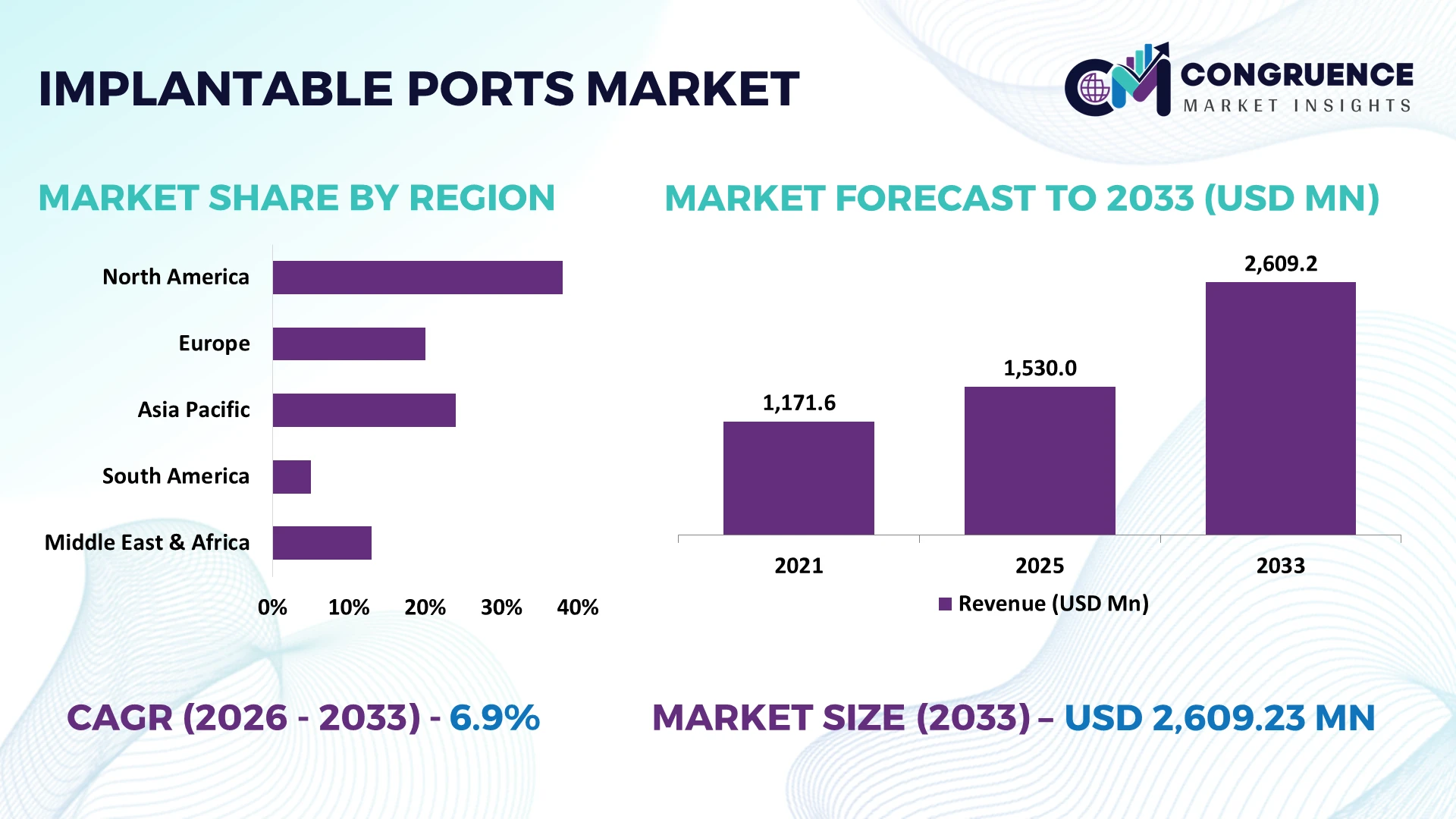
The Global Implantable Ports Market was valued at USD 1530 Million in 2025 and is anticipated to reach a value of USD 2609.23 Million by 2033 expanding at a CAGR of 6.9% between 2026 and 2033. Growth is driven by expanding chemotherapy administration, increasing long-term intravenous treatment requirements, and adoption of power-injectable vascular access ports for repeated infusion and diagnostic procedures.
The United States dominates the implantable ports market through extensive oncology treatment infrastructure, established vascular access practices, and advanced medical device manufacturing. Approximately 2.04 million new cancer cases were projected nationally in 2025, supporting demand for long-term chemotherapy access. The country also accounted for approximately 40% of global pharmaceutical research and development expenditure, strengthening its clinical innovation ecosystem. Compared with China, which recorded approximately 4.8 million new cancer cases in 2022, the United States benefits from established reimbursement pathways and widespread access to image-guided implantation procedures.
Strategically, manufacturers offering MRI-conditional, power-injectable ports with reliable catheter performance and infection-prevention features are positioned to strengthen hospital procurement relationships.
attempt access. Emerging Technologies: Three innovations shape advanced implantable ports: antimicrobial catheter materials, power-injectable reservoirs, and ultrasound-assisted vascular access techniques. Regional Leaders: North America leads established oncology access, Europe emphasizes standardized implantation practices, and Asia-Pacific expands hospital infusion capacity across 3 major healthcare environments. Consumer/End-User Trends: Approximately 20 million new cancer cases worldwide in 2022 reinforce demand for reliable repeated chemotherapy administration and durable vascular access devices. Pilot/Case Example: A 2024 clinical evaluation of totally implantable venous access ports demonstrated the importance of monitoring 2 outcomes: infection incidence and device-related thrombosis. Competitive Landscape: BD, Teleflex, B. Braun, AngioDynamics, and Cook Medical compete through 3 differentiators: catheter reliability, power injection compatibility, and clinical support. Regulatory & ESG Impact: EU Medical Device Regulation requires clinical evidence and post-market surveillance, reinforcing traceability across 4 implantable port components and associated accessories. Investment & Funding: Medical device manufacturers prioritize 3 investment areas: advanced biomaterials, automated production quality control, and distribution partnerships with oncology centers. Innovation & Future Outlook: By 2033, advanced implantable port development will increasingly prioritize 3 capabilities: reduced catheter complications, improved access ergonomics, and compatibility with diagnostic imaging workflows.
Key Highlights of the Global Implantable Ports Market
-
Market Size & Growth: USD 1,530 million in 2025, reaching USD 2,609.23 million by 2033 at 6.9% CAGR, supported by expanding oncology infusion requirements.
-
Top Growth Drivers: Cancer incidence increases approximately 77% globally by 2050; aging populations and repeated intravenous treatment requirements strengthen long-term vascular access demand.
-
Short-Term Forecast: By 2028, hospital procurement increasingly emphasizes 2 performance indicators: catheter-related infection incidence and successful first-attempt access.
-
Emerging Technologies: Three innovations shape advanced implantable ports: antimicrobial catheter materials, power-injectable reservoirs, and ultrasound-assisted vascular access techniques.
-
Regional Leaders: North America leads established oncology access, Europe emphasizes standardized implantation practices, and Asia-Pacific expands hospital infusion capacity across 3 major healthcare environments.
-
Consumer/End-User Trends: Approximately 20 million new cancer cases worldwide in 2022 reinforce demand for reliable repeated chemotherapy administration and durable vascular access devices.
-
Pilot/Case Example: A 2024 clinical evaluation of totally implantable venous access ports demonstrated the importance of monitoring 2 outcomes: infection incidence and device-related thrombosis.
-
Competitive Landscape: BD, Teleflex, B. Braun, AngioDynamics, and Cook Medical compete through 3 differentiators: catheter reliability, power injection compatibility, and clinical support.
-
Regulatory & ESG Impact: EU Medical Device Regulation requires clinical evidence and post-market surveillance, reinforcing traceability across 4 implantable port components and associated accessories.
-
Investment & Funding: Medical device manufacturers prioritize 3 investment areas: advanced biomaterials, automated production quality control, and distribution partnerships with oncology centers.
-
Innovation & Future Outlook: By 2033, advanced implantable port development will increasingly prioritize 3 capabilities: reduced catheter complications, improved access ergonomics, and compatibility with diagnostic imaging workflows.
The Implantable Ports Market is evolving as oncology providers prioritize durable vascular access for chemotherapy, supportive medication administration, and repeated blood sampling. Power-injectable ports, low-profile titanium reservoirs, and silicone catheter technologies are improving compatibility with clinical treatment pathways. Global cancer diagnoses are projected to increase approximately 77% between 2022 and 2050, reinforcing the importance of scalable infusion infrastructure. Healthcare providers are also strengthening device traceability and post-implantation surveillance under evolving medical device regulations. These developments are influencing hospital procurement criteria, manufacturer innovation priorities, and the strategic direction of long-term vascular access solutions.
What Is the Strategic Relevance and Future Pathways of the Implantable Ports Market?
Implantable ports are becoming strategically important to oncology infrastructure investment as healthcare providers prioritize reliable vascular access, outpatient chemotherapy delivery, and fewer treatment interruptions. The expanding use of long-duration infusion regimens is shifting procurement decisions toward device longevity, complication prevention, and compatibility with diagnostic procedures. Europe's Medical Device Regulation is also increasing clinical evidence and traceability requirements, encouraging manufacturers to strengthen quality systems and product documentation across international distribution networks.
Power-injectable implantable ports offer advantages over conventional non-power-rated devices by supporting contrast injection at manufacturer-specified flow rates, commonly up to 5 mL per second. This eliminates the need for separate intravenous access in eligible imaging procedures. North America benefits from established interventional radiology infrastructure, while India and China are expanding oncology treatment capacity through hospital modernization. Clinical studies report implanted port infection rates frequently below 2% in selected patient populations, emphasizing the value of standardized insertion techniques and maintenance protocols.
Between 2026 and 2028, manufacturers are expected to prioritize low-profile reservoirs, improved catheter materials, and streamlined implantation kits. Hospitals increasingly evaluate device performance through infection incidence, catheter patency, and unplanned removal rates. Partnerships with oncology networks and vascular access specialists will strengthen product adoption, while suppliers combining procedural efficiency with reliable long-term device performance will achieve stronger competitive positioning.
Implantable Ports Market Dynamics
DRIVER:
Expanding Oncology Treatment and Long-Term Vascular Access
Increasing cancer treatment volumes are strengthening demand for totally implantable venous access ports. Global cancer diagnoses are projected to increase approximately 77% by 2050, while cancer-related deaths are expected to rise approximately 90%, intensifying requirements for durable infusion infrastructure. In the United States, an estimated 40% of people develop cancer during their lifetime, supporting sustained oncology service utilization. Repeated chemotherapy cycles and supportive intravenous treatments make peripheral venous access increasingly impractical for selected patients. Hospitals are expanding outpatient infusion capacity and adopting image-guided port implantation to improve procedural consistency. Manufacturers are responding through power-injectable devices, improved catheter designs, and partnerships with oncology treatment centers. Long-term device reliability increasingly influences institutional procurement decisions.
RESTRAINT:
Device Complications and Procurement Cost Pressures
Device-related complications and procurement constraints limit implantable port adoption across resource-sensitive healthcare systems. Clinical studies report catheter-related infection rates ranging approximately 1–5%, while port-associated thrombosis occurs in around 2–5% of patients, depending on clinical conditions and follow-up duration. These complications increase treatment costs through additional imaging, antimicrobial therapy, and premature device replacement. In India, differences in hospital reimbursement arrangements and access to interventional radiology services create procurement challenges for smaller healthcare facilities. Imported titanium reservoirs, specialized silicone catheters, and sterile implantation accessories also increase supply-chain exposure. Manufacturers are responding through regional distribution partnerships, alternative material sourcing, and standardized device kits. Hospitals increasingly evaluate total treatment costs rather than initial acquisition prices.
OPPORTUNITY:
Advanced Port Designs and Outpatient Oncology Expansion
Outpatient oncology expansion creates opportunities for compact, power-injectable implantable ports designed for repeated treatment and diagnostic access. Approximately 70% of cancer deaths occur in low- and middle-income countries, highlighting the importance of accessible treatment infrastructure. Global cancer incidence is projected to increase approximately 77% by 2050, while selected clinical studies report implanted port infection rates below 2% under standardized maintenance protocols. China is expanding oncology treatment capacity through specialized hospitals and regional cancer centers, creating opportunities for cost-optimized vascular access products. Manufacturers are investing in low-profile reservoirs, improved septum durability, and antimicrobial surface technologies. Partnerships with outpatient infusion networks can accelerate adoption by combining device supply with procedural training and maintenance support.
CHALLENGE:
Procedural Standardization and Long-Term Device Performance
Maintaining consistent implantation quality and long-term catheter performance remains a critical challenge as vascular access procedures expand across different healthcare settings. Published clinical studies report mechanical complication rates of approximately 1–4%, while catheter-associated thrombosis ranges around 2–5%, depending on patient characteristics and device management. In India, differences in ultrasound availability, specialist training, and post-implantation follow-up practices complicate standardized care delivery. Port malfunction, catheter migration, and repeated access difficulties can interrupt chemotherapy schedules and increase unplanned hospital visits. Manufacturers must strengthen clinician training, device traceability, and post-market surveillance while improving catheter-tip stability and reservoir accessibility. Long-term competitiveness depends on reducing preventable complications through coordinated product engineering and clinical support.
Implantable Ports Market Latest Trends
-
Ultrasound Guidance Standardizes Venous Access: Hospitals increasingly use real-time ultrasound and fluoroscopic confirmation during implantable port placement. Ultrasound-guided internal jugular cannulation achieves first-attempt success rates exceeding 85% in experienced settings, while reducing mechanical complications compared with landmark techniques. Medical device suppliers are collaborating with interventional radiology departments to standardize procedural kits, improve catheter positioning, and reduce repeat cannulation requirements. This transition supports predictable procedure scheduling and more efficient use of specialist operating capacity.
-
Maintenance Protocols Prioritize Infection Prevention: Oncology providers are strengthening sterile access procedures, needle replacement schedules, and catheter flushing protocols. Published clinical series report port-related infection rates around 1–3%, with variation according to patient characteristics and maintenance practices. Hospitals are implementing standardized nursing competency assessments and electronic device maintenance records. Manufacturers are expanding clinician education and supplying compatible non-coring access needles, helping reduce preventable complications and unplanned treatment interruptions.
-
Regulatory Traceability Reshapes Device Manufacturing: European manufacturers are adapting implantable port documentation to Medical Device Regulation requirements, including clinical evaluation, post-market surveillance, and unique device identification. Implantable ports generally fall within Class III regulatory requirements, increasing scrutiny of long-term safety evidence. Suppliers are strengthening material traceability, validating sterilization processes, and digitizing batch records. These changes improve recall precision and encourage closer procurement relationships between hospitals and manufacturers with established regulatory infrastructure.
-
Patient Comfort Influences Port Selection: Oncology centers increasingly consider reservoir profile, implantation location, and repeated access comfort when selecting vascular access devices. Implantable ports commonly remain functional for several years when properly maintained, while standard non-coring needles typically require replacement within 7 days during continuous access. Manufacturers are refining septum geometry and reservoir ergonomics, supporting easier clinical access and reducing discomfort associated with repeated treatment visits.
Segmentation Analysis
By Type
Single-Lumen Ports Lead Established Clinical Utilization
Single-Lumen Ports represent the leading type within the global Implantable Ports Market, supported by widespread use in routine chemotherapy and long-term intravenous medication administration. Their single-reservoir configuration simplifies implantation, reduces device complexity, and supports established clinical maintenance protocols. Compared with Double-Lumen Ports, single-lumen systems require less subcutaneous space and generally offer lower acquisition costs. Clinical studies report successful long-term port functionality exceeding 90% in selected patient populations, reinforcing their suitability for repeated vascular access. Hospitals consequently prioritize single-lumen devices for patients requiring sequential rather than simultaneous infusions. Manufacturers maintain broad product portfolios emphasizing catheter durability, septum reliability, and procedural compatibility.
Power-Injectable Ports represent the fastest-growing type as healthcare providers increasingly coordinate infusion treatment with contrast-enhanced diagnostic imaging. Selected devices support injection flow rates up to 5 mL per second, enabling additional clinical functionality without separate peripheral access. Double-Lumen Ports serve patients requiring simultaneous administration of incompatible medications or complex infusion regimens. Manufacturers are expanding power-injectable product lines, improving reservoir identification features, and strengthening radiology partnerships to support integrated treatment workflows.
- The American Cancer Society estimated approximately 2.04 million new cancer diagnoses in the United States during 2025. This substantial treatment population reinforces demand for durable venous access systems, particularly single-lumen devices supporting repeated chemotherapy administration.
By Application
Chemotherapy Dominates Long-Term Vascular Access Demand
Chemotherapy represents the leading application within the Implantable Ports Market because repeated administration of anticancer medications requires reliable central venous access and consistent catheter performance. Patients receiving multiple treatment cycles benefit from reduced peripheral venipuncture requirements and improved access to vesicant medications. Global cancer diagnoses reached approximately 20 million in 2022, creating a substantial clinical population requiring systemic treatment evaluation. Hospitals and oncology centers increasingly standardize implantable port selection according to treatment duration, medication compatibility, and vascular access requirements. Blood Transfusion remains an established application for patients requiring recurrent blood product administration, particularly those with hematological disorders and complex treatment schedules.
Long-Term Medication Delivery is emerging as an important expansion application as providers manage chronic intravenous therapies beyond conventional oncology settings. Parenteral Nutrition supports specialized patients with prolonged gastrointestinal dysfunction, where reliable central access is essential. Clinical studies indicate port-associated infection rates commonly below 3% in selected cohorts, emphasizing the importance of maintenance protocols. Manufacturers are strengthening device compatibility, clinician training, and application-specific distribution to support broader therapeutic utilization.
- The World Health Organization's 2025 cancer information updates emphasize the increasing burden of malignancies worldwide, with approximately one in five people developing cancer during their lifetime. This clinical demand supports sustained investment in chemotherapy delivery infrastructure.
By End-User
Hospitals Lead Implantable Port Procurement
Hospitals represent the dominant end-user group within the Implantable Ports Market because they combine surgical implantation facilities, diagnostic imaging infrastructure, oncology departments, and specialist vascular access teams. Their integrated clinical environments support device insertion, complication management, and long-term maintenance within established treatment pathways. In the United States, approximately 2.04 million new cancer cases were projected for 2025, reinforcing hospital demand for reliable infusion access. Compared with Specialty Clinics, hospitals accommodate more complex patients requiring image-guided placement and multidisciplinary monitoring. Procurement teams increasingly prioritize device standardization, sterile procedure kits, and manufacturer-supported clinician training. Suppliers are strengthening institutional distribution agreements and product evaluation programs to improve purchasing consistency.
Ambulatory Surgical Centers represent a developing expansion segment as suitable implantation procedures shift toward scheduled outpatient settings. Specialty Cancer Centers maintain strong demand through concentrated chemotherapy services and dedicated infusion teams, while Specialty Clinics support ongoing access maintenance and medication delivery. Power-injectable ports capable of handling contrast flow rates up to 5 mL per second strengthen procedural flexibility. Manufacturers are expanding outpatient-focused device kits and clinical support partnerships.
- The American Hospital Association reported approximately 6,093 hospitals operating across the United States in its 2025 statistical profile. This extensive institutional network provides established procurement infrastructure for implantable vascular access devices and related clinical services.
Region-Wise Market Insights
North America accounted for the largest market share at an estimated 38% in 2025 however, Asia-Pacific is expected to register the fastest growth, expanding at a CAGR of an estimated 8.5% between 2026 and 2033.

North America Implantable Ports Market
Advanced Oncology Infrastructure Strengthens Vascular Access Adoption
North America maintains a leading position in the implantable ports market, supported by established oncology treatment networks, advanced interventional radiology capabilities, and standardized vascular access procedures. The United States accounts for the largest regional deployment concentration, while Canada contributes through publicly funded cancer treatment programs and specialized infusion centers. Hospitals increasingly prioritize power-injectable ports compatible with contrast-enhanced imaging and long-duration chemotherapy administration. Selected devices support contrast injection rates up to 5 mL per second, improving procedural flexibility. Established medical device manufacturers benefit from centralized hospital procurement, clinical training programs, and extensive distribution networks. The region's transition toward outpatient oncology delivery is also influencing device selection, with healthcare providers emphasizing low-profile reservoirs, catheter durability, and standardized maintenance. Suppliers offering integrated implantation kits and clinical education services strengthen institutional purchasing relationships.
United States Market Outlook: The United States benefits from extensive oncology infrastructure, established medical device regulatory pathways, and specialized vascular access teams. Approximately 2.04 million new cancer cases were projected nationally in 2025, reinforcing the clinical importance of durable infusion access. Hospitals increasingly use ultrasound-guided venous cannulation and fluoroscopic catheter-tip confirmation. Domestic manufacturers compete through power-injectable port technology, procedural support, and hospital distribution agreements.
Europe Implantable Ports Market
Regulatory Compliance and Clinical Standardization Reshape Procurement
Europe's implantable ports market is influenced by mature cancer treatment systems, stringent medical device regulation, and increasing emphasis on clinical evidence. Germany, France, Italy, and the United Kingdom represent important deployment centers, supported by established hospital oncology departments and specialist vascular access services. The European Medical Device Regulation strengthens clinical evaluation, post-market surveillance, and product traceability requirements for implantable devices. These obligations are encouraging manufacturers to invest in documentation systems, sterilization validation, and long-term device performance monitoring. Hospitals increasingly assess catheter-related infection incidence, mechanical reliability, and compatibility with established infusion protocols. European procurement systems also emphasize lifecycle performance rather than acquisition price alone. Manufacturers with validated product portfolios and established clinical support capabilities benefit from stronger relationships with institutional buyers and regional healthcare distributors.
Germany Market Outlook: Germany's extensive hospital infrastructure, specialized oncology centers, and established medical technology industry support implantable port utilization. Approximately 500,000 new cancer cases occur annually, creating substantial demand for chemotherapy delivery infrastructure. German healthcare providers emphasize standardized implantation procedures, ultrasound-assisted vascular access, and device maintenance protocols. Manufacturers benefit from established clinical evaluation capabilities and proximity to advanced medical device engineering and distribution networks.
Asia-Pacific Implantable Ports Market
Expanding Cancer Treatment Capacity Accelerates Device Deployment
Asia-Pacific is becoming an increasingly important implantable ports market as healthcare systems expand oncology treatment infrastructure and improve access to long-term infusion procedures. China, Japan, India, South Korea, and Australia contribute distinct clinical and manufacturing capabilities. China benefits from extensive hospital development and domestic medical device production, while Japan emphasizes advanced catheter technologies and standardized clinical maintenance. India is strengthening oncology infrastructure through specialized cancer hospitals and government-supported treatment programs. Regional manufacturers are expanding distribution networks and developing cost-competitive vascular access products to address differences in healthcare purchasing capacity. The adoption of image-guided implantation is improving procedural consistency across major urban hospitals. Procurement priorities increasingly favor reliable single-lumen devices alongside power-injectable systems, creating opportunities for suppliers offering differentiated product portfolios and clinician training.
China Market Outlook: China represents a major clinical demand center, with approximately 4.82 million new cancer cases recorded in 2022. The country's extensive tertiary hospital network supports increasing use of implantable venous access ports for repeated systemic treatment. Domestic medical device manufacturers are strengthening production capabilities, while oncology hospitals in Beijing, Shanghai, and Guangzhou are expanding specialized infusion services and image-guided implantation practices.
South America Implantable Ports Market
Oncology Service Modernization Supports Vascular Access Demand
South America's implantable ports market is developing through modernization of oncology treatment infrastructure, expansion of private healthcare networks, and improved access to specialized infusion procedures. Brazil represents the largest clinical demand center, followed by Argentina, Colombia, and Chile. Public healthcare systems provide substantial cancer treatment volumes, while private hospitals increasingly adopt advanced vascular access technologies. Brazil's Unified Health System supports extensive oncology service delivery, although regional differences in specialist availability influence device utilization. Implantable port procurement remains sensitive to imported device costs, reimbursement arrangements, and hospital purchasing budgets. Manufacturers are strengthening partnerships with local medical distributors and oncology centers to improve product availability. Standardized implantation kits and clinician education programs support more consistent procedural outcomes, particularly in hospitals expanding outpatient chemotherapy services.
Brazil Market Outlook: Brazil's extensive oncology treatment network and established medical device distribution sector support demand for implantable vascular access systems. Approximately 704,000 new cancer cases annually were estimated for the 2023–2025 period, excluding non-melanoma skin cancer from certain clinical comparisons. Major oncology institutions in São Paulo and Rio de Janeiro provide specialized infusion services. Suppliers are strengthening hospital procurement relationships and local distribution arrangements to improve device accessibility.
Middle East & Africa Implantable Ports Market
Healthcare Infrastructure Investment Expands Oncology Access
The Middle East & Africa implantable ports market is shaped by investment in specialized hospitals, oncology treatment modernization, and expanding access to advanced medical procedures. Saudi Arabia and the United Arab Emirates lead major healthcare infrastructure initiatives, while South Africa and Egypt represent important clinical demand centers. Gulf healthcare systems are expanding cancer treatment facilities and adopting international clinical standards for vascular access management. Saudi Arabia's Health Sector Transformation Program supports hospital modernization and improved access to specialized medical services. African markets face greater differences in oncology infrastructure, specialist availability, and imported device affordability. Manufacturers are developing regional distribution partnerships and clinician training programs to support broader deployment. Demand increasingly favors durable implantable ports that combine reliable catheter performance with manageable maintenance requirements and established clinical support.
Saudi Arabia Market Outlook: Saudi Arabia's healthcare modernization programs and expanding oncology infrastructure support advanced implantable port adoption. The country's Vision 2030 healthcare transformation emphasizes specialized treatment capacity, improved patient access, and medical technology investment. Major institutions in Riyadh and Jeddah are strengthening cancer treatment capabilities, including image-guided vascular access procedures. Manufacturers are expanding partnerships with hospital procurement organizations and regional distributors to support device availability and clinical training.
Market Competition Landscape
BD, Teleflex, B. Braun, AngioDynamics, and Vygon compete through implantable port design, catheter reliability, clinical support, and hospital distribution networks. These established manufacturers hold substantial procurement advantages, although their combined global market share requires validated company-level data. Competition increasingly centers on power-injection compatibility, infection prevention, and procedural efficiency. Selected clinical studies report port-related infection rates of 1–3%, while mechanical complications range approximately 1–4%, making device performance critical to purchasing decisions. BD emphasizes established vascular access portfolios, Teleflex leverages specialist procedural technologies, and B. Braun competes through integrated infusion solutions. Manufacturers strengthen market access through hospital partnerships, clinician training, product innovation, and regional distribution expansion. Regulatory documentation, sterilization validation, and specialized manufacturing capabilities create substantial entry barriers. Competitive positioning increasingly favors suppliers demonstrating consistent catheter performance, reliable product availability, and comprehensive clinical support across complex oncology treatment environments while maintaining disciplined pricing and dependable post-market surveillance systems globally.
Companies Profiled in the Implantable Ports Market Report
Technology Insights for the Implantable Ports Market
Contemporary implantable port systems combine titanium or polymer reservoirs, silicone catheters, and self-sealing septa to support repeated vascular access. Power-injectable designs accommodate contrast administration at manufacturer-specified flow rates, commonly reaching 5 mL per second. Ultrasound-guided implantation improves procedural accuracy compared with traditional landmark-based cannulation, with clinical studies demonstrating reductions exceeding 50% in selected mechanical complication outcomes. Fluoroscopic catheter-tip confirmation further supports reliable positioning. Hospitals increasingly integrate these technologies into standardized oncology workflows, reducing repeated venipuncture and improving coordination between chemotherapy administration and diagnostic imaging services.
Emerging innovations focus on antimicrobial catheter surfaces, low-profile reservoirs, and advanced septum materials designed for repeated needle penetration. Selected clinical studies report port-associated infection rates below 2% under structured maintenance protocols, emphasizing the importance of combining device engineering with procedural controls. Polymer-based reservoir designs offer alternatives to conventional metallic housings, while improved catheter materials target thrombosis and mechanical deterioration. Manufacturers investing in specialized biomaterials, sterilization validation, and clinician education gain competitive advantages through differentiated performance and stronger institutional purchasing relationships.
Between 2026 and 2028, technology development will prioritize improved device traceability, optimized catheter geometry, and simplified implantation accessories. Digital maintenance documentation and standardized clinical monitoring will strengthen long-term performance evaluation. Suppliers integrating advanced device engineering with reliable clinical training will improve procurement competitiveness and support broader outpatient treatment adoption.
Recent Developments in the Global Implantable Ports Market
-
June 2026: PorTal Access announced FDA clearance for its FLEXI-PORT implantable vascular access family, offering 5Fr and 6Fr configurations for adult and pediatric patients. The milestone enables commercialization, clinician training, and expanded chest or arm implantation options. Source: prnewswire.com
-
September 2025: BD received FDA clearance for Vaccess CT and PowerPort Duo implantable port configurations under submission K252478. The regulatory decision covers 3 device variants, supporting continued commercialization of power-injectable vascular access technologies for clinical infusion and imaging applications. Source: fda.gov
-
February 2025: Heidelberg University researchers published a clinical evaluation conducted with pfm medical involving 149 implantable port recipients. Among 1,240 documented catheter accesses, 91.4% were complication-free, strengthening clinical evidence supporting patient satisfaction and long-term vascular access performance. Source: springer.com
-
March 2025: Nanjing Medical University researchers evaluated single-incision axillary port implantation in 338 patients. The technique achieved 99.1% technical success and reduced average operating time from 36 to 26 minutes, demonstrating procedural efficiency advantages for oncology treatment centers. Source: nature.com
Scope of the Implantable Ports Market Report
The Implantable Ports Market Report provides comprehensive industry analysis for 2026–2033, covering three product types: Single-Lumen Ports, Double-Lumen Ports, and Power-Injectable Ports. Application coverage includes Chemotherapy, Blood Transfusion, Parenteral Nutrition, and Long-Term Medication Delivery. End-user assessment evaluates Hospitals, Specialty Cancer Centers, Ambulatory Surgical Centers, and Specialty Clinics. The report examines device utilization, procurement patterns, clinical adoption, and technological developments, including antimicrobial catheter materials, low-profile reservoirs, and image-guided implantation systems.
Regional analysis encompasses North America, Europe, Asia-Pacific, South America, and the Middle East & Africa, highlighting country-specific oncology infrastructure, regulatory requirements, and distribution capabilities. Competitive assessment profiles 12 manufacturers, examining product differentiation, manufacturing capabilities, and institutional partnerships. The report evaluates emerging outpatient implantation opportunities, power-injectable device adoption, and clinical performance indicators, supporting investment planning, geographical expansion, supplier selection, and strategic positioning through 2033.
Implantable Ports Market Report Summary
| Report Attribute/Metric | Report Details |
|---|
Market Revenue in 2025 | USD 1530 Million |
Market Revenue in 2033 | USD 2609.23 Million |
CAGR (2026 - 2033) | 6.9% |
Base Year | 2025 |
Forecast Period | 2026 - 2033 |
Historic Period | 2021 - 2025 |
Segments Covered | By TypeBy ApplicationLong-Term Medication Delivery
By End-UserAmbulatory Surgical Centers
|
Key Report Deliverable | Revenue Forecast, Growth Trends, Market Dynamics, Segmental Overview, Regional and Country-wise Analysis, Competition Landscape |
Region Covered | North America, Europe, Asia-Pacific, South America, Middle East, Africa |
Key Players Analyzed | Becton, Dickinson and Company (BD), Teleflex Incorporated, B. Braun Melsungen AG, AngioDynamics, Inc., Vygon Group, Cook Medical, ICU Medical, Inc., pfm medical, Medcomp, Access Vascular, Inc., Delta Med S.p.A., Polymed Medical Devices |
Customization & Pricing | Available on Request (10% Customization is Free) |