
Reports
The Global Imaging CRO Services Market was valued at USD 1697.46 Million in 2025 and is anticipated to reach a value of USD 3118.68 Million by 2033 expanding at a CAGR of 7.9% between 2026 and 2033. Growth is being driven by centralized imaging endpoints in oncology and neurology trials, rising imaging-biomarker use, and AI-enabled independent review across multinational Phase II–III studies.
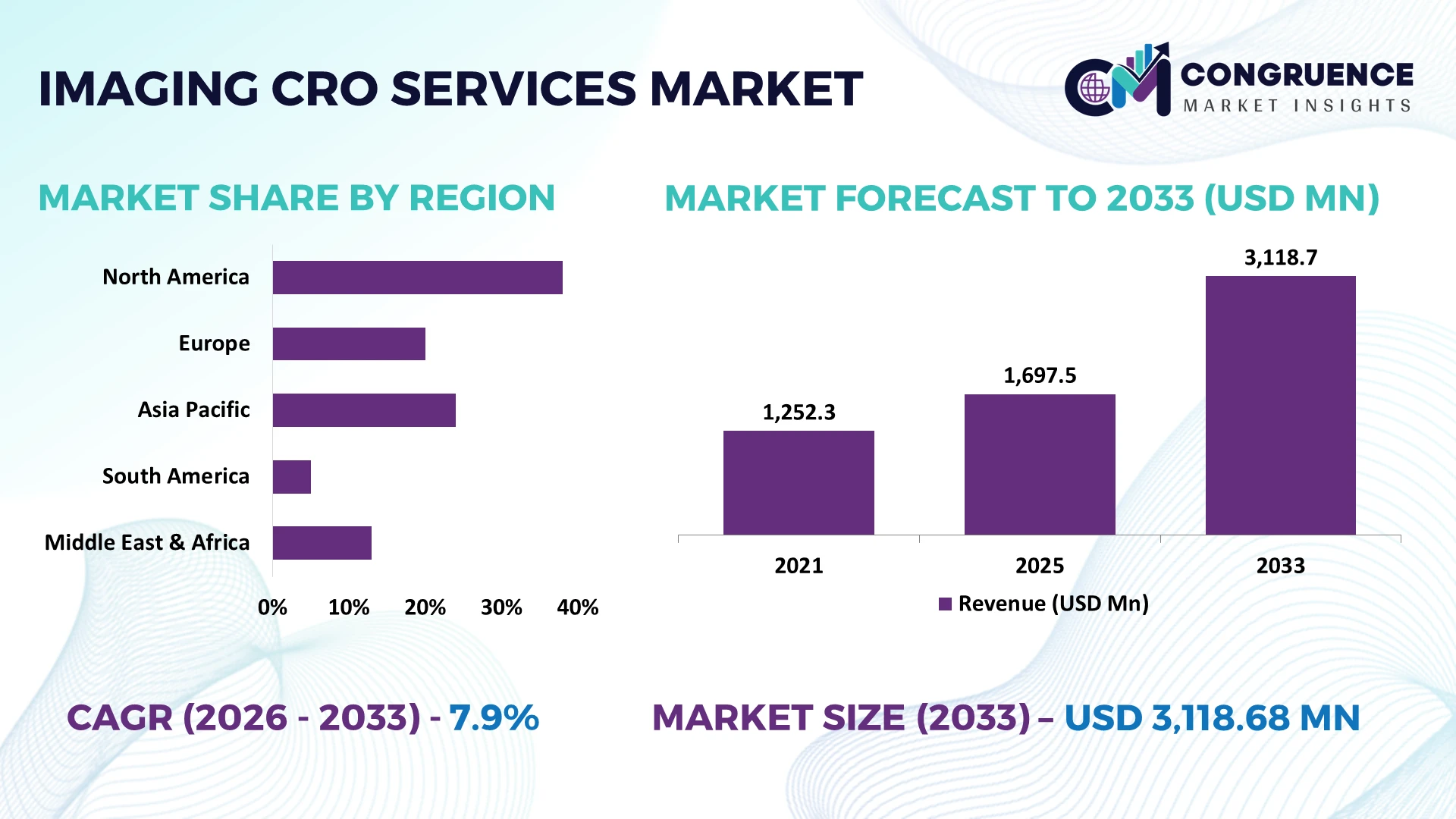
The U.S. anchors the global imaging CRO services landscape, with North America representing roughly 38–44% of clinical-trial imaging activity and the U.S. holding about 85.2% of North American demand. MRI represents approximately 35.9% of regional imaging workflows, while China holds about 39.8% of Asia-Pacific activity. FDA authorization of 40 radiation-oncology and diagnostic-imaging devices in 2024 reinforces U.S. technology adoption.
Strategically, sponsors should prioritize CRO partners combining global imaging-site coverage, regulatory-grade central reads, AI analytics, and scalable oncology expertise.
Market Size & Growth: USD 1,697.46 million in 2025 reaches USD 3,118.68 million by 2033 at 7.9%, supported by imaging-intensive oncology programs.
Top Growth Drivers: Oncology contributes 32.05%, Phase III studies 40.95%, and pharmaceutical/biotechnology sponsors 48.10% of clinical-trial imaging activity.
Short-Term Forecast: By 2028, AI-assisted workflows can deliver approximately 27.2% lower image-reading time, strengthening centralized review productivity.
Emerging Technologies: AI segmentation, quantitative imaging biomarkers, cloud-based image management, and automated quality control are reshaping advanced imaging CRO delivery.
Regional Leaders: At the 2033 market level, current regional mix implies approximately USD 1.22–1.37 billion for North America, USD 842 million for Europe, and USD 873 million for Asia-Pacific, with AI adoption and trial migration strengthening each hub.
End-User Trends: CROs represented 45.9% of U.S. clinical-trial imaging end use, confirming sustained outsourcing by biopharma sponsors seeking specialized readers and infrastructure.
Pilot/Case Example: In 2024, AI-supported CT interpretation reduced reading time 22.1%, from 421 seconds to 328 seconds per examination.
Competitive Landscape: North America holds roughly 44%; Clario, Medpace, IXICO, Alimentiv, and Resonance Health compete through centralized reads, biomarkers, and imaging analytics.
Regulatory & ESG Impact: FDA authorized 76 oncology devices in 2024, including 40 radiation-oncology and diagnostic-imaging devices, raising validation requirements for imaging workflows.
Investment & Funding: U.S. NCI funding reached USD 7.224 billion in FY2025, sustaining oncology research pipelines where imaging endpoints and biomarker services remain critical.
Innovation & Future Outlook: DovaVision AI now supports frame-level ulcerative-colitis endoscopy scoring, signaling a shift toward continuous quantitative endpoints across Phase I–IV trials.
Imaging CRO services are increasingly concentrated around oncology, neurology, gastroenterology, and precision-medicine studies requiring standardized multicenter image assessment. AI-assisted interpretation can reduce reading time by 27.2%, while cloud platforms, quantitative biomarkers, and automated quality checks strengthen endpoint consistency. The FDA’s expanding focus on AI and imaging-enabled oncology development is accelerating demand for validated, audit-ready global workflows, setting the stage for strategic vendor positioning.
Imaging CRO services are becoming strategically critical as biopharma companies shift complex oncology, neurology, and rare-disease trials toward centralized image review, quantitative biomarkers, and globally standardized endpoints. In FDA-approval-supporting cancer trials studied during the COVID-era transition, 95% adopted at least one decentralized element, while 89% used remote site monitoring. The FDA’s subsequent decentralized-trial framework has reinforced investment in secure image transfer, remote workflows, auditability, and interoperable clinical platforms.
Technology is changing the operating model. AI-assisted image interpretation reduces reading time by approximately 27.2% versus conventional human-only workflows and can reduce human reading volume by 58.5%, creating a significant productivity advantage for high-volume central review. U.S. sponsors lead deployment of AI-enabled imaging and regulatory-grade blinded independent central review, while China is scaling multicenter trial infrastructure and investigator capacity. This contrast increasingly favors providers capable of harmonizing heterogeneous scanner protocols across countries.
A practical model is AI-supported prescreening followed by specialist radiologist adjudication, which can reduce human reading volume by 61.7%. Through 2028, imaging CROs are prioritizing cloud platforms, biomarker analytics, oncology expertise, and technology partnerships. Providers combining validated AI with centralized quality control will secure stronger competitive positioning as imaging becomes a decision-grade clinical endpoint.
Oncology is the strongest structural driver because treatment-response assessment increasingly depends on CT, MRI, PET, and standardized independent review. In FDA-approval-supporting oncology trials assessed for decentralized adoption, 95% used at least one decentralized element, 89% implemented remote monitoring, and 68% incorporated telemedicine. The FDA’s formalization of decentralized clinical-trial practices strengthens the need to integrate locally acquired images into centrally controlled, submission-ready datasets. Imaging CROs therefore become essential for acquisition standardization, reader management, adjudication, and endpoint consistency. Companies are expanding cloud ingestion, AI-assisted quality control, and oncology-specific reading networks. The non-obvious advantage is data continuity: providers controlling imaging from site qualification through central review can reduce endpoint variability before it becomes a regulatory or trial-timeline problem.
Multicenter imaging remains structurally difficult because scanner generations, acquisition protocols, institutional policies, and data-transfer capabilities vary substantially between trial sites. Among oncology trials using decentralized elements, 83% of sponsors reported institutional-policy barriers, 61% encountered technology-adoption challenges, and 56% identified regulatory restrictions. These constraints become more pronounced when CT, MRI, PET, or nuclear-medicine images must satisfy identical endpoint criteria across U.S. and international sites. Poor protocol adherence creates image queries, repeat scans, reader uncertainty, and delayed database locks, directly raising operational workload. Imaging CROs are responding with pre-study scanner qualification, acquisition manuals, automated quality checks, and regional technical support. Strategically, early site standardization is more valuable than downstream correction because unusable baseline imaging can compromise an entire longitudinal response dataset.
AI is opening a higher-value opportunity beyond conventional image collection and central reading. Across medical-image interpretation studies, AI integration reduced reading time by 27.2% and human reading quantity by 58.5%; AI prescreening achieved a 61.7% reduction in reading volume. These efficiencies support scalable tumor segmentation, lesion tracking, quantitative biomarker extraction, and risk-based reader allocation. The FDA’s 2026 push toward digital health technologies and real-time clinical-trial concepts further strengthens the case for continuously connected imaging infrastructure. U.S. imaging CROs are investing in validated algorithms, cloud-native workflows, and partnerships linking radiology expertise with clinical data. The strategic opportunity lies in converting images into longitudinal quantitative evidence, allowing CROs to compete on endpoint intelligence rather than commoditized image logistics.
The long-term challenge is deploying AI across heterogeneous clinical environments without weakening reproducibility, cybersecurity, or human oversight. AI-supported interpretation delivers a 27.2% average reading-time reduction, yet performance varies by modality: CT shows approximately 25.6% time savings, while ultrasound evidence has not demonstrated equally consistent gains. Simultaneously, 61% of oncology trial sponsors using decentralized elements reported technology-adoption difficulties, highlighting the integration gap between sophisticated central platforms and individual research sites. Companies must validate algorithms across scanner types, populations, protocols, and software versions while preserving traceable reader adjudication. Investment is therefore shifting toward interoperable architectures, cybersecurity controls, algorithm monitoring, and specialized imaging scientists. Competitive durability will depend less on owning AI and more on proving that AI produces consistent, inspection-ready endpoints across multinational trials.
AI Moves Into Daily Operations: AI is shifting from pilot use into production imaging workflows as more than 50% of clinical trials and roughly 70% of oncology trials use imaging endpoints. High-volume platforms process thousands of uploads daily, prompting CROs to automate image classification, metadata checks, and routing while retaining specialist review for endpoint-critical decisions.
Decentralized Image Intake Expands: Distributed trial execution is restructuring image acquisition and transfer. In oncology studies adopting decentralized components, 95% used at least one remote element, 89% deployed remote monitoring, and 68% incorporated telemedicine. FDA decentralization guidance is pushing imaging providers toward cloud ingestion, remote site qualification, and standardized workflows connecting community facilities with central readers.
Flexible Outsourcing Models Gain Ground: Sponsor procurement is moving beyond rigid full-service contracts toward specialty, FSP, and blended arrangements. An industry survey found 72% of respondents expect greater flexible-outsourcing adoption, while ACRO’s 2025 dataset covered 4,296 outsourced studies and identified around half as trials with fewer than 100 participants. Imaging vendors are consequently modularizing specialist services.
Analytics Becomes Core Differentiator: Central reading is increasingly bundled with software, quantitative assessment, and data management rather than sold independently. Imaging software represented 31.85% of clinical-trial imaging activity in 2025, reading and analytical services accounted for approximately 30.95% in another industry assessment, and CT retained roughly 25% modality share. Providers are consolidating workflows around integrated endpoint platforms.
Within the specified service taxonomy, Clinical Imaging represents an estimated 44–46% of Imaging CRO Services Market activity, supported by Phase II–III endpoint assessment, multicenter image acquisition, blinded independent central review, and regulatory-grade data handling. More than 50% of clinical trials use imaging endpoints, rising to approximately 70% in oncology, giving clinical workflows substantially greater recurring service intensity than laboratory-oriented imaging. Preclinical Imaging maintains an estimated 18–20% share because pharmaceutical sponsors require longitudinal disease-model evaluation before human trials, while In Vivo Imaging accounts for roughly 15–17% through real-time pharmacodynamic and biodistribution assessment.
Bioanalytical Imaging is the fastest-shifting type as AI-derived phenotyping, quantitative biomarkers, and digital pathology convert images into measurable translational endpoints. Ex Vivo Imaging remains smaller but strategically important for tissue morphology, histology, and mechanistic validation. Providers are increasing investments in algorithm validation, multimodal data integration, and biomarker partnerships, shifting competitive advantage from image handling toward evidence generation. The commercial implication is clear: scalable clinical infrastructure protects current volume, while bioanalytical capability increasingly determines differentiation.
Drug Development leads the specified applications with an estimated 38–41% share because imaging supports efficacy evaluation, lesion measurement, dose-response assessment, safety monitoring, and regulatory endpoints throughout clinical development. Phase III studies alone represented about 40.95% of clinical-trial imaging activity in 2025, reinforcing demand for scalable reading networks and standardized multicenter workflows. Drug Discovery represents approximately 20–23%, with preclinical MRI, micro-CT, PET, and optical techniques supporting target validation and candidate selection. Pharmacokinetics and Toxicology Studies retain narrower but operationally important roles where imaging enables longitudinal distribution and organ-response assessment without repeated destructive sampling.
Biomarker Research is the fastest-expanding application within this taxonomy as sponsors move from qualitative interpretation toward quantitative imaging endpoints and patient stratification. Imaging biomarker services are gaining particular relevance in oncology, neurology, and rare-disease programs where anatomical change alone provides incomplete response information. CROs are responding by integrating segmentation algorithms, radiomics, pathology data, and centralized analytics into development platforms. Investment consequently shifts toward biomarker validation and data interoperability, making imaging intelligence increasingly critical to trial design rather than merely an endpoint-reading function.
Pharmaceutical Companies remain the dominant buyer group within the specified taxonomy, representing approximately 40–43% of Imaging CRO Services Market demand because large portfolios generate sustained requirements across protocol design, site qualification, image management, central reads, and regulatory submission. When pharmaceutical and biotechnology sponsors are considered together, they represented approximately 48.1% of clinical-trial imaging activity in 2025. Biotechnology Companies form the fastest-shifting direct-buyer segment as smaller sponsors increasingly outsource imaging infrastructure rather than building proprietary core laboratories. Contract Research Organizations also command a growing operational role as full-service CROs subcontract specialist imaging, analytics, and reader-management functions.
Academic Institutions and Research Institutes remain important for investigator-led studies, translational imaging, biomarker discovery, and early validation, although their projects typically operate at smaller scale and with tighter budgets. Imaging providers are responding with modular pricing, cloud access, specialty therapeutic packages, and preferred-provider partnerships. The non-obvious shift is toward ecosystem selling: specialist imaging companies increasingly need relationships with both sponsors and general CROs, because procurement authority and operational control are becoming separated across blended outsourcing models.
North America accounted for the largest market share at 38.1% in 2025 however, Asia-Pacific is expected to register the fastest growth, expanding at a CAGR of 8.6% between 2026 and 2033.
Centralized Imaging Infrastructure Reinforces Trial Leadership
North America commands approximately 38.1% of imaging CRO activity, supported by concentrated pharmaceutical R&D, mature academic medical centers, sophisticated radiology infrastructure, and extensive Phase II–III trial deployment. The U.S. remains the operational center, where oncology represents approximately 46% of clinical-trial imaging activity and image analysis and interpretation accounts for about 41% of service demand. FDA expectations around imaging endpoints and decentralized trial execution are accelerating cloud-based ingestion, blinded independent central review, and validated AI workflows. Providers are consequently expanding integrated imaging core laboratories rather than standalone reading capacity. Northeast U.S. facilities represented roughly 38% of domestic clinical-trial imaging activity in 2025, while West Coast biotechnology clusters are strengthening demand for biomarker-intensive trials. This concentration gives established CROs a decisive advantage in reader access, site connectivity, and sponsor relationships.
U.S. Market Outlook: The U.S. combines large biopharmaceutical pipelines with advanced imaging infrastructure and deep regulatory expertise. Pharmaceutical and biotechnology companies represent approximately 49% of domestic clinical-trial imaging end-user activity. Providers are building oncology, neurology, PET, and quantitative imaging capabilities around Boston, New York, Philadelphia, San Diego, and San Francisco, positioning specialist CROs closer to sponsor decision-making and early protocol development.
Regulatory Harmonization Reshapes Multicountry Imaging
Europe represents approximately 27% of global clinical-trial imaging activity, with Germany accounting for about 32% of regional demand and the U.K. approximately 24%. EU Clinical Trials Regulation implementation is creating more standardized multicountry submission and trial-management processes, increasing the value of CRO platforms capable of harmonizing imaging protocols, privacy controls, central reads, and cross-border data flows. Germany, France, the U.K., Italy, and Spain provide dense hospital networks suitable for oncology, neurological, cardiovascular, and rare-disease imaging studies. Providers are investing in interoperable image repositories and localized reader networks to manage GDPR requirements without fragmenting trial datasets. A structural shift toward multinational studies also favors vendors with European regulatory teams and standardized scanner-qualification processes. Competitive differentiation increasingly depends on coordinating heterogeneous hospital infrastructure under one validated imaging workflow rather than simply supplying interpretation capacity.
Germany Market Outlook: Germany is the region’s largest national imaging hub, representing approximately 32% of European clinical-trial imaging activity. Its university hospitals, established radiology networks, pharmaceutical manufacturing base, and high MRI and CT availability support complex multicenter studies. Imaging CROs are targeting German sites with standardized acquisition protocols and specialist reader networks, particularly for oncology, neurological disorders, and advanced therapeutic development.
Trial Localization Accelerates Imaging Deployment
Asia-Pacific accounts for approximately 28% of global clinical-trial imaging activity and is shifting rapidly from supplementary patient recruitment toward full-scale multinational study execution. China represents roughly 47% of regional activity, while Japan contributes approximately 22%, reflecting substantial concentration in two sophisticated clinical-research systems. Large patient pools, expanding biotechnology pipelines, competitive trial operating costs, and regulatory modernization are encouraging sponsors to place more imaging-intensive studies in China, Japan, South Korea, India, and Australia. PET deployment and advanced imaging biomarkers are gaining importance as oncology and precision-medicine programs expand. Imaging CROs are building local project-management teams, bilingual reader networks, cloud transfer infrastructure, and scanner-standardization capabilities to reduce cross-border variability. The region’s strategic advantage is increasingly data scale: broader patient access can strengthen enrollment speed while generating more diverse imaging datasets for biomarker validation and AI development.
China Market Outlook: China holds approximately 47% of Asia-Pacific clinical-trial imaging activity, supported by extensive tertiary-hospital infrastructure, expanding domestic biotechnology pipelines, and increasing participation in global drug development. CROs are strengthening partnerships with major hospitals in Shanghai, Beijing, Guangzhou, and Suzhou, where high-volume oncology studies create demand for CT, MRI, PET, centralized image management, and quantitative response assessment.
Brazil Anchors Expanding Trial Networks
South America remains a smaller imaging CRO market but offers strategically valuable patient recruitment capacity for multinational oncology, cardiovascular, metabolic, and infectious-disease studies. Brazil dominates deployment because of its large population, established research hospitals, and expanding sponsor interest in geographically diversified clinical programs. Brazil’s Law 14,874/2024 established a national framework for research involving human subjects, reshaping the regulatory environment for clinical development and increasing pressure for standardized documentation and data governance. Imaging CROs are responding through partnerships with local hospitals, remote image-transfer systems, and centralized quality-control models rather than capital-intensive proprietary site networks. Infrastructure quality remains uneven outside major urban centers, making scanner qualification and technical support essential. The operational opportunity therefore lies in connecting high-performing Brazilian and Argentine sites to global reading platforms without sacrificing protocol consistency or image turnaround.
Brazil Market Outlook: Brazil provides South America’s strongest combination of patient availability, tertiary-care infrastructure, and multinational trial participation. São Paulo, Rio de Janeiro, Porto Alegre, and Belo Horizonte concentrate advanced CT, MRI, PET, and academic research capacity. The 2024 clinical-research law is strengthening institutional governance, encouraging imaging CROs to establish localized regulatory expertise and closer site-support relationships for multinational studies.
Healthcare Modernization Opens Specialized Trial Capacity
Middle East & Africa represents roughly 6–7% of global clinical-trial imaging activity, with deployment concentrated in the UAE, Saudi Arabia, Israel, South Africa, and selected Turkish research centers. Gulf healthcare modernization is creating advanced radiology capacity that can support imaging-intensive oncology and precision-medicine trials, while South Africa provides established research institutions and comparatively broad patient access. Saudi Arabia’s biotechnology strategy and healthcare transformation are directing resources toward clinical research, genomics, localized pharmaceutical development, and digital health infrastructure. Imaging CROs are consequently building relationships with specialist hospitals and local research organizations instead of deploying broad standalone networks. Uneven research-site maturity remains a constraint across Africa, so centralized cloud infrastructure and remote quality assurance carry disproportionate operational value. Providers capable of linking modern Gulf imaging facilities with internationally standardized endpoint workflows gain an early positioning advantage.
Saudi Arabia Market Outlook: Saudi Arabia is emerging as a strategic Gulf clinical-research hub through Vision 2030 healthcare modernization and its National Biotechnology Strategy. Riyadh and Jeddah are adding sophisticated oncology, radiology, genomic, and digital-health capabilities. Imaging CROs are pursuing hospital partnerships and localized trial-support infrastructure, positioning for increased multinational studies requiring MRI, CT, PET, imaging biomarkers, and secure cross-border data management.
Clario, ICON, Medpace, Median Technologies, IXICO, and Imaging Endpoints define the core competitive field, with global CRO platforms competing against specialist imaging providers for oncology, neurology, and biomarker-intensive programs. The top five players collectively control an estimated 45–50% of imaging CRO activity, leaving meaningful scope for specialized providers. Technology is replacing price as the decisive battleground: AI-assisted interpretation can reduce reading time by about 27%, while centralized analytical services represent roughly 31% of clinical-trial imaging demand. Global leaders compete through integrated trial management, multinational site networks, and acquisitions; specialists counter with therapeutic expertise, faster customization, quantitative biomarkers, and proprietary analytics. Consolidation is shifting procurement toward end-to-end platforms combining image acquisition, quality control, central reading, and regulatory documentation. Validation requirements, specialist-reader availability, data-security infrastructure, and global site connectivity create formidable entry barriers. Winning requires scalable infrastructure, therapeutic depth, validated automation, rapid turnaround, and demonstrable endpoint consistency across multinational trials.
Clario
ICON plc
Medpace, Inc.
Median Technologies
IXICO plc
Imaging Endpoints
Micron, Inc.
Image Analysis Group
Biospective Inc.
MERIT CRO, Inc.
Perspectum
ProSciento
ABX-CRO
Resonance Health
AI-enabled image quality control, segmentation, de-identification, and reader assistance are becoming core technologies. Automated quality control can reduce common submission errors six- to 48-fold, while AI-assisted interpretation cuts reading time about 27%. Today, leading endpoint platforms report more than 1,600 AI deployments across clinical trials. Sponsors gain faster image acceptance, fewer queries, and more consistent central reads.
Emerging cloud-native imaging platforms integrate DICOM ingestion, EDC reconciliation, quantitative biomarkers, radiomics, and real-time trial oversight. Automated classification can identify more than 10,000 MRI or X-ray series weekly, while facial masking can compress selected manual quality-control tasks from roughly 60 minutes to one minute. Compared with legacy manual workflows, this represents about 98% faster processing for that task, benefiting imaging CROs managing multinational oncology and neuroscience datasets.
Disruptive development shifts toward multimodal AI that combines MRI, PET, CT, digital pathology, blood biomarkers, and clinical endpoints. Federated analytics, generative AI document processing, and validated algorithm governance will deepen integration without moving sensitive datasets unnecessarily. By 2026–2028, adoption will increasingly favor regulatory-grade platforms combining human oversight with automated biomarker extraction. Large specialist CROs and technology-led imaging providers benefit most because scale spreads validation costs across trials; sponsors should act now to secure interoperable, AI-ready workflows.
March 2024 — Clario partnered with Cleveland Clinic’s Cole Eye Institute, combining AI-enabled ophthalmic imaging with an expanded grader network. The collaboration covers 70+ Phase I–IV trials, strengthening quantitative retinal endpoints and accelerating sponsor access to specialized assessment. Source: clario.com
May 2025 — Image Analysis Group partnered with Picture Health to integrate DYNAMIKA with multimodal AI imaging biomarkers for oncology trials. IAG’s platform supports 700+ global trials, extending quantitative endpoint capabilities and helping sponsors identify treatment response earlier. Source: picturehealth.com
November 2025 — IXICO secured a global Phase III Huntington’s disease imaging-services contract exceeding £3.5 million over four years. The award expands AI-driven neuroimaging deployment in late-stage development and strengthens IXICO’s position in biomarker-intensive neurological trials worldwide significantly. Source: fca.org.uk
May 2026 — Image Analysis Group and HeartcoR Solutions partnered to integrate imaging with cardiac-safety services through DYNAMIKA. IAG has supported 700+ global trials; the unified workflow combines ECG, monitoring, adjudication, imaging acquisition, and quantitative analysis for sponsors. Source: dicardiology.com
The Imaging CRO Services Market report evaluates Preclinical Imaging, Clinical Imaging, In Vivo Imaging, Ex Vivo Imaging, and Bioanalytical Imaging across Drug Discovery, Drug Development, Biomarker Research, Pharmacokinetics, and Toxicology Studies. It assesses demand from pharmaceutical companies, biotechnology companies, academic institutions, research institutes, and contract research organizations, alongside North America, Europe, Asia-Pacific, South America, and Middle East & Africa.
Technology coverage includes AI-assisted interpretation, automated image quality control, cloud-native DICOM management, radiomics, quantitative biomarkers, central reading, and multimodal analytics. Leading platforms already demonstrate more than 1,600 AI deployments, while automated workflows can identify over 10,000 image series weekly, indicating increasing operational scale. The 2026–2033 assessment tracks therapeutic specialization, outsourcing models, regulatory-grade automation, geographic expansion, and emerging imaging endpoints, helping stakeholders prioritize investments, evaluate partnerships, benchmark competitors, identify deployment gaps, and position capabilities around increasingly data-intensive clinical development programs.
| Report Attribute/Metric | Report Details |
|---|---|
Market Revenue in 2025 | USD 1697.46 Million |
Market Revenue in 2033 | USD 3118.68 Million |
CAGR (2026 - 2033) | 7.9% |
Base Year | 2025 |
Forecast Period | 2026 - 2033 |
Historic Period | 2021 - 2025 |
Segments Covered | By Type
By Application
By End-User
|
Key Report Deliverable | Revenue Forecast, Growth Trends, Market Dynamics, Segmental Overview, Regional and Country-wise Analysis, Competition Landscape |
Region Covered | North America, Europe, Asia-Pacific, South America, Middle East, Africa |
Key Players Analyzed | Clario, ICON plc, Medpace, Inc., Median Technologies, IXICO plc, Imaging Endpoints, Micron, Inc., Image Analysis Group, Biospective Inc., MERIT CRO, Inc., Perspectum, ProSciento, ABX-CRO, Resonance Health |
Customization & Pricing | Available on Request (10% Customization is Free) |




