
Reports
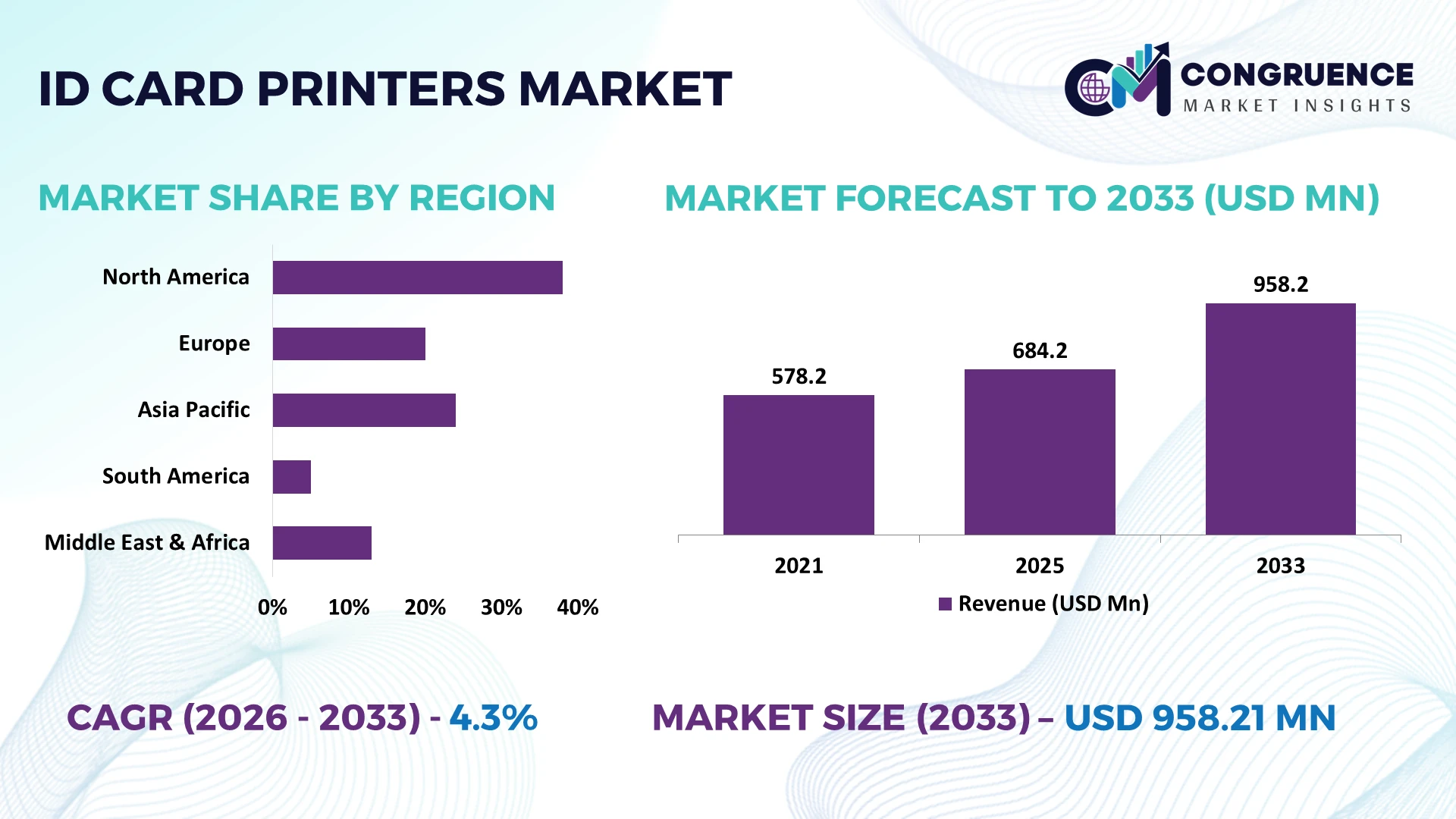
The Global ID Card Printers Market was valued at USD 684.2 Million in 2025 and is anticipated to reach a value of USD 958.21 Million by 2033 expanding at a CAGR of 4.3% between 2026 and 2033. Growth is driven by secure employee credentialing, government identity programs, contactless smart-card issuance, decentralized badge printing, and migration toward retransfer printers supporting higher-security card technologies.
The United States leads global ID card printer deployment, with North America accounting for approximately 36% of 2025 demand, supported by federal agencies, healthcare networks, universities, corporations, and access-control integrators. Federal PIV credentials use mandatory smart-card technology, while FIPS 201-3 strengthens requirements around identity proofing and authentication. Compared with India, where Aadhaar exceeds 1.4 billion generated IDs but relies heavily on centralized digital identity infrastructure, U.S. physical credential issuance remains more decentralized. Ongoing U.S.–China technology trade restrictions are also reinforcing secure electronics sourcing and supplier diversification.
Manufacturers should prioritize secure encoding, decentralized issuance software, retransfer technology, and resilient electronics sourcing to capture enterprise and government credential modernization programs.
Market Size & Growth: USD 684.2 million in 2025 reaches USD 958.21 million by 2033 at 4.3% CAGR, supported by secure credential modernization.
Top Growth Drivers: Contactless credential migration 38%, decentralized issuance 31%, and enterprise access-control modernization 26% lead adoption priorities.
Short-Term Forecast: By 2028, automated credential workflows can reduce manual enrollment and issuance handling by approximately 20–30% across centralized enterprise environments.
Emerging Technologies: 600-dpi printing, retransfer imaging, mobile credential integration, and automated encoding are improving personalization precision and credential security.
Regional Leaders: North America represents approximately 36%, Europe 29%, and Asia-Pacific 27%, with government and enterprise identification programs shaping deployment.
Consumer/End-User Trends: Contactless smart-card credentials increasingly dominate secure installations, with 13.56-MHz technologies supporting multi-application identity and access workflows.
Pilot/Case Example: In 2025, next-generation desktop platforms reached 300–600 dpi resolution while integrating printing, encoding, lamination, and software-controlled issuance.
Competitive Landscape: HID holds an estimated 20%+ market position, competing with Entrust, Zebra Technologies, Evolis, and Matica across secure credential issuance.
Regulatory & ESG Impact: ENERGY STAR imaging-equipment criteria target lower operating consumption, while reusable printer architecture can extend device service life beyond 5 years.
Investment & Funding: Leading identity-technology suppliers allocate USD 100+ million annually across R&D programs spanning secure credentials, digital identity, automation, and authentication technologies.
Innovation & Future Outlook: 600-dpi retransfer, cloud-managed issuance, and 2+ credential formats are shifting competition from standalone printers toward integrated identity platforms.
ID Card Printers Market demand is concentrated across government agencies, corporate campuses, healthcare networks, educational institutions, financial services, transportation, and hospitality environments requiring controlled credential issuance. Retransfer imaging, 600-dpi personalization, contactless encoding, automated lamination, and cloud-managed workflows are strengthening security and decentralizing production. North America accounts for approximately 36% of global demand, while large digital-identity programs in India demonstrate the parallel shift toward hybrid physical-digital credentials. Semiconductor and secure-electronics supply diversification amid continuing U.S.–China technology restrictions is also influencing procurement strategies, establishing the operational context for the market’s strategic assessment.
ID card printers are becoming strategically important as enterprises shift credentialing from visual identification toward authenticated physical-digital access. U.S. FIPS 201-3 requirements reinforce smart-card identity verification, while healthcare, education, corporate campuses, and government agencies increasingly integrate physical badges with logical access. Procurement is consequently shifting from standalone printers toward networked issuance platforms combining printing, encoding, lamination, and credential lifecycle management.
Technology upgrades materially improve personalization quality and workflow productivity. Current retransfer systems reach 600 dpi versus 300 dpi for mainstream direct-to-card platforms, delivering 100% higher linear print resolution while supporting edge-to-edge imagery and embedded smart-card electronics. North America emphasizes decentralized enterprise credentialing, Europe prioritizes privacy-compliant secure identity infrastructure, and India combines physical credentials with digital identity at population scale. Hybrid issuance therefore requires different hardware-software configurations by market.
Through 2026–2028, cloud-managed issuance, mobile credential interoperability, automated encoding, and remote fleet diagnostics will increasingly shape procurement. A multi-site healthcare network, for example, can centrally govern templates while printing badges locally, reducing credential distribution delays. HID, Entrust, Evolis, Zebra, and Matica are expanding integrated issuance capabilities. Competitive advantage will center on secure interoperability, workflow automation, serviceability, and lifecycle control rather than print hardware alone.
Enterprise access modernization is the strongest structural driver as organizations replace visually authenticated badges with encoded, machine-readable credentials. North America represents approximately 36% of global printer demand, while contactless credentials increasingly operate at 13.56 MHz and advanced retransfer platforms support up to 600-dpi personalization. In the United States, FIPS 201-3 reinforces stronger identity proofing and authentication across federal credential environments, influencing adjacent high-security deployments. This shift increases requirements for inline encoding, lamination, secure printing, and centralized issuance software. Manufacturers are responding by integrating smart-card encoders, UV security features, remote management, and multi-site administration into printer portfolios. The non-obvious advantage is recurring software and consumables attachment: secure credential modernization increases lifecycle value beyond the initial hardware installation.
High-security printers carry materially greater acquisition and operating requirements than conventional direct-to-card equipment because retransfer film, laminates, smart-card encoders, and secure consumables add workflow complexity. Standard systems commonly operate at 300 dpi, while premium 600-dpi platforms require higher-specification printheads, imaging components, and processing electronics. Retransfer workflows also introduce an additional transfer-film consumable, increasing material usage compared with direct-to-card printing. Semiconductor and electronics sourcing remains exposed to U.S.–China trade restrictions and supplier concentration, complicating component planning for globally distributed printer fleets. Vendors are responding with modular configurations, extended service contracts, regional inventory, and dual-sourced electronic components. The critical procurement issue is total credential cost: organizations must justify higher security and image quality against consumable expenditure and fleet utilization.
Distributed credential production creates a high-value opportunity as organizations combine centralized identity governance with local card printing. Approximately 36% of current market demand is concentrated in North America, where healthcare systems, universities, corporations, and public agencies operate geographically dispersed facilities. Cloud administration can manage 100% of approved card templates centrally while individual sites handle physical issuance, eliminating shipment delays for replacement credentials. Integration with 13.56-MHz contactless encoding and mobile credentials further allows one identity workflow to govern physical and digital access. Suppliers are investing in browser-based issuance, APIs, subscription software, and remote printer monitoring. The non-obvious opportunity is fleet orchestration: vendors controlling software, printers, consumables, and credential management can convert fragmented hardware installations into recurring managed-service relationships.
Connected credential printers introduce execution risks that conventional offline hardware avoided. Modern platforms combine network connectivity, USB interfaces, smart-card encoders, cloud administration, and access-control integration, creating multiple security and compatibility layers. Printers increasingly support 300–600 dpi output and several encoding technologies, while enterprise deployments can span hundreds of distributed issuance points. A compromised template, administrator credential, or networked printer can therefore affect physical access across multiple facilities rather than one workstation. U.S. government identity environments add stringent authentication requirements, while European deployments must align credential workflows with data-protection obligations. Manufacturers must strengthen encrypted communications, signed firmware, role-based administration, patch management, and API interoperability. Long-term competitiveness depends on treating the printer as a secured endpoint within identity infrastructure, not simply as an output peripheral.
Higher Resolution Becomes Standard: Secure credential programs are shifting from conventional 300-dpi output toward 600-dpi retransfer platforms, delivering 100% higher linear resolution for microtext, photographs, fine graphics, and security elements. Enterprises are pairing higher-resolution engines with automated encoding and lamination rather than operating separate workflows. HID, Entrust, Evolis, and Matica are strengthening premium portfolios as government and financial customers prioritize counterfeit resistance and image consistency.
Dual-Sided Automation Gains Ground: Organizations are consolidating employee photographs, identity data, barcodes, instructions, and credentials onto automatically printed two-sided cards. Dual-sided engines eliminate manual card reversal and can reduce operator handling steps by approximately 50% per two-sided credential. Universities and corporate campuses are standardizing duplex workflows for high-volume issuance. Vendors are responding with automatic card feeders, synchronized encoding, larger input hoppers, and workflow software designed to reduce intervention during enrollment peaks.
Security Overlays Move Inline: Lamination is increasingly integrated directly with printing as government agencies, healthcare organizations, and financial institutions strengthen physical credential protection. Inline platforms combine 300–600-dpi personalization with holographic or transparent overlays, eliminating a separate finishing stage. Laminates can extend card durability by 2–3 times under intensive handling. Suppliers are developing modular laminators and registered security overlays, converting post-print protection into an automated part of credential issuance.
Consumable Management Turns Digital: Printer fleets are adopting RFID-recognized ribbons, automated supply alerts, remote diagnostics, and centralized device dashboards to reduce consumable errors and unplanned downtime. Large deployments increasingly manage 100+ printers from centralized administrative environments, while smart consumable identification removes several manual configuration steps. Manufacturers are integrating telemetry and predictive maintenance as distributed workplaces increase support complexity, shifting service economics from reactive repair toward planned fleet management.
Direct-to-Card Printers lead the type segment with an estimated 45–50% share because their mature thermal-sublimation architecture provides favorable hardware economics, straightforward operation, and sufficient 300-dpi quality for employee, student, membership, and hospitality credentials. Dual-Sided Printers overlap strategically with higher-throughput installations, automating front-and-back personalization and reducing manual handling by approximately 50% for two-sided cards. Monochrome Printers retain relevance for basic identification and cost-sensitive applications where photographs and complex security graphics are unnecessary.
Retransfer Printers represent the fastest-growing type as governments, financial institutions, and healthcare organizations require stronger image quality and compatibility with embedded electronics. Premium systems deliver up to 600 dpi, twice the linear resolution of conventional 300-dpi platforms, while printing over card edges and uneven smart-card surfaces. Laminating Printers remain critical where durability and tamper resistance justify additional consumables. Manufacturers are therefore protecting scalable Direct-to-Card portfolios while directing higher-value engineering toward Retransfer, Dual-Sided, and Laminating platforms integrating encoding and automated security features.
Employee Identification represents the leading application with an estimated 30–35% share, supported by recurring onboarding, replacement badges, contractor credentials, and multi-site workforce administration. Corporations increasingly combine photographs, barcodes, smart chips, and access permissions on one card, making printer integration with identity-management systems operationally important. Student Identification provides another established volume stream because universities issue credentials across predictable annual enrollment cycles. Membership Cards remain comparatively cost-sensitive, favoring efficient Direct-to-Card equipment.
Access Control is the fastest-growing application as organizations migrate from visual badges toward encoded credentials integrated with physical security infrastructure. Contactless technologies operating at 13.56 MHz enable authentication without magnetic-stripe contact and support multiple applications on one credential. Government Identification demands stronger lamination, retransfer quality, and counterfeit protection, while Visitor Management increasingly uses rapid on-demand printing for temporary credentials. Manufacturers are adapting through encoder modules, automated duplex printing, secure laminates, API integration, and centralized template administration. Investment is shifting toward applications where printed cards function as authenticated security tokens rather than identification labels.
Corporations represent the largest end-user segment with an estimated 30–35% share, reflecting workforce scale, employee turnover, contractor management, and distributed office infrastructure. Large enterprises increasingly require local badge production synchronized with centralized identity policies, favoring networked printers with dual-sided output and smart-card encoding. Educational Institutions remain high-volume buyers around enrollment periods, while Hospitality Organizations prioritize rapid guest, staff, and membership credential production. Financial Institutions typically demand stronger authentication and tamper-resistant personalization.
Government Agencies represent the fastest-growing high-security end-user group as physical credentials increasingly integrate contactless chips, stronger identity proofing, and digital authentication. U.S. PIV infrastructure provides an established operational model, while Healthcare Organizations are strengthening employee and contractor identification as access controls extend across clinical facilities. Suppliers are targeting these customers through secure issuance software, retransfer platforms, lamination modules, service contracts, and system-integrator partnerships. Competitive investment is moving toward managed credential ecosystems because institutional buyers increasingly evaluate lifecycle security, interoperability, and fleet administration alongside printer acquisition costs.
North America accounted for the largest market share at 36% in 2025 however, Asia-Pacific is expected to register the fastest growth, expanding at a CAGR of 6.1% between 2026 and 2033.
Secure Credential Modernization Drives Deployment
North America represented approximately 36% of global ID card printer demand in 2025, supported by extensive enterprise access-control infrastructure, government credential programs, healthcare networks, universities, and financial institutions. U.S. federal FIPS 201-3 requirements maintain a strong operational benchmark for interoperable PIV credentials, encouraging deployment of smart-card encoding, secure lamination, and centralized issuance management. Corporate users increasingly migrate from standalone 300-dpi printers toward network-managed dual-sided and retransfer systems capable of integrating physical badges with logical access. HID, Entrust, and Zebra maintain substantial technology and distribution footprints across the region. Supply-chain pressure around secure electronics and semiconductors is simultaneously encouraging regional inventory buffers and diversified sourcing. The market increasingly rewards vendors that combine printer hardware with credential software, consumables, service contracts, and access-control interoperability.
United States Market Outlook: The United States anchors regional demand through federal credentialing, Fortune 500 workplaces, hospital systems, universities, and distributed corporate campuses. Federal PIV deployments require interoperable smart credentials, while advanced printer platforms provide up to 600-dpi personalization. Large organizations increasingly favor centrally administered templates with decentralized issuance, strengthening demand for network security, remote diagnostics, encoder integration, and lifecycle management.
Privacy Compliance Elevates Secure Issuance
Europe accounts for approximately 29% of global ID card printer demand, with Germany, France, the UK, Italy, and the Netherlands supporting substantial government, financial, educational, and enterprise credential infrastructure. GDPR requirements shape how organizations capture, process, retain, and protect personal information used during badge personalization, increasing demand for controlled issuance workflows and secure deletion of print-job data. Government identification and enterprise access programs increasingly combine contactless encoding with high-resolution personalization and tamper-resistant overlays. European manufacturers such as Evolis and Matica strengthen regional engineering capabilities, while system integrators connect printers with physical-access platforms. Advanced retransfer equipment delivering up to 600 dpi is gaining strategic relevance for high-security credentials. Procurement increasingly considers device security, energy consumption, repairability, and consumable management alongside print speed, raising lifecycle performance as a competitive purchasing criterion.
Germany Market Outlook: Germany provides a strong enterprise and industrial credentialing environment through manufacturing campuses, logistics facilities, financial institutions, universities, and government organizations. Contactless 13.56-MHz credentials increasingly support combined identity and facility-access workflows. Buyers emphasize durable hardware, secure data handling, integration with access-control infrastructure, and predictable service support, favoring established vendors and specialized identity-system integrators.
Digital Identity Scale Accelerates Hybrid Issuance
Asia-Pacific accounts for approximately 27% of global demand and combines large population-scale identity systems with expanding corporate, educational, healthcare, and financial infrastructure. India has generated more than 1.4 billion Aadhaar numbers, demonstrating the scale of identity infrastructure supporting adjacent credentialing ecosystems, although Aadhaar itself is fundamentally digital rather than printer-dependent. China contributes extensive electronics, printer-component, and card manufacturing capabilities, while Japan, South Korea, Singapore, and Australia maintain sophisticated enterprise access-control environments. Physical credentials increasingly complement mobile and biometric authentication rather than operate independently. Vendors are expanding retransfer, smart-card encoding, and decentralized issuance capabilities while local distributors provide installation and maintenance. Government digitalization programs are creating demand for hybrid identity workflows in which secure cards remain important for controlled facilities, institutional identification, and offline authentication.
India Market Outlook: India offers exceptional identity infrastructure scale alongside expanding corporate campuses, universities, hospitals, banks, transport systems, and public institutions. Aadhaar enrollment exceeding 1.4 billion identities has normalized digitally verified identity workflows. Printer vendors can address adjacent institutional credentialing through cost-efficient 300-dpi platforms, contactless encoding, centralized template control, and local technical-support partnerships.
Institutional Digitization Strengthens Secure Credentialing
South America represents approximately 4–5% of global ID card printer demand, led by Brazil, Argentina, Chile, and Colombia. Deployment is concentrated across government agencies, universities, financial institutions, healthcare organizations, corporate facilities, and membership-based businesses. Brazil’s extensive banking and higher-education ecosystems support recurring requirements for secure employee, student, access, and membership credentials. Institutions are progressively replacing manually managed badge workflows with database-connected printers, automatic duplex systems, and contactless encoding. However, imported printers, ribbons, printheads, laminates, and electronic components remain exposed to currency movements, customs costs, and longer replenishment cycles. Distributors therefore maintain local consumable inventories and technical-service capacity while vendors emphasize modular hardware with replaceable encoding and lamination options. Operational success depends heavily on aftermarket availability because consumable interruption can disable installed printer fleets.
Brazil Market Outlook: Brazil provides the region’s strongest deployment base through large employers, universities, hospitals, banks, government bodies, and commercial access-control installations. Local distributors increasingly bundle printers with ribbons, blank cards, maintenance, and credential software. Organizations favor modular 300-dpi systems for routine issuance while security-intensive installations adopt retransfer imaging, contactless encoding, and protective overlays.
Government Modernization Expands Credential Infrastructure
Middle East & Africa accounts for approximately 4% of global ID card printer demand, with the UAE, Saudi Arabia, South Africa, and selected African government programs forming major deployment centers. Gulf countries combine digital-government investment with large hospitality, aviation, healthcare, education, and enterprise projects requiring controlled employee and visitor credentials. Saudi Vision 2030 infrastructure development is expanding workplaces and service facilities where physical access management remains operationally important. The UAE’s highly digitized public and private sectors increasingly integrate smart cards, mobile credentials, biometrics, and centralized identity platforms. Across Africa, government identification and educational credential projects provide demand but procurement cycles and service infrastructure remain uneven. Vendors are strengthening distributor networks, local consumable inventories, technical certification, and system-integrator partnerships to maintain uptime across geographically dispersed installations.
United Arab Emirates Market Outlook: The UAE provides an advanced credentialing environment across government, aviation, hospitality, healthcare, universities, financial services, and commercial property. High digital-government adoption supports integration between physical cards and electronic identity systems. Suppliers increasingly compete through rapid local support, smart-card encoding, secure lamination, network management, and partnerships with access-control integrators serving Dubai and Abu Dhabi.
HID, Entrust, Evolis, Zebra Technologies, and Matica compete across enterprise, government, education, healthcare, and financial credentialing, while lower-cost OEMs pressure standardized desktop printing. The top five suppliers hold approximately 55–60% combined share, reflecting advantages in installed fleets, distribution, consumables, and identity integration. Direct-to-card platforms compete around acquisition cost and throughput, while 600-dpi retransfer systems deliver 100% higher linear resolution than mainstream 300-dpi printers. Automated dual-sided printing can remove roughly 50% of manual card-turning steps. Vendors are expanding encoder options, cloud administration, laminating modules, service partnerships, and regional consumable inventories. Competition is shifting from standalone hardware toward integrated credential ecosystems linking printing, access control, mobile identity, and lifecycle software. Proprietary consumables, certification requirements, channel relationships, cybersecurity, and installed-base switching costs create meaningful entry barriers. Winning requires secure interoperability, dependable consumable availability, scalable software, rapid technical support, and differentiated personalization performance across deployments.
HID Global
Entrust
Evolis
Zebra Technologies
Matica Technologies
Magicard
DASCOM
Kanematsu
IDP Corporation
CIM
Seaory
HiTi Digital
Nisca
Swiftcolor
Current ID card printer technology combines 300-dpi direct-to-card engines, retransfer imaging, contactless encoding, duplex printing, lamination, and network management. Retransfer platforms increasingly offer 600-dpi output, providing 100% higher linear resolution than conventional 300-dpi systems and improving microtext, photographs, and fine security graphics. Automated dual-sided printing removes manual card reversal, cutting handling steps by approximately 50%. Enterprise adoption is strongest where employee, government, healthcare, and campus credentials require integrated physical-access authentication.
Emerging platforms combine cloud-managed issuance, RFID-recognized consumables, mobile administration, encrypted communications, remote diagnostics, and modular smart-card encoders. Current desktop systems can reach approximately 180 color cards per hour, while high-volume monochrome operation reaches 700 cards per hour. Compared with legacy locally administered printers, connected fleets centralize templates, firmware, supplies monitoring, and diagnostics, reducing technician intervention. Vendors with established access-control ecosystems benefit because printer management becomes part of identity orchestration rather than isolated hardware support.
Through 2026–2028, digitally signed firmware, automated quality control, mobile credential convergence, and API-driven issuance will become procurement priorities. Physical cards will increasingly coexist with smartphone credentials and biometrics, making interoperability decisive. Manufacturers investing now in secure cloud administration, modular encoding, retransfer quality, and predictive maintenance can shorten issuance cycles, improve fleet uptime, and defend enterprise positioning.
September 2024 HID launched the FARGO HDP5000e, introducing seventh-generation retransfer technology after 25 years of HDP development, with increased card throughput and enhanced color performance. The upgrade strengthens secure personalization for universities, healthcare facilities, enterprises, and government agencies. Source: SourceSecurity
September 2025 Evolis launched Zenius 2, delivering color printing up to 180 cards per hour, monochrome output up to 700 cards per hour, and resolutions reaching 300×1200 dpi. Bundled ID-ALL software strengthens compact decentralized credential production for organizations. Source: Evolis
December 2025 IDP officially launched the SMART-81 retransfer printer, achieving single-sided YMCK issuance in 25 seconds and dual-sided YMCKK in 43 seconds, with 300-dpi output. Its rapid heating architecture reduces startup delays for secure, high-volume card issuance operations. Source: IDP
August 2025 Magicard expanded its HUB software platform to support 11 printer models, including Magicard, NEO, and PriceCardPro devices, while version 1.1 added black-card support. Centralized installation, consumable recognition, and technical support simplify multi-model printer administration for teams. Source: Magicard
The ID Card Printers Market Report covers Direct-to-Card, Retransfer, Monochrome, Dual-Sided, and Laminating Printers across Employee Identification, Access Control, Student Identification, Visitor Management, Membership Cards, and Government Identification. End-user assessment spans corporations, educational institutions, government agencies, healthcare organizations, financial institutions, and hospitality organizations. Regional analysis evaluates North America, Europe, Asia-Pacific, South America, and Middle East & Africa, with North America representing approximately 36% of 2025 demand.
Technology coverage examines 300–600-dpi personalization, retransfer imaging, contactless smart-card encoding, automated duplex printing, lamination, cloud-managed issuance, remote diagnostics, and mobile-credential integration. Competitive analysis tracks established printer manufacturers, identity-platform providers, distribution networks, and secure consumables ecosystems. The 2026–2033 outlook supports investment planning, geographic expansion, product positioning, channel development, procurement strategy, and technology prioritization, particularly as buyers shift from standalone printing toward integrated physical-digital credential management.
| Report Attribute/Metric | Report Details |
|---|---|
Market Revenue in 2025 | USD 684.2 Million |
Market Revenue in 2033 | USD 958.21 Million |
CAGR (2026 - 2033) | 4.3% |
Base Year | 2025 |
Forecast Period | 2026 - 2033 |
Historic Period | 2021 - 2025 |
Segments Covered | By Type
By Application
By End-User
|
Key Report Deliverable | Revenue Forecast, Growth Trends, Market Dynamics, Segmental Overview, Regional and Country-wise Analysis, Competition Landscape |
Region Covered | North America, Europe, Asia-Pacific, South America, Middle East, Africa |
Key Players Analyzed | HID Global, Entrust, Evolis, Zebra Technologies, Matica Technologies, Magicard, DASCOM, Kanematsu, IDP Corporation, CIM, Seaory, HiTi Digital, Nisca, Swiftcolor |
Customization & Pricing | Available on Request (10% Customization is Free) |




