
Reports
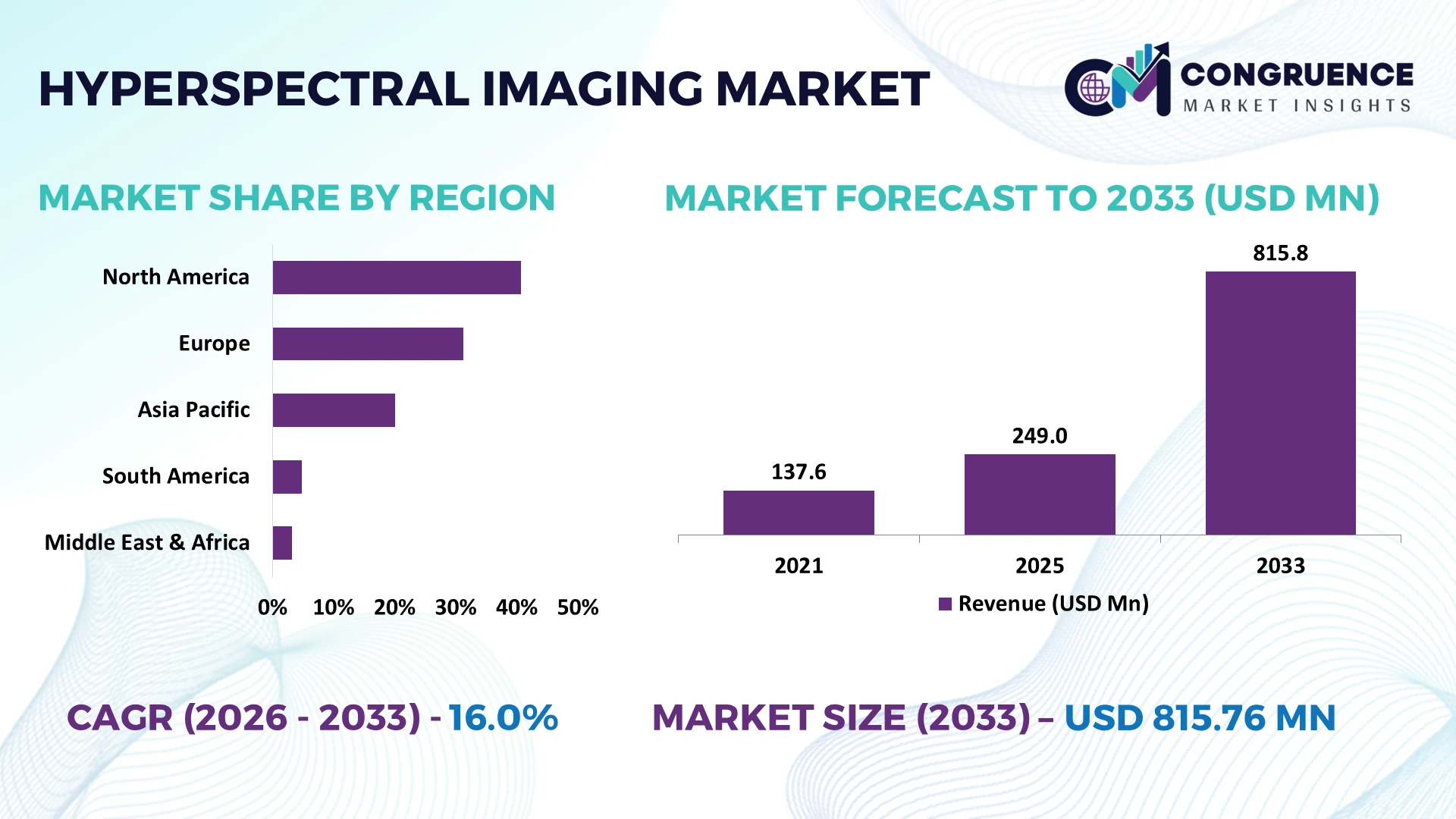
The Global Hyperspectral Imaging Market was valued at USD 249.0 Million in 2025 and is anticipated to reach a value of USD 815.8 Million by 2033 expanding at a CAGR of 15.99% between 2026 and 2033. Growth is driven by the integration of AI-powered spectral analytics, miniaturized imaging sensors, and real-time material identification across precision agriculture, pharmaceutical inspection, mineral exploration, and defense surveillance.
The United States maintains a leading position through defense modernization, NASA-linked Earth observation programs, and investments in advanced imaging technologies. Germany strengthens European adoption through industrial quality inspection and automotive manufacturing, while China expands domestic sensor production and agricultural monitoring. U.S. defense and aerospace applications remain particularly influential, with advanced spectral imaging supporting target identification and material classification.
The strategic priority is to align sensor development, AI integration, and application-specific partnerships with countries offering the strongest industrial adoption.
Market Size & Growth: The global market advances from USD 249.0 million in 2025 to USD 815.8 million by 2033, at a 15.99% CAGR, supported by AI-enabled spectral analytics and industrial inspection.
Top Growth Drivers: AI-based image processing contributes to an estimated 30% improvement in analytical productivity, precision agriculture accounts for approximately 25% of emerging application interest, and defense modernization supports around 20% of strategic procurement activity.
Short-Term Forecast: By 2028, sensor miniaturization and automated classification target 15–20% lower system operating costs and 20% faster spectral data interpretation.
Emerging Technologies: AI-powered classification, snapshot hyperspectral cameras, and short-wave infrared sensors are reshaping real-time inspection, material identification, and remote sensing.
Regional Leaders: North America leads through defense and aerospace deployment; Europe strengthens industrial inspection and environmental monitoring; Asia Pacific accelerates agricultural imaging, semiconductor inspection, and domestic sensor manufacturing.
Consumer/End-User Trends: Industrial and agricultural users increasingly prioritize application-specific imaging systems, with automated spectral classification targeting 20–30% reductions in manual inspection requirements.
Pilot/Case Example: NASA's 2024 Earth-observation and airborne imaging initiatives demonstrate the operational value of hyperspectral data for environmental characterization, mineral mapping, and land-surface analysis.
Competitive Landscape: Established technology suppliers include Headwall Photonics, Resonon, Specim, Corning Incorporated, and BaySpec, competing through sensor resolution, spectral coverage, portability, and software integration.
Regulatory & ESG Impact: Environmental monitoring and precision agriculture applications strengthen the business case for spectral imaging, with targeted reductions of up to 15% in unnecessary agricultural chemical application through more precise crop assessment.
Investment & Funding: Investment increasingly targets compact sensors, AI analytics, defense imaging, and semiconductor inspection, while strategic partnerships accelerate commercialization and application-specific product development.
Innovation & Future Outlook: Next-generation snapshot sensors, edge AI, and integrated spectral analytics are shifting competition from hardware specifications toward faster decisions, lower deployment complexity, and application-level performance.
The global hyperspectral imaging market is gaining traction in pharmaceutical quality control, food authentication, precision agriculture, and mineral exploration. Snapshot imaging and AI-based spectral classification are reducing dependence on conventional laboratory testing, while SWIR technology improves material differentiation. Automated inspection is becoming increasingly important, particularly as manufacturers seek consistent quality verification and traceability across geographically distributed production facilities.
Hyperspectral imaging is becoming strategically important as industries shift from conventional visual inspection toward data-driven material identification, predictive monitoring, and automated quality assessment. Its ability to capture hundreds of narrow spectral bands gives manufacturers, defense agencies, and agricultural operators deeper visibility into material composition and operational conditions. The deployment of commercial satellite constellations is also strengthening access to high-resolution spectral intelligence.
Technology improvements are changing the economics of deployment. Conventional scanning systems require sequential image acquisition, whereas snapshot hyperspectral cameras capture multiple spectral bands simultaneously, reducing acquisition complexity and supporting faster inspection workflows. North America benefits from established defense procurement and research infrastructure, while China and India are expanding applications in agriculture, aerospace, and domestic sensor development. Pixxel's 2025 Firefly constellation, featuring six satellites and imagery at approximately 5-metre resolution across more than 150 spectral bands, illustrates this shift.
Over the next 2–3 years, commercial priorities will center on compact sensors, edge-based AI processing, and integration with industrial machine vision. Companies are increasing investment in software capabilities, regional partnerships, and application-specific solutions. Competitive advantage will increasingly depend on delivering reliable spectral intelligence within existing operational systems rather than selling imaging hardware independently.
The integration of hyperspectral sensors with AI-based classification is accelerating automated defect detection, crop-health assessment, and material identification. Advanced spectral analytics distinguish chemical and physical characteristics that conventional RGB cameras cannot reliably identify, strengthening quality-control capabilities across manufacturing and agriculture. The United States and Germany are important adoption centers for defense imaging and industrial machine vision. Snapshot imaging and edge processing further reduce inspection latency and dependence on centralized analysis. Companies are responding through AI partnerships, compact sensor development, and integration with automated production lines. The strategic advantage lies in detecting invisible material defects before they create costly downstream production failures.
High sensor acquisition costs, calibration requirements, and specialized data-processing infrastructure restrict hyperspectral imaging adoption among smaller manufacturers and agricultural operators. High-resolution systems require substantial optical engineering, while SWIR and cooled detector configurations increase equipment complexity. System integration and calibration can add 15–25% to initial deployment budgets in technically demanding installations. Dependence on specialized detector materials, optical components, and international suppliers also exposes manufacturers to procurement volatility. Companies are addressing these constraints through modular camera architectures, localized integration, long-term component agreements, and lower-cost snapshot sensors. The commercial priority is reducing total ownership costs without compromising spectral accuracy or measurement reliability.
Commercial satellite constellations, UAV-mounted sensors, and compact SWIR cameras are creating opportunities beyond conventional laboratory and industrial inspection. India's expanding space-technology ecosystem offers opportunities in mineral exploration, crop monitoring, and environmental intelligence. Pixxel's Firefly constellation demonstrates the potential of commercial imaging through six operational satellites and spectral coverage exceeding 150 bands. AI-assisted spectral classification also targets 20–30% faster analytical workflows through automated feature extraction. Companies are positioning through R&D investment, satellite-data partnerships, and integration with agricultural analytics platforms. A particularly attractive opportunity lies in subscription-based spectral intelligence, allowing customers to access actionable data without purchasing expensive imaging infrastructure.
Scaling hyperspectral imaging across commercial environments requires consistent calibration, standardized spectral libraries, and integration with existing industrial software. Differences in illumination, sensor configurations, and environmental conditions can reduce classification consistency across deployments. Processing hundreds of spectral bands also increases storage and computational requirements, with poorly optimized workflows creating 20–30% additional processing overhead in data-intensive applications. Cybersecurity and data governance add complexity to defense, satellite, and pharmaceutical installations. Companies must prioritize edge computing, interoperable data formats, secure processing architectures, and application-specific validation. The strategic challenge is maintaining reproducible spectral accuracy across multiple sites while controlling infrastructure costs and ensuring dependable long-term performance.
Commercial Satellite Constellation Expansion: Commercial hyperspectral Earth observation is shifting toward frequent, high-resolution monitoring. In 2025, Pixxel deployed 6 operational Firefly satellites, each capturing more than 135 spectral bands at approximately 5-meter resolution. Daily revisit capabilities strengthen agricultural intelligence, mineral exploration, and environmental monitoring. Companies are investing in satellite constellations and integrated geospatial analytics to improve data availability and commercialize recurring intelligence services.
Automated Recycling and Material Sorting: European recycling requirements are accelerating the adoption of spectral identification across material recovery facilities. The EU Packaging and Packaging Waste Regulation establishes a 65% overall packaging recycling target for 2025, increasing to 70% by 2030; plastic targets rise from 50% to 55%. Industrial operators are integrating hyperspectral sensors into conveyor-based sorting systems to distinguish polymers and improve material recovery accuracy.
Lower-Cost Spectral Sensor Deployment: VNIR and SWIR detector price reductions are changing equipment procurement, with entry-level system pricing falling approximately 35% between 2024 and 2025. This improves affordability for agricultural cooperatives, smaller manufacturers, and field-based inspection teams. Suppliers are responding through compact optical assemblies, modular configurations, and localized system integration, while buyers increasingly evaluate lifetime operating costs rather than initial camera specifications.
Snapshot Imaging Workflow Transition: Snapshot technology is gaining relevance in applications requiring rapid image acquisition without mechanical scanning. Unlike conventional pushbroom systems, snapshot cameras capture complete spectral information in a single exposure, supporting moving-target inspection and portable diagnostics. The pushbroom segment retained 58.6% market share in 2025, highlighting the installed-base advantage, while manufacturers are expanding snapshot portfolios to address faster inspection workflows and compact deployment requirements.
Pushbroom technology dominated the global hyperspectral imaging market with approximately 58.6% share in 2025, supported by high spectral resolution, established airborne deployment, and compatibility with industrial line-scanning systems. Its ability to capture detailed spectral information makes it particularly suitable for remote sensing and continuous inspection environments. Established users prioritize measurement consistency and integration with existing calibration infrastructure, reinforcing pushbroom adoption. Snapshot technology represents the fastest-growing alternative because it captures complete spectral information in a single exposure, eliminating sequential scanning requirements. This capability is particularly relevant for moving production lines, portable instruments, and time-sensitive inspection. Other technologies retain specialized relevance where application-specific optical configurations and spectral acquisition requirements determine equipment selection. Manufacturers are strengthening snapshot sensor portfolios and improving processing speed, while continuing to optimize pushbroom resolution and system reliability. Investment priorities are gradually shifting toward compact imaging architectures without eliminating demand for established scanning platforms.
Agriculture and Food Sorting represented the leading application segment, accounting for approximately 34.8% market share in 2025. Its dominance reflects recurring requirements for crop-health assessment, contamination identification, food authentication, and automated quality inspection. Food processors increasingly integrate hyperspectral sensors into production lines to identify defects and foreign materials that conventional optical systems overlook. Industrial Inspection and Recycling is gaining momentum as manufacturers modernize material recovery operations and improve automated waste classification. Defense and Security remains strategically important for surveillance, reconnaissance, and target identification, while Others covers specialized applications with emerging commercial relevance. Companies are expanding application-specific software, conveyor-integrated imaging systems, and automated spectral classification capabilities. Investment is increasingly moving toward industrial inspection and recycling as regulatory compliance creates measurable demand for advanced material identification.
The Industrial segment accounted for approximately 46.2% market share in 2025, establishing its position as the leading end-user category. Demand concentration reflects continuous inspection requirements across manufacturing, food processing, agricultural operations, and recycling facilities. Industrial customers prioritize reliable spectral classification, production-line integration, and automated defect identification, supporting repeat equipment installations and system upgrades. Government and Defense represents an established buyer group, driven by surveillance, remote sensing, and national security requirements. Academic and Research institutions contribute through sensor development, spectral algorithm validation, and experimental imaging applications, while Others includes specialized institutional and commercial users. Industrial is also the fastest-growing end-user segment as manufacturers transition from laboratory-based spectral analysis toward integrated production-line monitoring. Companies are responding through customized imaging platforms, equipment partnerships, and application-specific software packages. Competitive positioning increasingly depends on reducing integration complexity and delivering consistent results across multiple industrial facilities.
North America accounted for the largest market share at 40.7% in 2025 however, Asia-Pacific is expected to register the fastest growth, expanding at a CAGR of 12.0% between 2026 and 2033.

Defense modernization and commercial Earth-observation investment reinforce regional leadership.
North America leads the global hyperspectral imaging market through established defense procurement, advanced aerospace infrastructure, and a strong concentration of sensor manufacturers and research institutions. The region accounted for approximately 40.7% of the global hyperspectral imaging systems market in 2025, supported by demand from military surveillance, remote sensing, medical diagnostics, and industrial inspection. The United States benefits from commercial satellite partnerships and federal research programs, while Canada contributes through geospatial intelligence, mining, and environmental monitoring. NASA's Commercial SmallSat Data Acquisition program carries a maximum contract ceiling of USD 476 million, supporting commercial Earth-observation data procurement through November 2028. This public-private procurement model strengthens commercial supplier participation and creates opportunities for specialized hyperspectral data providers.
United States Market Outlook: The United States remains the principal national market, supported by defense technology investment, aerospace manufacturing, and established imaging research infrastructure. Commercial hyperspectral satellite providers are gaining institutional access through government procurement programs. In 2025, a U.S. Department of Defense-funded development award of approximately USD 1.19 million supported a low-Earth-orbit thermal hyperspectral payload, demonstrating continued investment in compact intelligence, surveillance, and reconnaissance capabilities.
Europe maintains a significant position through advanced manufacturing, machine vision, recycling infrastructure, and environmental monitoring applications. The region represented approximately 31.2% of the global hyperspectral imaging systems market in 2025. Germany, the United Kingdom, and France support demand through automotive production, pharmaceutical inspection, industrial sorting, and defense research. The EU's packaging regulations, including recycling targets of 65% for 2025 and 70% for 2030, strengthen the case for automated material identification. Germany's established optical engineering ecosystem and industrial equipment suppliers support technology commercialization. Companies are prioritizing compact cameras, AI-assisted inspection, and integration with automated production facilities to improve material recovery and manufacturing consistency.
Germany Market Outlook: Germany holds a strategic position through its optical engineering, automotive manufacturing, and industrial automation capabilities. Its hyperspectral imaging ecosystem benefits from established specialist manufacturers and research collaborations. The acquisition of German industrial imaging specialist inno-spec by Headwall Photonics strengthened access to industrial sorting, quality testing, and recycling applications. Germany's manufacturing base creates opportunities for integrating spectral cameras into high-throughput production and material recovery systems.
Asia-Pacific is the fastest-growing hyperspectral imaging market, supported by expanding electronics manufacturing, agricultural modernization, satellite development, and industrial automation. The region accounted for approximately 20.1% of the global hyperspectral imaging systems market in 2025. China, Japan, India, and South Korea are strengthening adoption through investments in optical sensors, remote-sensing infrastructure, and advanced manufacturing. China benefits from domestic satellite programs and environmental monitoring capabilities, while Japan and South Korea contribute through precision electronics and imaging technologies. India is emerging as an important deployment and innovation center through commercial space partnerships and agricultural applications. Companies are increasing regional partnerships, localized product development, and sensor integration to address diverse industrial requirements.
India Market Outlook: India is strengthening its position through commercial space technology, agricultural intelligence, and domestic optical engineering capabilities. Bengaluru has emerged as an important center for hyperspectral satellite development, with companies developing commercial Earth-observation platforms for international customers. India's participation in NASA's commercial satellite data ecosystem through Pixxel demonstrates its growing role in international hyperspectral imaging supply chains. Expanding applications in crop monitoring, mineral exploration, and water-resource assessment provide additional commercial opportunities.
South America represents an emerging hyperspectral imaging market, with adoption concentrated in agricultural monitoring, mining, forestry, and environmental assessment. Brazil and Argentina are important demand centers because of their extensive soybean cultivation, commercial agriculture infrastructure, and mineral-resource industries. The region represented approximately 4.8% of the global hyperspectral imaging systems market in 2025. Agricultural operators are increasingly evaluating drone-mounted spectral sensors for crop-health assessment, disease identification, and soil-condition monitoring. Mining companies are also exploring spectral mapping for mineral identification and geological characterization. However, uneven rural connectivity, limited specialized processing infrastructure, and restricted procurement budgets affect large-scale commercialization. Suppliers are responding through partnerships with agricultural technology providers, local distributors, and mining service companies.
Brazil Market Outlook: Brazil represents the most strategically significant national market in South America because of its extensive agricultural production, mining operations, and established remote-sensing applications. Hyperspectral imaging offers opportunities in soybean monitoring, plantation management, mineral identification, and environmental compliance. The country's large-scale agricultural operations create demand for UAV-mounted sensors and geospatial analytics. Companies entering Brazil are prioritizing agricultural cooperatives, research institutions, and mining-sector partnerships to establish commercially sustainable deployment models.
The Middle East and Africa hyperspectral imaging market is developing through investments in satellite infrastructure, mining intelligence, agricultural monitoring, and environmental management. The region accounted for approximately 3.2% of the global hyperspectral imaging systems market in 2025. Saudi Arabia and the UAE are strengthening demand through national space initiatives, infrastructure modernization, and resource-management programs, while South Africa contributes through mining and geological exploration. The UAE's launch of Arab Satellite 813 in December 2025 marked an important regional milestone as the first Arab satellite equipped with hyperspectral imaging technology. The initiative also involved training 10 Arab engineers and researchers. Companies are increasingly pursuing government partnerships and specialized remote-sensing deployments to address regional requirements.
United Arab Emirates Market Outlook: The UAE is emerging as a strategically important market through its investment in satellite engineering, Earth observation, and environmental intelligence. The December 2025 launch of Arab Satellite 813 strengthened domestic hyperspectral imaging capabilities and regional research collaboration. Its integrated hyperspectral imaging, panchromatic camera, and atmospheric polarimeter technologies support environmental and climate monitoring. The country's growing satellite assembly, testing, and research infrastructure creates opportunities for imaging hardware suppliers, analytics companies, and international technology partners.
The market pits established camera OEMs Specim, Headwall Photonics, Resonon, Teledyne DALSA against specialist innovators including imec, BaySpec, Telops and satellite entrant Pixxel. Specim and Headwall compete directly in industrial and airborne systems; Resonon targets value-conscious research and field buyers, while imec supplies chip-level spectral technology to camera integrators. The top five players collectively account for approximately 40% of market revenue, indicating a moderately concentrated structure with meaningful specialist competition. Buyers compare spectral range, frame rate, calibration and integration cost; optimized systems target 15–20% faster inspection and 10–15% smaller footprints. Headwall is extending its industrial reach through acquisitions and partnerships, while Specim differentiates through high-speed SWIR cameras and integrated software. Pixxel competes in space-based data services rather than camera OEM sales. The shift toward on-chip sensors and satellite constellations pressures legacy hardware margins. Winning requires validated application performance, dependable supply, software integration and scalable customer support across demanding customer environments.
Orbital Sidekick, Inc.
Hyperspectral imaging is moving from laboratory pushbroom systems toward faster, smaller and more integrated platforms. Pushbroom cameras remain widely used for conveyor, airborne and geological scanning, while snapshot sensors capture a scene in one exposure for moving targets. In a 2025 peanut-inspection study, a snapshot-based lightweight neural network classified defects at 98.5% accuracy and 30 frames per second; the pushbroom workflow supported high-precision data collection. This demonstrates classification, although performance remains application-specific.
On-chip spectral sensors, filter-on-chip CMOS designs and compact VNIR/SWIR detectors are reducing optical complexity. Imec's IPERLITE payload uses 154 narrowband filters on a 4096 × 3076-pixel CMOS detector, spanning 470–900 nm with spectral resolution down to 5 nm. AI models, spectral libraries and edge processors operate together to limit data transfer. Automated sorting and quality control across food and materials processing operations, while satellite operators gain smaller payloads. Camera OEMs with calibration and software capabilities gain an advantage over component-only suppliers.
During 2026–2028, competition will center on snapshot systems, wafer-level sensors, SWIR coverage and analytics. Compared with conventional scanning, snapshot acquisition removes line-by-line motion constraints, while integrated AI targets 15–20% shorter inspection cycles. Adoption will depend on validated accuracy, stable calibration and lower lifecycle costs—not spectral-band counts alone.
January 2025 — Pixxel launched its first three Firefly hyperspectral satellites, each designed for 135-plus bands and five-metre resolution. The deployment initiated commercial constellation operations and expanded high-detail Earth-observation capacity for commercial customers and institutional Earth-observation users worldwide. Source: pixxel.space
April 2025 — Headwall Photonics partnered with GRYFN to combine hyperspectral cameras, calibration and processing software. The integrated workflow targets agriculture, natural resources and defense users, reducing acquisition friction and strengthening application-level delivery and simplifies end-user system deployment. Source: headwall.com
September 2025 — Specim introduced the SX25 SWIR camera, covering 960–2500 nm with up to 392 spectral bands and 162 frames per second. The launch strengthens high-throughput material analysis and industrial sorting, improving material discrimination at production speed. Source: specim.com
November 2025 — imec reported its sensor aboard the IPERLITE Earth-observation demonstrator, using 154 narrowband filters on a 4096 × 3076 CMOS detector. The 470–900 nm payload validates compact spectral imaging in orbit for future commercial constellation designs. Source: imec-int.com
The report evaluates the global hyperspectral imaging market across technology, application and end-user dimensions, covering pushbroom, snapshot and other imaging configurations; agriculture and food sorting, industrial inspection and recycling, defense and security, and other applications; and industrial, government and defense, academic and research, and other buyers. It assesses sensor architectures, VNIR and SWIR capabilities, snapshot acquisition, on-chip spectral filters, AI-enabled classification and data-processing integration.
Geographic coverage spans North America, Europe, Asia-Pacific, South America, and the Middle East and Africa, with country-level attention to manufacturing, defense, agriculture, mining, space programs and regulatory priorities. Competitive analysis profiles established camera OEMs, component suppliers, software specialists and satellite-data providers. The assessment supports investment screening, product positioning, partnership selection, geographic expansion and operational planning, identifying where application requirements, deployment readiness and technology transitions shape strategic decisions through 2033.
| Report Attribute / Metric | Details |
|---|---|
| Market Revenue (2025) | USD 249.0 Million |
| Market Revenue (2033) | USD 815.8 Million |
| CAGR (2026–2033) | 15.99% |
| Base Year | 2025 |
| Forecast Period | 2026–2033 |
| Historic Period | 2021–2025 |
| Segments Covered |
By Type
By Application
By End-User
|
| Key Deliverables | Revenue Forecast; Market Trends; Growth Drivers & Restraints; Technology Insights; Segmentation Analysis; Regional Insights; Competitive Landscape; Regulatory & ESG Overview; Recent Developments |
| Regions Covered | North America; Europe; Asia-Pacific; South America; Middle East & Africa |
| Companies Profiled | Headwall Photonics, Inc.; Specim, Spectral Imaging Ltd.; Resonon, Inc.; Teledyne DALSA; Corning Incorporated; BaySpec, Inc.; imec; Telops Inc.; Norsk Elektro Optikk AS (HySpex); Cubert GmbH; XIMEA GmbH; Pixxel; Orbital Sidekick, Inc. |
| Customization & Pricing | Available on Request (10% Customization Free) |




