
Reports
The Global Hypersonic Vehicle Thermal Protection Materials Market was valued at USD 720 Million in 2025 and is anticipated to reach a value of USD 1695.48 Million by 2033 expanding at a CAGR of 11.3% between 2026 and 2033. Growth is driven by Mach 5+ weapons deployment, carbon-carbon manufacturing scale-up, ultra-high-temperature ceramic qualification, reusable hypersonic platforms, and higher-temperature propulsion and leading-edge requirements.
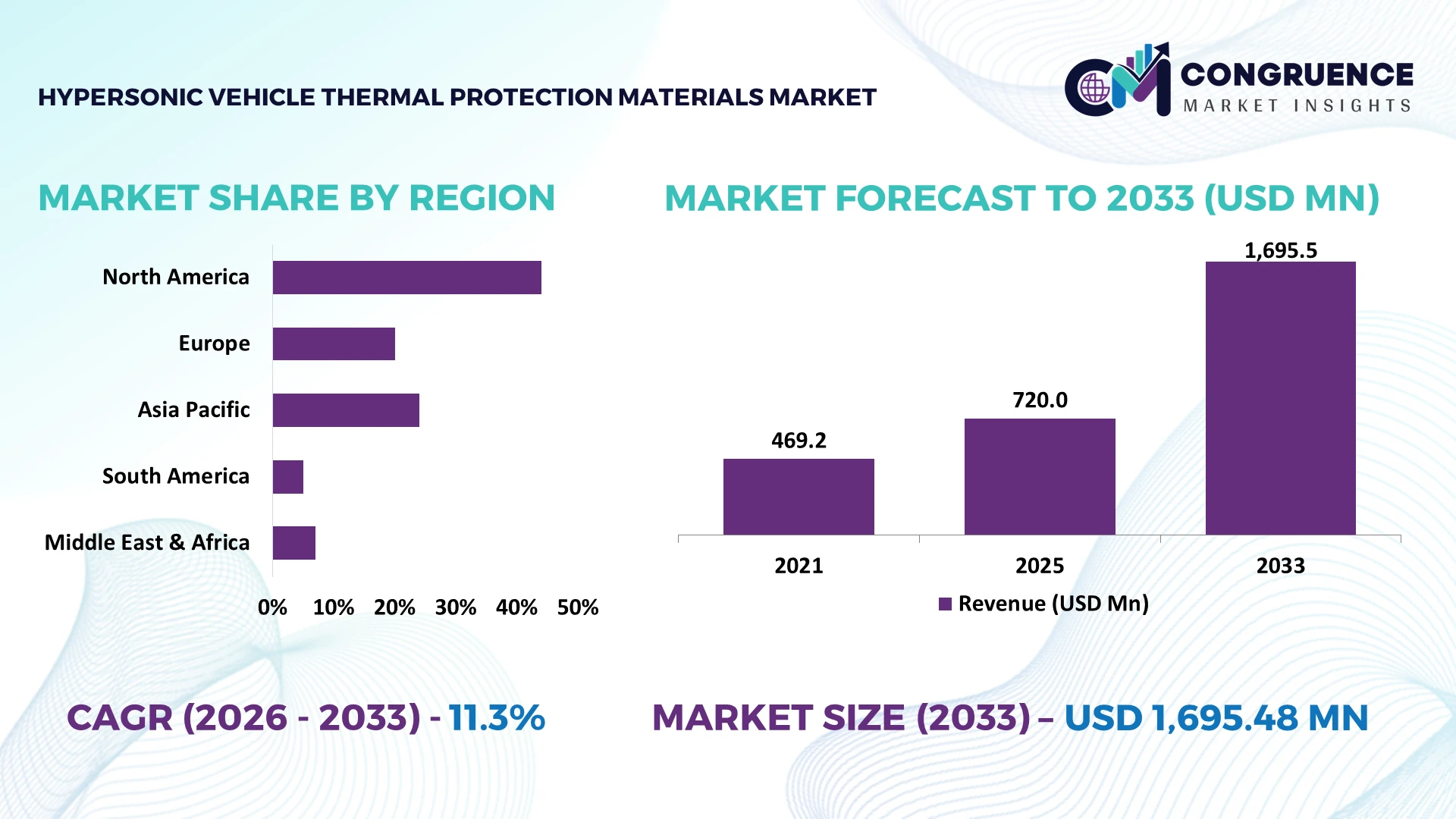
The United States represents roughly 44% of 2025 market activity, supported by the Pentagon’s USD 6.9 billion FY2025 hypersonic request and programs spanning boost-glide weapons, scramjet systems, reentry structures, and advanced propulsion. Carbon-carbon remains critical above Mach 7, while UHTCs withstand temperatures exceeding 3,000°C. China maintains greater operational hypersonic deployment maturity, but U.S. material-development investment is accelerating as Washington responds to Chinese and Russian hypersonic capabilities and strengthens domestic refractory-material supply chains.
The strategic priority is scalable qualification: suppliers combining extreme-temperature performance with repeatable carbon-carbon, CMC, UHTC, coating, and precision-manufacturing capability will capture the most defensible program positions.
Market Size & Growth: USD 720 million in 2025 advances toward USD 1.70 billion by 2033 at 11.3%, driven by hypersonic weapon production, reusable platforms, and advanced thermal-structural integration.
Top Growth Drivers: CMCs hold about 28.5%, passive protection represents 55%, and hypersonic glide vehicles contribute roughly 38% of material demand, concentrating qualification around extreme aerothermal structures.
Short-Term Forecast: By 2028, next-generation manufacturing targets double-digit reductions in carbon-carbon production cycle time as defense programs push densification, machining, and qualification toward repeatable higher-volume output.
Emerging Technologies: UHTCs exceeding 3,000°C capability, multifunctional ceramic-matrix composites, additive manufacturing, smart TPS sensors, and gradient anti-ablation coatings are reshaping leading-edge and aeroshell design.
Regional Leaders: By 2033, North America is positioned above USD 700 million, Asia-Pacific near USD 600 million, and Europe above USD 200 million as defense qualification and reusable-flight research expand.
End-User Trends: Military applications account for more than 50% of broader hypersonic technology deployment, making defense procurement the primary qualification pathway for advanced thermal-protection materials.
Pilot/Case Example: A Mach 6.15 flight demonstration using transpiration-cooled leading-edge technology achieved cooling effectiveness approaching 40%, validating active thermal management for sustained extreme-speed operation.
Competitive Landscape: Lockheed Martin leads with approximately 11%, while Northrop Grumman, RTX, Boeing, and GE Aerospace help place the top five near 40% combined share.
Regulatory & ESG Impact: Reusable TPS architectures can eliminate 100% of consumable ablator replacement for qualifying surfaces, shifting material engineering toward durability, inspection, and repeated thermal-cycle survivability.
Investment & Funding: The Pentagon requested USD 6.9 billion for hypersonic programs in FY2025, reinforcing investment in domestic carbon-carbon, CMC, UHTC, testing, machining, and thermal-management capabilities.
Innovation & Future Outlook: Active and semi-active thermal protection is expanding from an approximately 13% base as reusable concepts shift procurement toward sensorized, multifunctional, repairable, and thermally adaptive structures.
The Hypersonic Vehicle Thermal Protection Materials Market centers on carbon-carbon composites, ceramic-matrix composites, UHTCs, ablative systems, thermal-barrier coatings, and emerging active cooling architectures for missiles, glide vehicles, propulsion sections, reusable aircraft, and reentry systems. CMCs represent roughly 28.5% of current material demand, while UHTCs are gaining qualification at leading edges exposed above 3,000°C. U.S.-China-Russia hypersonic competition is accelerating domestic material localization, scalable densification, additive processing, embedded sensing, and integrated thermal-structural design, creating the foundation for the strategic pathways ahead.
Hypersonic thermal protection materials are becoming strategically decisive because sustained flight above Mach 5 exposes leading edges, propulsion structures, and aeroshells to temperatures beyond conventional aerospace alloys. Investment is shifting from laboratory material qualification toward scalable carbon-carbon, ceramic-matrix composites, ultra-high-temperature ceramics, and active cooling. U.S. programs increasingly emphasize faster carbon-carbon manufacturing, making production throughput and repeatability as strategically important as maximum temperature resistance.
Technology selection directly affects vehicle endurance and operating economics. Reusable SiC/SiC thermal structures can operate near 1,650°C, while advanced carbon-carbon and UHTC systems tolerate localized temperatures above 2,500°C. Compared with legacy ablative protection requiring material replacement after severe heating, reusable architectures substantially reduce refurbishment requirements. The United States emphasizes manufacturing scale, while China concentrates operational deployment and India advances actively cooled scramjet technologies.
Between 2026 and 2028, procurement will increasingly favor multifunctional materials combining thermal protection, structural strength, oxidation resistance, and manufacturability. Additively manufactured cooling channels provide a practical example by integrating thermal management into complex components while reducing assembly steps. Suppliers are expanding automated processing, domestic capacity, and qualification partnerships. Competitive advantage will depend on shortening production cycles while maintaining repeatable extreme-temperature performance.
Mach 7+ vehicle development is accelerating demand for carbon-carbon, ceramic-matrix composites, and ultra-high-temperature ceramics capable of surviving sustained aerothermal loading. Carbon-carbon structures tolerate temperatures exceeding 2,500°C, while advanced UHTCs can remain functional above 3,000°C under controlled conditions. Ceramic-matrix composites can reduce structural weight by approximately 30% compared with equivalent high-temperature metallic systems while maintaining thermal stability. U.S. defense programs are consequently shifting from prototype fabrication toward scalable production, increasing requirements for rapid densification, precision machining, coatings, and non-destructive inspection. Manufacturers are investing in automated layup, faster infiltration, domestic precursor capacity, and modular manufacturing cells. The strategic advantage increasingly comes from repeatability: suppliers reducing processing variability and qualification cycles can support higher vehicle production rates without sacrificing thermal reliability.
Carbon-carbon and advanced ceramic production remain constrained by lengthy processing cycles, specialized equipment, and limited qualified precursor supply. Conventional carbon-carbon components require repeated infiltration, carbonization, and high-temperature treatment, with densification sometimes consuming several months. Extreme-temperature qualification above 2,000°C also requires specialized furnaces, arc-jet facilities, and non-destructive inspection systems, increasing fixed manufacturing costs. Material utilization can fall below 70% when complex leading-edge geometries require extensive machining from conventionally processed billets. Export restrictions affecting advanced fibers, refractory materials, and aerospace manufacturing equipment further complicate international procurement. Suppliers are responding through domestic sourcing, near-net-shape processing, long-term precursor agreements, and alternative ceramic formulations. The critical constraint is therefore manufacturing economics: expensive facilities become operationally inefficient when defense-program schedules fluctuate and qualified production volumes remain uneven.
Multifunctional thermal protection creates a high-value opportunity by combining heat shielding, structural support, sensing, and cooling within fewer vehicle components. SiC/SiC systems can operate near 1,650°C, while carbon-carbon and UHTC combinations address leading-edge environments exceeding 2,500°C. Additive manufacturing can reduce component count by approximately 20–30% in complex thermal assemblies by integrating internal cooling passages and near-net-shape geometries. India’s development of actively cooled scramjet technologies demonstrates expanding international interest beyond established U.S. programs. Companies are investing in ceramic additive manufacturing, oxidation-resistant coatings, embedded temperature sensors, graded material interfaces, and digital process control. A non-obvious opportunity lies in mass reduction: integrating structural and thermal functions removes separate insulation and attachment hardware, improving vehicle payload efficiency while lowering assembly complexity and creating higher-value supplier positions.
Long-term scalability depends on proving that advanced materials maintain predictable properties through thermal cycling, oxidation, vibration, aerodynamic loading, and manufacturing variability. Hypersonic leading edges can experience localized temperatures above 2,500°C, while reusable structures must survive repeated heating cycles without coating delamination or microcracking. Even defect levels below 1% can become critical when flaws occur in load-bearing fibers, ceramic interfaces, joints, or cooling channels. High-enthalpy and arc-jet test infrastructure remains concentrated in relatively few national laboratories and specialized facilities, restricting qualification throughput. Companies must expand digital twins, embedded sensing, automated inspection, computed tomography, and standardized material databases while partnering with government laboratories. The strategic challenge is qualification speed: superior materials deliver limited competitive value if testing bottlenecks prevent repeatable certification at production scale.
Active Cooling Moves Into Hardware: Transpiration and regenerative cooling are progressing from laboratory studies toward integrated hypersonic structures as passive materials approach thermal limits. Actively cooled scramjet demonstrations have sustained combustion beyond 1,000 seconds, while porous-wall concepts target temperature reductions above 30%. Developers are integrating coolant channels, porous CMC structures, and thermal sensors, reducing peak material loading and extending operating envelopes for sustained hypersonic missions.
Additive Manufacturing Reshapes Thermal Components: Ceramic and refractory-metal additive manufacturing is enabling cooling channels, lattice structures, and geometries difficult to produce through conventional machining. Near-net-shape processing can reduce material waste by 20–40% and component counts by approximately 25% for selected assemblies. U.S. aerospace suppliers are integrating additive production with digital inspection, shortening iteration cycles while reducing dependence on subtractive machining of expensive high-temperature materials.
Coatings Become Performance Multipliers: Oxidation-resistant coatings are increasingly determining usable life for carbon-carbon and ceramic structures rather than functioning as secondary protection. Silicon-carbide and ultra-high-temperature ceramic coatings can reduce oxidation-related mass loss by more than 50% under representative extreme-temperature conditions. Manufacturers are developing multilayer and compositionally graded coatings that minimize thermal-expansion mismatch, improving durability without replacing expensive structural substrates.
Digital Qualification Compresses Development Cycles: Material developers are combining computational thermomechanics, digital twins, embedded sensors, and automated non-destructive evaluation to reduce dependence on repeated physical prototypes. Model-based engineering can cut design iterations by 20–30%, while automated inspection improves defect-detection consistency above 90% for selected composite structures. Defense contractors are connecting manufacturing data with thermal testing, accelerating qualification decisions and identifying process deviations before costly flight hardware reaches final assembly.
Ceramic Matrix Composites represent the leading material type with an estimated 28–30% share, supported by high strength-to-weight performance, oxidation resistance, and suitability for integrated load-bearing thermal structures. SiC/SiC and C/SiC architectures operate around 1,600–2,000°C while delivering weight reductions of approximately 20–30% compared with high-temperature metallic assemblies. Carbon-Carbon Composites remain essential for nose tips, leading edges, and propulsion components exposed above 2,500°C, although oxidation protection and lengthy densification restrict production throughput.
Ultra-High Temperature Ceramics are the fastest-growing type as zirconium diboride, hafnium diboride, and carbide systems move into Mach 7+ leading-edge applications requiring tolerance above 3,000°C. Ablative Materials retain strategic relevance for single-use reentry and missile surfaces where material sacrifice simplifies extreme heat management. Thermal Barrier Coatings increasingly extend carbon-carbon and CMC operating life by reducing oxidation and surface recession. Suppliers are investing in hybrid CMC-UHTC structures, graded coatings, automated densification, and additive ceramic processing, shifting investment toward multifunctional systems rather than standalone thermal layers.
Hypersonic Missiles account for approximately 40–45% of thermal protection material demand, reflecting active procurement of boost-glide and air-breathing weapon systems requiring nose-tip, aeroshell, control-surface, and propulsion thermal protection. Temperatures on critical surfaces can exceed 2,000°C during sustained Mach 5+ operation, concentrating requirements around carbon-carbon, CMCs, UHTCs, and oxidation-resistant coatings. Reentry Vehicles remain a mature application because decades of thermal protection engineering support predictable ablative and reusable material qualification, while Spacecraft continue adopting advanced ceramic structures for high-energy atmospheric return.
Scramjet Engines are the fastest-growing application as longer-duration combustion shifts thermal exposure from seconds toward sustained operating periods. Indian testing has demonstrated actively cooled scramjet operation beyond 1,000 seconds, materially increasing requirements for integrated cooling channels and high-temperature structures. Hypersonic Aircraft remain earlier in deployment but require reusable TPS rather than expendable protection. Manufacturers are responding with actively cooled CMC components, additive-manufactured passages, graded coatings, and integrated thermal-structural assemblies, placing recurring-flight durability at the center of future engineering investment.
Defense Agencies represent the leading end-user group with an estimated 42–46% share because national hypersonic programs fund material development, arc-jet qualification, flight testing, and production transition. U.S. Department of Defense programs account for a particularly concentrated procurement base, while China, India, Russia, Japan, and Australia maintain sovereign hypersonic research or deployment initiatives. Missile Manufacturers translate these requirements into production demand for carbon-carbon nose structures, ablatives, coatings, and ceramic control surfaces. Space Agencies maintain established thermal-protection expertise but prioritize reusable spacecraft, atmospheric entry, and technology demonstrators rather than weapon-scale production.
Aerospace OEMs are the fastest-growing end-user group as programs move from government-funded prototypes toward integrated flight hardware and scalable manufacturing. Companies are investing in vertically integrated ceramic processing, digital qualification, automated composite manufacturing, and dedicated high-temperature production lines. Research Institutions remain strategically important for UHTC formulations, arc-jet validation, and material modeling. Suppliers increasingly target defense-OEM partnerships rather than transactional material sales because qualification can lock approved materials into programs for multiple production cycles.
North America accounted for the largest market share at 44.2% in 2025 however, Asia-Pacific is expected to register the fastest growth, expanding at a CAGR of 13.8% between 2026 and 2033.
Production Qualification Replaces Prototype-Led Development
North America represented approximately 44.2% of global demand in 2025, anchored by U.S. hypersonic weapons, reentry systems, scramjet research, and reusable aerospace programs. Industrial activity is shifting toward scalable carbon-carbon, SiC/SiC ceramic-matrix composites, ablatives, UHTCs, and oxidation-resistant coatings as programs transition from demonstrations toward production. Mach 5–10 platforms expose leading structures to temperatures exceeding 2,000°C, making material qualification inseparable from vehicle performance. DARPA’s Carbon Crunch initiative specifically targets faster carbon-carbon manufacturing for Mach 7+ systems, highlighting throughput as an industrial priority. Lockheed Martin, Northrop Grumman, RTX, Boeing, GE Aerospace, and specialized material suppliers are strengthening domestic manufacturing and testing partnerships. Investment is increasingly directed toward automated composite processing, high-temperature furnaces, non-destructive inspection, and digital qualification, reducing dependence on slow artisanal production methods.
United States Market Outlook: The United States maintains the strongest thermal-protection technology ecosystem through defense procurement, NASA research, national laboratories, aerospace OEMs, and specialized composite manufacturers. Programs require materials capable of surviving temperatures above 2,500°C at critical surfaces. Expansion of arc-jet testing, carbon-carbon processing, additive manufacturing, and ceramic qualification gives U.S. suppliers a decisive advantage in transitioning laboratory materials into flight-certified structures.
Sovereign Hypersonic Research Expands Material Qualification
Europe accounted for approximately 14.6% of global market activity in 2025, with France, Germany, the United Kingdom, and Italy concentrating hypersonic research, propulsion development, reentry expertise, and advanced ceramic manufacturing. France’s V-MaX program provides a direct requirement for thermal structures capable of sustained hypersonic atmospheric operation, while European space programs maintain extensive expertise in ablative systems, CMCs, and atmospheric-entry protection. Ceramic-matrix composite architectures offering roughly 20–30% weight reduction versus comparable high-temperature metallic structures are receiving increased attention for reusable applications. European manufacturers benefit from established aerospace ceramics, carbon-fiber, coating, and precision-engineering supply chains but operate at smaller defense production volumes than U.S. counterparts. Companies are emphasizing dual-use materials, collaborative research programs, high-temperature testing, and reusable thermal structures, positioning specialized performance and qualification capability above high-volume manufacturing.
France Market Outlook: France represents Europe’s strongest sovereign hypersonic materials demand center through V-MaX glide-vehicle development, missile engineering, aerospace research, and advanced composite capabilities. Successful hypersonic testing above Mach 5 strengthens requirements for carbon-carbon leading edges, UHTCs, thermal coatings, and ablatives. French suppliers also benefit from established missile and spacecraft programs that provide transferable expertise in high-temperature structural qualification and atmospheric-entry protection.
Operational Deployment Accelerates Materials Scaling
Asia-Pacific represented approximately 31.5% of global market activity in 2025, with China, India, Japan, South Korea, and Australia increasing hypersonic research, flight testing, propulsion development, and domestic material capability. China maintains the region’s strongest operational position through deployed hypersonic glide systems and extensive missile infrastructure, creating sustained requirements for carbon-carbon, UHTCs, ablatives, and thermal coatings. India is advancing scramjet propulsion and actively cooled thermal structures, including ground demonstrations exceeding 1,000 seconds. Japan is investing in hypersonic guided weapons and high-temperature propulsion research, while Australia contributes through collaborative flight-testing programs. Suppliers are expanding ceramic processing, refractory-material production, additive manufacturing, and high-enthalpy testing. The region’s strategic advantage is increasingly vertical: countries linking material science, propulsion, flight testing, and domestic defense manufacturing can compress qualification cycles and reduce dependence on restricted foreign technologies.
China Market Outlook: China holds Asia-Pacific’s strongest deployment position through operational hypersonic weapons, large aerospace manufacturing capacity, and extensive domestic materials research. Mach 5+ systems require high-performance carbon-carbon, UHTCs, ablatives, and ceramic coatings across aeroshells and control surfaces. China’s established refractory-material and carbon-material industries provide upstream scale, allowing defense programs to localize more of the thermal-protection value chain than import-dependent markets.
Space Programs Anchor Advanced Material Demand
South America accounted for approximately 3.4% of global market activity in 2025, with Brazil representing the principal center for aerospace composites, propulsion research, atmospheric-entry technology, and high-temperature materials. Regional demand remains research-intensive rather than deployment-driven because dedicated hypersonic weapons programs and specialized high-enthalpy testing infrastructure remain limited. Brazil’s established aerospace industry and Alcântara Space Center nevertheless provide an industrial base for ablative materials, carbon composites, thermal coatings, and reentry-related research. Hypersonic structures operating above 2,000°C require testing capabilities substantially beyond conventional aerospace qualification, restricting rapid commercialization. Universities and aerospace institutions are therefore emphasizing computational aerothermodynamics, ceramic research, propulsion experimentation, and international collaboration. Suppliers are more likely to capture near-term opportunities through space and research programs than through high-volume missile production, making dual-use thermal materials commercially important.
Brazil Market Outlook: Brazil provides the region’s strongest foundation through Embraer’s aerospace ecosystem, the Brazilian Space Agency, defense research institutions, and Alcântara launch infrastructure. Domestic experience with composites, propulsion, and thermal protection creates transferable capability for future high-speed systems. Strategic progress depends on expanding high-enthalpy testing and UHTC processing rather than replicating large-scale U.S. or Chinese hypersonic production infrastructure.
Defense Localization Builds Advanced Materials Capability
Middle East & Africa represented approximately 6.3% of global market activity in 2025, with Israel, Saudi Arabia, the UAE, and South Africa providing the strongest aerospace, missile, composite-material, and defense-industrial foundations. Regional demand centers primarily on missile systems, high-temperature propulsion components, aerospace research, and imported technology integration rather than mature indigenous hypersonic vehicle production. Saudi Arabia and the UAE are increasing defense localization targets, encouraging investment in advanced composites, precision manufacturing, additive production, and materials testing. Israel contributes established missile engineering and thermal-management expertise, while South Africa maintains aerospace and high-speed research capabilities. Temperatures exceeding 2,000°C at hypersonic surfaces create substantial barriers for local qualification infrastructure. Companies are consequently pursuing international technology partnerships, research collaborations, and localized component manufacturing before committing to fully integrated thermal-protection supply chains.
Israel Market Outlook: Israel represents the region’s strongest technology-centered market through established missile-defense engineering, propulsion capabilities, aerospace manufacturing, and advanced composite expertise. Domestic programs provide practical foundations for thermal coatings, ablatives, carbon composites, and high-temperature structures. Increasing emphasis on high-speed interception and long-range missile technologies strengthens demand for materials that maintain structural integrity under severe aerodynamic heating and rapid thermal cycling.
Lockheed Martin, Northrop Grumman, RTX, GE Aerospace, and specialized materials suppliers compete across thermal-system integration, carbon-carbon manufacturing, ceramic composites, UHTCs, and coatings. The top five participants control approximately 38% of qualified program-linked demand, reflecting procurement concentration around flight-proven suppliers. Competition centers on temperature capability, weight, manufacturing speed, and qualification reliability. CMC structures can reduce weight 20–30% versus metallic alternatives, while UHTCs tolerate temperatures above 3,000°C and advanced processing targets cycle-time reductions exceeding 20%. Prime contractors increasingly partner with material specialists, universities, and defense laboratories while vertically integrating design, simulation, testing, and manufacturing. Competition is shifting from maximum-temperature performance toward scalable, repeatable production as hypersonic programs enter procurement phases. Qualification remains the decisive entry barrier because small material defects can invalidate flight hardware after lengthy testing. Winning requires domestic precursor security, repeatable processing, rapid qualification, multifunctional material architectures, and direct integration with vehicle-level thermal-management requirements across production programs.
Lockheed Martin Corporation
Northrop Grumman Corporation
RTX Corporation
The Boeing Company
GE Aerospace
L3Harris Technologies
CoorsTek, Inc.
SGL Carbon SE
Materion Corporation
Hexcel Corporation
Teijin Limited
Mitsubishi Chemical Group Corporation
Saint-Gobain
Ultramet
Current hypersonic thermal protection relies on carbon-carbon composites, ceramic-matrix composites, ablatives, and oxidation-resistant coatings matched to local heat flux. Carbon-carbon retains mechanical capability near 2,000°C in inert environments, while C/SiC systems remain oxidation-stable to roughly 1,600°C. Automated fiber placement, faster densification, and nondestructive inspection are improving manufacturing consistency by 10–20%, supporting repeatable aeroshell and leading-edge production at industrial scale.
Emerging systems combine UHTC coatings, graded ceramic interfaces, additive manufacturing, and embedded thermal sensing. Fiber-reinforced CMCs containing roughly 35–60% ceramic fiber improve toughness versus monolithic UHTCs, whose density can be three to six times higher than carbon-carbon. Compared with legacy monolithic ceramics, composite architectures deliver about 20–30% better mass efficiency while reducing thermal-shock exposure. Additive processes also integrate cooling passages, lowering component count and accelerating design iteration.
Disruptive active-passive architectures integrate carbon-carbon or HfB2-SiC protection with internal coolant channels for environments above 3,100 K. High-conductivity C/C-HfC-SiC systems have demonstrated 218 W/mK conductivity and approximately 200°C lower surface temperature than lower-conductivity counterparts. Adoption remains concentrated in defense prototypes and qualification programs, but 2026–2028 investment will move toward scalable aeroshells, sensorized TPS, and reusable hot structures. Prime contractors and composite producers benefit most; acting now secures qualification positions before production architectures become fixed.
September 2024 Canopy Aerospace received $2.8 million in U.S. Air Force contracts to commercialize next-generation thermal protection systems for hypersonic and reentry platforms, advancing high-temperature ceramic manufacturing intended to improve component performance while reducing production cost and supply constraints domestically. Source: Canopy
December 2024 Dynetics secured a $670.5 million U.S. Army contract covering the Common Hypersonic Glide Body and thermal protection system, with $65.8 million initially obligated, moving critical glide-body thermal hardware toward sustained engineering, testing, and production through October 2029 domestically. Source: AFCEA
March 2025 MATSYS began a $899,981 Navy Phase II program advancing additively manufactured carbon-fiber phthalonitrile thermal-protection composites. The project develops prototype manufacturing and modeling after Phase I demonstrated promising mechanical properties, low thermal conductivity, and low ablation performance for hypersonics. Source: SBIR
May 2026 Leidos received a $2.7 billion U.S. Army contract combining the Thermal Protection Shield and Common Hypersonic Glide Body programs. Moving both from prototyping toward production is designed to shorten timelines, stabilize component supply, and accelerate operational hypersonic deliveries. Source: Reuters
The Hypersonic Vehicle Thermal Protection Materials Market Report evaluates Ceramic Matrix Composites, Carbon-Carbon Composites, Ultra-High Temperature Ceramics, Ablative Materials, and Thermal Barrier Coatings across Hypersonic Missiles, Hypersonic Aircraft, Reentry Vehicles, Spacecraft, and Scramjet Engines. Coverage extends to Defense Agencies, Aerospace OEMs, Space Agencies, Missile Manufacturers, and Research Institutions, with carbon-carbon and CMC systems receiving particular attention for Mach 5+ aerothermal environments.
Regional analysis covers North America, Europe, Asia-Pacific, South America, and Middle East & Africa, assessing manufacturing capacity, qualification infrastructure, deployment programs, and supply-chain localization. Technology coverage includes additive manufacturing, rapid carbon-carbon densification, UHTC coatings, active-passive cooling, embedded sensing, and digital qualification. With North America representing roughly 44% of 2025 activity, the report supports 2026–2033 decisions on capacity investment, technology partnerships, supplier positioning, production expansion, qualification strategy, and exposure to emerging reusable hypersonic architectures.
| Report Attribute/Metric | Report Details |
|---|---|
Market Revenue in 2025 | USD 720 Million |
Market Revenue in 2033 | USD 1695.48 Million |
CAGR (2026 - 2033) | 11.3% |
Base Year | 2025 |
Forecast Period | 2026 - 2033 |
Historic Period | 2021 - 2025 |
Segments Covered | By Type
By Application
By End-User
|
Key Report Deliverable | Revenue Forecast, Growth Trends, Market Dynamics, Segmental Overview, Regional and Country-wise Analysis, Competition Landscape |
Region Covered | North America, Europe, Asia-Pacific, South America, Middle East, Africa |
Key Players Analyzed | Lockheed Martin Corporation, Northrop Grumman Corporation, RTX Corporation, The Boeing Company, GE Aerospace, L3Harris Technologies, CoorsTek, Inc., SGL Carbon SE, Materion Corporation, Hexcel Corporation, Teijin Limited, Mitsubishi Chemical Group Corporation, Saint-Gobain, Ultramet |
Customization & Pricing | Available on Request (10% Customization is Free) |




