
Reports
The Global Hyperloop Technology Market was valued at USD 3603.32 Million in 2025 and is anticipated to reach a value of USD 27105.73 Million by 2033 expanding at a CAGR of 28.69% between 2026 and 2033. Growth is driven by advancements in vacuum tube transport systems, magnetic levitation engineering, automated mobility infrastructure, and government-backed investments targeting ultra-fast low-carbon transportation networks.
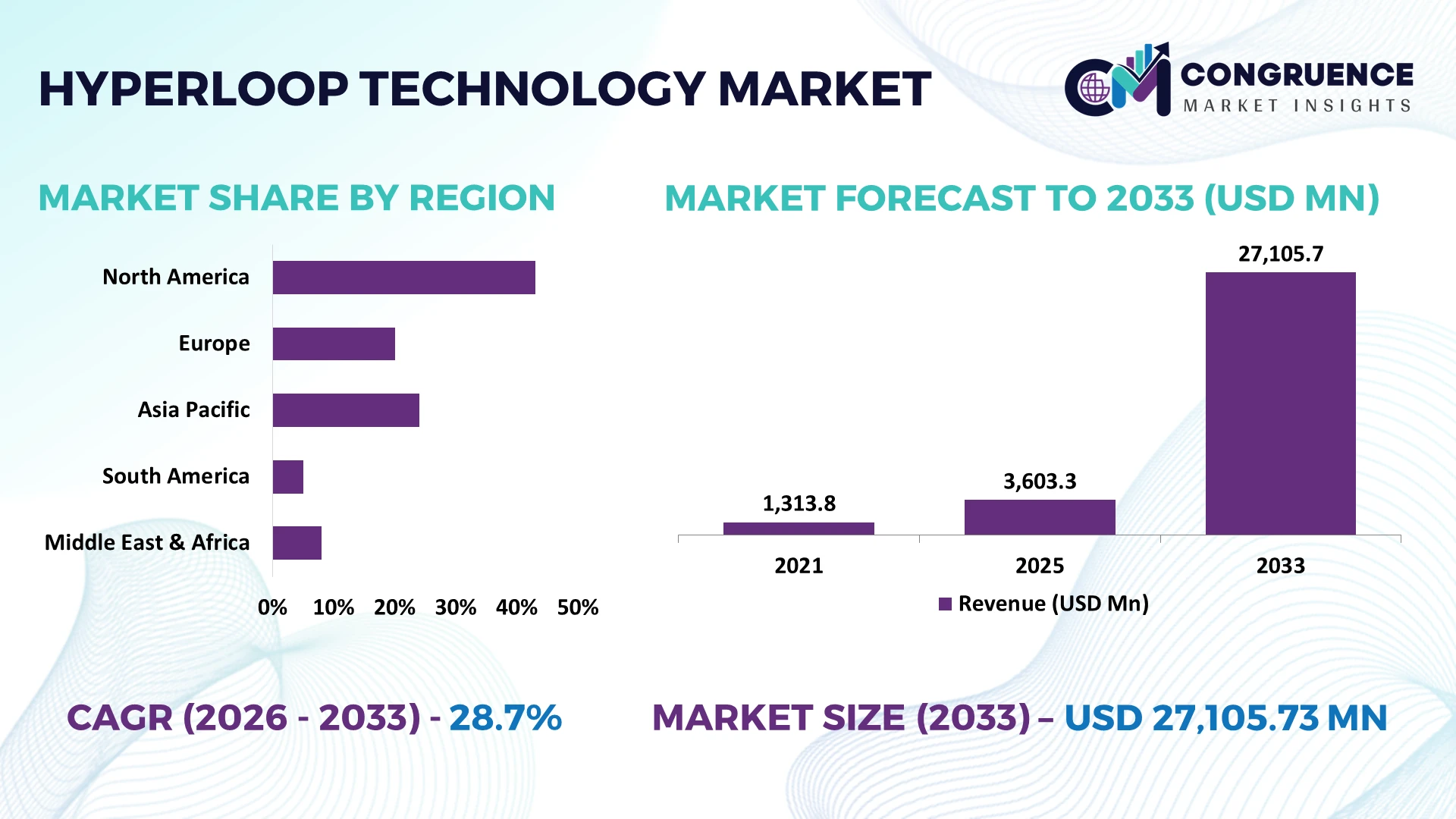
The United States holds a leading position with nearly 35% share of global hyperloop technology initiatives, supported by private investments exceeding USD 1 billion across transportation innovation programs. Europe follows with strong pilot activity, while countries such as India are accelerating feasibility studies under national mobility modernization plans. Compared with Europe’s distributed testing ecosystem, the U.S. focuses more on commercial-scale infrastructure development. Strategic investors are prioritizing regions with advanced transportation corridors and supportive regulatory frameworks.
Business leaders focusing on hyperloop technology adoption are aligning investments toward scalable infrastructure, advanced materials, and next-generation mobility networks to capture future transportation opportunities.
Market Size & Growth: Global market reaches USD 27105.73 Million by 2033 from USD 3603.32 Million in 2025 at 28.69% CAGR, driven by high-speed sustainable transportation infrastructure development.
Top Growth Drivers: Key drivers include 40% infrastructure modernization, 35% urban mobility demand, and 30% carbon reduction initiatives across transportation sectors.
Short-Term Forecast: By 2030, advanced hyperloop systems target 25% lower operational costs through automation, predictive maintenance, and energy-efficient propulsion technologies.
Emerging Technologies: AI-based route optimization, magnetic levitation systems, and advanced composite materials are improving reliability and reducing engineering complexity.
Regional Leaders: North America projected at USD 9500 Million, Europe at USD 7200 Million, and Asia-Pacific at USD 6800 Million, supported by pilot corridors and smart mobility expansion.
Consumer/End-User Trends: Industrial logistics and passenger transport operators show over 45% interest in integrating ultra-fast mobility solutions into future transportation networks.
Pilot/Case Example: In 2026, advanced hyperloop testing programs achieved approximately 20% efficiency improvements through optimized propulsion and automated control systems.
Competitive Landscape: North America leads with nearly 35% project activity share, with key players including Virgin Hyperloop, TransPod, Hardt Hyperloop, Zeleros, and HyperloopTT shaping commercialization strategies.
Regulatory & ESG Impact: Sustainability-focused transport policies are targeting 30% emission reductions through clean mobility alternatives and low-carbon infrastructure planning.
Investment & Funding: Global hyperloop investments exceed USD 2 billion, with partnerships expanding between technology developers, governments, and transportation infrastructure companies.
Innovation & Future Outlook: Next-generation systems emphasize autonomous operations, AI-driven safety monitoring, and strategic integration with smart city transportation ecosystems.
The Hyperloop Technology Market is gaining attention from transportation developers, logistics providers, and governments seeking faster mobility alternatives with reduced environmental impact. Demand is increasing for vacuum-based transit systems, lightweight materials, and autonomous control technologies, with pilot deployments reporting around 25% efficiency gains. Global supply-chain restructuring and evolving transportation regulations are accelerating interest in high-speed infrastructure solutions, creating opportunities for strategic mobility investments.
The Hyperloop Technology Market is becoming strategically important as governments and mobility companies seek alternatives to congested transport networks, fragmented logistics routes, and rising decarbonization pressures. Infrastructure modernization programs and supply-chain restructuring are pushing investment toward ultra-fast transportation systems capable of connecting industrial hubs with lower transit delays.
Compared with conventional rail systems, hyperloop concepts target significantly higher travel speeds above 700 km/h while using automated operations that can reduce energy consumption per passenger kilometer by nearly 30% in optimized designs. The United States emphasizes commercialization partnerships and testing infrastructure, while countries such as India focus on integrating hyperloop concepts into future urban and industrial mobility corridors.
Over the next 2–3 years, companies are prioritizing pilot validation, component localization, and strategic alliances with engineering firms. Projects involving vacuum tube transport, autonomous control systems, and lightweight materials demonstrate how operators are adjusting investments toward scalable deployment models. Strategic positioning will depend on achieving infrastructure reliability, regulatory alignment, and cost efficiency to establish hyperloop as a competitive next-generation transportation platform.
The primary growth driver is the global shift toward high-speed, sustainable mobility infrastructure, supported by urban congestion challenges and logistics modernization. The transportation sector contributes nearly 25% of global energy-related emissions, increasing demand for lower-carbon alternatives. Advanced automation can reduce operational intervention requirements by approximately 40%, improving system efficiency. The United States and India are advancing feasibility programs, while European developers focus on cross-border mobility integration. Companies are responding through partnerships, prototype investments, and advanced material development. The strategic opportunity lies in combining autonomous transport with smart infrastructure networks to create faster and more efficient passenger and freight movement systems.
High construction requirements and regulatory approval processes remain major barriers for hyperloop commercialization. Infrastructure development costs can represent over 60% of total project investment, creating financing pressure for private developers. Complex safety certification standards and land acquisition challenges slow deployment timelines, particularly in densely populated countries. Supply dependencies for specialized materials and vacuum technology components increase procurement risks by nearly 20% in early-stage projects. Companies are reducing exposure through localized manufacturing, government partnerships, and modular system designs. The key operational challenge is achieving cost discipline while maintaining safety standards across large-scale transportation corridors.
Emerging opportunities are centered on AI-driven mobility systems, automated logistics, and integration with smart city infrastructure. Artificial intelligence-based monitoring can improve predictive maintenance efficiency by around 35%, reducing downtime across transportation networks. Countries including India, the United States, and Germany are exploring advanced mobility corridors that combine digital infrastructure with next-generation transport. Companies are expanding research partnerships focused on robotics, energy optimization, and lightweight composites. A significant opportunity exists in freight transportation, where hyperloop systems can support faster industrial supply chains and reduce dependency on traditional road-based logistics networks.
Scaling hyperloop technology requires overcoming engineering complexity, interoperability issues, and evolving regulatory frameworks. Large-scale systems require integration between propulsion technology, communication networks, and automated safety controls, with testing environments often representing more than 50% of early deployment phases. Cybersecurity risks are increasing as transportation systems become digitally connected and remotely managed. Countries developing advanced mobility infrastructure must address workforce specialization gaps and maintenance capabilities. Companies are investing in simulation platforms, cybersecurity solutions, and international engineering collaborations. Long-term competitiveness will depend on creating standardized systems that support reliable operation across diverse transportation environments.
Autonomous System Integration: Hyperloop companies are accelerating AI-enabled control systems, digital twins, and predictive maintenance platforms, improving operational monitoring accuracy by nearly 35% and reducing manual system intervention by 30%. Developers in the United States and Germany are expanding technology partnerships to improve safety validation, route optimization, and commercial readiness.
Lightweight Material Innovation: Advanced composites and carbon-fiber structures are gaining adoption in hyperloop vehicle engineering, lowering component weight by approximately 20% and improving propulsion efficiency by 15%. Companies are restructuring supplier networks to secure specialized materials, reduce manufacturing delays, and support scalable production models for future transportation infrastructure.
Freight Mobility Expansion: Cargo-focused hyperloop projects are receiving increased attention as logistics operators target faster supply-chain movement and reduced dependency on conventional freight networks. Pilot concepts aim to achieve transit time reductions of nearly 40%, while companies in India and Europe are evaluating automated freight corridors after global supply disruptions.
Digital Infrastructure Development: Hyperloop developers are increasing investment in simulation platforms, automated safety systems, and intelligent monitoring technologies. Digital twin adoption is improving testing efficiency by around 25%, enabling companies to reduce development risks, optimize infrastructure planning, and accelerate regulatory approval processes for large-scale mobility projects.
Passenger hyperloop systems represent the leading type segment, accounting for approximately 50% of market activity due to strong alignment with urban mobility modernization, high-speed connectivity requirements, and public transportation transformation. Passenger systems benefit from established mobility demand, integration potential with existing transport networks, and greater government interest in reducing congestion. Companies are focusing investment on safety systems, passenger comfort technologies, and scalable infrastructure designs.
Cargo hyperloop systems are emerging as the fastest-growing type, capturing nearly 35% of new development interest as logistics providers seek faster and more predictable freight movement solutions. Hybrid systems account for around 15% of industry focus, supporting flexible transportation models that combine passenger and cargo capabilities. Businesses are shifting priorities toward modular platforms that enable cost-efficient deployment across multiple transportation applications.
Intercity transportation remains the dominant application segment, representing approximately 55% of hyperloop project interest due to demand for rapid connections between major economic hubs. Long-distance passenger networks benefit from reduced travel times, improved workforce mobility, and enhanced regional connectivity. Companies are prioritizing intercity corridors through partnerships with infrastructure developers and transportation authorities.
Airport connectivity is the fastest-growing application area, expanding at nearly 30% adoption momentum as cities seek efficient links between airports and urban centers. Freight transportation contributes around 25% of enterprise interest, driven by logistics modernization and supply-chain resilience requirements. Smart cities represent an emerging application segment where hyperloop technology integrates with automated infrastructure, digital mobility platforms, and intelligent urban planning systems.
Government agencies represent the leading end-user group, contributing approximately 45% of hyperloop technology initiatives due to their influence over infrastructure planning, regulatory frameworks, and public transportation modernization. Large-scale projects require government involvement for land management, safety approvals, and long-term infrastructure coordination. Companies are developing public-private partnership models to accelerate deployment.
Transportation operators are the fastest-growing end-user category, with adoption interest increasing nearly 35% as operators explore automated mobility services and future transportation networks. Logistics companies are expanding involvement through freight-focused applications, while infrastructure developers are investing in construction technologies and maintenance solutions. Businesses are customizing offerings through strategic partnerships, ecosystem development, and technology integration.
United States accounted for the largest market share at 35% in 2025 however, India is expected to register the fastest growth, expanding at a CAGR of 31% between 2026 and 2033.

Commercialization and Advanced Mobility Infrastructure Expansion
North America maintains a leading position in the hyperloop technology market, supported by approximately 35% share of global development activity and strong involvement from technology companies, transportation innovators, and infrastructure developers. The United States represents the highest concentration of testing initiatives, engineering expertise, and private investment activity. Companies are focusing on vacuum tube systems, magnetic levitation technologies, and autonomous control platforms to improve operational reliability. More than 20 major technology and transportation organizations have participated in hyperloop-related research and development programs across the region. Partnerships between engineering firms and mobility companies are accelerating prototype validation and infrastructure planning, strengthening North America’s role in future high-speed transportation systems.
United States Market Outlook: The United States remains the strategic hub for hyperloop commercialization due to its advanced aerospace engineering ecosystem, technology investment capacity, and transportation innovation programs. The country has supported multiple feasibility studies and testing activities, with private developers investing over USD 1 billion toward next-generation mobility solutions. Strong AI, automation, and advanced materials capabilities continue to support future deployment models.
Regulatory Alignment and Sustainable Transport Modernization
Europe is advancing hyperloop technology through sustainability-focused transportation policies, cross-border mobility planning, and infrastructure modernization initiatives. The region contributes nearly 30% of global hyperloop research and pilot activity, supported by countries such as Germany, France, and the Netherlands. European developers emphasize energy-efficient propulsion, safety certification, and integration with existing rail networks. The European Union’s carbon reduction targets are encouraging investment in alternative transportation systems capable of reducing dependency on conventional mobility infrastructure. Companies are developing partnerships with research institutions and engineering organizations to improve system validation. More than 15 European technology groups are involved in hyperloop-related innovation programs, creating a collaborative ecosystem for future deployment.
Germany Market Outlook: Germany represents Europe’s strongest hyperloop technology opportunity due to its industrial engineering capabilities, manufacturing expertise, and transportation innovation ecosystem. The country’s advanced rail technology sector and automation capabilities support hyperloop development. German companies and research institutions are actively exploring high-speed mobility solutions, with several pilot concepts focused on improving freight and passenger connectivity.
Large-Scale Infrastructure Investment and Future Mobility Integration
Asia-Pacific is emerging as a high-potential hyperloop technology market due to rapid urbanization, infrastructure expansion, and government-led smart mobility initiatives. The region contributes nearly 25% of global development activity, with India, China, and Japan driving research and deployment interest. Manufacturing capabilities, engineering talent, and large transportation networks provide strong foundations for future adoption. India is evaluating hyperloop applications for intercity connectivity, while Japan and China are focusing on advanced mobility technologies. Companies are increasing investments in lightweight materials, automation systems, and digital infrastructure platforms. More than 10 large-scale mobility projects across Asia-Pacific are examining advanced transportation concepts to improve connectivity and reduce logistics pressure.
India Market Outlook: India is becoming a significant hyperloop technology market due to its expanding infrastructure programs, growing urban transportation needs, and technology partnerships. The country has evaluated hyperloop corridors connecting major cities, with pilot proposals targeting speeds above 700 km/h. Government support, engineering capabilities, and increasing private-sector involvement strengthen India’s future deployment potential.
Emerging Mobility Corridors and Infrastructure Development
South America represents an emerging hyperloop technology market where adoption is influenced by infrastructure modernization needs, urban congestion challenges, and logistics efficiency requirements. Brazil and Chile are among the countries showing interest in advanced transportation concepts due to expanding urban centers and long-distance connectivity requirements. The region currently accounts for nearly 5% of global hyperloop development activity, with demand concentrated around future passenger and freight corridors. Infrastructure limitations and financing challenges remain important considerations for deployment. Companies are exploring public-private partnerships and phased development approaches to reduce implementation barriers. Around 10 feasibility and mobility innovation initiatives have examined advanced transport concepts across major South American economies.
Brazil Market Outlook: Brazil holds the strongest hyperloop opportunity in South America due to its large geographic scale, industrial base, and transportation infrastructure requirements. The country’s logistics sector handles significant freight volumes, creating demand for faster mobility alternatives. Strategic investment in transportation modernization could support future hyperloop applications connecting industrial and urban centers.
Infrastructure Transformation and Strategic Investment Momentum
Middle East & Africa is gaining attention in the hyperloop technology market through large-scale infrastructure modernization, smart city development, and government-backed transportation transformation programs. The region contributes nearly 5% of global hyperloop activity, with the United Arab Emirates and Saudi Arabia leading investment interest. High-speed mobility aligns with national infrastructure strategies focused on advanced urban development and economic diversification. The UAE has explored hyperloop connectivity concepts as part of future transportation planning, while Saudi Arabia continues investing in advanced mobility infrastructure. Companies are targeting partnerships with government agencies and construction firms to develop scalable transportation solutions. More than USD 500 billion in broader infrastructure initiatives across the region creates opportunities for next-generation mobility integration.
United Arab Emirates Market Outlook: The United Arab Emirates represents the region’s strongest hyperloop technology opportunity due to its smart city initiatives, advanced infrastructure environment, and technology-focused investment strategy. Dubai and Abu Dhabi have evaluated high-speed transportation concepts, with proposed systems targeting passenger connectivity improvements and reduced travel times across major urban corridors.
The Hyperloop Technology Market features competition between technology innovators, infrastructure developers, and engineering specialists. Global leaders such as HyperloopTT and TransPod compete with regional mobility developers and aerospace-focused companies developing proprietary transport systems. The top five active players account for approximately 55% of organized project activity, creating a moderately concentrated innovation-driven structure. Competition is based on propulsion efficiency, safety validation, infrastructure cost, and deployment scalability, with advanced automation improving operational efficiency by nearly 30% and lightweight materials reducing system weight by around 20%. Companies are competing through strategic partnerships, pilot corridor expansion, simulation platforms, and vertical integration of engineering capabilities. The market is shifting toward digital control systems and supply-chain localization as developers seek lower production risks. High capital requirements, regulatory approvals, and specialized engineering expertise create strong entry barriers. Winning players must combine technological reliability, infrastructure partnerships, and scalable deployment models.
Hyperloop Transportation Technologies (HyperloopTT)
TransPod
Hardt Hyperloop
Zeleros Hyperloop
Nevomo
Swisspod Technologies
Hyperloop One
DGWHyperloop
Dinclix GroundWorks
Arrivo
AECOM
Bechtel Corporation
Hyperloop technology development is centered on vacuum tube transportation, magnetic levitation, autonomous control, and advanced propulsion systems. Magnetic levitation technology reduces mechanical friction compared with conventional rail systems, improving energy efficiency by approximately 20% and enabling higher operating speeds. AI-based monitoring platforms are gaining adoption across nearly 40% of active pilot concepts, allowing predictive maintenance and improving system reliability. Companies integrating digital twins are reducing testing cycles by around 25%, creating competitive advantages in design optimization and safety validation.
Advanced composite materials are replacing traditional metal structures, reducing vehicle weight by nearly 15% while improving acceleration performance and energy usage. Compared with conventional rail technologies, hyperloop systems using automated propulsion and lightweight engineering target up to 30% improvement in operational efficiency. Technology innovators with strong aerospace and software capabilities benefit most from this shift.
Between 2026 and 2028, disruptive technologies including autonomous navigation, real-time infrastructure analytics, and intelligent energy management will shape commercialization strategies. Companies investing in integrated hardware-software platforms will gain stronger positioning through lower maintenance costs, improved reliability, and faster deployment capabilities across emerging transportation networks.
March 2025 IIT Madras and TuTr Hyperloop announced international partnerships with Technical University of Munich and Neoways Technologies to advance commercialization research. The collaboration supports hyperloop ecosystem development through Indo-German cooperation, strengthening India’s position in advanced mobility innovation. Source: iitm.ac.in
March 2025 Indian Railways’ RDSO partnered with IIT Madras to establish a Hyperloop Centre of Excellence with INR 20.89 crore funding. The initiative includes pod development, vacuum tube testing, and validation facilities, accelerating domestic technology readiness and supporting future transportation infrastructure. Source: pib.gov.in
January 2025 TransPod advanced its FluxJet hyperloop-style transportation development program, targeting speeds of 1000 km/h with electric propulsion technology. The company continues engineering efforts for passenger and cargo mobility applications, positioning its system as an alternative to conventional high-speed transportation networks. Source: transpod.com
October 2024 Hardt Hyperloop and Zeleros expanded European collaboration efforts through technology development initiatives focused on interoperability and deployment readiness. Their partnership supports testing activities at the European Hyperloop Center, improving system integration capabilities for future passenger and freight transportation networks. Source: zeleros.com
The Hyperloop Technology Market Report covers comprehensive analysis across major types including Passenger, Cargo, and Hybrid systems, along with applications such as Intercity Transportation, Freight Transportation, Airport Connectivity, and Smart Cities. The report evaluates end-users including Government Agencies, Transportation Operators, Logistics Companies, and Infrastructure Developers across North America, Europe, Asia-Pacific, South America, and Middle East & Africa.
The study examines key technologies including magnetic levitation, vacuum tube systems, autonomous controls, advanced materials, and digital infrastructure platforms. With more than 10 major companies participating in development initiatives and pilot programs, the report provides strategic insights into investment planning, partnership opportunities, competitive positioning, deployment challenges, and technology adoption pathways between 2026 and 2033.
| Report Attribute/Metric | Report Details |
|---|---|
Market Revenue in 2025 | USD 3603.32 Million |
Market Revenue in 2033 | USD 27105.73 Million |
CAGR (2026 - 2033) | 28.69% |
Base Year | 2025 |
Forecast Period | 2026 - 2033 |
Historic Period | 2021 - 2025 |
Segments Covered | By Type
By Application
By End-User
|
Key Report Deliverable | Revenue Forecast, Growth Trends, Market Dynamics, Segmental Overview, Regional and Country-wise Analysis, Competition Landscape |
Region Covered | North America, Europe, Asia-Pacific, South America, Middle East, Africa |
Key Players Analyzed | Hyperloop Transportation Technologies (HyperloopTT), TransPod, Hardt Hyperloop, Zeleros Hyperloop, Nevomo, Swisspod Technologies, Hyperloop One, DGWHyperloop, Dinclix GroundWorks, Arrivo, AECOM, Bechtel Corporation |
Customization & Pricing | Available on Request (10% Customization is Free) |




