
Reports
The Global Hydrostatic Transmission Pump Market was valued at USD 2691.55 Million in 2025 and is anticipated to reach a value of USD 4257.65 Million by 2033 expanding at a CAGR of 5.9% between 2026 and 2033. Growth is being driven by the shift toward variable-displacement pumps, precision control, and electronically managed hydraulic systems in construction and agricultural machinery.
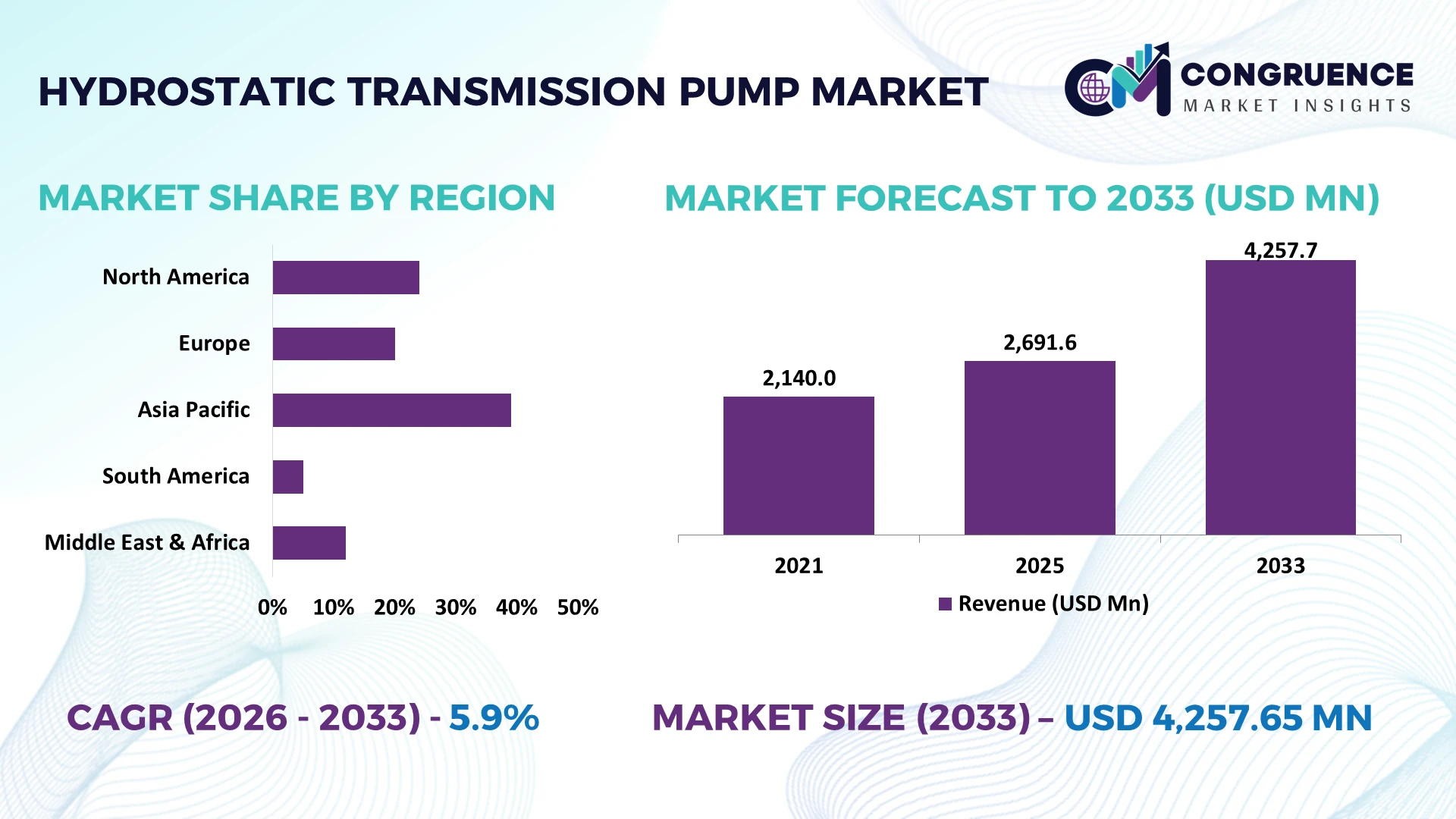
China represents the dominant country market, supported by its large construction-equipment and agricultural-machinery manufacturing base, extensive hydraulic-component production capacity, and accelerating equipment electrification. China accounts for more than 30% of global hydrostatic transmission pump demand, while India remains a faster-developing adoption market, with mechanization and localized equipment production expanding across agriculture and construction. Geopolitical supply-chain diversification is further strengthening local sourcing strategies.
Strategically, manufacturers should prioritize China for scale and production localization while targeting India for incremental adoption and aftermarket expansion.
Market Size & Growth: USD 2,691.55 million in 2025 to USD 4,257.65 million by 2033 at 5.9% CAGR, supported by variable-displacement technology.
Top Growth Drivers: Construction equipment 3%; agricultural mechanization 4%; smart hydraulics adoption 5%.
Short-Term Forecast: By 2030, digitally controlled systems target efficiency gains of 8–12% through optimized displacement control.
Emerging Technologies: AI diagnostics, IoT condition monitoring, and advanced materials are reshaping next-generation pump platforms.
Regional Leaders: Asia-Pacific USD 1.51 billion by 2035; Europe prioritizes efficient systems; North America leads replacement-driven adoption.
Consumer/End-User Trends: Variable-displacement pumps captured 63.7% share in 2025, reflecting precision-control requirements.
Pilot/Case Example: 2025 dynamic-control research demonstrated improved response and load adaptability in forklift hydrostatic systems.
Competitive Landscape: Kawasaki leads APAC at about 23%; Danfoss, Bosch Rexroth, Parker, and Nachi remain major competitors.
Regulatory & ESG Impact: Energy-efficiency requirements are accelerating lower-loss hydraulic architectures and electronically optimized pump control.
Investment & Funding: APAC recorded USD 992.4 million in 2025, while localization partnerships strengthen regional supply resilience.
Innovation & Future Outlook: Smart pumps, electro-hydraulic integration, and predictive diagnostics are shifting competition toward digitally enabled systems.
The Hydrostatic Transmission Pump Market is seeing strongest demand from construction, agricultural machinery, mining, and material-handling platforms requiring precise speed control and variable power delivery. Variable-displacement pumps already represent more than 63% of market share, reinforcing the move toward electronically controlled hydraulics. In 2026, supply-chain localization in China and expanding mechanization across India are strengthening regional sourcing, setting the stage for the strategic discussion.
The Hydrostatic Transmission Pump Market is becoming strategically important as OEMs compete on hydraulic efficiency, machine controllability, operating costs, and automated power management. In 2026, supply-chain restructuring is accelerating dual-source procurement and domestic component qualification, particularly for construction and agricultural machinery. Variable-displacement hydrostatic transmission pumps are gaining preference because they align hydraulic output with real-time load requirements rather than maintaining continuous flow.
Compared with conventional fixed-displacement hydraulic architectures, advanced variable-displacement pumps can reduce energy losses by approximately 8–15% in variable-load duty cycles while electronically controlled hydrostatic systems improve pressure and displacement response. China maintains the strongest manufacturing scale and hydraulic-component localization, Germany leads precision electro-hydraulic engineering, and India is expanding equipment deployment through agricultural mechanization and construction investment. This country-level contrast is shaping pump sourcing, technology partnerships, and localization strategies.
During 2026–2028, electronically controlled hydrostatic transmission pumps, predictive diagnostics, and automated displacement management will become increasingly important across excavators, tractors, forklifts, and specialized mobile machinery. Load-sensing excavator systems provide a practical deployment pathway by matching pump output with operating demand and limiting unnecessary hydraulic losses. Leading manufacturers are increasing R&D spending, localized assembly, and technology partnerships. Competitive positioning will increasingly depend on hydraulic efficiency, electronic integration, lifecycle reliability, and resilient component supply.
The primary Hydrostatic Transmission Pump Market driver is the transition toward variable-displacement and electronically controlled hydraulic systems. Advanced hydrostatic transmission pumps can improve hydraulic efficiency by approximately 8–15%, while intelligent displacement management can reduce unnecessary flow losses by more than 10% in variable-load applications. China is expanding domestic hydraulic-component production, while India is increasing mechanized equipment deployment across agriculture and construction. This technology shift is moving OEM purchasing decisions from standalone pump specifications toward complete electro-hydraulic system performance. Manufacturers are responding with localized production, control-system partnerships, and integrated pump-controller development. A key market insight is that software-enabled displacement control is becoming a competitive differentiator because it improves machine calibration, response consistency, and energy utilization without requiring major mechanical redesign.
Cost-intensive precision components remain a structural restraint for the Hydrostatic Transmission Pump Market. High-performance hydrostatic pump assemblies can allocate approximately 20–30% of manufacturing cost to precision-machined components, while dependence on specialized imported controls and sensors can extend procurement lead times by 15–25%. Chinese manufacturers benefit from deeper hydraulic-component localization, whereas smaller producers remain more exposed to imported valves, sensors, and specialized materials. These dependencies pressure margins and complicate production planning during logistics disruptions. Hydrostatic pump manufacturers are reducing exposure through supplier diversification, localized machining, long-term procurement agreements, and standardized component interfaces. The strategic issue is increasingly supply-chain economics: a technically superior pump loses commercial advantage when component availability prevents consistent high-volume production.
Smart hydrostatic transmission pumps represent a high-value opportunity as machinery shifts toward connected and automated operation. Predictive condition monitoring can reduce maintenance requirements by approximately 10–20%, while electronically optimized pump displacement can deliver 8–12% efficiency improvements in variable-duty applications. India presents significant untapped potential as agricultural mechanization and construction-equipment deployment expand, while China offers manufacturing scale for advanced pump validation and commercialization. From 2026 onward, embedded pressure sensing, advanced materials, IoT connectivity, and AI-assisted diagnostics will strengthen intelligent hydraulic architectures. Companies are responding through R&D partnerships, localized manufacturing, and integrated pump-control platforms. The strongest opportunity is moving beyond component sales toward intelligent hydraulic systems that monetize fuel savings, uptime, predictive maintenance, and machine-performance optimization.
Integration complexity is becoming a major Hydrostatic Transmission Pump Market challenge as conventional hydraulic architectures evolve into software-managed electro-hydraulic systems. Digital pump platforms can require approximately 20–30% greater calibration and integration effort during equipment development, while advanced diagnostics increase technician training requirements. India faces uneven availability of specialized hydraulic-electronic service capabilities, whereas Germany and Japan provide mature precision-engineering ecosystems but operate with higher labor costs. Connected hydrostatic transmission pumps also introduce software compatibility and cybersecurity considerations across increasingly networked machinery. Manufacturers must invest in standardized communication protocols, remote diagnostics, modular control architectures, and specialized workforce training. The critical competitive issue is system-level execution: companies that successfully synchronize pump displacement, electronic controls, sensors, and machine software will achieve more consistent commissioning and stronger lifecycle performance.
Electronically Managed Pump Systems: OEMs are increasing deployment of electronically controlled hydrostatic transmission pumps, with advanced displacement management targeting 8–12% better hydraulic efficiency and 10% lower unnecessary flow losses. China-based machinery manufacturers are integrating sensors and controllers directly into pump platforms, reducing calibration time and enabling software-based performance tuning. Companies are shifting investment toward integrated electro-hydraulic architectures rather than standalone pump upgrades.
Localized Hydraulic Supply Chains: Supply-chain restructuring is increasing local sourcing of precision hydraulic components, with manufacturers targeting 20–30% reductions in imported component exposure and 15% shorter procurement cycles. China is expanding domestic machining and valve capacity, while Indian equipment producers are adding qualified suppliers for agricultural and construction machinery. The non-obvious shift is that localization is becoming a product-development strategy, not simply a procurement response.
Automation Drives Pump Specification: Automated excavators, forklifts, and agricultural machinery are increasing demand for pumps capable of rapid pressure and displacement response. Automated material-handling deployments can target 10–20% labor-efficiency gains, while digitally coordinated hydraulic systems reduce unnecessary machine-cycle losses. Labor shortages and electrification initiatives are accelerating this transition. Manufacturers are responding with programmable pump controls, remote diagnostics, and partnerships linking hydraulic suppliers with automation integrators.
Efficiency-Focused Machine Redesign: Decarbonization policies are pushing equipment manufacturers to optimize hydraulic energy consumption rather than relying exclusively on drivetrain electrification. Efficiency-focused pump architectures can reduce hydraulic losses by approximately 8–15% in variable-load applications. Germany emphasizes precision engineering and low-loss systems, while India prioritizes durable, cost-efficient platforms. Companies are redesigning pump-control packages to improve fuel utilization, thermal performance, and component life without compromising machine productivity.
Variable Displacement is the leading type, accounting for approximately 38% of the Hydrostatic Transmission Pump Market, supported by superior flow control, load matching, and compatibility with electronically managed machinery. Its adoption is strongest in construction equipment and agricultural machinery where operating loads change rapidly. Axial Piston pumps remain strategically dominant within high-pressure applications because of their power density, while Radial Piston pumps retain relevance where ruggedness and high starting torque are priorities. Fixed Displacement remains cost-focused and established in simpler hydraulic architectures.
Variable Displacement is also the fastest-shifting type, with adoption expanding roughly 7–9% across newer electronically controlled equipment platforms. Axial Piston technology follows closely, particularly in China and Germany, where manufacturers are integrating compact high-pressure units into automated machinery. Companies are prioritizing variable-displacement R&D, digital controls, and pump-controller partnerships, while fixed-displacement suppliers are concentrating on standardized, cost-sensitive equipment platforms.
Construction Equipment represents the leading application, contributing approximately 42% of Hydrostatic Transmission Pump Market demand because excavators, loaders, and specialized machinery require continuous variable-speed control and high hydraulic power density. Agricultural Machinery follows with approximately 31%, supported by tractor and harvesting-equipment modernization. Construction applications increasingly prioritize load-sensing and electronically controlled pumps, while agricultural buyers remain more price-sensitive and durability-focused. Manufacturers are adapting pump platforms to machine duty cycles rather than offering uniform hydraulic configurations.
Mining Equipment is the fastest-growing application, with adoption increasing approximately 8–10% as mine operators prioritize automated haulage, high-load machinery, and equipment uptime. Material Handling is also shifting toward electronically managed hydraulic systems as warehouses address labor constraints and automation requirements. China is emphasizing high-volume construction equipment, while India is strengthening agricultural and infrastructure machinery deployment. Companies are responding with heavy-duty pump packages, predictive diagnostics, and application-specific calibration.
Construction is the leading end-user, representing approximately 40% of Hydrostatic Transmission Pump Market demand because excavators, loaders, and mobile construction platforms require high-duty-cycle hydraulic transmission systems. Agriculture accounts for roughly 28%, supported by increasing mechanization and equipment modernization. Construction buyers prioritize uptime, power density, serviceability, and lifecycle cost, whereas agricultural buyers place greater emphasis on affordability, fuel efficiency, and localized service. This difference is pushing manufacturers toward application-specific pump configurations and differentiated pricing strategies.
Mining is the fastest-growing end-user category, with hydrostatic system adoption advancing approximately 8–10% as automation, remote operation, and high-load equipment deployment expand. Industrial users increasingly prioritize precision and energy management, while Forestry remains a specialized but technically demanding segment requiring compact, rugged hydraulic systems. Companies are expanding through equipment-maker partnerships, customized pump packages, regional service networks, and predictive-maintenance capabilities. The competitive priority is shifting toward lifecycle performance rather than initial pump price.
Asia-Pacific accounted for the largest market share at 41% in 2025 however, Asia-Pacific is expected to register the fastest growth, expanding at a CAGR of 6.8% between 2026 and 2033.
Automation and Infrastructure Spending Reshape Equipment Demand
North America represents approximately 24% of the Hydrostatic Transmission Pump Market, with demand concentrated in the United States across construction equipment, agricultural machinery, mining, and material-handling platforms. The region is shifting toward electronically controlled variable-displacement pumps as OEMs prioritize fuel efficiency, machine automation, and predictive maintenance. In 2026, Caterpillar reported a 35% increase in construction-equipment sales, with North American sales rising 50%, reinforcing the equipment-investment environment supporting hydraulic component demand. Manufacturers are responding through expanded production capacity, software-enabled hydraulic controls, and stronger supplier localization. The U.S. market also benefits from data-center, infrastructure, and industrial construction activity, creating demand for high-duty-cycle equipment and replacement components.
United States Market Outlook: The United States remains North America's strategic production and deployment center, supported by large construction fleets, advanced agricultural equipment, and established hydraulic service infrastructure. Approximately 60% of North American hydrostatic pump demand is concentrated in U.S.-based equipment applications. Manufacturers are increasing domestic capacity and dealer inventories to reduce delivery exposure and support faster aftermarket replacement cycles.
Efficiency Regulation Accelerates Electro-Hydraulic Modernization
Europe accounts for approximately 21% of the Hydrostatic Transmission Pump Market, with Germany, Italy, France, and the United Kingdom forming major equipment-manufacturing clusters. Demand is increasingly tied to hydraulic efficiency, machinery automation, low-emission equipment design, and replacement of inefficient legacy systems. Germany remains particularly important for precision hydraulic engineering and advanced mobile machinery, while Italy maintains strong agricultural and industrial equipment manufacturing capabilities. European construction-equipment demand is also benefiting from infrastructure renewal and industrial investment. Manufacturers are responding by integrating electronically controlled pumps, load-sensing architectures, and digital diagnostics. The region's regulatory emphasis on machinery efficiency is shifting purchasing decisions toward lifecycle operating cost rather than initial component price, strengthening demand for higher-value hydrostatic transmission pump systems.
Germany Market Outlook: Germany is Europe's key technology and engineering center for hydrostatic transmission pumps, supported by sophisticated machinery OEMs, precision machining capabilities, and advanced electro-hydraulic development. Approximately 30% of European high-performance mobile hydraulic equipment production is linked to German manufacturing networks. Companies are emphasizing compact pump designs, sensor integration, and digitally controlled displacement to meet efficiency and automation requirements.
China-Led Localization Strengthens Manufacturing Scale
Asia-Pacific holds the largest position at approximately 41% of global Hydrostatic Transmission Pump Market demand, with China accounting for the majority of regional production and equipment deployment. Construction machinery, agricultural equipment, mining systems, and material-handling platforms are driving large-volume pump requirements. China is accelerating hydraulic-component localization, reducing dependence on imported precision components while strengthening domestic supply chains. India is emerging as a complementary demand center as agricultural mechanization and construction-equipment deployment expand. Approximately 45% of regional hydrostatic pump demand is linked to construction and agricultural machinery. Manufacturers are increasing local assembly, developing application-specific pump platforms, and forming partnerships with equipment OEMs. The strategic advantage is scale: high production volumes allow Chinese manufacturers to combine lower component costs with faster product iteration.
China Market Outlook: China is the region's most strategically significant country because of its integrated construction-machinery ecosystem, extensive hydraulic-component manufacturing base, and large domestic equipment fleet. Local manufacturers are increasingly producing pumps, valves, controls, and related hydraulic components within domestic supply networks. This localization is strengthening cost competitiveness and shortening procurement cycles, while export-oriented equipment manufacturers are using domestic hydraulic platforms to expand into overseas markets.
Agricultural Mechanization Anchors Equipment Demand
South America contributes approximately 8% of the Hydrostatic Transmission Pump Market, with Brazil generating the largest share of regional demand through agricultural machinery, construction equipment, forestry, and mining applications. Brazil's large-scale soybean, corn, sugarcane, and forestry operations require high-utilization tractors, harvesters, loaders, and specialized machinery using hydrostatic power transmission. The country's 2025/26 agricultural financing framework allocated R$516.2 billion to commercial agriculture, reinforcing equipment investment capacity. Agricultural applications represent roughly 50% of regional hydrostatic pump demand. However, imported precision components and uneven service coverage remain operational constraints outside major industrial centers. Manufacturers are responding with localized distribution, application-specific pump configurations, and partnerships with agricultural-equipment OEMs. Brazil therefore offers a scale-driven opportunity, but aftermarket infrastructure remains critical to converting equipment demand into recurring pump sales.
Brazil Market Outlook: Brazil is the region's dominant country market because agricultural mechanization operates at unusually large commercial-farm scale and overlaps with strong sugarcane, forestry, mining, and construction equipment demand. Government-backed agricultural financing is supporting machinery modernization, while local distributors are expanding technical support. Approximately 47% agricultural-technology adoption among targeted family-farming programs in 2025 demonstrates the country's broader mechanization trajectory.
Mega-Projects and Mining Modernization Expand Deployment
The Middle East & Africa market represents approximately 6% of global Hydrostatic Transmission Pump demand, with Saudi Arabia, the United Arab Emirates, South Africa, and selected North African economies driving deployment. Saudi Arabia is the principal investment center, where infrastructure, logistics, industrial development, and large-scale construction projects require high-duty-cycle mobile machinery. Mining activity in South Africa also supports demand for robust hydrostatic systems designed for harsh operating environments. Approximately 35% of regional demand is associated with construction and infrastructure equipment. Extreme heat, dust exposure, and limited specialized hydraulic service capacity create stronger requirements for thermal management, filtration, and component durability. Manufacturers are responding through distributor partnerships, regional service centers, reinforced pump designs, and localized inventory. The strategic opportunity is concentrated in high-value equipment rather than broad commodity pump volumes.
Saudi Arabia Market Outlook: Saudi Arabia is the region's most strategically significant country because Vision 2030-linked infrastructure, logistics, industrial, and urban-development projects are increasing demand for construction and material-handling machinery. Equipment suppliers are expanding local service capabilities and stocking critical hydraulic components closer to project sites. The country's harsh operating conditions also favor hydrostatic transmission pumps engineered for high ambient temperatures, contamination resistance, and extended service intervals.
The Hydrostatic Transmission Pump Market pits Bosch Rexroth, Danfoss, Parker Hannifin, Kawasaki Heavy Industries, and Eaton against regional specialists and cost-focused Asian manufacturers. The top five players collectively hold an estimated 38% share, leaving room for differentiated suppliers commercially. Competition centers on technology, with electronically controlled variable-displacement platforms delivering roughly 8–15% efficiency gains over conventional architectures, while localized sourcing can reduce component costs by 10–20%. Danfoss and Bosch Rexroth compete through electro-hydraulic integration, digital controls, and OEM partnerships; Kawasaki emphasizes high-pressure performance, while Asian producers compete on cost, customization, and delivery speed. Vertical integration and regional assembly are increasing as manufacturers seek tighter control over valves, sensors, software, and precision components. The competitive shift is moving from standalone pump performance toward integrated hydraulic intelligence and supply resilience. High tooling requirements, application-specific engineering, and qualification cycles remain entry barriers. Winning requires superior efficiency, dependable supply, rapid customization, and deep OEM integration.
Bosch Rexroth
Danfoss
Parker Hannifin
Eaton
Kawasaki Heavy Industries
KYB Corporation
Nachi-Fujikoshi
Yuken Kogyo
Bucher Hydraulics
HAWE Hydraulik
Linde Hydraulics
Casappa
Hydro-Gear
Hydrostatic transmission pump technology is shifting from mechanically controlled variable displacement toward electro-hydraulic architectures combining electronic displacement control, load sensing, embedded pressure sensors, and connected diagnostics. Compared with conventional fixed-displacement systems, advanced variable-displacement pumps can reduce hydraulic energy losses by approximately 8–15% under variable loads. Adoption is strongest in new excavators, tractors, forklifts, and specialized mobile machinery, where digital controls improve response consistency and enable application-specific calibration. Bosch Rexroth, Danfoss, Parker Hannifin, and leading OEM partners benefit by integrating pumps with controllers rather than selling isolated hydraulic components.
Emerging systems add IoT monitoring, edge analytics, and predictive-maintenance algorithms. Condition-based monitoring can reduce unplanned maintenance requirements by roughly 10–20%, while sensor-driven control improves pressure and displacement management by around 5–10%. Adoption is expanding fastest in automated construction and material-handling fleets, where uptime and remote diagnostics influence operating economics. These capabilities also create recurring software and service opportunities alongside pump hardware.
From 2026–2028, AI-assisted diagnostics, advanced surface treatments, compact high-pressure architectures, and electro-hydraulic integration will reshape product differentiation. Manufacturers with strong software capabilities and OEM ecosystems gain an advantage over cost-only suppliers. Companies should act now because pump qualification cycles, machine-platform integration, and field validation typically precede commercial deployment by product-development stages.
April 2024 Bosch Rexroth partnered with FirstElement Fuel on a hydrostatic-drive cryopump reaching 600 kg of liquid hydrogen per hour. The 280-kW system targets 100-kg truck refueling in under 10 minutes, extending hydraulic technology into hydrogen infrastructure projects. Source: boschrexroth.com
December 2024 TVH UK became a Certified Excellence Distribution Partner for Bosch Rexroth, supporting mobile-hydraulics distribution with more than 1,000,000 references in stock. The partnership strengthens next-day availability and aftermarket responsiveness for hydrostatic pump customers across Britain’s network. Source: tvh.com
October 2025 Danfoss launched Hybrid Load Control for H1P and MP1P pumps, combining load-independent and load-dependent displacement control. The solution targets telehandlers, wheel loaders, sweepers, and forestry machines, improving control flexibility without separate pump architectures or redesigns immediately. Source: danfoss.com
October 2025 Fluid Power World reported Danfoss Power Solutions’ X1P open-circuit pump winning a gold LEAP Award, with up to 80% lower control hysteresis. The innovation supports tighter machine packaging and advanced electronic controls, strengthening premium pump differentiation. Source: fluidpowerworld.com
The Hydrostatic Transmission Pump Market Report covers Axial Piston, Radial Piston, Variable Displacement, and Fixed Displacement pump types across Agricultural Machinery, Construction Equipment, Material Handling, and Mining Equipment. End-user analysis spans Agriculture, Construction, Mining, Forestry, and Industrial operations, enabling comparison of equipment intensity, hydraulic-system requirements, purchasing priorities, and adoption patterns.
The report evaluates North America, Europe, Asia-Pacific, South America, and Middle East & Africa, with country-level analysis emphasizing China, the United States, Germany, India, Brazil, and Saudi Arabia. Technology coverage includes electronically controlled displacement, load-sensing architectures, embedded sensing, predictive diagnostics, and electro-hydraulic integration. Segment-level analysis identifies leading categories, where variable-displacement systems represent approximately 38% of demand and construction equipment approximately 42%. These insights support investment planning, localization, capacity expansion, supplier partnerships, competitive positioning, and technology prioritization through 2026–2033.
| Report Attribute/Metric | Report Details |
|---|---|
Market Revenue in 2025 | USD 2691.55 Million |
Market Revenue in 2033 | USD 4257.65 Million |
CAGR (2026 - 2033) | 5.9% |
Base Year | 2025 |
Forecast Period | 2026 - 2033 |
Historic Period | 2021 - 2025 |
Segments Covered | By Type
By Application
By End-User
|
Key Report Deliverable | Revenue Forecast, Growth Trends, Market Dynamics, Segmental Overview, Regional and Country-wise Analysis, Competition Landscape |
Region Covered | North America, Europe, Asia-Pacific, South America, Middle East, Africa |
Key Players Analyzed | Bosch Rexroth, Danfoss, Parker Hannifin, Eaton, Kawasaki Heavy Industries, KYB Corporation, Nachi-Fujikoshi, Yuken Kogyo, Bucher Hydraulics, HAWE Hydraulik, Linde Hydraulics, Casappa, Hydro-Gear |
Customization & Pricing | Available on Request (10% Customization is Free) |




