
Reports
The Global Hydroponics Technologies Market was valued at USD 2,590.4 Million in 2025 and is anticipated to reach a value of USD 5,161.5 Million by 2033 expanding at a CAGR of 9.0% between 2026 and 2033. Growth is driven by water-efficient closed-loop cultivation, automated fertigation, controlled-environment agriculture, and rising investment in local food production as climate and supply-chain risks intensify.
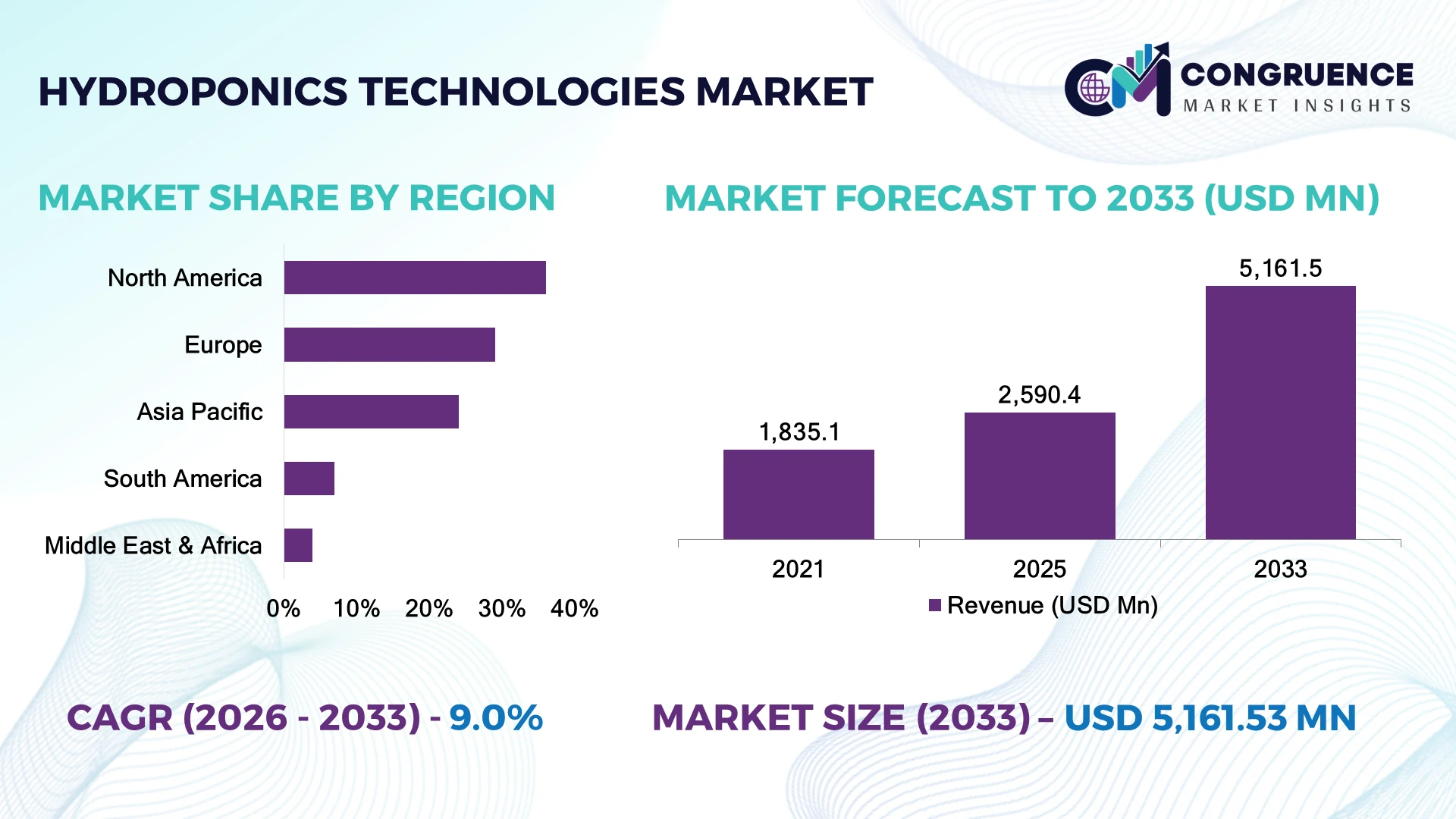
The United States represents the dominant commercial market, accounting for approximately 36% of global hydroponics technology demand, supported by extensive vertical-farming and controlled-environment agriculture deployment. The Netherlands remains a technology benchmark, with approximately 5,945 hectares associated with hydroponic and indoor cultivation and high automation penetration. Singapore is expanding high-density systems for food resilience, while the UAE is prioritizing hydroponics because advanced systems can reduce water consumption by more than 90%. The U.S. therefore leads commercial scale, while the Netherlands leads technology integration.
Investment is shifting toward automated, resource-efficient systems integrating hydroponics with sensors, AI, climate control, and closed-loop water management.
Market Size & Growth: USD 2.59 billion in 2025 to USD 5.16 billion by 2033 at 9.0% CAGR, supported by automation and closed-loop cultivation.
Top Growth Drivers: Water efficiency 90%+, automation adoption 30%+, and controlled-environment deployment 20%+.
Short-Term Forecast: By 2028, automated fertigation and climate controls can reduce manual intervention by 15–25% and improve resource-use efficiency by 10–20%.
Emerging Technologies: AI crop monitoring, automated nutrient dosing, LED optimization, robotic handling, and sensor-based climate control are moving into commercial-scale facilities.
Regional Leaders: North America is projected at approximately USD 1.85 billion, Europe at USD 1.45 billion, and Asia-Pacific at USD 1.35 billion by 2033, with APAC emphasizing food-security deployment.
Consumer/End-User Trends: Retail-oriented controlled-environment farms increasingly prioritize predictable local supply, with leafy greens and herbs representing the most established commercial crop categories.
Pilot/Case Example: Singapore's Green Harvest hydroponic greenhouse produces up to 4,000 kg of leafy greens daily, demonstrating high-throughput urban production at commercial scale.
Competitive Landscape: North America leads commercially, while technology leadership remains concentrated among Dutch automation, climate-control, lighting, and greenhouse specialists.
Regulatory & ESG Impact: Closed-loop systems deliver water reductions exceeding 90% in demonstrated operations, strengthening adoption in water-stressed markets and sustainability-led procurement.
Investment & Funding: Singapore has committed more than USD 40 million equivalent across agricultural technology projects, accelerating automation, controlled-environment systems, and productivity upgrades.
Innovation & Future Outlook: 2026–2028 investment is shifting toward AI-enabled crop recipes, autonomous dosing, energy-efficient lighting, modular farms, and integrated water-energy management.
The hydroponics technologies market is increasingly concentrated around controlled-environment agriculture, automated fertigation, vertical farming, nutrient-film systems, smart greenhouses, and precision crop monitoring. Advanced facilities are targeting water reductions of 90% or more, while AI-enabled sensing and automated dosing improve operational consistency. The 2026 UAE expansion of hydroponic tomato production highlights the shift toward localized supply where import exposure and water scarcity remain strategic constraints.
Hydroponics technologies are becoming strategically important because food producers are competing not only on yield, but also on water intensity, production predictability, proximity to consumers, and resilience against climate-driven supply disruption. The strongest commercial shift is from basic recirculating systems toward integrated controlled-environment platforms combining fertigation, sensors, climate control, lighting, and software. This changes investment priorities from equipment procurement toward measurable productivity and resource-efficiency outcomes.
Closed-loop hydroponics can reduce water consumption by 90% or more compared with conventional cultivation in demonstrated systems, while automated dosing and monitoring reduce manual intervention and improve nutrient consistency. In the U.S., hydroponics represented more than half of vertical-farming system deployment, whereas the Netherlands emphasizes highly automated greenhouse infrastructure and technology exports. The regional contrast favors North American commercial scale, European engineering sophistication, and Asian food-security-led deployment.
Over the next 2–3 years, commercial operators will prioritize AI-assisted crop monitoring, predictive climate control, automated harvesting, and energy-efficient lighting. Singapore's expanding vertical-farming infrastructure demonstrates the direction toward high-density commercial production, with individual facilities targeting thousands of tonnes of annual vegetable output from limited land areas. Companies integrating water, energy, automation, and crop intelligence into one operating platform will secure the strongest competitive positioning.
Water-efficient cultivation is becoming a core investment criterion as commercial farms face rising water and land constraints. Advanced hydroponic systems can reduce water consumption by 90–95% versus conventional cultivation, while automated fertigation can reduce manual nutrient-management requirements by 20–30%. In the UAE, water scarcity and food-security initiatives are accelerating controlled-environment agriculture deployment. Singapore is similarly prioritizing high-density production to strengthen domestic supply resilience. These economics are pushing operators toward integrated hydroponics, climate control, sensors, and dosing platforms rather than standalone growing equipment. Technology providers are responding with modular systems, automated nutrient management, and remote monitoring, creating measurable reductions in resource intensity while improving crop consistency and production predictability.
Electricity consumption remains a significant constraint for indoor hydroponic operations, particularly where artificial lighting and climate-control loads dominate operating costs. Lighting and HVAC can collectively represent 30–50% of energy consumption in intensive facilities, while energy-price volatility can materially compress farm margins. Operators in the United States and Europe increasingly face pressure to optimize lighting schedules, cooling loads, and peak electricity usage. Supply-chain exposure for LEDs, pumps, sensors, and control components can additionally increase equipment procurement costs by 10–20% during disruption periods. Companies are mitigating exposure through local sourcing, long-term component contracts, high-efficiency LEDs, renewable-power agreements, and hybrid greenhouse designs. The key constraint is therefore not water efficiency, but achieving commercially viable energy productivity.
AI-driven crop intelligence is creating an opportunity to convert hydroponic facilities from automated farms into continuously optimized production systems. Computer vision can reduce manual crop-inspection workloads by approximately 30–50%, while predictive nutrient and climate algorithms can improve selected resource-use parameters by 10–20%. In Japan and Singapore, high-density facilities are increasingly suited to sensor-rich cultivation because limited land availability increases the value of every production cycle. Companies are developing digital twins, machine-learning crop recipes, automated dosing, and predictive maintenance platforms that integrate directly with farm-management systems. A less obvious opportunity lies in monetizing operational intelligence: standardized crop-performance data can support licensing, remote farm optimization, and technology partnerships, allowing equipment providers to capture recurring value beyond hardware sales.
Commercial hydroponic expansion increasingly depends on integrating climate control, fertigation, lighting, robotics, sensors, and farm-management software without creating incompatible operating layers. Integration failures can increase commissioning time by 10–20%, while poorly calibrated sensors can create 5–10% variability in nutrient or environmental control. Labor shortages further increase dependence on automation, particularly for facilities requiring continuous monitoring and harvesting. The Netherlands demonstrates the complexity of highly automated cultivation, where greenhouse engineering, robotics, and crop-control systems must operate as one production architecture. Companies must therefore invest in interoperable control platforms, standardized communication protocols, workforce training, and predictive maintenance. The strategic challenge is shifting from automating individual processes to maintaining stable performance across the entire cultivation system as facility scale increases.
AI Moves Into Daily Operations: Commercial farms are moving beyond basic sensor dashboards toward AI-assisted crop monitoring, with computer vision reducing manual inspection workloads by roughly 30–50% and predictive systems improving selected resource-use metrics by 10–20%. U.S. operators are integrating machine learning into crop scheduling, disease detection, and environmental optimization, shifting software from monitoring tool to operational decision layer.
Modular Farms Gain Traction: Containerized and modular hydroponic units are gaining adoption where land availability, deployment speed, and local production requirements outweigh large-facility economics. Prefabricated systems can shorten installation timelines by approximately 20–40% compared with heavily customized builds. Companies are standardizing fertigation, lighting, and climate modules to replicate production models across urban and food-security projects.
Lighting Becomes More Adaptive: LED systems are increasingly being controlled according to crop stage, daylight availability, and electricity pricing rather than fixed schedules. Dynamic lighting strategies can reduce lighting-related energy consumption by approximately 10–25% while maintaining targeted photoperiods. Operators in energy-sensitive markets are pairing high-efficiency LEDs with automated dimming, renewable power, and demand-response controls to protect production economics.
Local Supply Chains Reshape Procurement: Hydroponics operators are increasingly localizing pumps, sensors, nutrient systems, growing media, and maintenance components after recent logistics disruptions exposed dependence on imported equipment. Local sourcing can reduce selected procurement lead times by 15–30%. Companies are consequently building regional service partnerships and multi-supplier frameworks, with supply resilience becoming a purchasing criterion alongside equipment efficiency and upfront cost.
NFT systems lead as commercial scalability shifts toward precision delivery
Nutrient Film Technique (NFT) represents the leading hydroponic technology, accounting for approximately 31% of market deployment, supported by low water circulation requirements, compact channel architecture, and strong compatibility with leafy greens and herbs. Deep Water Culture (DWC) follows at approximately 24%, benefiting from straightforward root-zone management and suitability for larger crop volumes. Drip systems account for roughly 22% and remain strategically important for tomatoes, cucumbers, and other fruiting crops requiring individualized nutrient delivery. Ebb-and-flow systems represent approximately 16%, while wick and other configurations serve smaller, specialized installations.
Drip hydroponics is the fastest-shifting segment as commercial growers demand greater crop-specific control and automated fertigation. Automated dosing can reduce manual nutrient intervention by approximately 20–30%, strengthening integration with sensors and farm-management platforms. Companies are therefore prioritizing modular NFT and drip architectures, while retaining DWC for crops where root oxygenation and system simplicity provide operational advantages.
Vegetable cultivation anchors demand while controlled-environment crops diversify
Vegetable cultivation represents the leading application, accounting for approximately 54% of hydroponic technology deployment, reflecting strong suitability for lettuce, spinach, kale, and other short-cycle crops. Herb cultivation contributes approximately 17%, supported by premium pricing and compact production requirements, while fruit cultivation accounts for roughly 15% and increasingly uses precision drip systems. Flower cultivation and other specialized crops comprise the remaining demand, with more fragmented deployment patterns.
Fruit cultivation is emerging as the fastest-shifting application because improved fertigation, trellising, climate control, and crop-specific nutrient recipes are expanding hydroponic suitability beyond leafy greens. Automated monitoring can reduce selected crop-inspection workloads by 30–50%, improving consistency in high-value production. Companies are consequently expanding controlled-environment trials for strawberries, tomatoes, cucumbers, and specialty crops, while vegetable-focused operators are increasing automation to maximize throughput and labor productivity.
Commercial growers dominate as investment shifts toward integrated farm platforms
Commercial growers represent the dominant end-user group, accounting for approximately 69% of hydroponics technology demand, driven by large installation sizes, continuous production cycles, and requirements for automated fertigation and climate management. Protected-agriculture enterprises and urban vertical-farm operators form the next major buyer groups, while institutional and research facilities and residential users maintain smaller but strategically important positions. Commercial installations typically prioritize scalability, uptime, crop consistency, and integration with farm-management software.
Urban vertical-farm operators represent the fastest-evolving end-user group as land constraints and proximity to consumers increase the value of high-density cultivation. Automation adoption is particularly relevant, with 8 of 9 surveyed vertical-farming operators reporting full or partial real-time monitoring and all 9 reporting automated nutrient or delivery-system adoption. Technology providers are responding with modular systems, remote monitoring, customized crop recipes, and service partnerships rather than one-time equipment sales. This shifts competitive positioning toward integrated platforms capable of supporting multiple farm formats.
North America accounted for the largest market share at approximately 36.0% in 2025 however, Asia-Pacific is expected to register the fastest growth, expanding at a CAGR of approximately 10.2% between 2026 and 2033.

Commercial vertical farming shifts toward automated production economics
North America represents approximately 36% of global hydroponics technology demand, supported by large-scale vertical farms, greenhouse operators, technology suppliers, and established controlled-environment agriculture infrastructure. The United States dominates regional deployment, particularly across California, Arizona, Texas, and New York, where water efficiency and year-round production influence investment decisions. Commercial facilities increasingly combine NFT, drip hydroponics, LED lighting, automated fertigation, and environmental controls. Automation penetration across advanced facilities is estimated at more than 50%, reflecting pressure to offset labor costs and improve crop consistency. Operators are also restructuring farm footprints toward modular and high-density production rather than expanding conventional agricultural land. Technology companies are responding with integrated controls, remote monitoring, and AI-enabled crop analytics, while major growers are prioritizing profitable crop categories such as leafy greens, herbs, and strawberries.
United States Market Outlook: The United States remains the region's principal deployment center, supported by sophisticated greenhouse engineering, venture-backed controlled-environment agriculture, and strong food-retail integration. Hydroponics represents more than half of vertical-farming technology deployment, while advanced facilities increasingly use automated nutrient dosing and real-time environmental monitoring. Operators are concentrating investments on high-value crops and facilities located close to major consumption centers to reduce logistics exposure and improve supply predictability.
Engineering-led cultivation prioritizes automation and resource productivity
Europe accounts for approximately 29% of global hydroponics technology demand, with the Netherlands, Germany, France, Spain, and the U.K. forming the principal technology and deployment centers. The region's competitive advantage is concentrated in advanced greenhouse engineering, climate control, fertigation, lighting, and automation rather than purely indoor vertical farming. The Netherlands has approximately 5,900 hectares of technologically advanced greenhouse cultivation, providing an extensive installed base for hydroponic and controlled-environment systems. Energy costs and sustainability requirements are accelerating investment in high-efficiency LEDs, heat recovery, water recirculation, and automated climate management. European suppliers increasingly export integrated cultivation technologies, while growers prioritize resource productivity and predictable output over facility expansion alone.
Netherlands Market Outlook: The Netherlands remains Europe's strongest technology hub, combining commercial greenhouse scale with advanced automation, horticultural engineering, and precision cultivation expertise. Its dense supplier ecosystem supports integrated fertigation, climate-control, lighting, and crop-management solutions. Commercial facilities increasingly operate with automated environmental controls, while water recirculation and precision dosing reduce resource losses. Dutch technology companies are also expanding internationally through turnkey greenhouse and controlled-environment agriculture projects.
Food-security investment accelerates high-density cultivation
Asia-Pacific accounts for approximately 24% of global hydroponics technology demand and represents the fastest-developing deployment base, led by China, Japan, Singapore, South Korea, and Australia. Limited arable land, urbanization, water constraints, and food-security priorities are driving controlled-environment investment. Singapore is particularly advanced in urban hydroponics, while Japan emphasizes automation and precision crop management. China combines large agricultural technology manufacturing capacity with expanding protected cultivation infrastructure. Automated fertigation and environmental monitoring are increasingly incorporated into commercial facilities, with advanced farms targeting 20–30% reductions in manual operating requirements. Companies are adapting systems for compact footprints, modular deployment, and local climate conditions, creating opportunities for equipment suppliers with scalable and serviceable technology platforms.
China Market Outlook: China provides the region's strongest combination of manufacturing capacity, agricultural technology investment, and protected-cultivation scale. Domestic equipment production supports competitive pricing for pumps, sensors, lighting, fertigation equipment, and environmental controls. Large commercial operators are increasingly adopting automated cultivation platforms, while technology suppliers are integrating IoT monitoring and precision dosing. The country's manufacturing ecosystem also positions Chinese suppliers to expand hydroponic equipment exports into emerging agricultural markets.
Controlled cultivation expands around premium urban supply chains
South America accounts for approximately 7% of global hydroponics technology demand, with Brazil representing roughly 60% of regional deployment. Commercial adoption is concentrated around São Paulo, Minas Gerais, Paraná, and other major agricultural and consumer centers where logistics, protected cultivation, and year-round production support investment. Brazil's established agricultural technology ecosystem provides access to irrigation equipment, greenhouse structures, fertilizers, and crop-management expertise. Hydroponic leafy-green production remains the most established application, while tomatoes, strawberries, herbs, and specialty crops are expanding selectively. Automated fertigation can reduce manual nutrient-management requirements by approximately 20–30%. Companies are increasingly using localized suppliers and modular systems to limit capital exposure, while urban proximity is becoming a stronger determinant of project economics.
Brazil Market Outlook: Brazil is the region's most strategically significant market because of its agricultural technology base, large food-production industry, and concentration of urban consumers. Hydroponic operations increasingly target premium vegetables, herbs, and specialty crops where controlled quality supports stronger margins. São Paulo provides particularly favorable conditions because of its dense consumer base and established logistics infrastructure. Operators are adopting automated irrigation and nutrient management to reduce labor requirements by approximately 20–30%.
Water scarcity drives investment in resource-efficient cultivation
Middle East & Africa accounts for approximately 4% of global hydroponics technology demand, with the UAE, Saudi Arabia, Israel, and South Africa representing the principal technology and deployment centers. Water scarcity is the dominant structural driver, with advanced hydroponic systems capable of reducing water consumption by more than 90% compared with conventional cultivation. Gulf countries are investing in controlled-environment agriculture to strengthen domestic food supply and reduce dependence on imported produce. Saudi Arabia and the UAE are prioritizing large greenhouse, vertical-farm, and automated cultivation projects, while Israel contributes advanced irrigation, fertigation, and agricultural-control technologies. Companies are increasingly combining desalinated or recycled water with precision dosing, climate control, and renewable-energy systems to improve project economics.
UAE Market Outlook: The UAE represents the region's strongest hydroponics technology market because food-security policy, water scarcity, and high dependence on imported produce directly support controlled-environment investment. Commercial facilities increasingly combine hydroponics with climate-controlled greenhouses and automated fertigation. Advanced systems can reduce water consumption by more than 90%, creating a strong economic justification in a water-constrained market. Operators are also prioritizing local vegetable production to reduce exposure to international logistics disruptions and import-price volatility.
Plenty, Netafim, Priva, Signify, and Richel compete as technology-led platform providers, while regional greenhouse integrators and lower-cost equipment suppliers challenge them on price and customization. The top five account for approximately 28% of the fragmented market. Competition centers on automation, energy efficiency, water productivity, integration, and deployment speed. Advanced systems can reduce water use by 90%+, while automated fertigation cuts manual intervention by 20–30%. Companies compete through turnkey projects, R&D partnerships, localized manufacturing, digital platforms, and modular farm designs. The competitive shift is moving from standalone hydroponic hardware toward integrated climate, lighting, irrigation, analytics, and software ecosystems. Entry barriers include agronomic know-how, system integration, after-sales service, and farm-level validation. Suppliers with local manufacturing and standardized components are gaining leverage as logistics risks reshape procurement. Winning requires demonstrable crop economics, interoperable controls, rapid commissioning, reliable service, and the ability to scale standardized technology without sacrificing crop-specific customization across commercial farming markets.
AI-enabled crop monitoring is becoming the next control layer, combining computer vision, sensors, and machine learning to detect crop stress and optimize environmental settings. Commercial deployments can reduce manual inspection workload by 30–50% and improve selected resource-use metrics by 10–20%. Automated fertigation is similarly expanding, with advanced dosing systems reducing manual nutrient intervention by 20–30%. Adoption is strongest in large controlled-environment facilities, where integrated controllers connect irrigation, climate, lighting, and farm-management software.
LED optimization is shifting from fixed photoperiods toward dynamic light recipes based on crop stage, electricity prices, and daylight availability. Adaptive lighting can reduce lighting-related energy consumption by approximately 10–25%. Compared with conventional fixed-output lighting, sensor-controlled systems improve energy utilization by roughly 15–20% while maintaining crop-specific light targets. Priva and other automation specialists benefit because their platforms can integrate multiple equipment layers rather than selling isolated components.
Between 2026 and 2028, digital twins, predictive maintenance, AI dosing, autonomous climate control, and robotic harvesting will move from pilot environments toward broader commercial deployment. Modular architecture will also gain importance because standardized systems can shorten commissioning by 20–40%. Technology leaders that combine agronomic models with interoperable hardware will capture greater value, while low-cost suppliers remain exposed to commoditization and weaker software differentiation.
September 2024 Plenty opened its Richmond, Virginia farm, designed to produce more than 4 million pounds of strawberries annually in under 40,000 square feet. The Driscoll’s partnership validates vertical hydroponics for premium berries and supports year-round commercial production. Source: plenty.ag
July 2024 Plenty partnered with UAE-based Mawarid in a $680 million joint venture covering five indoor farms. The first $130 million Abu Dhabi facility targets more than 4.5 million pounds of strawberries annually, strengthening Gulf food-security infrastructure. Source: reuters.com
February 2025 Netafim launched its Hybrid Dripline, combining integral and on-line dripper functions in one system. The design eliminates manual hole-punching and fitting-ring tasks, improving installation efficiency and strengthening precision irrigation integration for commercial greenhouse and hydroponic operations. Source: netafim.com
January 2025 Priva reopened its redesigned indoor-growing R&D facility in De Lier, integrating independent climate-control chambers, API connectivity, and digital energy optimization. The facility enables internal and external testing, accelerating validation of integrated indoor-farming technologies before commercial deployment. Source: priva.com
The report covers major hydroponic technology configurations, including nutrient film technique, deep water culture, drip systems, ebb-and-flow systems, and other specialized architectures. Application coverage spans vegetables, herbs, fruits, flowers, and specialty crops, while end-user analysis includes commercial growers, vertical farms, protected-agriculture operators, institutional facilities, and residential users. NFT represents approximately 31% of deployment, while commercial growers account for nearly 69% of demand.
Geographic coverage includes North America, Europe, Asia-Pacific, South America, and Middle East & Africa, with country-level assessment of technology adoption, infrastructure, manufacturing, and deployment activity. Key technology coverage includes automated fertigation, LED optimization, AI crop monitoring, sensors, climate control, robotics, digital twins, and closed-loop water systems. The report supports investment planning, market-entry strategy, expansion prioritization, technology partnerships, competitive positioning, and operating-model decisions through 2026–2033.
| Report Attribute/Metric | Report Details |
|---|---|
|
Market Revenue in 2025 |
USD 2,590.4 Million |
|
Market Revenue in 2033 |
USD 5,161.5 Million |
|
CAGR (2026 - 2033) |
9% |
|
Base Year |
2025 |
|
Forecast Period |
2026 - 2033 |
|
Historic Period |
2021 - 2025 |
|
Segments Covered |
By Type
By Application
By End-User
|
|
Key Report Deliverable |
Revenue Forecast, Growth Trends, Market Dynamics, Segmental Overview, Regional and Country-wise Analysis, Competition Landscape |
|
Region Covered |
North America, Europe, Asia-Pacific, South America, Middle East, Africa |
|
Key Players Analyzed |
Plenty Unlimited Inc., Orbia Netafim, Priva, Signify N.V., Richel Group, Certhon, Heliospectra AB, Hydrofarm Holdings Group, Inc., American Hydroponics, Argus Control Systems, Vertical Future, Scotts Miracle-Gro Company |
|
Customization & Pricing |
Available on Request (10% Customization is Free) |




