
Reports
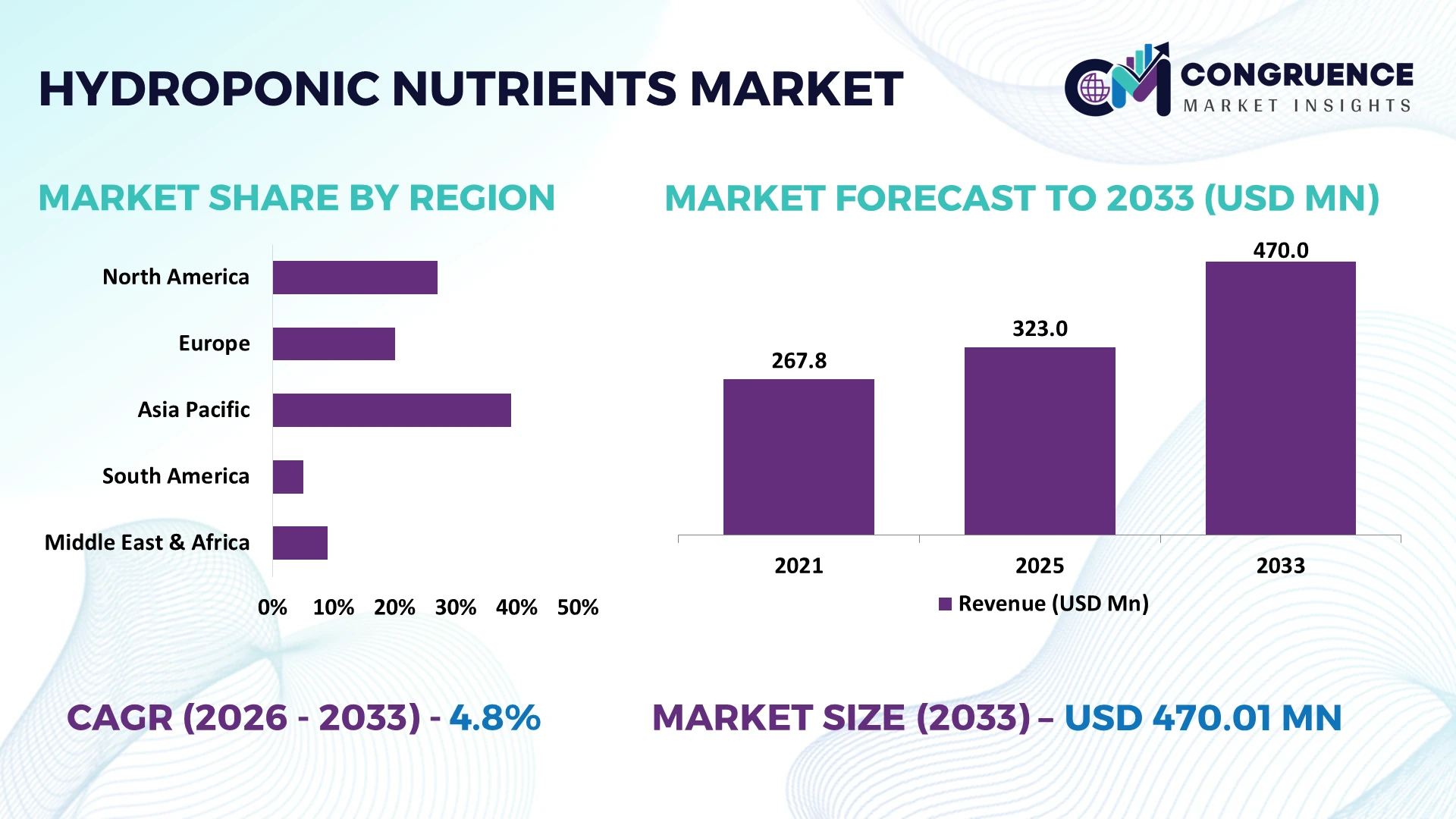
The Global Hydroponic Nutrients Market was valued at USD 323.01 Million in 2025 and is anticipated to reach a value of USD 470.01 Million by 2033 expanding at a CAGR of 4.8% between 2026 and 2033. Growth is supported by rapid expansion of controlled-environment agriculture, precision nutrient dosing systems, and commercial greenhouse investments that improve crop productivity while reducing fertilizer waste.
The Netherlands remains the dominant country, accounting for approximately 18% of global commercial hydroponic cultivation capacity, supported by over 90% greenhouse technology integration and continuous investment in advanced horticulture. Compared with Spain, Dutch facilities achieve higher automation levels and nutrient-use efficiency through precision fertigation. Ongoing European food security initiatives following regional supply-chain disruptions continue accelerating investment in resilient indoor farming infrastructure. Businesses prioritizing technology-enabled nutrient solutions gain stronger production consistency and long-term competitive positioning.
Market Size & Growth: USD 323.01 Million in 2025, reaching USD 470.01 Million by 2033 at 4.8% CAGR, driven by advanced precision fertigation and commercial greenhouse expansion.
Top Growth Drivers: Controlled-environment farming expands 11%, automated nutrient dosing adoption rises 15%, and water-efficient cultivation improves resource utilization by 25%.
Short-Term Forecast: By 2028, nutrient application efficiency increases 18% while fertilizer wastage declines 14% through automated monitoring systems.
Emerging Technologies: AI nutrient optimization, IoT sensor networks, and automated fertigation platforms improve nutrient accuracy by approximately 20%.
Regional Leaders: Europe approaches USD 160 Million, Asia Pacific exceeds USD 135 Million, and North America reaches nearly USD 110 Million, supported by regional greenhouse expansion and localized production.
Consumer/End-User Trends: More than 52% of commercial hydroponic growers adopt customized nutrient formulations for higher crop consistency and quality.
Pilot/Case Example: In 2026, a commercial greenhouse modernization program improved nutrient-use efficiency by 19% while reducing water consumption by 17%.
Competitive Landscape: The leading supplier holds approximately 14% market share alongside Haifa Group, Yara International, ICL Group, The Scotts Miracle-Gro Company, and K+S.
Regulatory & ESG Impact: Sustainable fertilizer programs reduce nutrient runoff by approximately 16%, supporting stricter environmental compliance across major agricultural regions.
Investment & Funding: More than USD 600 Million supports greenhouse expansion, strategic partnerships, and localized nutrient manufacturing amid global supply-chain diversification.
Innovation & Future Outlook: Next-generation bioavailable nutrient blends and digital crop management accelerate high-growth commercial farming with stronger operational resilience.
Hydroponic nutrients are gaining stronger demand across leafy vegetables, herbs, berries, and high-value greenhouse crops as growers prioritize consistent yields and resource efficiency. Advanced micronutrient formulations and sensor-integrated dosing systems improve nutrient uptake by approximately 18%, while localized production strategies reduce supply-chain risks amid evolving agricultural regulations. These developments strengthen operational performance and set the foundation for deeper strategic market evaluation.
Hydroponic nutrients have become strategically important as commercial food producers prioritize controlled-environment agriculture to strengthen supply resilience, improve crop consistency, and reduce dependence on unpredictable outdoor cultivation. Infrastructure modernization and localized fertilizer production are reshaping procurement strategies, while digital nutrient management platforms enable growers to optimize input efficiency. Commercial greenhouse operators are increasingly integrating automated fertigation systems to standardize production and reduce operational variability.
Modern AI-assisted nutrient dosing systems improve nutrient-use efficiency by approximately 20% compared with conventional manual mixing while reducing fertilizer losses by nearly 15%. The Netherlands continues to lead in precision greenhouse deployment, whereas India is expanding commercial hydroponic installations through protected cultivation and urban farming investments. Over the next two to three years, automated nutrient monitoring adoption is expected to exceed 40% among newly established commercial hydroponic facilities, improving production reliability and operational planning.
A practical example is large-scale greenhouse operators deploying sensor-driven fertigation integrated with real-time crop analytics, enabling faster nutrient adjustments and lower water consumption. Companies are strengthening partnerships with greenhouse technology providers, expanding localized manufacturing, and investing in customized nutrient formulations. These strategies reinforce competitive differentiation through higher cultivation efficiency, resilient supply networks, and long-term operational performance.
Commercial greenhouse expansion and precision cultivation remain the primary structural drivers for hydroponic nutrients. Automated fertigation improves nutrient utilization by approximately 18%, while sensor-based monitoring reduces fertilizer waste by nearly 16% and shortens crop management cycles by around 12%. The Netherlands continues investing in high-technology greenhouse clusters, while India is expanding protected cultivation programs to improve year-round production. This transition directly increases demand for specialized nutrient formulations with consistent composition and higher compatibility across automated systems. In response, manufacturers are expanding localized blending facilities, introducing crop-specific nutrient portfolios, and forming technology partnerships with greenhouse equipment suppliers. The strategic advantage lies in delivering integrated nutrient solutions rather than standalone fertilizer products, strengthening customer retention and operational efficiency.
The market continues to face structural pressure from fluctuating prices of mineral salts and specialty micronutrients used in premium hydroponic formulations. Input costs have experienced fluctuations of approximately 12–18% during recent procurement cycles, while imported specialty ingredients still account for nearly 40% of supply requirements in several developing countries. Logistics disruptions and stricter fertilizer quality regulations further complicate inventory planning and production scheduling. These factors reduce pricing flexibility for nutrient manufacturers and compress margins for commercial growers. Companies are responding by diversifying sourcing strategies, increasing domestic blending capacity, securing long-term supplier agreements, and optimizing formulation efficiency to reduce dependence on imported raw materials while maintaining product consistency and regulatory compliance.
Next-generation opportunities are emerging through AI-enabled nutrient optimization, crop-specific formulations, and precision agriculture platforms. Digital nutrient management systems improve application accuracy by approximately 20%, while customized formulations enhance crop productivity by nearly 15% across high-value vegetables and herbs. Japan is accelerating indoor farming innovation through automated cultivation technologies, creating demand for advanced nutrient programs integrated with real-time monitoring. Companies are expanding research partnerships, developing data-driven nutrient recommendations, and investing in modular production facilities capable of rapid formulation adjustments. A non-obvious opportunity lies in subscription-based nutrient management services combining software analytics with recurring nutrient supply, strengthening long-term customer relationships while improving operational predictability for commercial growers.
Expanding hydroponic operations requires seamless integration between nutrient management software, environmental controls, irrigation infrastructure, and greenhouse automation. System integration can increase project implementation timelines by approximately 20%, while skilled workforce shortages affect nearly 30% of advanced controlled-environment agriculture facilities in several developed markets. Australia and Canada continue addressing operational complexity through workforce training and digital infrastructure investments, yet interoperability between equipment vendors remains inconsistent. These execution challenges influence production consistency and increase maintenance requirements as facilities scale. Companies must prioritize standardized communication protocols, technician development programs, strategic technology partnerships, and interoperable automation platforms to achieve reliable long-term deployment, maintain cultivation precision, and strengthen competitive positioning.
Precision Fertigation Gains Momentum Automated nutrient delivery systems are becoming standard across commercial hydroponic operations, with deployment increasing by approximately 24% in newly commissioned facilities. Real-time EC and pH monitoring improves nutrient-use efficiency by nearly 18% while reducing manual intervention by around 30%. Greenhouse operators in the Netherlands are integrating cloud-connected dosing platforms to address labor shortages, prompting nutrient suppliers to expand compatibility with digital cultivation software and automated irrigation infrastructure.
Localized Nutrient Manufacturing Expansion Supply-chain restructuring is encouraging manufacturers to establish regional blending facilities, reducing delivery lead times by approximately 20% and lowering logistics expenses by nearly 12%. India and Mexico are strengthening domestic production capabilities to reduce dependence on imported specialty mineral inputs. Companies are responding through contract manufacturing partnerships, inventory decentralization, and flexible production systems that improve product availability while minimizing operational disruptions during global trade fluctuations.
Crop-Specific Formula Development Demand is shifting from universal nutrient blends toward customized formulations designed for leafy vegetables, herbs, and berries. Specialized nutrient programs improve crop uniformity by approximately 15% and shorten nutrient adjustment cycles by nearly 10%. Manufacturers are accelerating formulation research, collaborating with commercial greenhouse operators, and introducing precision nutrient portfolios that strengthen customer retention through measurable production consistency rather than price-based competition.
Sustainability-Driven Product Innovation Environmental compliance and resource optimization are accelerating adoption of cleaner nutrient technologies, with recyclable packaging usage increasing by approximately 22% and water-efficient cultivation practices improving by nearly 17%. Commercial growers are prioritizing products compatible with recirculating hydroponic systems to reduce nutrient discharge. Companies are restructuring product portfolios, expanding environmentally optimized formulations, and integrating digital performance analytics, creating a competitive advantage through operational sustainability instead of production scale alone.
Liquid nutrients dominate the Hydroponic Nutrients Market with an estimated 42% share, supported by rapid solubility, accurate dosing, and seamless integration with automated fertigation systems. Commercial greenhouse operators prefer liquid formulations because they reduce mixing time by approximately 20% and improve nutrient distribution consistency across large cultivation areas. Powder nutrients remain strategically important due to lower transportation costs, longer storage stability, and flexibility for bulk commercial operations. Manufacturers continue expanding concentrated liquid portfolios while improving packaging efficiency and compatibility with automated dosing platforms.
Organic nutrients represent the fastest-growing segment as commercial producers respond to premium produce demand and sustainability objectives. Adoption has increased by nearly 18% across controlled-environment agriculture, while synthetic nutrients continue serving high-intensity production requiring precise nutrient control and predictable crop performance. Companies are investing in advanced organic formulations, expanding localized production, and introducing hybrid nutrient solutions combining operational efficiency with environmental performance. Investment priorities increasingly favor differentiated nutrient portfolios capable of serving both intensive commercial farming and premium specialty crop cultivation.
Vegetables account for approximately 48% of hydroponic nutrient consumption, supported by continuous production cycles, high planting density, and stable commercial demand from retailers and food service operators. Leafy greens, tomatoes, and cucumbers require highly controlled nutrient programs, encouraging growers to adopt automated fertigation capable of improving nutrient-use efficiency by approximately 18%. Flowers and herbs continue expanding in premium cultivation systems, while fruit production maintains strategic importance for high-value greenhouse operations requiring customized nutrient schedules.
Herbs represent the fastest-growing application, with adoption increasing by nearly 16% as urban farms and indoor cultivation facilities prioritize premium culinary products and year-round harvesting. Fruit cultivation is also advancing through precision greenhouse technologies that improve crop quality and consistency. Companies are responding by developing crop-specific nutrient formulations, integrating digital nutrient recommendations, and expanding partnerships with commercial greenhouse operators. Demand is increasingly shifting toward specialized nutrient programs tailored to crop physiology rather than standardized formulations, strengthening long-term customer relationships.
Commercial farms represent the largest end-user segment with an estimated 46% market share because of their large-scale cultivation capacity, continuous nutrient consumption, and investment in automated production systems. Precision fertigation adoption exceeds 55% across modern commercial hydroponic operations, improving operational efficiency while reducing nutrient losses. Greenhouses remain a highly significant buyer group due to infrastructure-intensive cultivation requiring consistent nutrient delivery and automated environmental control systems.
Home growers are emerging as the fastest-growing end-user segment, with adoption increasing by approximately 19% as compact hydroponic systems become more accessible through digital monitoring and simplified nutrient kits. Research institutes continue supporting product validation, formulation testing, and crop optimization programs that accelerate commercial innovation. Companies are strengthening competitive positioning through customized packaging, subscription-based nutrient supply, technical support services, and strategic partnerships with greenhouse technology providers, ensuring differentiated solutions across professional and consumer cultivation environments.
Europe accounted for the largest market share at 36% in 2025 however, Asia-Pacific is expected to register the fastest growth, expanding at a 5.9% between 2026 and 2033.
Advanced Greenhouse Automation Strengthens Commercial Production
North America represents approximately 29% of the global Hydroponic Nutrients Market, supported by large-scale greenhouse cultivation, vertical farming expansion, and advanced fertigation infrastructure. Commercial operators continue integrating automated nutrient dosing, cloud-based crop monitoring, and sensor-driven irrigation to improve production consistency. More than 58% of new controlled-environment agriculture projects incorporate automated nutrient management platforms. Investments in domestic greenhouse expansion and localized nutrient blending facilities are shortening procurement cycles while improving inventory resilience. Companies are expanding strategic collaborations with indoor farming technology providers to deliver integrated crop nutrition systems that increase operational efficiency and simplify commercial deployment.
United States Market Outlook: The United States leads regional demand through extensive commercial greenhouse infrastructure, advanced indoor farming networks, and rapid technology commercialization. Precision fertigation adoption exceeds 60% among newly established commercial hydroponic facilities, supported by enterprise investment in AI-enabled cultivation platforms. Nutrient manufacturers continue expanding localized production, technical advisory services, and customized crop nutrition programs for leafy vegetables, herbs, and berries, strengthening operational efficiency across professional growers.
Technology-Led Greenhouse Modernization Drives Market Leadership
Europe maintains the largest market position through highly automated greenhouse production, precision horticulture, and strong sustainability standards. The region contributes approximately 36% of global demand, supported by advanced fertigation infrastructure and extensive protected cultivation capacity. More than 70% of commercial greenhouse operators utilize automated nutrient management systems, improving fertilizer efficiency and reducing operational variability. Environmental regulations continue encouraging nutrient optimization and water recirculation technologies. Companies are expanding precision nutrient portfolios, strengthening regional manufacturing capacity, and partnering with greenhouse automation specialists to improve integrated cultivation performance.
Netherlands Market Outlook: The Netherlands remains Europe's technology leader, supported by one of the world's highest greenhouse automation rates. More than 90% of commercial greenhouse facilities utilize precision fertigation and environmental monitoring technologies. Domestic nutrient producers focus on research-driven formulations, digital cultivation integration, and export-oriented production, enabling commercial growers to maintain high crop uniformity while supporting year-round intensive horticultural operations.
Rapid Commercial Deployment Accelerates Market Expansion
Asia-Pacific is emerging as the fastest-expanding regional market due to increasing investments in protected cultivation, urban agriculture, and commercial greenhouse infrastructure. The region accounts for approximately 24% of global demand while recording strong deployment across high-density agricultural economies. Automated hydroponic systems have expanded by nearly 20% in newly commissioned facilities, supported by food security initiatives and modern cultivation technologies. Manufacturers are increasing regional blending capacity and strengthening distribution networks to improve supply responsiveness and product availability.
China Market Outlook: China leads regional expansion through large-scale protected agriculture, smart farming investments, and government-supported agricultural modernization. Commercial greenhouse deployment continues expanding across major agricultural provinces, while digital nutrient monitoring adoption has increased by approximately 22% in modern facilities. Domestic companies are strengthening manufacturing capabilities, automation partnerships, and customized nutrient product development to support intensive year-round cultivation.
Protected Cultivation Expands Commercial Adoption
South America is strengthening its hydroponic nutrient industry through increasing greenhouse investments, commercial vegetable production, and modernization of high-value horticulture. The region contributes approximately 7% of global demand, with commercial hydroponic projects expanding steadily across export-oriented farming operations. Modern fertigation deployment has improved nutrient application efficiency by nearly 15%, encouraging greater adoption among professional growers. Infrastructure limitations remain, yet companies continue expanding regional distribution partnerships and localized technical support to improve commercial implementation.
Brazil Market Outlook: Brazil represents the largest market within South America due to expanding greenhouse vegetable production and growing investment in protected agriculture. Commercial growers increasingly deploy automated irrigation and nutrient management systems, improving operational consistency across premium crop production. Domestic distributors are strengthening technical service capabilities and expanding partnerships with greenhouse equipment suppliers to accelerate adoption among medium- and large-scale farming enterprises.
Food Security Investments Reshape Controlled Agriculture
The Middle East & Africa market is expanding through strategic investments in controlled-environment agriculture, water-efficient cultivation, and greenhouse modernization. The region contributes approximately 4% of global demand, supported by increasing deployment of hydroponic farming systems in water-constrained environments. Automated nutrient delivery has improved cultivation efficiency by approximately 16% across new commercial greenhouse projects. Companies are establishing regional partnerships, localized supply networks, and technical training programs to improve operational reliability while supporting national food security strategies.
United Arab Emirates Market Outlook: The United Arab Emirates leads regional adoption through advanced greenhouse infrastructure, smart farming initiatives, and investment in sustainable food production. Commercial hydroponic projects increasingly integrate digital nutrient management and climate-controlled cultivation technologies, improving production consistency despite harsh climatic conditions. Companies continue collaborating with technology providers and agricultural developers to expand commercial-scale hydroponic operations supported by precision nutrient solutions.
The Hydroponic Nutrients Market is led by Haifa Group, Yara International, ICL Group, The Scotts Miracle-Gro Company, and K+S, competing against specialized nutrient formulators and regional blending companies. The top five players collectively control approximately 48% of the market, while regional manufacturers compete through localized supply, crop-specific formulations, and faster customer support. Competition centers on nutrient precision, formulation stability, delivery speed, and digital cultivation compatibility, with automated fertigation solutions improving nutrient efficiency by nearly 18% and localized manufacturing reducing lead times by approximately 20%. Global leaders strengthen positions through product innovation, strategic greenhouse partnerships, and vertical integration across production and distribution, while regional suppliers compete on customization and operational flexibility. Technology-enabled nutrient optimization is replacing price-only competition, accelerating portfolio differentiation. Entry barriers include formulation expertise, regulatory compliance, technical agronomy capabilities, and established distribution networks. Success increasingly depends on integrated nutrient solutions, reliable supply chains, precision agriculture compatibility, and long-term commercial grower partnerships.
Haifa Group
Yara International
ICL Group
The Scotts Miracle-Gro Company
K+S
Masterblend International
Hydrodynamics International
General Hydroponics
Advanced Nutrients
Growth Technology Ltd.
CANNA
Plant Magic Plus
Greenway Biotech Inc.
HydroGarden Ltd.
Commercial hydroponic nutrient management is shifting toward precision fertigation integrated with IoT sensors, automated dosing, and cloud-based crop analytics. More than 58% of newly commissioned commercial hydroponic facilities deploy automated nutrient control, improving nutrient-use efficiency by approximately 18% while reducing fertilizer waste by nearly 15%. Real-time EC and pH monitoring enables continuous formulation adjustments, reducing manual intervention and improving crop consistency. Compared with conventional manual mixing, AI-assisted nutrient dosing delivers around 22% higher operational accuracy and faster response to changing crop requirements, providing commercial growers with measurable productivity and labor advantages.
Emerging technologies between 2026 and 2028 include AI-driven nutrient optimization, digital twin greenhouse platforms, machine vision-based crop diagnostics, and predictive nutrient recommendation engines. Approximately 35% of large commercial greenhouse operators are integrating nutrient management software with climate-control platforms to create unified cultivation workflows. Automated formulation algorithms reduce nutrient correction cycles by nearly 20%, while cloud-connected analytics improve operational planning and inventory optimization. Manufacturers increasingly embed digital advisory platforms alongside nutrient portfolios to strengthen customer retention and improve cultivation outcomes.
Disruptive innovation is moving beyond fertilizer formulations toward integrated crop nutrition ecosystems. Companies combining customized nutrient programs, automation partnerships, and digital agronomy services gain stronger competitive positioning than suppliers competing primarily on product pricing. Localized blending supported by predictive demand planning shortens supply lead times by approximately 18%, while data-driven nutrient optimization strengthens commercial scalability. Through 2028, enterprises investing in intelligent nutrient platforms, interoperable greenhouse technologies, and precision formulation capabilities will establish lasting operational differentiation.
March 2026 ICL Group opened a specialty water-soluble fertilizer manufacturing facility in Maharashtra, India, strengthening regional supply security and supporting localized production in a major import-dependent market. The facility expands domestic manufacturing capacity for specialty fertilizers, improving delivery resilience and customer responsiveness. Source: icl-group.com
March 2026 Yara International expanded its Hanninghof Research Centre in Germany to accelerate biological crop solution development as demand for biologicals increased fivefold over the past two decades. The investment strengthens innovation capabilities and supports next-generation crop nutrition technologies. Source: yara.com
July 2026 Haifa Group highlighted new precision nutrition innovations, including Haifa Soluble™ DUO, MultiMatch™, and enhanced digital crop nutrition tools, reinforcing integrated fertilizer management. The company operates through 19 subsidiaries, strengthening global deployment of precision nutrient technologies. Source: haifa-group.com
July 2026 Yara International agreed to acquire the Gulf Coast Ammonia facility in Texas with an expected nameplate production capacity of 1.3 million tonnes annually, strengthening upstream supply integration and improving long-term competitiveness across specialty crop nutrition markets. Source: yara.com
The report delivers comprehensive analysis across liquid nutrients, powder nutrients, organic nutrients, and synthetic nutrients while evaluating demand across vegetables, fruits, herbs, and flowers. It further assesses commercial farms, greenhouses, research institutes, and home growers, covering more than 20 major countries across North America, Europe, Asia-Pacific, South America, and the Middle East & Africa. The study examines deployment trends, precision fertigation adoption, automation integration, digital nutrient management, and evolving product innovation strategies.
Strategic assessment includes competitive positioning, technology adoption patterns, regional deployment differences, supply-chain transformation, and operational benchmarking between 2026 and 2033. The report evaluates company expansion strategies, partnership activity, product differentiation, localized manufacturing, and precision agriculture integration while highlighting emerging opportunities in controlled-environment agriculture, urban farming, AI-enabled nutrient optimization, and sustainable crop nutrition systems. These insights support investment prioritization, portfolio planning, market entry evaluation, and long-term competitive decision-making.
| Report Attribute/Metric | Report Details |
|---|---|
Market Revenue in 2025 | USD 323.01 Million |
Market Revenue in 2033 | USD 470.01 Million |
CAGR (2026 - 2033) | 4.8% |
Base Year | 2025 |
Forecast Period | 2026 - 2033 |
Historic Period | 2021 - 2025 |
Segments Covered | By Type
By Application
By End-User
|
Key Report Deliverable | Revenue Forecast, Growth Trends, Market Dynamics, Segmental Overview, Regional and Country-wise Analysis, Competition Landscape |
Region Covered | North America, Europe, Asia-Pacific, South America, Middle East, Africa |
Key Players Analyzed | Haifa Group, Yara International, ICL Group, The Scotts Miracle-Gro Company, K+S, Masterblend International, Hydrodynamics International, General Hydroponics, Advanced Nutrients, Growth Technology Ltd., CANNA, Plant Magic Plus, Greenway Biotech Inc., HydroGarden Ltd. |
Customization & Pricing | Available on Request (10% Customization is Free) |




