
Reports
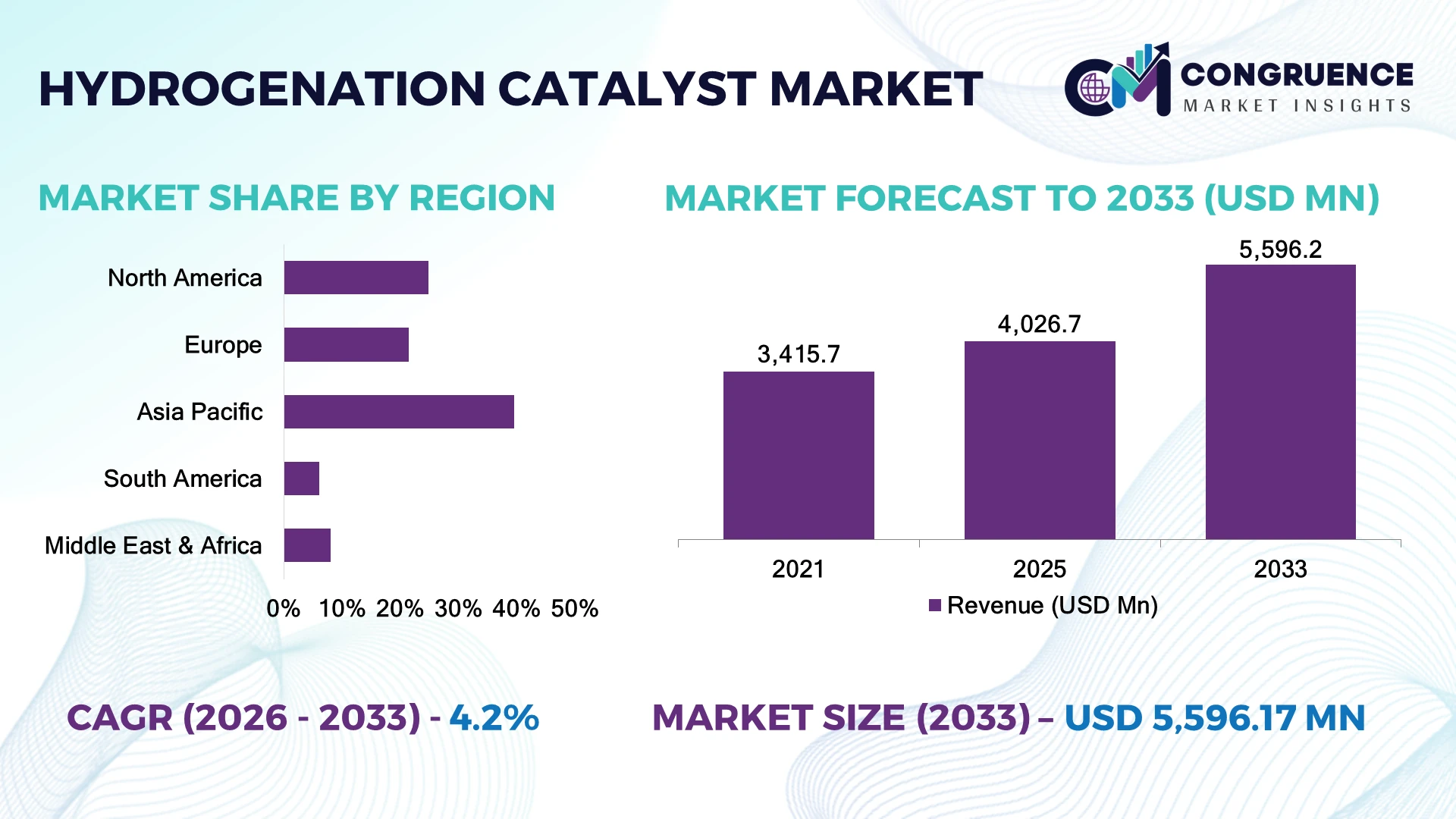
The Global Hydrogenation Catalyst Market was valued at USD 4,026.7 Million in 2025 and is anticipated to reach a value of USD 5,596.2 Million by 2033 expanding at a CAGR of 4.2% between 2026 and 2033. Growth is driven by refinery hydroprocessing, renewable diesel expansion, pharmaceutical hydrogenation, and increasing deployment of selective catalysts that improve conversion while reducing precious-metal loading.
China accounts for approximately 30% of global hydrogenation catalyst consumption and production capacity, supported by refining, chemicals, and pharmaceutical manufacturing, while the U.S. represents roughly 18–20% of demand with stronger specialty-chemical and renewable-fuels applications. European producers maintain advanced catalyst development capabilities, with precious-metal optimization reducing metal intensity by approximately 10–15%; Red Sea logistics disruptions are also accelerating regional inventory diversification.
Strategically, catalyst suppliers with localized production, lower precious-metal intensity, and application-specific formulations are best positioned to capture investment as refiners and chemical producers modernize assets through 2033.
The Hydrogenation Catalyst Market is concentrated across petroleum refining, renewable diesel, petrochemicals, specialty chemicals, pharmaceuticals, edible oils, and fine chemicals. Nickel, palladium, platinum, ruthenium, and supported-metal catalysts remain important, while structured and low-metal formulations are gaining traction. Advanced catalysts can improve selectivity by approximately 10–15%. Supply-chain diversification following Red Sea disruptions is strengthening regional catalyst inventories and recycling capabilities, setting the stage for strategic investment.
Hydrogenation catalysts are becoming strategically important because catalyst performance increasingly determines refinery throughput, product quality, hydrogen efficiency, and operating economics. Refiners, chemical manufacturers, and pharmaceutical producers are moving from standardized catalyst procurement toward application-specific formulations that balance activity, selectivity, lifetime, and precious-metal intensity. This shift is strengthening the role of catalyst suppliers in plant modernization and process optimization.
Technology differentiation is particularly visible in metal utilization. Advanced supported and structured catalysts can reduce precious-metal loading by approximately 10–15% while maintaining comparable conversion, compared with conventional high-loading formulations. Asia-Pacific combines the largest industrial demand with rapid refinery and chemical-capacity expansion, whereas Europe emphasizes low-carbon processing, recycling, and metal efficiency. North American demand is increasingly linked to renewable fuels and refinery optimization.
Over the next 2–3 years, digital catalyst monitoring, AI-assisted formulation, and recycling systems are expected to gain wider industrial adoption, with optimized catalyst cycles targeting 8–12% longer operating periods. In practical refinery hydroprocessing, improved catalyst selectivity can reduce downstream treatment requirements and hydrogen losses. Suppliers are therefore expanding regional manufacturing, precious-metal recovery, technical partnerships, and customized catalyst development.
The competitive advantage will increasingly belong to producers that combine catalyst activity with metal efficiency, supply security, recycling capability, and application-specific engineering.
Refinery modernization and renewable-fuel processing are increasing demand for high-activity hydrogenation catalysts, particularly in China, India, and the U.S. Hydroprocessing units account for an estimated 35–40% of industrial hydrogenation catalyst consumption, while renewable diesel and sustainable-fuel applications are expanding catalyst requirements by roughly 10–15%. Stricter sulfur specifications are also increasing catalyst severity and regeneration frequency. Chinese and Indian refiners are upgrading hydrotreating and hydrocracking assets rather than relying solely on new capacity, creating recurring catalyst demand. Producers are responding with higher-activity nickel, cobalt-molybdenum, and precious-metal formulations, alongside technical-service partnerships. The non-obvious advantage is longer catalyst cycle length: a 8–12% extension can materially improve refinery turnaround economics and reduce replacement logistics.
Volatility in platinum-group and palladium pricing remains a structural constraint for premium hydrogenation catalysts, particularly pharmaceutical and specialty-chemical formulations. Precious metals can represent 20–40% of catalyst material value in selected formulations, while recycling and recovery rates vary substantially by application. Supply concentration also exposes European and Asian manufacturers to procurement disruptions and inventory costs. Red Sea shipping disruptions have reinforced the need for regional stockholding and alternative logistics routes. Companies are reducing exposure through lower-metal-loading catalysts, nickel-based alternatives, closed-loop recovery, and longer procurement contracts. The strategic pressure is shifting from simply securing catalyst supply to controlling metal intensity: reducing precious-metal loading by 10–15% can protect formulation economics without sacrificing required catalytic activity.
Structured catalysts, advanced supports, and digitally optimized formulations create opportunities to improve hydrogen utilization and reactor productivity without major plant redesign. Structured catalyst architectures can increase effective mass transfer by approximately 10–20%, while optimized supports can improve selectivity by 8–15% in targeted hydrogenation processes. Pharmaceutical manufacturers in India and China are increasingly adopting continuous and intensified processing, creating demand for catalysts engineered around specific reaction pathways. AI-assisted catalyst screening is also shortening formulation cycles by approximately 20–30% in development workflows. Suppliers are partnering with chemical producers, engineering firms, and research organizations to commercialize application-specific systems. A less obvious opportunity lies in catalyst-as-a-service models combining formulation, performance monitoring, regeneration, and metal recovery into recurring industrial contracts.
Moving advanced hydrogenation catalysts from laboratory validation to continuous industrial operation remains technically demanding. Differences in feed composition, reactor hydrodynamics, impurity loading, and temperature profiles can reduce commercial performance by 5–15% compared with controlled development conditions. Pharmaceutical plants in India and Europe face additional qualification requirements when catalyst changes affect impurity profiles or product specifications. Workforce shortages in catalyst engineering and process analytics further constrain rapid deployment, while increasingly complex reactor configurations raise commissioning requirements by approximately 10–15%. Companies must strengthen pilot-scale testing, digital reactor modelling, process partnerships, and application engineering. The critical competitive issue is not catalyst activity alone but reproducibility across production sites; suppliers that standardize performance validation can reduce commissioning delays and improve customer retention.
Low-Metal Formulations Gain Traction: Catalyst developers are reducing precious-metal loading by 10–15% while maintaining targeted conversion levels. Nickel, ruthenium, and engineered supported-metal systems are gaining attention as platinum-group-metal volatility persists. European and Japanese suppliers are accelerating reformulation and recycling programs, shifting competition toward metal efficiency rather than catalyst volume alone.
Digital Catalyst Monitoring Expands: Refiners are integrating process sensors, predictive analytics, and catalyst-performance models to improve operating decisions. Digital monitoring can extend catalyst operating periods by approximately 8–12% and reduce unplanned performance degradation by 5–10%. U.S. and Chinese operators are increasingly connecting catalyst data with refinery optimization platforms, creating stronger demand for technically supported catalyst contracts.
Recycling Becomes Strategic Infrastructure: Precious-metal recovery is moving from a waste-management function toward supply-chain security. Closed-loop recovery can reclaim approximately 90–95% of selected precious metals from spent catalyst streams, reducing exposure to primary-metal procurement. Manufacturers are establishing dedicated recycling partnerships and regional recovery networks, particularly where geopolitical logistics disruptions have increased inventory requirements.
Selective Catalysts Improve Product Quality: Specialty chemical and pharmaceutical producers increasingly prioritize selectivity alongside conversion, particularly where downstream purification is expensive. Advanced catalyst systems can improve reaction selectivity by approximately 8–15%, reducing unwanted by-products and separation loads. Indian and European manufacturers are expanding application-specific catalyst development, making formulation expertise an increasingly important competitive differentiator.
Supported Metal Catalysts Lead, Advanced Precious-Metal Systems Gain Value
Supported metal catalysts represent the leading type, accounting for approximately 55–60% of hydrogenation catalyst demand because nickel, cobalt, and molybdenum-based systems offer scalable performance, established reactor compatibility, and lower material costs than precious-metal alternatives. Nickel-based catalysts remain particularly important in edible oils, petrochemicals, and bulk chemical processing, while conventional supported systems retain a strong installed base across refineries. Precious-metal catalysts account for roughly 18–22% of demand but command significantly higher value intensity because of their activity and selectivity in pharmaceutical and specialty-chemical reactions.
The fastest-growing shift is toward advanced precious-metal and engineered supported catalysts, where lower metal loading and improved dispersion can reduce material intensity by 10–15% while maintaining conversion. Regenerable and structured formulations are also gaining traction, particularly in Europe, Japan, and the U.S. Companies are expanding catalyst recycling, application-specific R&D, and lower-metal formulations. The business priority is shifting from catalyst volume toward activity per unit of metal and longer operating cycles.
Refining Dominates Volume While Pharmaceuticals Drive Specialization
Petroleum refining represents the leading application, accounting for approximately 42–47% of hydrogenation catalyst demand, supported by hydrotreating, hydrocracking, desulfurization, and fuel-quality requirements. Large refineries in China, India, Saudi Arabia, and the U.S. create substantial recurring catalyst requirements because catalyst activity directly affects throughput and product specifications. Chemical and petrochemical processing follows at approximately 25–30%, while edible oils, pharmaceuticals, and specialty chemicals represent smaller but higher-value applications.
Pharmaceutical hydrogenation is the fastest-growing application segment, supported by expanding API manufacturing and increasingly selective synthesis requirements in India, China, and Europe. Advanced catalyst systems can improve selectivity by approximately 8–15%, reducing downstream purification requirements. Renewable diesel and sustainable-fuel processing is also strengthening demand for tailored hydroprocessing catalysts, with selected operators targeting 10–20% improvements in catalyst utilization. Companies are responding through application-specific formulations, technical partnerships, catalyst regeneration, and regional service teams, shifting investment toward higher-margin specialty applications alongside established refinery volumes.
Refiners Anchor Demand as Specialty Chemical Buyers Premiumize
Petroleum and fuel refiners represent the leading end-user group, accounting for approximately 45–50% of hydrogenation catalyst consumption because of extensive hydroprocessing infrastructure and continuous catalyst replacement requirements. Their purchasing decisions prioritize activity, cycle length, regeneration capability, and feedstock tolerance, with longer catalyst runs delivering measurable maintenance and turnaround advantages. Chemical and petrochemical producers account for roughly 25–30%, while pharmaceutical, food-oil, and specialty-chemical manufacturers represent smaller but increasingly technology-intensive demand pools.
Pharmaceutical and specialty-chemical manufacturers constitute the fastest-growing end-user group, driven by selective hydrogenation, impurity control, and expansion of API production in India and China. These buyers can accept 10–20% higher catalyst costs when improved selectivity reduces purification and solvent requirements. Refiners, by contrast, remain more price- and throughput-sensitive. Catalyst suppliers are therefore segmenting portfolios by application, offering performance contracts, regeneration services, and customized formulations. The strategic shift favors suppliers capable of serving both high-volume refinery accounts and technically demanding specialty manufacturers without compromising catalyst consistency.
Asia-Pacific accounted for the largest market share at 39.6% in 2025 however, Middle East & Africa is expected to register the fastest growth, expanding at a CAGR of 5.3% between 2026 and 2033.
Refinery optimization and renewable-fuel processing strengthen catalyst intensity
North America accounted for approximately 24.8% of the global hydrogenation catalyst market in 2025, supported by extensive refining infrastructure, petrochemical production, pharmaceutical manufacturing, and expanding renewable-fuel processing. The U.S. represents the dominant regional demand center, with refineries increasingly upgrading hydrotreating systems to accommodate changing feedstocks and tighter product specifications. Renewable diesel and sustainable aviation fuel projects are creating additional requirements for high-activity hydroprocessing catalysts. Advanced catalyst formulations can extend operating cycles by approximately 8–12%, improving turnaround economics for large facilities. Producers are responding through catalyst regeneration, precious-metal recovery, and application-specific formulations rather than relying exclusively on conventional catalyst grades. Gulf Coast refining and chemical clusters remain particularly important, while domestic manufacturing and inventory diversification are reducing exposure to international logistics disruptions.
U.S. Market Outlook: The U.S. combines the region's largest refining base with sophisticated catalyst engineering, pharmaceutical production, and renewable-fuel infrastructure. Gulf Coast facilities account for a substantial concentration of refining and petrochemical capacity, supporting recurring demand for hydrotreating and hydrogenation catalysts. Renewable diesel and sustainable aviation fuel projects are increasing interest in selective hydroprocessing systems, with catalyst optimization targeting approximately 5–10% lower hydrogen consumption in selected applications. Domestic catalyst regeneration and precious-metal recovery capabilities further strengthen supply resilience and operating economics.
Low-carbon processing accelerates catalyst efficiency and recycling
Europe represented approximately 21.5% of global hydrogenation catalyst demand in 2025, with Germany, the Netherlands, France, Italy, and the U.K. forming major refining, chemical, pharmaceutical, and specialty-chemical clusters. Environmental requirements and industrial decarbonization programs are encouraging producers to prioritize catalysts that reduce hydrogen consumption, extend operating cycles, and support cleaner feedstocks. Precious-metal recovery is becoming increasingly important as manufacturers seek to reduce exposure to volatile raw-material costs. Advanced formulations can lower precious-metal intensity by approximately 10–15% while maintaining targeted catalytic activity. European catalyst producers are also expanding technical partnerships with refiners and chemical manufacturers to improve regeneration, recycling, and application-specific performance.
Germany Market Outlook: Germany remains a strategically important market because of its integrated chemical industry, specialty-chemical production, refinery infrastructure, and advanced catalyst engineering capabilities. Industrial users increasingly prioritize high-selectivity catalysts that reduce downstream separation requirements and improve process efficiency. German manufacturers are also investing in catalyst recycling and metal recovery to strengthen supply security. Advanced catalyst systems targeting 8–12% longer operating cycles provide an important economic advantage for continuous chemical and refinery processes, particularly where plant shutdowns carry substantial production costs.
Refining expansion and chemical manufacturing reinforce supply dominance
Asia-Pacific held approximately 39.6% of the global hydrogenation catalyst market in 2025, making it the largest regional market due to China's extensive refining and chemical infrastructure, India's expanding hydroprocessing capacity, and strong pharmaceutical manufacturing across India, China, Japan, and South Korea. China represents a major catalyst production and consumption hub, while India is strengthening domestic manufacturing to support refinery and pharmaceutical expansion. Regional catalyst producers are increasing investments in nickel-based systems, precious-metal recovery, structured supports, and customized formulations. Automated catalyst manufacturing and quality-control systems can improve batch consistency by approximately 8–12%, supporting export competitiveness and reducing dependence on imported specialty grades.
China Market Outlook: China is the region's most strategically significant country because of its large refining, petrochemical, pharmaceutical, and chemical manufacturing base. Extensive hydroprocessing infrastructure creates recurring demand for nickel, cobalt-molybdenum, and precious-metal catalysts. Domestic producers are increasingly developing higher-activity formulations to serve both large state-linked refiners and specialty chemical manufacturers. Catalyst localization is also reducing import exposure, while advanced formulations targeting approximately 10–15% lower metal intensity are strengthening competitiveness in high-value applications.
Refinery modernization and biofuel processing reshape catalyst demand
South America represented approximately 6.1% of global hydrogenation catalyst demand in 2025, with Brazil accounting for the largest regional requirement through refining, biofuel, edible-oil, petrochemical, and chemical-processing activities. Brazil's established biodiesel industry creates demand for hydrogenation and upgrading technologies, while refinery modernization supports continued hydrotreating catalyst consumption. Industrial operators increasingly seek catalyst systems capable of handling variable feedstocks without compromising product specifications. Catalyst optimization can improve cycle length by approximately 8–10% in selected processing applications, reducing maintenance frequency. Import dependence for specialized catalyst grades remains an operational consideration, encouraging distributors and producers to maintain regional inventories and strengthen technical-service capabilities near major industrial clusters.
Brazil Market Outlook: Brazil dominates regional catalyst demand because of its large refining network, biofuel industry, agricultural-processing base, and chemical manufacturing infrastructure. São Paulo, Rio de Janeiro, Bahia, and other industrial centers concentrate major processing assets requiring recurring catalyst replacement and technical support. Biodiesel and renewable-fuel processing provide additional demand for selective hydrogenation systems. Localized catalyst servicing and regeneration can reduce replacement-related logistics requirements by approximately 10–15%, encouraging suppliers to establish closer relationships with refiners, biofuel producers, and chemical manufacturers.
Refinery integration drives higher-value catalyst deployment
Middle East & Africa accounted for approximately 8.0% of global hydrogenation catalyst demand in 2025, with Saudi Arabia, the UAE, Kuwait, Qatar, and South Africa representing important refining and petrochemical centers. Large integrated refinery-petrochemical projects are increasing requirements for hydrotreating, hydrocracking, and specialty hydrogenation catalysts. Saudi Arabian and Gulf producers are emphasizing higher-value downstream processing rather than exporting predominantly unprocessed hydrocarbons, increasing catalyst intensity across integrated complexes. Modern catalyst systems can extend processing cycles by approximately 8–12%, supporting higher refinery utilization and reducing turnaround requirements. Suppliers are responding with regional technical-service teams, localized inventory, regeneration agreements, and partnerships with major refinery operators.
Saudi Arabia Market Outlook: Saudi Arabia represents the region's strongest catalyst opportunity because of its large integrated refining and petrochemical infrastructure and continuing downstream diversification. Major industrial clusters around Jubail, Yanbu, and Ras Tanura support substantial demand for hydroprocessing catalysts used across fuels and chemical streams. Refinery-petrochemical integration increases the value of catalysts capable of tolerating diverse feedstocks while maintaining product quality. Suppliers offering regeneration and performance-monitoring services can improve catalyst utilization by approximately 8–12%, strengthening long-term industrial contracts and reducing replacement logistics.
BASF, Clariant, Evonik, Johnson Matthey, and regional catalyst producers compete across refinery, chemical, pharmaceutical, and specialty hydrogenation applications. The top five players hold an estimated 28% combined share. Competition centers on activity, selectivity, price, metal efficiency, supply security, and customization: advanced formulations can improve selectivity 8–15%, reduce precious-metal loading 10–15%, and extend catalyst cycles 8–12%. BASF competes through integrated R&D, low-metal formulations, and regional manufacturing; Clariant differentiates with chromium-free hydrogenation platforms; Evonik emphasizes high-pressure process expertise; Johnson Matthey combines catalyst engineering with precious-metal recycling. Regional Chinese producers compete aggressively on cost and localized supply, particularly for base-metal systems. The competitive structure is shifting toward application-specific catalysts, recycling, and integrated technical services as customers demand feedstock flexibility. Entry barriers remain high because qualification, reactor compatibility, process data, metal sourcing, and regeneration infrastructure require substantial investment. Winning requires superior catalyst economics, proven scale-up, reliable supply, rapid technical support, and measurable performance gains.
Hydrogenation catalyst technology is shifting toward low-metal formulations, engineered supports, structured geometries, and digitally monitored reactors. BASF’s low-density precious-metal systems target higher metal efficiency, while structured catalysts improve mass transfer and can reduce pressure drop by approximately 10–20%. Commercial adoption is strongest in refinery and petrochemical applications where catalyst performance directly affects throughput and cycle economics.
AI-assisted catalyst screening, advanced characterization, and computer-designed catalyst shapes are accelerating formulation development. Compared with conventional catalyst bodies, optimized structures can improve effective reactor performance by roughly 8–15% while reducing energy losses. Chromium-free formulations are also gaining adoption as European chemical producers tighten hazardous-substance controls. Clariant’s hydrogenation portfolio illustrates the competitive advantage of suppliers combining performance, regulatory compliance, and drop-in compatibility.
Between 2026 and 2028, catalyst manufacturing will increasingly integrate 3D printing, digital performance monitoring, automated quality control, and precious-metal recycling. BASF’s X3D technology is moving toward industrial production, while regional producers are expanding application-specific engineering. Digital monitoring can extend catalyst utilization by approximately 8–12%, and closed-loop metal recovery can reclaim 90–95% of selected precious metals. Suppliers investing now gain advantages in metal efficiency, faster scale-up, feedstock tolerance, and lifecycle cost control. These capabilities will increasingly determine qualification decisions for high-throughput, lower-carbon processing assets.
December 2024 BASF opened its Ludwigshafen Catalyst Development and Solids Processing Center after a double-digit million-euro investment. The facility accelerates pilot-scale catalyst synthesis and scale-up, shortening development cycles and strengthening commercialization of advanced hydrogenation formulations for chemical customers. Source: basf.com
November 2025 Clariant’s chromium-free HySat hydrogenation catalyst won Best Catalyst Technology at the Gulf Energy Information Excellence Awards. Commercial validation and repeat orders demonstrate adoption, while removing hexavalent chromium strengthens regulatory compliance, workplace safety, and sustainable catalyst positioning. Source: gasprocessingnews.com
May 2025 Johnson Matthey agreed to sell Catalyst Technologies to Honeywell for £1.8 billion enterprise value. The transaction reshapes catalyst ownership, giving Honeywell a broader technology platform, while Johnson Matthey concentrates resources on Clean Air and platinum-group-metal services. Source: reuters.com
May 2026 BASF opened a refinery-catalyst R&D center in Attapulgus, Georgia, colocated with its largest refinery-catalyst production site. The facility integrates research, engineering, and operations, accelerating scale-up and strengthening process-testing capabilities for advanced catalyst development and deployment globally. Source: chemengonline.com Chemical Engineering
The Hydrogenation Catalyst Market Report covers supported metal, base-metal, precious-metal, structured, and advanced catalyst systems across petroleum refining, petrochemicals, specialty chemicals, pharmaceuticals, edible oils, renewable fuels, and fine chemicals. End-user analysis includes refiners, chemical manufacturers, pharmaceutical producers, food-oil processors, and specialty-chemical companies across North America, Europe, Asia-Pacific, South America, and Middle East & Africa.
The report evaluates catalyst activity, selectivity, regeneration, metal efficiency, structured supports, low-density formulations, AI-assisted catalyst development, digital monitoring, 3D-printed catalyst architectures, and precious-metal recycling. Supported catalysts account for approximately 55–60% of demand, while advanced formulations increasingly prioritize 8–15% selectivity improvements and 10–15% lower precious-metal intensity. The analysis supports investment planning, regional expansion, supplier selection, technology positioning, partnership strategy, and competitive decision-making through 2026–2033.
| Report Attribute/Metric | Report Details |
|---|---|
|
Market Revenue in 2025 |
USD 4,026.7 Million |
|
Market Revenue in 2033 |
USD 5,596.2 Million |
|
CAGR (2026 - 2033) |
4.2% |
|
Base Year |
2025 |
|
Forecast Period |
2026 - 2033 |
|
Historic Period |
2021 - 2025 |
|
Segments Covered |
By Type
By Application
By End-User
|
|
Key Report Deliverable |
Revenue Forecast, Growth Trends, Market Dynamics, Segmental Overview, Regional and Country-wise Analysis, Competition Landscape |
|
Region Covered |
North America, Europe, Asia-Pacific, South America, Middle East, Africa |
|
Key Players Analyzed |
BASF SE, Clariant AG, Evonik Industries AG, Johnson Matthey Plc, Umicore N.V., Heraeus Holding, W. R. Grace & Co., Topsoe A/S, Albemarle Corporation, Axens, Sinopec Catalyst Company, JGC Catalysts & Chemicals Ltd., N.E. Chemcat Corporation, SÜD-CHEMIE India Pvt. Ltd. |
|
Customization & Pricing |
Available on Request (10% Customization is Free) |




