
Reports
The Global Hydrogen Truck Market was valued at USD 1660 Million in 2025 and is anticipated to reach a value of USD 4498.08121044794 Million by 2033 expanding at a CAGR of 13.27% between 2026 and 2033. Growth is driven by zero-emission heavy-duty freight requirements, expanding hydrogen corridors, stricter fleet-emission rules, and rapid fuel-cell deployment across logistics and industrial transport.
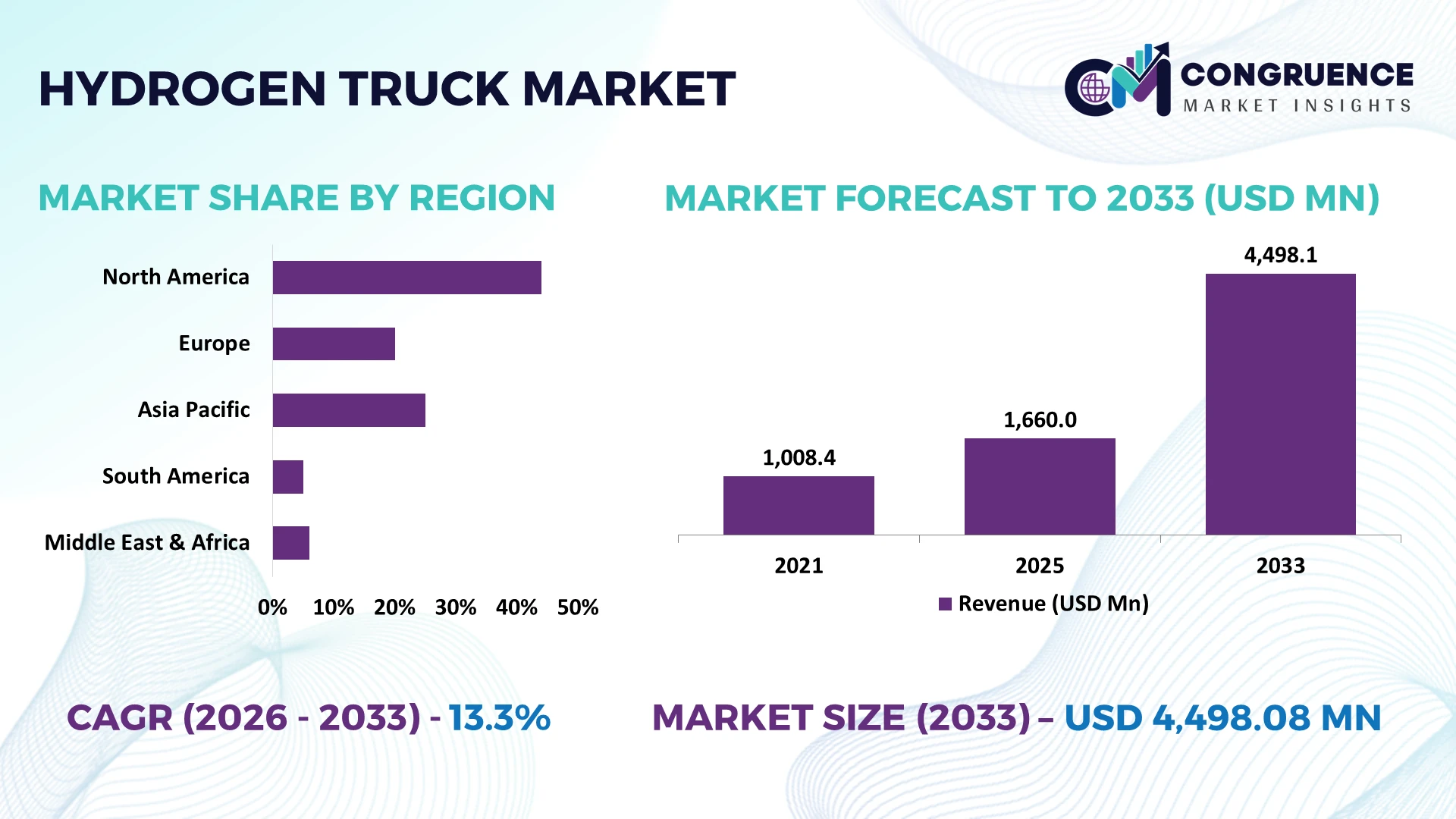
China dominates hydrogen commercial-vehicle deployment, accounting for 82% of the global fuel-cell bus fleet and 88–98% of light, medium, and heavy-duty fuel-cell vehicle fleets. China recorded 10,782 fuel-cell vehicle sales in 2025 and operated more than 570 hydrogen refueling stations, while hydrogen demand for road transport represented 75% of global demand in 2024. By comparison, India has launched five hydrogen transport pilots covering 37 vehicles and 9 refueling stations. China’s scale gives suppliers stronger advantages in fleet localization, component sourcing, and industrial corridor deployment.
Strategic implication: Prioritize China-linked supply chains, heavy-duty logistics corridors, fuel-cell systems, and integrated vehicle-refueling partnerships when allocating market-entry capital.
Market Size & Growth: USD 1.66 billion in 2025 to USD 4.50 billion by 2033 at 13.27% CAGR, supported by fuel-cell commercialization and heavy-duty freight decarbonization.
Top Growth Drivers: Heavy-duty trucks 49.8%; logistics and transport 56.0%; PEMFC technology 75.4%, highlighting concentrated commercial adoption.
Short-Term Forecast: By 2030, larger production runs are positioned to reduce fuel-cell system costs while improving vehicle range, utilization, and fleet economics.
Emerging Technologies: AI fleet optimization, high-power PEMFC stacks, advanced hydrogen storage, and automated refueling are accelerating operational efficiency and uptime.
Regional Leaders: Asia Pacific reaches USD 14.16 billion by 2033; North America USD 8.61 billion; Europe USD 6.37 billion, with fleet corridors driving adoption.
Consumer/End-User Trends: Logistics and transport represented 56.0% of market revenue in 2025, confirming freight operators as the primary commercial adoption base.
Pilot/Case Example: Hyundai’s Swiss XCIENT fleet crossed 10 million km in 2024, avoiding approximately 6,300 tonnes of CO₂ versus comparable diesel operation.
Competitive Landscape: China-led manufacturers hold a strong deployment position, while Hyundai, Daimler Truck, Volvo, Nikola, Toyota, and IVECO expand commercial hydrogen platforms.
Regulatory & ESG Impact: Europe had more than 250 hydrogen stations by end-2024, while emissions regulations increasingly connect fleet procurement with measurable decarbonization outcomes.
Investment & Funding: The EUR 12 million H2Haul project, approximately USD 13 million, combines OEMs, fuel-cell suppliers, infrastructure companies, and logistics operators across four European sites.
Innovation & Future Outlook: Next-generation 700-km-class trucks, integrated hydrogen corridors, automated fueling, and localized stack manufacturing are shifting competition toward total fleet economics.
The Hydrogen Truck Market is shifting from demonstration fleets toward commercial logistics, mining, municipal transport, and long-haul freight applications where battery weight and charging downtime constrain vehicle utilization. Heavy-duty trucks represented 49.8% of market revenue in 2025, while logistics and transport accounted for 56.0%, concentrating near-term demand around high-mileage fleet operators. China’s commercial-vehicle leadership is reinforced by more than 570 operating hydrogen stations and 10,782 fuel-cell vehicle sales in 2025. Europe is simultaneously expanding cross-border hydrogen logistics corridors, creating opportunities for OEMs, stack suppliers, storage manufacturers, and refueling operators.
Hydrogen trucks are becoming strategically important as freight operators balance zero-emission mandates with payload, range, and utilization requirements. Fuel-cell powertrains can refuel in roughly 15–30 minutes, compared with several hours for high-capacity battery charging, strengthening their position in high-mileage logistics. China’s deployment scale is materially ahead of India, while Europe is prioritizing cross-border hydrogen corridors. This divergence is reshaping supplier partnerships, fleet procurement, and infrastructure investment.
Technology economics are also improving. Modern PEM fuel-cell systems can achieve electrical efficiencies of approximately 50–60%, compared with roughly 40–45% for conventional diesel engines, while eliminating tailpipe CO₂ emissions. Over the next 2–3 years, fleet operators are expected to prioritize depot-based hydrogen supply, higher-utilization routes, and standardized fueling systems rather than broad infrastructure coverage. Companies are increasingly combining vehicle purchases with long-term hydrogen supply and station agreements.
Operational deployments demonstrate the shift. Hyundai’s XCIENT trucks accumulated more than 10 million km in Switzerland, validating hydrogen for sustained freight operations. Chinese manufacturers are simultaneously expanding integrated vehicle-stack-refueling ecosystems, while European OEMs are developing corridor-based partnerships. Competitive positioning will increasingly depend on securing hydrogen supply, maximizing fleet uptime, and integrating vehicles with infrastructure rather than vehicle technology alone.
Heavy-duty freight is accelerating hydrogen adoption because payload preservation and rapid refueling remain critical on intensive routes. Logistics and transport accounted for 56.0% of market revenue in 2025, while heavy-duty trucks represented 49.8%, concentrating deployment around commercial fleets rather than private mobility. China recorded 10,782 fuel-cell vehicle sales in 2025, reinforcing manufacturing scale and component localization. European emissions policies are simultaneously pushing fleet operators toward zero-emission alternatives. Companies are responding through OEM-infrastructure partnerships, depot-based hydrogen stations, and integrated fuel-supply contracts. The non-obvious advantage is utilization: hydrogen enables longer operating cycles without allocating substantial vehicle downtime to charging, improving asset productivity on fixed high-mileage routes.
Hydrogen trucking remains constrained by uneven refueling availability and production economics. Road transport represented approximately 75% of global hydrogen demand in 2024, intensifying competition for low-carbon hydrogen between mobility, industrial, and energy applications. China operates more than 570 hydrogen refueling stations, whereas India’s national hydrogen transport pilots currently cover 37 vehicles and 9 refueling stations, illustrating substantial infrastructure asymmetry. Electrolyzer utilization, renewable-power availability, compression, storage, and transport costs directly influence delivered fuel prices. Companies are reducing exposure through localized hydrogen production, multi-year supply agreements, and vertically integrated station models. The immediate operational priority is securing reliable fuel availability before expanding fleet volumes.
The strongest opportunity is shifting from standalone truck sales toward integrated hydrogen logistics ecosystems. Fuel-cell vehicle deployments can be paired with renewable hydrogen production, automated dispensing, fleet-management software, and predictive maintenance, creating recurring service revenue beyond vehicle manufacturing. Hydrogen fuel-cell efficiency can reach approximately 50–60%, while AI-enabled route optimization can further increase vehicle utilization by reducing idle and refueling inefficiencies. China’s industrial corridors provide a scalable testing environment, while India’s emerging hydrogen mobility pilots create opportunities for localized components and station technology. Companies are positioning through joint ventures covering stacks, storage systems, refueling infrastructure, and fleet operations. A strategic opportunity lies in selling uptime and fuel availability as an integrated service rather than competing solely on vehicle price.
Hydrogen trucking faces an execution challenge as vehicle deployment, station standards, storage capacity, and fuel specifications must scale simultaneously. More than 570 stations in China demonstrate infrastructure momentum, but deployment remains geographically concentrated around industrial corridors. Europe had more than 250 hydrogen stations by the end of 2024, yet cross-border freight requires consistent dispensing standards and reliable corridor coverage. Differences in pressure systems, station throughput, payment interfaces, and maintenance protocols can reduce fleet utilization even when vehicles are technically compatible. Companies must therefore invest in standardized fueling interfaces, digital monitoring, technician training, and cross-border infrastructure partnerships. Long-term competitiveness will depend on delivering predictable fleet uptime across interconnected logistics networks rather than isolated demonstration projects.
Fuel-Cell Fleet Scaling: China remains the operational center, with fuel-cell commercial vehicles representing almost 95% of the global stock. Heavy-truck deployments are expanding faster than passenger applications, prompting OEMs to scale stacks, storage systems, and depot refueling partnerships for intensive freight routes.
Refueling Network Modernization: Global hydrogen refueling infrastructure has surpassed 1,300 stations, while China operates more than 570. Standardized high-pressure dispensing, station automation, and higher-throughput depots are becoming priorities as operators shift from demonstration routes toward repeatable commercial workflows.
Industrial Fleet Conversion: Mining and industrial logistics are moving beyond pilots as companies replace diesel vehicles on controlled routes. Adani’s 2025 deployment uses 40-ton hydrogen trucks with a 200-km range, demonstrating how predictable routes can support infrastructure investment and structured fleet conversion.
Supply-Chain Localization: China accounts for 65% of global installed electrolyzer capacity and nearly 60% of manufacturing capacity, encouraging overseas suppliers to localize production and partnerships. This is reshaping procurement toward domestic assembly, service networks, and diversified component sourcing.
Fuel-Cell Leadership Reshapes Deployment
Fuel Cell Electric trucks remain the leading type, accounting for approximately 75% of hydrogen-truck deployments, supported by zero tailpipe emissions, fast refueling, and suitability for high-utilization freight. Long-Haul Trucks represent roughly 45% of demand, where range and payload constraints strengthen the value proposition. Heavy-Duty Trucks remain commercially important, while Hydrogen Internal Combustion and Hybrid Hydrogen platforms retain niche relevance for operators prioritizing existing drivetrain familiarity and transitional fleet economics.
Fuel Cell Electric remains the established technology, while Hydrogen Internal Combustion is gaining attention as manufacturers explore lower integration barriers and conventional-engine expertise. Hybrid Hydrogen systems provide another transition pathway but remain less standardized. Companies are directing R&D toward higher-output stacks, hydrogen storage, thermal management, and fleet-specific powertrains. The investment priority is shifting toward technologies that maximize vehicle utilization rather than simply reducing tailpipe emissions.
Long-Haul Freight Drives Utilization
Long-Haul Freight represents the leading application at approximately 42% share, reflecting high annual mileage, payload sensitivity, and the operational value of rapid refueling. Regional Freight follows at roughly 24%, supported by repeatable depot-to-depot routes. Mining Transport is emerging rapidly as controlled routes simplify hydrogen station placement, while Port Operations, Construction Logistics, and Municipal Transport remain targeted applications with location-specific infrastructure requirements.
Mining Transport is the fastest-expanding application, with adoption increasingly linked to dedicated hydrogen production and fixed-cycle logistics. Adani’s 2025 deployment in India uses hydrogen trucks carrying 40 tonnes across 200 km, illustrating how predictable mining routes can support fleet conversion. Companies are integrating vehicles with onsite or corridor-based refueling, while port and construction operators are evaluating hydrogen where diesel replacement must preserve heavy payload capacity and operating continuity.
Logistics Buyers Drive Fleet Demand
Logistics Companies represent the leading end-user group at approximately 34% share, supported by centralized fleets, predictable freight schedules, and direct control over depot operations. Freight Carriers account for about 25%, while Fleet Operators increasingly influence procurement through multi-brand vehicle management. Mining Companies, Construction Companies, and Port Operators remain specialized buyers where fixed routes and concentrated operating locations reduce infrastructure complexity.
Mining Companies are emerging as a high-growth buyer group, with hydrogen increasingly integrated into controlled haulage operations. Construction Companies and Port Operators are similarly evaluating hydrogen where heavy-duty utilization makes diesel displacement operationally significant. Companies are responding through customized vehicle specifications, long-term hydrogen supply contracts, joint infrastructure development, and fleet-management integration. The competitive shift is toward bundled vehicle-plus-fuel solutions, allowing buyers to manage uptime, refueling availability, and lifecycle operating costs through one ecosystem.
Asia-Pacific accounted for the largest market share at 78% in 2025 however, Middle East & Africa is expected to register the fastest growth, expanding at a CAGR of 13.0% between 2026 and 2033.
Fleet Pilots Shift Toward Port-Centered Deployment
North America is developing around heavy-duty fleet pilots, particularly California port drayage, regional freight corridors, and depot-based hydrogen supply. The United States represents the principal deployment center, supported by truck manufacturers, fuel-cell developers, logistics companies, and clean-transport programs. Commercial activity remains concentrated rather than widespread, making infrastructure utilization a critical investment metric. California’s freight corridors are encouraging partnerships between OEMs, station operators, hydrogen producers, and fleet owners to coordinate vehicle availability with fueling capacity. Technology programs increasingly emphasize higher-power stacks, thermal management, and route-specific vehicle configurations. The strategic shift is from demonstration vehicles toward commercially structured fleet ecosystems, where hydrogen supply contracts and station uptime determine operating economics. Companies are therefore prioritizing corridor density, service capability, and fleet integration over isolated vehicle launches.
United States Market Outlook: The United States combines major truck manufacturing capabilities with advanced fuel-cell research and established freight infrastructure. California remains a central testing environment for zero-emission heavy-duty transport, while companies are developing partnerships around ports, distribution centers, and dedicated freight routes. This creates opportunities for localized hydrogen production, fleet services, and high-throughput refueling infrastructure.
Cross-Border Hydrogen Corridors Gain Structure
Europe is moving toward corridor-based hydrogen trucking as emissions regulation, freight decarbonization, and infrastructure modernization converge. Germany leads public hydrogen refueling infrastructure with 72 operational stations, representing approximately 39% of Europe’s total in May 2025. Heavy-duty dispensers accounted for 33% of European dispenser capacity, demonstrating infrastructure adaptation toward commercial trucks. Germany, France, the Netherlands, and Switzerland remain important deployment centers, while logistics operators are integrating hydrogen trucks into industrial and port-linked routes. The Düsseldorf station opened in 2025 with capacity of up to 5 tonnes of hydrogen per day and simultaneous refueling for three vehicles, illustrating the transition toward higher-throughput infrastructure. Companies are responding through cross-border partnerships, depot investments, and vehicle-infrastructure coordination rather than standalone fleet procurement.
Germany Market Outlook: Germany combines the region’s strongest hydrogen refueling footprint with substantial commercial-vehicle manufacturing and industrial demand. Its 72 operational public stations represented approximately 39% of Europe’s total in May 2025. Daimler Truck and other industrial groups are therefore positioned to connect truck production with hydrogen corridors, component supply, and fleet demonstration programs.
China Drives Manufacturing and Deployment Scale
Asia-Pacific remains the largest hydrogen-truck deployment center, led overwhelmingly by China’s manufacturing ecosystem and commercial-fleet programs. China recorded 10,782 fuel-cell vehicle sales in 2025, mainly trucks and buses, while more than 570 hydrogen refueling stations were operating. Shanxi, Hebei, Henan, Shandong, and Guangdong are important heavy-duty commercial-vehicle clusters, linking hydrogen deployment with steel, logistics, mining, and industrial freight. South Korea and Japan contribute advanced fuel-cell technologies, while India is building localized hydrogen transport pilots and component capabilities. Chinese suppliers are increasingly integrating vehicle manufacturing, fuel-cell stacks, hydrogen storage, and refueling infrastructure, lowering coordination friction across deployment projects. Companies outside China are responding through localized manufacturing partnerships and technology alliances to compete with the region’s scale advantage.
China Market Outlook: China’s strategic advantage comes from combining vehicle manufacturing depth with dense commercial-fleet deployment. More than 570 hydrogen stations and 10,782 fuel-cell vehicle sales in 2025 provide a substantial operational base for component learning, service-network expansion, and technology cost reduction. Manufacturers are increasingly targeting heavy-duty corridors where fleet utilization supports dedicated hydrogen infrastructure.
Brazil Opens Commercial Hydrogen Truck Testing
South America remains an emerging hydrogen-truck market, with Brazil developing the strongest near-term industrial platform through vehicle testing, research partnerships, and domestic manufacturing infrastructure. In 2025, GWM brought its first hydrogen truck to Brazil for validation and road testing, using a 40-kg hydrogen storage system and a 105-kWh battery. The project involved Brazilian universities and explored hydrogen produced through electrolysis and ethanol-based processes, linking transport development with local energy resources. In 2026, GWM completed Latin America’s first hydrogen-truck cargo operation in Brazil using a fuel-cell truck with up to 500 km of range. The development shifts market activity from laboratory validation toward operational freight demonstration. Companies are prioritizing localized testing, fuel-production partnerships, and route-specific infrastructure before committing to larger fleet deployments.
Brazil Market Outlook: Brazil offers an important combination of industrial manufacturing capacity, renewable-energy resources, ethanol infrastructure, and large freight networks. GWM’s 2026 loaded cargo demonstration established a practical reference point for hydrogen trucking, using a truck rated at 544 hp with up to 500 km of range. The focus is now shifting toward commercial viability, fuel availability, and fleet economics.
Hydrogen Projects Enable Industrial Fleet Integration
The Middle East & Africa market is developing around hydrogen production projects, mining logistics, industrial transport, and export-oriented energy infrastructure. Saudi Arabia, the UAE, Oman, and South Africa are strategically relevant because hydrogen projects can connect large-scale production with heavy-duty mobility applications. Mining corridors in South Africa provide controlled operating environments where dedicated refueling infrastructure can support predictable truck cycles. Middle Eastern developers are increasingly evaluating hydrogen mobility alongside ammonia, renewable power, and industrial hydrogen projects, allowing transport demand to become an additional offtake channel. The region’s opportunity is therefore tied less to broad public vehicle deployment and more to integrated industrial ecosystems. Companies are prioritizing project partnerships, dedicated fleet pilots, renewable hydrogen supply, and infrastructure co-location. This model can reduce logistics complexity by locating production, storage, and vehicle operations within connected industrial zones.
Saudi Arabia Market Outlook: Saudi Arabia combines large-scale renewable-energy development with major hydrogen and industrial investment programs, creating conditions for hydrogen trucks to operate within controlled logistics ecosystems. Heavy-duty applications linked to ports, mining, construction, and industrial zones offer concentrated demand. Companies can integrate vehicle fleets with dedicated hydrogen production and storage, reducing dependence on fragmented public refueling networks.
China-based OEMs such as SAIC Hongyan, Foton and Dongfeng compete against Hyundai, Daimler Truck, Volvo, Toyota and IVECO through technology and deployment models. Chinese players emphasize localized supply chains, high-volume manufacturing and cost control, while global OEMs focus on fuel-cell durability, fleet integration and corridor partnerships. The top five players are estimated to control about 38% of hydrogen heavy-truck value, indicating a fragmented structure with regional concentration. Competition centers on fuel-cell efficiency, range, storage, service coverage and delivered operating cost. Chinese fuel-cell systems can cost roughly 50% less than comparable Western systems, while European and Korean suppliers emphasize lifecycle performance. Companies compete through production expansion, joint ventures, hydrogen-station agreements and integrated fleet pilots. The shift is toward vertical integration as access to stacks, hydrogen supply and refueling infrastructure becomes important. Entry barriers remain high because certification and service networks require capital. Winning requires cost-efficient technology, reliable supply and ecosystem control.
Hyundai Motor Company
Toyota Motor Corporation
Daimler Truck Holding AG
Volvo Group
IVECO Group
SAIC Motor Corporation
Foton Motor Group
Dongfeng Motor Corporation
FAW Group
Sinotruk Group
Shaanxi Automobile Group
Nikola Corporation
Ballard Power Systems
GWM Hydrogen
Fuel-cell electric powertrains remain the core technology, using PEM fuel cells, high-pressure hydrogen storage, regenerative braking, and battery buffering. Current systems deliver roughly 50–60% electrical efficiency, while high-pressure dispensing can complete refueling in 10–20 minutes. China accounts for almost 95% of global fuel-cell commercial-vehicle stock, giving Chinese OEMs scale, component learning, and procurement advantages. Fleet telematics integration is improving route planning and hydrogen consumption visibility.
Emerging technologies are improving performance through advanced membrane materials, higher-power stacks, carbon-fiber tanks, liquid-hydrogen storage, and hydrogen combustion engines. Volvo’s HPDI-based hydrogen engine testing in 2026 targets higher efficiency and lower fuel consumption than conventional hydrogen combustion. Compared with diesel powertrains, fuel-cell systems eliminate tailpipe pollutants and can improve energy efficiency by roughly 10–20 percentage points. Automated refueling and predictive diagnostics are also reducing operational interruptions.
By 2026–2028, the disruptive shift will center on integrated hydrogen ecosystems combining trucks, renewable hydrogen production, digital fleet management, and automated stations. GWM’s 2026 Brazilian truck demonstrates 500-km range, 400-kW power, and more than 10 hours of continuous operation. Companies pairing vehicle platforms with fuel supply and infrastructure gain stronger uptime control, while suppliers specializing in stacks, storage, and software benefit from recurring fleet integration demand and lower downtime.
June 2024 Hyundai’s XCIENT fuel-cell trucks surpassed 10 million km in Swiss fleet operation, with 48 units deployed. The milestone validated long-term heavy-duty reliability and supported wider European commercial deployment across logistics, retail distribution, refuse collection, and specialized freight applications.
October 2025 GWM Hydrogen deployed 500 additional fuel-cell trucks in Baoding, taking its operating fleet beyond 2,000 units. The expansion included 300 heavy trucks for coal logistics, demonstrating commercial scaling and strengthening integrated vehicle, fuel-cell, infrastructure, service, and regional capabilities.
October 2025 the IEA reported that China held almost 95% of the world’s fuel-cell commercial-vehicle stock. Heavy trucks remained the only rapidly expanding road fuel-cell segment, reinforcing China’s manufacturing scale and concentrating supplier opportunities around commercial fleet ecosystems and procurement.
August 2025 Hyroad acquired 113 Class 8 hydrogen trucks and related assets from Nikola’s bankruptcy auction. The transaction preserved deployed vehicle support while shifting hydrogen trucking assets toward a specialized trucking-as-a-service model, highlighting consolidation and ownership structures across North America. S
The Hydrogen Truck Market Report covers the global commercial ecosystem for hydrogen-powered heavy vehicles, including Fuel Cell Electric, Hydrogen Internal Combustion, and Hybrid Hydrogen technologies across Long-Haul Trucks and Heavy-Duty Trucks. Application analysis spans Long-Haul Freight, Regional Freight, Mining Transport, Port Operations, Construction Logistics, and Municipal Transport, while end-user coverage includes Logistics Companies, Freight Carriers, Mining Companies, Construction Companies, Port Operators, and Fleet Operators.
Geographic coverage includes North America, Europe, Asia-Pacific, South America, and Middle East & Africa, with country-level analysis of manufacturing clusters, hydrogen corridors, refueling infrastructure, pilot fleets, and policy-driven deployment. The scope evaluates PEM fuel cells, hydrogen storage, automated refueling, digital fleet management, predictive maintenance, and emerging hydrogen combustion systems. Deployment indicators and enterprise participation help assess investment priorities, expansion opportunities, supplier positioning, infrastructure partnerships, and technology direction from 2026 to 2033.
| Report Attribute/Metric | Report Details |
|---|---|
Market Revenue in 2025 | USD 1660 Million |
Market Revenue in 2033 | USD 4498.08121044794 Million |
CAGR (2026 - 2033) | 13.27% |
Base Year | 2025 |
Forecast Period | 2026 - 2033 |
Historic Period | 2021 - 2025 |
Segments Covered | By Type
By Application
By End-User
|
Key Report Deliverable | Revenue Forecast, Growth Trends, Market Dynamics, Segmental Overview, Regional and Country-wise Analysis, Competition Landscape |
Region Covered | North America, Europe, Asia-Pacific, South America, Middle East, Africa |
Key Players Analyzed | Hyundai Motor Company, Toyota Motor Corporation, Daimler Truck Holding AG, Volvo Group, IVECO Group, SAIC Motor Corporation, Foton Motor Group, Dongfeng Motor Corporation, FAW Group, Sinotruk Group, Shaanxi Automobile Group, Nikola Corporation, Ballard Power Systems, GWM Hydrogen |
Customization & Pricing | Available on Request (10% Customization is Free) |




