
Reports
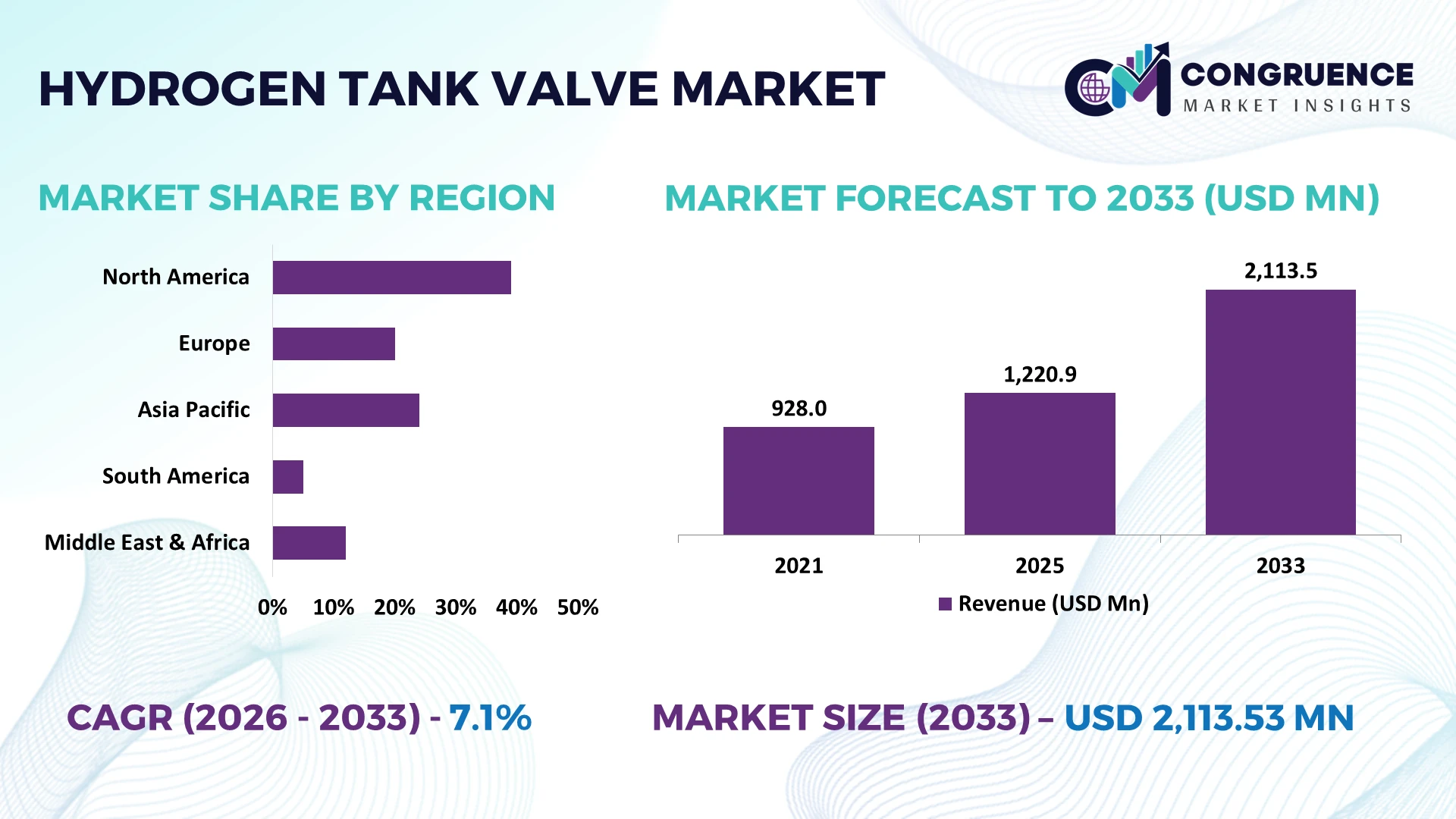
The Global Hydrogen Tank Valve Market was valued at USD 1220.94 Million in 2025 and is anticipated to reach a value of USD 2113.53 Million by 2033 expanding at a CAGR of 7.1% between 2026 and 2033. Growth is driven by high-pressure Type IV hydrogen storage deployment, fuel-cell vehicle expansion, hydrogen refueling infrastructure, and stricter requirements for leak prevention, thermal protection, and pressure regulation.
China leads with an estimated 29% share of hydrogen tank valve manufacturing capacity, supported by fuel-cell vehicles, electrolyzer projects, and heavy-duty mobility investments exceeding USD 10 billion across hydrogen infrastructure programs. Japan follows near 15%, emphasizing precision valves and fuel-cell systems. European manufacturers are accelerating localization as energy-security priorities intensified after Russia’s invasion of Ukraine. Adoption of electronically controlled shutoff valves exceeds 40% in advanced mobility platforms.
Strategic decisions should prioritize high-pressure, electronically controlled valve platforms and localized supply chains in China, Japan, and Europe.
Market Size & Growth: USD 1220.94 Million in 2025 is projected to reach USD 2113.53 Million by 2033 at a 7.1% CAGR, driven by high-pressure hydrogen mobility and storage expansion.
Top Growth Drivers: Fuel-cell mobility 31%, hydrogen refueling infrastructure 24%, and stationary storage 18% represent leading growth contributors.
Short-Term Forecast: By 2028, advanced valve automation is expected to reduce inspection costs by 12% and improve pressure-control efficiency by 9%.
Emerging Technologies: Smart pressure sensors, electronically controlled shutoff valves, advanced sealing materials, and digital diagnostics are reshaping high-pressure hydrogen storage.
Regional Leaders: Asia-Pacific is projected at USD 1.05 Billion, Europe at USD 520 Million, and North America at USD 410 Million, with high-pressure mobility deployments accelerating.
Consumer/End-User Trends: More than 45% of new hydrogen mobility systems increasingly specify electronically monitored valves for safety, diagnostics, and remote fault detection.
Pilot/Case Example: A 2025 heavy-duty hydrogen mobility pilot integrating intelligent tank-valve monitoring achieved approximately 10% faster pressure-response diagnostics.
Competitive Landscape: China holds approximately 29% manufacturing capacity, competing with Parker Hannifin, Emerson, Hamai Industries, KITZ, and GFI Control Systems.
Regulatory & ESG Impact: Hydrogen storage safety standards are driving electronically monitored valve adoption above 40%, while improved leak prevention supports lower hydrogen losses.
Investment & Funding: More than USD 20 billion in global hydrogen mobility and infrastructure commitments are accelerating valve-system partnerships, localization, and manufacturing expansion.
Innovation & Future Outlook: Next-generation valves combine pressure sensing, thermal protection, smart diagnostics, and lightweight materials, shifting competition toward integrated safety and lifecycle performance.
Hydrogen tank valves are becoming critical components across fuel-cell vehicles, hydrogen refueling stations, stationary storage, aerospace applications, and industrial gas systems. Demand is shifting toward electronically controlled high-pressure valves capable of operating at 700-bar storage conditions, with smart-valve adoption approaching 40% in newer mobility platforms. Manufacturers are responding to tightening safety standards and supply-chain restructuring by developing localized component ecosystems, advanced sealing systems, and integrated pressure-monitoring technologies, creating a stronger foundation for strategic investment.
Hydrogen tank valves are becoming strategic safety and performance components as 350-bar and 700-bar storage systems scale across mobility, refueling, and stationary applications. Electronically controlled valves with integrated sensing can reduce response time by 10–15% and inspection intervention by 8–12% versus conventional mechanical architectures. Supply-chain localization is accelerating as manufacturers seek qualified domestic sources for pressure-critical components.
China leads high-volume deployment through fuel-cell vehicles and hydrogen infrastructure, while Japan emphasizes precision valve engineering and compact fuel-cell systems. Germany and the United States are advancing digitally monitored storage platforms and stringent validation practices. Over the next 2–3 years, smart-valve penetration in newly deployed mobility systems is positioned to approach 55%, while automated leak diagnostics can improve maintenance productivity by 10%.
A practical deployment combines pressure regulation, thermal shutoff, electronically triggered isolation, and real-time diagnostics within the tank-valve assembly. Manufacturers are expanding testing capacity, partnering with fuel-cell and tank developers, and localizing seals, sensors, and precision-machined components. Competitive advantage increasingly depends on validated high-pressure performance, diagnostic intelligence, and supply continuity, making integrated valve platforms central to hydrogen-system reliability and long-term industrial positioning.
Expansion of 700-bar fuel-cell vehicle platforms is strengthening demand for high-performance tank valves, with advanced electronically controlled systems improving pressure-response performance by approximately 10–15% and reducing manual inspection requirements by 8–10%. China’s expanding fuel-cell vehicle ecosystem and Japan’s established hydrogen mobility programs are accelerating qualification activity. Safety standards increasingly emphasize leak prevention, pressure control, and thermal protection, pushing OEMs toward integrated valve assemblies. Manufacturers are responding by expanding high-pressure testing facilities, partnering with composite-tank producers, and localizing precision components. The strategic advantage lies in validated valve-tank integration: suppliers that qualify complete assemblies can secure longer platform cycles and reduce downstream integration complexity.
High-pressure hydrogen valves require specialized machining, sealing materials, sensors, and validation, with precision components contributing roughly 25–35% of assembly cost. Imported critical parts can increase procurement exposure by 10–15% when logistics, certification, and currency effects combine. Japan and Germany maintain strong technical capabilities, but emerging manufacturers face qualification barriers when sourcing advanced elastomers and pressure-rated electronics. Companies are reducing exposure through dual sourcing, localized machining, strategic inventory, and long-term supplier agreements. The immediate business constraint is qualification time: replacing a pressure-critical component without complete validation can disrupt production schedules, making supplier diversification valuable only when alternative components are pre-qualified.
Connected valves combining pressure sensing, thermal monitoring, electronic isolation, and predictive diagnostics create new opportunities across hydrogen vehicles and refueling infrastructure. Smart architectures can reduce diagnostic time by 10–15% and improve fault-detection efficiency by approximately 12%. The United States and South Korea are particularly relevant for digitally managed hydrogen mobility platforms, while China offers scale for localized production. Manufacturers are investing in sensor integration, embedded controls, and cloud-connected diagnostics through partnerships with tank and fuel-cell developers. A non-obvious opportunity is aftermarket monitoring: intelligent valve data can support condition-based servicing, enabling fleet operators to replace components according to actual operating conditions rather than fixed maintenance intervals.
Hydrogen tank valves increasingly interact with pressure sensors, vehicle control units, refueling protocols, and thermal-management systems, creating integration demands that extend beyond mechanical design. Digital architectures can increase validation workloads by 15–20%, while cybersecurity requirements add another layer for connected platforms. U.S., German, and Japanese developers face rigorous qualification expectations across pressure cycling, leakage, temperature exposure, and electronic reliability. Companies are responding with automated test benches, hardware-in-the-loop validation, standardized interfaces, and joint development programs. The long-term challenge is maintaining interoperability across rapidly evolving hydrogen platforms; suppliers that cannot validate mechanical and digital performance together risk losing platform positions even when individual valve specifications remain competitive.
Electronic Monitoring Becomes Standard: New hydrogen valve platforms increasingly combine pressure sensors and electronic isolation, with connected functionality appearing in roughly 35% of newer mobility systems. Automated diagnostics can reduce inspection time by 10–12%, prompting Japanese and European suppliers to integrate sensor-ready architectures.
High-Pressure Cycling Intensifies: Testing requirements are becoming more demanding as 700-bar storage expands, with qualification cycles increasing approximately 15% and automated pressure testing reducing validation labor by 8–10%. Manufacturers are expanding test infrastructure and partnering with tank producers to shorten qualification schedules.
Localized Components Gain Momentum: Supply-chain disruptions have pushed manufacturers toward domestic machining, seals, and electronics. Localization programs can reduce component lead times by 15–20%, while dual sourcing cuts procurement exposure by approximately 10%. Chinese and Indian suppliers are expanding precision manufacturing and pre-qualified component inventories.
Compact Valve Packages Improve Integration: Space-constrained fuel-cell platforms are adopting smaller multifunction assemblies, reducing installation footprint by 8–12% and connection points by roughly 10%. OEMs are consolidating shutoff, pressure-control, and thermal functions into integrated modules, improving assembly consistency and reducing leak-risk interfaces.
Shut-Off Valves lead with approximately 32% market share because they provide rapid isolation during leakage, collision, thermal events, and refueling faults. Their straightforward safety function supports broad deployment across storage and mobility systems, while electronic actuation can improve response consistency by 10–15% versus purely mechanical arrangements. Ball Valves remain important for robust flow control, while Check Valves support reverse-flow prevention with comparatively lower complexity. Pressure Relief Valves retain essential protection roles in overpressure scenarios.
Solenoid Valves are the fastest-growing type, with adoption increasing around 14–16% as hydrogen systems incorporate electronically managed controls and automated safety logic. Their integration with sensors and vehicle control units strengthens diagnostic capability. Manufacturers are expanding electronically actuated portfolios, while tank and fuel-cell developers increasingly specify integrated valve assemblies. Investment is shifting toward smart shutoff and solenoid architectures because they combine safety functionality with digital control.
Hydrogen Storage leads with approximately 36% market share because every high-pressure tank requires reliable isolation, pressure management, and protection against abnormal operating conditions. Adoption of 700-bar systems has increased the importance of precision sealing and pressure cycling, while electronically monitored assemblies can improve fault detection by 10–12%. Fuel Cell Systems represent another established application, requiring compact valves capable of repeated pressure transitions and thermal exposure.
Hydrogen Refueling is the fastest-growing application, with deployment-driven adoption increasing approximately 16–18% as station networks expand and faster dispensing protocols raise component-performance requirements. Refueling valves increasingly require automated control, rapid response, and high-cycle durability. Industrial Gas Systems remain comparatively mature, emphasizing reliability and long service intervals. Manufacturers are adapting through station-specific valve packages, integrated diagnostics, and partnerships with dispenser and storage-system developers, making refueling compatibility a stronger purchasing criterion.
Automotive end-users account for approximately 39% of demand, reflecting the growing use of high-pressure storage in fuel-cell vehicles and the need for rapid isolation, pressure control, and thermal protection. Automotive platforms increasingly specify electronically controlled valves, with smart monitoring adoption approaching 40% in newer vehicle programs. Hydrogen Producers represent a more infrastructure-oriented buyer group, emphasizing storage reliability and large-scale handling compatibility.
Fueling Stations are the fastest-growing end-user segment, with valve deployment expanding around 17% as dispensing infrastructure becomes more sophisticated. Station operators prioritize high-cycle durability, rapid actuation, remote diagnostics, and compatibility with 350-bar and 700-bar dispensing. Industrial Gas Companies remain focused on long service life and proven pressure-management performance. Suppliers are responding with customized assemblies, station partnerships, and integrated monitoring packages. Competitive positioning is shifting toward lifecycle support and interoperability rather than component pricing alone.
Asia-Pacific accounted for the largest market share at 46% in 2025 however, Middle East & Africa is expected to register the fastest growth, expanding at a CAGR of 8.4% between 2026 and 2033.
Digital safety architecture reshapes high-pressure storage deployment
North America represents approximately 22% of global hydrogen tank valve demand, concentrated in U.S. fuel-cell mobility, hydrogen production, and emerging refueling infrastructure. Deployment increasingly favors electronically actuated shut-off valves, pressure sensors, and thermal protection integrated within tank assemblies. U.S. developers are prioritizing 700-bar platforms, while Canadian projects emphasize heavy-duty transport and industrial hydrogen applications. Newer systems can reduce diagnostic intervention by 10–12% through remote pressure monitoring. OEMs and valve suppliers are expanding qualification programs and forming partnerships around high-pressure composite tanks and fueling systems. The strategic shift is toward validated, digitally monitored assemblies rather than standalone mechanical valves, giving suppliers with integrated testing and electronics capabilities stronger access to vehicle and infrastructure programs.
United States Market Outlook: The United States remains the principal North American deployment center, supported by fuel-cell vehicle programs, industrial hydrogen projects, and expanding refueling infrastructure. More than 40% of newly specified mobility-oriented valve systems increasingly incorporate electronic monitoring, strengthening demand for smart isolation and pressure-control technologies.
Safety regulation and engineering precision drive component upgrades
Europe accounts for approximately 25% of global hydrogen tank valve demand, supported by Germany, France, Italy, and the Netherlands. European manufacturers emphasize high-pressure durability, leak prevention, compact assemblies, and compliance-oriented validation. Hydrogen mobility and industrial decarbonization projects are increasing requirements for electronically controlled isolation and pressure management. Approximately 35% of advanced European valve deployments increasingly incorporate sensor-enabled diagnostics. Germany and Italy retain strong precision-engineering capabilities, while France and the Netherlands are developing hydrogen infrastructure around transport and industrial hubs. Companies are investing in automated pressure-cycle testing, advanced sealing materials, and localized component production. Sustainability requirements also encourage longer valve service intervals, reducing replacement frequency and lifecycle material consumption.
Germany Market Outlook: Germany provides Europe’s strongest combination of hydrogen engineering, automotive manufacturing, and industrial infrastructure. Its manufacturers increasingly integrate tank valves with digital pressure monitoring and fuel-cell control systems. High-pressure testing programs are expanding, while approximately 30% of newer development platforms emphasize electronically controlled safety functions.
Manufacturing scale accelerates high-pressure valve localization
Asia-Pacific commands approximately 46% of global hydrogen tank valve demand, led by China, Japan, and South Korea. China combines large fuel-cell vehicle deployment with extensive domestic component manufacturing, while Japan emphasizes precision valves for mobility and stationary fuel-cell systems. South Korea is expanding hydrogen infrastructure and commercial-vehicle applications. China’s domestic hydrogen equipment ecosystem supports shorter component lead times, with localized sourcing reducing procurement cycles by approximately 15–20%. Japanese suppliers compete through sealing precision, miniaturization, and reliability, while Chinese manufacturers emphasize cost and production scale. Companies are expanding machining capacity, qualifying domestic materials, and partnering with tank and fuel-cell developers. The region’s strongest advantage is vertical integration from valve machining through vehicle-system assembly.
China Market Outlook: China leads Asia-Pacific through its large hydrogen mobility ecosystem, domestic manufacturing base, and expanding refueling infrastructure. Local suppliers increasingly develop 350-bar and 700-bar valve platforms with integrated sensors. Domestic production capabilities can shorten component procurement cycles by around 20%, strengthening competitiveness in high-volume vehicle programs and stationary storage projects.
Industrial hydrogen projects create selective component demand
South America represents approximately 5% of global hydrogen tank valve demand, with Brazil leading deployment through industrial hydrogen, mobility, and renewable-hydrogen initiatives. Chile is also strategically important because of large-scale green-hydrogen development and export-oriented infrastructure. Demand remains concentrated around storage, production, and emerging refueling projects rather than mature fuel-cell vehicle fleets. Approximately 20% of newer project specifications increasingly emphasize high-pressure monitoring and certified isolation systems. Imported precision components continue to create longer procurement cycles, encouraging distributors to hold critical inventories and suppliers to establish regional service arrangements. Companies are prioritizing modular valve assemblies that can be integrated into different storage and dispensing configurations, reducing engineering duplication as projects move from pilot scale toward commercial deployment.
Brazil Market Outlook: Brazil has the region’s broadest industrial base and strongest hydrogen manufacturing potential, supported by established chemical, energy, and automotive industries. Domestic project developers increasingly require certified high-pressure components, while local technical support is becoming a procurement differentiator. Around 20% of emerging hydrogen projects incorporate advanced pressure-control requirements.
Hydrogen localization accelerates infrastructure-led modernization
Middle East & Africa accounts for approximately 3% of global hydrogen tank valve demand, with Saudi Arabia, the United Arab Emirates, Oman, and South Africa establishing important project pipelines. Large renewable-hydrogen developments are creating requirements for high-pressure storage, transport, and dispensing equipment. Saudi Arabia and the UAE are emphasizing integrated industrial infrastructure, while South Africa offers opportunities around mining and heavy-duty mobility. New project specifications increasingly require certified isolation and pressure-management systems, with advanced monitoring adoption approaching 30% in newer installations. Valve suppliers are forming distributor partnerships, expanding technical-service capabilities, and targeting local assembly opportunities. The strategic opportunity is early supplier positioning: manufacturers securing qualification within major hydrogen projects can establish long-term component relationships before local production ecosystems mature.
Saudi Arabia Market Outlook: Saudi Arabia is the region’s strongest strategic market because of large-scale renewable-hydrogen development, industrial infrastructure, and localization objectives. New hydrogen facilities increasingly incorporate high-pressure storage and automated safety systems. Suppliers with certification expertise, local service capabilities, and project-level integration experience are best positioned to participate in emerging industrial hydrogen clusters.
Parker Hannifin, Emerson, Hamai Industries, KITZ, and GFI Control Systems compete across high-pressure valves, while Chinese and Japanese specialists challenge premium suppliers through localized manufacturing and precision engineering. The top five players collectively hold an estimated 32% share, leaving meaningful space for regional manufacturers. Competition centers on technology, certification, price, customization, and supply reliability. Premium suppliers can command 15–25% advantages where electronically monitored valves, advanced sealing, and validation are required, while localized producers often reduce lead times by 15–20%. Companies are expanding high-pressure testing, partnering with tank and fuel-cell developers, and localizing precision components. The competitive shift is moving from mechanical valve supply toward integrated safety assemblies with sensors and digital diagnostics. Entry barriers remain high because pressure cycling, hydrogen compatibility, leakage control, and certification require specialized infrastructure. Winning suppliers need validated performance, scalable manufacturing, responsive technical support, and integration capability across vehicle, storage, and fueling platforms.
Parker Hannifin Corporation
Emerson Electric Co.
Hamai Industries Ltd.
KITZ Corporation
GFI Control Systems, Inc.
WEH GmbH
Rotarex
FIBA Technologies, Inc.
Worthington Industries
Hexagon Purus
Luxfer Gas Cylinders
CIMC Enric
Zhejiang Sanhua Intelligent Controls
Zhejiang Jingxin Hydrogen Technology
Hydrogen tank valves increasingly use electronically actuated solenoids, pressure sensors, thermal protection, and hydrogen-compatible seals. Hamai’s 70-MPa on-tank solenoid platforms support pressures up to 87.5 MPa, while integrated controls can improve response consistency 8–12% versus legacy mechanical isolation. Adoption is strongest in new fuel-cell vehicle programs.
Emerging systems combine compact regulators, check valves, diagnostics, and automated control interfaces. Hamai’s two-stage regulator reduces pressure from 87.5 MPa to fuel-cell levels, while integrated check-valve architecture cuts component interfaces 10–15%. Bürkert systems extend hydrogen shutoff toward 1,000 bar, strengthening refueling and storage deployment. Premium Japanese and European suppliers benefit most where certification and precision outweigh lowest upfront cost.
Disruptive development centers on smart, highly integrated valve modules and advanced materials resistant to embrittlement and rapid decompression. OMAL’s H2 Invictus reaches 700 bar and uses 316 stainless steel with Nitronic 50 components. From 2026–2028, intelligent monitoring, automated diagnostics, and modular safety assemblies should improve maintenance productivity 8–10% and shorten qualification workflows 5–8%. Companies acting now gain stronger platform integration, safety validation, and supply-chain resilience. These technologies also support lighter assemblies, tighter leakage control, and more standardized interfaces across vehicle, storage, and refueling platforms, reducing engineering duplication and accelerating commercial qualification cycles for global deployment.
February 2025 Rotarex launched its D655 pneumatic high-pressure hydrogen bundle valve for tube trailers and MEGCs, operating up to 500 bar with leakage below 10⁻³ mbar·l/sec. Remote actuation improves operational control and expands automated hydrogen transport applications. Source: rotarex.com
February 2025 Emerson introduced the Anderson Greenwood Type 84 pressure-relief valve for hydrogen storage, transport, and refueling. The design uses hydrogen-resistant materials and ASME-certified high-pressure capability up to 22,000 psig, strengthening leak-tight protection across critical infrastructure. Source: automation.com
April 2026 Goetze Valves presented hydrogen safety, pressure-reduction, and overflow valves at the Canadian Hydrogen Convention, with products developed for applications reaching 1,500 bar. The North American push strengthens local technical support for high-pressure hydrogen production, storage, and distribution. Source: goetze-group.com
July 2026 OMAL expanded its hydrogen valve portfolio from 25 to 700 bar, including the H2 Invictus ball valve. The flagship achieved 102,000 operating-cycle tests and ISO 19880-3 certification, strengthening positioning for high-pressure refueling infrastructure and long-life applications. Source: omal.com
The report evaluates the Hydrogen Tank Valve Market across Solenoid Valves, Ball Valves, Check Valves, Pressure Relief Valves, and Shut-Off Valves, covering Hydrogen Storage, Hydrogen Refueling, Fuel Cell Systems, and Industrial Gas Systems. End-user analysis includes Automotive, Hydrogen Producers, Fueling Stations, and Industrial Gas Companies, enabling comparison of deployment intensity, safety requirements, and purchasing priorities.
Regional coverage spans North America, Europe, Asia-Pacific, South America, and Middle East & Africa, with country-level assessment of manufacturing capacity, infrastructure readiness, regulatory alignment, and technology adoption. The study examines 350-bar and 700-bar systems, smart sensing, electronically actuated isolation, advanced sealing materials, pressure relief technologies, and integrated valve modules. Segment shares, adoption indicators, competitive positioning, and supplier capabilities support investment planning, localization, partnership decisions, capacity expansion, and technology prioritization through 2026–2033.
| Report Attribute/Metric | Report Details |
|---|---|
Market Revenue in 2025 | USD 1220.94 Million |
Market Revenue in 2033 | USD 2113.53 Million |
CAGR (2026 - 2033) | 7.1% |
Base Year | 2025 |
Forecast Period | 2026 - 2033 |
Historic Period | 2021 - 2025 |
Segments Covered | By Type
By Application
By End-User
|
Key Report Deliverable | Revenue Forecast, Growth Trends, Market Dynamics, Segmental Overview, Regional and Country-wise Analysis, Competition Landscape |
Region Covered | North America, Europe, Asia-Pacific, South America, Middle East, Africa |
Key Players Analyzed | Parker Hannifin Corporation, Emerson Electric Co., Hamai Industries Ltd., KITZ Corporation, GFI Control Systems, Inc., WEH GmbH, Rotarex, FIBA Technologies, Inc., Worthington Industries, Hexagon Purus, Luxfer Gas Cylinders, CIMC Enric, Zhejiang Sanhua Intelligent Controls, Zhejiang Jingxin Hydrogen Technology |
Customization & Pricing | Available on Request (10% Customization is Free) |




