
Reports
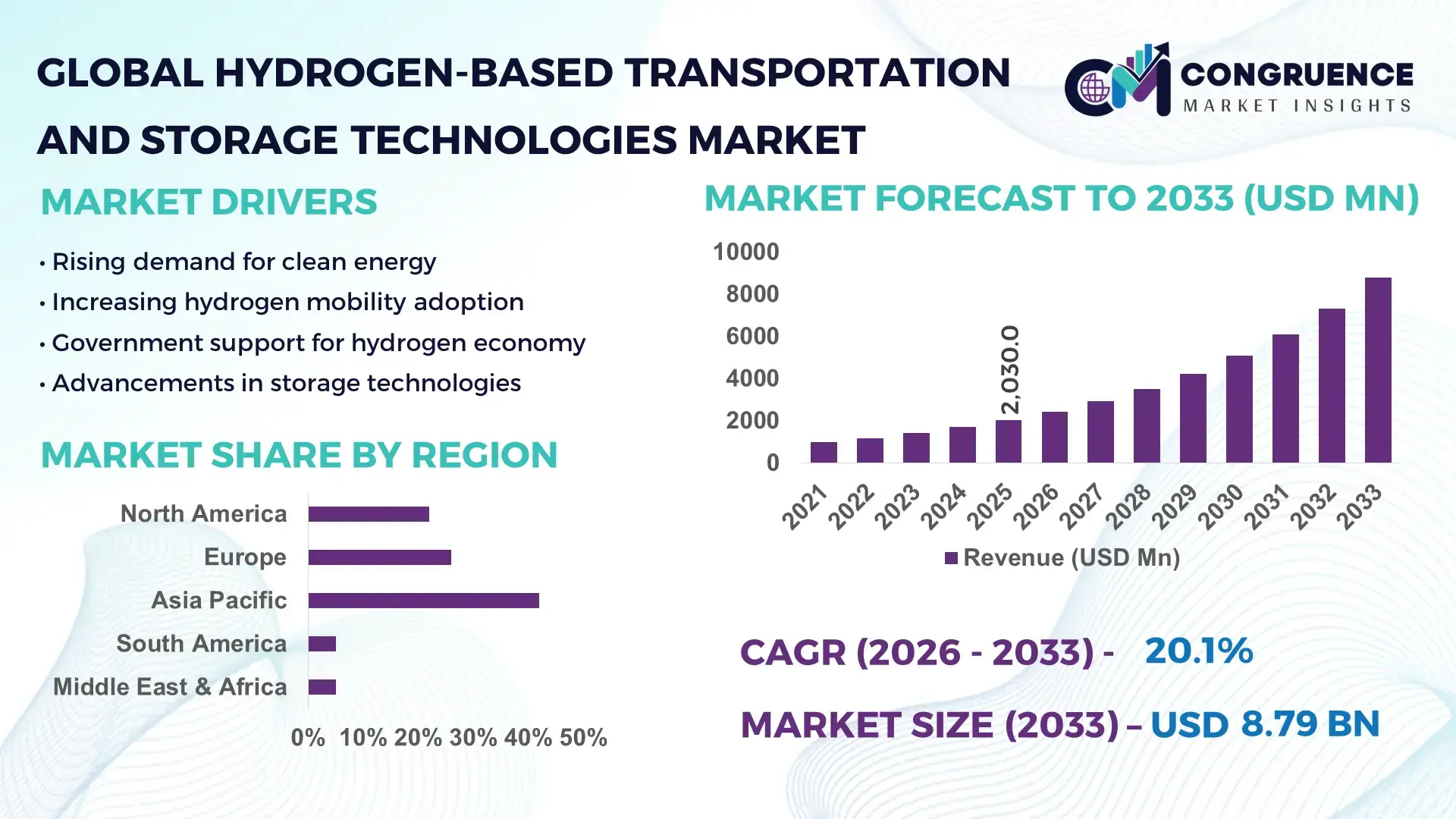
The Global Hydrogen-Based Transportation and Storage Technologies Market was valued at USD 2,030.0 Million in 2025 and is anticipated to reach a value of USD 8,787.0 Million by 2033 expanding at a CAGR of 20.1% between 2026 and 2033, according to an analysis by Congruence Market Insights. This growth is primarily driven by increasing investments in clean energy infrastructure and decarbonization of heavy transport sectors.
China dominates the Hydrogen-Based Transportation and Storage Technologies Market with extensive hydrogen production capacity exceeding 33 million tons annually, accounting for over 30% of global output. The country has deployed more than 1,200 hydrogen refueling stations and over 50,000 fuel cell vehicles, particularly in logistics and public transportation. Industrial hydrogen use in refining and ammonia production exceeds 60% of domestic consumption, while ongoing investments surpass USD 15 billion in green hydrogen projects. Advanced liquid hydrogen storage and pipeline transportation pilots are expanding across key industrial provinces, with hydrogen blending initiatives reaching up to 10% in natural gas networks.
Market Size & Growth: USD 2,030.0 Million in 2025, projected USD 8,787.0 Million by 2033, CAGR 20.1%, driven by clean energy transition and transport electrification.
Top Growth Drivers: 42% rise in hydrogen mobility adoption, 35% efficiency gain in storage systems, 28% increase in industrial hydrogen utilization.
Short-Term Forecast: By 2028, hydrogen storage costs expected to reduce by 18% through material and compression innovations.
Emerging Technologies: Solid-state hydrogen storage, liquid organic hydrogen carriers (LOHC), and high-pressure composite tanks.
Regional Leaders: Asia-Pacific (~USD 3,600 Million by 2033) driven by industrial scale; Europe (~USD 2,700 Million) focused on green hydrogen; North America (~USD 2,200 Million) emphasizing mobility infrastructure.
Consumer/End-User Trends: Heavy-duty transport and industrial sectors account for over 55% of hydrogen demand, with rising adoption in rail and shipping.
Pilot or Case Example: In 2025, a hydrogen logistics pilot in China improved fleet efficiency by 22% and reduced emissions by 30%.
Competitive Landscape: Market leader holds ~18% share, followed by Air Liquide, Linde, Plug Power, and ITM Power.
Regulatory & ESG Impact: Over 60 countries implementing hydrogen roadmaps, targeting 45% emission reduction by 2035.
Investment & Funding Patterns: Over USD 90 billion committed globally in hydrogen infrastructure and technology deployment.
Innovation & Future Outlook: Integration of hydrogen with renewable grids and large-scale storage hubs expected to transform energy ecosystems.
Hydrogen-based transportation technologies contribute nearly 48% of overall demand, followed by storage solutions at 32%, while distribution infrastructure accounts for 20%. Innovations in cryogenic storage and composite tank materials have improved efficiency by 25%. Regulatory frameworks promoting carbon neutrality are accelerating adoption, particularly in Asia-Pacific and Europe, with logistics, energy, and heavy industry emerging as key growth sectors.
The Hydrogen-Based Transportation and Storage Technologies Market holds strategic importance in global decarbonization initiatives, particularly in sectors where electrification alone is insufficient. Hydrogen fuel cell systems deliver up to 40% higher energy efficiency compared to traditional internal combustion engines, making them a viable alternative for long-haul transportation and industrial logistics. Additionally, advanced composite storage systems offer 30% higher energy density compared to conventional metal tanks, improving transportation feasibility and reducing operational constraints.
Asia-Pacific dominates in volume due to large-scale industrial hydrogen production, while Europe leads in adoption with over 35% of enterprises integrating hydrogen technologies into energy and transport systems. Governments across regions are implementing hydrogen strategies aligned with climate goals, resulting in accelerated infrastructure deployment and cross-border hydrogen trade initiatives.
By 2028, advancements in green hydrogen production technologies are expected to reduce storage and transportation costs by 20%, significantly improving economic viability. Firms are committing to ESG targets, including reducing carbon emissions by up to 50% by 2035 through hydrogen integration in logistics and manufacturing operations.
In 2025, Japan achieved a 25% reduction in transportation emissions through hydrogen-powered public transit systems, supported by investments in fuel cell buses and refueling infrastructure. This demonstrates the practical scalability of hydrogen ecosystems in urban environments.
Looking ahead, the Hydrogen-Based Transportation and Storage Technologies Market is poised to become a cornerstone of sustainable energy systems, enabling resilience, regulatory compliance, and long-term industrial transformation through clean fuel integration.
The Hydrogen-Based Transportation and Storage Technologies Market is influenced by rapid advancements in clean energy policies, infrastructure development, and industrial decarbonization efforts. Increasing deployment of hydrogen refueling stations, which surpassed 1,000 globally, is supporting mobility applications, particularly in heavy-duty vehicles and rail transport. Technological improvements in storage, including high-pressure tanks capable of handling up to 700 bar, are enhancing safety and efficiency. Industrial demand remains strong, with hydrogen consumption in refining and chemical sectors exceeding 70 million tons annually worldwide.
The push for zero-emission transportation is a major driver, with over 25 countries mandating stricter emission regulations targeting a 40–60% reduction by 2035. Hydrogen fuel cell vehicles offer refueling times under 5 minutes and ranges exceeding 600 km, making them ideal for commercial fleets. Adoption in heavy-duty trucks has increased by over 30% annually in pilot deployments. Public transit systems are also transitioning, with more than 5,000 hydrogen buses deployed globally. These developments are accelerating infrastructure investments and expanding hydrogen usage beyond traditional industrial applications.
High capital requirements remain a critical barrier, with hydrogen refueling stations costing between USD 1–2 million per unit. Green hydrogen production costs are still 2–3 times higher than conventional hydrogen derived from fossil fuels. Storage challenges, including energy losses of up to 30% during liquefaction, further impact efficiency. Limited pipeline infrastructure restricts large-scale distribution, and only a small percentage of existing gas pipelines are currently compatible with hydrogen blending above 10–15%, slowing widespread adoption.
The expansion of green hydrogen presents significant opportunities, with electrolyzer capacity expected to exceed 200 GW globally by 2030. Renewable energy integration is enabling cost reductions of up to 25% in hydrogen production. Emerging applications in maritime and aviation sectors are opening new markets, with hydrogen-powered ships and aircraft prototypes already achieving operational efficiency improvements of over 20%. Hydrogen hubs and export corridors are also being developed, facilitating international trade and long-term supply chain stability.
Hydrogen storage and transportation face technical challenges due to low volumetric energy density, requiring high-pressure or cryogenic solutions. Leakage risks and material compatibility issues increase system complexity and maintenance costs. Transportation via liquid hydrogen requires temperatures below -253°C, leading to energy losses exceeding 25%. Additionally, global standardization of hydrogen infrastructure remains inconsistent, creating interoperability challenges. These factors collectively hinder rapid scalability and require significant technological innovation and regulatory alignment.
Rapid Expansion of Hydrogen Refueling Infrastructure: Global hydrogen refueling stations increased by over 35% between 2023 and 2025, surpassing 1,200 operational units. Asia-Pacific leads deployment with over 55% share, while Europe is focusing on cross-border hydrogen corridors to support long-haul transport logistics.
Advancements in High-Pressure Storage Systems: Adoption of 700-bar storage tanks has grown by 40%, improving vehicle range by up to 30%. Composite materials are reducing tank weight by 20%, enhancing efficiency in automotive and aerospace applications.
Integration of Renewable Energy with Hydrogen Production: Over 45% of new hydrogen projects are now linked with solar and wind energy sources, reducing carbon emissions by up to 60% compared to conventional methods and improving sustainability metrics.
Increasing Adoption in Heavy Industry and Logistics: Hydrogen usage in heavy industry accounts for over 50% of total demand, with logistics fleets adopting hydrogen-powered trucks showing a 25% reduction in operational emissions and a 15% improvement in fuel efficiency.
The Hydrogen-Based Transportation and Storage Technologies Market is segmented across type, application, and end-user categories, reflecting diverse industrial and mobility requirements. Storage technologies dominate due to their critical role in maintaining hydrogen integrity, while transportation technologies are gaining momentum with expanding fuel cell vehicle adoption. Applications span mobility, industrial energy, and power storage systems, with increasing integration across sectors. End-users include transportation, energy, manufacturing, and logistics industries, each contributing significantly to demand expansion through varying adoption rates and technological investments.
Hydrogen storage technologies hold the largest share at approximately 46%, driven by increasing demand for high-pressure tanks and cryogenic storage systems. Transportation technologies account for 34%, while hydrogen distribution infrastructure contributes the remaining 20%. However, liquid organic hydrogen carrier (LOHC) systems are growing fastest, with an expected CAGR of 23%, due to their safer handling and long-distance transport capabilities. High-pressure gaseous storage remains widely used due to its maturity and cost-effectiveness, while cryogenic liquid hydrogen storage is gaining traction in aerospace and large-scale energy applications. Emerging solid-state storage solutions are also contributing niche growth, offering improved safety and compact storage. Combined, these emerging technologies account for nearly 20% of the segment.
Transportation applications dominate with approximately 52% share, driven by adoption in fuel cell vehicles, buses, and trucks. Industrial energy storage accounts for 28%, while power generation and grid balancing contribute 20%. However, hydrogen use in maritime and aviation is growing fastest, with a CAGR of 24%, supported by global decarbonization targets. In 2025, over 38% of logistics companies globally initiated hydrogen pilot programs for fleet operations. Additionally, more than 45% of energy utilities are integrating hydrogen into hybrid storage systems. These trends highlight increasing cross-sector adoption.
Transportation sector leads with approximately 48% share, followed by industrial manufacturing at 30% and energy utilities at 22%. However, logistics and supply chain operators represent the fastest-growing segment, with a CAGR of 22%, driven by demand for zero-emission freight solutions. More than 40% of large enterprises have initiated hydrogen adoption strategies, particularly in heavy transport and industrial operations. Additionally, over 35% of logistics firms are testing hydrogen-powered fleets, indicating strong future demand.
Asia-Pacific accounted for the largest market share at 42% in 2025 however, Europe is expected to register the fastest growth, expanding at a CAGR of 21.3% between 2026 and 2033.
Asia-Pacific leads with over 60% of global hydrogen production capacity and more than 50,000 fuel cell vehicles deployed. Europe is rapidly expanding infrastructure, with over 300 hydrogen refueling stations planned by 2030. North America accounts for approximately 22% share, supported by strong investments exceeding USD 20 billion in hydrogen projects. Middle East & Africa and South America collectively contribute around 10%, with increasing investments in green hydrogen export projects and renewable energy integration.
North America holds approximately 22% of the global market share, driven by strong demand in transportation, energy, and chemical sectors. The U.S. leads with over 15 hydrogen hubs under development and federal incentives supporting clean energy adoption. Regulatory frameworks promote emission reductions of up to 50% by 2035. Companies are investing in digital monitoring systems and advanced storage technologies to improve efficiency. A major player has deployed hydrogen-powered truck fleets, improving logistics efficiency by 18%. Consumer adoption is higher in enterprise sectors such as logistics and heavy industry, reflecting strong institutional support.
Europe accounts for around 26% market share, with Germany, France, and the UK leading adoption. Strict environmental regulations and carbon neutrality targets are driving hydrogen integration. Over 40% of industrial firms are implementing hydrogen solutions to meet emission standards. Technological advancements in green hydrogen production and storage are widely adopted. A leading European company is developing cross-border hydrogen pipelines, improving energy security. Consumer behavior reflects strong preference for sustainable energy solutions, driven by regulatory compliance requirements.
Asia-Pacific dominates in volume with over 42% market share, led by China, Japan, and South Korea. The region has over 1,200 hydrogen stations and the highest number of fuel cell vehicles globally. Industrial hydrogen consumption exceeds 60% of total demand. Governments are investing heavily in hydrogen infrastructure, with large-scale production facilities and export projects. A regional player has implemented hydrogen-powered buses across urban networks, improving efficiency by 22%. Consumer adoption is driven by industrial demand and government-backed initiatives.
South America holds approximately 5% market share, with Brazil and Argentina leading development. The region is leveraging renewable energy resources, particularly wind and solar, for green hydrogen production. Government incentives are promoting infrastructure development and export capabilities. Industrial sectors such as mining and energy are key demand drivers. A local company is developing hydrogen export terminals to support international trade. Consumer behavior is closely tied to industrial and export-oriented applications.
Middle East & Africa account for nearly 5% market share, with UAE and Saudi Arabia leading investments. The region is focusing on green hydrogen production using solar energy, with projects exceeding 10 GW capacity. Oil & gas companies are diversifying into hydrogen technologies. Trade partnerships are supporting export-oriented growth. A regional player is developing large-scale hydrogen plants for international markets. Consumer adoption is driven by industrial diversification and energy transition strategies.
China – 32% Market share: Strong production capacity and large-scale deployment of hydrogen infrastructure
United States – 21% Market share: High investment levels and growing adoption in transportation and industrial sectors
The Hydrogen-Based Transportation and Storage Technologies Market is moderately fragmented, with over 50 active global and regional players competing across storage, transportation, and infrastructure segments. The top five companies collectively account for approximately 55% of the total market share, indicating a mix of consolidation and competitive diversity. Leading players are focusing on strategic partnerships, joint ventures, and large-scale project developments to strengthen their market position.
Technological innovation remains a key competitive factor, with companies investing heavily in advanced storage materials, fuel cell systems, and hydrogen distribution infrastructure. Over 30% of market participants are engaged in R&D initiatives to improve efficiency and reduce operational costs. Mergers and acquisitions have increased by 20% over the past two years, reflecting consolidation trends and expansion strategies. Additionally, collaborations between energy companies and automotive manufacturers are accelerating the development of hydrogen mobility solutions. The competitive landscape is further shaped by government-backed initiatives and funding programs supporting innovation and infrastructure deployment.
Linde plc
Plug Power Inc.
ITM Power plc
Nel ASA
Ballard Power Systems
Hydrogenics Corporation
McPhy Energy
Cummins Inc.
Toshiba Energy Systems
Siemens Energy
FuelCell Energy Inc.
Bloom Energy Corporation
Hexagon Composites ASA
Technological advancements are playing a critical role in shaping the Hydrogen-Based Transportation and Storage Technologies Market. High-pressure storage systems operating at 350–700 bar are widely used, offering improved safety and efficiency for transportation applications. Composite materials have reduced storage tank weight by up to 20%, enhancing vehicle performance. Cryogenic liquid hydrogen storage systems are gaining traction, particularly in aerospace and large-scale energy applications, despite requiring temperatures below -253°C.
Electrolyzer technologies are also advancing rapidly, with efficiency improvements of up to 30% in recent systems. Solid oxide electrolyzers are being deployed for industrial-scale hydrogen production, offering higher efficiency compared to traditional alkaline systems. Digital monitoring and predictive maintenance technologies are improving system reliability by over 15%, reducing operational downtime.
Emerging technologies such as liquid organic hydrogen carriers (LOHC) and metal hydride storage are addressing challenges related to storage density and transportation safety. Integration with renewable energy systems is enabling decentralized hydrogen production, reducing transmission losses. Additionally, AI-driven optimization tools are being used to enhance hydrogen distribution networks, improving efficiency and scalability across supply chains.
• In October 2025, Air Liquide announced a USD 50 million investment to expand its hydrogen supply network along the U.S. Gulf Coast, strengthening long-term supply agreements and enhancing infrastructure for industrial and mobility applications. Source: www.airliquide.com
• In November 2025, Air Liquide deployed hydrogen-powered trucks within its logistics operations in the Netherlands, supporting zero-emission transport initiatives and demonstrating scalability of hydrogen mobility solutions in real-world supply chains.
• In October 2025, Plug Power successfully completed delivery of 44.5 metric tons of hydrogen for the H2CAST project in Germany and secured an additional 35-ton contract, validating its hydrogen transport and supply capabilities across Europe.
• In March 2025, ITM Power signed a strategic agreement with Deutsche Bahn to develop hydrogen infrastructure for rail transport, focusing on sustainable mobility solutions and large-scale electrolyzer deployment in transportation networks.
The Hydrogen-Based Transportation and Storage Technologies Market Report provides a comprehensive analysis of technologies, applications, and regional dynamics shaping the industry. The report covers key segments including hydrogen storage systems such as compressed gas, liquid hydrogen, and solid-state solutions, along with transportation technologies encompassing pipelines, tanker trucks, and maritime transport systems. It also evaluates infrastructure components such as refueling stations and distribution networks.
From an application perspective, the report examines hydrogen usage across transportation, industrial energy, power generation, and emerging sectors like aviation and maritime. End-user industries analyzed include logistics, manufacturing, energy utilities, and chemical processing, each contributing significantly to market expansion.
Geographically, the report spans major regions including North America, Europe, Asia-Pacific, South America, and the Middle East & Africa, highlighting regional variations in adoption, infrastructure development, and policy frameworks. It also addresses technological advancements such as advanced storage materials, electrolyzers, and digital monitoring systems.
The scope further includes emerging trends such as hydrogen hubs, cross-border trade corridors, and renewable energy integration. This report serves as a strategic tool for decision-makers, offering insights into industry developments, competitive landscape, and future opportunities within the hydrogen ecosystem.
| Report Attribute / Metric | Details |
|---|---|
| Market Revenue (2025) | USD 2,030.0 Million |
| Market Revenue (2033) | USD 8,787.0 Million |
| CAGR (2026–2033) | 20.1% |
| Base Year | 2025 |
| Forecast Period | 2026–2033 |
| Historic Period | 2021–2025 |
| Segments Covered |
By Type
By Application
By End-User Insights
|
| Key Report Deliverables | Revenue Forecast; Market Trends; Growth Drivers & Restraints; Technology Insights; Segmentation Analysis; Regional Insights; Competitive Landscape; Regulatory & ESG Overview; Recent Developments |
| Regions Covered | North America; Europe; Asia-Pacific; South America; Middle East & Africa |
| Key Players Analyzed | Air Liquide; Linde plc; Plug Power Inc.; ITM Power plc; Nel ASA; Ballard Power Systems; Hydrogenics Corporation; McPhy Energy; Cummins Inc.; Toshiba Energy Systems; Siemens Energy; FuelCell Energy Inc.; Bloom Energy Corporation; Hexagon Composites ASA |
| Customization & Pricing | Available on Request (10% Customization Free) |




