
Reports
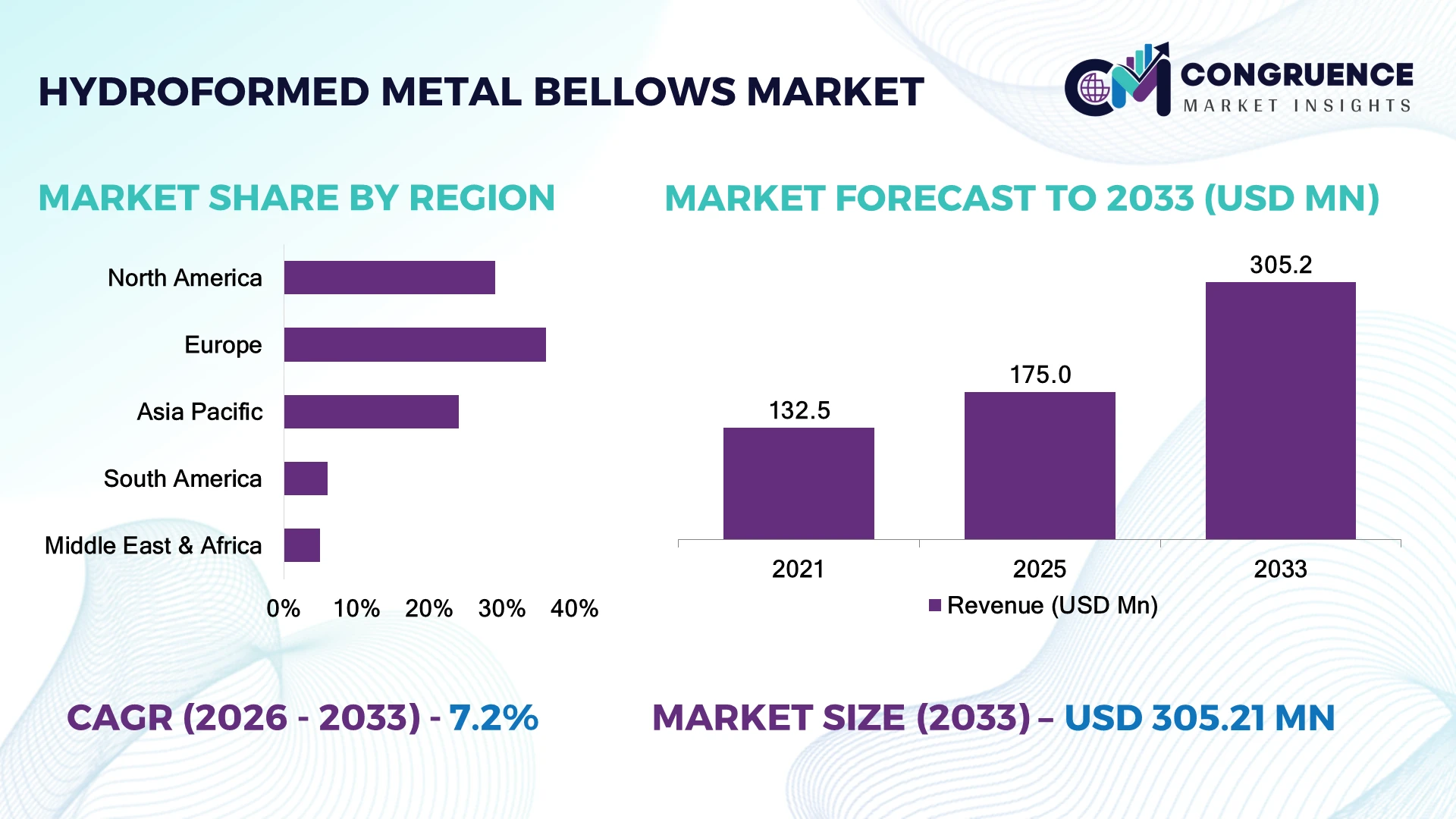
The Global Hydroformed Metal Bellows Market was valued at USD 175.0 Million in 2025 and is anticipated to reach a value of USD 305.2 Million by 2033 expanding at a CAGR of 7.2% between 2026 and 2033. Growth is primarily driven by rising deployment of precision pressure-control systems, aerospace propulsion assemblies, semiconductor manufacturing equipment, and high-performance industrial automation platforms requiring leak-tight flexible metal components.
Germany remains the dominant country in the market, accounting for nearly 18% of global hydroformed metal bellows production capacity, supported by over USD 2.5 billion in annual investments across aerospace, automotive engineering, and industrial automation sectors. German manufacturers achieve automation penetration above 72% in precision metal forming operations, compared with approximately 58% in the United States. Ongoing European industrial modernization and energy-transition projects continue accelerating adoption of advanced bellows technologies for high-pressure and high-temperature applications.
This leadership position reinforces Germany’s role as a strategic manufacturing hub for global supply chains and advanced engineering procurement decisions.
Market Size & Growth: USD 175.0 Million in 2025 reaching USD 305.2 Million by 2033 at 7.2% CAGR, supported by expanding aerospace and semiconductor manufacturing investments.
Top Growth Drivers: Aerospace demand (+12%), industrial automation adoption (+15%), and semiconductor equipment expansion (+18%) are accelerating market penetration.
Short-Term Forecast: By 2028, precision-forming cycle times are projected to decline by 20% while production efficiency improves by 16%.
Emerging Technologies: AI-driven process control, laser-assisted hydroforming, and advanced nickel-alloy bellows enhance dimensional accuracy by over 25%.
Regional Leaders: Europe (~USD 95 Million), North America (~USD 78 Million), and Asia-Pacific (~USD 70 Million) lead through aerospace, automation, and electronics manufacturing expansion.
Consumer/End-User Trends: More than 65% of aerospace and vacuum-system OEMs prioritize high-cycle-life metal bellows for mission-critical applications.
Pilot/Case Example: In 2024, a semiconductor equipment manufacturer improved vacuum sealing performance by 22% through next-generation hydroformed bellows integration.
Competitive Landscape: Top manufacturers collectively control nearly 45% market share, led by Witzenmann, Senior Flexonics, MW Components, Servometer, and BellowsTech.
Regulatory & ESG Impact: Lightweight precision components reduce material consumption by up to 12% while supporting stricter industrial efficiency standards.
Investment & Funding: More than USD 350 Million has been directed toward precision metal forming expansion, localization, and supply-chain resilience initiatives.
Innovation & Future Outlook: Additive manufacturing integration and digital quality inspection are reducing defect rates by nearly 18% across advanced production facilities.
Hydroformed metal bellows are increasingly utilized in aerospace actuators, semiconductor vacuum systems, medical instrumentation, cryogenic equipment, and industrial process control applications. Recent innovations focus on high-strength nickel alloys, miniature precision bellows, and automated hydroforming technologies that improve dimensional consistency by more than 20%. A notable trend is the localization of critical component manufacturing as manufacturers seek stronger supply-chain resilience and reduced lead-time exposure, creating new opportunities for strategic capacity expansion and technology partnerships.
Hydroformed metal bellows are becoming strategically important because they enable highly reliable motion control, pressure compensation, vibration isolation, and sealing performance in industries where operational precision directly affects competitiveness. The market is benefiting from supply-chain restructuring initiatives across aerospace, semiconductor manufacturing, and advanced industrial equipment sectors. As OEMs prioritize component reliability and lifecycle performance, hydroformed bellows are increasingly integrated into next-generation systems requiring tighter tolerances and higher durability.
From a technology perspective, hydroformed bellows typically deliver up to 30% greater dimensional uniformity and approximately 20% lower material waste than traditional mechanically formed alternatives. Germany and the United States continue leading high-specification deployments through aerospace and automation investments, while China is rapidly expanding manufacturing scale through semiconductor and industrial equipment production. Adoption of automated inspection systems has reduced quality-control variability by nearly 15% across advanced facilities.
A practical example can be seen in semiconductor fabrication equipment, where precision hydroformed bellows improve vacuum stability and reduce maintenance intervals. Companies are expanding alloy-processing capabilities, forming strategic supplier partnerships, and increasing investments in precision manufacturing infrastructure. Over the next two to three years, stronger localization efforts and advanced materials integration will strengthen competitive positioning, improve operational resilience, and reinforce the long-term strategic relevance of hydroformed metal bellows across critical industrial value chains.
The increasing complexity of aerospace platforms, semiconductor tools, and industrial automation systems is accelerating demand for hydroformed metal bellows. Aerospace production output has expanded by more than 10% in key manufacturing countries, while semiconductor capital expenditure growth has exceeded 15% in several advanced economies. Additionally, nearly 70% of high-vacuum equipment manufacturers now prioritize precision-formed bellows for critical sealing applications. The push toward domestic manufacturing resilience following global supply-chain disruptions has further increased procurement of locally sourced engineered components. In response, manufacturers are expanding hydroforming capacity, investing in automated forming technologies, and strengthening partnerships with aerospace and electronics OEMs. A key strategic insight is that suppliers capable of delivering tighter tolerances and shorter lead times are securing preferred-vendor status in high-value industrial programs.
Hydroformed metal bellows production depends heavily on stainless steel, nickel alloys, and specialty metals whose prices remain subject to significant volatility. Nickel price fluctuations have exceeded 20% during recent market cycles, while specialty alloy procurement costs have risen by approximately 12% in some manufacturing hubs. Production facilities also require high-precision tooling and process control systems, increasing capital intensity. Supply concentration in specific countries creates additional sourcing pressure for critical alloys. These factors directly affect manufacturing margins, contract pricing, and project scalability. To reduce exposure, companies are adopting multi-source procurement strategies, negotiating long-term material contracts, and expanding localized supply networks. A significant operational insight is that procurement efficiency increasingly influences competitiveness as much as production capability in specialized bellows manufacturing.
Emerging demand from semiconductor fabrication, hydrogen infrastructure, and advanced energy systems is creating new growth avenues for hydroformed metal bellows manufacturers. Semiconductor equipment investments have increased by over 18% in major production markets, while hydrogen-related industrial projects are expanding at rates exceeding 20% annually. Advanced hydroforming processes can improve component consistency by nearly 25%, enabling deployment in highly sensitive environments. Governments are also supporting strategic manufacturing and clean-energy initiatives that require precision pressure-management components. Companies are responding through R&D programs focused on corrosion-resistant alloys, miniature bellows designs, and automated quality validation systems. A less obvious opportunity lies in next-generation cryogenic and vacuum applications, where reliability requirements create high-value market segments with limited supplier competition.
As application requirements become increasingly demanding, maintaining uniform quality across larger production volumes remains a significant challenge. Precision tolerance requirements have tightened by nearly 15% in aerospace and semiconductor applications, while inspection and certification workloads have increased by more than 20%. Workforce shortages in advanced metal forming and precision engineering further complicate production scaling. Manufacturers also face growing pressure to integrate digital quality systems and traceability frameworks without disrupting throughput. These challenges affect deployment consistency, customer qualification timelines, and long-term competitiveness. Companies must invest in advanced metrology, digital manufacturing platforms, workforce development, and strategic technology partnerships. A critical operational insight is that future market leaders will be defined not only by production capacity but by their ability to consistently deliver certified precision at scale.
Advanced Alloy Material Adoption Manufacturers are increasingly deploying nickel-based and high-performance stainless-steel alloys to improve fatigue resistance and service life. Advanced alloy utilization has risen by approximately 22%, while component lifecycle performance has improved by nearly 18%. Aerospace and semiconductor equipment suppliers are tightening durability requirements, prompting companies to expand metallurgical capabilities, automate quality validation workflows, and strengthen strategic supplier agreements to secure specialty materials and maintain production continuity.
Precision Automation Reshaping Production Automated hydroforming cells and digital inspection systems are transforming manufacturing operations. Production throughput has increased by roughly 20%, while dimensional variation has declined by nearly 15% across leading facilities. Labor shortages in Germany and Japan have accelerated smart-factory deployment, encouraging manufacturers to integrate machine vision, process analytics, and robotic handling systems. The result is faster order fulfillment, improved repeatability, and lower rework costs for high-specification industrial applications.
Supply-Chain Localization Strategies Industrial buyers are reducing dependence on concentrated sourcing networks by shifting procurement closer to end-use manufacturing hubs. Localized sourcing activity has expanded by around 17%, while lead times have shortened by nearly 12% in critical applications. Companies are restructuring supplier ecosystems, expanding domestic production footprints, and establishing regional partnerships to improve resilience against geopolitical disruptions and transportation bottlenecks affecting precision-engineered component availability.
Miniaturization for High-Tech Systems Demand for compact bellows solutions is accelerating as semiconductor tools, medical devices, and analytical instruments require smaller precision components. Miniature bellows deployment has increased by approximately 25%, while space-constrained equipment designs have expanded by nearly 19%. Manufacturers are investing in micro-forming technologies, specialized tooling, and collaborative engineering programs. A notable insight is that smaller bellows designs often command higher technical value despite lower material consumption, improving profitability and differentiation.
The market is segmented into Stainless Steel Bellows, Nickel Alloy Bellows, Titanium Bellows, and Other Specialty Alloy Bellows. Stainless Steel Bellows hold the leading position with approximately 48% market share due to their balance of corrosion resistance, manufacturability, and cost efficiency. Their widespread integration across industrial automation, process equipment, and vacuum systems supports consistent demand. More than 65% of standard industrial bellows deployments utilize stainless-steel configurations because of proven reliability and easier supply-chain availability. Manufacturers continue expanding stainless-steel hydroforming capacity to support growing requirements from automation and instrumentation sectors. Nickel Alloy Bellows represent the fastest-growing segment, supported by increasing adoption in aerospace propulsion systems, semiconductor fabrication equipment, and high-temperature processing environments. Demand for nickel-based solutions has expanded by nearly 16% as operators seek superior fatigue performance and thermal stability. Titanium Bellows maintain strategic relevance in lightweight aerospace assemblies and corrosive operating environments, while specialty alloy variants address highly customized engineering requirements. Companies are prioritizing advanced alloy development, precision forming technologies, and application-specific product portfolios to capture higher-value industrial programs.
The market is segmented into Aerospace & Defense, Semiconductor Equipment, Industrial Automation, Medical Devices, Energy & Power, and Others. Aerospace & Defense remains the leading application segment with approximately 34% share, driven by stringent performance requirements in propulsion systems, actuation assemblies, and fluid management systems. High-cycle durability and leak-tight performance remain critical procurement criteria. More than 60% of advanced aircraft subsystem suppliers continue integrating hydroformed bellows into mission-critical assemblies, reinforcing demand stability across defense modernization and aviation production programs. Semiconductor Equipment is the fastest-growing application segment as advanced chip fabrication facilities require precision vacuum management and contamination-control technologies. Equipment deployment activity has increased by nearly 18%, while automation-intensive semiconductor manufacturing continues expanding globally. Industrial Automation and Energy & Power applications remain important due to increasing use of flexible pressure-compensation components in process-control environments. Medical Devices are gaining traction through demand for compact and highly reliable motion-control assemblies. Companies are responding through targeted product customization, automated production expansion, and closer collaboration with OEM engineering teams.
The market is segmented into Aerospace OEMs, Semiconductor Equipment Manufacturers, Industrial Equipment Manufacturers, Medical Device Companies, Energy Infrastructure Operators, and Others. Aerospace OEMs account for approximately 32% of total demand due to extensive deployment across aircraft systems, defense platforms, and advanced propulsion technologies. Large-scale procurement programs, long qualification cycles, and strict engineering standards create concentrated purchasing activity. More than 55% of premium-specification hydroformed bellows are supplied directly into aerospace production ecosystems, supporting consistent demand for certified high-performance components. Semiconductor Equipment Manufacturers represent the fastest-growing end-user category, with procurement volumes increasing by nearly 17% as fabrication facilities expand capacity and upgrade process technologies. Industrial Equipment Manufacturers continue representing a substantial buyer base due to automation modernization initiatives, while Medical Device Companies are increasing adoption of miniature precision bellows for advanced instrumentation. Energy Infrastructure Operators are deploying specialized bellows solutions in pressure-management and process-control applications. To strengthen market position, suppliers are expanding application engineering services, forming strategic development partnerships, and offering customized performance specifications tailored to individual end-user requirements.
Europe accounted for the largest market share at 36% in 2025 however, Asia-Pacific is expected to register the fastest growth, expanding at a CAGR of 8.4% between 2026 and 2033.
North America represents approximately 29% of the global Hydroformed Metal Bellows Market, supported by strong aerospace manufacturing, semiconductor equipment production, defense modernization programs, and advanced industrial automation investments. The region benefits from a highly developed precision engineering ecosystem and extensive deployment of high-performance bellows in vacuum systems, propulsion assemblies, and process-control applications. More than 60% of regional demand originates from aerospace, defense, and semiconductor-related industries where reliability and dimensional precision remain critical procurement criteria. Increased reshoring of advanced manufacturing operations has encouraged investment in domestic component production and specialized forming capabilities. Companies are expanding automated inspection systems and precision manufacturing infrastructure to reduce lead times and strengthen supply-chain resilience. Strategic collaborations between component manufacturers and OEMs continue improving product qualification speed and deployment efficiency across critical industrial sectors.
United States Market Outlook: The United States dominates the regional market through its leadership in aerospace manufacturing, semiconductor equipment production, and defense procurement programs. The country accounts for more than 75% of North American hydroformed bellows consumption, supported by extensive deployment across aircraft systems, vacuum technology platforms, and industrial automation equipment. Ongoing investments in semiconductor fabrication facilities and advanced manufacturing infrastructure are increasing demand for high-specification bellows solutions, while strong domestic engineering capabilities support innovation and product customization.
Europe maintains the leading position in the global market with approximately 36% share, driven by its concentration of aerospace manufacturers, industrial automation suppliers, precision engineering firms, and advanced process industries. The region benefits from strong manufacturing standards and extensive adoption of high-performance metal components in mission-critical applications. Industrial modernization programs and investments in automation technologies continue accelerating deployment of precision-formed bellows across production facilities. More than 70% of major industrial equipment manufacturers within the region increasingly prioritize advanced sealing and pressure-compensation solutions to improve operational efficiency. Manufacturers are strengthening localized supply networks and expanding advanced alloy processing capabilities to support growing requirements from aerospace and high-value industrial applications. Continuous investment in precision manufacturing technologies further reinforces Europe's competitive position.
Germany Market Outlook: Germany serves as the strategic center of the European market due to its strong industrial machinery, automotive engineering, aerospace, and automation sectors. The country contributes nearly one-third of regional production capacity and maintains one of the highest levels of industrial automation deployment globally. Advanced manufacturing facilities increasingly utilize digitally controlled hydroforming processes, improving production consistency and supporting the country's position as a key exporter of precision-engineered components.
Asia-Pacific accounts for approximately 24% of global market activity and represents the fastest-evolving regional landscape. Rapid expansion of semiconductor manufacturing, industrial automation, electronics production, and advanced machinery industries is increasing demand for precision hydroformed bellows. Regional manufacturers continue scaling production capacity to support growing domestic and export-oriented industries. Semiconductor equipment deployment has increased significantly across key manufacturing economies, while industrial automation investments continue expanding across factory modernization programs. Companies are investing in automated hydroforming systems, digital quality-control technologies, and advanced materials processing to improve productivity and product performance. Strong manufacturing ecosystems and expanding engineering capabilities are enabling regional suppliers to move toward higher-value precision component production.
China Market Outlook: China leads the regional market through its extensive manufacturing infrastructure, semiconductor investment programs, and industrial modernization initiatives. The country accounts for more than 40% of regional demand, supported by large-scale deployment across electronics manufacturing, industrial machinery, and process industries. Expansion of advanced manufacturing clusters and increasing localization of precision component production are strengthening domestic supply capabilities while creating opportunities for technology-intensive bellows applications.
South America represents approximately 6% of the global market and is experiencing increasing demand from industrial processing, mining, energy, and infrastructure-related sectors. Modernization of industrial facilities and replacement of aging equipment are encouraging greater use of precision-engineered pressure-management components. Mining and resource-processing industries remain important demand centers due to their requirement for durable components capable of operating in challenging environments. Several manufacturers are expanding regional distribution networks and technical support capabilities to improve market penetration. Infrastructure constraints and dependence on imported specialty materials continue influencing production economics; however, increasing industrial investment is gradually strengthening market fundamentals. Companies are prioritizing localized service capabilities and strategic partnerships to improve responsiveness and operational efficiency.
Brazil Market Outlook: Brazil is the largest market within South America due to its substantial industrial base, mining operations, energy infrastructure, and manufacturing activity. The country contributes more than 45% of regional demand and benefits from ongoing industrial modernization efforts. Investments in process industries, energy projects, and advanced manufacturing facilities are increasing requirements for reliable pressure-control and sealing technologies, supporting continued adoption of hydroformed metal bellows solutions.
The Middle East & Africa region accounts for approximately 5% of global demand and is increasingly supported by industrial diversification strategies, energy infrastructure projects, and advanced manufacturing investments. Hydroformed metal bellows are gaining traction across oil and gas processing facilities, industrial automation projects, and specialized engineering applications requiring high-performance sealing and pressure-compensation capabilities. Industrial modernization programs are encouraging greater adoption of precision-engineered components across critical infrastructure sectors. Several countries are investing in manufacturing localization initiatives to reduce dependence on imported industrial equipment. Companies are strengthening regional partnerships and expanding technical service networks to support growing project activity. Increasing deployment of automated industrial systems is further enhancing demand for advanced bellows technologies across selected sectors.
Saudi Arabia Market Outlook: Saudi Arabia leads the regional market through extensive industrial development programs, energy-sector investments, and manufacturing diversification initiatives. The country accounts for more than 35% of regional demand and continues expanding industrial infrastructure linked to petrochemicals, energy processing, and advanced manufacturing. Large-scale industrial projects and localization policies are encouraging adoption of precision-engineered components while creating opportunities for suppliers capable of supporting stringent operational and performance requirements.
The Hydroformed Metal Bellows Market is characterized by competition between global engineering leaders such as Witzenmann, Senior Flexonics, MW Components, BOA Group, and EagleBurgmann and specialized regional manufacturers focused on custom-engineered solutions. The top five players collectively account for approximately 42% of market activity, creating a moderately consolidated structure where technology capability outweighs pure scale. Global suppliers compete on precision forming, alloy expertise, and qualification credentials, while regional players challenge through faster delivery and application-specific customization. Manufacturing automation has improved throughput by nearly 20%, advanced alloy adoption has increased by approximately 22%, and digital inspection systems have reduced defect rates by around 15%, making operational efficiency a key competitive differentiator. Companies are expanding production footprints, strengthening OEM partnerships, integrating advanced quality-control platforms, and localizing supply chains to improve responsiveness. The competitive shift is moving from cost-based competition toward engineering performance and reliability. Strict certification requirements, specialized tooling investments, and qualification cycles remain major entry barriers. Winning requires precision manufacturing, supply-chain resilience, rapid customization, and deep application expertise.
Senior Flexonics
MW Components
BOA Group
EagleBurgmann
Technetics Group
Hyspan Precision Products
Penflex Corporation
U.S. Bellows, Inc.
BellowsTech LLC
Duraflex, Inc.
Flexider S.r.l.
Aerosun Corporation
KSM Corporation
Hydroforming technology remains the foundation of the market, but production systems are rapidly evolving through automation, digital metrology, and advanced material engineering. Automated hydroforming cells now account for roughly 45% of production within leading facilities, reducing process variability by nearly 15%. Real-time inspection systems using machine vision and dimensional analytics improve consistency while shortening quality-control cycles. Compared with conventional mechanically formed bellows, advanced hydroformed designs deliver approximately 30% higher dimensional uniformity and up to 20% lower material waste, creating measurable manufacturing advantages.
Emerging technologies focus on high-performance nickel alloys, laser-assisted welding, digital twins, and predictive process monitoring. Advanced alloy integration has increased by nearly 22%, improving fatigue resistance and high-temperature performance. Manufacturers serving aerospace, semiconductor, and vacuum-system applications benefit most because tighter tolerances directly influence operational reliability. Digital process monitoring is increasingly embedded into production workflows to reduce rework and accelerate qualification timelines.
Between 2026 and 2028, intelligent manufacturing platforms, AI-assisted process optimization, and micro-hydroforming technologies are expected to gain broader deployment. Early adopters are targeting 10–15% faster production cycles and stronger customization capabilities. Companies acting now gain operational flexibility, higher-value program access, and stronger competitive positioning in precision-engineered applications.
February 2026 – Witzenmann announced construction of a new manufacturing facility in Chennai, India, supporting metal bellows and industrial component production. The project adds scalable capacity and strengthens export logistics capabilities for growing mobility and industrial markets. Business impact: improved regional supply resilience and production flexibility. Source: www.media.witzenmann.com
May 2025 – Witzenmann held the topping-out ceremony for its Buchbusch II production complex in Germany, designed for future-oriented digital manufacturing. The company highlighted expanded manufacturing infrastructure and technology modernization initiatives. Business impact: stronger automation readiness and enhanced precision production capabilities. Source: www.witzenmann.com
October 2025 – MW Components launched its Office of Commercial Excellence to accelerate organic growth and improve commercial execution across precision component operations, including bellows manufacturing. Business impact: enhanced customer engagement processes and stronger operational alignment across manufacturing facilities. Source: www.mwcomponents.com
June 2024 – Senior Flexonics highlighted expanded support for medical bellows applications, serving surgical, cardiovascular, and endoscopic device manufacturers through custom-engineered solutions. The company emphasized more than 120 years of engineering experience supporting highly regulated applications. Business impact: strengthened presence in high-value medical technology markets.
This report provides comprehensive coverage of the Hydroformed Metal Bellows Market across key product categories, including stainless steel, nickel alloy, titanium, and specialty alloy bellows. The analysis evaluates major application areas such as aerospace and defense, semiconductor equipment, industrial automation, medical devices, and energy infrastructure. More than 70% of demand concentration is assessed through high-precision industrial applications where reliability, pressure management, and sealing performance remain critical operational requirements.
The report delivers detailed assessment across North America, Europe, Asia-Pacific, South America, and the Middle East & Africa, highlighting deployment patterns, manufacturing concentration, technology adoption, and competitive positioning. It also examines advanced hydroforming technologies, automation integration, digital inspection systems, and next-generation material innovations. Strategic insights support investment prioritization, capacity expansion planning, supplier evaluation, partnership strategies, and competitive benchmarking. Particular attention is given to emerging semiconductor, aerospace, vacuum-system, and high-performance industrial applications expected to influence market direction and procurement decisions between 2026 and 2033.
| Report Attribute / Metric | Details |
|---|---|
| Market Revenue (2025) | USD 175.0 Million |
| Market Revenue (2033) | USD 305.2 Million |
| CAGR (2026–2033) | 7.2% |
| Base Year | 2025 |
| Forecast Period | 2026–2033 |
| Historic Period | 2021–2025 |
| Segments Covered |
By Type
By Application
By End-User
|
| Key Deliverables | Revenue Forecast; Market Trends; Growth Drivers & Restraints; Technology Insights; Segmentation Analysis; Regional Insights; Competitive Landscape; Regulatory & ESG Overview; Recent Developments |
| Regions Covered | North America; Europe; Asia-Pacific; South America; Middle East & Africa |
| Companies Profiled | Witzenmann GmbH; Senior Flexonics; MW Components; BOA Group; EagleBurgmann; Technetics Group; Hyspan Precision Products; Penflex Corporation; U.S. Bellows, Inc.; BellowsTech LLC; Duraflex, Inc.; Flexider S.r.l.; Aerosun Corporation; KSM Corporation |
| Customization & Pricing | Available on Request (10% Customization Free) |




