
Reports
The Global Hydraulic Recloser Market was valued at USD 678.36 Million in 2025 and is anticipated to reach a value of USD 964.7 Million by 2033 expanding at a CAGR of 4.5% between 2026 and 2033. Distribution grid hardening, wildfire resilience programs, rural feeder automation, renewable generation interconnection, and replacement of aging protection equipment are sustaining investment in hydraulic reclosers.
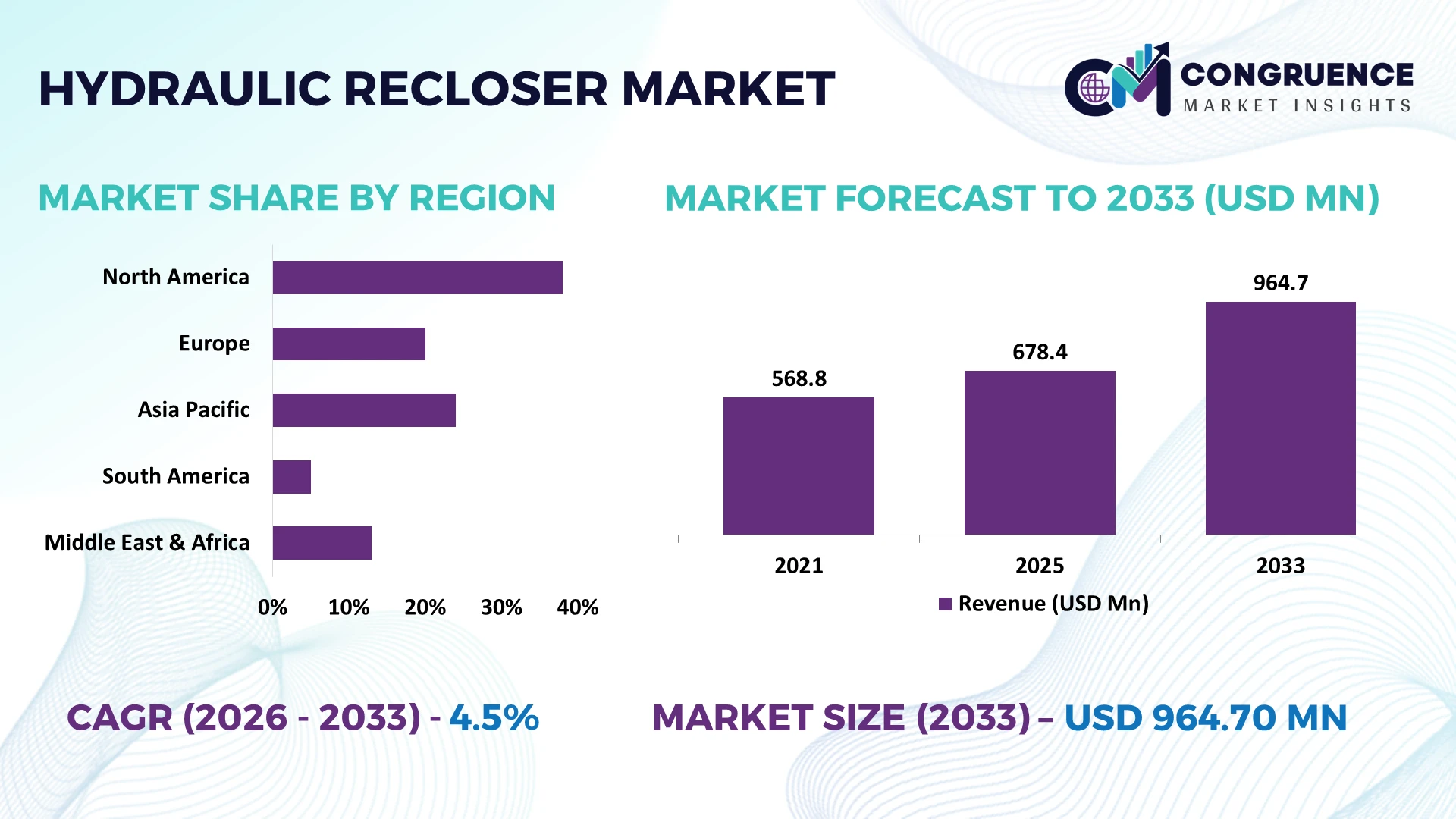
The United States anchors hydraulic recloser deployment, with North America representing approximately 35% of global demand, supported by extensive overhead distribution networks, electric utilities, cooperatives, and rural feeders. The country operates more than 5 million miles of distribution lines, creating a substantial protection equipment replacement base. Compared with Germany, where underground distribution limits recloser intensity, the United States maintains significantly greater overhead feeder exposure. Wildfire related grid hardening in California and hurricane resilience programs across Gulf Coast states are reinforcing sectionalizing and fault isolation investment.
Strategically, suppliers with utility approved designs, dependable interruption performance, field service coverage, and retrofit compatibility are positioned strongest for distribution modernization programs.
Market Size & Growth: USD 678.36 million in 2025 reaches USD 964.7 million by 2033 at 4.5% CAGR, supported by distribution grid hardening and aging protection equipment replacement.
Top Growth Drivers: Grid modernization contributes approximately 38%, renewable integration 27%, and rural electrification 21% to incremental equipment requirements across priority utility programs.
Short Term Forecast: By 2028, coordinated feeder protection upgrades are positioned to reduce sustained outage exposure by approximately 15% across modernized overhead distribution circuits.
Emerging Technologies: Electronic controls, remote monitoring, fault indicators, and advanced sensing are improving protection visibility, with automated feeder schemes targeting more than 95% event detection accuracy.
Regional Leaders: Indicative 2033 values place North America near USD 338 million, Asia Pacific around USD 309 million, and Europe approximately USD 193 million, reflecting different grid modernization priorities.
End User Trends: Electric utilities represent approximately 70% of equipment demand as operators prioritize automatic fault clearing, feeder sectionalizing, and rural network reliability.
Pilot and Case Example: Advanced feeder automation projects can isolate faults within seconds and reduce affected customer counts by 30% or more compared with conventional manual restoration workflows.
Competitive Landscape: Eaton holds an estimated 18% share, competing with ABB, Schneider Electric, Siemens, and G&W Electric through utility approvals, reliability, controls, and installed service capabilities.
Regulatory and ESG Impact: Modern protection coordination can reduce outage duration by approximately 20%, supporting resilience requirements while limiting unnecessary truck rolls and repeated field intervention.
Investment and Funding: United States grid programs include USD 10.5 billion for Grid Resilience and Innovation Partnerships, reinforcing utility investment in distribution resilience, automation, and protection infrastructure.
Innovation and Future Outlook: Next generation protection integrates sensors, remote controls, and distribution management platforms, targeting 20% faster fault localization while shifting procurement toward digitally visible feeder assets.
Hydraulic Recloser Market demand is concentrated across overhead distribution feeders, rural electrification networks, utility substations, renewable interconnections, and industrial power systems where automatic fault interruption limits prolonged outages. Utilities increasingly combine proven hydraulic interruption mechanisms with improved sensing, fault indicators, and coordinated protection strategies. Modern feeder automation can reduce sustained outage exposure by approximately 15% to 20% on upgraded circuits. Wildfire mitigation programs in the United States and resilience investment following severe weather events are sharpening protection requirements, while emerging markets prioritize dependable equipment for expanding distribution networks. These operating shifts establish the strategic context for evaluating future market pathways.
Hydraulic reclosers are strategically important as utilities strengthen overhead distribution networks against storms, vegetation faults, equipment failures, and expanding distributed generation. The United States operates more than 5 million miles of distribution lines, creating substantial protection replacement requirements. Grid resilience programs are shifting procurement from isolated fault interruption toward coordinated feeder protection, making reliability performance and installed compatibility central investment criteria.
Traditional fuse based protection requires field replacement after permanent faults, while reclosers automatically restore service after temporary disturbances. Coordinated recloser deployment can reduce sustained outage exposure by approximately 15% to 20% on suitable feeders. North America emphasizes resilience and wildfire mitigation, while India and Brazil prioritize expanding rural distribution coverage. Through 2028, utilities will increasingly combine hydraulic interruption reliability with remote fault indication and supervisory monitoring.
A rural feeder equipped with sectionalized reclosers can isolate a damaged section while restoring unaffected customers within seconds, reducing restoration crews and outage scope. Manufacturers are strengthening utility partnerships, retrofit compatibility, local inventories, and monitoring capabilities. Competitive advantage will depend on dependable interruption, protection coordination, and lifecycle support across increasingly complex distribution networks.
Grid resilience programs are accelerating hydraulic recloser replacement and deployment across overhead distribution feeders exposed to storms, vegetation contact, lightning, and equipment faults. Utilities account for approximately 70% of recloser demand, while North America represents around 35% of global deployment. Coordinated protection schemes can reduce sustained outage exposure by 15% to 20% on suitable circuits by clearing temporary faults without prolonged customer interruption. United States resilience investment following hurricanes, wildfires, and severe winter events is shifting capital toward sectionalizing and automated restoration infrastructure. Manufacturers are responding with higher interruption capability, improved hydraulic coordination, monitoring accessories, and utility specific configurations. A critical operational advantage is avoiding unnecessary fuse replacement, reducing truck deployment while restoring unaffected feeder sections substantially faster.
Hydraulic reclosers face structural pressure as utilities increasingly specify electronically controlled vacuum equipment for communication intensive distribution networks. Advanced electronic systems can provide protection settings with accuracy approaching 1%, while traditional hydraulic devices offer substantially less configuration flexibility. Digital reclosers can also support remote operation that reduces field intervention by approximately 20% to 30% on automated feeders. Australia and several European utility markets increasingly emphasize supervisory control, event recording, and distribution management integration, narrowing addressable applications for purely hydraulic equipment. Suppliers are responding by concentrating hydraulic products on rural, remote, and cost sensitive networks while adding monitoring accessories and hybrid control options. The strategic constraint is functional positioning because simple hydraulic architecture remains reliable but captures less value where utilities require granular digital visibility.
Rural electrification and remote feeder protection create a differentiated opportunity where communications infrastructure remains limited and maintenance access is expensive. India has achieved electricity access above 99% of households, yet distribution reliability and feeder modernization remain continuing priorities. Brazil also operates extensive overhead networks serving geographically dispersed customers. Hydraulic reclosers can reduce sustained interruptions by approximately 15% to 20% on appropriately coordinated feeders without requiring continuous communications connectivity. Future designs integrating compact fault indicators, improved insulation, and optional remote monitoring can bridge conventional protection and digital utility requirements. Manufacturers are expanding local distribution partnerships, application engineering, and configurable products for these environments. The non obvious opportunity lies in networks where digital sophistication adds limited operational value compared with dependable autonomous fault clearing and simplified field maintenance.
Distributed solar, battery systems, electric vehicle charging, and bidirectional power flows are making feeder protection coordination increasingly difficult. Distributed energy can alter fault magnitude and direction, challenging conventional settings designed around one way electricity flow. Solar supplied more than 7% of United States electricity during 2024, while distributed installations continue increasing across California, Texas, and other states. Utilities consequently require protection schemes capable of responding consistently as network conditions change. Hydraulic reclosers with fixed operating characteristics face greater engineering complexity when coordinated with smart inverters, sectionalizers, fuses, and electronic protection equipment. Manufacturers must invest in application modelling, configurable protection, hybrid monitoring, and engineering partnerships. Long term relevance depends on maintaining hydraulic simplicity while ensuring reliable coordination within increasingly dynamic distribution systems.
• Vacuum Interruption Gains Ground: Utilities are combining established recloser architecture with vacuum interruption to reduce contact maintenance and improve interruption consistency. Vacuum units can deliver mechanical endurance exceeding 10,000 operations, while maintenance requirements can fall approximately 20% versus older interruption designs. United States distribution operators are prioritizing these configurations during equipment replacement. Manufacturers are expanding sealed interrupter platforms and standardized pole mounting packages to shorten field installation.
• Wildfire Protection Changes Settings: California utilities are applying faster protection settings on wildfire exposed circuits, shifting recloser operation from conventional reliability optimization toward ignition risk mitigation. Sensitive protection schemes can detect faults within milliseconds, while targeted sectionalizing limits the number of customers exposed to an individual event. Utilities are upgrading controllers and protection coordination practices. Equipment manufacturers are adapting products for configurable trip profiles and improved fault sensing.
• Utility Inventories Become More Strategic: Transformer and switchgear supply constraints have encouraged utilities to standardize protection equipment and maintain larger replacement inventories. Lead times for selected distribution components have remained multiple times above historical norms, while standardized recloser configurations can reduce engineering and procurement cycles by approximately 15%. United States utilities are consolidating approved specifications. Suppliers are expanding domestic inventories, framework agreements, and interchangeable configurations to protect project schedules.
• Condition Monitoring Extends Asset Life: Utilities increasingly attach sensors and fault indicators to existing protection assets instead of replacing functioning hydraulic equipment immediately. Monitoring can reduce unnecessary field inspections by approximately 20% and identify abnormal operations before permanent failure. This creates a non obvious modernization pathway for rural networks. Manufacturers are responding with retrofit monitoring accessories, communication modules, and maintenance analytics that extend installed asset usefulness.
Three Phase reclosers represent the leading type with an estimated 40% to 45% share, reflecting their importance across three phase distribution feeders serving commercial, industrial, and dense residential loads. Coordinated interruption across phases supports system protection where fault consequences extend beyond individual laterals. Single Phase equipment remains established across rural networks and individual distribution branches because lower equipment complexity supports economical protection of geographically dispersed loads. Pole Mounted configurations dominate field installation because overhead feeders remain the principal application environment.
Vacuum Reclosers represent the fastest advancing type as utilities prioritize longer contact life, reduced maintenance, and dependable interruption. Vacuum interrupters can support more than 10,000 mechanical operations in suitable designs, strengthening lifecycle economics. Substation Mounted units retain strategic importance where utilities coordinate outgoing feeder protection with broader substation schemes. Manufacturers are shifting portfolios toward sealed vacuum technology, configurable controls, compact pole packages, and utility specific mounting arrangements. Investment priorities increasingly favor equipment combining proven interruption performance with compatibility for future monitoring and automation requirements.
Distribution Networks represent the leading application with an estimated 35% to 40% share because reclosers protect extensive medium voltage circuits connecting substations with residential, commercial, agricultural, and industrial customers. Overhead Lines remain a mature application, particularly in the United States, Brazil, India, and Australia, where exposed conductors experience vegetation, lightning, wildlife, and weather related faults. Feeder Protection remains strategically important because coordinated reclosers prevent temporary disturbances from developing into prolonged circuit outages.
Grid Automation is the fastest advancing application as utilities combine reclosers with sensors, communication equipment, and supervisory platforms. Automated schemes can reduce affected customer counts by approximately 30% during localized faults by isolating damaged sections and restoring healthy feeder segments. Fault Isolation consequently becomes increasingly integrated with automation rather than functioning as a standalone protection objective. Manufacturers are expanding controller compatibility, remote operation, communication interfaces, and coordinated protection packages. Commercial value is moving toward applications where interruption equipment contributes directly to measurable distribution reliability performance.
Electric Utilities represent the dominant end user group with an estimated 55% to 60% share because they manage extensive medium voltage networks requiring coordinated protection across substations, feeders, branches, and overhead laterals. Distribution Companies form another established buying group, emphasizing standardized equipment, lifecycle cost, and interoperability across large installed fleets. Rural Utilities maintain strong dependence on autonomous protection because dispersed networks increase technician travel requirements and make rapid automatic restoration operationally valuable.
Renewable Energy Operators represent the fastest advancing end user segment as solar, wind, and battery projects introduce new protection requirements at distribution interconnection points. Renewable generation supplied more than 20% of United States electricity in recent years, increasing attention to bidirectional power flow and coordination. Industrial Facilities remain selective buyers where process continuity justifies dedicated feeder protection. Manufacturers are targeting these groups through configurable ratings, utility qualification programs, application engineering, monitoring options, and long term service support, shifting competitive emphasis toward end user specific protection architectures.
North America accounted for the largest market share at 35% in 2025 however, Asia Pacific is expected to register the fastest growth, expanding at a CAGR of 5.8% between 2026 and 2033.

Grid Hardening Reshapes Protection Procurement
North America accounted for approximately 35% of global demand in 2025, supported by extensive overhead distribution infrastructure, utility modernization, storm resilience programs, and aging protection assets. The United States operates more than 5 million miles of distribution lines, creating a substantial installed base requiring sectionalizing and fault protection. Wildfire mitigation in California and storm resilience across Texas and Gulf Coast states are pushing utilities toward faster fault isolation and coordinated feeder protection. Rural electric cooperatives remain important hydraulic recloser users because autonomous operation reduces dependence on communications infrastructure. Distribution automation is simultaneously increasing demand for monitoring accessories and configurable controls. Manufacturers are strengthening domestic inventories, utility qualification programs, vacuum interruption portfolios, and retrofit packages as procurement shifts toward standardized equipment that shortens installation and replacement cycles.
United States Market Outlook: The United States provides the region's deepest replacement opportunity through its extensive overhead feeder network and large rural utility base. More than 900 electric cooperatives serve approximately 42 million people, creating substantial demand for reliable autonomous protection. Utilities increasingly combine established recloser hardware with fault indicators, remote monitoring, and coordinated sectionalizing to improve restoration performance.
Underground Networks Reshape Equipment Demand
Europe represents approximately 20% of global demand, with hydraulic recloser deployment concentrated where medium voltage overhead feeders remain operationally important. Germany, France, Spain, Italy, and the United Kingdom increasingly favor digitally controlled protection equipment as renewable penetration and distribution automation intensify. Extensive underground cabling in dense urban areas limits conventional pole mounted demand compared with North America, shifting opportunities toward rural feeders and specialized distribution applications. Renewable electricity exceeds 40% of generation across the European Union, increasing protection coordination requirements as distributed solar and wind reshape feeder power flows. Manufacturers are emphasizing vacuum interruption, configurable protection, compact equipment, and compatibility with supervisory control platforms. Utilities increasingly evaluate lifecycle maintenance and digital visibility alongside interruption performance, creating pressure on conventional hydraulic designs without monitoring capabilities.
Germany Market Outlook: Germany combines highly reliable distribution infrastructure with substantial distributed renewable generation, making protection coordination increasingly sophisticated. Renewables provide more than half of national electricity generation in recent periods. Hydraulic equipment therefore competes most effectively in selective rural and autonomous applications, while manufacturers increasingly add sensing and monitoring functionality to address evolving utility specifications.
Distribution Expansion Creates Deployment Scale
Asia Pacific accounts for approximately 30% of global demand, supported by expanding electricity networks, rural feeder modernization, renewable interconnections, and extensive overhead infrastructure in India, China, Australia, Indonesia, and Southeast Asia. India presents particularly strong operational relevance because near universal household electrification is shifting investment priorities from network access toward reliability and distribution quality. China combines large grid scale with advanced automation, while Australia requires robust feeder protection across geographically dispersed networks exposed to bushfires and severe weather. Vacuum technology and intelligent controls are gaining adoption, although autonomous hydraulic equipment retains value where communication coverage remains limited. Manufacturers are expanding local assembly, distribution partnerships, application engineering, and utility specific product portfolios. Localization is strategically important because shorter supply chains improve tender competitiveness and replacement availability.
India Market Outlook: India provides a significant addressable base through extensive 11 kV and 33 kV distribution infrastructure, agricultural feeders, industrial corridors, and rural networks. Household electricity access exceeds 99%, shifting utility attention toward reliability improvement. Domestic manufacturing and standardized utility procurement increasingly favor suppliers offering locally supported reclosers, spare parts, application engineering, and dependable field servicing.
Overhead Networks Sustain Protection Requirements
South America represents approximately 9% of global demand, led by Brazil, followed by Argentina, Chile, Colombia, and other electricity markets with substantial overhead distribution infrastructure. Brazil's continental network, dispersed customer base, vegetation exposure, and severe weather create favorable operating conditions for automatic feeder protection. Renewable electricity contributes more than 80% of Brazilian generation, while distributed solar expansion increasingly changes distribution power flows and protection requirements. Hydraulic reclosers remain relevant across rural and less digitally connected feeders, although electronic and vacuum alternatives are gaining ground in automated urban networks. Currency volatility and imported equipment exposure can complicate procurement schedules, encouraging utilities to standardize products and maintain strategic inventories. Suppliers are strengthening local distribution partnerships, technical support, configurable ratings, and regional stocking arrangements to improve tender responsiveness.
Brazil Market Outlook: Brazil offers the region's strongest deployment base through extensive medium voltage overhead networks and geographically dispersed electricity consumption. Distributed solar capacity has expanded rapidly, increasing bidirectional feeder conditions. Utilities consequently require stronger coordination between reclosers, sectionalizers, fuses, and inverter connected generation, rewarding suppliers with application engineering and locally available replacement equipment.
Electrification Investment Expands Protection Needs
Middle East and Africa represents approximately 6% of global demand, with deployment shaped by grid expansion, electrification, industrial development, and distribution reliability requirements. Saudi Arabia and the United Arab Emirates emphasize digitally managed infrastructure, while South Africa, Kenya, Nigeria, and other African markets present stronger requirements for feeder reinforcement and autonomous protection. Sub Saharan Africa still has hundreds of millions of people without electricity access, keeping network expansion strategically important. Hydraulic reclosers offer practical value where communication infrastructure and maintenance resources remain constrained. Conversely, Gulf utilities increasingly specify electronically controlled equipment compatible with smart grid platforms. Manufacturers are responding through local distributors, utility partnerships, training programs, ruggedized equipment, and standardized voltage configurations. Competitive positioning depends strongly on technical support because remote networks impose higher consequences when replacement parts or trained personnel are unavailable.
South Africa Market Outlook: South Africa combines extensive distribution infrastructure with sustained reliability and network maintenance requirements. Electricity supply constraints have accelerated private generation and embedded renewable installations, adding protection coordination complexity. Recloser suppliers can address this environment through robust outdoor equipment, configurable protection, local spare inventories, and technical partnerships supporting utilities, municipalities, industrial facilities, and renewable operators.
Eaton, Schneider Electric, Siemens, G&W Electric, and NOJA Power compete across utility protection, with established electrical OEMs challenging specialist recloser suppliers through broader grid portfolios and integrated automation. The top five players collectively account for approximately 55% of market demand. Eaton benefits from installed utility relationships, while NOJA Power and G&W Electric compete aggressively through intelligent protection and automation. Digital controllers can reduce restoration intervention by 20% to 30%, while vacuum interruption lowers maintenance requirements by roughly 20%. Price differences of 10% to 15% remain influential in cost sensitive rural tenders. Players are expanding local inventories, utility partnerships, application engineering, and digitally enabled product lines. Competition is shifting from standalone interruption hardware toward monitored, configurable protection ecosystems. Utility qualification cycles, certification requirements, field reliability records, and service infrastructure create substantial entry barriers. Winning requires proven interruption performance, competitive lifecycle cost, rapid supply, configurable protection, and dependable local engineering support.
Eaton
Schneider Electric
Siemens
G&W Electric
NOJA Power
S&C Electric Company
Tavrida Electric
Hubbell Incorporated
Arteche
Entec Electric & Electronic
Shinsung Industrial Electric
Elektrolites
Hughes Power System
Ningbo Tianan Group
Current hydraulic recloser technology emphasizes sealed hydraulic controls, vacuum interruption, solid dielectric insulation, and coordinated fault protection. Modern vacuum interrupters support more than 10,000 mechanical operations, while reduced contact maintenance can lower lifecycle servicing requirements by approximately 20%. Adoption remains strongest on rural overhead feeders where autonomous operation provides reliable protection without communications infrastructure or external control power.
Emerging technology combines recloser hardware with digital fault indicators, SCADA connectivity, remote controls, and configurable protection. Smart reclosers can restore healthy feeder sections within one minute, while remote operation reduces unnecessary field intervention by approximately 20%. Compared with legacy fuse protection requiring manual replacement, automatic reclosing can improve restoration efficiency by more than 30%. Utilities with geographically dispersed networks gain the greatest operational advantage from this transition.
Disruptive development centers on synchrophasor measurement, adaptive protection, cybersecurity, and renewable integration. Intelligent controllers can stream more than one gigabyte of timestamped network data daily, enabling granular disturbance analysis. Between 2026 and 2028, utilities will increasingly combine reclosers with distribution management platforms and bidirectional protection schemes. Suppliers offering interoperable controls, retrofit flexibility, and secure communications gain competitive advantage as distributed generation makes static protection strategies operationally inadequate.
March 2025 G&W Electric unveiled its next generation Viper ST recloser with ratings reaching 170 kV BIL and 1,000 A continuous current. Expanded automation readiness strengthens utility flexibility for distributed generation, grid modernization, and higher capacity distribution applications.
May 2025 NOJA Power secured Australian backed equipment deployment for Ukraine under a AUD 10 million contract including local installation. OSM reclosers enable remote distribution switching, improving restoration capability while reducing utility worker exposure in conflict affected electricity networks.
October 2024 S&C Electric signed a framework agreement with National Grid Electricity Distribution, serving nearly 8 million customers, to deploy TripSaver II reclosers. Temporary faults represented over 90% during trials, supporting fewer sustained outages and reduced crew dispatch requirements.
October 2025 Memphis Light, Gas and Water approved G&W Electric as the compliant bidder for a USD 7.84 million recloser purchase after six bids were received. The procurement strengthens automatic fault isolation across Memphis electricity distribution infrastructure.
The Hydraulic Recloser Market report evaluates Single Phase, Three Phase, Pole Mounted, Substation Mounted, and Vacuum Reclosers across Overhead Lines, Feeder Protection, Distribution Networks, Fault Isolation, and Grid Automation. End user analysis covers Electric Utilities, Distribution Companies, Rural Utilities, Industrial Facilities, and Renewable Energy Operators. Electric utilities represent approximately 55% to 60% of demand, while three phase equipment accounts for roughly 40% to 45% of type based deployment.
Regional coverage includes North America, Europe, Asia Pacific, South America, and Middle East and Africa, alongside country specific grid modernization priorities. Technology assessment examines vacuum interruption, solid dielectric insulation, remote control, SCADA connectivity, adaptive protection, and synchrophasor measurement. The report supports investment planning, geographic expansion, utility partnership strategies, product positioning, and competitive benchmarking through 2033, including emerging opportunities around renewable interconnections, rural feeder modernization, and digitally coordinated distribution protection.
| Report Attribute/Metric | Report Details |
|---|---|
Market Revenue in 2025 | USD 678.36 Million |
Market Revenue in 2033 | USD 964.7 Million |
CAGR (2026 - 2033) | 4.5% |
Base Year | 2025 |
Forecast Period | 2026 - 2033 |
Historic Period | 2021 - 2025 |
Segments Covered | By Type
By Application
By End-User
|
Key Report Deliverable | Revenue Forecast, Growth Trends, Market Dynamics, Segmental Overview, Regional and Country-wise Analysis, Competition Landscape |
Region Covered | North America, Europe, Asia-Pacific, South America, Middle East, Africa |
Key Players Analyzed | Eaton, Schneider Electric, Siemens, G&W Electric, NOJA Power, S&C Electric Company, Tavrida Electric, Hubbell Incorporated, Arteche, Entec Electric & Electronic, Shinsung Industrial Electric, Elektrolites, Hughes Power System, Ningbo Tianan Group |
Customization & Pricing | Available on Request (10% Customization is Free) |




