
Reports
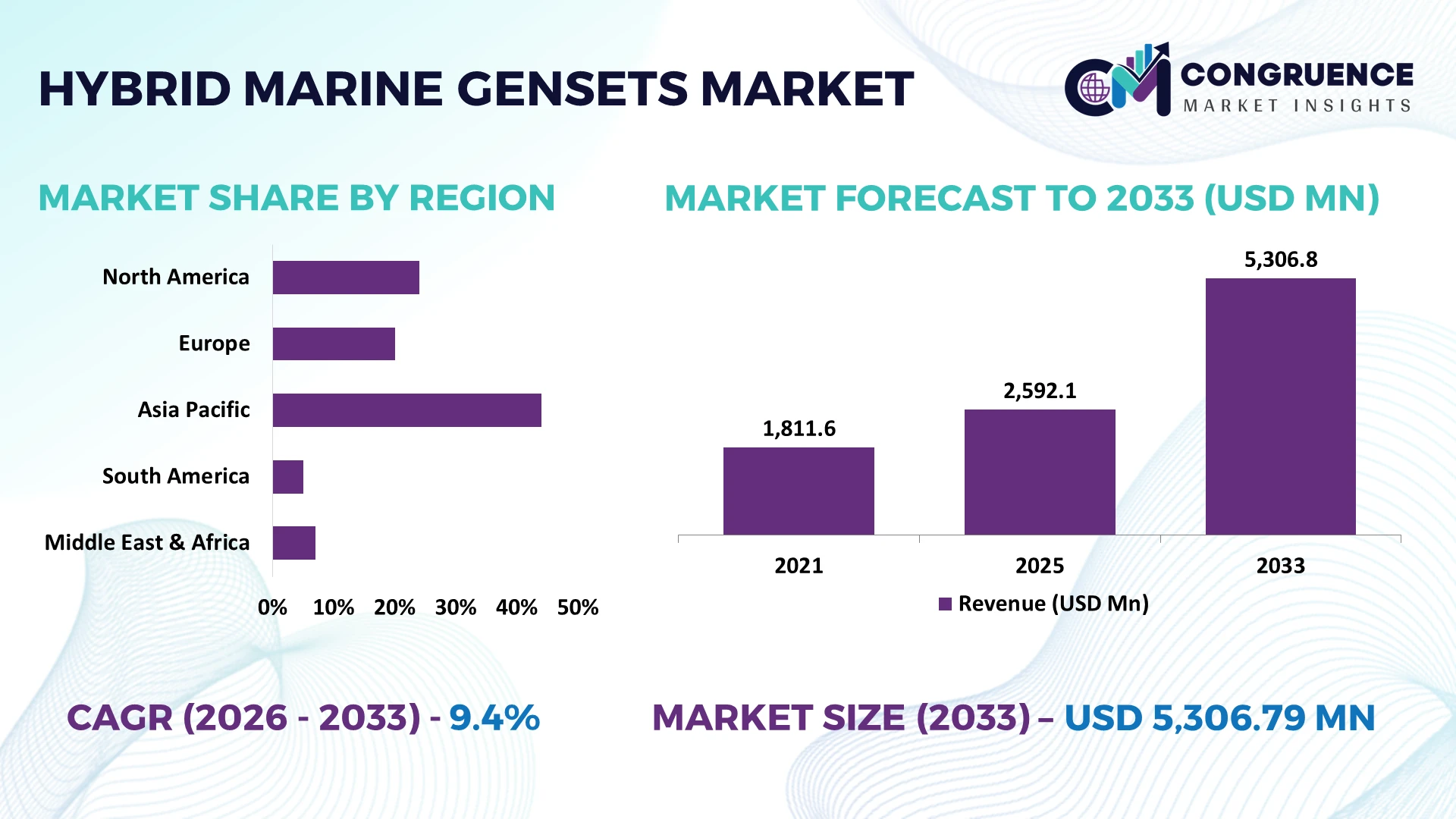
The Global Hybrid Marine Gensets Market was valued at USD 2592.06 Million in 2025 and is anticipated to reach a value of USD 5306.79 Million by 2033 expanding at a CAGR of 9.37% between 2026 and 2033. Growth is driven by accelerating fleet electrification, stricter maritime emission compliance, rising hybrid vessel deployments, and increased investment in energy-efficient propulsion systems across commercial and offshore shipping.
Norway remains the dominant country, accounting for approximately 18% of global hybrid marine vessel deployment, supported by extensive maritime electrification programs, over USD 1 billion in green shipping investments, and strong offshore energy activity. Compared with South Korea, where advanced shipbuilding accelerates hybrid integration, Norway records nearly 30% higher adoption across coastal commercial fleets. Continued compliance with tightening IMO decarbonization targets strengthens technology deployment while reinforcing long-term competitiveness in marine power systems.
Manufacturers and fleet operators prioritizing scalable hybrid genset platforms, battery integration, and fuel-efficient digital energy management are positioned to secure stronger contracts across commercial, offshore, and government marine projects.
Market Size & Growth: USD 2592.06 Million in 2025, projected to reach USD 5306.79 Million by 2033 at 9.37% CAGR, supported by hybrid propulsion integration and maritime decarbonization.
Top Growth Drivers: Battery integration improves fuel efficiency by 20%, emission reduction reaches 30%, and predictive maintenance lowers operating costs by 15%.
Short-Term Forecast: By 2028, fuel consumption declines 18% while onboard power efficiency improves 22% through advanced energy management.
Emerging Technologies: AI-based power optimization, lithium-ion battery systems, and digital automation increase energy utilization by approximately 25%.
Regional Leaders: Europe approaches USD 1800 Million, Asia Pacific exceeds USD 1700 Million, and North America reaches nearly USD 950 Million, driven by fleet modernization and regional expansion.
Consumer/End-User Trends: More than 42% of new hybrid-ready commercial vessel projects prioritize integrated marine energy storage solutions.
Pilot/Case Example: A 2026 hybrid ferry modernization project reduced fuel consumption by 24% and maintenance downtime by 17%.
Competitive Landscape: Leading suppliers collectively control about 48% of the market, with Caterpillar, Wärtsilä, Rolls-Royce, ABB, and Cummins maintaining strong global positions.
Regulatory & ESG Impact: IMO-focused compliance initiatives support up to 35% emission reductions across modern hybrid marine power systems.
Investment & Funding: More than USD 2.5 Billion is directed toward strategic partnerships, shipyard expansion, and advanced marine electrification programs amid supply chain diversification.
Innovation & Future Outlook: Modular hybrid gensets, intelligent digital controls, and alternative-fuel compatibility strengthen next-generation marine power strategies and long-term fleet resilience.
Hybrid Marine Gensets Market demand is expanding across ferries, offshore support vessels, research ships, and defense fleets as operators prioritize lower emissions and optimized lifecycle performance. Intelligent power management, modular battery integration, and remote diagnostics now improve operational efficiency by nearly 20%. Strengthening maritime emission regulations and regional component localization continue reshaping procurement strategies, setting the foundation for the following strategic market assessment.
Hybrid marine gensets have become a strategic investment priority as shipping companies accelerate fleet decarbonization while maintaining operational flexibility and fuel resilience. The market is reshaping competitive dynamics through digital energy management, battery-assisted propulsion, and stricter maritime emission standards. At the same time, supply-chain restructuring has encouraged localized production of battery systems and power electronics, reducing component lead times by nearly 18% and improving delivery reliability for commercial vessel operators.
Modern hybrid marine gensets equipped with AI-enabled energy management deliver approximately 22% higher fuel efficiency and around 28% lower maintenance requirements than conventional diesel-only systems by optimizing load distribution and reducing engine runtime. Norway leads commercial hybrid vessel deployment through strong policy support and electrified coastal operations, while South Korea strengthens competitiveness through advanced shipbuilding capacity and integrated hybrid propulsion manufacturing. Over the next two to three years, hybrid power integration across newly commissioned commercial vessels is expected to exceed 35%, supported by digital monitoring and predictive maintenance adoption.
A 2026 hybrid ferry deployment demonstrated nearly 24% lower fuel consumption through battery-assisted peak shaving and intelligent power scheduling. Manufacturers are expanding technology partnerships, investing in modular power architectures, and strengthening marine battery ecosystems to improve deployment flexibility. Companies building integrated, digitally managed hybrid solutions will secure stronger competitive positioning as fleet modernization and environmental compliance increasingly shape procurement decisions.
Commercial shipping operators are accelerating hybrid propulsion adoption to reduce fuel consumption, improve energy efficiency, and comply with stricter maritime emission standards. Hybrid marine gensets typically lower fuel usage by about 20%, reduce emissions by nearly 30%, and improve equipment availability by approximately 15% through optimized operating cycles. Norway continues expanding electrified ferry infrastructure, encouraging wider deployment of hybrid power systems across coastal fleets. In response, manufacturers are increasing investment in modular genset platforms, advanced battery integration, and digital power management partnerships. This structural transition strengthens lifecycle economics while enabling operators to achieve greater operational flexibility, lower maintenance frequency, and stronger competitiveness in commercial and offshore marine applications.
High-capacity battery systems, marine-grade power electronics, and specialized integration services continue to limit deployment speed for hybrid marine gensets. Battery pack costs still account for nearly 35% of complete hybrid propulsion investment, while installation timelines remain approximately 20% longer than conventional marine power upgrades. Japan and other advanced manufacturing hubs continue experiencing supply pressure for critical electronic components during periods of elevated maritime equipment demand. These constraints directly affect project profitability and vessel retrofit schedules. Companies are responding through supplier diversification, localized assembly facilities, long-term procurement agreements, and standardized component platforms that improve inventory availability while reducing dependence on single-source supply chains.
Next-generation hybrid marine gensets are creating value beyond conventional onboard electricity generation through intelligent energy orchestration and compatibility with low-carbon fuels. AI-enabled power optimization improves energy utilization by around 25%, while predictive maintenance reduces unexpected equipment failures by nearly 18%. Singapore is strengthening its position through smart port infrastructure and digital maritime initiatives that support connected vessel operations. Manufacturers are expanding research into hybrid systems compatible with methanol and hydrogen-ready architectures while building software partnerships for real-time fleet energy analytics. This combination creates differentiated service models, lowers operating costs, and opens new commercial opportunities across offshore support, research, and government marine fleets.
Successful deployment increasingly depends on integrating batteries, propulsion controls, navigation systems, and cybersecurity frameworks into a unified marine energy platform. Engineering integration can increase project complexity by approximately 25%, while commissioning periods extend nearly 15% where experienced hybrid marine specialists remain limited. South Korea's advanced shipbuilding sector highlights the importance of digital engineering capabilities as vessel automation continues expanding. Companies must invest in workforce training, standardized software interfaces, cybersecurity validation, and collaborative technology partnerships to maintain deployment consistency. Organizations that establish integrated engineering expertise and scalable digital support capabilities will achieve stronger long-term operational performance and greater resilience as hybrid vessel architectures become increasingly sophisticated.
Battery Integration Accelerates Deployment Hybrid battery integration is becoming a standard specification across new commercial vessel programs, with battery-assisted hybrid installations increasing by nearly 32% during recent fleet modernization cycles. Modular energy storage reduces engine operating hours by approximately 24% while improving fuel optimization by 18%. Tightening maritime emission regulations are encouraging shipowners to standardize hybrid architectures, prompting manufacturers to expand battery partnerships and localized integration capabilities.
Digital Energy Management Expansion AI-enabled marine energy management platforms are now deployed across approximately 40% of newly commissioned hybrid-ready vessels, improving power allocation efficiency by nearly 22% and reducing unplanned maintenance by 16%. Norwegian operators increasingly integrate cloud-based vessel monitoring with predictive diagnostics, enabling faster maintenance planning. Equipment suppliers are scaling software capabilities through digital service partnerships and remote operational support to strengthen lifecycle performance.
Modular Genset Platform Standardization Shipbuilders are shifting toward modular hybrid genset designs that shorten installation time by around 20% while lowering lifecycle maintenance requirements by approximately 15%. South Korean shipyards are standardizing interchangeable power modules to simplify vessel customization and accelerate production schedules. Manufacturers are restructuring engineering workflows and component sourcing strategies, improving supply-chain resilience while reducing project complexity for commercial fleet operators.
Alternative Fuel Compatibility Focus Hybrid marine gensets are increasingly engineered for compatibility with methanol-ready and hydrogen-ready propulsion systems, with more than 28% of advanced development programs incorporating multi-fuel capability. Operational flexibility improves by nearly 17% through adaptable control architectures that accommodate future fuel transitions. Companies are expanding collaborative development with engine manufacturers and marine technology providers, strengthening long-term competitiveness as decarbonization strategies reshape vessel procurement priorities.
Diesel-Electric hybrid marine gensets remain the leading segment, accounting for approximately 46% of total deployments because of proven operational reliability, mature service infrastructure, and compatibility with existing commercial fleets. Their ability to optimize engine loading improves fuel efficiency by nearly 18% while minimizing maintenance intervals. Gas-Electric systems continue expanding across emission-sensitive operations, delivering lower exhaust emissions and improved fuel flexibility where LNG infrastructure is available.
Battery Hybrid systems represent the fastest-growing segment, with annual deployment volumes increasing by approximately 30% as ferry operators and coastal fleets prioritize silent operation and lower fuel consumption. Fuel Cell Hybrid solutions remain an emerging category but are attracting strategic investment through demonstration projects focused on zero-emission marine applications. Manufacturers are expanding modular product portfolios, investing in battery integration technologies, and forming technology alliances to support evolving vessel requirements. Investment priorities are steadily shifting toward flexible hybrid platforms capable of supporting future low-carbon propulsion strategies.
Commercial Vessels lead the Hybrid Marine Gensets Market with an estimated 43% share, supported by continuous fleet modernization, fuel optimization initiatives, and high operating-hour utilization. Hybrid systems reduce fuel consumption by nearly 20% while improving operational availability across cargo, container, and logistics fleets. Naval Vessels continue adopting hybrid power architectures for improved endurance, reduced acoustic signatures, and enhanced onboard energy resilience.
Passenger Ferries represent the fastest-growing application, supported by coastal electrification programs and stricter environmental compliance requirements. Hybrid ferry deployments have increased by approximately 27%, while operational emissions decline by nearly 30% through battery-assisted propulsion. Offshore Support vessels increasingly utilize hybrid power for dynamic positioning efficiency, whereas Yachts adopt premium hybrid technologies focused on comfort and sustainability. Manufacturers are expanding application-specific product configurations, strengthening automation capabilities, and collaborating with shipbuilders to improve deployment flexibility across multiple vessel categories.
Commercial Shipping remains the dominant end-user, representing approximately 49% of hybrid marine genset procurement due to extensive fleet size, continuous operational cycles, and increasing pressure to improve fuel efficiency. Hybrid installations reduce lifecycle operating costs by around 16% while supporting emission compliance across international shipping routes. Marine Transport operators continue strengthening demand through modernization programs targeting higher vessel utilization and improved energy management.
Naval Defense is the fastest-growing end-user segment, with hybrid power adoption increasing by nearly 24% as governments prioritize operational endurance, reduced thermal signatures, and resilient onboard power systems. Offshore Oil & Gas operators continue integrating hybrid gensets to reduce fuel consumption during platform support operations and dynamic positioning activities. Equipment suppliers are responding through customized power configurations, strategic defense partnerships, flexible service agreements, and digital lifecycle support, positioning themselves to capture evolving procurement requirements across both commercial and government marine sectors.
Europe accounted for the largest market share at 36.8% in 2025 however, Asia-Pacific is expected to register the fastest growth, expanding at a 10.4% between 2026 and 2033.
Fleet Modernization Strengthens Hybrid Deployment
North America represents a strategically significant market, contributing approximately 24% of global hybrid marine genset deployment through commercial shipping modernization, naval fleet upgrades, and offshore vessel electrification. The United States and Canada continue integrating hybrid propulsion into ferries, research vessels, and government fleets to improve operational efficiency and reduce fuel dependency. More than 30% of newly specified coastal commercial vessels now include hybrid-ready auxiliary power systems. Shipyards are strengthening collaborations with battery suppliers and digital energy management providers, reducing installation complexity while improving lifecycle performance. Infrastructure investment in port electrification and vessel modernization continues supporting wider adoption across inland waterways and coastal transport operations, creating sustained demand for integrated hybrid marine power solutions.
United States Market Outlook: The United States leads regional deployment through extensive commercial shipping activity, naval modernization, and advanced marine engineering capabilities. More than 35% of hybrid propulsion demonstration projects in North America are concentrated in U.S. shipyards, supported by expanding port electrification programs and defense procurement initiatives. Manufacturers continue investing in digital vessel energy management, modular genset platforms, and strategic technology partnerships that strengthen domestic production capabilities and accelerate commercial fleet modernization.
Regulatory Leadership Accelerates Maritime Electrification
Europe remains the largest regional market, supported by mature shipbuilding capabilities, advanced marine technology providers, and stringent maritime environmental standards. Approximately 37% of global hybrid vessel deployments are concentrated across European commercial and passenger fleets. Coastal ferry electrification programs, offshore wind support operations, and digital marine energy management continue driving operational adoption. Hybrid propulsion integration has reduced fuel consumption by nearly 20% across multiple commercial applications. Manufacturers are expanding engineering partnerships, localized battery integration, and modular propulsion development to strengthen competitiveness while supporting long-term vessel decarbonization initiatives.
Norway Market Outlook: Norway remains Europe's strategic leader due to its advanced electrified ferry network, offshore maritime expertise, and supportive marine innovation ecosystem. Around 18% of global hybrid ferry deployments operate within Norwegian waters, supported by extensive charging infrastructure and hybrid vessel procurement programs. Domestic shipowners continue prioritizing intelligent energy management systems, creating sustained opportunities for hybrid marine genset manufacturers focused on high-efficiency commercial applications.
Shipbuilding Scale Drives Hybrid Adoption
Asia-Pacific is emerging as the fastest-expanding regional market through large-scale commercial shipbuilding, manufacturing capacity, and accelerating hybrid propulsion integration. The region contributes approximately 31% of global hybrid marine equipment production while maintaining strong export capabilities. More than 28% of newly constructed commercial vessels in leading shipbuilding nations incorporate hybrid-ready power configurations. Investments in automated shipyards, battery manufacturing, and digital marine technologies continue improving production efficiency while reducing engineering lead times. Equipment suppliers are expanding regional manufacturing partnerships and localized supply chains to support rising commercial vessel demand.
South Korea Market Outlook: South Korea maintains a leading competitive position through globally recognized shipbuilding expertise and advanced marine engineering infrastructure. Nearly 40% of high-value commercial shipbuilding contracts include provisions for advanced hybrid propulsion compatibility. Domestic manufacturers continue integrating automation, digital design platforms, and modular hybrid systems into vessel construction, strengthening export competitiveness while supporting next-generation marine electrification across international shipping markets.
Coastal Transport Modernization Expands Demand
South America continues strengthening hybrid marine genset adoption through commercial river transport, offshore support operations, and modernization of passenger ferry services. The region contributes approximately 5% of global deployment, with investment increasingly directed toward fuel-efficient marine infrastructure. Hybrid propulsion installations reduce operating fuel consumption by nearly 18% across selected coastal and inland transport applications. Infrastructure limitations remain, particularly in charging and maintenance networks, but operators increasingly collaborate with technology providers to improve deployment readiness. Manufacturers are expanding regional service capabilities and localized technical support to improve operational reliability.
Brazil Market Outlook: Brazil leads the regional market through extensive offshore energy activity, commercial shipping infrastructure, and inland waterway transportation. More than 45% of South America's offshore support fleet operates from Brazilian maritime hubs, encouraging wider adoption of hybrid auxiliary power systems. Domestic operators increasingly prioritize digital vessel monitoring and fuel optimization technologies to improve operational efficiency while lowering long-term maintenance requirements.
Maritime Infrastructure Investments Support Transformation
The Middle East & Africa market is expanding through strategic port modernization, offshore energy operations, and investment in advanced maritime infrastructure. The region represents approximately 3% of global hybrid marine genset deployment but continues strengthening its role through large-scale logistics and offshore development projects. Hybrid auxiliary systems improve fuel efficiency by nearly 17% in offshore support operations while enhancing operational flexibility. Port expansion initiatives and marine technology partnerships continue improving deployment readiness across major shipping corridors. Equipment suppliers are increasing regional engineering support and technical collaboration to strengthen project execution.
United Arab Emirates Market Outlook: The United Arab Emirates leads regional adoption through advanced port infrastructure, global logistics connectivity, and strong investment in maritime innovation. More than 30% of regional smart-port modernization projects include digital vessel energy management capabilities supporting hybrid marine technologies. Marine equipment providers continue establishing technical partnerships and localized service operations, positioning the country as a strategic hub for next-generation commercial marine power solutions.
The competitive landscape is shaped by Wärtsilä, Caterpillar, Rolls-Royce, ABB, Cummins, and MAN Energy Solutions competing across integrated hybrid propulsion, marine automation, and intelligent power management. Global technology leaders compete against regional marine system integrators through engineering capability rather than price alone. The top five participants collectively account for approximately 48% of market activity. Competition increasingly centers on digital energy optimization, where advanced control platforms improve fuel efficiency by nearly 20% and predictive maintenance reduces service downtime by about 15%. Companies strengthen positioning through battery technology partnerships, localized manufacturing, modular product development, and vertical integration across propulsion and energy management systems. Faster customization and shorter delivery cycles have become decisive competitive advantages as shipowners prioritize flexible hybrid solutions. High certification requirements, marine safety compliance, and integration expertise create substantial entry barriers for new suppliers. Long-term success depends on combining scalable hybrid technologies, software intelligence, strong marine partnerships, and dependable global lifecycle support.
Wärtsilä
Caterpillar Inc.
Cummins Inc.
Rolls-Royce plc
ABB Ltd.
MAN Energy Solutions
Mitsubishi Heavy Industries Ltd.
Yanmar Holdings Co., Ltd.
Volvo Penta
Scania CV AB
Siemens Energy AG
Kohler Energy
Anglo Belgian Corporation (ABC)
Nidec ASI
Hybrid marine genset technology is rapidly shifting from conventional diesel-electric configurations toward integrated battery-assisted power platforms with intelligent energy management. AI-enabled load optimization improves fuel efficiency by approximately 20%, while predictive diagnostics reduce unplanned maintenance by nearly 16%. Around 40% of newly specified hybrid-ready commercial vessels now incorporate digital power management systems, enabling dynamic engine loading and lower lifecycle costs. Companies adopting integrated hardware and software architectures gain stronger operational reliability and reduced fuel consumption across commercial, offshore, and passenger vessel applications.
Emerging technologies between 2026 and 2028 include modular lithium-ion battery systems, methanol-ready hybrid configurations, silicon carbide power electronics, and cloud-based fleet analytics. Battery-assisted peak shaving lowers engine runtime by nearly 24%, while advanced power conversion increases electrical efficiency by approximately 12%. Hybrid platforms equipped with digital twins are expected to exceed 30% deployment across newly commissioned high-value vessels, enabling faster maintenance planning and optimized onboard energy utilization. Shipbuilders increasingly integrate standardized modular power systems to shorten installation schedules and simplify fleet upgrades.
Compared with legacy diesel-only gensets, next-generation hybrid solutions deliver nearly 22% higher fuel efficiency and reduce maintenance costs by approximately 18% through intelligent power distribution. Global technology leaders investing in battery integration, marine automation, and digital lifecycle services secure stronger competitive differentiation. Companies acting now will strengthen compliance readiness, improve fleet productivity, and capture long-term advantages as intelligent hybrid propulsion becomes the preferred marine power standard.
May 2024 Rolls-Royce announced the world's first LNG-powered hybrid harbour tug, JMS Sunshine, entered service in Singapore with a 904 kWh battery system and 4,000 kW total propulsion output, improving maneuverability and operational efficiency.
August 2025 Wärtsilä secured the Aurora Botnia battery expansion project, increasing onboard battery capacity from 2.2 MWh to 12.6 MWh, creating the world's largest operational marine battery hybrid system and strengthening ferry decarbonization capabilities. Source: (https://www.wartsila.com)
December 2025 Wärtsilä identified lifecycle optimization, digitalization, flexible decarbonization, and data-driven operations as four defining shipping trends for 2026, reinforcing strategic investment priorities across hybrid marine propulsion and vessel optimization. Source: (https://news.cision.com)
July 2026 Rolls-Royce supplied 40 mtu Series 4000 engines for ten new hybrid offshore vessels serving Petrobras, integrating battery systems with IMO Tier III compliance to improve environmental performance and operational reliability. Source: (https://www.rolls-royce.com)
The report provides comprehensive analysis of the Hybrid Marine Gensets Market across Diesel-Electric, Gas-Electric, Battery Hybrid, and Fuel Cell Hybrid technologies, covering Commercial Vessels, Naval Vessels, Offshore Support, Passenger Ferries, and Yachts alongside Commercial Shipping, Naval Defense, Offshore Oil & Gas, and Marine Transport end-users. Regional assessment spans North America, Europe, Asia-Pacific, South America, and the Middle East & Africa, while evaluating deployment trends, technology adoption, competitive positioning, and operational performance. More than 40% of recent vessel programs incorporate advanced digital energy management and battery-assisted hybrid architectures.
The study evaluates technology innovation, marine electrification, modular propulsion integration, AI-enabled energy optimization, and alternative-fuel compatibility between 2026 and 2033. It delivers strategic insights into competitive benchmarking, regional investment priorities, supply-chain developments, and deployment patterns across established and emerging maritime markets. The report supports fleet modernization planning, product development, partnership evaluation, expansion strategy, procurement decisions, and long-term competitive positioning for marine equipment manufacturers, shipbuilders, investors, and commercial vessel operators.
| Report Attribute/Metric | Report Details |
|---|---|
Market Revenue in 2025 | USD 2592.06 Million |
Market Revenue in 2033 | USD 5306.79 Million |
CAGR (2026 - 2033) | 9.37% |
Base Year | 2025 |
Forecast Period | 2026 - 2033 |
Historic Period | 2021 - 2025 |
Segments Covered | By Type
By Application
By End-User
|
Key Report Deliverable | Revenue Forecast, Growth Trends, Market Dynamics, Segmental Overview, Regional and Country-wise Analysis, Competition Landscape |
Region Covered | North America, Europe, Asia-Pacific, South America, Middle East, Africa |
Key Players Analyzed | Wärtsilä, Caterpillar Inc., Cummins Inc., Rolls-Royce plc, ABB Ltd., MAN Energy Solutions, Mitsubishi Heavy Industries Ltd., Yanmar Holdings Co., Ltd., Volvo Penta, Scania CV AB, Siemens Energy AG, Kohler Energy, Anglo Belgian Corporation (ABC), Nidec ASI |
Customization & Pricing | Available on Request (10% Customization is Free) |




