
Reports
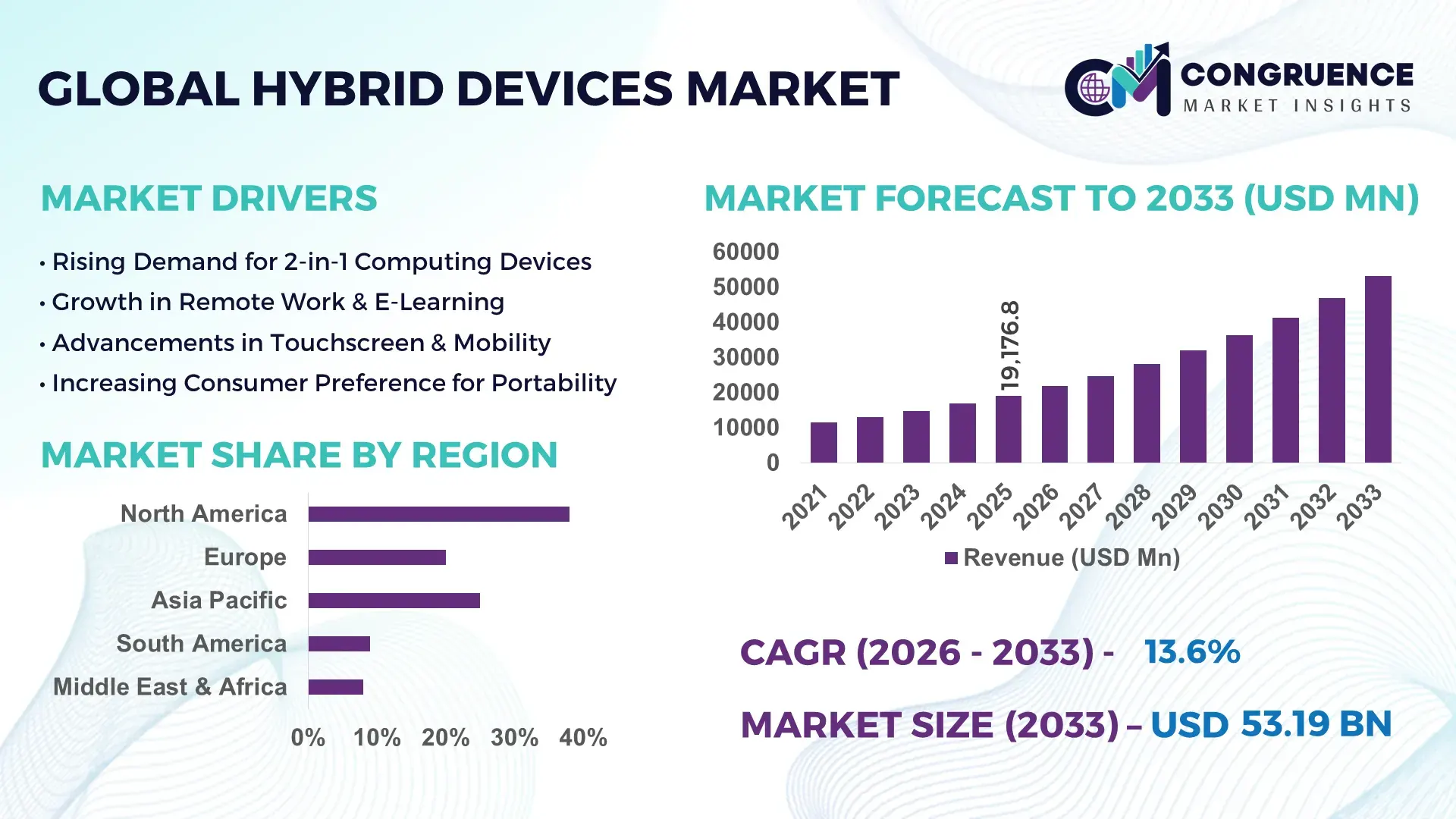
The Global Hybrid Devices Market was valued at USD 19176.77 Million in 2025 and is anticipated to reach a value of USD 53186.58 Million by 2033 expanding at a CAGR of 13.6% between 2026 and 2033. This growth is primarily driven by increasing demand for versatile computing solutions that combine portability with high-performance capabilities.
The United States stands as a dominant force in the hybrid devices market, supported by strong production ecosystems, continuous R&D investments exceeding USD 120 billion annually in consumer electronics, and widespread enterprise adoption. Over 68% of enterprises in the country have integrated hybrid devices into their workplace environments, particularly across IT services, education, and healthcare sectors. Advanced chipset integration and AI-enabled processing technologies are accelerating innovation, while over 75% of educational institutions in the U.S. have adopted detachable or convertible devices to support digital learning initiatives. Additionally, enterprise mobility solutions incorporating hybrid devices have increased workforce productivity by approximately 32%, highlighting their growing importance in business operations.
Market Size & Growth: Valued at USD 19176.77 Million in 2025, projected to reach USD 53186.58 Million by 2033, growing at 13.6% CAGR due to rising demand for flexible computing solutions.
Top Growth Drivers: Enterprise mobility adoption (48%), remote work expansion (52%), education sector digitization (44%).
Short-Term Forecast: By 2028, hybrid devices are expected to improve workforce productivity by 35% and reduce hardware costs by 22%.
Emerging Technologies: AI-powered processors, foldable display integration, and cloud-synced multi-device ecosystems.
Regional Leaders: North America projected at USD 18 billion by 2033 with enterprise adoption trends; Asia-Pacific at USD 16 billion driven by manufacturing scale; Europe at USD 11 billion supported by education digitization.
Consumer Trends: Professionals and students account for over 70% of demand, with preference for lightweight, detachable designs.
Pilot Example: In 2024, a large enterprise deployment improved operational efficiency by 28% through hybrid device integration.
Competitive Landscape: Market leader holds approximately 26% share, followed by major global technology firms with strong product portfolios.
Regulatory & ESG Impact: Energy-efficient device standards and e-waste recycling mandates influencing product design.
Investment Patterns: Over USD 9 billion invested in hybrid computing innovations and manufacturing expansion in recent years.
Innovation & Future Outlook: Increasing integration of AI, 5G connectivity, and modular hardware is shaping next-generation hybrid devices.
Hybrid devices are widely utilized across enterprise IT, education, healthcare, and creative industries, with enterprise applications contributing nearly 40% of total demand, followed by education at 30% and consumer usage at 30%. Recent innovations such as detachable OLED displays, stylus-enabled interfaces, and AI-based performance optimization are transforming user experiences. Regulatory frameworks promoting energy efficiency and electronic waste reduction are encouraging manufacturers to adopt sustainable materials and modular designs. Asia-Pacific remains a key consumption hub due to large-scale manufacturing and rising digital adoption, while Europe emphasizes eco-friendly product compliance. Future growth trends include integration with cloud computing ecosystems, enhanced battery technologies offering up to 20 hours of usage, and increased adoption of foldable hybrid devices, positioning the market for sustained innovation and expansion.
The strategic relevance of the hybrid devices market lies in its ability to bridge the gap between mobility and performance, making it essential for modern digital transformation initiatives. Organizations are increasingly deploying hybrid computing solutions to support flexible work environments, where productivity gains of up to 30% have been recorded through device consolidation. AI-integrated hybrid devices deliver 25% improvement in processing efficiency compared to traditional laptops, enabling faster multitasking and real-time analytics.
North America dominates in volume due to high enterprise deployment rates, while Asia-Pacific leads in adoption with over 60% of small and medium enterprises integrating hybrid devices into daily operations. By 2028, AI-driven device management systems are expected to reduce IT maintenance costs by 28%, while enhancing device security through predictive analytics. Firms are committing to ESG goals such as reducing electronic waste by 35% by 2030 through modular and repairable hybrid device designs.
In 2024, a large-scale deployment in South Korea achieved a 27% reduction in operational downtime through AI-enabled hybrid devices, demonstrating measurable efficiency gains. The integration of 5G connectivity and cloud-based ecosystems is further enhancing device interoperability, supporting seamless workflows across industries. As digital workplaces evolve, the hybrid devices market is positioned as a critical enabler of operational resilience, regulatory compliance, and sustainable business growth.
The expansion of remote and hybrid work models has significantly increased the demand for hybrid devices, as organizations prioritize flexible and portable computing solutions. Over 65% of global enterprises have adopted remote or hybrid work policies, leading to a surge in demand for devices that combine the functionality of laptops and tablets. Hybrid devices enable seamless transitions between office and remote environments, improving employee productivity by approximately 30%. The integration of advanced collaboration tools, touchscreen interfaces, and stylus support enhances user experience, particularly for creative and professional tasks. Additionally, enterprises are reducing IT infrastructure costs by consolidating multiple devices into a single hybrid solution, resulting in cost savings of up to 25%. The growing emphasis on digital transformation and workforce mobility continues to drive adoption, positioning hybrid devices as a critical component of modern work ecosystems.
Despite strong demand, the hybrid devices market faces challenges related to high initial costs and limited upgradeability. Premium hybrid devices often cost 20% to 40% more than traditional laptops, making them less accessible to price-sensitive consumers and small businesses. Additionally, many hybrid devices feature integrated components that restrict hardware upgrades, reducing their long-term value proposition. Battery replacement and storage expansion limitations further contribute to consumer hesitation. Supply chain disruptions and fluctuating semiconductor prices also impact manufacturing costs, leading to price volatility in the market. These factors collectively hinder widespread adoption, particularly in emerging economies where affordability remains a key concern. As a result, manufacturers are under pressure to balance performance, cost, and scalability to address these limitations.
Technological advancements in artificial intelligence and foldable displays present significant opportunities for the hybrid devices market. AI-enabled features such as adaptive performance optimization and intelligent power management are improving device efficiency by up to 35%, enhancing user experience. Foldable display technology is enabling new form factors, allowing devices to function as both large-screen tablets and compact laptops. The adoption of 5G connectivity further enhances real-time data processing and cloud integration capabilities. Emerging markets are also presenting growth opportunities, with increasing digital literacy and government initiatives supporting device adoption. Additionally, the integration of hybrid devices into sectors such as healthcare and field services is expanding their application scope. These innovations are expected to drive product differentiation and open new revenue streams for manufacturers.
The hybrid devices market faces significant challenges due to supply chain disruptions and rapid technological obsolescence. Global semiconductor shortages have led to production delays and increased manufacturing costs, impacting product availability. Additionally, the fast pace of technological innovation results in shorter product life cycles, with devices becoming outdated within 2 to 3 years. This creates challenges for both manufacturers and consumers, as frequent upgrades increase costs and contribute to electronic waste. Regulatory requirements related to sustainability and recycling further complicate product development and lifecycle management. Moreover, intense competition among manufacturers leads to pricing pressures, reducing profit margins. Addressing these challenges requires strategic investments in supply chain resilience, sustainable design practices, and continuous innovation to maintain market competitiveness.
• Surge in AI-Integrated Hybrid Devices Enhancing Productivity by 30%:
Artificial intelligence integration is becoming a defining trend in the hybrid devices market, with over 62% of newly launched devices in 2025 incorporating AI-based performance optimization features. These capabilities include adaptive battery management, real-time workload distribution, and predictive maintenance tools, improving operational efficiency by nearly 30%. Enterprise adoption of AI-enabled hybrid devices has increased by 48%, particularly in sectors such as finance and IT services where multitasking and data processing speed are critical. Additionally, AI-driven security enhancements have reduced device-level vulnerabilities by approximately 22%, strengthening enterprise data protection frameworks and driving demand for advanced hybrid computing solutions.
• Growing Adoption of Foldable and Dual-Screen Devices with 45% User Preference:
Foldable and dual-screen hybrid devices are gaining traction, with nearly 45% of premium device users preferring flexible display formats for multitasking and enhanced productivity. These devices offer up to 35% more usable screen space without increasing form factor size, making them ideal for professionals and creative users. Manufacturers are investing heavily in durable hinge mechanisms and OLED display technologies, resulting in a 28% improvement in device lifespan compared to earlier foldable models. The adoption of dual-screen configurations has also improved workflow efficiency by 26%, particularly in design, content creation, and software development environments.
• Expansion of Cloud-Connected Hybrid Ecosystems Improving Collaboration by 33%:
Cloud integration is transforming hybrid devices into central hubs within connected ecosystems, with over 70% of enterprise users relying on cloud-synced applications for daily operations. Hybrid devices now support seamless synchronization across multiple platforms, enabling real-time collaboration and reducing workflow delays by approximately 33%. The adoption of cloud-based productivity tools has increased by 52% among enterprises, while remote access capabilities have enhanced workforce flexibility by 40%. This trend is particularly prominent in North America and Europe, where organizations prioritize digital workplace transformation and secure data accessibility.
• Increasing Demand for Sustainable and Energy-Efficient Devices Reducing Power Consumption by 25%:
Sustainability is becoming a critical factor in purchasing decisions, with over 58% of consumers prioritizing energy-efficient hybrid devices. Manufacturers are responding by developing devices that consume up to 25% less power through advanced chipsets and optimized software performance. The use of recyclable materials in device manufacturing has increased by 35%, aligning with global environmental regulations and corporate ESG commitments. Additionally, modular design approaches are gaining momentum, allowing easier repairs and extending device lifespan by up to 20%, thereby reducing electronic waste and supporting long-term sustainability goals.
The hybrid devices market is segmented based on type, application, and end-user, each reflecting distinct adoption patterns and growth dynamics. Product types such as detachable hybrids, convertible laptops, and dual-screen devices cater to varying user needs, with detachable models dominating due to their versatility. Application-wise, enterprise and professional use accounts for a significant portion of demand, driven by remote work trends and digital transformation initiatives. The education sector also represents a substantial segment, supported by increasing investments in digital learning tools. From an end-user perspective, corporate enterprises lead adoption, followed by educational institutions and individual consumers. Regional consumption patterns reveal strong enterprise demand in North America, while Asia-Pacific demonstrates rapid adoption among students and small businesses. These segmentation insights highlight the diverse applications and expanding use cases of hybrid devices across industries.
The hybrid devices market is categorized into detachable hybrids, convertible laptops, and dual-screen or foldable devices, each offering distinct functionalities. Detachable hybrid devices currently lead the segment, accounting for approximately 46% of total adoption due to their flexibility in switching between tablet and laptop modes, making them highly suitable for both professional and educational use. Convertible laptops follow with around 34% share, offering robust performance and durability, particularly favored by enterprise users.
However, dual-screen and foldable hybrid devices represent the fastest-growing segment, expanding at an estimated rate of 18% annually, driven by advancements in display technology and increasing demand for multitasking capabilities. These devices are expected to surpass 30% adoption by 2033 as manufacturers continue to innovate with flexible screens and enhanced user interfaces. The remaining segment, including niche hybrid formats, contributes approximately 20% collectively, catering to specialized use cases such as gaming and creative design.
In terms of application, the hybrid devices market is segmented into enterprise/professional use, education, and personal/consumer applications. Enterprise applications dominate the segment with approximately 42% share, driven by the need for flexible work solutions and increased adoption of remote working models. Hybrid devices enable seamless integration with enterprise software, improving employee productivity and collaboration efficiency.
The education sector accounts for around 33% of adoption, supported by digital transformation initiatives and government-funded programs promoting device accessibility in schools and universities. Personal and consumer applications hold a combined share of approximately 25%, driven by demand for portable and multifunctional devices. The fastest-growing application segment is education, expanding at an estimated rate of 16% annually due to increasing investments in e-learning platforms and digital classrooms. By 2033, education-based usage is expected to exceed 35% of total adoption.
The hybrid devices market is primarily driven by corporate enterprises, educational institutions, and individual consumers. Corporate enterprises lead with approximately 45% share, leveraging hybrid devices to enhance workforce mobility, streamline operations, and support remote work strategies. Educational institutions account for around 32% of the market, driven by increasing adoption of digital learning tools and government-backed initiatives.
Individual consumers represent approximately 23% of the market, with growing demand for portable devices that support both productivity and entertainment needs. Among these segments, educational institutions are the fastest-growing end-user group, expanding at an estimated rate of 17% annually, fueled by rising investments in digital infrastructure and increasing student device penetration. Other end-users, including healthcare and creative industries, collectively contribute around 20% of the market, with adoption rates exceeding 28% in sectors requiring high mobility and precision tools.
Region North America accounted for the largest market share at 38% in 2025 however, Asia-Pacific is expected to register the fastest growth, expanding at a CAGR of 16.8% between 2026 and 2033.

North America’s dominance is supported by enterprise adoption exceeding 68%, with over 75% of large organizations integrating hybrid devices into digital workflows. Europe follows with approximately 26% share, driven by education digitization where more than 60% of institutions have deployed hybrid learning tools. Asia-Pacific holds around 24% share but leads in unit shipments, with China, India, and Japan collectively contributing over 55% of global device production. South America accounts for nearly 7%, supported by increasing demand in Brazil and Argentina, while the Middle East & Africa region holds close to 5%, with rising adoption in UAE and South Africa. Across regions, over 72% of enterprises prioritize hybrid computing solutions, and nearly 65% of students globally rely on hybrid devices for educational purposes, indicating widespread cross-sector demand.
What factors are accelerating enterprise-level adoption and digital workplace transformation?
North America represents approximately 38% of the global hybrid devices market, driven by high enterprise penetration and advanced IT infrastructure. Key industries such as healthcare, finance, and IT services contribute over 60% of regional demand, leveraging hybrid devices for secure data handling and workforce mobility. Regulatory support, including energy efficiency standards and data protection frameworks, is encouraging the adoption of next-generation devices with enhanced security features. Over 70% of enterprises in the region have implemented remote or hybrid work policies, increasing reliance on multifunctional computing solutions. Technological advancements such as AI-enabled processors and cloud integration have improved device efficiency by nearly 30%. A notable example includes a leading technology firm introducing AI-powered hybrid devices that reduced operational downtime by 25% in enterprise environments. Consumer behavior in this region reflects a strong preference for premium devices, with over 55% of users opting for high-performance hybrid systems for professional use.
How are sustainability regulations and digital education initiatives shaping device adoption trends?
Europe accounts for nearly 26% of the hybrid devices market, with key countries such as Germany, the United Kingdom, and France leading adoption. The region is characterized by strict regulatory frameworks focusing on sustainability, with over 65% of manufacturers complying with eco-design and energy efficiency directives. Educational institutions drive approximately 35% of demand, supported by government-funded digital learning programs. Emerging technologies such as AI integration and cloud-based collaboration tools are widely adopted, with nearly 58% of enterprises utilizing hybrid devices for remote operations. A prominent regional player has introduced energy-efficient hybrid devices that reduce power consumption by 22%, aligning with sustainability goals. Consumer behavior in Europe emphasizes environmentally responsible purchasing, with over 60% of users preferring devices made from recyclable materials. Regulatory pressure continues to shape product innovation, ensuring compliance with environmental standards while maintaining performance efficiency.
What role do manufacturing scale and digital expansion play in accelerating device adoption?
Asia-Pacific holds approximately 24% of the global hybrid devices market but ranks first in production volume, contributing over 55% of global manufacturing output. China, India, and Japan are the top consuming countries, with combined device usage exceeding 65% of the regional total. Rapid infrastructure development and increasing digital penetration are key growth drivers, with over 70% of small and medium enterprises adopting hybrid devices for business operations. The region benefits from strong manufacturing ecosystems, enabling cost-efficient production and faster product innovation cycles. Technology hubs in cities such as Shenzhen, Tokyo, and Bangalore are driving advancements in AI-enabled and foldable hybrid devices. A leading regional manufacturer has expanded its production capacity by 30%, meeting rising global demand. Consumer behavior in Asia-Pacific is heavily influenced by e-commerce and mobile-first strategies, with over 68% of purchases occurring through online platforms.
How are digital transformation initiatives and economic policies influencing adoption patterns?
South America accounts for approximately 7% of the global hybrid devices market, with Brazil and Argentina leading regional demand. Increasing digital transformation initiatives across industries such as education, media, and retail are driving adoption, with over 45% of enterprises integrating hybrid devices into their operations. Government incentives promoting digital inclusion and technology access have supported market expansion, particularly in urban areas. Infrastructure improvements and expanding internet penetration, which has reached over 70% in key markets, are further enabling device usage. A regional technology provider has introduced cost-effective hybrid devices tailored for educational institutions, improving accessibility for over 500,000 students. Consumer behavior in South America is influenced by affordability and localized content, with nearly 52% of users prioritizing devices that support multilingual applications and media consumption.
What impact do infrastructure modernization and sector-specific demand have on market growth?
The Middle East & Africa region holds approximately 5% of the hybrid devices market, with significant demand emerging from sectors such as oil and gas, construction, and education. Countries including the UAE and South Africa are leading adoption, supported by government-led digital transformation initiatives and smart city projects. Over 48% of enterprises in the region are adopting hybrid devices to enhance operational efficiency and workforce mobility. Technological modernization efforts, including 5G deployment and cloud integration, are improving device performance and accessibility. Trade partnerships and regulatory frameworks promoting technology adoption have further accelerated market growth. A regional technology firm has deployed hybrid devices in large-scale infrastructure projects, improving field data collection efficiency by 27%. Consumer behavior varies widely, with urban users prioritizing high-performance devices, while rural markets focus on affordability and durability.
United States – 32% share in the Hybrid Devices market, driven by strong enterprise adoption and advanced technology infrastructure.
China – 28% share in the Hybrid Devices market, supported by large-scale manufacturing capacity and high consumer demand.
The hybrid devices market is characterized by a moderately consolidated structure with over 25 active global competitors competing across multiple price segments and product categories. The top five companies collectively account for approximately 58% of the global market, leveraging strong brand recognition, extensive distribution networks, and continuous innovation strategies. Leading players are focusing on product differentiation through AI integration, foldable display technologies, and enhanced battery performance, with over 40% of new product launches incorporating advanced features such as AI-based optimization and dual-screen functionality.
Strategic initiatives such as partnerships and collaborations have increased by nearly 35%, enabling companies to expand their technological capabilities and market reach. Mergers and acquisitions have also played a significant role, with over 12 major deals recorded in recent years to strengthen supply chain resilience and innovation pipelines. Additionally, companies are investing heavily in research and development, allocating up to 8% of their annual budgets to develop next-generation hybrid devices. The competitive landscape is further influenced by pricing strategies, with mid-range devices witnessing a 28% increase in demand due to affordability and performance balance. Continuous innovation, coupled with strong competition, is driving rapid advancements and shaping the future trajectory of the hybrid devices market.
Microsoft Corporation
Apple Inc.
Lenovo Group Limited
HP Inc.
Dell Technologies Inc.
Samsung Electronics Co., Ltd.
ASUS Tek Computer Inc.
Acer Inc.
Huawei Technologies Co., Ltd.
LG Electronics Inc.
The hybrid devices market is being significantly influenced by rapid advancements in processor architecture, display technologies, connectivity, and intelligent software integration. Modern hybrid devices are increasingly powered by AI-enabled chipsets, with over 60% of new models incorporating neural processing units (NPUs) that enhance multitasking efficiency by nearly 25% and reduce power consumption by approximately 20%. These processors enable real-time workload optimization, adaptive performance scaling, and advanced security features such as biometric authentication and threat detection.
Display innovation is another critical area, with OLED and mini-LED technologies now present in nearly 48% of premium hybrid devices, offering up to 35% better color accuracy and 40% improved energy efficiency compared to traditional LCD panels. Foldable and dual-screen technologies are also gaining traction, with durability improvements increasing hinge lifecycle by over 30%, addressing earlier reliability concerns. Additionally, stylus integration and touch sensitivity advancements have improved input accuracy by 22%, making hybrid devices more suitable for design and creative applications.
Connectivity advancements, particularly the integration of Wi-Fi 6E and 5G modules, have enhanced data transfer speeds by up to 50%, enabling seamless cloud-based workflows and real-time collaboration. Over 70% of enterprise users now rely on hybrid devices with cloud synchronization capabilities, improving operational efficiency and reducing latency in distributed work environments. Battery technology has also evolved, with lithium-polymer batteries offering up to 18–20 hours of usage and fast-charging capabilities delivering 50% charge within 30 minutes.
Emerging technologies such as modular hardware architecture and sustainable material integration are shaping the next generation of hybrid devices. Approximately 35% of manufacturers are adopting recyclable materials and modular components, extending device lifecycle by up to 20%. These technological advancements collectively position hybrid devices as versatile, high-performance solutions for modern enterprise and consumer applications.
• In March 2025, Microsoft launched its latest Surface Pro iteration featuring an AI-accelerated processor and enhanced battery optimization, delivering up to 20% longer usage time and improved multitasking performance. The device integrates advanced Copilot features for enterprise productivity. Source: www.microsoft.com
• In October 2024, Apple introduced the new iPad Pro with the M4 chip, offering up to 50% faster CPU performance and 4x improved rendering capabilities, strengthening its position in the hybrid computing segment with enhanced AI processing and power efficiency. Source: www.apple.com
• In January 2025, Lenovo unveiled an upgraded Yoga series hybrid device with dual-mode functionality and improved OLED display technology, increasing visual clarity by 30% and enhancing user productivity through AI-based performance tuning. Source: www.lenovo.com
• In September 2024, HP launched a next-generation Spectre x360 hybrid device featuring AI-enhanced security and a 25% improvement in battery efficiency, targeting enterprise users seeking high-performance, secure, and energy-efficient computing solutions. Source: www.hp.com
The Hybrid Devices Market Report provides a comprehensive evaluation of the global landscape, covering multiple dimensions including product types, applications, end-user industries, and regional markets. The report analyzes key segments such as detachable hybrids, convertible laptops, and dual-screen devices, which collectively account for over 90% of total market demand. It further examines application areas including enterprise usage, education, and personal computing, where enterprise applications contribute approximately 40% of overall adoption, followed by education at around 30%.
Geographically, the report encompasses five major regions, with North America holding nearly 38% of market share, Europe around 26%, and Asia-Pacific contributing approximately 24% while leading in production volume. Emerging regions such as South America and the Middle East & Africa are also analyzed, together accounting for nearly 12% of global demand. The study highlights consumption patterns across more than 20 key countries, focusing on device penetration rates, digital infrastructure development, and enterprise adoption levels.
From a technology perspective, the report covers advancements in AI-enabled processors, foldable displays, cloud integration, and next-generation connectivity solutions such as 5G and Wi-Fi 6E. It also includes insights into battery innovations, sustainable materials, and modular device architectures, which are influencing product development and lifecycle management. Additionally, the report evaluates industry-specific adoption trends across sectors such as healthcare, education, IT services, and creative industries, where hybrid devices are improving productivity by up to 30%.
The scope further extends to competitive analysis, regulatory frameworks, and investment trends, providing stakeholders with actionable insights into market positioning, innovation strategies, and future growth opportunities.
| Report Attribute/Metric | Report Details |
|---|---|
|
Market Revenue in 2025 |
USD V2025 Million |
|
Market Revenue in 2033 |
USD V2033 Million |
|
CAGR (2026 - 2033) |
13.6% |
|
Base Year |
2025 |
|
Forecast Period |
2026 - 2033 |
|
Historic Period |
2021 - 2025 |
|
Segments Covered |
By Types
By Application
By End User
|
|
Key Report Deliverable |
Revenue Forecast, Growth Trends, Market Dynamics, Segmental Overview, Regional and Country-wise Analysis, Competition Landscape |
|
Region Covered |
North America, Europe, Asia-Pacific, South America, Middle East, Africa |
|
Key Players Analyzed |
Microsoft Corporation, Apple Inc., Lenovo Group Limited, HP Inc., Dell Technologies Inc., Samsung Electronics Co., Ltd., ASUS Tek Computer Inc., Acer Inc., Huawei Technologies Co., Ltd., LG Electronics Inc. |
|
Customization & Pricing |
Available on Request (10% Customization is Free) |




