
Reports
The Global Hybrid Cloud Market was valued at USD 190.4 Million in 2025 and is anticipated to reach a value of USD 668.5 Million by 2033 expanding at a CAGR of 17% between 2026 and 2033. Growth is accelerating as enterprises modernize mission-critical workloads, strengthen cyber resilience, and integrate AI-enabled applications across private and public cloud environments while meeting stricter data sovereignty requirements.
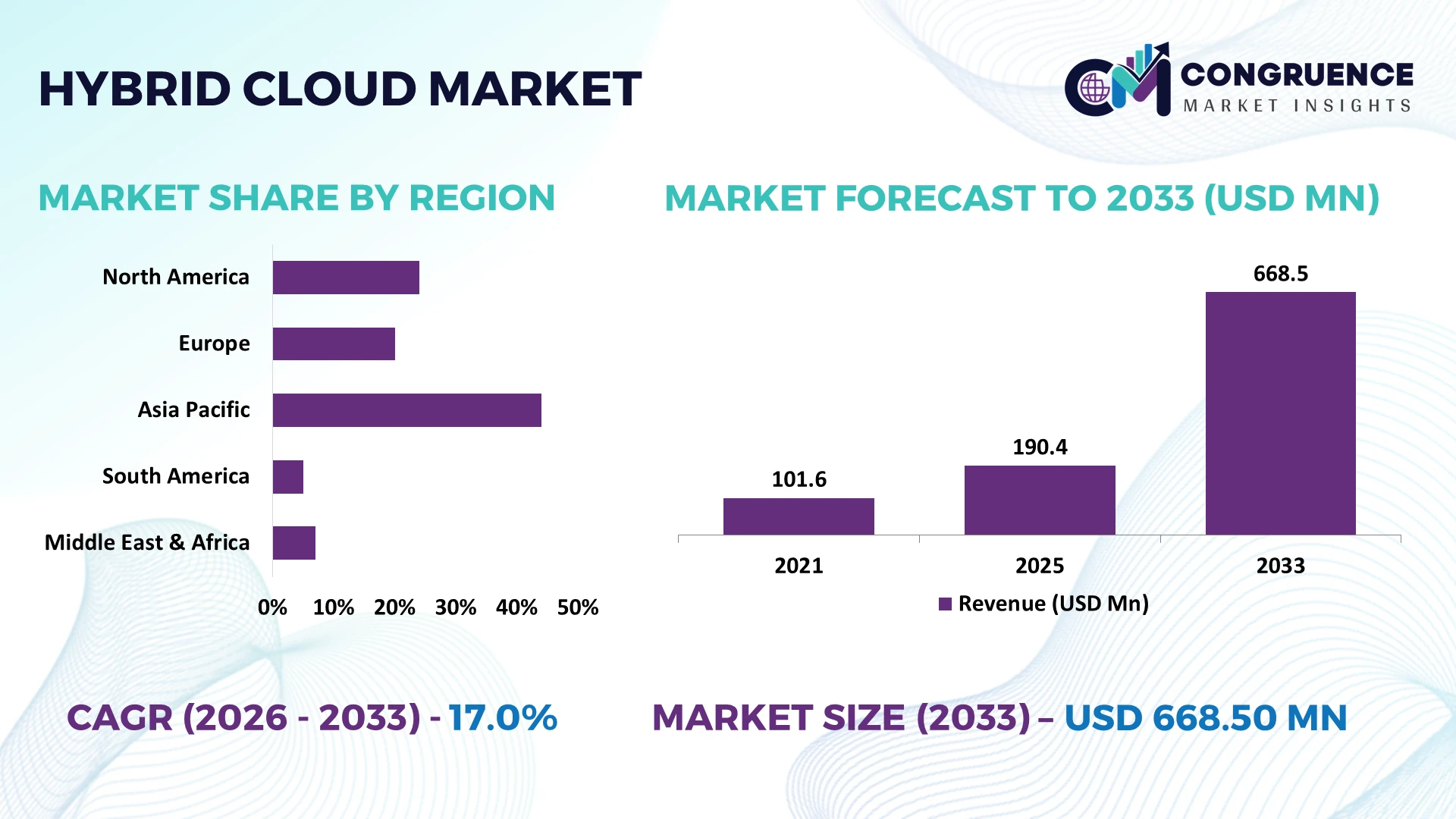
The United States leads the global hybrid cloud market with approximately 36% of total deployment capacity, supported by hyperscale infrastructure investments exceeding USD 75 billion and strong adoption across BFSI, healthcare, manufacturing, and government sectors. In comparison, Germany is advancing through sovereign cloud initiatives, with enterprise hybrid cloud adoption surpassing 68% amid evolving European data governance requirements, highlighting stronger regulatory alignment than many emerging markets.
For market participants, prioritizing secure multi-cloud orchestration, regional data compliance, and AI-ready infrastructure remains essential to strengthen competitive positioning and capture long-term enterprise transformation opportunities.
Market Size & Growth: USD 190.4 Million in 2025, reaching USD 668.5 Million by 2033 at a 17% CAGR, driven by enterprise AI deployment and hybrid IT modernization.
Top Growth Drivers: AI-enabled workload expansion (+34%), data sovereignty initiatives (+29%), and cybersecurity investments (+27%) continue accelerating global adoption.
Short-Term Forecast: By 2028, hybrid cloud management platforms improve infrastructure utilization by 31% while reducing operational costs by nearly 24%.
Emerging Technologies: AI orchestration, Kubernetes automation, confidential computing, and edge-cloud integration improve deployment efficiency by over 30%.
Regional Leaders: North America approaches USD 245 Million, Europe USD 170 Million, and Asia-Pacific USD 165 Million by 2033, supported by digital infrastructure expansion and sovereign cloud adoption.
Consumer/End-User Trends: More than 72% of large enterprises prioritize hybrid cloud for mission-critical workloads requiring security and operational flexibility.
Pilot/Case Example: In 2026, a multinational manufacturing deployment reduced application downtime by 38% through AI-driven hybrid cloud resource optimization.
Competitive Landscape: Top providers collectively control about 55% of the market, led by Microsoft, Amazon Web Services, Google Cloud, IBM, and Oracle.
Regulatory & ESG Impact: Energy-efficient data center strategies lower infrastructure emissions by approximately 18% while strengthening compliance with evolving digital regulations.
Investment & Funding: More than USD 40 billion supports cloud infrastructure expansion, strategic partnerships, and AI-ready platform development amid global supply chain diversification.
Innovation & Future Outlook: Agentic AI, cloud-native security, and autonomous workload optimization reshape enterprise IT strategies with stronger regional infrastructure localization.
Hybrid cloud adoption continues expanding across financial services, healthcare, manufacturing, and public sector organizations seeking secure workload portability and AI-ready infrastructure. Advanced container platforms, intelligent automation, and zero-trust security frameworks improve operational efficiency by nearly 30% while simplifying multi-environment management. Growing data localization policies and resilient digital infrastructure investments are reinforcing regional deployment strategies, setting the foundation for the following strategic market assessment.
Hybrid cloud has become a strategic enterprise platform as organizations balance performance, security, compliance, and AI-driven innovation across distributed IT environments. Infrastructure modernization and tightening data sovereignty regulations are accelerating adoption, particularly in sectors handling sensitive workloads such as financial services, healthcare, manufacturing, and government. The restructuring of digital infrastructure following global supply-chain disruptions is also encouraging organizations to diversify computing resources across public and private environments, improving operational resilience while reducing dependence on a single provider.
Modern containerized hybrid cloud platforms deliver approximately 35% faster application deployment and reduce infrastructure management costs by nearly 25% compared with legacy on-premise architectures. The United States continues leading large-scale enterprise deployments through hyperscale ecosystems, while Japan emphasizes hybrid cloud for industrial automation and smart manufacturing with stronger edge computing integration. Over the next two to three years, enterprise AI workload deployment across hybrid environments is expected to exceed 70% among large organizations, supported by increasing automation and unified cloud management platforms.
Manufacturers and financial institutions are expanding hybrid cloud deployments to integrate AI analytics, disaster recovery, and real-time operations while forming strategic partnerships with cloud infrastructure and cybersecurity providers. Companies are prioritizing localized data centers, cloud-native applications, and energy-efficient infrastructure to strengthen compliance and operational continuity. Organizations building interoperable, secure, and AI-ready hybrid ecosystems will secure stronger competitive positioning and long-term digital resilience.
Enterprise adoption of AI, advanced analytics, and cloud-native applications remains the primary structural driver for hybrid cloud deployment. More than 72% of large enterprises now operate multi-environment workloads, while AI-enabled infrastructure management improves resource utilization by approximately 30% and reduces application downtime by nearly 28%. Germany's expanding sovereign cloud initiatives and the United States' continued hyperscale infrastructure investments are accelerating enterprise migration toward secure hybrid architectures. This transformation enables organizations to balance regulatory compliance with operational flexibility. Leading technology providers are responding through regional data center expansion, AI platform integration, and strategic cybersecurity partnerships, creating differentiated service portfolios that improve workload resilience and strengthen long-term enterprise competitiveness.
Hybrid cloud implementation continues to face structural barriers from fragmented infrastructure, interoperability constraints, and rising operational costs. Nearly 46% of enterprises report integration complexity across multiple cloud platforms, while migration and application modernization projects increase implementation expenses by roughly 22%. Data localization requirements in countries such as India and France further complicate cross-border workload management and infrastructure planning. These challenges directly affect deployment speed, IT efficiency, and enterprise scalability. Organizations are reducing operational exposure through standardized cloud architectures, vendor-neutral orchestration platforms, localized infrastructure investments, and long-term service agreements that improve compatibility while limiting dependence on individual technology ecosystems.
The strongest opportunity lies in combining hybrid cloud with edge computing, autonomous operations, and sovereign cloud infrastructure. AI-enabled workload automation improves infrastructure efficiency by approximately 33%, while intelligent resource scheduling lowers energy consumption by nearly 18%. Saudi Arabia and Singapore continue expanding national digital infrastructure programs that encourage localized cloud deployment and advanced industrial digitization. Companies are increasing investment in cloud-native software, edge data processing, and industry-specific AI platforms to support manufacturing, healthcare, and smart city initiatives. Strategic ecosystem partnerships between infrastructure providers, software developers, and telecom operators are unlocking new enterprise service models with higher operational efficiency and stronger regulatory alignment.
Maintaining consistent governance across expanding hybrid and multi-cloud environments remains the industry's most significant execution challenge. Approximately 58% of enterprises identify cybersecurity skill shortages as a major operational constraint, while complex identity management increases security administration workloads by nearly 27%. The rapid expansion of AI-enabled applications is intensifying infrastructure monitoring requirements, particularly across large enterprise environments in the United States and the United Kingdom. Without standardized governance frameworks, organizations risk inconsistent security policies, delayed deployments, and reduced operational resilience. Companies are addressing these issues through zero-trust architectures, AI-assisted security operations, workforce development, and unified cloud management platforms that improve visibility, automate compliance, and strengthen long-term infrastructure sustainability.
• AI-Native Cloud Operations Enterprise IT teams are embedding AI into hybrid cloud management, with automated workload orchestration improving resource utilization by approximately 32% and reducing incident response times by nearly 38%. More than 65% of large enterprises are deploying AI-assisted monitoring platforms. Companies are expanding automation partnerships and integrating predictive operations to address growing infrastructure complexity while improving service continuity amid increasing enterprise AI adoption.
• Sovereign Cloud Deployment Expansion Data sovereignty regulations and national digital infrastructure programs are accelerating localized hybrid cloud deployment. Enterprise demand for region-specific cloud environments has increased by roughly 28%, while localized data processing improves regulatory compliance by about 24%. Germany and India are strengthening domestic cloud ecosystems, prompting providers to establish regional data centers, expand local partnerships, and redesign deployment architectures for compliance-driven operations rather than centralized infrastructure.
• Edge-Integrated Enterprise Workloads Manufacturing, logistics, and telecommunications organizations are combining edge computing with hybrid cloud to support real-time operations. Edge-enabled deployments reduce application latency by approximately 42% while improving operational efficiency by nearly 27%. Companies are restructuring application architectures and expanding edge infrastructure to process critical workloads closer to operational sites, reducing network dependency and strengthening business continuity for industrial environments.
• Sustainability-Driven Infrastructure Optimization Energy efficiency has become a procurement priority as enterprises optimize hybrid cloud infrastructure. Intelligent workload placement lowers power consumption by approximately 18%, while server utilization improves by nearly 26% through dynamic resource allocation. Cloud providers are modernizing data centers, deploying liquid cooling technologies, and adopting renewable energy agreements, enabling organizations to reduce operating costs while meeting evolving corporate sustainability and compliance objectives.
Infrastructure as a Service (IaaS) remains the dominant segment, accounting for approximately 41% of hybrid cloud deployments because of its scalability, infrastructure flexibility, and efficient workload migration capabilities. Enterprises continue prioritizing IaaS to modernize legacy applications while maintaining security and operational control across distributed environments. Software as a Service (SaaS) retains strong adoption for enterprise productivity and collaboration, while Hybrid Hosting remains strategically important for organizations requiring dedicated environments alongside public cloud integration.
Platform as a Service (PaaS) is the fastest-growing segment as cloud-native application development and AI integration accelerate enterprise software modernization. More than 62% of development teams now utilize container-based platforms, while application deployment cycles have shortened by nearly 35% through automated development pipelines. Technology vendors are strengthening platform ecosystems through Kubernetes integration, developer tools, and strategic alliances, shifting investment toward application modernization and intelligent automation while expanding enterprise digital transformation capabilities.
Data Backup & Recovery represents the largest application segment with an estimated 34% share, supported by rising cybersecurity investments, business continuity priorities, and expanding enterprise data volumes. Organizations increasingly rely on hybrid cloud to secure distributed workloads while maintaining rapid recovery capabilities. Disaster Recovery continues gaining importance for mission-critical operations, whereas Cloud Bursting supports seasonal computing demand and Application Development remains central to digital product delivery.
Big Data Analytics is the fastest-growing application as enterprises integrate AI-driven insights into operational decision-making. More than 68% of large organizations are processing analytics workloads across hybrid environments, improving processing efficiency by approximately 30%. Businesses are expanding cloud automation, integrating real-time analytics platforms, and strengthening workload portability to improve decision speed and infrastructure performance. These evolving deployment models are making hybrid cloud an operational foundation for enterprise intelligence and resilient business operations.
BFSI remains the leading end-user segment with approximately 29% of total hybrid cloud adoption, driven by strict regulatory requirements, high transaction volumes, and continuous demand for secure digital banking services. Financial institutions prioritize hybrid environments to balance data security with scalable customer-facing applications. Government and IT & Telecommunications maintain strong deployment activity through national digital transformation initiatives and expanding communications infrastructure, while Manufacturing increasingly integrates hybrid cloud into connected production systems.
Healthcare is the fastest-growing end-user segment as digital health platforms, AI-assisted diagnostics, and electronic medical records increase infrastructure requirements. Nearly 64% of healthcare organizations are expanding hybrid cloud deployments, improving clinical data accessibility by approximately 26%. Cloud providers are responding through healthcare-specific security frameworks, compliance-focused platforms, and strategic partnerships with hospitals and health technology firms. Competitive differentiation is increasingly driven by industry-specific solutions, localized deployment capabilities, and integrated cybersecurity services tailored to complex enterprise environments.
North America accounted for the largest market share at 38% in 2025 however, Asia-Pacific is expected to register the fastest growth, expanding at a 19.4% between 2026 and 2033.
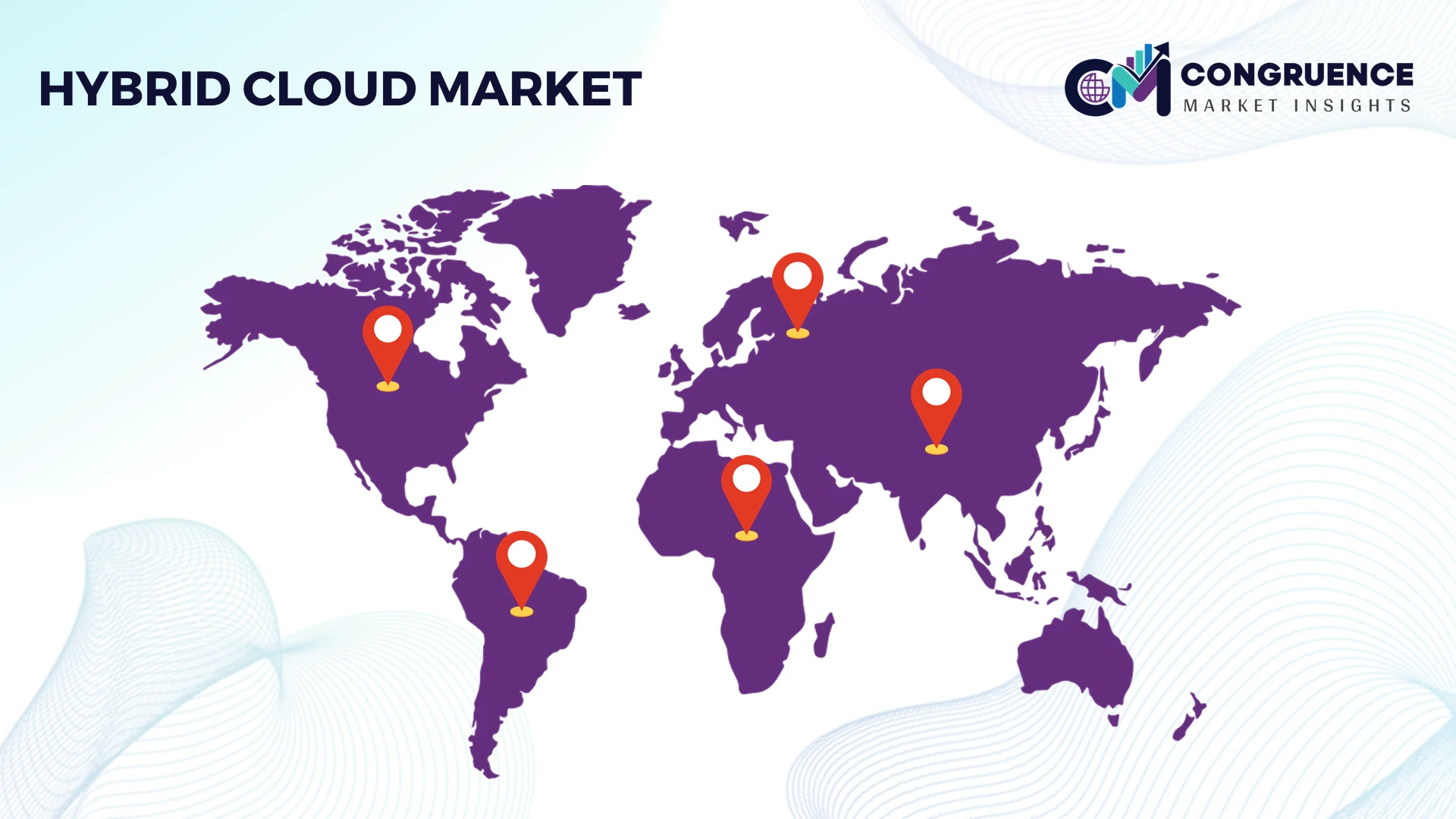
Enterprise AI Infrastructure Driving Hybrid Cloud Leadership
North America maintains the largest share of the hybrid cloud market through mature hyperscale infrastructure, enterprise AI adoption, and advanced cybersecurity capabilities. The region contributes approximately 38% of global deployments, supported by extensive digital transformation across BFSI, healthcare, manufacturing, and government sectors. More than 74% of large enterprises operate hybrid cloud environments to balance regulatory compliance with scalable computing resources. Continued investments in AI-ready data centers and cloud-native platforms are accelerating workload modernization, while strategic partnerships between cloud providers and cybersecurity firms strengthen operational resilience. Infrastructure expansion, edge computing integration, and automated cloud management continue improving deployment efficiency, enabling enterprises to optimize performance while maintaining business continuity across distributed environments.
United States Market Outlook: The United States remains the strategic center of the hybrid cloud market because of its concentration of hyperscale data centers, enterprise software innovation, and AI infrastructure investments. Approximately 78% of Fortune 500 organizations operate hybrid cloud environments supporting mission-critical workloads. Financial institutions, healthcare providers, and federal agencies continue modernizing legacy systems through cloud-native platforms, while technology companies expand regional infrastructure and security partnerships to strengthen workload resilience and regulatory compliance.
Sovereign Cloud and Compliance Reshaping Enterprise Deployment
Europe continues strengthening hybrid cloud deployment through digital sovereignty initiatives, strict data governance frameworks, and enterprise modernization programs. The region represents approximately 27% of global market activity, with regulated industries prioritizing secure multi-cloud environments for sensitive workloads. More than 67% of medium and large enterprises have integrated hybrid cloud into core operations. Investment in localized data centers and energy-efficient infrastructure is accelerating operational resilience while supporting evolving digital regulations. Cloud providers are expanding sovereign cloud capabilities and compliance-focused services, enabling enterprises to maintain secure cross-border operations without compromising regulatory obligations or application performance.
Germany Market Outlook: Germany leads the European market through strong industrial digitization, manufacturing automation, and sovereign cloud implementation. Enterprise hybrid cloud adoption exceeds 68%, particularly across automotive, industrial engineering, and financial services. Organizations continue investing in localized cloud infrastructure, industrial AI platforms, and cybersecurity technologies while technology providers expand regional cloud ecosystems aligned with stringent national and European data governance requirements.
Digital Infrastructure Expansion Accelerates Enterprise Adoption
Asia-Pacific is emerging as the fastest-expanding hybrid cloud market through rapid enterprise digitalization, AI deployment, and large-scale infrastructure investment. The region accounts for approximately 24% of global deployments while maintaining the highest pace of enterprise cloud modernization. More than 64% of large organizations are adopting hybrid architectures to support manufacturing, telecommunications, retail, and financial services. Governments continue investing in advanced digital infrastructure, encouraging localized cloud deployment and industrial automation. Cloud providers are expanding regional data centers, AI services, and edge computing capabilities to improve workload performance while supporting growing enterprise demand for scalable computing environments.
China Market Outlook: China remains the region's largest operational market due to extensive digital infrastructure, industrial cloud adoption, and advanced manufacturing transformation. Enterprise cloud utilization continues expanding across electronics, e-commerce, and financial technology sectors, with hybrid cloud deployment exceeding 66% among major enterprises. Domestic technology firms are strengthening cloud ecosystems through AI integration, localized infrastructure, and intelligent manufacturing platforms that improve industrial productivity and digital resilience.
Enterprise Modernization Strengthens Regional Demand
South America is steadily expanding hybrid cloud deployment as organizations modernize enterprise infrastructure and improve digital service delivery. The region contributes approximately 6% of global market activity, led by financial institutions, telecommunications providers, and retail enterprises. Enterprise adoption has increased by nearly 24% as organizations seek secure workload management and improved disaster recovery capabilities. Infrastructure limitations remain in selected markets, yet continued investment in regional data centers and managed cloud services is improving deployment consistency. Technology providers are expanding partnerships with telecommunications companies and enterprise software vendors to improve cloud accessibility and operational performance.
Brazil Market Outlook: Brazil represents the region's strongest hybrid cloud market through expanding enterprise digitization and growing investment in cloud infrastructure. Banking, retail, and public sector organizations continue migrating mission-critical applications to hybrid environments. More than 60% of large enterprises have implemented hybrid cloud strategies, while technology providers continue expanding regional cloud availability and cybersecurity capabilities to support increasing digital transformation initiatives.
National Digital Transformation Accelerates Cloud Investment
The Middle East & Africa market is progressing through national digital transformation programs, smart city initiatives, and enterprise infrastructure modernization. The region contributes approximately 5% of global hybrid cloud deployment, supported by growing investments in government services, energy, financial services, and telecommunications. Enterprise cloud adoption has increased by nearly 26% as organizations prioritize secure digital infrastructure and operational resilience. Cloud providers are establishing new regional facilities, expanding managed services, and strengthening cybersecurity capabilities to support localized deployment while improving compliance with national digital strategies.
Saudi Arabia Market Outlook: Saudi Arabia leads regional hybrid cloud expansion through Vision 2030 digital transformation initiatives and significant investment in cloud infrastructure. Enterprise adoption continues accelerating across government, energy, healthcare, and financial sectors, with cloud deployment increasing by approximately 31% over recent years. Global technology providers are partnering with domestic organizations to establish localized cloud services, AI platforms, and secure digital ecosystems supporting long-term enterprise modernization.
The hybrid cloud market is led by Microsoft, Amazon Web Services, Google Cloud, IBM, and Oracle, while VMware and regional cloud providers compete through specialized enterprise solutions and localized infrastructure. Global hyperscale providers compete on AI integration, cloud-native services, and platform breadth, whereas regional providers differentiate through compliance, data residency, and customized managed services. The top five companies collectively hold approximately 56% of the market. Competition increasingly centers on AI-enabled automation, where intelligent resource management improves operational efficiency by nearly 30%, while cloud-native deployment reduces application delivery time by approximately 35%. Strategic partnerships with cybersecurity firms, telecom operators, and enterprise software vendors continue expanding service portfolios. Infrastructure localization and sovereign cloud capabilities have become decisive competitive differentiators as regulatory requirements intensify. High capital requirements, advanced security capabilities, and hyperscale infrastructure remain significant entry barriers. Sustained success depends on delivering secure AI-ready platforms, localized infrastructure, operational reliability, and seamless multi-cloud interoperability.
Microsoft
Amazon Web Services (AWS)
Google Cloud
IBM
Oracle
VMware
Hewlett Packard Enterprise (HPE)
Dell Technologies
Cisco Systems
Nutanix
Alibaba Cloud
Fujitsu
Rackspace Technology
Tencent Cloud
Hybrid cloud technology is evolving around AI-driven orchestration, Kubernetes containerization, software-defined networking, and zero-trust security frameworks. More than 72% of large enterprises now deploy containerized workloads across hybrid environments, while AI-assisted resource scheduling improves infrastructure utilization by approximately 31% and reduces manual operations by nearly 26%. Unified observability platforms further enhance workload visibility, enabling faster fault detection and stronger operational continuity across distributed cloud ecosystems.
Emerging technologies include confidential computing, edge-cloud integration, platform engineering, and intelligent FinOps solutions. Edge-integrated hybrid architectures reduce application latency by nearly 42%, while confidential computing improves protected workload performance by approximately 18% for regulated industries. Compared with legacy virtual machine-centric infrastructure, cloud-native container platforms shorten application deployment cycles by about 35% and improve workload portability by nearly 40%. Financial services, healthcare, and manufacturing organizations gain the greatest competitive advantage through secure AI-enabled automation and real-time analytics.
Between 2026 and 2028, agentic AI, autonomous infrastructure management, and composable cloud platforms will redefine enterprise operations. Hybrid cloud adoption is expected to exceed 78% among large enterprises deploying AI-intensive applications, with automated policy management reducing compliance administration by approximately 24%. Organizations investing now in interoperable, AI-ready hybrid architectures will strengthen operational resilience, accelerate software delivery, and achieve sustainable competitive differentiation as cloud ecosystems become increasingly distributed and intelligent.
March 2024 Microsoft and Oracle expanded Oracle Database@Azure from existing regions by announcing five additional cloud regions, targeting 15 planned regions globally. The expansion strengthens multicloud deployment flexibility and lowers application latency for enterprise workloads.
September 2024 Oracle introduced enhanced Oracle Database@Azure capabilities with deeper Microsoft data and AI integration, enabling low-latency multicloud database services across Azure data centers. The update improves enterprise AI readiness and streamlines hybrid cloud application modernization. Source: Microsoft Azure
May 2026 IBM and Oracle expanded their 40-year partnership to accelerate AI and hybrid cloud modernization through integrated consulting and enterprise technology services. The initiative strengthens customer deployment flexibility and supports larger-scale AI integration across complex hybrid environments. Source: IBM Newsroom
July 2026 Databricks expanded its long-term partnership with Microsoft, increasing Azure deployment while serving more than 20,000 organizations, including about 70% of Fortune 500 companies. The collaboration strengthens enterprise AI, analytics, and hybrid cloud infrastructure capabilities. Source: Reuters
This report delivers a comprehensive assessment of the hybrid cloud market across Infrastructure as a Service (IaaS), Platform as a Service (PaaS), Software as a Service (SaaS), and Hybrid Hosting. It evaluates major applications including Data Backup & Recovery, Application Development, Disaster Recovery, Big Data Analytics, and Cloud Bursting, alongside demand across BFSI, Healthcare, IT & Telecommunications, Government, and Manufacturing. The analysis covers North America, Europe, Asia-Pacific, South America, and the Middle East & Africa, representing more than 95% of enterprise hybrid cloud deployment activity.
The report examines technology adoption patterns, enterprise deployment strategies, AI-enabled cloud operations, edge integration, cybersecurity evolution, and cloud-native modernization trends between 2026 and 2033. It provides competitive benchmarking across leading technology providers, deployment models, and regional investment priorities while highlighting operational efficiency improvements, enterprise adoption levels exceeding 70% in large organizations, and emerging opportunities supporting expansion planning, infrastructure optimization, market entry strategies, and long-term competitive positioning.
| Report Attribute/Metric | Report Details |
|---|---|
Market Revenue in 2025 | USD 190.4 Million |
Market Revenue in 2033 | USD 668.5 Million |
CAGR (2026 - 2033) | 17% |
Base Year | 2025 |
Forecast Period | 2026 - 2033 |
Historic Period | 2021 - 2025 |
Segments Covered | By Type
By Application
By End-User
|
Key Report Deliverable | Revenue Forecast, Growth Trends, Market Dynamics, Segmental Overview, Regional and Country-wise Analysis, Competition Landscape |
Region Covered | North America, Europe, Asia-Pacific, South America, Middle East, Africa |
Key Players Analyzed | Microsoft, Amazon Web Services (AWS), Google Cloud, IBM, Oracle, VMware, Hewlett Packard Enterprise (HPE), Dell Technologies, Cisco Systems, Nutanix, Alibaba Cloud, Fujitsu, Rackspace Technology, Tencent Cloud |
Customization & Pricing | Available on Request (10% Customization is Free) |




