
Reports
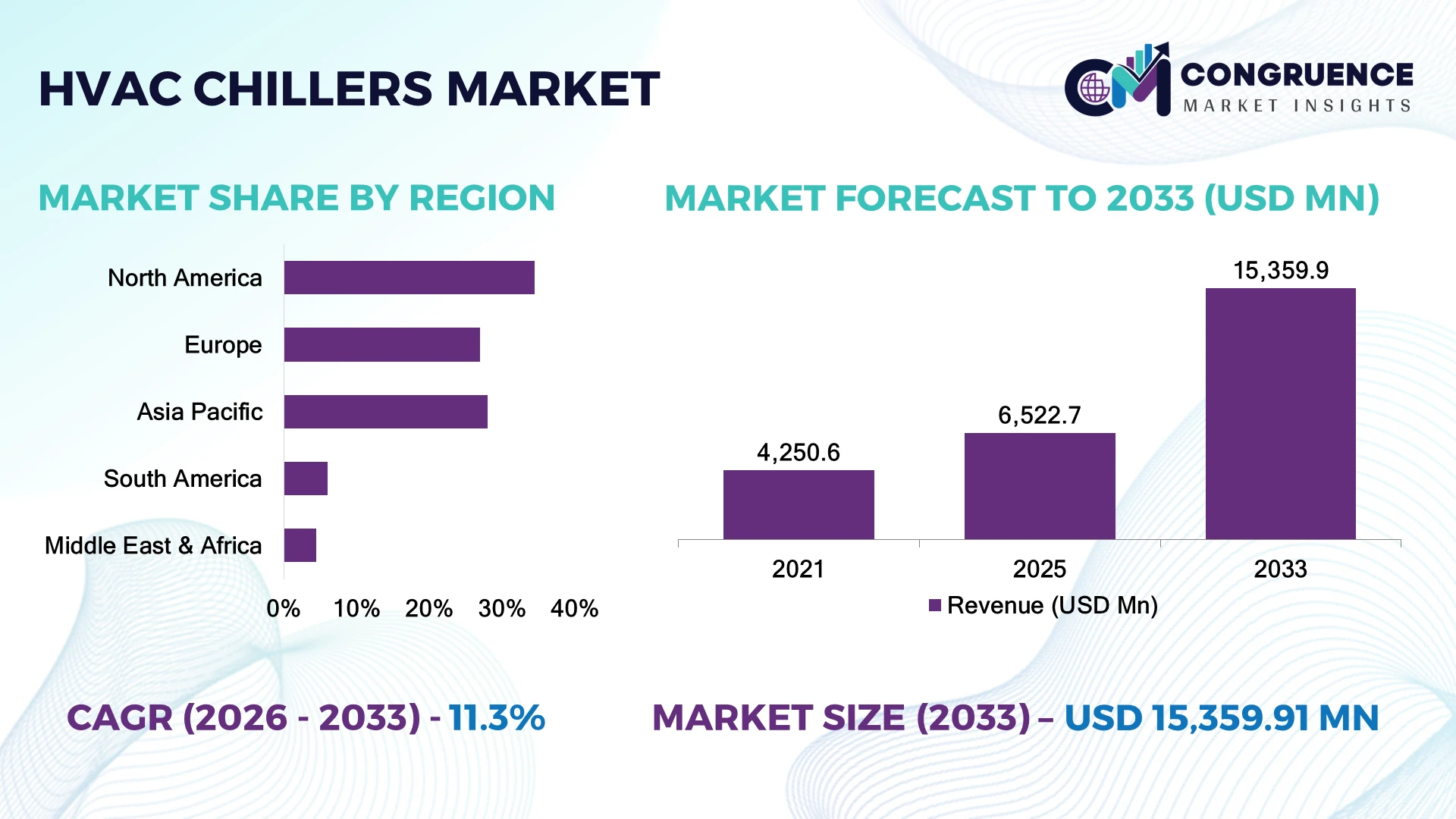
The Global HVAC Chillers Market was valued at USD 6,522.7 Million in 2025 and is anticipated to reach a value of USD 15,359.9 Million by 2033 expanding at a CAGR of 11.3% between 2026 and 2033. Growth is driven by AI data-center cooling, high-efficiency centrifugal and magnetic-bearing chillers, commercial building modernization, district cooling, and tighter energy-performance requirements.
The United States remains a dominant high-value market, supported by hyperscale data centers, commercial buildings, healthcare, and advanced manufacturing, while India is rapidly strengthening its industrial position. In May 2026, Carrier committed USD 100 million to a new Sri City manufacturing facility targeting high-capacity chillers above 1,500 TR, alongside 15 testing and R&D laboratories. India is therefore shifting from a demand market toward a manufacturing and export base, while U.S. projects remain more concentrated in mission-critical cooling.
Chiller investment is moving toward high-capacity, digitally connected, low-energy platforms, making manufacturing localization and data-center cooling capability decisive competitive priorities.
The HVAC chillers market is increasingly concentrated around water-cooled and air-cooled centrifugal systems, magnetic-bearing chillers, screw compressors, modular platforms, district cooling, and digitally connected building systems. Data centers are becoming a particularly important demand center as AI workloads raise thermal densities. High-efficiency equipment can deliver 10–20% operational energy improvements in suitable applications, while localized manufacturing is strengthening supply resilience. India's 2026 expansion of high-capacity chiller manufacturing illustrates the shift toward regional production and export-oriented HVAC supply chains.
HVAC chillers are becoming strategic infrastructure rather than conventional building equipment because cooling performance increasingly determines data-center uptime, pharmaceutical production continuity, industrial productivity, and commercial-building energy intensity. The strongest market shift is toward high-capacity systems engineered for AI infrastructure, where thermal loads are rising faster than conventional building requirements. This is pushing manufacturers toward magnetic-bearing compressors, advanced controls, low-GWP refrigerants, and integrated thermal-management architectures.
Technology selection is increasingly based on lifecycle performance rather than purchase price. Magnetic-bearing centrifugal systems eliminate conventional oil-management requirements and can improve part-load efficiency by roughly 10–20% in suitable applications. Water-cooled systems remain important for large centralized loads, while air-cooled platforms gain relevance where water availability and site infrastructure constrain deployment. India is emerging as a manufacturing hub, while the U.S. remains highly concentrated in data-center and mission-critical cooling.
Over the next 2–3 years, connected chillers, predictive diagnostics, automated sequencing, and AI-assisted optimization will increasingly become standard specifications for large projects. Carrier's 2026 Sri City investment demonstrates the shift toward localized high-capacity manufacturing, with more than 1,500-TR equipment and dedicated testing infrastructure. Competitive advantage will increasingly depend on combining thermal efficiency, digital controls, reliable service, and manufacturing proximity into one lifecycle proposition.
AI data centers are increasing cooling loads and accelerating procurement of high-capacity chillers, particularly in the United States. High-density computing environments can allocate 30–40% of facility electricity consumption to cooling, making chiller efficiency a direct operating-cost lever. Variable-speed compressors and advanced sequencing can improve part-load efficiency by approximately 10–20%. The rapid expansion of AI infrastructure is also increasing demand for redundant chilled-water systems and modular cooling capacity. Manufacturers are responding with high-capacity centrifugal platforms, liquid-cooling integration, predictive controls, and localized production. The strategic shift is significant: chiller suppliers that can support high thermal density, rapid commissioning, and 24/7 reliability are gaining preference over suppliers competing primarily on equipment purchase price.
Large chiller installations face competing energy and water requirements, particularly in regions with expensive electricity or restricted water availability. Cooling systems can account for approximately 30–40% of data-center electricity consumption, while cooling-tower water requirements can materially increase operating complexity. Water-cooled systems generally provide strong efficiency at scale, but dependence on cooling-tower infrastructure creates additional permitting and water-management requirements. In India and the Middle East, site-level water availability is increasingly influencing equipment selection. Manufacturers are responding with hybrid cooling, air-cooled alternatives, variable-speed drives, and water-treatment optimization. The key commercial pressure is lifecycle economics: equipment with a lower purchase price can become less competitive when energy, water, maintenance, and compliance costs are included over the operating life.
Oil-free magnetic-bearing compressors are creating a premium opportunity where continuous operation and part-load efficiency justify higher technology content. Magnetic-bearing systems can improve part-load efficiency by approximately 10–20% and eliminate conventional compressor-oil management requirements, reducing selected maintenance interventions by 15–25%. Data-center operators and pharmaceutical manufacturers are particularly suited to these systems because uptime and thermal stability carry higher economic value than initial equipment cost alone. In the United States, Europe, and advanced Asian manufacturing hubs, suppliers are expanding magnetic-bearing portfolios and integrating AI-based diagnostics. A less obvious opportunity lies in retrofit applications: replacing aging fixed-speed chillers with variable-speed and oil-free systems can improve plant efficiency without requiring complete cooling-infrastructure replacement.
Modern chiller plants increasingly combine variable-speed drives, building-management systems, predictive analytics, thermal storage, pumps, cooling towers, and electrical controls. Integration errors can extend commissioning schedules by approximately 10–20%, while inconsistent sensor calibration can create 5–10% deviations in control performance. Cybersecurity is also becoming material as remotely connected chillers exchange operational data with centralized building platforms. Large U.S. data centers are therefore demanding standardized communication protocols, redundant controls, and cybersecurity validation before commissioning. Manufacturers must invest in interoperable software, digital commissioning tools, technician training, and predictive maintenance infrastructure. The non-obvious risk is that higher automation does not automatically deliver higher efficiency: poorly coordinated plant sequencing can offset equipment-level gains, making controls engineering as important as compressor technology.
AI Cooling Changes Specifications: Data-center operators are increasingly specifying chillers around high-density AI workloads rather than conventional building loads. Cooling can represent approximately 30–40% of data-center electricity consumption, while advanced controls can improve part-load efficiency by 10–20%. Manufacturers are responding with higher-capacity centrifugal systems, redundant architectures, and controls designed for rapidly changing thermal loads.
Refrigerant Transition Reshapes Portfolios: Low-GWP refrigerants are becoming a stronger equipment-selection criterion as regulatory requirements tighten across major markets. Refrigerant transitions can affect approximately 10–20% of equipment design and servicing considerations through compressor, heat-exchanger, and safety changes. Manufacturers are redesigning product families, retraining service networks, and increasing refrigerant-management capabilities to maintain compliance without disrupting installed-base operations.
Localized Manufacturing Gains Importance: Chiller producers are increasing regional manufacturing and testing capacity as long equipment lead times expose large projects to schedule risk. Localized production can reduce selected delivery timelines by approximately 15–30% and improve access to replacement components. India's growing high-capacity manufacturing base illustrates this shift, while global suppliers are expanding regional sourcing and service partnerships to reduce supply-chain dependency.
Predictive Service Becomes Commercial Lever: Connected chillers are shifting maintenance from scheduled intervention toward condition-based servicing, with sensor-driven diagnostics capable of reducing selected unplanned interventions by approximately 20–30%. This is particularly valuable for hospitals, data centers, and pharmaceutical plants where cooling interruptions carry high operational costs. Manufacturers are responding with cloud-connected monitoring, remote diagnostics, automated fault detection, and lifecycle service contracts that extend beyond equipment sales.
Centrifugal chillers lead as high-capacity cooling intensifies
Centrifugal chillers represent the leading technology type, accounting for approximately 39% of global HVAC chiller demand, supported by high cooling capacity, strong efficiency at full and partial loads, and suitability for hospitals, data centers, district cooling, and large commercial complexes. Screw chillers follow at approximately 32%, providing greater flexibility across medium-capacity installations and industrial applications. Scroll chillers account for about 18%, remaining important for smaller commercial facilities, while absorption chillers represent roughly 11% and retain strategic relevance where waste heat or district-energy integration is available.
Magnetic-bearing centrifugal systems are the fastest-shifting technology within the premium segment, with adoption concentrated in mission-critical facilities seeking oil-free operation and improved part-load performance. Advanced systems can deliver approximately 10–20% better part-load efficiency than conventional fixed-speed configurations, while variable-speed designs reduce compressor energy consumption by roughly 15–25% under suitable loads. Manufacturers are expanding oil-free platforms, developing modular capacities, and partnering with data-center and district-cooling developers.
Commercial buildings remain dominant as mission-critical cooling accelerates
Commercial buildings represent the leading application, accounting for approximately 38% of global HVAC chiller demand, supported by offices, shopping centers, hotels, mixed-use developments, and large institutional buildings. Industrial facilities follow at approximately 27%, where process cooling and stable temperature control support manufacturing continuity. Data centers account for roughly 18% but represent the fastest-growing application, followed by healthcare at about 10% and other applications at approximately 7%. Traditional commercial installations remain volume-driven, while data centers increasingly prioritize redundancy, rapid load response, and continuous cooling availability.
Data-center chiller demand is expanding as AI workloads increase rack density and thermal requirements. Cooling infrastructure can represent approximately 30–40% of data-center electricity consumption, strengthening the business case for high-efficiency centrifugal systems, variable-speed drives, and integrated controls. Manufacturers are responding with modular chiller plants, liquid-cooling interfaces, predictive controls, and higher-capacity configurations. This is shifting investment from conventional building HVAC replacement toward mission-critical thermal infrastructure.
Commercial and institutional operators drive premium chiller procurement
Commercial and institutional facilities represent the leading end-user group, accounting for approximately 44% of global HVAC chiller demand because of extensive installed cooling capacity across offices, hospitals, hotels, universities, and mixed-use properties. Industrial users contribute approximately 31%, supported by manufacturing, pharmaceuticals, food processing, and other temperature-sensitive operations. Data-center operators account for around 15% but represent the fastest-growing buyer segment, while district-cooling and other specialized users contribute the remaining 10%.
Data-center operators increasingly prioritize reliability and lifecycle efficiency over lowest acquisition cost, with redundant cooling architectures and advanced controls becoming standard requirements. High-capacity users can target 10–20% improvements in part-load efficiency through variable-speed compression and optimized sequencing. Industrial buyers remain more focused on process stability and maintenance continuity. Manufacturers are therefore segmenting portfolios by thermal load, uptime requirements, refrigerant strategy, and service intensity, while expanding lifecycle contracts and predictive-maintenance offerings to strengthen customer retention.
North America accounted for the largest market share at approximately 34.5% in 2025 however, Asia-Pacific is expected to register the fastest growth, expanding at a CAGR of approximately 12.0% between 2026 and 2033.

AI infrastructure accelerates high-capacity cooling modernization
North America represents approximately 34.5% of global HVAC chiller demand, supported by data centers, healthcare facilities, advanced manufacturing, commercial real estate, and district-energy installations. The United States dominates regional deployment, with hyperscale data-center construction increasingly favoring high-capacity centrifugal chillers, redundant chilled-water plants, and liquid-cooling integration. Data-center cooling can represent approximately 30–40% of facility electricity consumption, strengthening investment in variable-speed compression and intelligent plant sequencing. Canada adds demand through data centers, institutional infrastructure, and industrial facilities. Manufacturers are expanding local production, service networks, and high-capacity testing capabilities to shorten project lead times. The region's key shift is toward mission-critical cooling specifications, where uptime, part-load efficiency, controls interoperability, and lifecycle service increasingly outweigh lowest upfront equipment cost.
United States Market Outlook: The United States remains the region's primary chiller market, driven by hyperscale data centers, semiconductor facilities, hospitals, pharmaceuticals, and commercial modernization. AI-oriented data-center projects increasingly require redundant cooling architectures and high-capacity chilled-water systems. Advanced plants targeting 10–20% better part-load efficiency are gaining preference, while manufacturers are expanding domestic production and service capacity to support faster deployment and reduce exposure to international equipment lead times.
Decarbonization reshapes commercial cooling specifications
Europe accounts for approximately 27% of global HVAC chiller demand, with Germany, the U.K., France, Italy, and Spain representing major installation centers. Energy-efficiency requirements, refrigerant transitions, building renovation, and industrial decarbonization are reshaping replacement demand. High-efficiency centrifugal and screw chillers increasingly incorporate variable-speed drives, heat recovery, and lower-GWP refrigerants. Germany's industrial base creates strong demand for process cooling, while the U.K. and France emphasize commercial and institutional modernization. Advanced chiller configurations can reduce cooling-related energy consumption by approximately 10–20% under suitable operating conditions. Manufacturers are therefore prioritizing compliant refrigerant platforms, retrofit packages, and digital service contracts rather than relying solely on new-build projects.
Germany Market Outlook: Germany provides Europe's strongest combination of industrial cooling demand, engineering expertise, and commercial-building modernization. Pharmaceuticals, chemicals, automotive manufacturing, data centers, and large institutional facilities require precise thermal management. Manufacturers are increasingly offering heat-recovery configurations, variable-speed compressors, and low-GWP refrigerant options. Energy-optimization projects targeting approximately 10–20% lower cooling energy consumption are strengthening replacement economics and supporting premium chiller adoption.
Data centers and industrialization drive capacity expansion
Asia-Pacific accounts for approximately 28% of global HVAC chiller demand and is the largest manufacturing and emerging deployment base, led by China, India, Japan, South Korea, and Southeast Asia. Rapid data-center construction, semiconductor investment, pharmaceuticals, electronics manufacturing, airports, and commercial infrastructure are increasing demand for high-capacity cooling. China provides substantial equipment manufacturing capacity, while India is expanding both domestic demand and export-oriented production. In 2026, major manufacturers are increasing local capabilities for large centrifugal chillers and advanced testing. Variable-speed systems and intelligent controls can improve plant efficiency by approximately 10–20%, making premium equipment increasingly attractive for energy-intensive facilities. Local manufacturing is also reducing lead-time and component-sourcing pressure.
China Market Outlook: China remains the region's largest manufacturing center for HVAC equipment, supported by extensive compressor, heat-exchanger, controls, and component supply chains. Large commercial developments, semiconductor facilities, electronics manufacturing, and data centers are sustaining demand for high-capacity chillers. Domestic manufacturers increasingly compete on integrated controls and cost efficiency, while advanced projects are adopting variable-speed systems capable of delivering approximately 10–20% improved part-load performance.
Industrial cooling and commercial modernization strengthen demand
South America represents approximately 6% of global HVAC chiller demand, with Brazil accounting for roughly 60% of regional installations. Demand is concentrated in São Paulo, Rio de Janeiro, Minas Gerais, and major industrial corridors serving pharmaceuticals, food processing, chemicals, shopping centers, hospitals, and commercial complexes. Brazil's large installed base creates replacement opportunities as operators modernize inefficient equipment and adopt variable-speed compressors. Advanced systems can reduce selected cooling energy consumption by approximately 10–20%, improving payback for high-utilization facilities. Economic volatility and imported-component exposure remain important procurement considerations. Manufacturers are responding through distributor partnerships, localized service networks, retrofit packages, and more standardized product configurations that reduce project complexity and maintenance requirements.
Brazil Market Outlook: Brazil is the region's primary chiller market because of its industrial base, large commercial-building stock, and concentration of healthcare and manufacturing facilities. São Paulo remains particularly important for large commercial and industrial cooling projects. Replacement demand is increasingly influenced by energy efficiency, with variable-speed systems targeting approximately 10–20% lower cooling energy use. Suppliers are strengthening local technical support and component availability to improve lifecycle service.
District cooling and mega-projects reshape premium demand
Middle East & Africa accounts for approximately 4.5% of global HVAC chiller demand, with Saudi Arabia, the UAE, Qatar, and South Africa representing major deployment centers. Gulf construction programs are driving large district-cooling plants, airports, hotels, hospitals, mixed-use developments, and data centers requiring high-capacity chilled-water infrastructure. District cooling can deliver approximately 20–40% better energy efficiency than decentralized cooling in suitable high-density applications. Saudi Arabia's large-scale urban developments and the UAE's commercial infrastructure are increasing demand for centrifugal chillers, thermal storage, and intelligent plant controls. Manufacturers are responding with water-efficient systems, modular equipment, local service partnerships, and high-efficiency platforms designed for extreme ambient temperatures.
Saudi Arabia Market Outlook: Saudi Arabia is the region's most strategically significant market because major urban-development and infrastructure programs require centralized cooling at substantial scale. District-cooling systems are increasingly deployed across mixed-use developments, hospitality projects, healthcare facilities, and large commercial districts. Suitable centralized configurations can improve cooling efficiency by approximately 20–40% compared with decentralized alternatives. Chiller suppliers are therefore prioritizing high-capacity centrifugal systems, thermal-storage integration, and local service capabilities.
Carrier, Trane Technologies, Johnson Controls, Daikin, and Mitsubishi Electric compete as OEM leaders, while regional manufacturers challenge them on price, customization, and delivery speed. The top five players hold approximately 35% of chiller demand globally. Competition centers on energy efficiency, digital controls, refrigerant compliance, manufacturing proximity, and lifecycle service. Premium magnetic-bearing platforms can improve part-load efficiency by 10–20%, while localized production can reduce selected equipment lead times by 15–30%. Companies are competing through data-center partnerships, regional factories, low-GWP product launches, retrofit programs, and integrated service contracts. The competitive shift is moving from standalone chillers toward thermal-management platforms connecting chillers, liquid cooling, controls, and analytics. Entry barriers remain high because certification, application engineering, service coverage, and installed-base relationships require investment. Cost-focused regional suppliers retain leverage in projects, but mission-critical buyers increasingly prioritize reliability and lifecycle economics. Winning requires high-efficiency equipment, rapid deployment, digital integration, localized support, and proven performance under demanding loads.
Magnetic-bearing centrifugal compression is becoming a priority for high-load facilities because oil-free operation improves part-load performance and reduces maintenance complexity. Advanced systems can deliver roughly 10–20% better part-load efficiency than conventional fixed-speed configurations. Adoption is strongest in data centers, hospitals, and premium commercial plants, where continuous operation makes energy and reliability gains commercially important. Variable-speed screw chillers remain important for medium-capacity applications, offering precise load matching and reducing compressor energy use under variable demand.
Low-GWP refrigerants, advanced heat exchangers, and adaptive controls are reshaping equipment design. New-generation systems can reduce selected lifecycle energy consumption by 10–20%, while optimized heat exchangers improve thermal transfer and compactness by approximately 5–10%. Compared with older fixed-speed, higher-GWP configurations, variable-speed low-GWP platforms provide better part-load efficiency and regulatory longevity. Carrier, Trane, Johnson Controls, and Daikin benefit because integrated portfolios allow them to combine equipment, controls, software, and service.
Between 2026 and 2028, AI-assisted plant sequencing, predictive diagnostics, liquid-cooling interfaces, and digital twins will move deeper into mission-critical deployments. Connected chillers can reduce selected unplanned service interventions by approximately 20–30%. Manufacturers with interoperable controls and localized service networks will gain an advantage as data-center operators demand faster commissioning, measurable efficiency, and resilient thermal management systems globally.
February 2026 Carrier introduced AquaEdge 30CF, an air-cooled centrifugal chiller for data centers, strengthening its QuantumLeap portfolio for AI-driven loads. The launch targets continuous cooling reliability and expands Carrier’s mission-critical thermal-management offering for rapidly scaling AI infrastructure. Source: carrier.comCarrier
March 2025 Johnson Controls expanded YORK YVAM magnetic-bearing chillers across Europe, delivering 40% lower annual power use at equivalent cooling capacity. The expansion strengthens deployment options for hyperscale facilities facing AI-driven thermal loads and stricter resource-efficiency requirements. Source: johnsoncontrols.comJohnson Controls
February 2026 Trane launched HSAG, its first Asia-Pacific air-cooled magnetic-bearing centrifugal chiller, delivering 10–20% improved IPLV versus traditional screw chillers. The platform targets hyperscale facilities in high-heat markets, strengthening Trane’s premium data-center cooling position across Asia-Pacific markets. Source: trane.comTrane
July 2026 Daikin and NTT DATA began an AI-driven data-center cooling proof of concept in Japan, integrating HVAC, chillers, and liquid cooling. The companies will validate server thermal prediction during FY2026, supporting planned commercialization in FY2027 for commercial deployment. Source: Daikin corporate release Daikin
The report covers water-cooled and air-cooled chillers across centrifugal, screw, scroll, absorption, and other configurations, with application analysis spanning commercial buildings, industrial facilities, data centers, healthcare, and district cooling. End-user coverage includes commercial operators, industrial enterprises, institutions, data-center operators, and specialized infrastructure owners, developers, and operators. Centrifugal chillers represent approximately 39% of demand, while data centers are the fastest-shifting application.
Regional analysis covers North America, Europe, Asia-Pacific, South America, and Middle East & Africa, with country-level assessment of manufacturing, deployment, infrastructure, and technology adoption. Technology coverage includes magnetic-bearing compression, variable-speed drives, low-GWP refrigerants, AI diagnostics, digital plant controls, thermal storage, and liquid-cooling integration. The report supports investment planning, manufacturing localization, market expansion, retrofit strategy, partnership development, competitive positioning, and technology prioritization through 2026–2033.
| Report Attribute/Metric | Report Details |
|---|---|
|
Market Revenue in 2025 |
USD 6,522.7 Million |
|
Market Revenue in 2033 |
USD 15,359.9 Million |
|
CAGR (2026 - 2033) |
11.3% |
|
Base Year |
2025 |
|
Forecast Period |
2026 - 2033 |
|
Historic Period |
2021 - 2025 |
|
Segments Covered |
By Type
By Application
By End-User
|
|
Key Report Deliverable |
Revenue Forecast, Growth Trends, Market Dynamics, Segmental Overview, Regional and Country-wise Analysis, Competition Landscape |
|
Region Covered |
North America, Europe, Asia-Pacific, South America, Middle East, Africa |
|
Key Players Analyzed |
Carrier Global Corporation, Trane Technologies plc, Johnson Controls International plc, Daikin Industries, Ltd., Mitsubishi Electric Corporation, LG Electronics, Midea Group, Dunham-Bush, Smardt Chiller Group, Multistack, Kirloskar Chillers, Blue Star Limited, Thermax Limited, Climaveneta |
|
Customization & Pricing |
Available on Request (10% Customization is Free) |




