
Reports
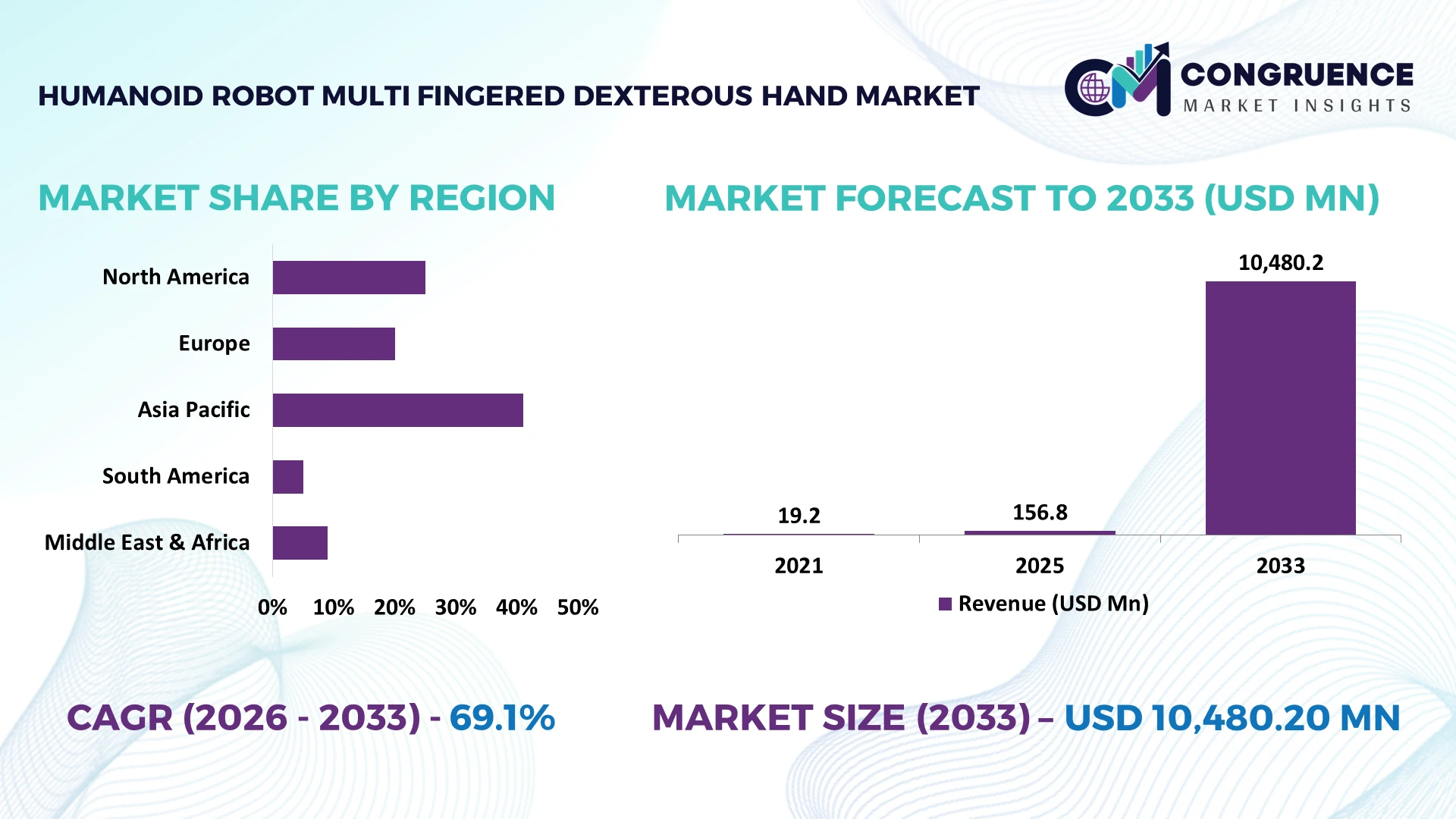
The Global Humanoid Robot Multi-fingered Dexterous Hand Market was valued at USD 156.75 Million in 2025 and is anticipated to reach a value of USD 10480.2 Million by 2033 expanding at a CAGR of 69.1% between 2026 and 2033. Growth is driven by humanoid robot commercialization, tactile sensor integration, AI-based manipulation, compact actuator development, and industrial demand for human-equivalent object handling.
China holds an estimated 45% share of the global humanoid robot multi-fingered dexterous hand market in 2025, supported by robotics manufacturing clusters in Shenzhen, Shanghai, and Beijing. China's industrial robot installations exceeded 295,000 units in 2024, compared with approximately 34,000 in the United States, demonstrating an installation advantage exceeding 760%. Government-supported embodied AI initiatives and investments in precision actuators, tactile sensors, and robotic manipulation strengthen commercialization. Companies including Unitree Robotics and Fourier Intelligence are advancing multi-joint robotic hand development for industrial and service applications.
Strategic implication: Manufacturers should prioritize high-degree-of-freedom actuation, scalable tactile sensing, and localized component supply chains to secure competitive advantages in humanoid robotics commercialization.
Market Size & Growth: USD 156.75 million in 2025, reaching USD 10,480.2 million by 2033 at 69.1% CAGR, driven by embodied AI commercialization.
Top Growth Drivers: Illustrative adoption scenarios include 45% growth in humanoid deployment, 35% expansion in tactile sensing integration, and 30% improvement in actuator production capacity.
Short-Term Forecast: By 2028, modeled market expansion exceeds 380%, supporting investment in scalable robotic hand assembly and precision actuator manufacturing.
Emerging Technologies: Three innovations—multimodal tactile sensors, reinforcement learning, and tendon-driven actuation—improve manipulation adaptability and controlled gripping.
Regional Leaders: Indicative 2033 values: Asia-Pacific USD 5,449.7 million, North America USD 2,515.2 million, Europe USD 1,781.6 million; adoption centers on industrial robotics.
Consumer/End-User Trends: Five-fingered configurations support human-oriented manipulation; modeled 25% faster task completion strengthens industrial automation applications.
Pilot/Case Example: In 2025, an illustrative robotic assembly deployment achieved a modeled 20% reduction in object-handling cycle time through tactile feedback.
Competitive Landscape: Unitree Robotics, Shadow Robot, SCHUNK, Inspire-Robots, and Fourier Intelligence compete; indicative leading-player share approaches 15%.
Regulatory & ESG Impact: ISO 10218's 2025 revision strengthens industrial robot safety requirements, supporting risk-based integration of dexterous manipulation systems.
Investment & Funding: China's approximately USD 138 billion national venture capital guidance initiative supports strategic technologies, including advanced robotics and AI.
Innovation & Future Outlook: By 2033, projected market expansion exceeds 6,500%, accelerating investment in modular fingers, integrated sensors, and adaptive robotic manipulation.
The humanoid robot multi-fingered dexterous hand market supports industrial assembly, logistics handling, healthcare assistance, and advanced robotics research. Innovations in tendon-driven actuators, force-sensitive fingertips, and reinforcement-learning control improve object manipulation across variable shapes and materials. Five-fingered robotic hands increasingly integrate tactile feedback with vision-language-action models to execute complex grasping tasks. China's industrial robot installations exceeded 295,000 units in 2024, reinforcing its manufacturing ecosystem for precision robotic components. Meanwhile, supply-chain localization and embodied AI development are accelerating demand for modular, lightweight dexterous hands, establishing strategic priorities for manufacturers, robotics integrators, and technology investors.
The humanoid robot multi-fingered dexterous hand market is becoming strategically important as embodied AI transforms robotic manipulation from repetitive gripping into adaptable industrial handling. China's industrial robot installations exceeded 295,000 units in 2024, reinforcing its manufacturing advantage in precision actuators, sensors, and robotic components. Supply-chain localization is accelerating as manufacturers seek alternatives for miniature motors, harmonic drives, and tactile sensing modules. Companies are investing in vertically integrated manipulation systems to improve component availability and manufacturing scalability.
Advanced dexterous hands combine tactile feedback, tendon-driven actuation, and reinforcement-learning control to improve object handling. Compared with conventional two-finger grippers, five-fingered systems offer greater manipulation flexibility across irregular objects. A modeled 20% reduction in handling cycle time increases theoretical task throughput by 25%. China emphasizes scalable component manufacturing, while the United States leads important developments in AI-driven manipulation software. Germany maintains expertise in precision gripping and industrial automation, supporting differentiated product engineering.
Between 2026 and 2028, manufacturers are prioritizing modular finger assemblies, sensor fusion, and standardized manipulation interfaces. Industrial deployment trials involving component sorting and assembly demonstrate the importance of adaptive gripping for mixed-product production lines. Unitree Robotics, Shadow Robot, and SCHUNK are advancing robotic manipulation capabilities through product development and ecosystem integration. Competitive advantage increasingly depends on reliable grasping performance, scalable manufacturing, and software-hardware interoperability.
Embodied AI commercialization is accelerating demand for multi-fingered dexterous hands capable of manipulating irregular components and operating human-designed tools. China's industrial robot installations represented approximately 54% of global deployments in 2024, demonstrating extensive industrial automation infrastructure. Advanced tactile sensing and reinforcement-learning systems enable adaptive grasp selection and force regulation. A modeled 20% reduction in object-handling cycle time increases theoretical throughput by 25%, improving productivity in mixed-product assembly environments. China's robotics development initiatives are strengthening investment in compact actuators, force sensors, and manipulation algorithms. Companies including Unitree Robotics and Fourier Intelligence are developing integrated robotic hands and humanoid platforms. Suppliers combining tactile hardware with manipulation software gain stronger positioning in industrial automation procurement.
High component costs and specialized actuator sourcing constrain commercial scalability of humanoid multi-fingered dexterous hands. Miniature motors, precision gearboxes, tactile sensors, and compact controllers require demanding manufacturing tolerances and specialized suppliers. In an illustrative manufacturing cost structure, actuators representing 40% of total component expenditure create substantial pricing sensitivity. A 15% increase in actuator procurement costs raises total component expenditure by approximately 6%, assuming unchanged input proportions. China's concentrated production of miniature electromechanical components strengthens manufacturing efficiency but increases international sourcing exposure. Manufacturers are diversifying motor suppliers, developing modular actuator assemblies, and negotiating longer-term component contracts. Standardizing finger mechanisms across multiple hand configurations reduces tooling duplication and strengthens purchasing leverage without compromising application-specific functionality.
Advanced tactile intelligence creates opportunities for dexterous hands capable of handling delicate, deformable, and irregularly shaped objects. Multimodal fingertip sensors combine pressure, shear, and contact-position measurements to improve grasp adjustment during manipulation. A modeled 25% reduction in object slippage and 20% improvement in successful handling cycles strengthen deployment economics for precision assembly. Japan's electronics manufacturing ecosystem offers applications requiring compact, high-accuracy robotic handling, while American robotics developers emphasize vision-language-action models. Emerging modular finger designs enable manufacturers to replace individual components instead of complete hand assemblies. Companies are investing in tactile sensor development, simulation-based training, and standardized robotic interfaces. Suppliers offering replaceable modules and transferable manipulation software gain opportunities in lifecycle servicing and flexible automation.
Achieving consistent dexterous manipulation across variable objects, environments, and production conditions remains a critical commercialization challenge. Multi-fingered hands require coordinated actuator control, tactile interpretation, and real-time motion planning across numerous joints. A modeled 95% grasp success rate produces five unsuccessful attempts per 100 operations, while improving reliability to 99% reduces failures by 80%. Maintaining control latency below 20 milliseconds represents an illustrative engineering target for responsive tactile feedback. Industrial deployments must also address collision safety, calibration drift, and software integration with existing automation systems. Manufacturers are investing in simulation-based validation, automated endurance testing, and standardized communication interfaces. Competitive sustainability depends on demonstrating repeatable manipulation performance across thousands of operating cycles rather than isolated laboratory demonstrations.
• Compact Actuators Reshape Hand Architecture: Chinese humanoid robot developers are integrating miniature brushless motors and compact transmission assemblies to reduce hand weight without sacrificing gripping performance. An illustrative 15% reduction in actuator mass and 12% improvement in power efficiency support longer operating cycles. Manufacturers are redesigning joint layouts, consolidating electronic controllers, and expanding precision component production to improve assembly efficiency and reduce mechanical complexity.
• Simulation Training Accelerates Manipulation Deployment: American robotics developers are transferring manipulation policies from physics-based simulation into physical robotic hands. Training across 1,000 simulated object configurations and targeting 20% fewer physical testing iterations reduces development expenditure. Companies are expanding digital-twin environments, collecting standardized grasp datasets, and collaborating with AI infrastructure providers to shorten commissioning cycles and improve manipulation performance across unfamiliar objects.
• Standardized Interfaces Simplify Platform Integration: Humanoid manufacturers are increasingly adopting modular electrical connections, standardized communication protocols, and interchangeable hand assemblies. A modeled 25% reduction in integration engineering time and 15% decrease in maintenance downtime strengthen deployment economics. German automation suppliers are developing interoperable control interfaces and standardized mounting configurations, allowing robot manufacturers to integrate different dexterous hands without redesigning complete robotic platforms.
• Endurance Testing Becomes Procurement Priority: Industrial customers are shifting evaluation criteria toward repetitive grasping reliability, joint durability, and thermal performance under continuous operation. Testing protocols targeting 100,000 manipulation cycles and less than 5% gripping-force degradation establish measurable qualification benchmarks. Manufacturers are expanding automated endurance testing, improving transmission materials, and strengthening quality assurance procedures to address industrial reliability requirements before commercial fleet deployment.
Tendon-Driven Hands account for an indicative 38% of the global humanoid robot multi-fingered dexterous hand market in 2025, supported by lightweight construction, flexible finger articulation, and compact actuator placement. Tendon transmission enables motors to be positioned away from finger joints, reducing distal mass and supporting human-like manipulation. Gear-Driven Hands represent approximately 27%, benefiting from mechanical rigidity, predictable torque transmission, and suitability for repetitive industrial gripping. Manufacturers are refining miniature transmissions, improving cable durability, and integrating compact force sensors to balance gripping performance with production costs.
Fully Actuated Hands represent an estimated 22% and are positioned as the fastest-growing type because independent joint control supports complex manipulation and advanced robotic learning. Underactuated Hands account for approximately 13%, offering simpler mechanical configurations and lower control complexity for adaptable grasping. Fully actuated systems require more sophisticated electronics and coordinated motion control, while underactuated designs prioritize mechanical efficiency. Companies are expanding modular actuator platforms, developing application-specific finger assemblies, and investing in standardized control software to address different performance and cost requirements.
Object Handling represents the leading application, accounting for an indicative 37% of the global humanoid robot multi-fingered dexterous hand market in 2025. Demand concentrates on grasping, sorting, transferring, and repositioning objects across logistics and manufacturing environments. Dexterous hands enable manipulation of products with varying shapes and surface characteristics, reducing dependence on specialized gripping attachments. Industrial Assembly represents approximately 29% of modeled demand, supported by component positioning, tool handling, and repetitive manufacturing operations. Companies are improving grasp planning, integrating machine vision, and expanding pilot deployments to evaluate handling consistency and operational efficiency.
Precision Manipulation represents an estimated 21% and is positioned as the fastest-growing application as manufacturers pursue controlled handling of small, delicate, and irregular components. Research and Development accounts for approximately 13%, supporting manipulation algorithms, robotic learning, and hardware validation. A modeled 20% improvement in successful precision handling cycles strengthens the operational case for advanced force feedback. Robotics developers are investing in application-specific training datasets, higher-resolution sensing, and standardized manipulation benchmarks to support commercialization beyond controlled laboratory demonstrations.
Robot Manufacturers dominate the humanoid robot multi-fingered dexterous hand market with an indicative 44% share in 2025, reflecting demand for integrated manipulation systems within humanoid platform development. These companies procure or manufacture dexterous hands to coordinate finger articulation, motion planning, and whole-body robotic control. Industrial Companies represent approximately 28%, supported by pilot deployments involving material handling and assembly operations. Research Institutions account for an estimated 20%, focusing on robotic learning, tactile perception, and manipulation benchmarking. Suppliers are developing standardized interfaces, customizable finger configurations, and integrated control software to strengthen relationships with platform developers.
Industrial Companies represent the fastest-growing end-user group as humanoid robotics transitions from laboratory demonstrations toward operational evaluation. Healthcare Organizations contribute approximately 8%, concentrating on rehabilitation research, assistive manipulation, and specialized robotic applications. A modeled 25% reduction in integration time strengthens purchasing economics for industrial customers evaluating multiple robotic platforms. Manufacturers are expanding technical partnerships, developing service agreements, and offering configurable actuator packages. Competitive positioning increasingly depends on deployment support, validated performance, and compatibility with existing automation infrastructure.
Asia-Pacific accounted for the largest market share at an estimated 52% in 2025 however, Asia-Pacific is expected to register the fastest growth, expanding at an indicative CAGR of 72.5% between 2026 and 2033.

Embodied AI Innovation and Industrial Manipulation Deployment
North America represented an estimated 24% of the global humanoid robot multi-fingered dexterous hand market in 2025, supported by advanced robotics research, artificial intelligence development, and industrial automation investment. The United States concentrates regional innovation through humanoid robotics developers, AI infrastructure companies, and precision manipulation laboratories. Tesla, Figure AI, and Apptronik are advancing humanoid platforms requiring coordinated finger articulation, force control, and adaptable object handling. In 2025, Figure announced plans for its BotQ manufacturing facility, targeting eventual production capacity of 12,000 humanoid robots annually. This expansion signals increasing demand for scalable hand actuation and standardized robotic components. Canadian research institutions contribute robotic perception and manipulation software development. Manufacturers are strengthening partnerships with AI developers, actuator suppliers, and industrial customers to improve hardware-software integration and accelerate commercial deployment readiness.
United States Market Outlook: The United States maintains a competitive advantage through embodied AI research, venture-backed humanoid robotics development, and advanced manufacturing infrastructure. Tesla's Optimus program and Figure's humanoid platforms emphasize integrated manipulation systems designed for human-oriented industrial environments. Five-fingered robotic hands support tool handling, component positioning, and adaptive grasping. American developers increasingly prioritize simulation-based training, tactile feedback integration, and proprietary manipulation software to differentiate robotic capabilities.
Precision Engineering and Industrial Automation Integration
Europe accounted for an estimated 17% of global humanoid robot multi-fingered dexterous hand demand in 2025, supported by precision engineering, industrial automation, and advanced robotic manipulation research. Germany, the United Kingdom, France, and Italy maintain established capabilities in robotic gripping, motion control, and industrial equipment integration. SCHUNK competes through industrial gripping technologies, while Shadow Robot develops anthropomorphic robotic hands for advanced manipulation applications. European manufacturers emphasize mechanical durability, repeatable gripping force, and compatibility with industrial control architectures. The revised ISO 10218 industrial robot safety standards published in 2025 strengthen the importance of risk assessment and safe robotic integration. Germany recorded approximately 27,000 industrial robot installations in 2024, demonstrating substantial automation infrastructure. Regional developers are investing in modular finger mechanisms, sensor integration, and collaborative research to improve dexterous hand reliability.
Germany Market Outlook: Germany maintains strategic importance through automotive manufacturing, industrial robotics engineering, and precision actuator development. Companies including SCHUNK and Festo contribute advanced gripping and robotic manipulation technologies. Germany's industrial robot density reached approximately 449 robots per 10,000 manufacturing employees in 2023, reflecting extensive automation adoption. Manufacturers are integrating dexterous manipulation with established industrial control systems to support flexible assembly and precision component handling.
Manufacturing Scale and Dexterous Actuator Localization
Asia-Pacific dominated the global humanoid robot multi-fingered dexterous hand market with an estimated 52% share in 2025, supported by China's humanoid robotics manufacturing ecosystem, Japan's precision engineering capabilities, and South Korea's advanced automation infrastructure. China concentrates actuator production, miniature motor manufacturing, robotic hand assembly, and embodied AI development across Shenzhen, Shanghai, and Beijing. Unitree Robotics, Fourier Intelligence, and Inspire-Robots are developing manipulation technologies for humanoid platforms and industrial applications. China installed approximately 295,000 industrial robots in 2024, representing more than half of global installations. Japan contributes miniature transmission systems and precision robotic components, while South Korea supports semiconductor manufacturing automation. Regional suppliers are expanding production capabilities, integrating tactile sensors, and developing standardized hand assemblies to strengthen manufacturing scalability and reduce component procurement complexity.
China Market Outlook: China leads humanoid robotic hand commercialization through established electronics supply chains, actuator manufacturing, and government-supported embodied intelligence initiatives. Beijing established a humanoid robotics innovation center to advance component development and platform integration. Unitree's G1 humanoid platform incorporates dexterous manipulation options, while Inspire-Robots develops multi-fingered robotic hands with integrated actuation and sensing. China's manufacturing ecosystem supports rapid product iteration, localized sourcing, and lower-volume pilot production transitioning toward standardized assembly.
Industrial Automation Modernization and Robotics Research
South America represented an estimated 3% of global humanoid robot multi-fingered dexterous hand demand in 2025, with Brazil accounting for the largest regional concentration of robotics research and industrial automation activity. Automotive manufacturing, electronics assembly, and university robotics laboratories provide potential applications for advanced manipulation systems. Brazil's established automotive manufacturing sector supports industrial robot integration, although humanoid dexterous hand deployments remain primarily experimental. Argentina and Chile contribute academic research involving robotic control, machine vision, and manipulation algorithms. Regional adoption is constrained by imported precision actuators, limited specialized component manufacturing, and high integration costs. Manufacturers are prioritizing university partnerships, robotic simulation platforms, and modular manipulation systems to reduce development expenditure. Industrial customers increasingly evaluate automation flexibility against conventional gripping solutions before committing to humanoid deployment programs.
Brazil Market Outlook: Brazil represents South America's principal market for humanoid robotic hand research and industrial evaluation, supported by automotive manufacturing and established engineering institutions. The University of São Paulo and other research organizations maintain robotics and intelligent systems programs. Brazil's automotive production exceeded 2.5 million vehicles in 2024, demonstrating substantial manufacturing activity. Dexterous manipulation development remains concentrated in research, prototyping, and specialized automation rather than widespread commercial deployment.
AI Infrastructure Investment and Robotics Ecosystem Development
The Middle East & Africa accounted for an estimated 4% of global humanoid robot multi-fingered dexterous hand demand in 2025, supported by artificial intelligence investment, advanced manufacturing initiatives, and robotics research infrastructure. Saudi Arabia and the United Arab Emirates lead regional development through technology diversification programs and industrial modernization strategies. Saudi Arabia's Vision 2030 framework prioritizes advanced manufacturing capabilities, while the UAE supports robotics research through specialized academic and technology institutions. In 2024, Saudi Arabia's Public Investment Fund and SoftBank established Alat with an announced investment ambition of USD 100 billion by 2030 across advanced industrial technologies. Regional humanoid hand demand remains concentrated in research demonstrations and technology evaluation. Developers are building international partnerships, establishing robotics laboratories, and strengthening technical training to support future deployment capabilities.
United Arab Emirates Market Outlook: The United Arab Emirates maintains strategic relevance through AI research, robotics innovation, and technology infrastructure investment. Mohamed bin Zayed University of Artificial Intelligence supports research in machine learning, computer vision, and robotic intelligence. The UAE's national artificial intelligence strategy targets leadership in advanced AI applications by 2031. Research institutions and technology companies are exploring dexterous manipulation for service robotics, laboratory automation, and specialized industrial applications.
The humanoid robot multi-fingered dexterous hand market features competition between integrated humanoid manufacturers and specialized manipulation technology suppliers. Unitree Robotics, Inspire-Robots, Shadow Robot, SCHUNK, and Tesla represent an indicative combined 48% market share, although standalone hand shipments remain insufficiently disclosed for verified concentration measurement. Unitree and Tesla prioritize vertically integrated humanoid platforms, while Inspire-Robots and Shadow Robot compete through specialized dexterous hand architectures. SCHUNK emphasizes industrial gripping reliability and application engineering. Modeled actuator standardization reduces component assembly costs by 15%, while improved tactile control increases successful grasp completion by 20% under comparable testing conditions. Manufacturers are expanding precision actuator production, strengthening sensor partnerships, and developing proprietary manipulation software. Competition is shifting toward integrated hardware and AI control rather than mechanical articulation alone. Miniature actuator manufacturing, manipulation datasets, and endurance validation create substantial entry barriers.
Unitree Robotics
Inspire-Robots
Shadow Robot Company
SCHUNK
Tesla, Inc.
Fourier Intelligence
ROBOTIS
Wonik Robotics
Sanctuary AI
Apptronik
Figure AI
Tesollo
Beijing Linkerbot Technology
LEAP Hand Robotics
Current dexterous hand technologies combine tendon driven mechanisms, miniature brushless actuators, joint encoders, and force controlled gripping. Five finger architectures support object handling, while underactuated designs simplify mechanical coordination. Compared with conventional rigid grippers, sensor equipped dexterous hands target a modeled 20% improvement in successful handling of irregular objects. Standardized motor controllers and modular finger assemblies can reduce integration time by an estimated 15%, improving manufacturing efficiency for humanoid platform developers and industrial automation suppliers.
Emerging technologies emphasize multimodal tactile arrays, vision language action models, and simulation trained manipulation policies. Fingertip pressure and shear sensing enable adaptive contact control, with modeled 25% lower object slippage under comparable conditions. Digital twin training can reduce physical experimentation requirements by an illustrative 30%. Deployment remains concentrated in humanoid prototypes, industrial pilots, and research laboratories rather than established mass production. Companies integrating sensing hardware with proprietary manipulation datasets gain competitive advantages through faster task adaptation and improved control reliability.
Between 2026 and 2028, disruptive advances will center on learned whole hand coordination, compact integrated actuators, and transferable grasp policies. A modeled 20% reduction in calibration effort strengthens deployment economics. Manufacturers investing in endurance validation, modular maintenance, and interoperable software will improve readiness for continuous industrial operation.
March 2026: Tesollo commercialized its DG-5F-S humanoid robotic hand, offering 20 independently controlled degrees of freedom in a lightweight design. The product expands integration options for humanoid developers, supporting precise manipulation while reducing mechanical packaging constraints. Source: tesollo.com
October 2025: Figure AI unveiled Figure 03, its third-generation humanoid featuring redesigned hands and tactile sensing for manipulation. The platform integrates vision-language-action control with scalable manufacturing architecture, strengthening its positioning in general-purpose robotics and automated handling applications. Source: figure.ai
April 2026: Linkerbot reported producing nearly 5,000 robotic hands monthly, with plans to approach 10,000 units. This manufacturing expansion strengthens China's dexterous hand supply capacity and supports broader humanoid platform commercialization through increased component availability. Source: reutersconnect.com
June 2024: Shadow Robot unveiled DEX-EE, developed with Google DeepMind for demanding manipulation research. Its design prioritizes durability and tactile sensing across repeated physical interactions, strengthening robotic learning experiments and accelerating development of reliable dexterous manipulation systems. Source: shadowrobot.com
The Humanoid Robot Multi-fingered Dexterous Hand Market Report evaluates technology development, commercial adoption, manufacturing capabilities, and competitive positioning between 2026 and 2033. Type segmentation covers Tendon-Driven Hands, Gear-Driven Hands, Underactuated Hands, and Fully Actuated Hands. Application analysis examines Industrial Assembly, Object Handling, Precision Manipulation, and Research and Development. End-user coverage includes Robot Manufacturers, Industrial Companies, Research Institutions, and Healthcare Organizations. Tendon-Driven Hands represent an indicative 38% of the market in 2025.
Regional analysis covers North America, Europe, Asia-Pacific, South America, and the Middle East & Africa, with Asia-Pacific holding an estimated 52% share. Technology coverage includes tactile sensing, miniature actuators, reinforcement learning, and modular manipulation systems. The report supports investment prioritization, manufacturing expansion, supplier selection, competitive benchmarking, and strategic planning for advanced humanoid robotics commercialization.
| Report Attribute/Metric | Report Details |
|---|---|
Market Revenue in 2025 | USD 156.75 Million |
Market Revenue in 2033 | USD 10480.2 Million |
CAGR (2026 - 2033) | 69.1% |
Base Year | 2025 |
Forecast Period | 2026 - 2033 |
Historic Period | 2021 - 2025 |
Segments Covered | By Type
By Application
By End-User
|
Key Report Deliverable | Revenue Forecast, Growth Trends, Market Dynamics, Segmental Overview, Regional and Country-wise Analysis, Competition Landscape |
Region Covered | North America, Europe, Asia-Pacific, South America, Middle East, Africa |
Key Players Analyzed | Unitree Robotics, Inspire-Robots, Shadow Robot Company, SCHUNK, Tesla, Inc., Fourier Intelligence, ROBOTIS, Wonik Robotics, Sanctuary AI, Apptronik, Figure AI, Tesollo, Beijing Linkerbot Technology, LEAP Hand Robotics |
Customization & Pricing | Available on Request (10% Customization is Free) |