
Reports
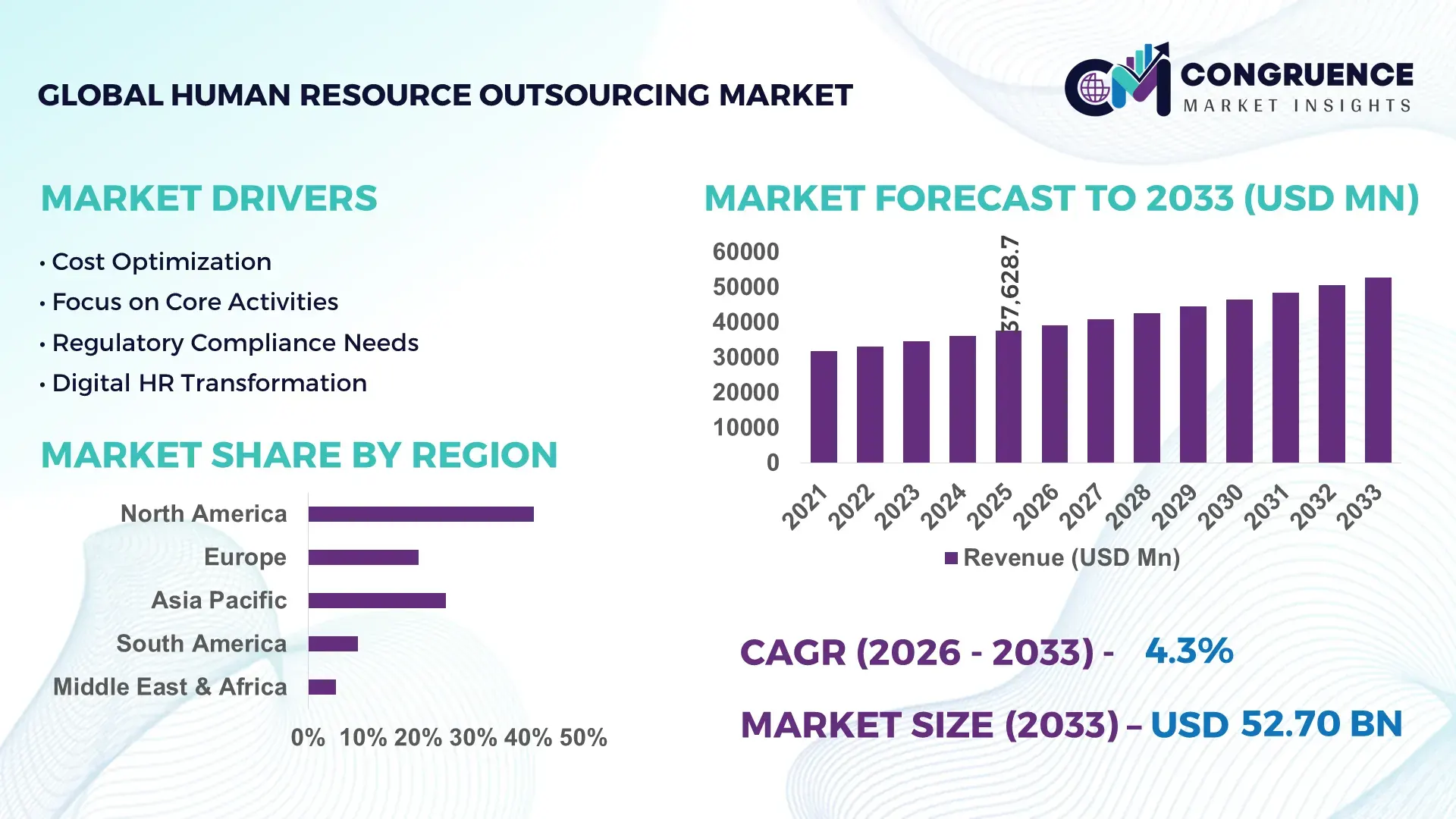
The Global Human Resource Outsourcing Market was valued at USD 37628.69 Million in 2025 and is anticipated to reach a value of USD 52697.94 Million by 2033 expanding at a CAGR of 4.3% between 2026 and 2033. Growth is driven by enterprises increasingly shifting non-core HR functions to specialized service providers to enhance cost efficiency, compliance accuracy, and workforce scalability.
The United States remains the most influential country within the global Human Resource Outsourcing market, supported by advanced service delivery capabilities and high enterprise penetration. In 2025, approximately 62% of large U.S. organizations outsourced at least one critical HR function such as payroll management, benefits administration, or recruitment process outsourcing. Corporate spending on HRO services surpassed USD 18 billion, with strong demand from BFSI, healthcare, IT services, and retail sectors. Technological adoption is notably high, with over 70% of providers integrating AI-based workforce analytics, cloud-hosted HR platforms, and automated compliance tools, significantly expanding processing capacity and service reliability across distributed workforces.
Market Size & Growth: Valued at USD 37628.69 Million in 2025 and forecast to reach USD 52697.94 Million by 2033 at a CAGR of 4.3%, supported by rising enterprise focus on operational agility and HR cost optimization.
Top Growth Drivers: Cloud-based HR platform adoption at 58%, payroll automation delivering 42% efficiency improvement, compliance outsourcing reducing regulatory risk exposure by 36%.
Short-Term Forecast: By 2028, organizations implementing integrated HRO models are expected to achieve average HR operational cost reductions of nearly 28%.
Emerging Technologies: Artificial intelligence–driven talent analytics, robotic process automation for payroll processing, and cloud-native human capital management solutions.
Regional Leaders: North America projected to reach USD 20500 Million by 2033 with high enterprise adoption; Europe expected to reach USD 14800 Million driven by compliance-focused outsourcing; Asia-Pacific forecast at USD 12300 Million supported by rapid SME onboarding.
Consumer/End-User Trends: Large enterprises continue to dominate multi-process HRO contracts, while SMEs increasingly adopt modular payroll, recruitment, and benefits outsourcing solutions.
Pilot or Case Example: In 2024, a global IT services firm deployed AI-enabled recruitment outsourcing, reducing average hiring cycle time by 34%.
Competitive Landscape: ADP leads with an estimated 22% share, followed by Accenture, IBM, Randstad, and Infosys.
Regulatory & ESG Impact: Strengthening data protection laws and labor compliance standards are accelerating adoption of compliant HRO platforms with integrated ESG workforce reporting.
Investment & Funding Patterns: Recent global investments exceeded USD 4.6 billion, primarily directed toward cloud HR platforms, AI-driven automation, and digital service expansion.
Innovation & Future Outlook: Growing integration of HR analytics with enterprise ERP systems and increased adoption of outcome-based HRO contracts are shaping long-term market evolution.
The Human Resource Outsourcing Market serves key industry sectors including BFSI, healthcare, manufacturing, IT & telecom, and retail, with BFSI and IT services together contributing more than 40% of overall service consumption due to complex workforce and compliance requirements. Technological innovations such as predictive workforce analytics, AI-powered attrition modeling, and blockchain-based credential verification are reshaping service offerings. Regulatory pressures, evolving labor laws, and economic cost-containment initiatives continue to influence adoption patterns, while Asia-Pacific shows accelerating consumption growth driven by SME digitalization. Looking ahead, the market is expected to evolve toward fully integrated digital HR ecosystems aligned with hybrid work models and data-driven workforce strategies.
The Human Resource Outsourcing Market holds growing strategic relevance as organizations recalibrate operating models to balance workforce agility, compliance assurance, and cost discipline. Enterprises are increasingly positioning HR outsourcing as a core component of enterprise risk management and digital transformation strategies rather than a purely tactical cost-saving tool. Advanced platforms combining cloud-based human capital management with AI-driven analytics are reshaping service delivery models; for example, AI-enabled workforce analytics delivers approximately 35% improvement in workforce planning accuracy compared to traditional spreadsheet-based HR systems. From a regional perspective, North America dominates in volume due to the concentration of large enterprises and complex regulatory environments, while Asia-Pacific leads in adoption, with nearly 48% of mid-sized enterprises outsourcing at least one HR function. In the short term, by 2028, intelligent automation and generative AI embedded within outsourcing platforms are expected to improve payroll accuracy and compliance monitoring by nearly 30%. ESG considerations are also influencing strategic decisions, with firms committing to workforce transparency and social compliance improvements, including targeted 25% reductions in compliance-related audit findings by 2030. In 2024, a leading U.S.-based technology company achieved a 32% reduction in HR process cycle time through the deployment of AI-powered recruitment process outsourcing across multiple geographies. Looking ahead, the Human Resource Outsourcing Market is increasingly positioned as a pillar of organizational resilience, regulatory compliance, and sustainable workforce growth in an environment defined by talent scarcity and regulatory complexity.
Enterprises are under increasing pressure to manage workforce complexity while controlling administrative overhead and ensuring compliance with evolving labor regulations. Human Resource Outsourcing enables organizations to centralize payroll processing, benefits administration, and compliance management through specialized providers with standardized processes. Studies indicate that organizations outsourcing payroll and compliance functions reduce processing errors by more than 40% and shorten audit resolution timelines by nearly 30%. The expansion of cross-border employment has further amplified demand, as multinational firms rely on outsourcing partners to manage country-specific labor laws, tax filings, and statutory reporting. This driver is particularly pronounced in regulated industries such as BFSI and healthcare, where non-compliance penalties and reputational risks significantly influence operational decisions.
Despite its advantages, the Human Resource Outsourcing Market faces restraints linked to data security risks and system integration challenges. HR outsourcing involves the handling of sensitive employee data, including compensation, personal identifiers, and health-related information. Data breaches in third-party environments have heightened enterprise caution, with surveys indicating that nearly 38% of organizations delay outsourcing decisions due to cybersecurity concerns. Additionally, integrating outsourced HR platforms with existing enterprise resource planning and legacy HR systems can be complex and time-consuming. In large organizations, integration projects often exceed planned timelines by 20–25%, creating operational disruption and resistance among internal stakeholders, which limits the pace of adoption.
Digital transformation presents significant growth opportunities for the Human Resource Outsourcing Market as organizations seek advanced, analytics-driven HR capabilities without building them internally. The integration of AI-based talent acquisition, predictive attrition analytics, and automated compliance reporting allows service providers to offer higher-value, outcome-oriented solutions. Adoption of cloud-native HR platforms among SMEs has increased steadily, enabling providers to penetrate previously underserved segments. Emerging economies, particularly in Asia-Pacific and Latin America, offer additional opportunities as enterprises formalize HR processes and adopt outsourced models to support workforce expansion. These trends enable outsourcing providers to move beyond transactional services into strategic workforce advisory roles.
Human Resource Outsourcing initiatives often face internal resistance stemming from concerns about job displacement, loss of control, and changes to established processes. Employee apprehension regarding external handling of HR functions can negatively impact morale and adoption rates. Research indicates that nearly 45% of large organizations implementing HR outsourcing experience initial resistance from internal HR teams, leading to extended transition periods. Change management costs, including training, communication, and stakeholder alignment, can account for up to 15% of total outsourcing program expenditure. Addressing these challenges requires structured governance frameworks, transparent communication, and phased implementation strategies, adding complexity to outsourcing engagements.
Acceleration of Modular and Function-Specific HR Outsourcing Models
Organizations are increasingly shifting from full-spectrum HR outsourcing to modular, function-specific engagement models to gain flexibility and cost control. In 2025, nearly 52% of enterprises outsourced only selected HR functions such as payroll, recruitment process outsourcing, or benefits administration rather than adopting end-to-end contracts. Modular outsourcing has enabled organizations to reduce fixed HR operating costs by approximately 24% while improving service-level responsiveness by 31%. This trend is particularly strong among mid-sized enterprises, where adoption rates exceeded 46%, allowing companies to scale HR support in alignment with workforce size fluctuations and regional expansion requirements.
Integration of AI-Driven Analytics and Automation Across Outsourced HR Processes
Advanced analytics and automation are becoming embedded within Human Resource Outsourcing service offerings. AI-enabled resume screening and candidate matching tools are now used in over 60% of outsourced recruitment programs, reducing average hiring cycle times by 33%. Automated payroll validation systems have improved processing accuracy by nearly 40%, significantly lowering manual intervention rates. Additionally, predictive analytics deployed through outsourced platforms has helped organizations identify attrition risks with up to 28% higher accuracy, enabling proactive workforce planning and targeted retention strategies.
Rising Demand for Compliance-Centric and Multi-Country HR Outsourcing Solutions
Global workforce expansion and evolving labor regulations are driving demand for compliance-focused Human Resource Outsourcing solutions. In 2025, approximately 57% of multinational organizations relied on outsourcing partners for statutory compliance across three or more countries. Outsourced compliance management reduced audit-related discrepancies by 35% and shortened regulatory response times by nearly 29%. This trend is especially prominent in highly regulated sectors such as BFSI and healthcare, where organizations manage complex reporting, tax, and employee data protection requirements across multiple jurisdictions.
Expansion of Digital Employee Experience and Self-Service Platforms via Outsourcing
Human Resource Outsourcing providers are increasingly enhancing digital employee experience through cloud-based self-service portals and mobile HR applications. More than 65% of outsourced HR contracts now include employee self-service modules, enabling workers to manage leave, benefits, and payroll inquiries independently. Adoption of these platforms has reduced HR service ticket volumes by approximately 38% and improved employee satisfaction scores by 22%. Usage rates are highest among organizations with distributed and hybrid workforces, where digital access and real-time HR support are critical to workforce engagement and operational continuity.
The Human Resource Outsourcing Market is segmented by type, application, and end-user, reflecting diverse enterprise needs, workforce structures, and operational priorities. By type, organizations adopt varying levels of outsourcing ranging from single-function engagement to comprehensive, end-to-end HR service models. Application-based segmentation highlights strong demand across payroll management, recruitment, benefits administration, and compliance management, driven by regulatory complexity and workforce globalization. End-user segmentation shows differentiated adoption patterns between large enterprises, SMEs, and sector-specific organizations such as BFSI and healthcare. Adoption intensity varies based on workforce scale, geographic dispersion, and compliance exposure, with measurable differences in outsourcing depth and technology utilization across segments. This segmentation framework enables stakeholders to evaluate demand concentration, service customization requirements, and growth potential across enterprise categories.
The Human Resource Outsourcing Market by type includes payroll outsourcing, recruitment process outsourcing (RPO), benefits administration outsourcing, learning and development outsourcing, and multi-process or end-to-end HR outsourcing. Payroll outsourcing is the leading type, accounting for approximately 34% of total adoption, due to its standardized processes, high compliance requirements, and measurable error reduction benefits. Recruitment process outsourcing follows with nearly 26% adoption, driven by talent scarcity and demand for faster hiring cycles. Benefits administration and learning outsourcing together contribute around 18%, serving organizations seeking employee experience optimization. End-to-end HR outsourcing, while currently representing about 22%, is the fastest-growing type with an estimated growth rate of 7.1%, supported by enterprises consolidating vendors and seeking integrated HR governance. The remaining niche services collectively account for roughly 14%, addressing specialized needs such as expatriate management and HR analytics.
By application, payroll management remains the dominant segment, representing nearly 38% of overall Human Resource Outsourcing usage due to mandatory accuracy, recurring frequency, and regulatory oversight. Recruitment and talent acquisition applications account for approximately 29%, as organizations prioritize speed-to-hire and quality-of-hire metrics. Compliance and risk management applications are expanding rapidly and are the fastest-growing application area, with an estimated growth rate of 6.8%, driven by cross-border employment and evolving labor laws. Learning, training, and performance management applications contribute a combined 21%, supporting workforce upskilling and retention strategies. Other applications, including HR analytics and employee engagement management, collectively account for around 12%, addressing advanced decision-support needs.
End-user segmentation shows large enterprises as the leading adopters, accounting for approximately 46% of Human Resource Outsourcing usage, supported by complex organizational structures, multi-country operations, and higher compliance exposure. Small and medium-sized enterprises represent about 34% of adoption, increasingly outsourcing payroll and recruitment to manage costs and access advanced HR technology. SMEs are also the fastest-growing end-user segment, with adoption expanding at an estimated 7.5%, fueled by cloud-based outsourcing models and subscription pricing. Sector-wise, BFSI and healthcare together account for nearly 28% of total end-user adoption, reflecting stringent regulatory requirements and workforce scale. Manufacturing, IT, and retail collectively contribute around 26%, leveraging outsourcing to support distributed and seasonal workforces.
North America accounted for the largest market share at 41% in 2025 however, Asia-Pacific is expected to register the fastest growth, expanding at a CAGR of 6.9% between 2026 and 2033.
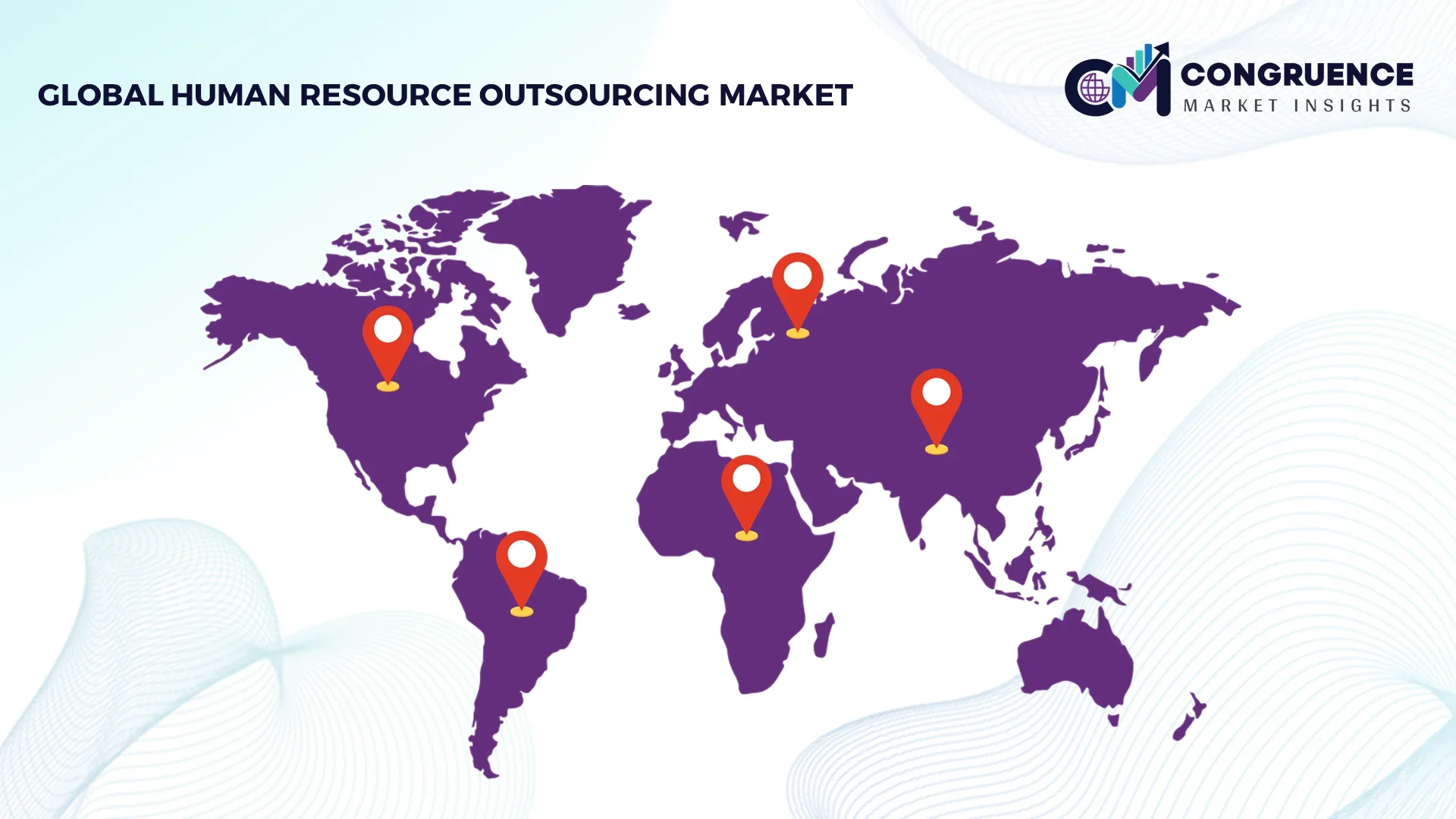
North America continues to lead due to high enterprise outsourcing penetration, with over 63% of large organizations outsourcing at least one HR function. Europe follows with approximately 29% share, supported by strong regulatory compliance requirements and cross-border workforce complexity. Asia-Pacific represents nearly 22% of the market, driven by rapid SME adoption, expanding IT services, and workforce formalization across India, China, and Southeast Asia. South America and the Middle East & Africa collectively contribute around 8%, with rising demand linked to infrastructure development, multinational expansion, and labor law modernization. Regionally, adoption intensity varies by industry, with BFSI and healthcare dominating in mature markets, while IT, manufacturing, and retail drive volume growth in emerging economies.
How is enterprise-scale workforce complexity reshaping outsourced HR demand?
The region accounts for approximately 41% of the Human Resource Outsourcing Market, reflecting high penetration among large enterprises and regulated industries. Healthcare, BFSI, and IT services together represent more than 48% of outsourced HR activity, driven by strict labor compliance and data protection requirements. Regulatory frameworks related to employee data privacy and wage transparency have increased reliance on specialized outsourcing providers. Digital transformation is advanced, with over 72% of outsourcing contracts integrating cloud-based HR platforms and AI-enabled payroll validation. Local players such as ADP continue expanding automation capabilities, processing payroll for millions of employees while improving accuracy rates by over 35%. Consumer behavior shows higher adoption of multi-process outsourcing in healthcare and finance, where compliance risk and workforce scale remain critical decision factors.
Why is regulatory intensity accelerating structured HR outsourcing adoption?
Europe holds close to 29% share of the Human Resource Outsourcing Market, led by Germany, the UK, and France, which together contribute over 60% of regional demand. Stringent labor laws, GDPR compliance, and sustainability reporting requirements are shaping outsourcing decisions. Regulatory bodies emphasize transparency and worker protection, increasing demand for compliance-focused HR services. Adoption of explainable AI and auditable HR systems is rising, with nearly 54% of European enterprises preferring outsourcing platforms offering detailed compliance reporting. Local providers are enhancing multilingual payroll and statutory reporting solutions to serve cross-border workforces. Consumer behavior reflects strong preference for compliance assurance over cost savings, particularly among manufacturing and public-sector organizations.
How are digital-first enterprises accelerating outsourced HR adoption at scale?
Asia-Pacific ranks third by market size at approximately 22% share but leads in growth momentum. China, India, and Japan account for nearly 67% of regional demand, supported by expanding IT services, manufacturing hubs, and formal employment growth. Infrastructure development and rapid enterprise digitalization are increasing reliance on outsourced payroll and recruitment solutions. Over 49% of SMEs in the region now outsource at least one HR function, compared to 34% five years earlier. Regional innovation hubs are driving adoption of mobile-first HR platforms and AI-enabled recruitment tools. Local service providers are focusing on scalable, low-cost solutions tailored to high-volume hiring markets. Consumer behavior reflects strong uptake driven by e-commerce expansion and mobile workforce management needs.
Why is workforce formalization increasing reliance on external HR expertise?
South America contributes around 5% of the Human Resource Outsourcing Market, with Brazil and Argentina as the primary demand centers. Infrastructure projects, energy investments, and expanding service sectors are driving workforce growth and compliance needs. Governments are introducing labor formalization initiatives and digital tax systems, increasing demand for outsourced payroll and compliance management. Regional providers are expanding multilingual and multi-currency payroll capabilities to support cross-border operations. Media, telecommunications, and shared services industries show higher outsourcing adoption. Consumer behavior highlights demand tied to language localization, labor documentation accuracy, and administrative efficiency rather than advanced analytics.
How are economic diversification strategies influencing outsourced HR adoption?
The Middle East & Africa region accounts for approximately 3% of the global Human Resource Outsourcing Market, with demand concentrated in the UAE, Saudi Arabia, and South Africa. Oil & gas, construction, and large-scale infrastructure projects drive workforce outsourcing needs. Governments are modernizing labor regulations and promoting foreign investment, increasing demand for compliant HR service models. Technological modernization is accelerating, with over 44% of enterprises adopting cloud-based HR outsourcing platforms. Local providers are expanding services around expatriate workforce management and statutory compliance. Consumer behavior reflects higher reliance on outsourcing for workforce mobility, visa management, and payroll standardization.
United States Human Resource Outsourcing Market – 34% share: Dominance supported by high enterprise outsourcing penetration, complex regulatory environment, and advanced HR technology adoption.
United Kingdom Human Resource Outsourcing Market – 9% share: Strong position driven by cross-border workforce management needs, stringent labor regulations, and widespread adoption among BFSI and professional services sectors.
The Human Resource Outsourcing Market exhibits a moderately consolidated competitive environment with over 120 active global providers offering a mix of specialized and end-to-end services. The top five companies—ADP, Accenture, IBM, Randstad, and Infosys—collectively account for approximately 58% of the market, highlighting significant concentration at the leading tier while leaving room for niche and regional players. Competitive strategies focus on technological innovation, strategic partnerships, and service portfolio expansion. For instance, over 62% of leading providers have integrated AI-enabled recruitment platforms, cloud-based HR management systems, and automated payroll solutions to enhance service efficiency and compliance accuracy. Mergers, acquisitions, and alliances are increasingly common, with 17 major deals executed globally in the past two years to expand geographic presence or service capabilities. Innovation trends driving differentiation include mobile-first HR portals, predictive workforce analytics, and multi-country compliance platforms. The market’s structure encourages both established and emerging providers to continuously optimize service delivery, create scalable outsourcing models, and strengthen enterprise client relationships to maintain competitive positioning.
Randstad
Infosys
Ceridian
Capgemini
Wipro
Aon Hewitt
Tata Consultancy Services (TCS)
Technology is playing a transformative role in the Human Resource Outsourcing Market, reshaping service delivery, operational efficiency, and strategic decision-making. Cloud-based human capital management (HCM) platforms are now utilized by over 68% of outsourced HR providers, enabling centralized data access, real-time reporting, and seamless multi-country payroll processing. Artificial intelligence (AI) and machine learning have become critical for talent acquisition and workforce planning, with AI-driven recruitment platforms reducing average hiring cycle times by 32% and improving candidate-job fit accuracy by approximately 28%. Robotic process automation (RPA) is widely deployed in payroll validation, benefits administration, and compliance checks, decreasing manual intervention by nearly 41% and significantly reducing human error.
Emerging technologies such as generative AI for HR documentation, predictive attrition analytics, and blockchain for employee credential verification are gaining traction. Nearly 24% of mid- to large-scale enterprises implementing HR outsourcing now incorporate AI-assisted attrition models to forecast turnover risks, enabling proactive workforce retention strategies. Mobile-first HR portals and self-service applications are another key trend, with over 62% of employees in outsourced setups accessing benefits, leave management, and payroll data via mobile platforms, improving efficiency and engagement.
Additionally, multi-language and multi-currency platforms are increasingly integrated to support global workforce management, particularly in regions with diverse labor regulations. HR analytics dashboards allow organizations to track compliance, performance, and employee engagement metrics in real time, enhancing governance and strategic planning. Overall, technological adoption is not only optimizing transactional HR functions but also enabling outsourced providers to deliver predictive, insights-driven, and scalable HR solutions across industries.
• In February 2025, ADP and Microsoft announced a strategic partnership to accelerate cloud‑based HR outsourcing solutions by integrating ADP’s payroll and HR services with Microsoft’s 365 and Azure ecosystems, enhancing global workforce management capabilities across hybrid and remote environments.
• In July 2024, IBM entered into a multi‑year HR outsourcing partnership with ManpowerGroup to deploy AI‑powered HR cloud platforms, cognitive processes, and advanced data analytics aimed at streamlining recruitment, payroll, and employee lifecycle services for multinational clients.
• In May 2025, Ceridian launched its Dayforce AI Suite, expanding its HR outsourcing offerings with AI‑powered talent analytics, recruitment automation, and enhanced onboarding capabilities, strengthening its competitive position in automated HR service delivery.
• In July 2025, ManpowerGroup secured a multi‑year HR outsourcing contract with a major global financial services firm, expanding its enterprise HR services footprint and managed workforce solutions across multiple regions, marking a significant commercial milestone in large‑scale outsourced HR engagements.
The Human Resource Outsourcing Market Report encompasses a comprehensive examination of service types, technology adoption patterns, customer segments, and geographic demand variations. It covers key service categories including payroll outsourcing, recruitment process outsourcing (RPO), benefits administration, compliance and risk management outsourcing, employee engagement services, and multi‑process HR management solutions. The report analyzes how organizations across sectors such as BFSI, healthcare, IT & telecom, retail, and manufacturing leverage outsourced HR functions to support workforce scalability, regulatory compliance, and digital transformation. It details segmentation by enterprise size, with insights into large enterprise strategies and the growing uptake among small and medium‑sized enterprises (SMEs). Geographic coverage spans North America, Europe, Asia‑Pacific, South America, and Middle East & Africa, highlighting regional demand drivers, regulatory impacts, and adoption behaviors.
Technological dimensions of the report include the integration of cloud‑native HCM platforms, AI and automation in talent acquisition and payroll processing, predictive workforce analytics, and mobile self‑service HR tools. The report also explores emerging niches such as diversity, equity, and inclusion (DEI) outsourcing services, blockchain‑enabled credential management, and custom HR analytics dashboards. It profiles competitive dynamics, key provider strategies, innovation trends, contract models, and buyer behavior insights. Additionally, the scope includes future pathways for HR outsourcing technology deployment, industry‑specific use cases, and strategic implications for decision‑makers seeking scalable, compliant, and data‑driven HR service models. The content provides a forward‑looking view of market evolution, service differentiation, and enterprise priorities within the Human Resource Outsourcing landscape.
| Report Attribute/Metric | Report Details |
|---|---|
|
Market Revenue in 2025 |
USD V2025 Million |
|
Market Revenue in 2033 |
USD V2033 Million |
|
CAGR (2026 - 2033) |
4.3% |
|
Base Year |
2025 |
|
Forecast Period |
2026 - 2033 |
|
Historic Period |
2021 - 2025 |
|
Segments Covered |
By Types
By Application
By End-User
|
|
Key Report Deliverable |
Revenue Forecast, Growth Trends, Market Dynamics, Segmental Overview, Regional and Country-wise Analysis, Competition Landscape |
|
Region Covered |
North America, Europe, Asia-Pacific, South America, Middle East, Africa |
|
Key Players Analyzed |
ADP, Accenture, IBM, Randstad, Infosys, Ceridian, Capgemini, Wipro, Aon Hewitt, Tata Consultancy Services (TCS) |
|
Customization & Pricing |
Available on Request (10% Customization is Free) |




