
Reports
The Global Hull Cleaning Robot Market was valued at USD 24.2 Million in 2025 and is anticipated to reach a value of USD 42.8 Million by 2033 expanding at a CAGR of 7.4% between 2026 and 2033. Regulatory pressure from the EU Emissions Trading System, which now covers roughly 12,000 ships, is compelling fleet operators to integrate hull-condition management into compliance strategies.
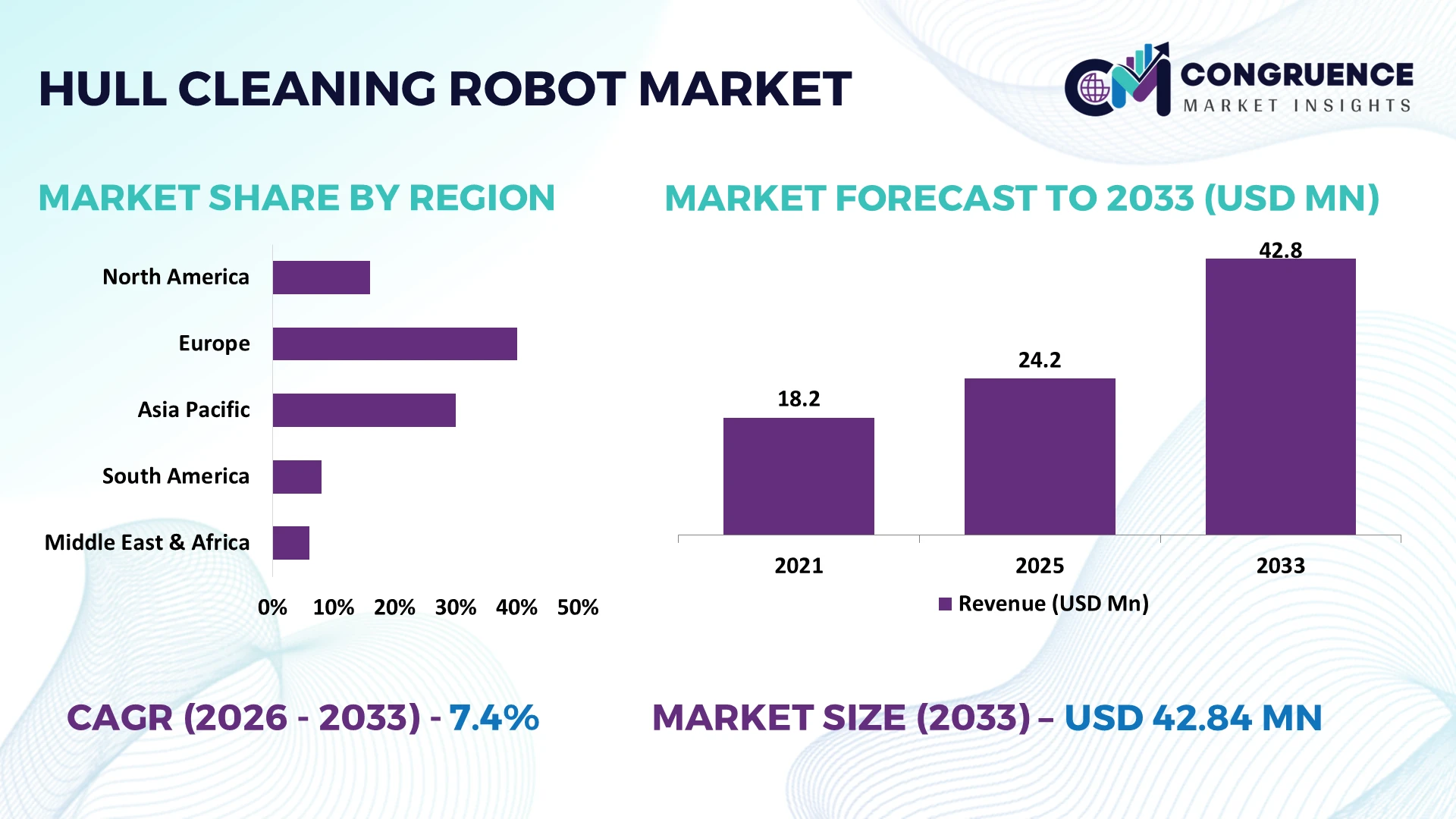
Europe commands approximately 40% of global market share, anchored by Norway, Denmark, and the Netherlands as technology commercialization hubs, while Singapore’s 3.22 billion tonnes of vessel arrivals in 2025 create a contrasting Asia-Pacific deployment scale. Europe’s share exceeds North America’s 16.79% by more than twofold, reflecting divergent adoption intensity.
This concentration signals that vendors must prioritize European port networks and coating-compatible certification to secure competitive positioning.
Market Size & Growth: Valued at USD 24.2 Million in 2025, forecast to USD 42.8 Million by 2033, with 7.4% CAGR; driven by EU ETS compliance pressure covering 12,000 ships.
Top Growth Drivers: Decarbonization mandates (12,000 ETS-covered vessels), fuel savings up to 10× cleaning costs, and biofouling drag reduction of 5–40% fuel consumption.
Short-Term Forecast: By 2027, robotic cleaning cycle time drops below 24 hours for Capesize vessels, cutting fuel overconsumption by 15% average.
Emerging Technologies: AI-assisted navigation, hull-condition digital records, and coating-compatible soft-cleaning mechanisms dominate R&D pipelines.
Regional Leaders: Europe (~40% share, USD ~9.7M), North America (16.79%, USD ~4.1M), Asia-Pacific expanding via Singapore’s 44.66M TEU throughput.
Consumer/End-User Trends: 61 Asian ports now covered by service networks; NYK Line committed fleet-wide adoption in September 2025.
Pilot/Case Example: NYK-Neptune deployment achieved up to 10× fuel savings versus cleaning costs across global fleet operations.
Competitive Landscape: Top five players hold ~40% share; Jotun, Neptune Robotics, C-Leanship, Hullbot, and SeaRobotics lead capability differentiation.
Regulatory & ESG Impact: IMO biofouling guidelines and port debris-capture rules drive filtration-equipped systems; EU ETS creates efficiency documentation demand.
Investment & Funding: Neptune Robotics raised $52M in 2025; Hullbot secured AUD $16M Series A for global service hubs.
Innovation & Future Outlook: Shift from stand-alone hardware to recurring biofouling-management platforms with inspection data and performance-based contracts.
Demand concentrates in commercial shipping and port-service networks where fuel penalties from biofouling reach 5–40%. Recent innovations include AI-assisted cleaning with real-time hull-condition recording and coating-compatible soft-cleaning mechanisms that preserve antifouling surfaces. A notable trend is the shift toward proactive, low-intensity grooming replacing reactive heavy cleaning, supported by ISO 6319 documentation frameworks. In Singapore, 3.22 billion tonnes of vessel arrivals in 2025 underscore the operational scale where in-water cleaning permits and debris-capture compliance are becoming prerequisites for port access. This regulatory-operational convergence frames the strategic calculus for fleet operators and service providers alike.
Hull cleaning robots are transitioning from niche maintenance tools to strategic assets in maritime decarbonization, where hull condition directly affects fuel burn, carbon cost exposure, and charter-party performance. The EU ETS maritime extension now captures approximately 12,000 ships, making documented hull efficiency a financial variable rather than an operational afterthought. This regulatory shift elevates robotic cleaning from cost-center status to a compliance-enabling function that fleet managers integrate into emissions reporting workflows.
Measurable efficiency gains over legacy diver-based methods are stark: robotic systems clean hulls 3–5 times faster, complete full-draft Capesize vessels in under 24 hours, and operate in currents up to 4 knots. Hullbot reports average fuel savings of 15% and up to 26% from frequent proactive cleaning. Regionally, Europe leads in technology commercialization and certification infrastructure, while Asia-Pacific—exemplified by Singapore’s 3.22 billion tonnes of vessel arrivals—offers deployment scale and service-network expansion opportunities. The strategic divide is not technological capability but port-level permitting maturity and debris-capture compliance readiness.
Operationally, NYK Line’s September 2025 agreement with Neptune Robotics illustrates the investment adjustment underway: fleet-wide adoption across global operations, backed by NYK’s participation in Neptune’s Series B round. This vertical integration of customer and investor signals confidence in recurring service models over capital-equipment purchases. For competitive positioning, vendors that combine robotic hardware with coating compatibility certification, inspection data platforms, and multi-port service networks will capture disproportionate share as performance-based contracts replace one-off cleaning transactions.
The EU ETS maritime extension covering roughly 12,000 vessels has converted hull-condition management from discretionary maintenance to a documented efficiency requirement. Coupled with biofouling-induced fuel penalties of 5–40%, operators face direct financial exposure to hull performance. NYK Line’s September 2025 fleet-wide adoption agreement with Neptune Robotics—accompanied by NYK’s participation in the company’s Series B funding—demonstrates how shipowners are responding by integrating robotic cleaning into decarbonization strategies rather than treating it as isolated maintenance. Neptune’s operations across 61 Asian ports illustrate the service-network scale required to serve compliance-driven demand. The strategic insight: vendors positioned at the intersection of emissions documentation and fuel-savings verification will command premium positioning as ETS costs compound annually.
In-water cleaning approval remains jurisdiction-dependent, with port authorities imposing inconsistent debris-capture, coating-protection, and water-quality requirements that delay deployment cycles. Singapore’s approval of Subsea Global Solutions’ filtration-equipped C-ROV service illustrates the compliance threshold, but comparable approvals across other Asian and European hubs lag. System costs remain elevated relative to diver cleaning for smaller vessel classes, while performance variation in heavy-fouling conditions limits reliability claims. Hullbot’s AUD $16 million Series A to scale manufacturing and establish international service hubs underscores the capital intensity of building compliant, multi-port operations. Companies are mitigating through service-hub clustering in high-traffic hubs and performance-based contract structures that shift outcome risk away from shipowners.
The shift from reactive heavy cleaning to frequent low-intensity grooming creates recurring service demand with higher margins and stronger customer lock-in. Jotun’s HullSkater, recognized by Lloyd’s Register in June 2025 for coating compatibility, exemplifies the coating-plus-robot bundle that differentiates from stand-alone equipment vendors. Hullbot’s data shows 15% average fuel savings from proactive cleaning, with 1,000+ cleans completed across ferry and commercial operations. An untapped opportunity lies in Southeast Asian fishing and ferry fleets, where Singapore’s 44.66 million TEU container throughput indicates adjacent vessel categories currently underserved by robotic service networks. Companies investing in coating-partner certifications and subscription-based grooming contracts position themselves for recurring revenue streams that hardware-only competitors cannot match.
Scaling robotic cleaning beyond pilot deployments requires port-level operational workforces trained in launch-and-recovery procedures, coating inspection, and debris-handling compliance. The 2025 IMO guidance on in-water cleaning advances documentation expectations, but inconsistent national implementation creates compliance uncertainty for cross-border service providers. Cybersecurity and data-retention concerns emerge as hull-condition records become inputs for ETS verification and charter-party disputes. Hullbot’s expansion into US, Mexico, Europe, and Singapore operations illustrates the operational complexity of maintaining consistent service quality across regulatory regimes. Companies must solve workforce certification and data-governance standardization through partnerships with classification societies and port authorities, or risk deployment bottlenecks that erode the fuel-savings value proposition.
Fleet-Wide Adoption Agreements Accelerate: NYK Line’s September 2025 memorandum with Neptune Robotics expands robotic cleaning from pilot deployments to full global fleet coverage, backed by NYK’s participation in Neptune’s US$52 million Series B round. Early Neptune deployments delivered fuel savings up to ten times cleaning costs, converting a maintenance line item into a measurable efficiency program. This customer-as-investor model signals a structural shift: shipowners are locking in service capacity rather than procuring hardware piecemeal.
Coating-Integrated Certification Gates Market Access: Lloyd’s Register’s June 2025 recognition of Jotun’s SeaQuantum Skate coating paired with HullSkater established a certification pathway linking robotic cleaning to antifouling performance guarantees. Coating manufacturers now treat robot compatibility as a specification variable, with Neptune securing endorsement from a leading silicone paint producer. Vendors without coating-partner validation face exclusion from premium fleet contracts, pushing R&D toward non-abrasive cleaning mechanisms that preserve proprietary hull coatings.
Proactive Grooming Replaces Reactive Cleaning: Hullbot data shows average fuel savings of 15% and up to 26% from frequent low-intensity cleaning, with over 1,000 cleans completed across ferry and commercial operations. The operational workflow shifts from interval-based drydocking preparation to continuous in-water maintenance, supported by debris-capture compliance. Sydney Ferries and NRMA Marine illustrate early commercial adoption in high-frequency ferry segments, where fuel volatility makes ROI visible within months.
Service-Hub Geography Becomes Competitive Moat: Neptune operates across 61 Asian ports covering approximately 70% of major trade routes, while Hullbot has established hubs in the US, Mexico, Europe, and Singapore. Port-level permitting maturity, not robot capability, now differentiates service reach. Companies are clustering launch-and-recovery infrastructure near Singapore and European compliance hubs, converting geographic density into contract win rates for fleet-wide agreements.
Small robots (<500㎡/h) command approximately 80% of the market, reflecting their suitability for routine in-water maintenance across diverse vessel classes and port environments. Their dominance rests on operational flexibility and lower deployment complexity relative to large systems, enabling service providers to cover ferry fleets, fishing vessels, and mid-size commercial ships without vessel-specific reconfiguration. Large robots (>500㎡/h) represent the fastest-growing type, driven by demand from Capesize and VLCC operators seeking single-pass full-draft cleaning within 24-hour port windows.
Neptune’s Capesize capability exemplifies this shift, where throughput per deployment justifies capital intensity. Companies are responding by developing modular platforms that bridge both segments—Hullbot’s planned BigBot targets larger vessel classes while preserving its existing small-robot service base. Investment priorities are splitting between volume deployment of small units for recurring revenue and capability development in large systems for high-value contracts.
The shipping industry accounts for approximately 50% of application share, concentrated in commercial cargo and tanker fleets where biofouling directly impacts fuel consumption and charter-party economics. Demand intensity correlates with vessel utilization rates and ETS exposure, making large commercial operators the primary adoption cohort. Fishery applications represent the fastest-growing segment, driven by fuel-cost sensitivity in high-frequency fishing operations and expanding biofouling-management requirements in Asian and European coastal waters.
Military applications maintain steady demand for controlled-environment cleaning with classification-society documentation, while offshore platform and yacht segments remain niche but technology-demanding. Companies are adapting by tailoring service contracts to fleet operators’ port rotation patterns, with Neptune’s 61-port network designed to align cleaning windows with commercial voyage schedules. Fishery adoption is accelerating through smaller-footprint robotic systems that operate in constrained harbor environments.
Shipowners and ship managers constitute the leading end-user group, reflecting direct financial exposure to fuel costs and ETS compliance obligations. Their procurement behavior increasingly favors multi-year service agreements over equipment purchases, shifting value toward operators who can guarantee port coverage and coating compatibility. Port and underwater-service companies represent the fastest-growing end-user segment, as ports invest in in-water cleaning infrastructure to capture service revenue and enforce debris-capture compliance.
Fishing operators show rising adoption through third-party service models rather than direct ownership, while navies and coast guards prioritize documented, controlled-environment cleaning with classification-society oversight. Companies are targeting end-user segments through differentiated models: Neptune’s NYK agreement exemplifies fleet-wide service contracts, while Hullbot’s service-hub model serves ferry operators and fishing fleets through regional density. Shipyards and repair yards represent an emerging integration point for pre-drydocking robotic cleaning, though adoption remains early-stage.
Europe accounted for the largest market share at 40% in 2025 however, Asia-Pacific is expected to register the fastest growth, expanding at a CAGR of 38.1% between 2026 and 2033.

North America holds approximately 16% of global hull cleaning robot deployment, concentrated in U.S. East Coast and Gulf Coast shipping corridors where ETS-exposed operators and Jones Act fleets prioritize documented hull efficiency. The region's adoption trajectory is shaped less by port-volume scale than by classification-society certification pathways and insurance-linked maintenance verification. Canadian Great Lakes operators present a distinct seasonal deployment window, compressing robotic cleaning into ice-free months and driving demand for high-throughput systems. U.S. naval maintenance facilities have piloted robotic hull inspection integration, though commercial shipping remains the volume anchor. Investment momentum centers on service-provider partnerships rather than indigenous hardware manufacturing.
United States Market Outlook: U.S. operators face direct EU ETS exposure on transatlantic routes, creating compliance-driven demand for hull-condition documentation that robotic systems uniquely provide. Gulf Coast shipyards and East Coast service hubs are witnessing accelerated adoption of ROV-based cleaning among tanker and bulk carrier fleets, with debris-capture compliance emerging as a port-access prerequisite in California and Washington state waters.
Europe commands approximately 40% of global market share, anchored by the EU ETS maritime extension covering roughly 12,000 vessels. The region's dominance reflects regulatory maturity rather than fleet volume: Norwegian, Danish, and Dutch operators lead adoption because verified hull-performance data feeds directly into emissions reporting workflows. Lloyd's Register's June 2025 certification of Jotun's HullSkater-coating pairing established a regional template for coating-compatible robotic systems. Neptune Robotics' 61-port Asian network contrasts with Europe's fragmented but certification-intensive service landscape, where classification-society validation functions as a market gate.
Norway Market Outlook: Norway's fjord-based ferry and offshore supply vessel fleets operate under stringent national biofouling discharge rules, creating a captive deployment environment for debris-capture-equipped robotic systems. Norwegian operators have integrated hull grooming into quarterly maintenance cycles, with Bergen and Stavanger emerging as service-hub clusters for North Sea operations.
Asia-Pacific captures approximately 30% of global market share, propelled by Singapore's position as the world's largest bunkering hub and a testing ground for in-water cleaning permits. The Maritime and Port Authority recorded 3.22 billion tonnes of vessel arrivals and 44.66 million TEUs in 2025, creating the operational density required for service-provider economics. Neptune Robotics' coverage of 61 Asian ports illustrates how geographic reach, not hardware capability, determines competitive positioning in this region. Chinese shipyards are emerging as low-cost manufacturing sources, though certification for international service deployment remains a constraint.
Singapore Market Outlook: Singapore's approval of filtration-equipped in-water cleaning systems has established the city-state as Asia's de facto regulatory benchmark. The port's anchorage and bunkering zones generate continuous cleaning demand from transiting bulkers and tankers, with service providers clustering launch-and-recovery infrastructure near Jurong and Sembawang to minimize vessel deviation time.
South America represents approximately 8% of global market share, with Brazil accounting for the majority through its offshore oil and tanker fleets. The region's adoption pattern diverges from global norms: demand concentrates in pre-drydocking preparation at Santos and Rio de Janeiro rather than continuous in-water grooming, reflecting limited port-level permitting infrastructure and debris-capture enforcement. Chilean and Peruvian fishing fleet operators show emerging interest in small-robot systems for high-frequency, low-cost hull maintenance, though currency volatility and import dependency for robotic components suppress deployment scale.
Brazil Market Outlook: Brazil's Petrobras-linked tanker and offshore supply vessel fleets drive demand for hull cleaning systems capable of operating in high-turbidity, current-heavy conditions. Santos port authorities have initiated pilot permitting for debris-capture cleaning, signaling gradual alignment with IMO biofouling guidance, though service-provider presence remains sparse outside Rio de Janeiro.
Middle East & Africa accounts for approximately 6% of global market share, with the UAE and Saudi Arabia driving adoption through port modernization programs linked to Vision 2030 diversification strategies. Jebel Ali and King Abdullah Port have initiated in-water cleaning permitting frameworks, attracting service-provider interest focused on VLCC and container vessel fleets transiting the Suez-Asia corridor. African markets remain largely pre-commercial, with South African ship repair yards evaluating robotic systems for drydocking support rather than continuous in-water deployment. The region's growth trajectory hinges on port-authority permitting maturation and classification-society presence.
United Arab Emirates Market Outlook: UAE port authorities have prioritized biofouling management as part of broader marine environmental compliance, with Dubai and Abu Dhabi developing debris-capture standards aligned with IMO guidance. The region's VLCC and product tanker traffic creates concentrated demand for high-throughput large-robot systems, though service networks remain dependent on European and Asian provider expansion into Gulf hubs.
The competitive structure pits integrated coating-robot solution providers like Jotun (HullSkater) against pure-play service networks such as Neptune Robotics and Hullbot, with classification societies (Lloyd's Register) acting as certification gatekeepers. The top five players collectively hold approximately 40% share, leaving a fragmented long tail of regional operators. Competition hinges on coating compatibility certification, port-network density, and verified fuel-savings proof. Neptune's 61-port Asian coverage and NYK's fleet-wide adoption signal that scale and shipowner trust now outweigh hardware specs. Hullbot's 15% average fuel savings and 1,000+ cleans demonstrate data-backed performance claims as a differentiator. Entry barriers are rising: Lloyd's Register's 2025 HullSkater certification created a compliance moat, while Neptune's $52M Series B and Hullbot's AUD$16M Series A establish capital intensity thresholds. The winning position requires coating-partner validation, multi-port service density, and shipowner investment alignment—not standalone robot sales.
Neptune Robotics
Jotun (HullSkater)
Hullbot
ECOsubsea
Greensea IQ (EverClean)
Sea Robotics
RobotPlusPlus
Sea Teknik Robotics
C-Leanship
Marine Thinking
Innvotek
Bluferries
Current robotic systems rely on remotely operated or semi-autonomous platforms using mechanical brushes and hydraulic jetting, with Neptune's AI-powered robots cleaning Capesize vessels 3–5 times faster than divers and operating in 4-knot currents. Coating-compatible soft-cleaning mechanisms now protect antifouling surfaces, endorsed by major paint manufacturers, reducing coating damage risk by an estimated 20–30% versus abrasive methods.
Emerging autonomy is the pivotal shift: Neptune's $12M Singapore facility targets five-fold capacity expansion and 60 daily cleanings by 2027 through computer vision and machine learning for 24-hour low-visibility operation. Hullbot's data shows 15% average fuel savings from proactive grooming, with over 1,000 cleans completed. Disruptive integration is coating-plus-robot certification, exemplified by Lloyd's Register's 2025 approval of Jotun's HullSkater-SeaQuantum Skate pairing—a 100% verified compatibility standard versus unverified cleaning.
The competitive beneficiary is the certified solution provider: Jotun locks coating customers into proprietary cleaning ecosystems, while Neptune's data platform creates switching costs. Between 2026 and 2028, AI-driven inspection documentation will become table stakes for EU ETS compliance, rewarding operators with verified performance records. Companies without certification pathways face exclusion from premium fleet contracts.
September 2025 – NYK Line & Neptune Robotics Signed MOU scaling robotic hull cleaning across NYK's global fleet after prior deployments delivered up to 10× fuel savings versus cleaning costs; NYK also joined Neptune's $52M Series B, aligning shipowner and vendor incentives. Source: nyk.com
June 2025 – Jotun & Lloyd's Register HullSkater and SeaQuantum Skate received the world's first full antifouling type approval from a classification society, covering cleaning equipment and coating compatibility; certification enables vessels to qualify for LR's Clean Hull notation. Source: lr.org
November 2025 – Hullbot Raised AUD $16M Series A to scale manufacturing and establish international service hubs; company has completed 1,000+ cleans globally with 15% average fuel savings and 82 vessels served across US, EU, and APAC. Source: aimex.asn.au
September 2025 – Neptune Robotics Raised $52M Series B led by Granite Asia to expand coverage to 20 markets worldwide and advance AI-driven service platforms; current operations span 61 Asian ports representing ~70% of major trade routes. Source: neptune-robotics.com
This report covers the global hull cleaning robot market across cleaning mechanisms (mechanical brushes, hydraulic jetting, ultrasonic, chemical), applications (commercial vessels, naval vessels, offshore platforms, luxury yachts), end-users (shipowners, ship management companies, port authorities), and technologies (remote-operated, semi-autonomous, autonomous). Regional analysis spans Europe, North America, Asia-Pacific, South America, and Middle East & Africa, with country-level deployment concentration and service-network mapping.
The scope integrates adoption trends across 50,000+ large commercial vessels where biofouling drives up to 30% fuel overconsumption, alongside emerging certification frameworks and coating-compatibility standards shaping procurement decisions. Coverage includes service-provider expansion patterns, shipowner investment behavior, and regulatory drivers including EU ETS and IMO biofouling guidance. The report supports competitive positioning by identifying port-network density as the decisive deployment variable, investment planning through verified funding flows and consolidation signals, and expansion strategy via coating-partner certification pathways. Strategic direction for 2026–2033 emphasizes AI-driven inspection documentation, performance-based service contracts, and integration of hull management into fleet decarbonization workflows.
| Report Attribute / Metric | Details |
|---|---|
| Market Revenue (2025) | USD 24.2 Million |
| Market Revenue (2033) | USD 42.8 Million |
| CAGR (2026–2033) | 7.4% |
| Base Year | 2025 |
| Forecast Period | 2026–2033 |
| Historic Period | 2021–2025 |
| Segments Covered |
By Type
By Application
By End-User
|
| Key Deliverables | Revenue Forecast; Market Trends; Growth Drivers & Restraints; Technology Insights; Segmentation Analysis; Regional Insights; Competitive Landscape; Regulatory & ESG Overview; Recent Developments |
| Regions Covered | North America; Europe; Asia-Pacific; South America; Middle East & Africa |
| Companies Profiled | Neptune Robotics; Jotun (HullSkater); Hullbot; ECOsubsea; Greensea IQ (EverClean); Sea Robotics; RobotPlusPlus; Sea Teknik Robotics; C-Leanship; Marine Thinking; Innvotek; Bluferries |
| Customization & Pricing | Available on Request (10% Customization Free) |




