
Reports
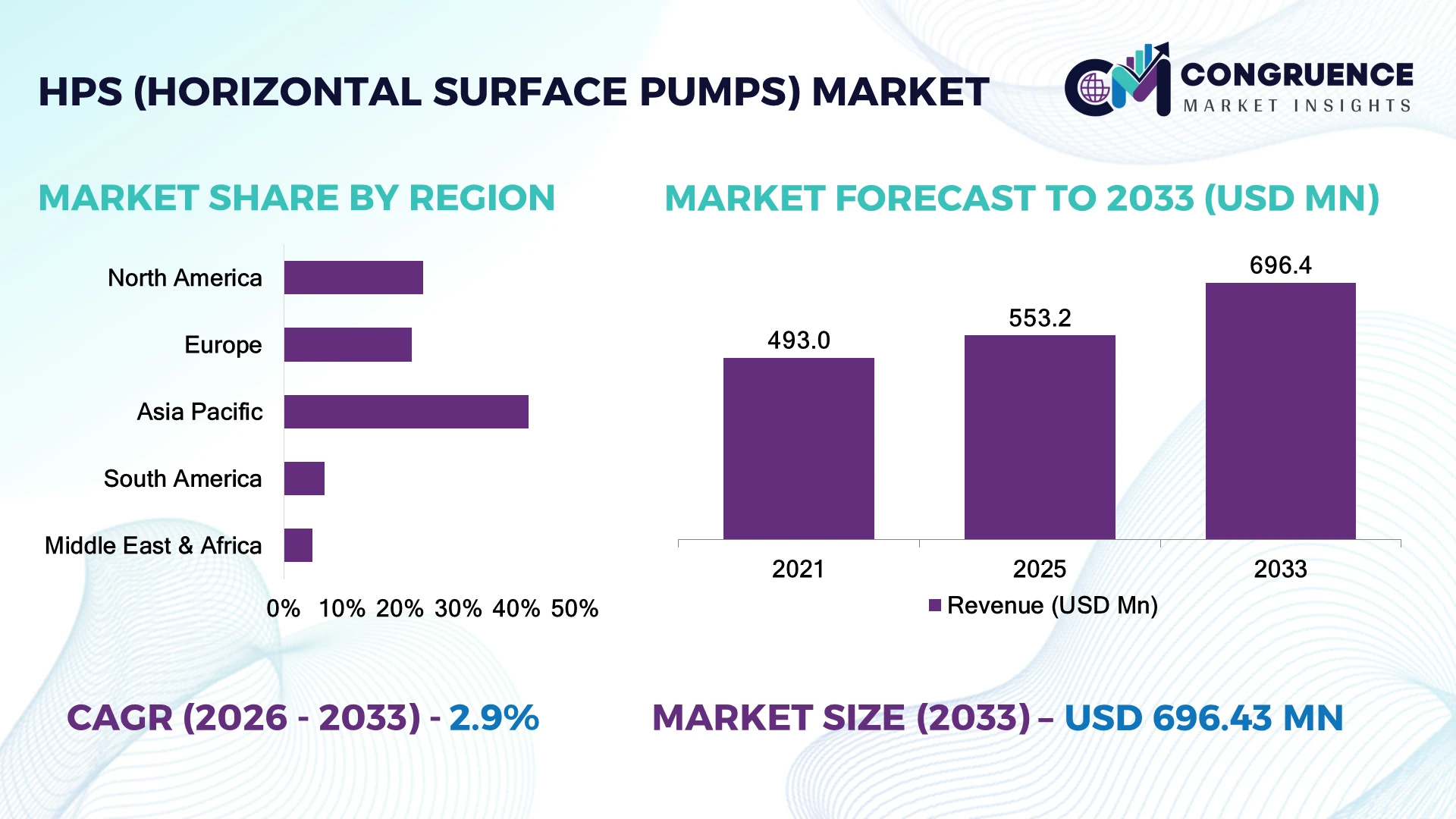
The Global HPS (Horizontal Surface Pumps) Market was valued at USD 553.2 Million in 2025 and is anticipated to reach a value of USD 696.4 Million by 2033 expanding at a CAGR of 2.92% between 2026 and 2033. Growth is driven by expanding municipal water infrastructure, industrial fluid handling modernization, and higher deployment of energy-efficient pumping systems across oil & gas, mining, and manufacturing facilities.
China dominates the global HPS (Horizontal Surface Pumps) Market with approximately 31% of global production capacity, supported by more than USD 9 billion in industrial water infrastructure investments and extensive manufacturing capabilities. The country exports pumps to over 150 nations, while the United States accounts for nearly 18% of advanced industrial pump installations, driven by refinery upgrades and municipal water projects. The Belt and Road Initiative continues to accelerate large-scale pump deployment across developing economies.
This competitive landscape reinforces localized manufacturing, supply-chain resilience, and technology-focused investment strategies for long-term market positioning.
Market Size & Growth: USD 553.2 Million in 2025, projected to reach USD 696.4 Million by 2033 at 2.92% growth, supported by industrial infrastructure modernization and energy-efficient pumping technologies.
Top Growth Drivers: Industrial automation (+24%), municipal water infrastructure expansion (+21%), and energy-efficient equipment adoption (+18%) remain the leading growth catalysts.
Short-Term Forecast: By 2028, predictive maintenance reduces unplanned downtime by nearly 30% while operating efficiency improves by approximately 18%.
Emerging Technologies: AI-enabled monitoring, IoT-based remote diagnostics, and advanced corrosion-resistant composite materials are reshaping pump performance.
Regional Leaders: Asia-Pacific exceeds USD 245 Million through manufacturing expansion, North America surpasses USD 145 Million with digital pump upgrades, while Europe approaches USD 130 Million through sustainable industrial investments.
Consumer/End-User Trends: More than 57% of industrial operators prioritize smart monitoring systems to reduce maintenance frequency and energy consumption.
Pilot/Case Example: In 2024, a smart municipal pumping project lowered maintenance requirements by 27% and reduced energy consumption by 19%.
Competitive Landscape: Grundfos leads with approximately 11% global share alongside Xylem, KSB, Flowserve, and Sulzer.
Regulatory & ESG Impact: High-efficiency motor regulations improve industrial energy performance by over 15% while reducing operational emissions.
Investment & Funding: More than USD 4.5 billion has been allocated toward manufacturing expansion, strategic partnerships, and digital pumping solutions amid global supply-chain diversification.
Innovation & Future Outlook: Digital twins, intelligent variable-speed controls, and lifecycle service platforms are strengthening operational reliability and long-term asset optimization.
Horizontal surface pumps continue to gain traction across water treatment, chemical processing, power generation, and mining operations where reliability and energy efficiency remain operational priorities. Manufacturers are introducing smart sensors, variable-frequency drives, and predictive maintenance capabilities that improve equipment availability by nearly 20%. Growing localization of component sourcing and industrial modernization initiatives are further strengthening deployment across emerging manufacturing economies, setting the foundation for broader strategic investments.
The HPS (Horizontal Surface Pumps) Market has become strategically important as industries prioritize operational efficiency, resilient water infrastructure, and uninterrupted fluid transfer across critical sectors. Infrastructure modernization, industrial digitalization, and supply-chain restructuring are encouraging manufacturers to redesign production footprints while strengthening regional sourcing networks to reduce procurement risks and improve delivery performance.
Modern smart horizontal surface pumps equipped with variable-frequency drives and real-time monitoring deliver approximately 18% higher energy efficiency than conventional fixed-speed systems while reducing maintenance interventions by nearly 25%. Asia-Pacific continues to lead large-scale manufacturing capacity and deployment, whereas North America emphasizes intelligent monitoring, retrofit projects, and digital asset management for industrial facilities. Over the next two to three years, adoption of predictive maintenance platforms is expected to expand across more than one-third of newly commissioned industrial pumping systems.
A practical example is the deployment of connected pump stations in municipal water networks, where remote diagnostics minimize service interruptions and optimize maintenance scheduling. Leading companies are expanding regional manufacturing facilities, strengthening engineering partnerships, and investing in intelligent service platforms to improve customer lifecycle support. These strategies enhance competitive differentiation, improve operational resilience, and reinforce long-term positioning in an increasingly technology-driven industrial landscape.
Expansion of municipal water systems, industrial process automation, and energy-efficient fluid management continues to strengthen demand for horizontal surface pumps. More than 62% of newly commissioned industrial pumping projects now specify variable-speed operation, while intelligent monitoring reduces maintenance interventions by nearly 25%. China's continuous investment in manufacturing facilities and water infrastructure, together with stricter motor-efficiency regulations in the European Union, is accelerating replacement of aging pump fleets. This structural shift improves lifecycle performance while lowering operating costs for end users. Manufacturers are expanding localized production, integrating digital monitoring platforms, and partnering with automation specialists to deliver connected pumping solutions. A notable strategic outcome is the growing preference for lifecycle service contracts that strengthen recurring customer engagement beyond initial equipment sales.
Volatility in stainless steel, specialty alloys, and electronic control components continues to influence production planning and procurement costs. Raw material expenses account for nearly 45% of manufacturing costs for industrial pumps, while delivery lead times for advanced electronic components remain approximately 20% higher than pre-disruption levels. Germany and Japan continue to depend on globally distributed precision component suppliers, increasing exposure to logistics disruptions and trade-related uncertainties. These structural constraints delay equipment delivery, compress manufacturer margins, and complicate long-term contract pricing. Companies are reducing operational risk by diversifying supplier networks, increasing regional sourcing, negotiating long-term procurement agreements, and redesigning products with standardized components that improve manufacturing flexibility and inventory resilience.
Digital transformation is expanding opportunities beyond traditional equipment sales through intelligent asset management and predictive maintenance platforms. Nearly 58% of industrial facilities are prioritizing connected equipment capable of remote diagnostics, while predictive analytics lowers unexpected equipment failures by approximately 30%. India's expanding industrial corridor projects and nationwide water infrastructure upgrades are creating substantial demand for digitally integrated pumping systems. Companies are investing in AI-enabled monitoring, cloud-based performance analytics, and digital twin technologies that optimize asset utilization throughout the equipment lifecycle. An emerging opportunity lies in subscription-based monitoring services that generate recurring value while reducing maintenance costs for customers. Strategic collaborations with industrial software providers are strengthening integrated automation ecosystems and enhancing long-term customer retention.
Successful deployment increasingly depends on seamless integration with industrial automation platforms, cybersecurity readiness, and specialized engineering expertise. Nearly 41% of industrial operators identify system integration complexity as a major implementation barrier, while approximately 35% report shortages of qualified maintenance personnel for advanced digital pumping systems. The United States faces increasing pressure to modernize aging industrial facilities without disrupting continuous production operations, making integration planning more demanding. Inconsistent communication protocols between legacy equipment and modern control systems also limit operational efficiency. Companies must expand technical training programs, invest in interoperable digital architectures, strengthen cybersecurity capabilities, and collaborate with automation partners to ensure reliable deployment, long-term operational consistency, and sustainable competitive differentiation.
Smart Monitoring Gains Momentum: Industrial operators are rapidly integrating IoT-enabled sensors and remote diagnostics into horizontal surface pumps, with connected pump deployments increasing by nearly 32% and predictive maintenance adoption exceeding 38% across large processing facilities. Rising labor shortages and stricter uptime requirements are driving automated monitoring workflows. Manufacturers are expanding digital service portfolios, partnering with industrial software providers, and embedding condition-based maintenance features that reduce unplanned shutdowns while improving maintenance scheduling efficiency.
Energy-Efficient Motor Upgrades: High-efficiency motors and variable frequency drives are replacing conventional pumping systems, reducing electricity consumption by approximately 18% while extending equipment operating life by nearly 22%. The implementation of tighter motor-efficiency regulations in the European Union and industrial sustainability targets in the United States continues to accelerate equipment replacement cycles. Companies are restructuring product portfolios around premium-efficiency pump packages and expanding retrofit programs to improve lifecycle performance for existing industrial installations.
Localized Manufacturing Expansion: Supply-chain diversification has prompted manufacturers to establish regional assembly and component sourcing networks, reducing average delivery times by nearly 24% and lowering logistics dependence by around 17%. India and Mexico are attracting new industrial equipment investments due to expanding manufacturing ecosystems and favorable production economics. Pump manufacturers are increasing localized sourcing, strengthening supplier partnerships, and redesigning components for greater interchangeability to improve production resilience and inventory flexibility.
Compact Modular Pump Systems: Demand for modular horizontal surface pumps has increased by approximately 27% as operators seek faster installation, easier maintenance, and reduced plant downtime. Mini Unit configurations are gaining traction across temporary industrial operations and decentralized water infrastructure where installation space is limited. Companies are introducing standardized modular platforms, expanding factory-built package solutions, and integrating plug-and-play control systems that shorten commissioning periods while improving deployment flexibility.
Conventional HPS (Horizontal Surface Pumps) account for approximately 46% of the market due to their proven reliability, broad industrial compatibility, and lower acquisition costs. Their widespread deployment across oilfields, industrial processing facilities, and mining operations supports consistent replacement demand. Gas Driven Side Mount systems remain essential for remote operating environments where electrical infrastructure is unavailable, while Electric Side Mount pumps continue expanding as industrial electrification programs accelerate. The Mini Unit segment represents the fastest-growing category, supported by increasing demand for compact, mobile, and rapidly deployable pumping solutions. Electric Side Mount pumps are recording the strongest adoption shift as industrial operators prioritize automation, lower emissions, and energy-efficient equipment, with installations increasing by nearly 21% across modern processing facilities. Manufacturers are investing in intelligent motor integration, lightweight materials, and modular product platforms while expanding customized offerings for specialized industrial applications. These investment priorities reflect the industry's transition toward digitally connected, flexible pumping systems without displacing established conventional equipment.
Industrial applications represent the largest segment with approximately 49% of total demand, supported by continuous fluid handling requirements across manufacturing, chemical processing, power generation, and municipal infrastructure. Large production facilities prioritize durable pumping systems capable of uninterrupted operation, creating sustained replacement and modernization demand. Oil & Natural Gas remains the fastest-growing application as upstream production optimization, pipeline expansion, and enhanced recovery projects increase deployment of high-performance surface pumping equipment. Mining applications continue to expand steadily through dewatering, slurry transfer, and mineral processing operations. Industrial facilities are accelerating digital integration, with nearly 44% of new installations incorporating automated monitoring and remote performance management. Oil & Natural Gas operators are deploying higher-capacity pumps designed for harsh operating conditions, while mining companies increasingly emphasize wear-resistant materials to reduce maintenance intervals. Manufacturers are expanding application-specific product portfolios, strengthening aftermarket services, and integrating intelligent control technologies to improve operational efficiency across multiple industrial environments.
Industrial enterprises account for approximately 47% of end-user demand because of continuous process operations, infrastructure upgrades, and ongoing equipment replacement cycles. Manufacturing plants require reliable pumping systems to maintain uninterrupted production while minimizing operational downtime. Oil & Natural Gas companies represent the fastest-growing buyer group as production optimization, pipeline development, and field modernization projects increase equipment procurement. Mining companies maintain stable purchasing activity driven by expanding mineral extraction, water management, and processing requirements in resource-intensive operations. Nearly 53% of industrial buyers now prioritize lifecycle operating efficiency alongside acquisition cost when selecting pumping systems, while automated monitoring capability influences procurement decisions in approximately 36% of large industrial projects. Manufacturers are responding through customized engineering solutions, long-term maintenance agreements, strategic partnerships with industrial contractors, and expanded regional service networks. Competitive positioning increasingly depends on integrated lifecycle support rather than standalone equipment sales, strengthening long-term customer relationships across critical industrial sectors.
Asia-Pacific accounted for the largest market share at 42% in 2025 however, North America is expected to register the fastest growth, expanding at a CAGR of 3.4% between 2026 and 2033.
North America represents approximately 24% of the global HPS (Horizontal Surface Pumps) Market, supported by extensive deployment across oil & gas production, municipal water infrastructure, mining operations, and industrial processing facilities. Digital asset management, predictive maintenance platforms, and higher adoption of variable-speed pumping systems continue to reshape equipment procurement strategies. More than 48% of newly commissioned industrial pumping projects incorporate remote monitoring capabilities to improve operational reliability and maintenance planning. Continued investment in refinery modernization and critical water infrastructure upgrades is strengthening replacement demand, while manufacturers are expanding regional service centers and engineering partnerships to improve aftermarket responsiveness. The market also benefits from increased standardization of energy-efficient pumping technologies across industrial enterprises seeking long-term operational optimization.
United States Market Outlook: The United States remains the region's largest HPS market due to its extensive oilfield operations, advanced manufacturing base, and large municipal water infrastructure network. More than 55% of regional industrial pump installations are concentrated within the country, supported by refinery modernization, shale production, and infrastructure rehabilitation programs. Domestic manufacturers continue investing in digital pump technologies, localized production capacity, and lifecycle maintenance services to strengthen customer retention while supporting industrial automation initiatives across multiple sectors.
Europe accounts for approximately 22% of global market demand, driven by stringent industrial efficiency regulations, modernization of water infrastructure, and strong manufacturing capabilities. Industrial operators continue replacing legacy pumping systems with digitally controlled, energy-efficient alternatives to comply with sustainability objectives and improve operational performance. Nearly 44% of industrial pump procurement projects now prioritize intelligent monitoring and premium-efficiency motor integration. Strategic partnerships between pump manufacturers and industrial automation providers are expanding smart maintenance capabilities while improving equipment lifecycle management. Continued investment in wastewater treatment modernization and industrial decarbonization further supports stable deployment across process industries.
Germany Market Outlook: Germany leads the European market through its strong industrial engineering sector, advanced manufacturing ecosystem, and leadership in industrial automation. Approximately one-third of regional industrial pump manufacturing capacity is concentrated in Germany, supported by chemical processing, automotive production, and precision engineering industries. Domestic companies continue investing in intelligent pumping platforms, energy-efficient equipment, and automated production technologies to strengthen export competitiveness and support industrial sustainability objectives.
Asia-Pacific contributes approximately 42% of the global HPS (Horizontal Surface Pumps) Market through its extensive manufacturing base, industrial expansion, and continuous investment in water infrastructure and energy projects. Large-scale deployment across manufacturing facilities, mining operations, and oil & gas installations sustains strong equipment demand. More than 60% of regional production capacity is concentrated within major industrial economies, supported by expanding export-oriented manufacturing. Manufacturers continue increasing localized production, strengthening supplier ecosystems, and expanding engineering facilities to improve delivery flexibility. Government-supported industrial development and infrastructure modernization programs further reinforce long-term deployment across multiple industrial sectors.
China Market Outlook: China dominates the regional market through its extensive manufacturing capacity, integrated industrial supply chain, and large-scale infrastructure investments. The country accounts for approximately 31% of global horizontal surface pump production capacity while exporting equipment to more than 150 international markets. Domestic manufacturers continue expanding automated production lines, investing in intelligent manufacturing technologies, and strengthening global distribution networks to maintain competitiveness across industrial, mining, and water infrastructure applications.
South America represents approximately 7% of the global market, supported by expanding mining projects, upstream oil production, and continued investment in industrial water management. Copper, lithium, and iron ore developments are increasing demand for reliable dewatering and process pumping systems across major mining operations. Nearly 36% of newly installed industrial pumps within the region are deployed in mining applications where equipment durability remains essential. Infrastructure limitations and logistics challenges continue influencing project timelines, encouraging manufacturers to establish stronger regional distribution and maintenance networks. Strategic partnerships with local engineering contractors are improving deployment efficiency and aftermarket service capabilities.
Brazil Market Outlook: Brazil leads the regional market through its diversified industrial economy, offshore energy sector, and large-scale mining operations. Continued investment in iron ore production, industrial manufacturing, and municipal infrastructure supports stable procurement of high-capacity pumping systems. Equipment suppliers are expanding regional assembly operations, strengthening service capabilities, and developing localized maintenance programs to improve operational reliability for industrial customers throughout the country.
The Middle East & Africa accounts for approximately 5% of global demand, supported by expanding oil & gas infrastructure, desalination facilities, mining developments, and industrial diversification programs. Large-scale energy projects and water security initiatives continue driving deployment of high-performance horizontal surface pumps. More than 40% of new regional installations are associated with hydrocarbon production and water infrastructure modernization. Industrial operators increasingly prioritize durable pumping equipment capable of operating under harsh environmental conditions, encouraging manufacturers to expand technical support, regional partnerships, and localized service operations. Infrastructure modernization initiatives continue improving long-term market accessibility.
Saudi Arabia Market Outlook: Saudi Arabia remains the region's most strategically significant market through its large-scale upstream oil production, industrial diversification initiatives, and continuing investment in water infrastructure. National industrial development programs are accelerating procurement of advanced pumping technologies across petrochemical complexes, desalination facilities, and energy infrastructure. Equipment suppliers continue strengthening regional partnerships, technical service centers, and localized engineering support to improve deployment efficiency and long-term operational performance.
The competitive landscape is led by global pump manufacturers including Flowserve, Sulzer, Grundfos, KSB, and Xylem, competing directly against regional engineering specialists and cost-focused manufacturers in Asia. The top five players collectively account for approximately 42% of the market, while regional suppliers compete through faster delivery, localized customization, and lower manufacturing costs. Global OEMs differentiate through digital monitoring, lifecycle services, and energy-efficient technologies, whereas regional competitors emphasize pricing advantages of 12–18% and delivery cycles shortened by nearly 20%. Manufacturers increasingly compete through production expansion, strategic partnerships, aftermarket service networks, and intelligent pump platforms rather than equipment sales alone. Vertical integration and localized sourcing have reduced procurement risks by approximately 15%, strengthening supply resilience. The competitive shift is moving toward software-enabled asset management and predictive maintenance capabilities. High engineering certification requirements, established distribution networks, and long-term customer relationships remain significant entry barriers. Success increasingly depends on combining technology leadership, responsive service, localized manufacturing, and lifecycle value.
Sulzer Ltd.
Grundfos Holding A/S
KSB SE & Co. KGaA
Xylem Inc.
ITT Inc.
EBARA Corporation
Ruhrpumpen Group
Wilo SE
Kirloskar Brothers Limited
ANDRITZ AG
CIRCOR International, Inc.
Digital intelligence is redefining horizontal surface pump operations through IoT-enabled monitoring, predictive analytics, and cloud-connected asset management. Nearly 40% of newly installed industrial pumping systems now incorporate remote monitoring, reducing unplanned maintenance by approximately 25%. Integrated condition monitoring enables operators to identify vibration, pressure, and temperature anomalies before failures occur, improving plant reliability while lowering maintenance expenditure. Companies with established digital service ecosystems gain stronger customer retention through lifecycle support and continuous performance optimization.
High-efficiency motors, variable frequency drives, and advanced hydraulic designs are replacing conventional fixed-speed pumping systems. Compared with legacy equipment, modern intelligent pumps improve energy efficiency by approximately 18% while reducing operating costs by nearly 15%. More than 45% of industrial modernization projects now specify variable-speed control technology to optimize flow management under changing operating conditions. Manufacturers combining advanced materials with digital controls achieve longer equipment life and improved operating stability across demanding industrial environments.
Between 2026 and 2028, digital twins, artificial intelligence, and machine-learning-based diagnostics are expected to become mainstream across large industrial facilities. Equipment manufacturers investing in integrated software platforms, cybersecurity, and automated performance optimization will strengthen competitive positioning. Early adopters benefit from faster maintenance decisions, higher asset utilization, and improved operational resilience as industrial customers increasingly prioritize intelligent pumping ecosystems over conventional standalone equipment.
February 2025 – Sulzer expanded its Vadodara Service Center in India following its Chennai facility launch, strengthening retrofit and pump service capabilities for the energy sector. The expansion supports faster regional service response and extends equipment lifecycle. Source: www.sulzer.com
March 2025 – Sulzer introduced its Energy Optimization Service combining machine learning and engineering expertise. The solution can improve pump efficiency by up to 20–30%, reducing energy consumption and operating costs across industrial facilities. Source: www.sulzer.com
May 2025 – Grundfos announced a major expansion of its Brookshire, Texas manufacturing facility through a multi-million-dollar investment, increasing production capacity and shortening lead times for North American customers while supporting long-term manufacturing expansion. Source: www.prnewswire.com
June 2025 – Grundfos partnered with Rahul Dravid to promote its intelligent SCALA2 pressure booster platform across India, strengthening awareness of smart residential water technologies while supporting adoption of energy-efficient pumping solutions. Business impact focused on accelerating smart pump market penetration.
This report provides comprehensive analysis of the global HPS (Horizontal Surface Pumps) Market across Conventional, Electric Side Mount, Gas Driven Side Mount, and The Mini Unit product categories, together with Industrial, Oil & Natural Gas, and Mining applications and end-user sectors. The assessment covers North America, Europe, Asia-Pacific, South America, and the Middle East & Africa, evaluating deployment patterns, manufacturing concentration, technology adoption, competitive positioning, and regional operational dynamics. More than 40% of market activity is concentrated in advanced industrial economies, while intelligent pumping adoption continues to expand across energy-intensive industries.
The report further examines digital monitoring, predictive maintenance, variable-speed drive integration, energy-efficient hydraulic systems, and lifecycle service strategies shaping industry competitiveness. It provides strategic insights into company positioning, supply-chain developments, regional expansion priorities, product innovation, and emerging deployment opportunities, enabling stakeholders to evaluate investment strategies, capacity planning, competitive benchmarking, operational modernization, and business expansion opportunities throughout the 2026–2033 forecast period.
| Report Attribute / Metric | Details |
|---|---|
| Market Revenue (2025) | USD 553.2 Million |
| Market Revenue (2033) | USD 696.4 Million |
| CAGR (2026–2033) | 2.92% |
| Base Year | 2025 |
| Forecast Period | 2026–2033 |
| Historic Period | 2021–2025 |
| Segments Covered |
By Type
By Application
By End-User
|
| Key Deliverables | Revenue Forecast; Market Trends; Growth Drivers & Restraints; Technology Insights; Segmentation Analysis; Regional Insights; Competitive Landscape; Regulatory & ESG Overview; Recent Developments |
| Regions Covered | North America; Europe; Asia-Pacific; South America; Middle East & Africa |
| Companies Profiled | Flowserve Corporation; Sulzer Ltd.; Grundfos Holding A/S; KSB SE & Co. KGaA; Xylem Inc.; ITT Inc.; EBARA Corporation; Ruhrpumpen Group; Wilo SE; Kirloskar Brothers Limited; ANDRITZ AG; CIRCOR International, Inc. |
| Customization & Pricing | Available on Request (10% Customization Free) |




