
Reports
The Global Household Water Softener System Market was valued at USD 3,497.1 Million in 2025 and is anticipated to reach a value of USD 5,367.0 Million by 2033 expanding at a CAGR of 5.5% between 2026 and 2033. Growth is driven by rising concern over calcium- and magnesium-related scale buildup, demand for appliance protection, and adoption of demand-initiated regeneration systems that optimize salt and water consumption.
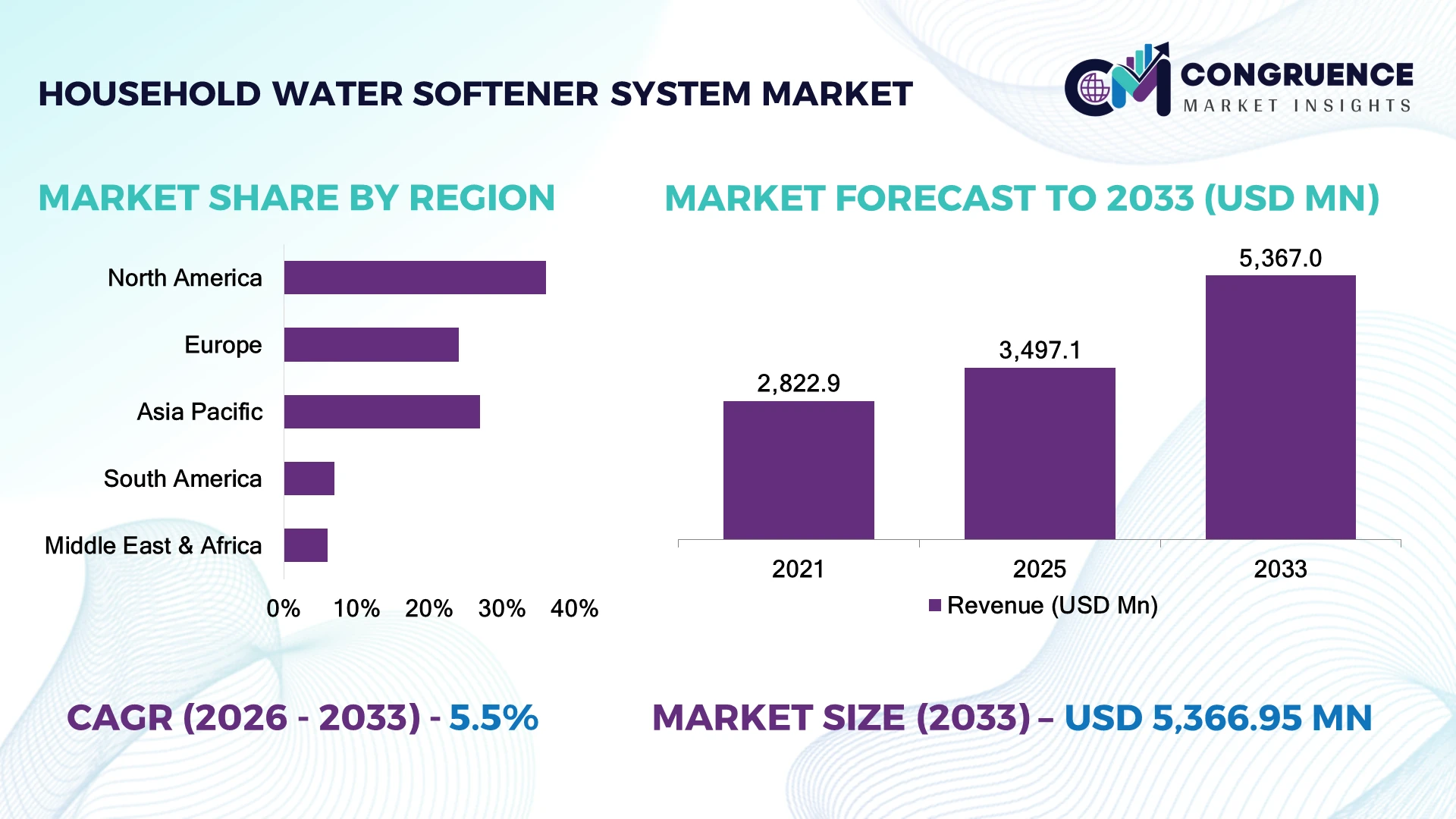
The United States anchors household water softener adoption, supported by established residential treatment channels and a large installed base of whole-house systems. North America accounted for an estimated 36% of global market value in 2025. Water hardness above 180 mg/L as calcium carbonate is classified as very hard, making treatment particularly relevant in affected communities. Compared with mature North American demand, Asia-Pacific offers opportunities tied to urban housing, rising appliance ownership, and growing awareness of water quality.
Strategic implication: prioritize efficient regeneration, water-hardness-specific product sizing, and service-led distribution to compete on lifecycle value rather than initial equipment price.
Market Size & Growth: The market is valued at USD 3,497.1 million in 2025 and is projected to reach USD 5,367.0 million by 2033, supported by scale prevention and efficient residential treatment.
Top Growth Drivers: North America holds an estimated 36% market share; very hard water exceeds 180 mg/L hardness; and demand-initiated regeneration improves resource use compared with fixed-time cycles.
Short-Term Forecast: By 2028, manufacturers will increasingly compete on salt consumption, regeneration-water use, remote monitoring, and maintenance frequency rather than softening capacity alone.
Emerging Technologies: Smart controllers, flow-based regeneration, salt-level alerts, and connected water-use monitoring are improving system management and service responsiveness.
Regional Leaders: North America remains the largest regional market, Europe emphasizes resource efficiency, and Asia-Pacific offers expansion potential through urban residential development and rising water-treatment awareness.
Consumer/End-User Trends: Buyers increasingly assess salt replenishment, maintenance support, installation requirements, and appliance protection alongside initial purchase price.
Pilot/Case Example: Smart high-efficiency softeners use water-condition sensing and demand-based regeneration to optimize salt, water, and energy use; reported savings depend on household hardness and usage conditions.
Competitive Landscape: Culligan, Pentair, EcoWater Systems, A. O. Smith, and Kinetico compete through dealer networks, system efficiency, product breadth, and installation and maintenance services.
Regulatory & ESG Impact: Residential cation-exchange systems covered by NSF/ANSI 44 are evaluated for capacity, rinse effectiveness, structural integrity, and salt and water efficiency claims.
Investment & Funding: Investment priorities include connected controls, efficient valves, service networks, and regional distribution; comparable consolidated investment totals are not consistently disclosed.
Innovation & Future Outlook: The next competitive shift favors systems that combine reliable hardness removal with lower operating inputs, predictive maintenance, and transparent lifecycle-cost benefits.
Household water softener systems address the practical costs of hard water, including scale accumulation in pipes, water heaters, and domestic appliances. Salt-based ion-exchange units remain important where actual hardness reduction is required, while salt-free conditioners appeal to households seeking alternatives to brine regeneration. In 2026, product differentiation is increasingly centered on demand-based controls, easier maintenance, and water- and salt-use optimization. This makes accurate household water assessment and appropriate system sizing essential to commercial performance.
Household water softener systems are becoming a more considered home-infrastructure purchase as consumers weigh appliance protection, maintenance requirements, and the recurring cost of water treatment. Hard water above 120 mg/L as calcium carbonate is classified as hard, while levels above 180 mg/L are considered very hard. This distinction supports more targeted product recommendations: households with substantial hardness need effective treatment, whereas indiscriminate installation can add unnecessary equipment, salt use, and maintenance expense.
Technology is shifting from timer-based regeneration toward systems that respond to water use and estimated softening demand. Demand-initiated regeneration can avoid unnecessary cycles, while connected controllers provide salt-level alerts, consumption information, and service notifications. North America benefits from established installation and service channels; in Asia-Pacific, product affordability, compact equipment, and dependable local support are important for broader adoption. The competitive opportunity lies in matching treatment performance to local water conditions rather than applying a single configuration across markets.
Over the next two to three years, suppliers will focus on efficient regeneration, easier installation, remote diagnostics, and service models that reduce ownership friction. A practical deployment begins with a water-hardness test, household-flow assessment, and suitable capacity selection. Manufacturers are strengthening dealer coverage, connected controls, and maintenance programs to improve customer retention. Long-term advantage will depend on verified operating efficiency, appropriate treatment recommendations, and reliable after-sales support rather than broad claims about water quality.
Hard water creates mineral deposits in water heaters, pipes, faucets, and appliances, increasing cleaning requirements and potentially reducing heat-transfer efficiency. Water above 180 mg/L as calcium carbonate is classified as very hard, providing a practical threshold for identifying households where treatment deserves closer evaluation. Salt-based ion exchange remains a proven option because it removes calcium and magnesium rather than merely conditioning their behavior. Demand is strengthened by homeowners seeking whole-house coverage and fewer scale-related maintenance issues. Manufacturers are responding with capacity-matched systems, high-efficiency valves, and water-hardness testing services. The key commercial insight is that precise sizing and correct regeneration settings can deliver a stronger value proposition than oversizing equipment to create a premium specification.
Conventional ion-exchange systems require salt, periodic regeneration, and discharge of brine containing sodium or chloride. These requirements increase recurring costs and can create compatibility concerns for septic systems and wastewater infrastructure. Under NSF/ANSI 44, the voluntary efficiency rating for residential cation-exchange softeners limits regeneration water use to 5 gallons or less per 1,000 grains of hardness removed. This benchmark makes efficiency measurable, but actual performance still depends on settings, hardness, household demand, and maintenance. Manufacturers are addressing the restraint through demand-initiated regeneration, improved brine control, and clearer operating guidance. In areas with discharge restrictions, product selection and local compliance can determine whether a conventional softener is commercially viable.
Connected softeners create opportunities to combine equipment sales with salt replenishment, maintenance alerts, and remote service support. Mobile applications can report salt levels, track water use, and notify homeowners or dealers when service is needed. These features reduce the burden of manual checks and give dealers a clearer basis for scheduled maintenance. High-efficiency controllers can also adjust regeneration according to demand, limiting avoidable cycles compared with fixed schedules. Suppliers are positioning connected systems through premium product lines, dealer applications, and service subscriptions. The less obvious opportunity is retention: timely alerts and reliable maintenance can keep customers engaged after installation, helping manufacturers and dealers build recurring service relationships without relying solely on replacement-equipment sales.
Household water softeners must accommodate hardness, daily consumption, peak flow, available installation space, and the characteristics of municipal or well water. A unit selected without testing can regenerate too frequently, deliver inconsistent performance, or operate inefficiently. Iron and other constituents can also require pretreatment rather than simply increasing softener capacity. Manufacturers expanding across countries face different plumbing practices, service capabilities, and discharge requirements. These variables make a single standardized product-and-installation package difficult to scale consistently. Companies must equip installers with water-testing protocols, sizing tools, and commissioning guidance, while maintaining spare-parts availability and responsive service networks. Competitive expansion depends on replicable installation quality as much as manufacturing scale.
Demand-Based Regeneration Replaces Fixed Cycles — Systems increasingly calculate regeneration from water use and estimated softening demand instead of relying solely on a preset schedule. This reduces unnecessary cycles when household consumption varies. Manufacturers are emphasizing metered valves and controller accuracy, while dealers can use commissioning data to tune performance. The benefit depends on correct hardness settings and household usage patterns.
Smart Monitoring Simplifies Maintenance — Connected softeners now offer salt-level alerts, water-use tracking, remote bypass, and service notifications. These functions help households avoid running out of salt and enable dealers to identify maintenance needs earlier. Suppliers are integrating applications with service operations, shifting competition from equipment specifications toward ongoing convenience and support.
Water Efficiency Becomes a Purchase Criterion — Regeneration consumes both water and salt, increasing scrutiny of operating efficiency. NSF/ANSI 44 includes a voluntary benchmark of 5 gallons or less per 1,000 grains of hardness removed for efficiency-rated systems. Manufacturers are refining brine control and regeneration logic, while purchasers increasingly compare lifecycle costs rather than initial price alone.
Salt-Free Conditioning Gains Targeted Attention — Salt-free conditioners appeal to households seeking to reduce salt handling and brine discharge, especially where local wastewater considerations affect system choice. However, conditioning is not equivalent to removing hardness minerals through ion exchange. Companies are responding with clearer product explanations and water testing to match the technology to the household’s scale-control requirements.
Salt-based ion-exchange systems lead the household water softener market, accounting for an estimated 60–65% of global demand in 2025. Their dominance reflects reliable calcium and magnesium removal, established installation practices, and broad availability of replacement salt and service support. Salt-free conditioning systems are gaining traction among households seeking lower-maintenance options and reduced brine discharge, although they generally condition scale formation rather than remove hardness minerals. Dual-tank configurations serve larger households requiring continuous softened-water availability, while other specialized systems address specific installation or operating requirements.
Salt-free systems represent a faster-emerging segment as buyers pay greater attention to maintenance, salt handling, and wastewater constraints. Their adoption depends on local water chemistry and whether the household needs actual hardness removal or scale control. Manufacturers are refining demand-based controls, compact designs, and service packages, while premium suppliers emphasize dual-tank reliability and high-capacity performance. Efficiency can be a meaningful differentiator: NSF/ANSI 44 includes a voluntary benchmark of no more than 5 gallons of regeneration water per 1,000 grains of hardness removed for qualifying systems. Investment is therefore shifting toward measurable lifecycle efficiency and fit-for-purpose treatment rather than technology claims alone.
Whole-house treatment is the leading application, representing an estimated 65–70% of global household-system demand in 2025. Treating water at the main entry point protects plumbing, water heaters, washing machines, and other connected appliances, making this configuration attractive to homeowners in hard-water areas. Point-of-use and localized systems serve specific needs where whole-house installation is impractical or unnecessary. Dedicated bathroom and laundry configurations also appeal to households seeking targeted scale management without upgrading every water line. Demand therefore depends on hardness levels, plumbing layout, household size, and the cost of installation.
Localized systems are gaining interest in apartments, renovations, and properties with limited space or restricted access to the main supply line. However, their smaller treatment coverage can limit suitability when hard water affects multiple appliances throughout the home. Suppliers are responding with compact equipment, simplified installation kits, and clearer water-testing guidance. In very hard-water areas—above 180 mg/L as calcium carbonate—system selection and capacity planning become particularly important. Companies that help customers compare whole-house and targeted treatment on installation cost, coverage, and maintenance can improve conversion while reducing mismatched purchases and post-installation dissatisfaction.
Single-family households are the leading end-user group, accounting for an estimated 70–75% of global household water softener demand in 2025. Individual homeowners can authorize installation directly and evaluate benefits such as reduced scale buildup, easier cleaning, and protection of water-using appliances. Multi-family residential buildings, including apartments and condominiums, require coordination among property owners, facility managers, and residents, making centralized treatment decisions more complex. Vacation homes and other secondary residences represent a smaller niche, with purchase priorities shaped by seasonal occupancy, space constraints, and the need to prevent scale during periods of intermittent use.
Multi-unit properties offer a developing opportunity because a shared treatment installation can serve multiple residences, but system sizing, metering, maintenance responsibility, and cost allocation must be resolved before deployment. Suppliers are tailoring proposals for property managers and residential developers, while consumer-facing brands focus on straightforward installation, transparent operating costs, and dependable after-sales support. In the United States, approximately 80% of the population lives in urban areas, reinforcing the importance of apartments and other higher-density housing even where single-family homes remain the main direct-purchase segment. Future positioning will depend on matching equipment capacity and service models to the buyer’s ownership structure and water-use profile.
North America accounted for the largest market share at an estimated 36.0% in 2025; however, Asia-Pacific is expected to register the fastest growth, expanding at an estimated CAGR of 6.3% between 2026 and 2033.
Established Installation Networks Shift Competition Toward Operating Efficiency
North America leads the household water softener system market through established whole-house treatment adoption, professional installation networks, and a strong replacement market. The region accounted for an estimated 36.0% of global market value in 2025, supported by residential demand in areas with hard groundwater and scale-related maintenance concerns. Salt-based ion-exchange systems remain important because they remove hardness minerals, while metered regeneration and connected controls help reduce unnecessary operating cycles. The United States anchors regional demand, with Canada contributing through residential treatment and well-water applications. Suppliers compete through dealer coverage, installation quality, service contracts, and lifecycle-cost transparency. The strongest differentiation is shifting from softening capacity alone toward efficient regeneration, dependable maintenance, and system sizing matched to household water conditions.
United States Market Outlook: The United States is the region’s primary market, supported by a mature home water-treatment industry, broad availability of replacement salt, and specialist installation and service providers. Households with very hard water—above 180 mg/L as calcium carbonate—have a clear technical basis for evaluating treatment. Suppliers can strengthen conversion by offering water-hardness testing, transparent capacity selection, and metered regeneration. Connected service alerts and dealer-led maintenance also create opportunities to retain customers beyond the initial equipment sale.
Resource Efficiency and Local Water Conditions Shape Product Choice
Europe’s household water softener market is shaped by varying water hardness, compact housing, environmental expectations, and country-specific installation practices. Germany, the United Kingdom, France, and Italy are relevant markets, although household need differs substantially by local water supply. Salt-based systems remain suited to applications requiring actual hardness removal, while salt-free conditioners appeal to selected buyers seeking reduced salt handling and no brine regeneration. Product selection increasingly considers installation footprint, regeneration-water use, maintenance access, and operating cost. Manufacturers are adapting through compact designs, demand-based controls, and clearer guidance on the difference between removing hardness minerals and conditioning scale formation. Regional expansion therefore depends on local water testing and distribution partnerships, not a uniform European product strategy.
Germany Market Outlook: Germany is strategically relevant because of its established plumbing and water-treatment distribution channels, strong engineering base, and varied municipal water-hardness conditions. Suppliers can differentiate through efficient valves, robust controls, and clear commissioning procedures for both retrofits and new homes. A household water test is especially important because hardness varies between local supplies; standardized product claims alone cannot establish the correct capacity. Partnerships with plumbing installers and specialist dealers remain central to customer acquisition, installation quality, and recurring maintenance.
Urban Housing and Affordability Open New Demand Channels
Asia-Pacific is expected to be the fastest-growing regional market as urban housing, rising appliance ownership, and awareness of scale-related maintenance broaden interest in household treatment. China, India, Japan, and Australia present distinct demand profiles, from compact residential equipment to premium whole-house systems. Compared with North America’s mature installation base, penetration remains less established in many Asia-Pacific markets, creating room for dealer development and affordable product tiers. Suppliers are responding with compact units, simplified installation, online sales, and localized service networks. The key operational constraint is uneven water quality: hardness, iron content, and available pressure differ by location. Companies that pair water testing with correctly sized systems can reduce mis-selling and build a more sustainable installation base.
China Market Outlook: China offers opportunities through its large urban housing stock, appliance manufacturing ecosystem, and developed e-commerce channels for home equipment. Suppliers can use digital product selection and installer partnerships to reach consumers, but must distinguish water softeners from broader filtration and reverse-osmosis systems. These technologies address different water-quality objectives. Compact designs, clear maintenance instructions, and local after-sales support can help manufacturers serve apartments and premium homes while limiting service costs. Product positioning should be based on household hardness and the required treatment outcome.
Urban Demand Expands While Distribution Determines Reach
South America remains a smaller but developing market, with Brazil representing an important demand center. Urban households, premium residential properties, and homes using groundwater create opportunities where hardness contributes to scale in plumbing and appliances. The region’s broad geography and uneven purchasing power complicate distribution, installation, and after-sales coverage. Unlike mature North American channels, suppliers often need to build awareness through local dealers, water-treatment specialists, and plumbing contractors. Product affordability and dependable maintenance are as important as technical performance. Manufacturers are best positioned when they offer capacity options, local installation support, and straightforward operating-cost comparisons rather than relying exclusively on imported premium equipment.
Brazil Market Outlook: Brazil is the most strategically significant country in the region because of its large urban population, residential construction activity, and established home-equipment distribution channels. Approximately 87% of the population lives in urban areas, supporting access to organized retail and professional installation in major cities. However, household water conditions differ by municipality and supply source. Suppliers should prioritize regional water testing, dealer training, and accessible service arrangements. Targeted offerings for homes, condominiums, and premium residential developments can broaden demand without assuming that every urban household requires a softener.
Residential Water Management Creates Opportunities for Efficient Treatment
The Middle East and Africa market is shaped by water scarcity, desalination dependence in Gulf countries, residential construction, and demand for reliable plumbing and appliance performance. Saudi Arabia and the United Arab Emirates offer opportunities in villas, premium apartments, hospitality-linked residences, and properties with centralized maintenance. Across African markets, adoption is more sensitive to affordability, installation capability, and access to replacement consumables. Water composition also varies: desalinated supplies can have different mineral characteristics from groundwater, so treatment needs must be verified rather than inferred from scarcity alone. Suppliers are responding with compact equipment, service partnerships, and product packages designed around local water conditions. Durable components and accessible maintenance are critical to sustaining performance after installation.
Saudi Arabia Market Outlook: Saudi Arabia is a leading regional opportunity because residential development and water-management priorities create demand for dependable treatment equipment. Desalination supplies and groundwater can differ in mineral composition, making source-specific testing essential before specifying a softener. Suppliers can target villas, residential compounds, and premium apartment developments through partnerships with plumbing contractors, property managers, and water-treatment specialists. Efficient controls, corrosion-resistant components where appropriate, and planned maintenance services can strengthen lifecycle value. Product recommendations should remain tied to measured hardness rather than assuming all desalinated water requires softening.
The household water softener system market pits Culligan and Kinetico’s dealer-led treatment models against Pentair and A. O. Smith’s broader water-treatment portfolios, while EcoWater Systems competes through residential specialization and distribution. A reliable global combined share for the five leading players is not consistently disclosed, so a precise percentage would be misleading. Competition centers on installed price, regeneration efficiency, system reliability, service reach, and replacement-salt availability. NSF/ANSI 44 sets an efficiency benchmark of no more than 5 gallons of regeneration water per 1,000 grains of hardness removed for qualifying systems. Demand-initiated regeneration helps differentiate products from timer-controlled units by matching cycles to actual use. Leading brands are investing in connected controls, installer training, and service programs; regional suppliers compete through lower installation costs and local responsiveness. Entry barriers include dealer access, plumbing expertise, product testing, and recurring service logistics. Winning requires verified efficiency, accurate sizing, dependable support, and competitive lifetime ownership costs.
Demand-initiated regeneration is replacing fixed-time cycles in advanced ion-exchange softeners. Metered valves and hardness sensors trigger regeneration according to actual water use, reducing unnecessary cycles. Pentair reports up to 50% lower salt and water consumption for its Foleo system compared with similar products. Results depend on installation, water hardness, and household consumption. These systems benefit households seeking lower operating costs and dealers aiming to differentiate through measurable efficiency.
Connected controls are extending system management beyond the equipment cabinet. Wi-Fi applications provide salt alerts, water-use histories, holiday settings, and remote service visibility. Pentair’s Easy-iQ controller adds USB-C field updates and multilingual programming, simplifying configuration for installers and OEMs. Adoption remains uneven, particularly in price-sensitive markets; in India, Eureka Forbes identifies household water softeners as a category with less than 1% penetration. Compact equipment, accessible pricing, and service-led distribution are therefore important alongside connectivity.
Between 2026 and 2028, competition will increasingly center on efficient regeneration, remote diagnostics, and installation simplicity. Variable-brining systems can reduce salt and water use by up to 10% in specified configurations, while premium connected designs target larger savings. These improvements can lower consumable requirements and strengthen dealer retention. Manufacturers should validate performance under local hardness conditions, publish comparable efficiency measures, and train installers to configure systems correctly. Global brands with connected platforms benefit from premium positioning; regional suppliers can compete through affordability, local service, and dependable replacement supplies. Investment should prioritize verified lifecycle savings over feature expansion without evidence.
March 2025 — Pentair showcased upgraded Autotrol Easy-iQ controllers and AccuSense technology at Aquatech Amsterdam. Hardness sensing reduces unnecessary regeneration, while variable brining can save up to 10% salt and water in specified configurations. Source: pentair.eu
March 2025 — BWT presented One Pipe Power at ISH Frankfurt, combining whole-building softening with kitchen-water mineralization through one pipe. The design removes the need for costly dual-piping, potentially simplifying installation and reducing retrofit complexity for residential developments. Source: bwt.com
July 2025 — BWT Poland announced Perlamat and Bewasoft household softener launches, extending its residential portfolio with two new models. The rollout strengthens local choice across household needs and gives dealers additional options for hardness-specific system recommendations. Source: bwt.com
FY 2025–2026 — Eureka Forbes reported double-digit growth in its water-softener category and household penetration below 1% in India. The company is leveraging more than 1,650 business partners and 9,000 service technicians to expand awareness and service coverage. Source: eurekaforbes.com
The report evaluates household water softener systems by technology type, including salt-based ion exchange, salt-free conditioning, dual-tank configurations, and other specialized designs. Application coverage distinguishes whole-house installations from point-of-use and localized treatment, while end-user analysis covers single-family homes, multi-unit residential properties, and secondary residences. Regional analysis spans North America, Europe, Asia-Pacific, South America, and the Middle East and Africa, highlighting differences in water hardness, housing patterns, installation channels, and service availability.
Technology assessment covers demand-initiated regeneration, variable brining, connected controls, remote diagnostics, and resource-efficiency improvements. Competitive analysis examines major manufacturers, dealer networks, component suppliers, installation models, and replacement-salt logistics. The report supports market-entry decisions, regional expansion, product positioning, channel development, and investment prioritization through 2033. It also evaluates emerging opportunities in compact systems, connected maintenance, and residential developments, while accounting for local water chemistry, operating costs, discharge considerations, and the distinction between hardness removal and scale conditioning.
| Report Attribute/Metric | Report Details |
|---|---|
|
Market Revenue in 2025 |
USD 3,497.1 Million |
|
Market Revenue in 2033 |
USD 5,367.0 Million |
|
CAGR (2026 - 2033) |
5.5% |
|
Base Year |
2025 |
|
Forecast Period |
2026 - 2033 |
|
Historic Period |
2021 - 2025 |
|
Segments Covered |
By Type
By Application
By End-User
|
|
Key Report Deliverable |
Revenue Forecast, Growth Trends, Market Dynamics, Segmental Overview, Regional and Country-wise Analysis, Competition Landscape |
|
Region Covered |
North America, Europe, Asia-Pacific, South America, Middle East, Africa |
|
Key Players Analyzed |
Culligan International, Pentair plc, A. O. Smith Corporation, EcoWater Systems LLC, Kinetico Incorporated, Water-Right, Inc., 3M Purification Inc., BWT Holding GmbH, Whirlpool Corporation, Canature Environmental Products Co., Ltd., Harvey Water Softeners, Monarch Water Ltd., Hague Quality Water International, AFWFilters |
|
Customization & Pricing |
Available on Request (10% Customization is Free) |




