
Reports
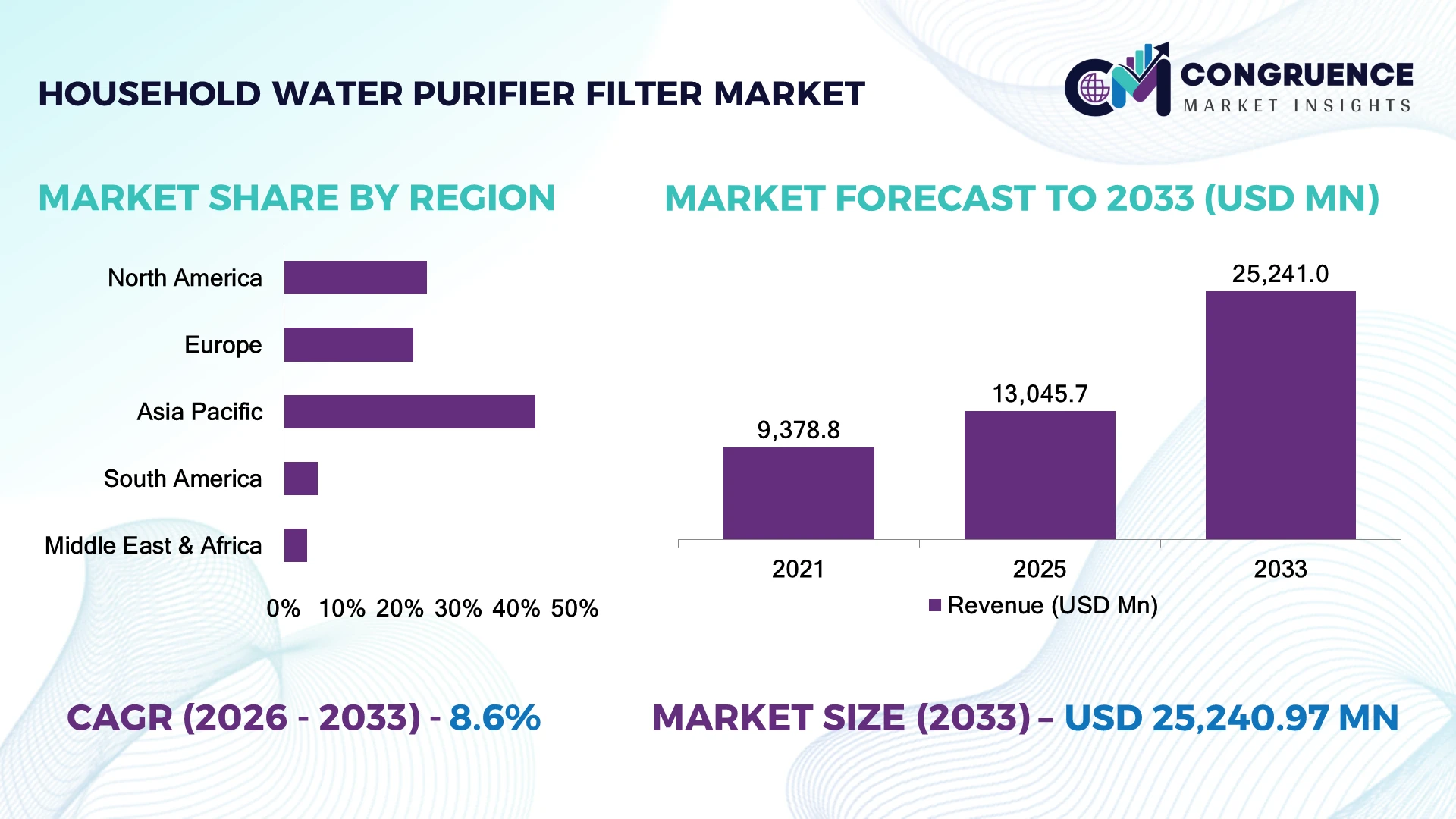
The Global Household Water Purifier Filter Market was valued at USD 13,045.7 Million in 2025 and is anticipated to reach a value of USD 25,241.0 Million by 2033 expanding at a CAGR of 8.6% between 2026 and 2033. Growth is being driven by tighter drinking-water quality requirements, rising replacement demand for membrane and activated-carbon filters, and household migration toward point-of-use purification in water-stressed cities.
China holds a dominant position, supported by large-scale domestic filtration manufacturing, dense urban housing, and expanding smart purifier adoption, while India is accelerating through decentralized water treatment and appliance penetration. China represents approximately 24% of global household purifier demand, compared with about 9% for India, with smart and multi-stage systems gaining traction across major urban markets. Geopolitical supply-chain diversification is also encouraging manufacturers to localize membrane, pump, and filter-cartridge production.
Manufacturers that combine localized supply, efficient filtration performance, and recurring replacement-filter models are best positioned to capture high-growth household demand.
Market Size & Growth: USD 13.05 billion in 2025 to USD 25.24 billion by 2033 at 8.6% CAGR, driven by membrane adoption and replacement-filter demand.
Top Growth Drivers: Urban water-quality concerns 31%, replacement demand 24%, and smart-purifier adoption 18% represent the strongest demand contributors.
Short-Term Forecast: By 2028, smart monitoring and optimized filtration are positioned to reduce maintenance costs by 10–15% while improving filter-utilization efficiency by 12%.
Emerging Technologies: RO membranes, UV-LED purification, and IoT-enabled filter monitoring are expanding, with connected systems targeting 15%+ adoption in premium urban households.
Regional Leaders: Asia-Pacific is projected to exceed USD 11 billion, North America USD 5 billion, and Europe USD 4 billion by 2033, led by different adoption and replacement cycles.
Consumer/End-User Trends: Approximately 35% of premium-category buyers increasingly prioritize multi-stage filtration, lower water wastage, and cartridge-life indicators over basic purification alone.
Pilot/Case Example: 2025 smart-purification deployments demonstrated approximately 10% lower unnecessary cartridge replacement through usage-based monitoring and automated replacement alerts.
Competitive Landscape: Leading manufacturers collectively command an estimated 30%+ share, with competition led by Coway, Brita, Eureka Forbes, A. O. Smith, and Panasonic.
Regulatory & ESG Impact: Efficiency-focused designs targeting 15–25% lower reject-water generation are gaining importance as water conservation becomes a stronger purchasing criterion.
Investment & Funding: Industry investment is increasingly directed toward membrane manufacturing, localized cartridge production, connected appliances, and strategic distribution partnerships across India and Southeast Asia.
Innovation & Future Outlook: Next-generation purifiers are shifting toward sensor-led maintenance, hybrid membrane-UV architectures, recyclable cartridges, and subscription-based filter replacement models.
Household water purifier filters are becoming more technology-intensive as consumers move from basic sediment and activated-carbon cartridges toward RO, UV, ultrafiltration, and hybrid systems. Replacement filters represent a recurring demand pool, with approximately 40% of installed-system economics increasingly linked to consumables and servicing. In 2026, manufacturers are prioritizing compact systems, lower reject-water ratios, and locally sourced components as supply-chain resilience becomes commercially important.
The household water purifier filter market is becoming strategically important because purification performance is increasingly tied to appliance intelligence, recurring consumables, and household water-management economics. Manufacturers are moving beyond one-time appliance sales toward cartridge ecosystems, service contracts, digital monitoring, and subscription replacement models. This shift strengthens customer retention while creating predictable aftermarket revenue opportunities.
Technology differentiation is becoming measurable. Modern multi-stage systems combining RO, UV, and membrane filtration can improve contaminant-removal consistency by approximately 10–20% versus basic single-stage filtration, while sensor-based systems reduce unnecessary filter changes by roughly 10–15%. China retains scale advantages through manufacturing depth, whereas India is expanding deployment through urban household penetration and localized appliance production. Southeast Asian markets are increasingly attractive for compact, lower-capacity systems.
Over the next 2–3 years, connected purifier adoption is positioned to rise by roughly 10 percentage points in premium urban segments as consumers demand real-time TDS, filter-life, and maintenance indicators. A practical deployment model combines IoT monitoring with scheduled cartridge delivery, reducing service delays and inventory mismatches. Companies are consequently investing in localized manufacturing, membrane R&D, retail partnerships, and digital service ecosystems. Competitive advantage will increasingly depend on filtration efficiency, lifecycle economics, and control of the replacement-filter ecosystem.
Connected purification is accelerating as households prioritize measurable water quality and predictable maintenance. Smart purifiers with TDS sensors, filter-life indicators, and automated alerts are gaining traction, with premium connected systems estimated to represent 15%–20% of new urban installations. Replacement cartridges contribute roughly 35%–40% of lifetime system value, strengthening recurring-demand economics. In India, localized membrane and cartridge manufacturing is reducing exposure to imported components amid broader supply-chain diversification. Manufacturers are responding by expanding domestic assembly, integrating IoT diagnostics, and forming retail-service partnerships. The non-obvious advantage is aftermarket control: companies that standardize proprietary cartridges can improve retention while reducing unauthorized replacement rates, making installed-base expansion strategically more valuable than standalone appliance sales.
Household purifier economics remain constrained by membrane costs, electricity requirements, and reject-water management. RO-based systems can discharge approximately 20%–50% of input water depending on configuration and feed conditions, creating a significant efficiency disadvantage versus lower-waste filtration architectures. Imported membrane materials and specialized pumps also expose manufacturers to currency and logistics volatility, with component costs capable of shifting 8%–15% during supply disruptions. In India, hard-water conditions increase pretreatment requirements and shorten component life, raising service intensity. Companies are mitigating exposure through localized sourcing, multi-supplier contracts, improved recovery-ratio membranes, and hybrid RO-UV-ultrafiltration designs. The strategic pressure is clear: improving water recovery is becoming as important as contaminant removal for scalable household deployment.
The strongest opportunity lies in combining high-efficiency membranes with digital monitoring and recurring filter services. Advanced recovery systems targeting 60%–75% water utilization can materially improve operating economics, while IoT-enabled maintenance can reduce unnecessary cartridge replacement by approximately 10%–15%. India, Indonesia, and Vietnam offer attractive deployment opportunities as urban households increasingly adopt compact point-of-use purification. Subscription-based cartridge replacement can raise customer retention by an estimated 15%–20% by simplifying maintenance and preventing overdue changes. Manufacturers are investing in sensor integration, recyclable cartridge housings, localized production, and appliance-retail partnerships. A non-obvious opportunity is the underserved mid-price segment: simplified connected systems can deliver premium monitoring features without the component intensity of fully automated flagship purifiers.
The next execution challenge is maintaining reliable performance across increasingly connected purifier architectures. Sensor-enabled systems introduce software, connectivity, calibration, and cybersecurity requirements alongside conventional filtration engineering, increasing service complexity by an estimated 10%–15% compared with basic mechanical units. Rural and semi-urban markets can face intermittent connectivity and limited technician coverage, while inconsistent water chemistry complicates standardized filter-life algorithms. By 2028, manufacturers targeting connected platforms will need stronger remote diagnostics, modular electronics, and technician training to maintain deployment consistency. Companies are responding through offline-capable monitoring, predictive maintenance algorithms, regional service hubs, and standardized component platforms. The strategic issue is not connectivity itself but ensuring that digital intelligence remains accurate when water quality, infrastructure, and servicing conditions vary substantially.
Connected Maintenance Becomes Standard: IoT-enabled purifiers are moving beyond premium positioning, with connected models estimated at 15%–20% of new urban installations and filter-life alerts reducing unnecessary replacements by 10%–15%. Manufacturers are integrating TDS sensors, app diagnostics, and automated service notifications to improve retention and reduce technician visits.
Water Recovery Gains Priority: Rising scrutiny of household water wastage is shifting product engineering toward higher-recovery RO systems. Newer configurations target 60%–75% water utilization versus substantially lower recovery in conventional units. Manufacturers are redesigning membranes, pumps, and flow-control systems to lower reject-water volumes without sacrificing filtration performance.
Localized Components Reshape Supply: Supply-chain diversification is increasing domestic sourcing of membranes, pumps, housings, and cartridges, particularly in India. Localization programs are targeting 20%–30% reductions in import exposure for selected components. Producers are adding regional suppliers and dual-source contracts, improving lead-time resilience while supporting faster product customization for local water conditions.
Compact Hybrids Expand Deployment: Space constraints and varied water quality are increasing adoption of compact RO-UV-ultrafiltration combinations, particularly in dense urban housing. Hybrid systems can consolidate three treatment stages into one appliance footprint while reducing maintenance complexity by approximately 10%. Manufacturers are prioritizing modular designs, standardized cartridges, and faster installation workflows to support broader retail deployment.
Reverse osmosis (RO) systems represent the leading type, accounting for an estimated 48% of global household water purifier filter demand. Their dominance reflects broad dissolved-solids removal, compatibility with multi-stage architectures, and established consumer familiarity in markets such as India and China. UV filtration holds approximately 18%, while ultrafiltration and activated-carbon systems collectively represent about 24%, retaining strong relevance where lower energy use and reduced water wastage are priorities. Manufacturers are improving membrane recovery, pump efficiency, and compact system design to protect RO's installed-base advantage while reducing operating penalties.
Ultrafiltration is the fastest-growing type, with adoption expanding approximately 12%–15% faster than mature gravity and basic carbon systems as households seek lower-energy treatment. Hybrid RO-UV-UF configurations are gaining traction because they combine dissolved-solids and microbial treatment within one platform. Companies are increasing investment in modular cartridges, localized membrane production, and application-specific filtration architectures. The strategic shift favors manufacturers capable of balancing purification performance, water efficiency, replacement economics, and localized water-quality requirements.
A 2025 India household-treatment study found that 41.7% of households practiced some form of water treatment, while urban treatment prevalence reached 56.5%; electronic purifiers accounted for 3.3% of reported treatment practices, highlighting substantial headroom for appliance-based purification adoption.
Drinking water remains the leading application, representing an estimated 57% of household water purifier filter demand because purification is directly linked to microbiological safety, dissolved solids, taste, and odor. Cooking-water purification accounts for approximately 24%, supported by households seeking treated water for food preparation rather than relying solely on boiling. Broader domestic or whole-house applications comprise the balance and remain more dependent on plumbing infrastructure and household purchasing power. Manufacturers are responding with compact multi-stage systems, dedicated drinking-water outlets, and modular installations that reduce deployment complexity by approximately 15%–20%.
Whole-house filtration is the fastest-growing application as higher-income households increasingly address water quality across kitchens, bathrooms, and appliances. Adoption is estimated to be accelerating 10%–14% faster than traditional drinking-point systems in premium urban housing. Companies are expanding point-of-entry configurations combining sediment, carbon, and specialized media. The business opportunity extends beyond appliance sales: broader household coverage increases cartridge consumption, service frequency, and customer lifetime value, encouraging manufacturers to develop integrated filtration ecosystems rather than isolated point-of-use products.
A 2025 field trial covering 239 households in Colombia and Mexico achieved WHO-recommended turbidity levels in more than 97% of samples, demonstrating the operational potential of automated household treatment where centralized water quality remains inconsistent.
Urban households are the dominant end-user group, accounting for an estimated 68% of household water purifier filter demand because of higher appliance penetration, greater purchasing power, and exposure to variable municipal and building-level water quality. Apartment households represent the strongest deployment cluster, while detached-home users show greater suitability for point-of-entry systems. Approximately 42% of urban buyers increasingly prioritize filter availability and maintenance convenience alongside purification performance. Manufacturers are responding with compact designs, subscription-based cartridge programs, financing options, and retailer-linked installation services.
Middle-income households in India, Indonesia, and Vietnam represent the fastest-expanding buyer group as purification moves beyond premium households into broader urban and semi-urban markets. This segment accounts for an estimated 20%+ of new system additions across selected high-growth urban markets. Established buyers increasingly favor connected monitoring, while emerging buyers prioritize affordability and cartridge accessibility. Companies are therefore developing localized product tiers, regional service networks, and modular RO-UV-UF platforms. The competitive advantage is shifting toward manufacturers that can combine lower acquisition costs with dependable aftermarket support.
The World Health Organization's 2026 evaluation program assessed 21 additional household water-treatment products in its latest testing rounds, reinforcing performance verification as an increasingly important consideration for procurement, regulation, and household-treatment technology selection.
Asia-Pacific accounted for the largest market share at 43.2% in 2025 however, North America is expected to register the fastest growth, expanding at a CAGR of 9.6% between 2026 and 2033.
Smart filtration is shifting the market toward premium, service-led replacement models
North America represented approximately 24.6% of global household water purifier demand in 2025, supported by established filtration penetration, aging municipal infrastructure, and heightened attention to contaminants such as PFAS. The U.S. dominates regional consumption, while Canada maintains a smaller but technologically mature installed base. Connected filtration, real-time TDS monitoring, and multi-stage RO-UV-carbon configurations are strengthening premium demand. Regulatory action on PFAS is accelerating specification upgrades, pushing manufacturers toward certified contaminant-reduction performance. Companies are responding with subscription cartridge programs, connected diagnostics, extended-life membranes, and installer partnerships. The competitive advantage is increasingly shifting from hardware placement toward lifetime filtration performance and recurring replacement economics.
U.S. Market Outlook: The U.S. accounts for roughly 85% of North American demand and benefits from extensive retail, installer, and aftermarket networks. PFAS standards introduced in 2024 are reinforcing demand for advanced filtration, while more than 100 million residents are served by water systems affected by PFAS concerns. Manufacturers are prioritizing certified reduction technologies and smart monitoring to strengthen premium positioning.
Regulatory precision is accelerating premium filtration specifications
Europe accounted for approximately 22.3% of global demand in 2025, with Germany, France, Italy, and the United Kingdom forming the principal consumption base. Drinking-water regulation, PFAS awareness, sustainability requirements, and aging residential infrastructure are reinforcing demand for higher-performance filtration. Smart purifier adoption increased by approximately 27% during 2025, indicating a shift toward electronically monitored systems. Manufacturers are emphasizing recyclable cartridges, longer service intervals, and compact multi-stage architectures to satisfy environmental and performance requirements.
Germany Market Outlook: Germany is the strongest European market because of its premium appliance ecosystem, engineering capabilities, and established household water-treatment infrastructure. Germany, France, Italy, and the U.K. collectively represent more than 67% of European demand, giving German manufacturers and distributors substantial regional scale. Companies are increasingly integrating smart monitoring and efficient filtration into premium kitchen systems.
Manufacturing scale is converging with mass residential adoption
Asia-Pacific held approximately 43.2% of the global household water purifier market in 2025, making it the largest demand center. China and India are the principal volume markets, supported by dense urban populations, expanding middle-class households, and persistent water-quality concerns. RO systems represented approximately 48.4% of domestic purifier technology demand, while localized manufacturing enables aggressive cost positioning. Companies are expanding regional assembly, membrane production, e-commerce distribution, and service networks. The strategic shift is toward compact, affordable systems with mineralization and smart-monitoring functions rather than conventional single-stage filtration.
China Market Outlook: China combines the region's strongest manufacturing ecosystem with extensive household appliance penetration and sophisticated component supply chains. The country's broader water purifier market is projected at approximately USD 7.82 billion in 2026, demonstrating substantial commercial scale. Manufacturers are using domestic membrane, electronics, and appliance capabilities to lower unit costs while integrating connected purification and automated filter-life monitoring.
Urban water-quality variability is strengthening decentralized purification demand
South America represents a smaller but strategically important household filtration market, with Brazil serving as the principal demand and distribution center. Urbanization, uneven infrastructure quality, and increasing household preference for point-of-use purification are supporting countertop, under-sink, and RO systems. Brazil is becoming an important center for appliance distribution and replacement-filter sales. Manufacturers are responding through regional distributors, compact systems, and lower-maintenance cartridges that reduce installation complexity. The main commercial constraint remains affordability, making cost-per-liter and replacement frequency decisive purchasing metrics. Suppliers with localized inventory and service coverage are better positioned to convert first-time users into recurring cartridge customers.
Brazil Market Outlook: Brazil provides the strongest South American platform because of its population scale, extensive urban housing base, and established consumer-appliance distribution. Household filtration demand is increasingly concentrated in major metropolitan areas, where consumers seek additional treatment beyond municipal supply. Manufacturers are emphasizing compact RO configurations, locally stocked replacement cartridges, and retail partnerships to improve affordability and service responsiveness.
Water-security investment is creating premium filtration opportunities
Middle East & Africa is supported by water scarcity, desalination dependence, rapid urban development, and rising investment in residential infrastructure. Gulf markets show stronger demand for advanced RO and multi-stage systems, while South Africa and Egypt provide broader opportunities for point-of-use filtration. RO configurations represent a substantial share of premium installations in Gulf households, where desalinated water and mineral-quality concerns influence purchasing decisions. Companies are increasingly combining filtration equipment with installation, maintenance, and replacement-cartridge services. The strategic opportunity is strongest for suppliers capable of delivering high-efficiency membranes, compact systems, and reliable local technical support alongside equipment.
Saudi Arabia Market Outlook: Saudi Arabia has the region's strongest strategic position because household water treatment is closely connected with desalination-intensive supply infrastructure and large-scale urban development. Vision 2030-linked water investments are reinforcing modernization across the water ecosystem. Manufacturers are prioritizing high-capacity RO membranes, mineralization stages, smart monitoring, and service networks capable of supporting premium residential developments and expanding urban household installations.
The household water purifier filter market pits A. O. Smith, Coway, and BRITA’s premium platforms against India-focused leaders Eureka Forbes and KENT, while digital-first brands compete on affordability and service. The top five players collectively hold about 21% of market share, indicating fragmentation. Competition centers on filtration performance, replacement economics, distribution, and smart features: premium systems command roughly 15–25% price premiums, while efficient designs target 20–30% lower water wastage. Established brands are expanding service networks, integrating IoT diagnostics, and extending cartridge life; challengers use direct-to-consumer channels, subscription servicing, and aggressive pricing. Recent consolidation, including A. O. Smith’s acquisition of Pureit, is strengthening channel control and portfolio breadth. The principal entry barrier is certification plus nationwide after-sales coverage, while cartridge availability remains a pressure point. Winning requires proprietary filtration, supply, localized pricing, and recurring-service execution that converts installations into relationships.
A. O. Smith Corporation
BRITA GmbH
Coway Co., Ltd.
Eureka Forbes Limited
KENT RO Systems Ltd.
LG Electronics Inc.
Panasonic Corporation
3M Company
Culligan International
Pentair plc
Whirlpool Corporation
Livpure Pvt. Ltd.
Tata Consumer Products
Koninklijke Philips N.V.
RO membranes, UV-LED modules, activated-carbon media, and multi-stage mineralization now define filtration. UV-LED systems reduce lamp-related maintenance by about 20%, while newer low-pressure RO architectures can cut energy consumption 10–15%. Smart TDS sensors, filter-life algorithms, and app alerts are moving from models into mass-market platforms, with connected functionality present in roughly 15% of new premium installations. This gives manufacturers diagnostic visibility and creates recurring cartridge-service opportunities.
The clearest technology shift is from conventional fixed-stage purifiers to sensor-controlled adaptive filtration. Compared with older fixed-cycle systems, demand-based monitoring can improve cartridge utilization by approximately 15% and reduce unnecessary replacement events by 10–12%. Under-sink direct-flow RO designs also reduce footprint and improve dispensing speed, benefiting appliance brands with kitchen positioning. Manufacturers are integrating water-quality displays, automatic flushing, UV sterilization, and mineral-retention controls to differentiate beyond basic removal.
Between 2026 and 2028, the competitive advantage will come from combining filtration intelligence with lower water wastage and longer cartridge life. Asia-Pacific manufacturers benefit from scale and localized components, while North American and European brands gain through certification, connected service, and premium design. Companies that commercialize smart monitoring, efficient membranes, and recyclable cartridges early will capture higher-value replacement cycles and strengthen customer retention.
August 2025 Coway surpassed 15 million cumulative water purifier sales in South Korea, equivalent to one-third of the population, reinforcing installed-base scale and replacement opportunities. The milestone strengthens recurring-service economics and validates premium filtration positioning. Source: company.coway.com
October 2024 A. O. Smith completed its acquisition of Pureit from Hindustan Unilever for INR 6.01 billion, adding a recognized Indian household purification brand and e-commerce reach. The transaction strengthened portfolio breadth and accelerated channel consolidation in India. Source: business-standard.com
June 2026 KENT RO Systems launched Sapphire, combining RO, UF, UV, alkaline, copper, TDS control, and in-tank UV across seven treatment stages. The launch strengthens premium differentiation while targeting households seeking mineral retention and comprehensive contaminant reduction. Source: tribuneindia.com
January 2025 Kent RO Systems filed draft papers for an IPO involving a 10% stake sale by existing shareholders. The proposed listing supports greater corporate visibility and provides a potential capital-market platform for expansion, technology investment, and distribution strengthening.
The Household Water Purifier Filter Market Report evaluates residential filtration demand across product types including RO, UV, UF, activated carbon, gravity-based, and multi-stage systems. Coverage spans point-of-use and point-of-entry applications, with analysis of households, apartments, premium residences, and rental properties. Regional assessment covers North America, Europe, Asia-Pacific, South America, and Middle East & Africa, with country-level evaluation of adoption, distribution, replacement cycles, and technology penetration.
The report examines membrane efficiency, UV-LED sterilization, smart sensors, IoT-enabled filter monitoring, mineralization, low-waste RO architectures, and recyclable cartridge designs. Quantitative analysis addresses segment shares, adoption levels, replacement frequency, channel contribution, and competitive participation. Strategic findings support investment planning, product localization, channel expansion, aftermarket development, partnership selection, and competitive positioning. The 2026–2033 outlook identifies priority markets, technology shifts, operational risks, and emerging niches such as connected filtration and subscription-based cartridge services.
| Report Attribute/Metric | Report Details |
|---|---|
|
Market Revenue in 2025 |
USD 13,045.7 Million |
|
Market Revenue in 2033 |
USD 25,241.0 Million |
|
CAGR (2026 - 2033) |
8.6% |
|
Base Year |
2025 |
|
Forecast Period |
2026 - 2033 |
|
Historic Period |
2021 - 2025 |
|
Segments Covered |
By Type
By Application
By End-User
|
|
Key Report Deliverable |
Revenue Forecast, Growth Trends, Market Dynamics, Segmental Overview, Regional and Country-wise Analysis, Competition Landscape |
|
Region Covered |
North America, Europe, Asia-Pacific, South America, Middle East, Africa |
|
Key Players Analyzed |
A. O. Smith Corporation, BRITA GmbH, Coway Co., Ltd., Eureka Forbes Limited, KENT RO Systems Ltd., LG Electronics Inc., Panasonic Corporation, 3M Company, Culligan International, Pentair plc, Whirlpool Corporation, Livpure Pvt. Ltd., Tata Consumer Products, Koninklijke Philips N.V. |
|
Customization & Pricing |
Available on Request (10% Customization is Free) |




