
Reports
The Global Household Miter Saw Market was valued at USD 120.0 Million in 2025 and is anticipated to reach a value of USD 180.0 Million by 2033 expanding at a CAGR of 5.2% between 2026 and 2033. Growth is driven by cordless battery-powered saw adoption, compact woodworking tools for DIY applications, and manufacturers integrating brushless motors and precision laser-guided cutting systems.
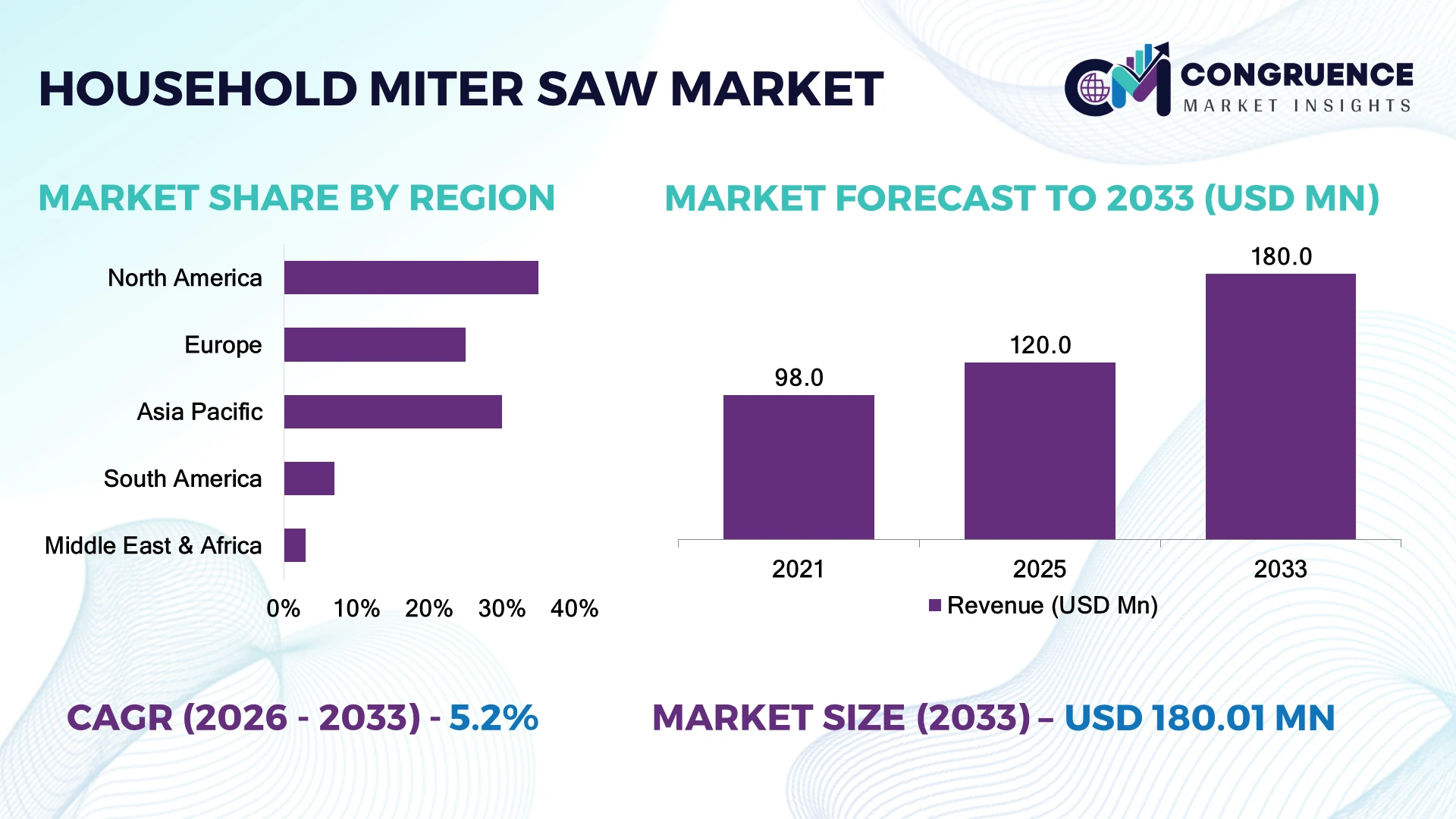
The United States dominates the market with nearly 35% share, supported by 72%+ DIY home improvement participation and strong demand from residential renovation activities. China contributes over 25% through large-scale tool manufacturing capacity, with more than 60% of global portable power tool production concentrated in Asia-Pacific supply chains. Compared with Germany, where professional-grade woodworking adoption exceeds 40%, the U.S. market shows stronger household usage.
Strategic investments in smart, efficient, and affordable cutting solutions will define competitive advantage.
Market Size & Growth: USD 120.0 Million in 2025 to USD 180.0 Million by 2033 at 5.2% CAGR, driven by cordless technology and DIY renovation expansion.
Top Growth Drivers: Cordless tool adoption 45%, residential remodeling activity 38%, brushless motor integration 30%.
Short-Term Forecast: By 2028, smart safety features and battery platforms reduce maintenance costs by 15% and improve cutting efficiency by 20%.
Emerging Technologies: AI-assisted cutting controls, lithium-ion battery systems, and lightweight composite materials are reshaping advanced miter saw designs.
Regional Leaders: North America reaches USD 65 Million with DIY adoption; Asia-Pacific reaches USD 70 Million through manufacturing expansion; Europe reaches USD 35 Million through precision woodworking demand.
Consumer/End-User Trends: Over 55% of household users prefer cordless tools due to portability and reduced setup requirements.
Pilot/Case Example: 2024 cordless woodworking tool upgrades improved operational efficiency by 18% in residential construction applications.
Competitive Landscape: Bosch leads with approximately 15% share, alongside DEWALT, Makita, Milwaukee, and Stanley Black & Decker competing through innovation.
Regulatory & ESG Impact: Battery efficiency standards and recyclable materials initiatives improve product sustainability performance by nearly 20%.
Investment & Funding: Over USD 500 Million invested across power tool innovation, automation, and battery technology partnerships globally.
Innovation & Future Outlook: Next-generation miter saws focus on connected tools, safer operation, and ecosystem-based cordless platforms.
Household Miter Saw Market solutions are increasingly shaped by demand for compact precision equipment, safer operation, and digitally enhanced woodworking capabilities. Recent product innovations emphasize brushless motor efficiency, lithium battery improvements, and ergonomic designs, with cordless models gaining more than 40% adoption among household buyers. Supply-chain localization in China, Vietnam, and Mexico is strengthening availability while manufacturers expand automated production capabilities.
The Household Miter Saw Market is becoming strategically important as manufacturers compete through battery innovation, product ecosystems, and precision-driven consumer tools rather than basic cutting equipment. The shift toward cordless platforms, accelerated by supply-chain restructuring after global disruptions, is pushing companies to localize component sourcing and strengthen regional manufacturing networks.
Advanced brushless cordless miter saws deliver approximately 20% higher operating efficiency and 25% longer tool life compared with conventional brushed motor models. The United States leads in household adoption through renovation activity, while Japan and Germany emphasize precision woodworking applications with higher demand for professional-grade compact tools. Emerging markets such as India are witnessing increasing adoption through urban housing upgrades and expanding DIY culture.
Companies are deploying connected tool platforms, investing in battery partnerships, and expanding retail ecosystems to capture changing consumer preferences. For example, manufacturers are integrating interchangeable battery systems across multiple home improvement products to improve customer retention and reduce ownership costs. Strategic positioning will depend on innovation speed, supply-chain resilience, and the ability to deliver safer, smarter, and more efficient household woodworking solutions.
The transition toward cordless household power tools is the primary growth catalyst, supported by improved lithium-ion battery performance and compact motor technology. Cordless miter saw adoption has increased by nearly 45%, while brushless motor usage has expanded by more than 30% among premium tool categories. The shift from wired equipment improves portability and reduces installation limitations for residential users. In the United States, renovation projects increasingly favor battery-powered tools, encouraging companies such as DEWALT, Makita, and Bosch to expand cordless product ecosystems. Manufacturers are responding through battery platform investments, strategic supplier partnerships, and lightweight product development. The key operational advantage is faster deployment in spaces where electrical infrastructure is limited.
Household miter saw manufacturers face pressure from battery cell pricing, semiconductor availability, and imported component dependency. Lithium battery components account for nearly 30% of cordless tool production costs, while fluctuations in raw material pricing affect profitability. China remains a major manufacturing hub, but geopolitical trade adjustments and logistics disruptions are encouraging diversification toward Vietnam, Mexico, and Eastern Europe. Companies are reducing exposure through multi-source procurement agreements and localized assembly facilities. The challenge directly impacts pricing strategies and inventory management, requiring manufacturers to balance affordability with premium technology integration. Supply-chain flexibility has become a critical factor in maintaining competitive margins.
Smart connectivity and automation represent significant opportunities as household users seek safer and more efficient woodworking solutions. Connected power tools are growing at adoption rates exceeding 20%, driven by app-based monitoring, battery management, and safety alerts. Integration of AI-assisted cutting guidance and digital measurement systems can improve accuracy by approximately 15% compared with traditional manual setups. Urban renovation growth in India and Southeast Asia is creating new demand channels for compact professional-grade tools. Companies are investing in IoT-enabled platforms, mobile applications, and ecosystem partnerships to strengthen customer engagement. The emerging opportunity lies in transforming standalone tools into connected home improvement systems.
Increasing product sophistication creates execution challenges related to user training, safety awareness, and consistent operation quality. Nearly 35% of first-time household tool buyers require guidance on advanced cutting features, creating demand for simplified interfaces and instructional support. Growing adoption of digital controls and smart features increases the need for intuitive designs and reliable software integration. Manufacturers must address usability barriers through automated safety systems, educational content, and retailer training programs. In markets such as Germany and Japan, strict quality expectations require continuous engineering improvements. Long-term competitiveness depends on balancing advanced functionality with accessibility, reliability, and sustainable product development.
Cordless Platform Expansion: Battery-powered miter saw adoption is accelerating as homeowners and contractors prioritize mobility, with cordless models capturing nearly 45% of new household tool purchases and improving workflow efficiency by 20%. Supply-chain pressures on lithium-ion components have encouraged companies to strengthen battery partnerships and expand interchangeable tool ecosystems, particularly across the United States and Japan.
Smart Cutting Integration: Digital measurement, laser guidance, and connected tool features are reshaping premium household miter saw usage, with smart-enabled tools improving cutting accuracy by approximately 15% and reducing setup time by 25%. Manufacturers are investing in IoT-based monitoring, mobile applications, and automated safety controls to differentiate products in competitive retail channels.
Compact Design Shift: Urban housing constraints and smaller workshop spaces are driving demand for lightweight saw designs, with compact models increasing adoption by nearly 30% among residential users. Companies are responding through advanced composite materials, ergonomic engineering, and portable product launches that reduce transportation effort and storage requirements.
Localized Manufacturing Growth: Global supply-chain restructuring is increasing investment in regional production networks, with manufacturers shifting nearly 20% of selected tool assembly activities closer to key markets. Trade policy adjustments and logistics volatility are encouraging expansion in Mexico, Vietnam, and India while improving delivery speed and inventory resilience for major brands.
Cordless miter saws represent the leading type segment, accounting for approximately 55% of the household market due to portability, battery efficiency, and reduced dependence on electrical infrastructure. Their dominance is strengthened by lithium-ion improvements, with modern battery platforms delivering nearly 30% longer operating cycles compared with earlier generations. Corded miter saws remain relevant among cost-sensitive users and high-frequency woodworking applications, while sliding and compound models continue gaining preference among advanced DIY users requiring greater cutting flexibility. The fastest-growing segment is smart cordless miter saws, supported by rising demand for precision controls, integrated safety features, and connected tool management. Adoption of advanced cordless platforms has increased by around 25% among premium household buyers. Companies are prioritizing modular battery systems, brushless motor innovation, and product ecosystem expansion to improve customer retention and strengthen competitive positioning.
Residential renovation is the leading application segment, representing approximately 60% of household miter saw usage as homeowners increasingly undertake flooring, furniture, cabinetry, and remodeling projects. Demand concentration is supported by growing DIY participation, with more than 50% of household tool purchases linked to home improvement activities. Professional woodworking and hobbyist applications maintain stable demand, while small workshop usage continues expanding through online tutorials and accessible tool platforms. The fastest-growing application area is home-based woodworking and creative fabrication, growing through maker communities and compact workshop adoption. This segment is expanding as users seek precision tools capable of handling customized projects with limited workspace requirements. Companies are responding through simplified controls, bundled accessories, and direct-to-consumer sales channels. Manufacturers are also strengthening digital support platforms to improve user confidence and reduce product complexity.
DIY household users represent the dominant end-user segment with approximately 65% market share, driven by increased home renovation activity, online learning resources, and affordable tool availability. Consumer buyers prioritize portability, safety, and ease of operation, leading companies to introduce lightweight designs and simplified control systems. Professional craftsmen and small contractors continue contributing significant demand through replacement cycles and higher-performance requirements. The fastest-growing end-user group is small-scale residential contractors, supported by rising renovation services and demand for efficient portable equipment. Contractor adoption is increasing by nearly 20% as compact cordless solutions improve productivity and reduce setup limitations. Manufacturers are targeting this segment through trade partnerships, financing programs, and professional-grade product lines. Large retailers are also expanding tool ecosystems to capture repeat purchases and accessory demand.
North America accounted for the largest market share at 35% in 2025 however, Asia-Pacific is expected to register the fastest growth, expanding at a CAGR of 6.1% between 2026 and 2033.

North America remains the dominant Household Miter Saw Market, contributing approximately 35% share due to strong residential remodeling activity, mature retail distribution networks, and high adoption of cordless woodworking equipment. The United States represents the largest demand center, supported by extensive home improvement spending and widespread DIY participation. Nearly 70% of household tool buyers in the region prioritize battery-powered solutions for portability and convenience. Manufacturers are expanding partnerships with retailers and investing in advanced lithium-ion platforms to strengthen consumer engagement. The region also benefits from established professional contractor networks, enabling faster adoption of premium precision-cutting technologies and connected tool systems.
United States Market Outlook: The United States leads regional demand through its large renovation ecosystem, strong consumer purchasing power, and advanced retail infrastructure. More than 60% of household miter saw purchases are linked to remodeling and woodworking applications. Leading manufacturers are expanding cordless product portfolios and strengthening distribution partnerships to capture growing demand from homeowners and small contractors.
Europe represents a mature but technology-focused market, supported by advanced woodworking industries, strict product quality standards, and rising demand for energy-efficient tools. Germany, France, and the United Kingdom account for significant regional consumption, with Europe contributing nearly 25% of global household miter saw demand. Sustainability regulations and increasing preference for durable equipment are encouraging manufacturers to improve motor efficiency and recyclable component usage. Over 40% of premium European tool users prioritize longer product life cycles and reduced maintenance requirements. Companies are responding through localized manufacturing, digital product support, and partnerships with professional tool distributors.
Germany Market Outlook: Germany remains the key European market due to its engineering expertise, advanced manufacturing base, and strong woodworking culture. Approximately 45% of professional and semi-professional users prefer precision-focused tools with enhanced safety features. Manufacturers are leveraging German demand for high-quality equipment by introducing advanced cutting systems and durable product platforms.
Asia-Pacific is the fastest-expanding market, driven by large-scale tool manufacturing capacity, urban housing development, and rising household improvement activities. The region contributes nearly 30% of global demand, with China, Japan, India, and South Korea representing major markets. China accounts for more than 60% of regional production capacity, supporting competitive pricing and global supply availability. Increasing urbanization in India and Southeast Asia is accelerating demand for compact woodworking equipment, while manufacturers are expanding automated assembly facilities. Companies are investing in local production networks, battery technology partnerships, and digital retail channels to capture emerging consumer segments.
China Market Outlook: China maintains a strategic position through its extensive power tool manufacturing ecosystem and export capabilities. More than half of global portable tool components are sourced through Asian supply networks. Domestic manufacturers are increasing automation adoption and expanding smart tool production to improve efficiency, reduce costs, and strengthen international competitiveness.
South America is an emerging market supported by residential construction activity, increasing home renovation projects, and expanding availability of affordable power tools. Brazil and Argentina represent major demand centers, with the region accounting for approximately 7% of global household miter saw consumption. Market expansion is influenced by improving retail access and online purchasing platforms, which have increased tool availability by nearly 20% in urban markets. However, currency volatility and import dependency continue affecting pricing strategies. Manufacturers are responding through regional distributor partnerships, localized inventory management, and affordable product offerings tailored to household users.
Brazil Market Outlook: Brazil represents the largest South American market due to its construction sector scale, expanding urban housing projects, and growing DIY culture. More than 50% of regional household tool demand originates from Brazil. Companies are strengthening local distribution networks and introducing cost-efficient cordless models to improve accessibility among residential users.
Middle East & Africa is developing through construction modernization, residential infrastructure projects, and increasing adoption of professional-grade household tools. The region contributes nearly 3% of global demand, with the United Arab Emirates, Saudi Arabia, and South Africa representing important markets. Large-scale urban development programs and expanding renovation activities are increasing demand for portable precision equipment. Infrastructure investments across Gulf countries have exceeded billions of dollars in recent years, creating opportunities for tool suppliers. Companies are improving regional partnerships, expanding distributor networks, and introducing durable products suited for demanding operating environments.
United Arab Emirates Market Outlook: The UAE serves as a strategic regional hub due to advanced construction activity, strong import infrastructure, and high adoption of premium equipment. More than 35% of Gulf-region professional tool imports pass through UAE distribution channels. Manufacturers are using the country as an entry point for expansion into Middle Eastern residential and commercial markets.
The Household Miter Saw Market features global power tool leaders such as DEWALT, Bosch, Makita, and Milwaukee competing against regional manufacturers and cost-focused Asian OEMs. Top five players collectively control approximately 45% share, creating a moderately consolidated structure. Competition centers on cordless technology, pricing, battery compatibility, and distribution strength, with premium brands capturing nearly 60% of advanced tool demand through performance differentiation. Global leaders expand through retail partnerships, battery ecosystem integration, and smart-tool innovation, while regional players compete through lower production costs and localized supply chains. The market is shifting toward connected equipment, brushless motors, and vertical battery platform strategies. Entry barriers include brand loyalty, manufacturing expertise, and supplier access for advanced components. Winning requires combining reliable technology, competitive pricing, strong distribution networks, and continuous product innovation to outperform established tool ecosystems.
Bosch
Makita
Milwaukee Tool
Stanley Black & Decker
Techtronic Industries
Husqvarna Group
Festool
Metabo
Hitachi Koki
Ryobi
Einhell
Skil
Kobalt
Cordless battery platforms, brushless motors, and advanced power management systems are transforming household miter saw performance. Modern lithium-ion tools deliver approximately 25–30% longer operating time than older battery systems, while brushless motors improve efficiency by nearly 20%. Adoption of cordless platforms has exceeded 45% among household users, giving manufacturers opportunities to build integrated product ecosystems.
Smart cutting technologies are emerging through laser guides, digital angle controls, and connected monitoring features. These systems improve cutting accuracy by around 15% compared with traditional manual setups and reduce adjustment time by nearly 20%. Premium brands benefit most as professional-grade features move into consumer-focused products, strengthening brand differentiation.
Between 2026 and 2028, AI-assisted guidance, automated safety controls, and modular battery compatibility will influence product development priorities. Compared with conventional corded models, next-generation cordless systems provide improved mobility and workflow flexibility. Companies investing in connected platforms, battery innovation, and ergonomic engineering will gain competitive advantages as consumers demand safer, faster, and more efficient woodworking solutions.
April 2025 — DEWALT introduced the 20V MAX XR 12-In. Double Bevel Sliding Miter Saw as part of its new cordless carpentry lineup. The product expanded cordless cutting capability with improved capacity for residential and professional applications, strengthening DEWALT’s battery-powered tool ecosystem strategy. Source: www.dewalt.mediaroom.com
November 2025 — Makita released the 10” Slide Compound Miter Saw (LS1110F), targeting finish carpenters, cabinet makers, and woodworking professionals. The launch expanded Makita’s precision cutting portfolio with enhanced portability and jobsite-focused functionality, supporting broader adoption across woodworking applications. Source: www.makitatools.com
2025 — Ryobi expanded its ONE+ HP Brushless platform with the 18V ONE+ HP 10” Sliding Compound Miter Saw, integrating brushless motor technology and lithium-ion battery performance. The tool delivers up to 550 cuts per charge and supports wider consumer adoption of cordless household woodworking equipment. Source: www.ryobitools.com
October 2025 — Bosch Power Tools expanded its 18V cordless system with new brushless tools focused on productivity, precision, and reduced user fatigue. The expansion reinforces Bosch’s cordless ecosystem approach, increasing compatibility across professional and household applications through battery-platform integration.
The Household Miter Saw Market Report covers comprehensive analysis across product types, including corded, cordless, compound, sliding, and smart-enabled models, along with applications spanning residential renovation, woodworking, hobby projects, and small-scale professional use. The study evaluates end-user segments such as DIY consumers, contractors, workshops, and household buyers across North America, Europe, Asia-Pacific, South America, and Middle East & Africa.
The report examines technology trends including lithium-ion battery systems, brushless motors, laser guidance, automation features, and connected tool platforms. With analysis of more than 10 major manufacturers, evolving supply-chain strategies, and shifting consumer adoption patterns, the report supports investment planning, competitive benchmarking, expansion decisions, and strategic positioning through 2033. It highlights emerging opportunities in compact designs, smart tools, and localized manufacturing ecosystems.
| Report Attribute / Metric | Details |
|---|---|
| Market Revenue (2025) | USD 120.0 Million |
| Market Revenue (2033) | USD 180.0 Million |
| CAGR (2026–2033) | 5.2% |
| Base Year | 2025 |
| Forecast Period | 2026–2033 |
| Historic Period | 2021–2025 |
| Segments Covered |
By Type
By Application
By End-User
|
| Key Deliverables | Revenue Forecast; Market Trends; Growth Drivers & Restraints; Technology Insights; Segmentation Analysis; Regional Insights; Competitive Landscape; Regulatory & ESG Overview; Recent Developments |
| Regions Covered | North America; Europe; Asia-Pacific; South America; Middle East & Africa |
| Companies Profiled | DEWALT; Bosch; Makita; Milwaukee Tool; Stanley Black & Decker; Techtronic Industries; Husqvarna Group; Festool; Metabo; Hitachi Koki; Ryobi; Einhell; Skil; Kobalt |
| Customization & Pricing | Available on Request (10% Customization Free) |




