
Reports
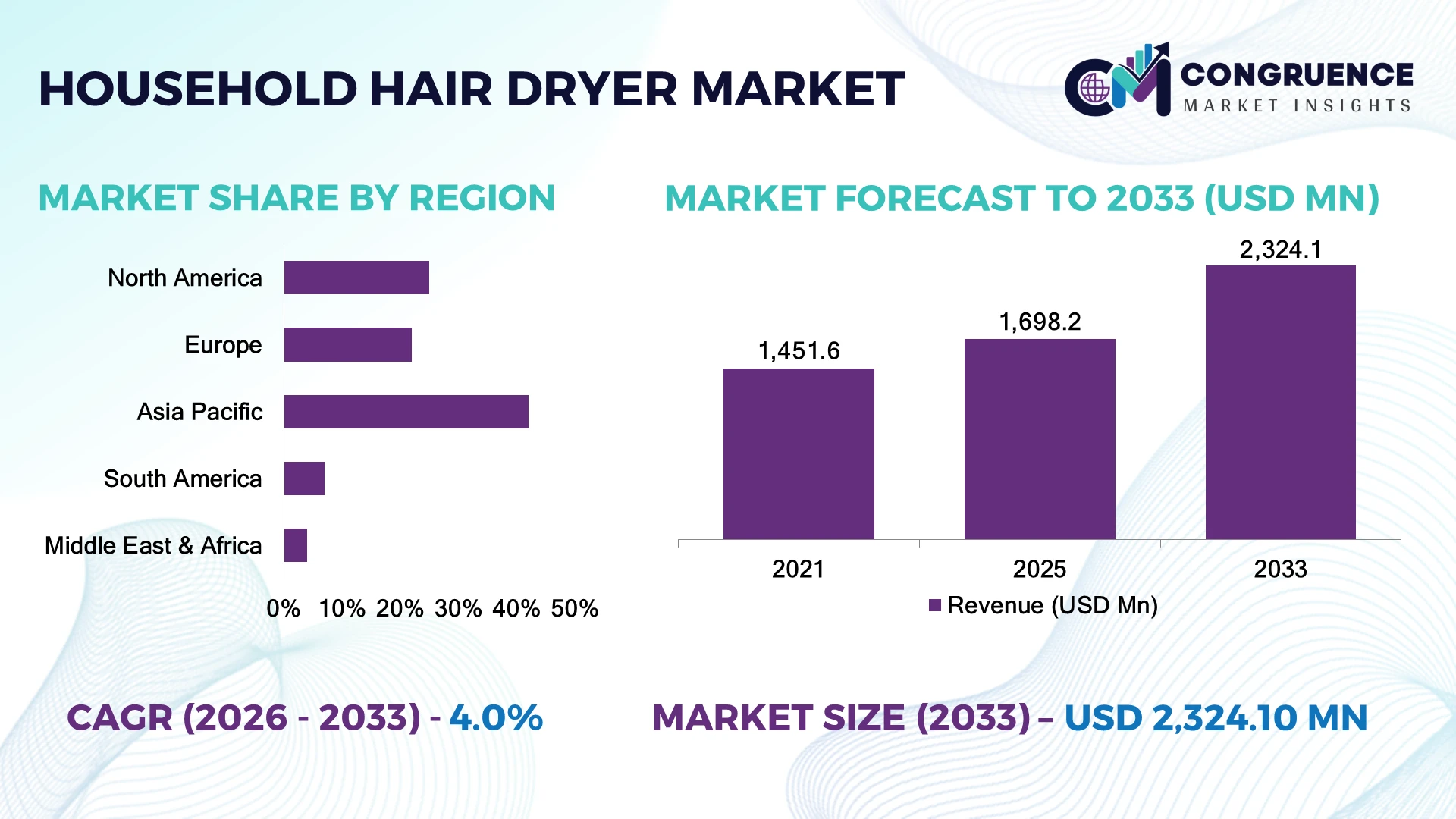
The Global Household Hair Dryer Market was valued at USD 1,698.2 Million in 2025 and is anticipated to reach a value of USD 2,324.1 Million by 2033 expanding at a CAGR of 4.0% between 2026 and 2033. Growth is being driven by brushless motors, ionic and ceramic heating, lightweight designs, faster drying cycles, and premium multi-function styling attachments.
China remains the dominant manufacturing and supply base, accounting for roughly 55–60% of global household hair-dryer production capacity, supported by concentrated electronics, motor, heating-element, and appliance-component ecosystems. Japan and South Korea lead premium technology development, while India is expanding assembly and consumer adoption. Brushless and electronically controlled models increasingly deliver 20–30% longer motor life and improved energy management. Geopolitical supply-chain diversification is encouraging brands to add Southeast Asian and Indian sourcing.
Strategically, brands that combine compact engineering, energy efficiency, premium styling performance, and diversified sourcing are best positioned to defend margins and capture upgrading consumers.
Market Size & Growth: USD 1,698.2 million in 2025 to USD 2,324.1 million by 2033, at a 4.0% CAGR, supported by brushless motors and premium multifunctional dryers.
Top Growth Drivers: Premium ionic technology 28%, lightweight designs 24%, and multifunctional styling 21% are the strongest demand catalysts.
Short-Term Forecast: By 2028, advanced motor and airflow systems are positioned to reduce drying time by 15–25% while improving energy efficiency by 10–20%.
Emerging Technologies: Brushless DC motors, AI-assisted temperature control, ionic systems, ceramic heating, and adaptive airflow are reshaping high-performance household hair dryers.
Regional Leaders: Asia-Pacific is projected at approximately USD 1.0 billion by 2033, Europe at USD 620 million, and North America at USD 560 million, with premium-device adoption strengthening.
Consumer/End-User Trends: Premium and technologically enhanced models represent roughly 35–40% of purchases in developed markets as consumers prioritize faster drying and hair-protection features.
Pilot/Case Example: 2026 premium dryer platforms using intelligent heat regulation demonstrate approximately 20% lower peak thermal exposure while maintaining drying performance.
Competitive Landscape: Leading brands collectively command a substantial premium segment, with Dyson estimated near 10–12%; Shark, Panasonic, Philips, Conair, and Groupe SEB remain major competitors.
Regulatory & ESG Impact: Energy-efficiency requirements and sustainability programs are pushing manufacturers toward recyclable plastics, longer-life motors, and approximately 10–20% lower electricity consumption.
Investment & Funding: Appliance companies are directing hundreds of millions of dollars globally toward motor miniaturization, smart controls, automation, and diversified Asian manufacturing capacity.
Innovation & Future Outlook: The market is shifting toward quieter brushless motors, sensor-controlled heating, modular attachments, connected diagnostics, and lower-energy premium appliances.
The household hair dryer market is concentrated around premium ionic dryers, lightweight brushless models, ceramic heating systems, compact travel devices, and multifunctional air-styling platforms. Ionic and temperature-control technologies increasingly influence purchasing decisions, with advanced models representing roughly 35–40% of premium-market demand. Supply-chain diversification across India and Southeast Asia is also reshaping appliance sourcing, creating a natural transition toward strategic investment considerations.
The Household Hair Dryer Market is becoming strategically important because appliance competition is shifting from basic airflow performance toward motor efficiency, thermal protection, noise reduction, and integrated styling functionality. Premium models increasingly combine multiple technologies in one device, allowing manufacturers to raise product value without relying solely on higher wattage. By 2028, intelligent heat management and brushless motor adoption are positioned to become stronger differentiators across premium and upper-mid-market products.
A significant supply-chain shift is also underway. Manufacturers are diversifying component sourcing beyond traditional Chinese production clusters toward India, Vietnam, Thailand, and other Asian manufacturing hubs. This reduces exposure to logistics disruptions while supporting shorter regional fulfillment cycles. Brushless motors can deliver approximately 10–20% better energy efficiency and substantially longer operating life than conventional brushed designs, strengthening lifecycle economics.
Regional competition remains differentiated: North America emphasizes premium technology and professional-style performance, Europe places greater weight on energy efficiency and sustainability, while Asia-Pacific combines manufacturing scale with rapid adoption of advanced consumer appliances. Companies are therefore increasing investments in motor technology, localized assembly, smart temperature controls, and modular attachments. The strategic winners through 2028 will be brands that combine reliable supply, measurable energy efficiency, premium performance, and differentiated user experience.
Brushless DC motors are becoming a major differentiator in premium household hair dryers, with advanced models delivering approximately 10–20% better energy efficiency, 20–30% longer motor life, and 15–25% faster airflow response than conventional designs. In China and Japan, compact high-speed motor platforms are accelerating premium product launches as manufacturers prioritize smaller housings and higher airflow density. This shift is moving competition beyond wattage toward motor architecture, thermal control, and acoustic performance. Companies are investing in proprietary motor systems, optimized impeller geometry, and localized component sourcing. A key operational advantage is reduced motor wear, allowing brands to support longer product lifecycles while strengthening premium pricing and after-sales positioning.
Household hair dryer manufacturers remain exposed to volatility in copper, rare-earth magnets, semiconductors, heating elements, and engineering plastics. Motor and electronic-control components can represent roughly 25–35% of manufacturing cost, while imported components can account for 30–40% of input requirements for brands with limited localization. China remains a critical sourcing hub, creating exposure to freight fluctuations, tariff changes, and geopolitical trade restrictions. Margin pressure is strongest in mid-priced models where manufacturers cannot fully pass higher component costs to consumers. Companies are responding through dual sourcing, Indian and Southeast Asian assembly, longer supplier contracts, and redesigned motor platforms. The non-obvious pressure point is that reducing component count without compromising thermal safety can improve both procurement resilience and manufacturing yield.
Intelligent temperature sensing and adaptive airflow create an underdeveloped opportunity for premium household hair dryers, with sensor-controlled systems capable of reducing excessive heat exposure by approximately 15–25% while improving energy efficiency by 10–20%. India, Indonesia, and Brazil offer attractive expansion opportunities as consumers increasingly trade up from basic dryers toward multifunctional styling appliances. Manufacturers can differentiate through infrared sensing, automatic heat adjustment, brushless motors, and interchangeable attachments rather than simply increasing power ratings. Partnerships between appliance brands, motor suppliers, and beauty-technology developers can accelerate commercialization. A particularly attractive opportunity is modular platforms that share motors, electronics, and attachments across several price tiers, lowering development costs while allowing companies to localize features for different consumer markets.
High-speed motors and compact housings create difficult thermal-management requirements, particularly as manufacturers pursue smaller devices with stronger airflow. Internal component temperatures can rise 10–20% faster in high-density architectures, increasing stress on heating elements, insulation, control electronics, and polymer housings. In India and Southeast Asia, higher ambient temperatures and inconsistent voltage conditions add further operating pressure. Manufacturers must balance airflow velocity, heater output, acoustic levels, and surface temperature within increasingly compact form factors. Advanced simulation, temperature sensors, ceramic heating elements, and automated end-of-line testing are becoming essential. The strategic challenge is maintaining premium performance without increasing failure rates or material costs. Companies that master thermal-electrical integration can achieve smaller designs while protecting warranty performance and brand reliability.
High-Speed Motors Reshape Product Design: Manufacturers are replacing conventional motors with compact brushless architectures delivering 15–25% higher airflow efficiency and 20–30% longer operating life. China-based suppliers are scaling miniature motor production, enabling lighter housings and quieter operation. Brands are increasingly treating motor efficiency as a premium differentiator rather than simply increasing wattage.
Heat Control Becomes More Precise: Infrared and electronic temperature sensing are moving into premium consumer models, reducing excessive thermal exposure by roughly 15–25%. European energy-efficiency priorities and growing hair-damage concerns are accelerating adoption. Manufacturers are integrating sensors directly into airflow systems, creating more consistent drying cycles while reducing unnecessary heater operation and improving component longevity.
Modular Styling Gains Commercial Traction: Multi-attachment platforms now account for roughly 25–30% of premium product configurations, combining drying, smoothing, volumizing, and styling functions. Companies are standardizing attachment interfaces across product families to reduce tooling complexity by approximately 10–15%. This approach expands SKU flexibility while allowing brands to sell accessories separately and increase lifetime customer value.
Supply Chains Shift Toward Asia: Appliance manufacturers are increasing sourcing from India, Vietnam, and Thailand as tariff exposure, freight volatility, and China concentration encourage supplier diversification. Localized sourcing can reduce selected component lead times by 15–25%. The non-obvious shift is greater localization of motors and electronic controls, allowing brands to customize products for country-specific voltage, plug, and performance requirements.
Corded hair dryers lead the Household Hair Dryer Market with approximately 82% share, supported by consistent power delivery, broader motor choices, and lower battery-related cost. Their established manufacturing base makes them particularly competitive across mass-market household channels in India, China, and Southeast Asia. Cordless models remain smaller but are the fastest-growing type as consumers prioritize portability, compact design, and use during travel or in spaces without convenient outlets. Cordless adoption is strengthening through higher-density lithium-ion batteries and more efficient brushless motors, while premium corded models increasingly incorporate ionic conditioning, ceramic heating, and intelligent temperature control. Companies are therefore maintaining corded volume portfolios while expanding cordless premium ranges.
The mature corded segment remains price-sensitive, with efficiency and durability driving replacement decisions, whereas cordless products can command approximately 20–30% price premiums. Travel-oriented models and high-speed compact dryers occupy important niches. Manufacturers are prioritizing modular battery platforms, lightweight housings, and common electronic architectures to reduce development complexity.
Our report analyzed that corded hair dryers represented 82.4% of global market revenue in 2025, confirming continued dominance from reliable power delivery and established consumer usage patterns.
Individual use accounts for approximately 61% of hair dryer demand, reflecting the broad installed base of household grooming appliances and frequent replacement of entry-level and mid-range units. Demand is concentrated around daily drying, basic styling, and increasingly heat-protection features. Professional use is the faster-growing application as salons and independent stylists upgrade toward high-airflow, lightweight, durable equipment capable of reducing service time. Professional-grade products increasingly incorporate ionic conditioning, ceramic heating, brushless motors, and multiple speed-temperature settings. Companies are responding by separating consumer and professional product architectures while sharing motors, control electronics, and thermal platforms to improve development efficiency.
Professional applications typically prioritize durability and operating intensity over purchase price, creating opportunities for higher-margin products. Individual buyers remain more price-sensitive, particularly in India and Southeast Asia, where online comparison increases promotional pressure. Multifunctional household dryers are narrowing the performance gap with salon equipment, intensifying competition between consumer and professional product portfolios.
A 2025 survey covering 1,000 Italian salons found clear brand-level preferences for professional hair dryers, demonstrating the importance of performance, ergonomics, and durability within commercial styling environments.
Households represent approximately 65–66% of global hair dryer demand, making individual consumers the dominant purchasing base by deployment volume. Household adoption is strongest where personal grooming appliances are widely distributed through supermarkets, electronics retailers, and e-commerce platforms. Professional salons form the fastest-growing end-user group as operators increasingly replace conventional dryers with lightweight, high-airflow equipment that improves stylist productivity. Premium household users are also adopting professional-grade technologies, including ionic conditioning and precise heat control, narrowing the traditional product distinction.
Household purchasing remains highly price-sensitive, with entry and mid-tier products competing on durability and basic performance, while premium buyers prioritize noise reduction, hair protection, motor longevity, and multifunctionality. Professional buyers place greater emphasis on continuous operating reliability and serviceability. Manufacturers are responding with differentiated channel strategies, salon partnerships, professional product lines, and direct-to-consumer premium launches. India is particularly attractive because expanding salon infrastructure and digital retail simultaneously broaden household and professional distribution.
Our report estimated that individual households accounted for 65.81% of global hair dryer market size in 2025, while professional salons represented the faster-expanding buyer group as premium equipment adoption increased.
Asia-Pacific accounted for the largest market share at 42.0% in 2025 however, Middle East & Africa is expected to register the fastest growth, expanding at a CAGR of 5.1% between 2026 and 2033.
Premiumization and high-speed engineering strengthen replacement demand
North America represents approximately 25% of the global Household Hair Dryer Market, supported by high penetration of premium personal-care appliances, strong e-commerce distribution, and established professional beauty channels. The United States concentrates most regional demand, with consumers increasingly upgrading from conventional dryers toward ionic, ceramic, brushless-motor, and temperature-controlled systems. Premium devices typically command 20–30% higher prices than conventional models, while high-speed architectures increasingly emphasize reduced drying time and acoustic performance. Major brands are expanding direct-to-consumer distribution and strengthening salon partnerships to capture both household and professional demand. Retailers are also increasing premium appliance assortment, making technology differentiation more important than basic wattage. The strategic opportunity lies in combining advanced airflow, hair-protection controls, and longer motor life within compact form factors.
United States Market Outlook: The United States remains the region's principal consumption and innovation center, supported by extensive beauty-product retail infrastructure and rapid adoption of premium personal-care electronics. More than 70% of premium-category consumers increasingly prioritize features such as heat protection, ionic conditioning, and lightweight ergonomics when upgrading appliances. Major brands are using direct-to-consumer channels, influencer-led product launches, and salon collaborations to accelerate premium positioning.
Energy efficiency and product durability reshape premium demand
Europe accounts for approximately 22% of global Household Hair Dryer Market demand, with Germany, the United Kingdom, France, and Italy forming important consumption and premium-appliance markets. Energy efficiency, repairability, material selection, and product longevity increasingly influence purchasing decisions as European sustainability requirements tighten. Advanced dryers using brushless motors and intelligent temperature regulation can reduce electricity consumption by roughly 10–20% compared with conventional operating architectures. Manufacturers are responding with recyclable polymers, longer-life components, modular attachments, and lower-noise designs. Germany and Italy also provide strong engineering and professional-beauty ecosystems, supporting technology-led product differentiation. The region's strategic importance increasingly comes from premium margins and regulatory-driven product redesign rather than volume expansion.
Germany Market Outlook: Germany provides a strong combination of engineering capability, consumer purchasing power, and established electrical-appliance distribution. German consumers show strong interest in durable, energy-efficient household appliances, encouraging manufacturers to emphasize motor longevity and controlled heat delivery. Premium hair dryers increasingly incorporate electronically regulated temperature systems, while domestic appliance retailers provide broad access to both professional-grade and mainstream products.
Manufacturing scale and premiumization reinforce market leadership
Asia-Pacific holds approximately 42% of global Household Hair Dryer Market demand and remains the principal manufacturing center for motors, heating assemblies, electronics, plastics, and finished appliances. China dominates production and export infrastructure, while Japan and South Korea contribute advanced motor, sensor, and thermal-control technologies. India is becoming increasingly important for localized assembly and domestic distribution, supported by expanding e-commerce and organized retail. Approximately 55–60% of global production capacity is concentrated within Chinese manufacturing ecosystems, creating substantial economies of scale. Companies are simultaneously diversifying selected assembly and component operations into India and Southeast Asia to reduce supply-chain concentration and improve regional responsiveness.
China Market Outlook: China remains the most strategically important country because its appliance ecosystem integrates motor manufacturing, electronics, injection molding, heating elements, packaging, and export logistics within highly developed industrial clusters. Shenzhen, Guangdong, Zhejiang, and Jiangsu support extensive supplier networks, enabling rapid product iteration and high-volume manufacturing. Manufacturers increasingly deploy brushless motors and compact high-speed architectures, strengthening China's role in both cost-efficient and premium hair-dryer production.
Brazil anchors organized retail and premium appliance adoption
South America represents approximately 7% of global Household Hair Dryer Market demand, with Brazil accounting for the majority of regional consumption because of its large consumer base, established personal-care culture, and extensive electronics distribution network. E-commerce is expanding access to imported premium dryers, while domestic brands compete strongly in entry and mid-price categories. Premium models with ionic conditioning, ceramic heating, and multiple attachments increasingly command 15–25% price premiums. Currency volatility and imported-component exposure remain important procurement considerations, encouraging distributors and manufacturers to maintain higher inventory buffers. Companies are responding through localized packaging, broader distributor networks, and selective regional assembly. The strongest commercial opportunity lies in combining accessible pricing with premium features rather than competing solely on motor power.
Brazil Market Outlook: Brazil is the region's primary commercial market, supported by a large beauty and personal-care sector and extensive pharmacy, supermarket, electronics, and online retail networks. Professional salons provide an important secondary demand channel, particularly for high-airflow and durable equipment. Manufacturers targeting Brazil increasingly adapt products to local voltage requirements and emphasize warranty coverage, replacement availability, and affordability, improving competitiveness in a price-sensitive market.
Premium hospitality and modern retail accelerate technology adoption
Middle East & Africa accounts for approximately 4% of global Household Hair Dryer Market demand, with the United Arab Emirates, Saudi Arabia, and South Africa serving as the principal commercial hubs. Premium hospitality development, expanding shopping infrastructure, and higher adoption of international beauty brands support demand for advanced dryers. Hotels and serviced residences increasingly specify compact, durable units with controlled heat and safety features, while affluent consumers favor premium high-speed products. UAE luxury retail channels provide particularly strong exposure to advanced personal-care technology, with premium models often carrying 20–30% price premiums. Companies are expanding distributor partnerships and regional inventory positions to reduce replenishment delays. Product localization, voltage compatibility, and after-sales support remain critical to maintaining channel reliability.
United Arab Emirates Market Outlook: The UAE serves as a strategic premium-appliance hub because Dubai and Abu Dhabi combine high-income consumers, luxury retail, international hospitality, and sophisticated e-commerce infrastructure. The country's hospitality sector provides a meaningful institutional channel for compact and durable hair dryers, while premium consumers increasingly favor high-speed, low-noise devices. Companies can use the UAE as a regional distribution and brand-building base for Gulf markets, supported by established logistics connectivity.
Dyson, SharkNinja, Panasonic, Philips, and Conair compete across premium innovation, mass-market scale, and value-led channels, while Remington and regional brands pressure mid-tier pricing. The top five players collectively represent approximately 34% of market value. Competition centers on motor efficiency, airflow, heat control, styling versatility, and supply economics: brushless platforms improve energy efficiency 10–20%, thermal control reduces excessive heat exposure 15–25%, and modular platforms can lower tooling complexity 10–15%. Dyson pushes sensor-enabled premium engineering; SharkNinja combines high-velocity airflow with multifunctional attachments; Panasonic and Philips emphasize hair-care technologies; Conair competes through broad distribution and price architecture. Companies are localizing assembly, expanding e-commerce, strengthening salon partnerships, and integrating motors, sensors, heaters, and attachments. The competitive shift is moving from wattage-based differentiation toward intelligent thermal management, lightweight design, and styling ecosystems. Certification, motor engineering, supplier scale, and brand recognition remain entry barriers. Winning requires measurable performance, reliable sourcing, premium differentiation, and efficient channel execution.
Dyson
SharkNinja
Panasonic Holdings Corporation
Koninklijke Philips N.V.
Conair Corporation
Groupe SEB
Spectrum Brands Holdings, Inc.
Helen of Troy Limited
Remington Products
Revlon, Inc.
Beauty Elite Group
Wahl Clipper Corporation
Solano International
Brushless high-speed motors, intelligent temperature sensing, ionic conditioning, and ceramic or streamlined heaters are defining current premium platforms. Brushless architectures can improve energy efficiency by 10–20% and extend motor life, while temperature sensors regulate heat dynamically. Premium multifunctional systems increasingly combine these technologies with interchangeable attachments, shifting differentiation from wattage toward controlled airflow and hair protection.
Sensor-based thermal management is the strongest disruptive layer. Dyson’s Nural architecture uses proximity sensing to reduce heat near the scalp, while RFID-enabled attachments automatically adjust settings. Panasonic’s nanoe systems target moisture retention, and Shark’s Heat IQ regulates temperature. Compared with conventional dryers, advanced thermal-control platforms can reduce excessive heat exposure by approximately 15–25%. These capabilities favor brands with proprietary electronics, motor engineering, and premium software-control expertise.
Between 2026 and 2028, intelligent attachments, compact high-speed motors, adaptive heating, and modular styling ecosystems will become more important. Dyson benefits from sensor and motor integration, while Panasonic and Philips leverage established hair-care technologies and global appliance channels. Manufacturers are also redesigning products around smaller housings and lower material intensity. The strategic priority is now integrating airflow, heating, sensing, and attachments into one efficient architecture, allowing brands to improve performance while supporting premium pricing and differentiated consumer experiences.
March 2025 Dyson expanded its Supersonic r range, introducing a consumer model 30% smaller and 20% lighter than the original. RFID-enabled attachments automatically adjust airflow and temperature, strengthening premium positioning while extending professional-grade precision into household premium channels. Source: dyson.com (Dyson)
September 2024 Shark Beauty launched SpeedStyle PRO and PRO FLEX systems with Heat IQ and Scalp Shield, automatically setting temperature to 50°C while maintaining airflow velocity. The launch strengthened Shark’s premium styling portfolio and salon-at-home positioning across markets. Source: sharkninja.com (SharkNinja)
May 2025 Panasonic expanded its premium nanoe hair-dryer range with EH-NA9N and EH-NA7M, using technology described as delivering 1,000 times more moisture than regular negative ions. The launch broadened premium hair-care differentiation across Middle Eastern consumer beauty markets. Source: panasonic.com (Panasonic)
January 2025 Philips documented its 5000 Series hair dryer with ThermoShield, mineral ionic care, eight-times ion performance, and 2,300W power. The platform demonstrates continued integration of thermal protection and ionic technologies into mainstream household appliance portfolios worldwide today. Source: philips.com (Philips Documents)
The Household Hair Dryer Market Report evaluates corded and cordless dryers across individual and professional applications and household, salon, and other end-user groups. Coverage spans North America, Europe, Asia-Pacific, South America, and Middle East & Africa, with country-level assessment of China, the United States, Japan, India, Germany, Brazil, and the UAE. The study evaluates established mass-market products alongside premium, travel, multifunctional, and salon-oriented formats.
Technology coverage includes conventional motors, brushless high-speed motors, ionic and nanoe systems, ceramic and advanced heaters, intelligent temperature sensing, RFID-enabled attachments, and modular styling platforms. Corded products retain roughly 82% share, while premium multifunctional systems are reshaping value capture. The report assesses manufacturing concentration, supply-chain diversification, e-commerce penetration, competitive positioning, product innovation, partnerships, and expansion priorities. Findings support investment planning, market entry, portfolio optimization, sourcing strategy, competitive benchmarking, and technology roadmaps through 2026–2033.
| Report Attribute/Metric | Report Details |
|---|---|
|
Market Revenue in 2025 |
USD 1,698.2 Million |
|
Market Revenue in 2033 |
USD 2,324.1 Million |
|
CAGR (2026 - 2033) |
4% |
|
Base Year |
2025 |
|
Forecast Period |
2026 - 2033 |
|
Historic Period |
2021 - 2025 |
|
Segments Covered |
By Type
By Application
By End-User
|
|
Key Report Deliverable |
Revenue Forecast, Growth Trends, Market Dynamics, Segmental Overview, Regional and Country-wise Analysis, Competition Landscape |
|
Region Covered |
North America, Europe, Asia-Pacific, South America, Middle East, Africa |
|
Key Players Analyzed |
Dyson, SharkNinja, Panasonic Holdings Corporation, Koninklijke Philips N.V., Conair Corporation, Groupe SEB, Spectrum Brands Holdings, Inc., Helen of Troy Limited, Remington Products, Revlon, Inc., Beauty Elite Group, Wahl Clipper Corporation, Solano International |
|
Customization & Pricing |
Available on Request (10% Customization is Free) |




