
Reports
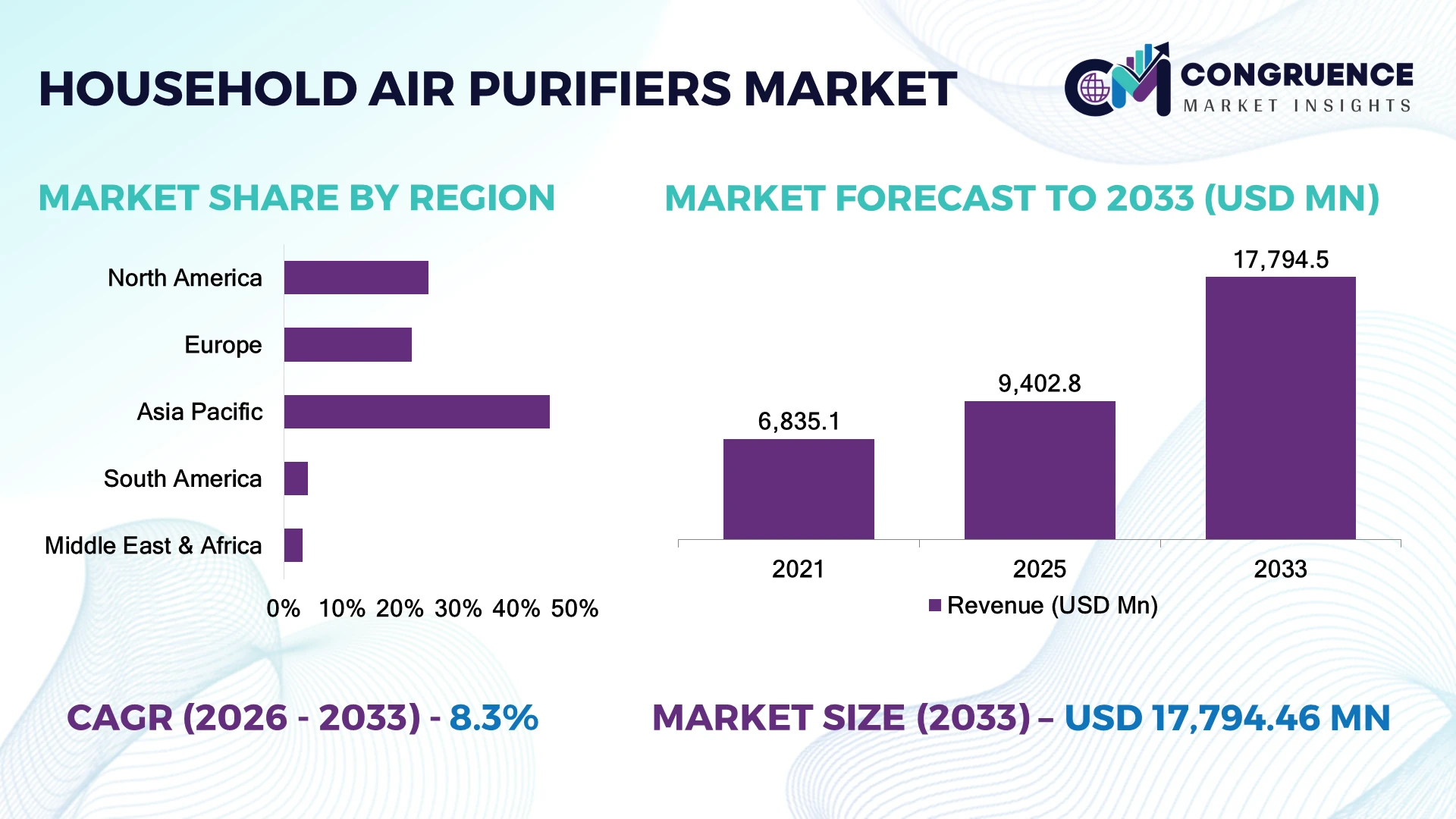
The Global Household Air Purifiers Market was valued at USD 9,402.8 Million in 2025 and is anticipated to reach a value of USD 17,794.5 Million by 2033 expanding at a CAGR of 8.3% between 2026 and 2033. Growth is driven by stricter indoor air quality standards, rising deployment of smart HEPA purification systems, and increasing replacement demand for energy-efficient residential filtration technologies.
China dominates the Household Air Purifiers market with approximately 36% of global production capacity, supported by large-scale consumer electronics manufacturing, smart appliance innovation, and vertically integrated supply chains. Compared with Japan, China ships nearly 41% more residential air purification units annually while smart Wi-Fi-enabled models account for approximately 58% of new household installations. Supply-chain diversification following geopolitical trade realignments has accelerated localized component sourcing and manufacturing resilience across the consumer appliance sector.
Manufacturers combining intelligent filtration, localized production, and connected home ecosystems are strengthening long-term competitive positioning.
Market Size & Growth: USD 9,402.8 million in 2025 to USD 17,794.5 million by 2033 at 8.3% CAGR, driven by smart filtration and indoor air quality regulations.
Top Growth Drivers: Smart purifier adoption (+34%), allergy awareness (+29%), filter replacement demand (+24%).
Short-Term Forecast: By 2028, connected purifier energy consumption declines by approximately 17% through AI optimization.
Emerging Technologies: AI air sensing, IoT connectivity, and advanced HEPA-carbon hybrid filtration accelerate product upgrades.
Regional Leaders: Asia-Pacific, North America, and Europe expand adoption through smart home integration and premium appliance demand.
Consumer/End-User Trends: Approximately 63% of urban households prefer app-enabled air purification systems.
Pilot/Case Example: A 2026 smart residential deployment improved indoor PM2.5 reduction efficiency by 27%.
Competitive Landscape: Leading brands control approximately 48% market share through technology differentiation and distribution strength.
Regulatory & ESG Impact: Energy-efficient purifier standards reduce household electricity consumption by nearly 15%.
Investment & Funding: More than USD 2.9 billion supports smart appliance manufacturing, automation, and production expansion.
Innovation & Future Outlook: Multi-function purification and predictive air quality management are redefining premium household appliances.
The Household Air Purifiers market is rapidly evolving through AI-enabled air quality monitoring, high-efficiency filtration technologies, and connected smart home ecosystems. Approximately 46% of premium residential models now incorporate real-time air quality sensors with automated purification control, improving energy efficiency and user experience. Tightening indoor air quality requirements and localized electronics manufacturing continue accelerating product innovation, providing a strong foundation for the strategic market assessment.
The Household Air Purifiers market has become strategically important as consumer electronics companies compete on connected home ecosystems rather than standalone appliances. Digital adoption, localized manufacturing, and component supply-chain restructuring are redefining product development strategies while strengthening operational resilience. Competition increasingly depends on intelligent sensing capabilities, energy efficiency, and software-enabled user experience instead of conventional filtration performance alone.
Modern AI-enabled air purifiers improve filtration efficiency by approximately 23% while reducing electricity consumption by nearly 18% compared with conventional fixed-speed systems. China leads high-volume manufacturing through integrated electronics supply chains, whereas South Korea focuses on premium smart appliance innovation with advanced sensor technologies and intelligent automation. Over the next two to three years, approximately 52% of newly launched premium residential air purifiers are expected to incorporate predictive air quality management and connected home integration.
Manufacturers are expanding partnerships with smart home platform providers, investing in advanced filter materials, and increasing regional manufacturing capacity to reduce supply-chain dependence. Multi-function appliances combining purification, environmental sensing, and automated airflow optimization are becoming the preferred deployment model for urban households. Companies integrating software intelligence, high-performance filtration, and resilient manufacturing networks will secure stronger competitive positioning as indoor air quality becomes a core component of connected residential living.
Integration of intelligent air quality monitoring with residential purification systems is accelerating market adoption across urban households. Approximately 54% of newly launched premium household air purifiers now include AI-based air quality sensors, while automated airflow optimization improves filtration efficiency by nearly 22% and reduces energy consumption by approximately 16%. South Korea's expansion of smart home ecosystems has accelerated demand for connected indoor air management devices integrated with voice assistants and home automation platforms. This shift enhances product differentiation while increasing recurring filter replacement opportunities. Manufacturers are expanding IoT-enabled product portfolios, investing in advanced HEPA and activated carbon technologies, and forming ecosystem partnerships with smart home platform providers. A strategic advantage now lies in delivering software-driven purification experiences rather than hardware performance alone.
Dependence on high-performance HEPA media, activated carbon, and electronic sensor components continues creating structural cost pressure for manufacturers. Filter assemblies account for approximately 34% of total production costs, while premium sensor component prices have increased by nearly 15% following supply-chain adjustments. Japan remains a leading supplier of advanced filtration materials, increasing procurement risks during component shortages. Rising input costs reduce pricing flexibility in the mid-range residential segment and compress manufacturer margins. Companies are mitigating these pressures through localized filter production, diversified supplier contracts, recyclable filter development, and automated manufacturing lines that improve material utilization while strengthening supply resilience.
Connected air purifiers are creating new recurring business models centered on predictive maintenance and automated filter replacement services. Approximately 43% of smart purifier users prefer app-based filter replacement reminders, while subscription programs improve customer retention by nearly 26%. China's rapid expansion of digital retail ecosystems is accelerating adoption of connected after-sales services integrated with smart appliance platforms. Manufacturers are investing in cloud-based device management, AI-powered filter diagnostics, and direct-to-consumer service ecosystems. A significant strategic opportunity lies in transforming household air purifiers from one-time hardware purchases into long-term connected service platforms generating predictable recurring customer engagement.
Increasing software integration and cloud connectivity are expanding operational complexity for smart household air purifiers. Approximately 39% of premium residential models now support remote device management, while firmware updates have increased by nearly 28% to address evolving cybersecurity and interoperability requirements. Germany's connected appliance market highlights growing consumer expectations for secure smart home integration and long-term software support. Inconsistent connectivity standards can reduce user experience and delay ecosystem compatibility. Companies must strengthen cybersecurity engineering, standardized communication protocols, cloud infrastructure investment, and long-term software maintenance strategies to sustain consumer trust and competitive differentiation in connected home environments.
AI Sensors Transform Operations: Approximately 49% of newly introduced premium household air purifiers feature AI-powered particulate sensing and adaptive purification, improving filtration efficiency by nearly 21%. Increasing smart home adoption and connected living preferences are driving deployment. Manufacturers are integrating machine learning algorithms and expanding software partnerships to deliver automated indoor air quality optimization.
Localized Manufacturing Expands Rapidly: Regional appliance production has increased by approximately 24%, while localized component sourcing has reduced logistics lead times by nearly 18%. Supply-chain diversification and geopolitical trade adjustments continue reshaping manufacturing strategies. Companies are expanding domestic assembly operations and strengthening supplier networks to improve delivery reliability and production flexibility.
Energy Optimization Gains Priority: Energy-efficient purification systems reduce electricity consumption by approximately 17% while maintaining high particulate removal performance. Updated appliance efficiency standards and rising household energy costs are accelerating demand for inverter-based airflow technologies. Manufacturers are redesigning motor systems and optimizing airflow management to improve operational efficiency without compromising purification capacity.
Multi-Function Devices Strengthen Demand: Approximately 32% of premium residential air purifiers now integrate humidification, environmental sensing, or climate control functions, increasing household utilization and reducing device redundancy. Smart appliance convergence is reshaping consumer purchasing behavior. Companies are expanding multifunction product portfolios, integrating connected ecosystems, and strengthening premium positioning through advanced indoor environmental management solutions.
HEPA air purifiers account for approximately 61% of the global Household Air Purifiers market due to their proven capability to capture fine particulate matter, broad regulatory acceptance, and compatibility with residential smart appliances. Their scalable manufacturing, standardized filtration performance, and seamless integration with activated carbon filters make them the preferred solution for allergy management and urban air pollution control. Activated carbon air purifiers remain strategically important for odor and volatile organic compound (VOC) removal, while ionic and UV-based systems serve specialized residential applications where compact design and supplementary purification functions are prioritized.
Smart hybrid air purifiers combining HEPA, activated carbon, UV-C, and IoT-enabled monitoring represent the fastest-growing segment as consumers increasingly prioritize automated indoor air quality management. These systems improve filtration efficiency by approximately 24% while reducing unnecessary operating time by nearly 18% through intelligent sensor control. Around 47% of premium product launches now feature multi-stage filtration and connected monitoring capabilities. Manufacturers are expanding smart appliance portfolios, investing in advanced filter materials, and strengthening software partnerships, reflecting a clear shift toward intelligent, integrated purification platforms.
A 2026 enterprise assessment by the Association of Home Appliance Manufacturers indicated that connected HEPA-based purification systems continued gaining share within premium residential air treatment installations because of higher filtration performance and smart automation capabilities.
Living rooms account for approximately 44% of Household Air Purifiers demand because they represent the largest shared indoor environment with continuous occupancy and higher exposure to airborne particles. Consumers increasingly install high-capacity purification systems in these areas to improve overall household air quality. Bedrooms remain a mature application supported by demand for quieter operation and sleep-focused purification, while home offices continue expanding as remote and hybrid work patterns reinforce the importance of healthier indoor environments.
Children's rooms represent the fastest-growing application as parents increasingly prioritize protection from allergens, fine particulate matter, and seasonal airborne pollutants. Approximately 36% of newly purchased premium household air purifiers are intended for children's rooms, while smart monitoring functions improve automated air quality management by nearly 22%. Manufacturers are introducing compact, low-noise products with child-safe designs, expanding app-enabled monitoring features, and strengthening retail partnerships. Demand is shifting toward application-specific air purification solutions that balance performance, convenience, and continuous indoor environmental monitoring.
A 2025 consumer appliance survey reported increasing household preference for dedicated room-based air purification, particularly in bedrooms and children's spaces, driven by growing awareness of indoor air quality management.
Urban households account for approximately 73% of the Household Air Purifiers market because higher population density, apartment living, and greater exposure to outdoor pollution create sustained demand for indoor air quality improvement. Consumers in metropolitan areas increasingly purchase connected purification systems as part of broader smart home ecosystems. Rural households maintain steady demand through seasonal allergy management and wildfire-related air quality concerns, although adoption remains comparatively lower due to reduced pollution intensity and price sensitivity.
Premium smart-home consumers represent the fastest-growing end-user segment as connected appliances become central to residential automation strategies. Approximately 42% of premium buyers prefer app-controlled purification systems integrated with voice assistants, while subscription-based filter replacement programs improve customer retention by nearly 25%. Manufacturers are targeting this segment through personalized software ecosystems, premium filtration technologies, and direct-to-consumer digital channels. Competitive positioning is increasingly shaped by recurring service models rather than hardware specifications alone.
A 2026 smart home adoption study released by the Consumer Technology Association found that connected indoor environmental devices, including intelligent air purification systems, continued expanding rapidly among households investing in integrated residential automation ecosystems.
Asia-Pacific accounted for the largest market share at 45.7% in 2025 however, Middle East & Africa is expected to register the fastest growth, expanding at a CAGR of 9.4% between 2026 and 2033.
Premium Smart Appliances Drive Replacement Demand
North America represents approximately 24.8% of the global Household Air Purifiers market, supported by high consumer awareness, premium appliance adoption, and rapid expansion of connected home ecosystems. Smart HEPA air purifiers integrated with AI-driven air quality monitoring are becoming standard across urban households, while subscription-based filter replacement programs strengthen recurring revenue streams. Approximately 58% of premium residential air purifier sales now include app-enabled monitoring and automated operation. Manufacturers are expanding domestic assembly, strengthening retail partnerships, and integrating products with broader smart home platforms to improve customer retention and accelerate premium product adoption in the residential appliance sector.
United States Market Outlook: The United States dominates the regional market through advanced consumer electronics adoption, extensive retail distribution, and strong demand for connected home appliances. Residential buyers increasingly prioritize intelligent purification systems offering real-time air quality monitoring and energy-efficient operation. Approximately 66% of premium household air purifier purchases now include Wi-Fi connectivity and automated environmental sensing, reinforcing the country's leadership in smart indoor air management technologies.
Energy Efficiency Shapes Product Innovation
Europe maintains a strong market position through strict appliance efficiency standards, increasing focus on indoor environmental quality, and growing consumer preference for sustainable home technologies. Approximately 35% of newly launched premium household air purifiers emphasize recyclable filter materials and low-energy operation. Manufacturers are redesigning products to comply with evolving environmental regulations while expanding local assembly and distribution capabilities. Smart filtration technologies continue gaining traction across urban residential markets, particularly within energy-conscious households seeking long-term operational savings.
Germany Market Outlook: Germany leads the European market through advanced engineering capabilities, premium appliance manufacturing, and strong adoption of energy-efficient residential technologies. Consumer preference increasingly favors quiet, connected, and high-performance air purification systems integrated into broader smart home environments. Approximately 41% of premium residential appliance launches now include advanced indoor air quality sensing and automated airflow optimization, strengthening Germany's technology leadership.
Manufacturing Scale Accelerates Smart Adoption
Asia-Pacific accounts for approximately 45.7% of the global Household Air Purifiers market, supported by extensive consumer electronics manufacturing, rapid urbanization, and increasing investment in connected home technologies. China, South Korea, and Japan continue driving product innovation through AI-enabled purification, high-efficiency filtration, and integrated smart appliance ecosystems. Around 61% of newly manufactured premium air purifiers in the region now incorporate real-time air quality sensing and intelligent automation. Manufacturers are expanding production capacity, localizing component sourcing, and strengthening regional supply chains to improve responsiveness and export competitiveness.
China Market Outlook: China leads the global market through vertically integrated manufacturing, large-scale electronics production, and rapid commercialization of smart household appliances. Domestic manufacturers continue expanding exports while strengthening AI-enabled product portfolios targeting premium residential consumers. Approximately 59% of newly introduced connected household air purifiers manufactured in China integrate IoT-enabled monitoring and automated filtration management, supporting its position as the industry's primary production hub.
Urban Air Quality Awareness Strengthens Demand
South America is witnessing steady expansion in household air purifier adoption as urban consumers become increasingly conscious of indoor air quality and seasonal air pollution. Residential demand is concentrated in major metropolitan areas where apartment living and changing environmental conditions support higher product penetration. Approximately 29% of premium appliance retailers have expanded smart air purifier portfolios over the past year. Manufacturers are strengthening distributor partnerships and regional service networks while balancing growth opportunities with affordability challenges and uneven retail infrastructure.
Brazil Market Outlook: Brazil remains the largest regional market due to its sizable urban population, expanding consumer appliance sector, and improving e-commerce penetration. Premium household air purifiers are increasingly positioned within connected home product portfolios, particularly in large cities. Approximately 38% of smart appliance retailers have expanded residential air purification offerings, improving consumer access to advanced filtration technologies across major metropolitan markets.
Residential Modernization Supports Premium Adoption
The Middle East & Africa market is expanding through rising investment in modern residential developments, premium home appliances, and indoor environmental quality solutions. High temperatures, dust exposure, and increasing adoption of smart residential technologies are encouraging deployment of advanced household air purification systems. Approximately 33% of newly developed premium residential communities now incorporate smart home-ready appliance ecosystems. Manufacturers are strengthening regional distribution partnerships and expanding localized after-sales support to improve long-term market penetration.
Saudi Arabia Market Outlook: Saudi Arabia leads regional demand through rapid residential modernization, expanding premium housing developments, and strong investment in connected living environments. Smart household appliances are increasingly integrated into new residential projects emphasizing comfort, automation, and energy efficiency. Approximately 44% of premium residential smart home installations now include connected indoor air quality management devices, reinforcing the country's position as the region's primary growth market for household air purifiers.
Global brands including Dyson, Coway, Blueair, Philips, and IQAir compete with value-focused manufacturers such as Xiaomi and Levoit, while smart-home innovators challenge traditional appliance specialists through software integration and connected ecosystems. The top five companies collectively account for approximately 51% of the global market. Competition centers on filtration efficiency, intelligent sensing, energy optimization, and filter lifecycle rather than price alone. AI-enabled purification improves operating efficiency by nearly 22%, while long-life filter technologies reduce replacement frequency by approximately 30%. Companies are expanding regional manufacturing, strengthening retail partnerships, integrating proprietary mobile applications, and vertically aligning filter production with finished appliances. Competitive advantage is shifting from standalone hardware toward connected air quality platforms with predictive automation and subscription-based filter services. High certification requirements, advanced filter engineering, and trusted distribution networks remain significant entry barriers. Winning requires differentiated smart technology, resilient supply chains, premium filtration performance, and recurring customer engagement beyond the initial hardware sale.
Dyson Ltd.
Coway Co., Ltd.
Blueair AB
IQAir AG
Xiaomi Corporation
Levoit
Winix Inc.
Sharp Corporation
Panasonic Corporation
Honeywell International Inc.
Daikin Industries, Ltd.
Camfil AB
Alen Corporation
LG Electronics Inc.
Artificial intelligence, multi-stage HEPA H13 filtration, laser particle sensing, and IoT connectivity are defining current technology leadership in household air purifiers. Approximately 55% of premium residential models now incorporate real-time PM2.5 monitoring with automatic airflow adjustment, improving filtration efficiency by nearly 23% while reducing electricity consumption by approximately 17%. Connected mobile applications enable predictive filter maintenance, remote diagnostics, and personalized indoor air quality management, creating stronger customer retention and recurring service opportunities.
Emerging technologies include long-life composite filters, formaldehyde decomposition catalysts, UV-C integration, and edge-based environmental analytics. Compared with conventional fixed-speed purification systems, AI-enabled adaptive purification improves particulate removal efficiency by approximately 26% while lowering unnecessary fan operation by nearly 19%. Premium brands benefit most because intelligent automation strengthens product differentiation, supports subscription-based filter replacement programs, and increases ecosystem integration with connected home platforms.
Between 2026 and 2028, predictive environmental intelligence, recyclable filtration materials, and multi-function climate management systems will reshape residential air purification. Deployment of cloud-connected purification platforms is expected to exceed 60% within premium product portfolios, while modular filtration designs shorten maintenance time by nearly 24%. Companies investing in software capabilities, advanced filtration materials, and localized manufacturing will secure stronger competitive positioning as consumers increasingly prioritize intelligent indoor environmental management over conventional standalone purification devices.
September 2025 Dyson introduced the HushJet Purifier Compact featuring jet-inspired airflow and filters designed to last five times longer while capturing 99.97% of particles as small as 0.3 microns, strengthening its premium technology positioning. Source: dyson.com
June 2025 Blueair launched the Blue Signature series with a 7-stage filtration system delivering 10× greater odor removal through OdorFence technology, expanding its premium smart purification portfolio and reinforcing differentiation in compact residential products. Source: blueair.com
April 2026 SharkNinja unveiled the Shark BreatheClear Max with NeverChange technology, scanning indoor air 3,600 times per hour while capturing 99.98% of airborne irritants, reducing maintenance requirements and strengthening competition in intelligent residential purification. Source: newsroom.sharkninja.com
May 2026 Dyson launched the Find+Follow Purifier Cool with intelligent occupant tracking that automatically directs purified airflow toward users while reducing unnecessary operation through automated room detection, strengthening energy-efficient premium residential air treatment. Source: Dyson.
This report provides a comprehensive evaluation of the Household Air Purifiers market across major product types, residential applications, end-user categories, competitive positioning, and regional demand dynamics. It assesses HEPA, activated carbon, ionic, UV, and hybrid purification technologies across living rooms, bedrooms, children's rooms, home offices, and other residential spaces. The study further analyzes consumer purchasing behavior, smart appliance integration, premium product adoption, and evolving filtration technologies across North America, Europe, Asia-Pacific, South America, and the Middle East & Africa.
The analysis covers technology adoption, deployment trends, manufacturing strategies, and competitive benchmarking between 2026 and 2033. Approximately 55% of premium household air purifiers now integrate intelligent sensing and connected ecosystem capabilities, highlighting the market's transition toward software-enabled indoor air management. Strategic insights support investment planning, product portfolio optimization, regional expansion, partnership evaluation, competitive differentiation, and long-term positioning across the rapidly evolving residential air quality and smart home appliance ecosystem.
| Report Attribute/Metric | Report Details |
|---|---|
|
Market Revenue in 2025 |
USD 9,402.8 Million |
|
Market Revenue in 2033 |
USD 17,794.5 Million |
|
CAGR (2026 - 2033) |
8.3% |
|
Base Year |
2025 |
|
Forecast Period |
2026 - 2033 |
|
Historic Period |
2021 - 2025 |
|
Segments Covered |
By Type
By Application
By End-User
|
|
Key Report Deliverable |
Revenue Forecast, Growth Trends, Market Dynamics, Segmental Overview, Regional and Country-wise Analysis, Competition Landscape |
|
Region Covered |
North America, Europe, Asia-Pacific, South America, Middle East, Africa |
|
Key Players Analyzed |
Dyson Ltd., Coway Co., Ltd., Blueair AB, IQAir AG, Xiaomi Corporation, Levoit, Winix Inc., Sharp Corporation, Panasonic Corporation, Honeywell International Inc., Daikin Industries, Ltd., Camfil AB, Alen Corporation, LG Electronics Inc. |
|
Customization & Pricing |
Available on Request (10% Customization is Free) |




