
Reports
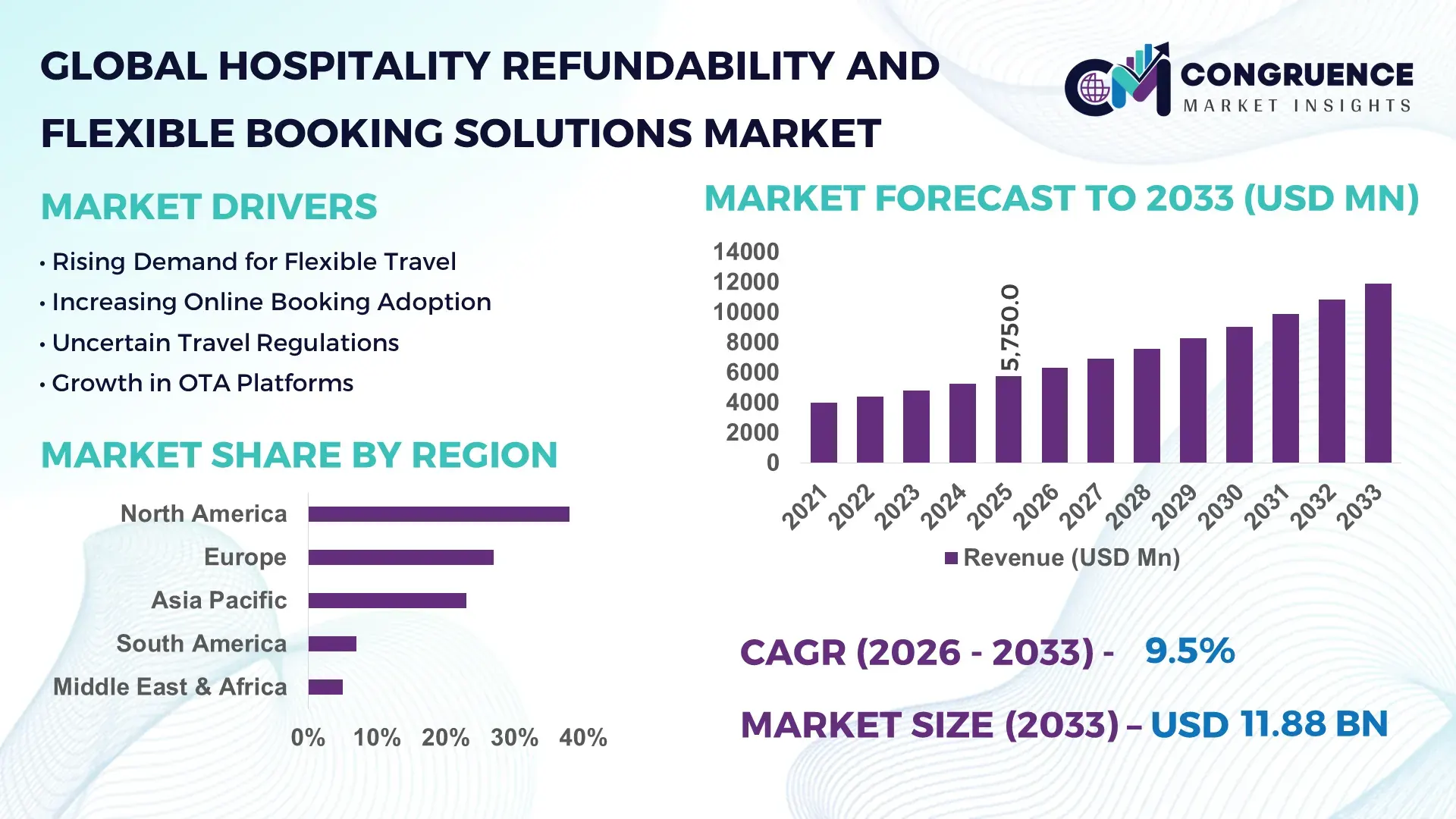
The Global Hospitality Refundability and Flexible Booking Solutions Market was valued at USD 5,750.0 Million in 2025 and is anticipated to reach a value of USD 11,884.5 Million by 2033 expanding at a CAGR of 9.5% between 2026 and 2033, according to an analysis by Congruence Market Insights. Growth is primarily driven by rising consumer demand for risk-free travel planning and flexible cancellation policies amid increasing booking uncertainties.
The United States leads the Hospitality Refundability and Flexible Booking Solutions Market with advanced digital booking infrastructure and high consumer adoption of flexible travel options. Over 68% of U.S. travelers prefer refundable bookings, while more than 72% of hotel chains have integrated flexible cancellation engines within their reservation systems. The country has witnessed over USD 1.2 billion in investments toward AI-enabled booking platforms and dynamic pricing systems. Additionally, more than 60% of online travel agency transactions in the U.S. now include flexible booking add-ons, supported by cloud-based reservation technologies and automated refund processing systems, enhancing operational efficiency and customer satisfaction.
Market Size & Growth: USD 5,750.0 Million in 2025 projected to reach USD 11,884.5 Million by 2033 at 9.5% CAGR, driven by increasing demand for flexible travel policies and digital booking platforms.
Top Growth Drivers: 72% traveler preference for flexible bookings, 65% OTA integration rate, 58% improvement in customer retention through refund options.
Short-Term Forecast: By 2028, automation in refund processing is expected to reduce processing time by 40% and improve booking conversion rates by 28%.
Emerging Technologies: AI-driven dynamic pricing, blockchain-based refund authentication, and cloud-native reservation management systems.
Regional Leaders: North America projected at USD 4,200 Million by 2033 with strong OTA penetration, Europe at USD 3,100 Million driven by regulatory compliance, Asia-Pacific at USD 2,900 Million supported by mobile-first booking growth.
Consumer/End-User Trends: Over 66% of millennials and Gen Z travelers prioritize refundable options, with mobile bookings accounting for 70% of flexible reservations.
Pilot or Case Example: In 2024, a global hotel chain implemented AI-based refund automation, reducing claim resolution time by 35% and improving customer satisfaction scores by 22%.
Competitive Landscape: Market leader holds approximately 24% share, followed by major players such as Expedia Group, Booking Holdings, Amadeus IT Group, Sabre Corporation, and Travelport.
Regulatory & ESG Impact: Stricter EU consumer protection laws have increased refundable booking adoption by 30%, while sustainability-linked travel policies are influencing flexible booking offerings.
Investment & Funding Patterns: Over USD 2.5 billion invested in travel tech startups focusing on flexible booking solutions, with rising venture capital in AI-powered reservation systems.
Innovation & Future Outlook: Integration of predictive analytics and personalized booking engines is expected to enhance conversion rates and customer loyalty in the coming years.
Flexible booking solutions are increasingly embedded across airline, hotel, and vacation rental segments, with hotels contributing nearly 52% of adoption, followed by airlines at 34%. AI-powered cancellation prediction tools and instant refund APIs are transforming customer experience. Regulatory mandates across Europe and North America, combined with rising mobile booking penetration in Asia-Pacific, are accelerating adoption, while subscription-based travel flexibility models are emerging as a key innovation shaping future demand.
The Hospitality Refundability and Flexible Booking Solutions Market holds strong strategic relevance as travel businesses prioritize customer-centricity, risk mitigation, and revenue optimization in a volatile global environment. Flexible booking capabilities are now integral to digital transformation strategies across hotels, airlines, and online travel agencies, enabling businesses to improve booking conversion rates by over 25% while reducing customer churn. AI-powered booking engines deliver 30% improvement compared to traditional static reservation systems by enabling real-time pricing adjustments and predictive cancellation analytics.
North America dominates in volume, driven by high OTA penetration and advanced digital infrastructure, while Asia-Pacific leads in adoption with over 64% of travelers preferring mobile-based flexible booking solutions. The rapid integration of AI and machine learning in booking systems is enabling personalized refund policies, improving customer satisfaction scores by up to 20%. By 2028, predictive analytics and automation technologies are expected to cut refund processing time by 45% while enhancing operational efficiency across hospitality platforms.
From a compliance and ESG perspective, firms are committing to improved transparency and sustainability, including 35% reduction in manual processing workflows and paperless refund systems by 2030. In 2024, a U.S.-based hospitality platform achieved a 38% reduction in refund turnaround time through AI-driven automation and blockchain-based transaction validation.
Looking ahead, the Hospitality Refundability and Flexible Booking Solutions Market is positioned as a critical pillar of resilience, enabling businesses to navigate uncertainties, meet evolving consumer expectations, and drive sustainable, technology-driven growth across the global travel ecosystem.
The Hospitality Refundability and Flexible Booking Solutions Market is experiencing dynamic transformation due to shifting consumer expectations, digital innovation, and evolving regulatory frameworks. Travelers increasingly demand flexibility, transparency, and instant refunds, prompting service providers to redesign booking architectures. The integration of AI, cloud computing, and automation has enabled faster processing of cancellations and refunds, reducing operational inefficiencies. Additionally, mobile-first booking behavior and the expansion of online travel agencies are accelerating adoption across global markets. Hospitality providers are leveraging data analytics to predict cancellation trends and optimize pricing strategies. Meanwhile, government regulations emphasizing consumer rights are further influencing refund policies, especially in regions such as Europe and North America. Strategic partnerships between hotels, fintech firms, and travel platforms are enhancing solution capabilities, ensuring seamless customer experiences while maintaining revenue stability.
The increasing preference for risk-free travel is a primary driver of market growth, with more than 70% of global travelers prioritizing flexible booking options. Consumers are increasingly unwilling to commit to non-refundable bookings due to uncertainties such as travel disruptions, health concerns, and economic fluctuations. Hotels and airlines have responded by integrating flexible cancellation policies, resulting in a 25–30% increase in booking conversions. Additionally, digital platforms offering instant refunds and policy customization have significantly improved customer retention rates by over 20%. Corporate travel policies are also evolving, with over 60% of enterprises mandating flexible booking options for employee travel. This shift is compelling service providers to invest in advanced reservation systems, automated refund workflows, and AI-driven decision-making tools, further strengthening market demand.
Despite strong demand, the market faces challenges due to increased operational costs associated with flexible booking policies. Refund processing, dynamic pricing adjustments, and cancellation management require significant technological investments and infrastructure upgrades. Hospitality providers often experience revenue volatility, as flexible bookings lead to higher cancellation rates, sometimes exceeding 35% during peak uncertainty periods. Additionally, managing real-time inventory availability becomes complex, especially for small and mid-sized hotels lacking advanced systems. The cost of integrating AI-based booking platforms and maintaining secure payment gateways further adds to financial burdens. These factors limit adoption among smaller players and create pricing challenges, as businesses must balance flexibility with profitability while maintaining competitive offerings.
Digital transformation presents significant opportunities for market expansion, particularly through AI and automation technologies. AI-driven predictive analytics enables hospitality providers to forecast cancellation patterns with accuracy levels exceeding 80%, allowing for better inventory management and pricing strategies. The adoption of blockchain for secure and transparent refund processing is gaining traction, improving transaction reliability and reducing fraud incidents by up to 25%. Emerging markets in Asia-Pacific and Latin America are witnessing rapid growth in mobile-based booking platforms, with adoption rates exceeding 65%. Additionally, the rise of subscription-based travel models offering flexible booking privileges is creating new revenue streams. Partnerships between fintech firms and hospitality providers are further enabling instant refund capabilities, enhancing customer experience and operational efficiency.
The market faces significant challenges due to integration complexities and varying regulatory requirements across regions. Implementing flexible booking systems requires seamless integration with existing reservation, payment, and customer management platforms, which can be technically demanding and time-consuming. Differences in consumer protection laws, particularly between regions such as Europe, North America, and Asia-Pacific, create compliance challenges for global operators. Additionally, ensuring data security and privacy in refund processing systems is critical, as cyber threats in the travel sector have increased by over 30% in recent years. Smaller hospitality providers often lack the technical expertise and resources to implement advanced solutions, limiting market penetration. These challenges necessitate standardized frameworks and scalable technologies to ensure consistent service delivery across diverse markets.
AI-driven cancellation prediction improving booking efficiency: Advanced AI models are now capable of predicting cancellations with over 82% accuracy, enabling hotels to optimize occupancy rates and reduce revenue losses by nearly 18%. More than 55% of large hotel chains have deployed predictive analytics tools to dynamically adjust pricing and availability based on cancellation risks.
Surge in mobile-first flexible booking adoption: Mobile platforms account for over 70% of flexible bookings globally, with Asia-Pacific leading at 75% mobile penetration. App-based booking systems offering one-click cancellations and instant refunds have improved user engagement by 35%, particularly among younger travelers.
Integration of instant refund and fintech solutions: Over 60% of travel platforms now offer instant or same-day refunds through integrated fintech solutions, reducing refund processing time by up to 50%. Digital wallets and BNPL options are used in nearly 45% of flexible booking transactions, enhancing payment flexibility.
Emergence of subscription-based travel flexibility models: Subscription-based booking services offering unlimited free cancellations have grown by 28% in adoption, with over 40% of frequent travelers opting for such models. These services improve customer loyalty by 30% and provide predictable revenue streams for service providers.
The Hospitality Refundability and Flexible Booking Solutions Market is segmented based on type, application, and end-user, each playing a critical role in shaping market dynamics. By type, solutions range from fully refundable bookings to partial refunds and dynamic pricing-based flexibility options. Applications span across hotels, airlines, vacation rentals, and corporate travel platforms, reflecting diverse use cases. End-users include large hotel chains, online travel agencies, and small hospitality providers, each adopting flexible booking technologies at varying levels. Increasing digitalization and consumer demand for transparency are influencing adoption across all segments, with AI-driven solutions becoming central to segmentation strategies.
Fully Refundable Booking Solutions dominate the segment, accounting for approximately 46% of adoption due to high consumer preference for risk-free travel. These solutions allow complete refunds without penalties, making them particularly popular among international travelers and corporate bookings. Partially Refundable Booking Solutions hold around 28% share, offering a balance between flexibility and cost savings, often used in mid-tier hospitality services. Dynamic Pricing-Based Flexible Solutions are the fastest-growing segment, expanding at an estimated CAGR of 11.8%, driven by AI integration and real-time pricing adjustments based on demand and cancellation probability. Other types, including voucher-based refunds and credit-based systems, collectively contribute nearly 26% of the market, serving niche segments such as budget travelers and loyalty program users.
• In 2025, a leading global hotel chain deployed AI-driven dynamic pricing for flexible bookings, improving occupancy rates by 21% and reducing last-minute cancellations significantly.
Hotels represent the leading application segment, accounting for nearly 52% of total adoption due to widespread implementation of flexible cancellation policies and direct booking platforms. Airlines follow with approximately 27% share, driven by the need for adaptable ticketing systems and changing travel regulations. Vacation rentals and alternative accommodations are the fastest-growing segment, expanding at a CAGR of 12.4%, supported by increasing demand for short-term stays and personalized travel experiences. Other applications, including cruise lines and corporate travel management, contribute a combined 21% share. In 2025, over 68% of travelers globally opted for flexible booking options when booking hotels, while 61% preferred refundable airline tickets for international travel.
• In 2024, a global OTA platform implemented flexible booking filters, resulting in a 33% increase in booking conversions and improved user engagement metrics.
Online Travel Agencies (OTAs) lead the end-user segment with approximately 44% share, leveraging advanced booking platforms and AI-driven recommendation engines to offer flexible booking options at scale. Large hotel chains account for around 34%, benefiting from integrated reservation systems and loyalty programs that promote refundable bookings. Small and medium-sized hospitality providers represent the fastest-growing segment, expanding at a CAGR of 10.9%, driven by increasing adoption of cloud-based booking solutions and third-party platforms. Other end-users, including corporate travel managers and independent property owners, contribute a combined 22% share. In 2025, over 62% of enterprises adopted flexible booking policies for business travel, while 58% of independent hotels reported increased bookings after introducing refund-friendly policies.
• In 2025, a hospitality technology provider enabled over 500 SMEs to integrate flexible booking systems, improving booking rates by 26% and operational efficiency significantly.
North America accounted for the largest market share at 38% in 2025 however, Asia-Pacific is expected to register the fastest growth, expanding at a CAGR of 11.2% between 2026 and 2033.

North America’s dominance is supported by over 70% penetration of online travel agencies and more than 65% of hotel chains offering flexible booking policies. Europe follows with a 27% share, driven by stringent consumer protection regulations and digital booking adoption exceeding 60%. Asia-Pacific holds approximately 23% share, with mobile-based bookings contributing over 75% of transactions, particularly in China and India. South America accounts for nearly 7% share, supported by increasing digital travel adoption and regional tourism recovery, while the Middle East & Africa contribute around 5%, driven by expanding hospitality infrastructure and tourism investments exceeding 30% growth in key markets such as the UAE and Saudi Arabia.
North America holds approximately 38% of the global market share, supported by strong adoption across hospitality, corporate travel, and airline industries. Over 72% of hotels in the region provide flexible cancellation policies, while nearly 68% of travelers actively select refundable options. Regulatory frameworks emphasizing consumer protection and transparent pricing have accelerated adoption. The region has seen over 60% integration of AI-based booking engines, enhancing refund automation and pricing optimization. Digital transformation is evident with more than 75% of bookings conducted through online platforms. A key player, Expedia Group, has implemented AI-powered flexible booking tools, improving customer retention rates by over 20%. Consumer behavior shows a strong preference for convenience, with enterprise travel programs driving nearly 55% of flexible booking demand.
Europe accounts for around 27% of the global market share, with key markets including Germany, the UK, and France contributing significantly. Regulatory bodies enforce strict consumer rights policies, leading to over 70% of travel providers offering refundable booking options. Sustainability initiatives and ESG-focused travel policies are influencing booking preferences, with nearly 40% of travelers opting for flexible options tied to eco-friendly travel packages. Adoption of AI and cloud-based booking platforms exceeds 58%, enabling efficient refund management. A notable player, Booking Holdings, has enhanced its platform with real-time refund tracking features, improving user satisfaction by 18%. Consumer behavior in Europe is strongly influenced by regulatory pressure, with over 65% of users prioritizing transparency and flexible cancellation policies.
Asia-Pacific ranks as the fastest-growing region and accounts for nearly 23% of global market volume. Major consuming countries include China, India, and Japan, where digital travel platforms dominate booking behavior. Over 75% of bookings in the region are conducted via mobile devices, reflecting strong e-commerce integration. Infrastructure expansion in hospitality and tourism sectors has increased demand for flexible booking systems, with adoption rates exceeding 60% among major hotel chains. Innovation hubs in cities like Singapore and Bangalore are driving AI-based booking technologies. A regional player, MakeMyTrip, has introduced instant refund features, reducing processing time by 35%. Consumer behavior is driven by mobile-first usage, with over 70% of users preferring app-based flexible booking solutions.
South America holds approximately 7% of the global market share, with Brazil and Argentina being key contributors. The region is experiencing increased digital transformation, with online bookings accounting for nearly 55% of total reservations. Government initiatives to boost tourism have led to a 20% increase in adoption of flexible booking policies. Infrastructure improvements and partnerships with international travel platforms are enhancing accessibility. A regional player, Despegar, has implemented flexible booking filters, increasing booking conversions by 18%. Consumer behavior in the region shows a growing preference for localized platforms and language-specific booking options, with nearly 62% of users favoring flexible travel policies due to economic uncertainties.
The Middle East & Africa region accounts for around 5% of the global market share, driven by rapid expansion in tourism and hospitality infrastructure. Countries such as the UAE and South Africa are leading growth, with tourism investments increasing by over 30% in recent years. Digital transformation initiatives have resulted in more than 50% adoption of online booking platforms across major hospitality providers. Regulatory reforms and international trade partnerships are encouraging the adoption of standardized booking systems. A regional player, Emaar Hospitality Group, has introduced flexible booking policies integrated with loyalty programs, enhancing customer engagement by 15%. Consumer behavior reflects a preference for premium travel experiences, with over 58% of users opting for flexible and refundable booking options.
United States – 34% Market share: Strong digital booking ecosystem, high OTA penetration, and widespread enterprise travel adoption drive the Hospitality Refundability and Flexible Booking Solutions Market.
China – 18% Market share: Rapid mobile booking adoption, large-scale tourism demand, and expansion of digital travel platforms accelerate the Hospitality Refundability and Flexible Booking Solutions Market.
The Hospitality Refundability and Flexible Booking Solutions Market is moderately fragmented, with over 120 active global and regional players competing across digital booking platforms, hospitality technology providers, and fintech-integrated solution vendors. The top five companies collectively account for approximately 52% of the market, indicating a balanced mix of consolidation and competitive diversity. Leading players are focusing on AI-driven booking engines, automated refund systems, and personalized pricing models to gain a competitive edge. Strategic initiatives such as partnerships between online travel agencies and fintech firms have increased by over 35% in recent years, enabling faster refund processing and improved customer experience. Product innovation remains a key differentiator, with more than 60% of companies investing in cloud-based reservation platforms. Mergers and acquisitions have also intensified, with over 25 notable deals recorded in the past two years, aimed at expanding technological capabilities and geographic reach. Additionally, companies are prioritizing ESG compliance and regulatory alignment, with nearly 45% integrating sustainable travel features into flexible booking solutions. Competitive intensity is further driven by rising consumer expectations, compelling players to continuously innovate and enhance service offerings.
Booking Holdings
Amadeus IT Group
Sabre Corporation
Travelport
Airbnb
MakeMyTrip
Despegar
Trip.com Group
Hopper
Agoda
OYO Hotels & Homes
Etraveli Group
Hostelworld Group
Cleartrip
Technology plays a pivotal role in shaping the Hospitality Refundability and Flexible Booking Solutions Market, with rapid advancements in artificial intelligence, cloud computing, and fintech integration redefining booking and refund processes. AI-driven predictive analytics is now capable of analyzing booking patterns with over 80% accuracy, enabling service providers to forecast cancellations and optimize pricing strategies. Machine learning algorithms are widely used to personalize booking options, increasing conversion rates by nearly 25% while improving customer satisfaction metrics.
Cloud-based reservation systems have achieved adoption rates exceeding 65% among large hospitality providers, enabling seamless integration of flexible booking features across multiple channels. These systems allow real-time updates, automated refund processing, and improved scalability, reducing operational inefficiencies by over 30%. Blockchain technology is also emerging as a transformative solution, offering secure and transparent refund transactions, reducing fraud incidents by approximately 20%.
Fintech integration is another critical technological trend, with over 60% of booking platforms now offering instant refunds through digital wallets and payment gateways. This has reduced refund processing times by up to 50%, significantly enhancing user experience. Additionally, mobile-first technologies dominate the market, with more than 70% of flexible bookings conducted via smartphones.
Advanced APIs and microservices architectures are enabling interoperability between booking platforms, payment systems, and customer relationship management tools, ensuring seamless end-to-end operations. As technology continues to evolve, the integration of generative AI, real-time analytics, and decentralized payment systems is expected to further enhance efficiency, transparency, and scalability across the hospitality ecosystem.
• In July 2025, Airbnb announced major updates to its cancellation framework, replacing its “Strict” policy with more flexible “Firm” and “Limited” options. Guests can now receive full refunds up to 30 days before check-in, with a 24-hour free cancellation window introduced to improve booking confidence. Source: www.skift.com
• In August 2025, Airbnb rolled out its “Reserve Now, Pay Later” feature in the U.S., allowing users to secure bookings without upfront payment for listings with flexible cancellation policies. The initiative targets budget-conscious travelers and strengthens demand for refundable and flexible booking options.
• In September 2025, Expedia Group expanded its Vrbo distribution network to over 70,000 businesses and 160,000 travel agents, while enhancing booking interfaces with improved filtering between refundable and flexible accommodation options, improving booking accessibility and flexibility for global users.
• In 2025, Booking Holdings reported over 309 million room nights booked in a single quarter, supported by continuous platform enhancements in flexible booking, payment options, and cancellation policies, reflecting strong consumer preference for adaptable travel solutions and increased use of refundable booking features.
The Hospitality Refundability and Flexible Booking Solutions Market Report provides a comprehensive analysis of key segments, technologies, applications, and regional dynamics shaping the industry. The report covers multiple solution types, including fully refundable bookings, partially refundable options, and dynamic pricing-based flexibility systems, which collectively account for over 90% of solution adoption. It evaluates application areas such as hotels, airlines, vacation rentals, and corporate travel platforms, with hotels contributing more than 50% of total demand.
Geographically, the report analyzes five major regions—North America, Europe, Asia-Pacific, South America, and the Middle East & Africa—highlighting variations in adoption rates, consumer preferences, and digital infrastructure. The study also explores end-user segments, including online travel agencies, large hotel chains, and small to medium-sized hospitality providers, which together represent over 85% of market utilization.
In addition to segmentation, the report focuses on technological advancements such as AI-driven predictive analytics, blockchain-based refund systems, and cloud-native reservation platforms, all of which are reshaping operational efficiency and customer experience. The scope further includes regulatory frameworks influencing flexible booking policies, including consumer protection laws and ESG-related initiatives.
The report also examines competitive dynamics, identifying over 100 active market participants and analyzing their strategic initiatives, product innovations, and partnership activities. Emerging trends such as subscription-based travel flexibility models, mobile-first booking ecosystems, and fintech integration are also covered, providing a forward-looking perspective for stakeholders seeking to capitalize on evolving market opportunities.
| Report Attribute / Metric | Details |
|---|---|
| Market Revenue (2025) | USD 5,750.0 Million |
| Market Revenue (2033) | USD 11,884.5 Million |
| CAGR (2026–2033) | 9.5% |
| Base Year | 2025 |
| Forecast Period | 2026–2033 |
| Historic Period | 2021–2025 |
| Segments Covered |
By Type
By Application
By End-User Insights
|
| Key Report Deliverables | Revenue Forecast; Market Trends; Growth Drivers & Restraints; Technology Insights; Segmentation Analysis; Regional Insights; Competitive Landscape; Regulatory & ESG Overview; Recent Developments |
| Regions Covered | North America; Europe; Asia-Pacific; South America; Middle East & Africa |
| Key Players Analyzed | Expedia Group; Booking Holdings; Amadeus IT Group; Sabre Corporation; Travelport; Airbnb; MakeMyTrip; Despegar; Trip.com Group; Hopper; Agoda; OYO Hotels & Homes; Etraveli Group; Hostelworld Group; Cleartrip |
| Customization & Pricing | Available on Request (10% Customization Free) |




