
Reports
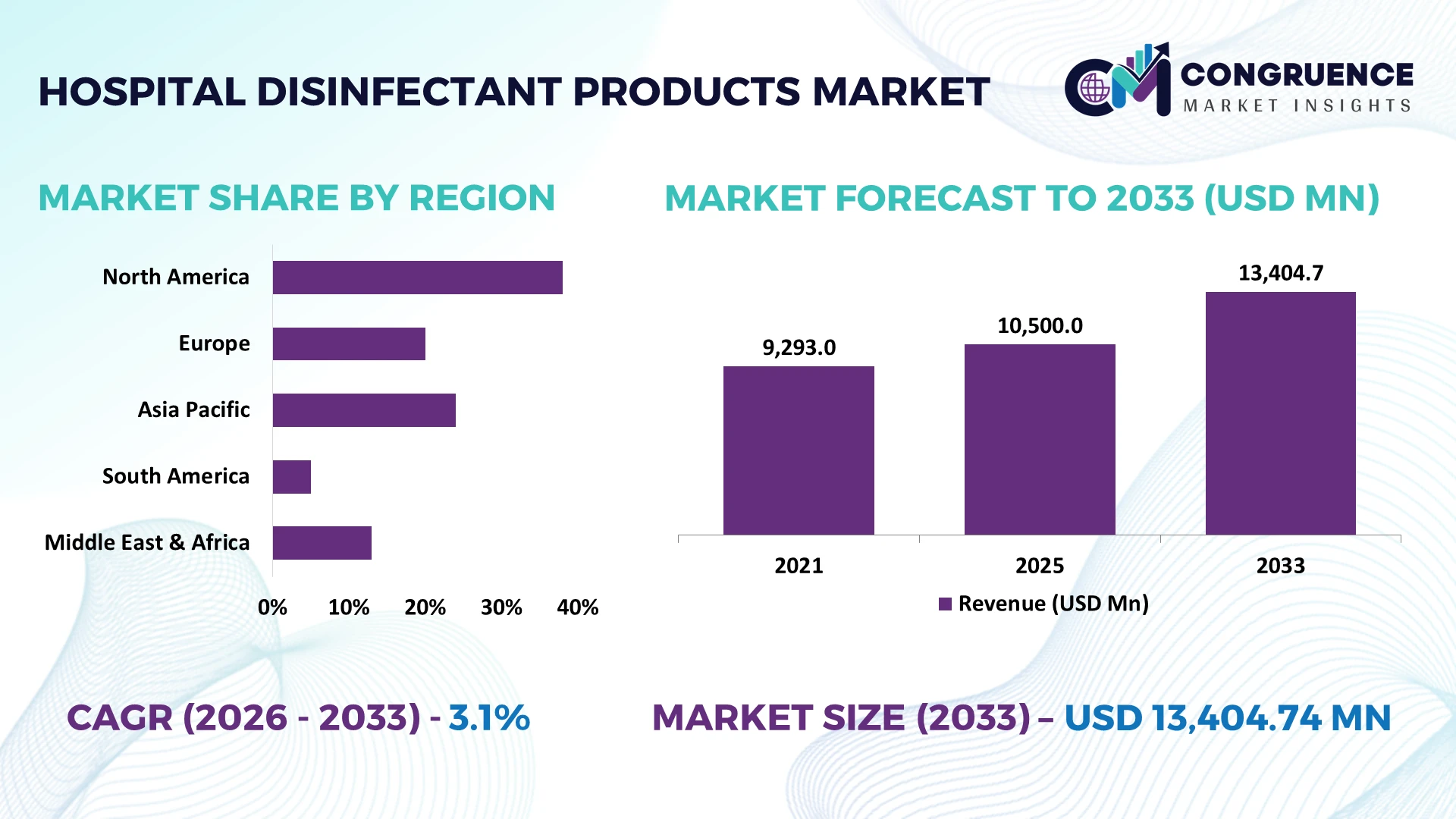
The Global Hospital Disinfectant Products Market was valued at USD 10500 Million in 2025 and is anticipated to reach a value of USD 13404.74 Million by 2033 expanding at a CAGR of 3.1% between 2026 and 2033. Growth is being driven by tighter hospital infection-control protocols, rising antimicrobial-resistance exposure, shorter disinfectant contact-time requirements, and conversion from reusable cleaning systems toward ready-to-use wipes, sprays, and automated dispensing formats.
The United States remains the dominant country, representing an estimated 30–33% of global hospital disinfectant product consumption, supported by more than 6,000 hospitals, centralized infection-prevention procurement, and extensive EPA-registered product deployment. Ecolab solutions alone support cleaning across 15 million patient rooms annually, while 1-minute disinfectant technologies are accelerating operating-room turnover. Compared with the U.S., Germany represents a smaller but regulation-intensive European market shaped by EU Biocidal Products Regulation compliance. The 2026 WHO/UNICEF finding that only 59% of healthcare facilities globally meet basic environmental-cleaning standards exposes a substantial operational gap, particularly across developing health systems and facilities managing antimicrobial-resistance risks.
Strategically, manufacturers offering rapid-contact, broad-spectrum, regulation-compliant and lower-waste hospital disinfectant products are positioned to capture procurement shifts toward measurable infection-control performance.
Market Size & Growth: USD 10.5 billion in 2025 advances toward USD 13.40 billion by 2033 at 3.1%, supported by faster-contact disinfectants and standardized hospital environmental-hygiene programs.
Top Growth Drivers: Infection-prevention compliance contributes approximately 34% of purchasing momentum, antimicrobial-resistance preparedness 27%, and hospital workflow optimization around 21% within institutional procurement decisions.
Short-Term Forecast: By 2028, wider use of 1-minute disinfectant formats is positioned to reduce surface-disinfection cycle time by approximately 30–50% compared with conventional 2-minute protocols.
Emerging Technologies: AI-linked hygiene monitoring, automated chemical-dosing systems, plastic-free substrates, and rapid-contact chemistries are reshaping advanced hospital disinfection workflows; digital dispensing increasingly connects consumption with compliance auditing.
Regional Leaders: Modelled 2033 demand places North America near USD 4.8 billion, Europe around USD 3.9 billion, and Asia-Pacific approximately USD 3.6 billion, with ready-to-use wipes, regulated biocides, and expanding hospital infrastructure respectively supporting adoption.
Consumer/End-User Trends: Only 59% of healthcare facilities globally met basic environmental-cleaning standards in 2025, highlighting a 41% compliance and infrastructure gap supporting institutional disinfectant adoption.
Pilot/Case Example: In a 2024 operating-room comparison, Ecolab’s plastic-free Disinfectant 1 Wipe reduced wipe utilization by 60% versus the leading alcohol-based alternative, lowering material consumption and operating waste.
Competitive Landscape: Ecolab holds an estimated low-double-digit global position, followed by Clorox, Reckitt, Diversey and 3M-linked healthcare portfolios, with the leading five suppliers collectively controlling roughly 35–40% of organized institutional demand.
Regulatory & ESG Impact: EPA efficacy verification and EU biocidal authorization increasingly shape procurement, while Ecolab’s next-generation wipe reached 94.3% relative biodegradation during accelerated testing, strengthening low-waste hospital purchasing criteria.
Investment & Funding: More than USD 500 million in modelled annual supplier investment across formulation, manufacturing automation, digital hygiene platforms and sustainable substrates is increasingly concentrated on high-compliance healthcare applications and regional supply resilience.
Innovation & Future Outlook: Clorox’s latest quat-alcohol wipes use 40% less alcohol with 1-minute contact time, while bleach-free sporicidal products eliminate selected pathogens within 1–4 minutes, signaling a decisive shift toward faster, surface-compatible disinfection.
Hospital disinfectant products are increasingly concentrated around high-frequency surface care, operating rooms, intensive-care environments, outpatient facilities and infection-isolation areas. Rapid-contact wipes, automated dispensing and plastic-free substrates are improving workflow economics; advanced wipes have demonstrated up to 60% lower consumption in clinical comparisons. Global antimicrobial-resistance pressure and stricter environmental-cleaning expectations are now moving procurement toward measurable efficacy, compliance and sustainability, strengthening the market’s strategic relevance.
Hospital disinfectant products are becoming strategically important as healthcare systems shift procurement from chemical volume toward verified efficacy, shorter contact times, surface compatibility, and infection-prevention compliance. Only about 59% of healthcare facilities globally meet basic environmental-cleaning standards, leaving a substantial operational gap. Procurement is simultaneously tightening around validated biocidal claims, while manufacturers restructure sourcing for wipes, active ingredients, and dispensing components to improve supply resilience.
Technology is changing cleaning economics. One-minute disinfectant wipes can cut required contact time by 50% versus two-minute legacy products, while clinical operating-room comparisons have demonstrated approximately 60% lower wipe consumption with optimized substrates. The United States leads deployment of ready-to-use formats and digital hygiene monitoring, whereas Germany emphasizes regulated biocidal efficacy and environmental performance. India presents a different pathway, with hospital infrastructure expansion increasing demand for standardized disinfection protocols and automated dilution systems.
Through 2028, rapid-contact formulations, closed-loop dispensing, digital compliance tracking, and lower-plastic substrates will gain procurement weight. A practical operating-room deployment reduces wipe usage while shortening room-reset workflows. Suppliers are consequently directing R&D toward broad-spectrum formulations, sustainable substrates, dispensing automation, and hospital partnerships. Competitive advantage will increasingly depend on delivering measurable infection-control performance per cleaning cycle rather than competing primarily on chemical price.
Hospital-acquired infection prevention is converting environmental cleaning from a housekeeping function into a measurable clinical-performance requirement. Globally, only about 59% of healthcare facilities meet basic environmental-cleaning standards, implying a 41% service gap, while hand-hygiene facilities are available at roughly 71% of healthcare facilities. In the United States, more than 6,000 hospitals create a large standardized procurement base for EPA-registered disinfectants. Intensifying antimicrobial-resistance surveillance is reinforcing this shift because contaminated high-touch surfaces remain part of pathogen-transmission control strategies. The operational effect is greater consumption of ready-to-use wipes, broad-spectrum chemistries, and controlled-dosing systems. Manufacturers are responding with one-minute formulations, hospital-specific efficacy portfolios, dispensing platforms, and infection-prevention partnerships. The strategic advantage belongs to suppliers that can document efficacy, workflow savings, and protocol compliance simultaneously.
Hospital disinfectant suppliers face a structural trade-off between high-level pathogen efficacy, material compatibility, regulatory approval, and affordable cost per application. Optimized wipes can reduce consumption by approximately 60%, yet advanced substrates, specialized active ingredients, packaging, and efficacy validation increase manufacturing complexity. Plastic-free alternatives can achieve more than 90% relative biodegradation under specific testing conditions, but converting established nonwoven supply chains requires capital and supplier qualification. Regulatory fragmentation adds another constraint: U.S. products require EPA-compliant antimicrobial claims, while Germany and other EU markets operate under the Biocidal Products Regulation, forcing separate authorization and labeling workflows. Companies are mitigating exposure through dual sourcing, concentrated formulations, local packaging, longer supplier contracts, and substrate redesign. The key operational issue is therefore not disinfectant availability, but maintaining consistent efficacy and margins across jurisdiction-specific product portfolios.
The strongest opportunity lies in combining disinfectant chemistry with workflow intelligence rather than selling chemicals as standalone consumables. One-minute contact technologies deliver roughly 50% faster required wet-contact performance than two-minute alternatives, while optimized wipe systems have demonstrated around 60% lower unit consumption in operating-room applications. The 41% global gap in basic healthcare environmental-cleaning coverage also identifies substantial unmet institutional demand. India is particularly attractive as new hospitals and diagnostic networks standardize infection-control infrastructure, creating openings for automated dilution, closed-loop dispensing, and digital compliance systems. Through 2028, connected dispensers, usage analytics, QR-enabled protocol verification, and lower-plastic substrates will increasingly differentiate premium contracts. Suppliers are investing in formulation R&D, monitoring software and hospital collaborations. The non-obvious opportunity is recurring data-enabled service contracts that convert disinfectant procurement from commodity purchasing into measurable hygiene-performance management.
Long-term competitiveness depends on converting laboratory efficacy into consistent bedside and operating-room execution. A disinfectant offering a 1-minute contact time still underperforms operationally when surfaces are insufficiently wetted, staff skip high-touch points, or incompatible materials restrict application. With approximately 41% of healthcare facilities lacking basic environmental-cleaning services and nearly 29% lacking basic hand-hygiene facilities, product innovation alone cannot eliminate execution variability. India and other rapidly expanding healthcare systems face an additional requirement: training infection-control teams while scaling standardized procedures across multi-site hospital networks. Digital monitoring improves traceability but introduces device integration, maintenance, data governance, and workforce-adoption requirements. Manufacturers must therefore invest beyond formulation science in training, dispensing infrastructure, implementation partnerships, and auditable compliance tools. The decisive strategic challenge is achieving repeatable disinfection outcomes across thousands of heterogeneous clinical environments.
Rapid-Contact Chemistries Reshape Workflows: Hospitals are shifting from multi-minute wet-contact protocols toward 1-minute disinfectants, cutting required contact time by approximately 50% versus 2-minute formulations. Ready-to-use formats now account for an estimated 45–50% of institutional surface-cleaning purchases in the United States. Suppliers are reformulating quat-alcohol and sporicidal portfolios while simplifying application steps, improving room-turnover speed and reducing protocol deviations.
Wipe Substrates Move Beyond Plastic: Healthcare buyers are reducing dependence on conventional polypropylene-heavy wipes as waste-management requirements tighten. New plastic-free substrates can achieve above 90% relative biodegradation under controlled testing, while optimized formats have demonstrated around 60% fewer wipes consumed per operating-room cleaning cycle. Manufacturers are redesigning nonwovens, consolidating packaging and qualifying cellulose-based materials, turning substrate engineering into a procurement differentiator rather than a secondary sustainability feature.
Dispensing Becomes Digitally Controlled: Concentrate users are migrating from manual dilution toward closed-loop and electronically monitored dispensing, with controlled systems capable of reducing chemical overuse by approximately 10–20% and dilution errors by more than 25% in high-frequency facilities. Hospital groups are linking dispensing data with environmental-services workflows. Suppliers are consequently expanding connected dispensers, service contracts and consumption analytics to protect margins while improving chemical traceability.
Formularies Shift Toward Fewer SKUs: Procurement teams are consolidating overlapping disinfectants into standardized facility-wide formularies, reducing selected cleaning portfolios by an estimated 15–25% while targeting 90%+ protocol compliance. U.S. hospitals face tighter scrutiny around EPA-registered claims and pathogen-specific instructions, accelerating SKU rationalization. Major suppliers are responding with broader-spectrum products, standardized training and bundled surface-care programs, increasing contract stickiness while lowering storage and staff-training complexity.
Liquid disinfectants represent the leading product type, accounting for approximately 34–37% of hospital disinfectant product demand. Their dominance reflects broad compatibility with floors, walls, equipment exteriors and high-volume environmental cleaning, alongside attractive chemical cost per treated square meter. Concentrated and ready-to-use liquids also fit centralized hospital procurement and automated dilution infrastructure. Disinfectant concentrates hold approximately 17–19% share and remain strategically important for large facilities seeking lower transportation, packaging and storage intensity.
Disinfectant wipes are the fastest-growing type, supported by point-of-care convenience, premeasured chemistry and shorter room-reset workflows. Their share is approaching 25–28% as hospitals replace reusable cloth-and-bucket processes in high-touch zones. Sprays retain roughly 10–12% participation for targeted applications, while disinfectant foams serve smaller niches where controlled application and vertical-surface adherence matter. Manufacturers are prioritizing 1-minute wipes, plastic-reduced substrates, concentrated chemistry and closed-loop dispensing. Investment is therefore moving toward formats that reduce labor steps and application variability rather than simply lowering chemical purchase prices.
Surface disinfection leads application demand with an estimated 38–41% share because bed rails, worktops, door handles, examination areas and other high-touch surfaces require repeated treatment throughout patient-care cycles. Its scale favors ready-to-use wipes and liquids with short contact times and broad material compatibility. Floor disinfection contributes approximately 18–20%, remaining a mature, high-volume application centered on concentrates, automated dilution and environmental-services contracts. Instrument disinfection maintains specialized demand where compatibility and validated processing protocols outweigh application speed.
Operating room disinfection is the fastest-growing application as surgical facilities prioritize faster terminal cleaning and measurable turnover performance. Optimized wipe systems can reduce material use by around 60% in selected operating-room workflows, shifting procurement toward rapid-contact chemistries and standardized kits. Environmental cleaning spans patient rooms, sanitation areas and communal zones, increasingly integrating chemical dispensing with compliance monitoring. Suppliers are expanding operating-room-specific portfolios, protocol training and connected dispensing systems. Business value is concentrating around reduced reset time, lower consumable use and consistent high-touch surface coverage.
Hospitals remain the dominant end-user, representing approximately 58–62% of hospital disinfectant product consumption because inpatient rooms, intensive-care units, operating theatres, emergency departments and common areas require continuous environmental hygiene. Large facilities also operate centralized environmental-services teams and automated chemical-dilution infrastructure, supporting high-volume contracts. Clinics account for approximately 14–16% of demand, favoring compact ready-to-use formats, while diagnostic centers increasingly prioritize rapid surface turnover around imaging, sampling and patient-contact equipment.
Ambulatory surgery centers are the fastest-growing buyer group as more procedures migrate into shorter-stay settings where room turnover directly affects daily case capacity. Long-term care facilities remain strategically important because repeated resident contact and shared spaces create persistent disinfection requirements, although price sensitivity encourages concentrates and multipurpose formulations. Suppliers are responding with segment-specific packaging, formulary bundles, training services and distributor partnerships. Competitive focus is moving from hospital-only contracts toward multi-site healthcare networks, where standardized chemistry and centralized procurement can lower product complexity by approximately 15–25%.
North America accounted for the largest market share at approximately 36% in 2025 however, Asia-Pacific is expected to register the fastest growth, expanding at a CAGR of approximately 4.3% between 2026 and 2033.
Rapid-Contact Formats Reshape Hospital Procurement
North America accounts for approximately 36% of global demand, anchored by large hospital networks, mature infection-prevention programs, EPA-regulated antimicrobial products, and high penetration of ready-to-use disinfectants. The United States has more than 6,000 hospitals, creating substantial recurring consumption across patient rooms, operating theatres, intensive-care units and outpatient facilities. Procurement is moving toward 1-minute contact formulations, pre-saturated wipes and closed-loop dilution systems that reduce application variability. Canadian healthcare systems add demand for standardized environmental cleaning and lower-waste consumables. Suppliers including Ecolab, Clorox and Diversey are strengthening broad-spectrum portfolios, dispensing technology and training services. The operational shift favors products that combine rapid pathogen kill, surface compatibility and documented protocol performance rather than competing solely on chemical cost.
United States Market Outlook: The United States leads through hospital scale, EPA antimicrobial-product oversight and sophisticated environmental-services procurement. More than 6,000 hospitals support concentrated institutional consumption, while large integrated health systems increasingly standardize disinfectant formularies across multiple facilities. Suppliers with 1-minute contact claims, automated dilution platforms and infection-prevention support gain an advantage in enterprise contracts where labor productivity and compliance consistency influence purchasing.
Biocidal Compliance Drives Portfolio Rationalization
Europe represents approximately 29% of global hospital disinfectant product demand, with Germany, France, the United Kingdom and Italy forming the principal institutional markets. The EU Biocidal Products Regulation is pushing suppliers toward tightly documented efficacy, active-substance authorization and standardized product claims, increasing the cost of maintaining fragmented portfolios. Hospitals are simultaneously prioritizing lower-plastic wipes, concentrated chemistries and controlled dosing as environmental procurement criteria become more prominent. Germany's extensive hospital infrastructure and France's centralized healthcare procurement support large-volume professional disinfectant use, while the United Kingdom increasingly emphasizes standardized infection-prevention procedures across NHS facilities. Manufacturers are responding by rationalizing SKUs, reformulating products and investing in recyclable packaging and cellulose-based substrates. Regulatory capability has consequently become a competitive asset because authorization efficiency directly influences launch speed and cross-country scalability.
Germany Market Outlook: Germany combines approximately 1,800 hospitals with strong professional hygiene standards and substantial institutional demand for surface and instrument disinfection. Its regulatory environment rewards suppliers capable of aligning efficacy documentation with EU biocidal requirements while serving high-throughput clinical environments. Concentrates, automated dosing and material-compatible surface products remain strategically important as hospitals balance infection prevention against chemical consumption and environmental-performance targets.
Hospital Expansion Accelerates Standardized Disinfection
Asia-Pacific accounts for approximately 24% of global demand and combines rapidly expanding healthcare infrastructure with significant variation in environmental-cleaning maturity. China, India, Japan and South Korea anchor institutional consumption, but India provides one of the strongest deployment pathways as public and private hospital networks add beds, surgical capacity and diagnostic infrastructure. China's large healthcare system supports high-volume procurement, while Japan favors high-specification, workflow-efficient hygiene products. Suppliers are expanding local manufacturing, distributor networks and concentrate-based portfolios to manage logistics and price sensitivity. Automated dilution and ready-to-use wipes are increasingly deployed where multi-site hospital operators require standardized chemical concentration and repeatable cleaning procedures. The region's strategic advantage lies in simultaneously scaling basic environmental hygiene and premium infection-control formats, giving manufacturers opportunities to differentiate portfolios by facility sophistication rather than applying one product architecture across all customers.
China Market Outlook: China operates more than 38,000 hospitals, giving suppliers a uniquely broad institutional deployment base spanning tertiary facilities, county hospitals and private providers. Centralized purchasing and domestic chemical manufacturing strengthen volume economics, while advanced urban hospitals increasingly demand rapid-contact wipes and automated dispensing. Companies combining local production with differentiated clinical formulations are positioned more strongly than import-dependent suppliers facing procurement and logistics pressure.
Hospital Modernization Broadens Institutional Demand
South America represents approximately 6% of global hospital disinfectant demand, led by Brazil, followed by Argentina, Colombia and Chile. Brazil's extensive hospital network creates the largest recurring requirement for surface disinfectants, concentrates and environmental-cleaning products, while private healthcare operators increasingly standardize infection-control procurement across multiple sites. Currency volatility and imported active-ingredient exposure constrain premium-product deployment, making locally formulated liquids and concentrates commercially important. Suppliers are therefore balancing rapid-contact innovation with affordability, package optimization and distributor coverage. Expansion of ambulatory facilities and diagnostic networks is also increasing consumption outside traditional hospitals. Local manufacturing and regional warehousing are becoming strategically valuable because shorter replenishment cycles reduce exposure to international freight and foreign-exchange disruption. The market consequently rewards suppliers capable of maintaining validated performance without creating excessive cost per cleaning cycle.
Brazil Market Outlook: Brazil's healthcare system includes more than 7,000 hospitals and a large network of public and private care facilities, establishing the country's strongest disinfectant consumption base in South America. ANVISA-regulated products, local chemical production and broad distributor coverage support institutional procurement. Suppliers are prioritizing economical concentrates, ready-to-use surface formats and dependable domestic inventories to address fragmented purchasing and cost-sensitive hospital operations.
Healthcare Investment Upgrades Hygiene Infrastructure
Middle East & Africa contributes approximately 5% of global demand, with procurement concentrated in Saudi Arabia, the United Arab Emirates, South Africa and larger urban healthcare systems. Gulf countries are accelerating hospital modernization, digital healthcare infrastructure and specialist-care capacity, supporting premium disinfectants, automated dispensing and standardized environmental-services programs. Saudi Arabia's healthcare transformation under Vision 2030 is particularly important as new hospitals and private-sector participation increase requirements for internationally validated infection-control products. In African markets, uneven access to basic environmental-cleaning infrastructure keeps concentrates and cost-efficient multipurpose formulations central to deployment. International suppliers are using distributor partnerships, localized inventories and institutional training to improve availability. The commercial divide is increasingly clear: Gulf healthcare systems prioritize workflow performance and advanced formats, while African procurement remains more dependent on affordability, reliable supply and simplified application protocols.
Saudi Arabia Market Outlook: Saudi Arabia combines healthcare infrastructure investment with expanding private-sector participation and internationally benchmarked hospital standards. Vision 2030 programs are increasing capacity across hospitals, ambulatory centers and specialist facilities, strengthening demand for automated dosing and high-performance surface disinfection. Suppliers establishing local distribution, technical support and institutional partnerships gain an operational advantage because procurement increasingly evaluates implementation capability alongside product efficacy.
Ecolab, Clorox, Reckitt, Diversey and 3M compete at the global institutional level, while regional chemical formulators challenge them through pricing, localized supply and distributor relationships. The top five players collectively represent approximately 35–40% of organized hospital disinfectant demand, leaving substantial room for specialized suppliers. Competition increasingly centers on validated pathogen efficacy, contact time, substrate performance and total cleaning cost. One-minute formulations can reduce required contact time by about 50%, while optimized wipe systems have demonstrated approximately 60% lower consumption in selected operating-room workflows; concentrated dispensing can reduce chemical overuse by 10–20%. Leaders are defending contracts through hospital partnerships, dispensing platforms, sustainable substrates and vertically coordinated formulation-to-service models. Competitive pressure is shifting from chemical price toward measurable workflow outcomes and regulatory-ready product portfolios. Authorization costs, efficacy testing and enterprise distribution remain significant entry barriers. Winning requires broad-spectrum performance, dependable supply, rapid application and demonstrable cleaning-cycle economics at institutional scale.
Ecolab Inc.
The Clorox Company
Reckitt Benckiser Group plc
3M Company
GOJO Industries, Inc.
PDI, Inc.
Metrex Research, LLC
SC Johnson Professional
B. Braun SE
Getinge AB
Paul Hartmann AG
Dr. Schumacher GmbH
GAMA Healthcare Ltd.
Whiteley Corporation
Current hospital disinfection technology is shifting toward rapid-contact chemistries, pre-saturated wipes, and closed-loop dilution systems. One-minute formulations cut required contact time 50% versus two-minute legacy products, while optimized wipe systems can reduce material consumption 60% in operating-room workflows. Ready-to-use formats represent roughly 45% of institutional surface-cleaning deployment, improving protocol consistency, room turnover, and labor productivity across high-frequency clinical environments.
Emerging systems combine electronically controlled dispensers, usage analytics, and digital hygiene auditing. Automated dilution can reduce chemical overuse 10–20% and lower concentration errors by more than 25% compared with manual mixing. Plastic-free cellulose substrates exceeding 90% relative biodegradation in controlled testing are also entering healthcare portfolios. Integration with environmental-services platforms enables hospitals to track consumption, cleaning completion, and compliance, giving technology-enabled suppliers stronger enterprise-contract differentiation.
Disruptive development is moving toward sensor-verified cleaning, AI-assisted workflow optimization, and automated UV-C adjunct systems integrated with chemical disinfection. Automated room technologies can deliver above 99% targeted microbial reduction under validated conditions, supplementing manual surface treatment rather than replacing it. Through 2026–2028, connected dispensing and verification deployment should expand across multi-site hospital networks. Suppliers combining chemistry, automation, data, and sustainable substrates will gain the strongest operational advantage as procurement shifts from product price toward verified cleaning outcomes.
May 2026 Ecolab introduced Disinfectant 1 Wipe, a plastic-free, 1-minute hospital disinfectant designed for more than 40 organisms. The wipe achieved 94.3% relative biodegradation in accelerated testing, strengthening Ecolab’s rapid-contact, lower-waste infection-prevention portfolio. Source: ecolab.com
June 2025 Clorox Healthcare introduced CloroxPro Clorox EcoClean Disinfecting Wipes, expanding its healthcare surface-disinfection platform with a 1-minute contact time and 38-organism efficacy profile. The launch improves turnover efficiency while addressing hospital demand for standardized ready-to-use environmental cleaning. Source: cloroxpro.com
November 2024 Diversey advanced its healthcare hygiene strategy through expanded infection-prevention solutions following integration into Solenis, whose combined operations employ more than 16,500 professionals across 130 countries. The expanded platform strengthens chemical, dispensing, service, and institutional-hygiene coverage for multinational healthcare customers. Source: solenis.com
September 2024 PDI strengthened its infection-prevention platform around Sani-Cloth Prime Germicidal Disposable Wipes, delivering a 1-minute overall contact time against more than 50 microorganisms. Rapid broad-spectrum performance supports faster standardized disinfection across high-throughput hospitals and ambulatory-care environments. Source: infectioncontroltoday.com
The Hospital Disinfectant Products Market Report evaluates liquid disinfectants, disinfectant wipes, sprays, concentrates, and foams across surface, instrument, floor, operating-room, and environmental cleaning applications. Coverage extends to hospitals, clinics, diagnostic centers, long-term care facilities, and ambulatory surgery centers. Liquids account for approximately 34–37% of product demand, while hospitals represent about 58–62% of end-user consumption, providing clear visibility into procurement concentration and format transitions.
Geographic assessment covers North America, Europe, Asia-Pacific, South America, and Middle East & Africa, alongside country-level deployment and competitive dynamics. Technology coverage includes rapid-contact chemistry, automated dilution, connected dispensing, plastic-reduced substrates, digital compliance monitoring, and automated room-disinfection adjuncts. The 2026–2033 framework evaluates procurement shifts, regulatory positioning, infrastructure gaps, supplier strategies, and emerging outpatient opportunities, supporting investment prioritization, geographic expansion, portfolio development, partnership decisions, and competitive positioning.
| Report Attribute/Metric | Report Details |
|---|---|
Market Revenue in 2025 | USD 10500 Million |
Market Revenue in 2033 | USD 13404.74 Million |
CAGR (2026 - 2033) | 3.1% |
Base Year | 2025 |
Forecast Period | 2026 - 2033 |
Historic Period | 2021 - 2025 |
Segments Covered | By Type
By Application
By End-User
|
Key Report Deliverable | Revenue Forecast, Growth Trends, Market Dynamics, Segmental Overview, Regional and Country-wise Analysis, Competition Landscape |
Region Covered | North America, Europe, Asia-Pacific, South America, Middle East, Africa |
Key Players Analyzed | Ecolab Inc., The Clorox Company, Reckitt Benckiser Group plc, 3M Company, GOJO Industries, Inc., PDI, Inc., Metrex Research, LLC, SC Johnson Professional, B. Braun SE, Getinge AB, Paul Hartmann AG, Dr. Schumacher GmbH, GAMA Healthcare Ltd., Whiteley Corporation |
Customization & Pricing | Available on Request (10% Customization is Free) |




