
Reports
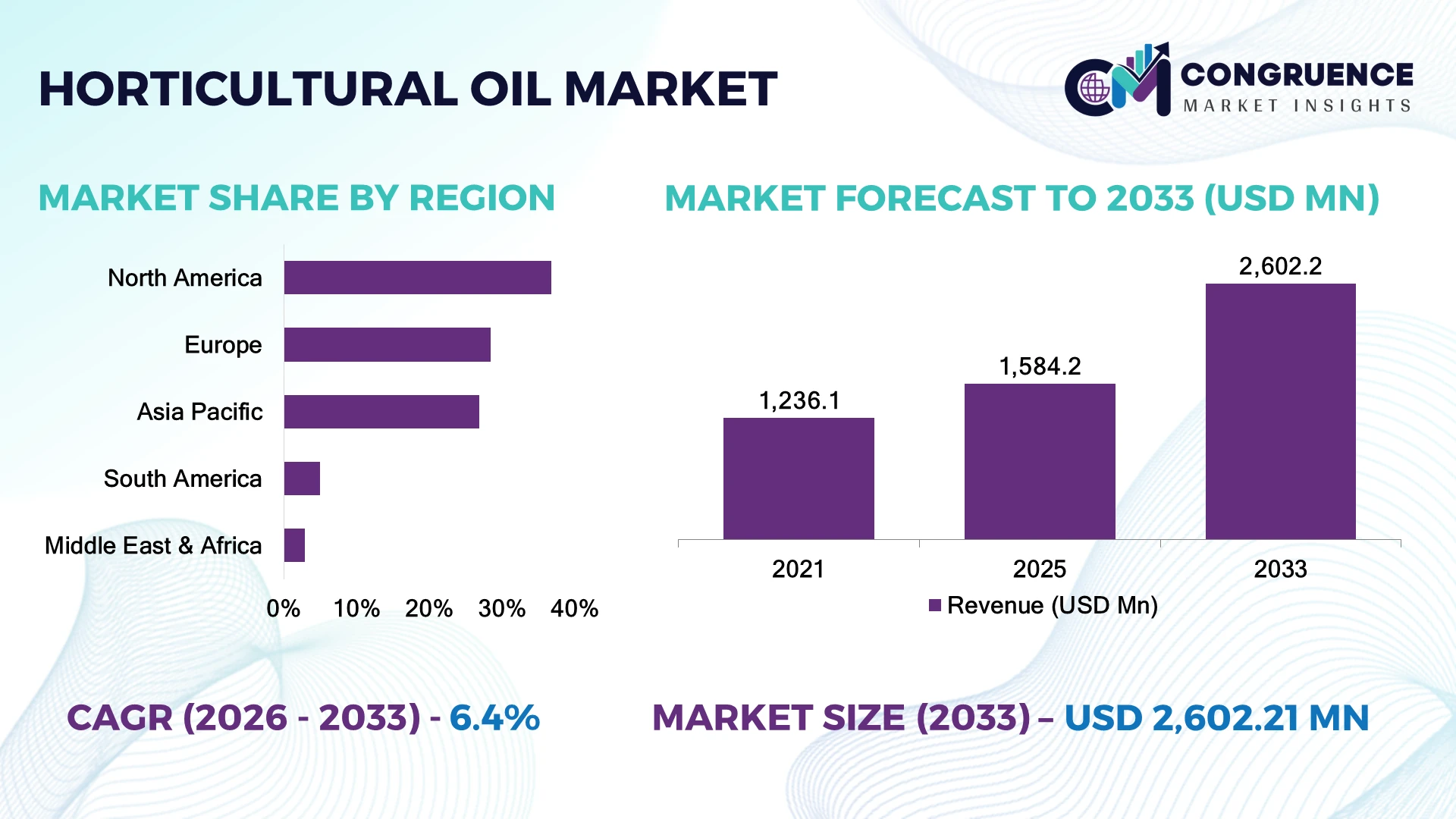
The Global Horticultural Oil Market was valued at USD 1,584.2 Million in 2025 and is anticipated to reach a value of USD 2,602.2 Million by 2033 expanding at a CAGR of 6.4% between 2026 and 2033. Growth is driven by stricter integrated pest management programs, expanding residue-free crop protection practices, and increasing replacement of conventional chemical pesticides in high-value horticultural production.
The United States leads the global horticultural oil market with approximately 29% share, supported by large-scale fruit orchards, specialty crop cultivation, and widespread Integrated Pest Management adoption across more than 70% of commercial orchards. Compared with Brazil, where tropical horticulture is expanding rapidly, the United States benefits from stronger precision spraying infrastructure and advanced agricultural technologies. Continued geopolitical pressure on agricultural input supply chains has accelerated domestic crop protection investments, reinforcing demand for premium horticultural oil formulations. Strategic investment in bio-based formulations and precision application technologies is becoming essential for sustained market leadership.
Market Size & Growth: USD 1,584.2 million (2025) to USD 2,602.2 million (2033) at 6.4% CAGR, driven by sustainable crop protection.
Top Growth Drivers: Integrated pest management 42%, residue-free farming 31%, specialty crops 24%.
Short-Term Forecast: By 2028, spray efficiency improves by 18% through precision application.
Emerging Technologies: Nano-emulsions, drone spraying, and precision agriculture improve coverage and efficacy.
Regional Leaders: North America, Europe, and Asia-Pacific contribute over 82% demand with expanding sustainable farming adoption.
Consumer/End-User Trends: More than 58% of commercial orchard operators prioritize low-residue pest control.
Pilot/Case Example: 2026 orchard trials reduced pest infestation by 27% using optimized horticultural oils.
Competitive Landscape: Top five manufacturers hold approximately 54% market share through formulation innovation.
Regulatory & ESG Impact: Eco-friendly crop protection programs reduce synthetic pesticide use by nearly 20%.
Investment & Funding: More than USD 750 million supports formulation development and production expansion.
Innovation & Future Outlook: Advanced bio-based oils and digital spraying systems strengthen sustainable agriculture.
The Horticultural Oil Market is expanding across fruit orchards, vineyards, greenhouse cultivation, and ornamental crops as growers seek effective low-residue pest management solutions. Advanced emulsifiable formulations improve spray coverage by nearly 22%, while precision application technologies enhance field efficiency. Increasing alignment with integrated pest management practices is strengthening long-term adoption, setting the stage for broader strategic market transformation.
The horticultural oil market has become strategically important as agricultural producers balance higher productivity with stricter environmental regulations and residue compliance. Integrated pest management has shifted from a niche practice to a mainstream cultivation strategy, encouraging growers to replace broad-spectrum chemical pesticides with selective oil-based crop protection. This transition is reshaping supplier portfolios, investment priorities, and distribution networks across commercial horticulture.
Modern highly refined horticultural oils deliver approximately 20% better pest coverage than conventional mineral oil formulations while reducing phytotoxicity risks under optimized application conditions. North America leads in precision spraying adoption and commercial orchard management, whereas Asia-Pacific is rapidly expanding protected cultivation and high-value fruit production. Over the next two to three years, digital spraying technologies and sensor-based application systems are expected to be deployed across nearly 35% of large commercial horticultural operations.
Manufacturers are investing in bio-based formulations, precision-compatible products, and partnerships with agricultural technology providers to strengthen field performance. Commercial citrus and apple growers increasingly integrate horticultural oils into seasonal pest management programs to reduce resistance development and improve crop quality. Companies combining formulation innovation, agronomic support, and precision agriculture compatibility will secure stronger competitive positioning in the evolving sustainable crop protection landscape.
The rapid expansion of integrated pest management (IPM) programs is strengthening demand for horticultural oils across commercial orchards, vineyards, and greenhouse cultivation. More than 65% of specialty crop growers in developed agricultural economies now integrate at least one biological or low-residue pest control solution, while horticultural oil compatibility with IPM programs has improved field adoption by nearly 28%. Regulatory restrictions on high-residue insecticides in the European Union and California continue accelerating formulation replacement. This shift improves crop protection flexibility while reducing pest resistance pressure. Manufacturers are responding by expanding bio-based mineral oil portfolios, investing in precision-compatible formulations, and partnering with agricultural distributors to deliver customized solutions for fruit, vegetable, and ornamental crop producers. A key operational advantage is the ability to target multiple pest stages without disrupting beneficial insect management strategies.
Volatility in highly refined mineral oil feedstocks and weather-dependent application windows continue limiting operational consistency. Base oil prices have fluctuated by approximately 18% over recent production cycles, while nearly 22% of scheduled applications are delayed because of temperature or humidity constraints that increase phytotoxicity risks. Supply-chain disruptions affecting lubricant-grade refining capacity have also tightened premium feedstock availability in the United States and Europe. These conditions increase formulation costs, reduce inventory predictability, and pressure distributor margins. Companies are mitigating exposure through diversified sourcing, localized blending facilities, and long-term procurement contracts while developing vegetable-based alternatives for selected crop segments. Strategic supply resilience has become as important as formulation performance in maintaining competitive positioning.
Precision agriculture creates significant opportunities for horticultural oil suppliers through targeted application technologies and digital crop management. Drone-assisted spraying can reduce product consumption by nearly 20%, while AI-enabled pest monitoring improves treatment timing accuracy by approximately 30%. Japan and Australia are expanding precision orchard management, encouraging suppliers to develop formulations optimized for automated spraying equipment. Companies are investing in nano-emulsion technologies, smart mixing systems, and partnerships with agricultural technology providers to improve spray uniformity and leaf coverage. A less obvious opportunity lies in integrating horticultural oils with biological pest control programs, enabling growers to reduce chemical inputs while improving operational efficiency and compliance with evolving residue standards.
Ensuring consistent efficacy across diverse crops, climatic conditions, and application systems remains a major execution challenge. Nearly 25% of performance variability is linked to improper spray timing, dilution practices, or environmental conditions rather than product quality. Increasing adoption of automated spraying equipment also requires formulations with stable viscosity and nozzle compatibility. Australia and Spain continue refining application guidelines to improve deployment consistency across commercial orchards. Companies must invest in agronomic advisory services, digital decision-support tools, operator training, and formulation optimization to maintain product reliability. Long-term competitiveness will depend on delivering predictable field performance under increasingly variable climatic and operational conditions rather than relying solely on formulation innovation.
Precision Spraying Adoption Commercial growers are integrating GPS-guided sprayers and drone-assisted applications, improving spray accuracy by approximately 24% while reducing product waste by nearly 18%. Labor shortages across California orchards and Australian fruit farms are accelerating automation investments, prompting manufacturers to optimize formulations for precision equipment and digital application workflows that improve operational efficiency.
Bio-Based Formulation Expansion Demand for bio-based horticultural oils has increased by nearly 27% as growers align with residue-management requirements and integrated pest management programs. Companies are restructuring product portfolios toward renewable feedstocks and higher-purity formulations that enhance crop safety, improve compatibility with beneficial insects, and strengthen acceptance across export-oriented horticultural supply chains.
Greenhouse Crop Intensification Protected cultivation now accounts for more than 35% of premium horticultural oil consumption in several intensive vegetable-producing markets. Expansion of controlled-environment agriculture enables year-round pest management, while manufacturers collaborate with greenhouse technology providers to deliver application protocols that improve pest suppression and reduce repeated treatment cycles.
Multi-Functional Crop Protection Advanced horticultural oils are increasingly formulated for insect, mite, and disease suppression within integrated spray programs, reducing application frequency by nearly 15%. Commercial suppliers are investing in formulation refinement and technical advisory services as stricter pesticide regulations encourage growers to adopt versatile products capable of supporting sustainable crop protection strategies.
Highly Refined Mineral Oil holds the largest market share at approximately 56% due to its broad compatibility with fruit orchards, vegetable crops, and ornamental plants while minimizing phytotoxicity risks. Its consistent purity, stable spray characteristics, and suitability for integrated pest management programs make it the preferred commercial choice. Superior coverage efficiency and compatibility with conventional spraying systems continue supporting large-scale deployment. Vegetable Oil-Based Horticultural Oil is the fastest-growing type as growers increasingly prioritize renewable crop protection solutions and residue management. Adoption of plant-derived formulations has expanded by nearly 24%, while premium mineral oils still account for over 70% of commercial orchard applications in developed agricultural markets.
Manufacturers are expanding bio-based product portfolios, investing in higher-purity refining technologies, and forming distribution partnerships to address evolving sustainability requirements. Semi-refined mineral oils remain relevant for cost-sensitive applications where operational budgets outweigh premium performance, while specialty blends designed for greenhouse cultivation and high-value horticulture continue attracting investment. Companies increasingly differentiate products through improved emulsification, broader crop compatibility, and longer storage stability, strengthening competitive positioning across diverse agricultural environments.
According to a 2025 International Organization for Biological Control (IOBC) assessment, highly refined horticultural oils remain among the most widely recommended compatible products within integrated pest management programs because of their low impact on beneficial arthropods when properly applied.
Fruit and Nut Crops account for the largest share at approximately 48% because perennial orchards require repeated pest management throughout multiple growing stages. Horticultural oils effectively control scale insects, mites, aphids, and overwintering pests while supporting residue-sensitive export production. Vegetable Crops represent the fastest-growing application as greenhouse cultivation, protected farming, and intensive vegetable production expand globally. Adoption within greenhouse vegetables has increased by nearly 22%, while commercial orchard spraying continues representing more than 60% of seasonal horticultural oil consumption across high-value farming operations.
Companies are expanding application-specific formulations optimized for citrus, apples, grapes, tomatoes, and peppers while improving compatibility with biological pest control programs. Ornamental Plants remain strategically important for nursery production where cosmetic quality drives purchasing decisions, whereas Plantation Crops and Other Specialty Crops continue generating niche demand through customized formulations and integrated spray schedules. Suppliers increasingly focus on precision application guidance, crop-specific labeling, and distributor training to improve field performance and strengthen long-term customer retention.
A 2026 enterprise survey conducted by the International Fresh Produce Association found that integrated pest management adoption continued expanding among commercial fruit and vegetable growers, increasing demand for residue-compatible crop protection inputs, including horticultural oils.
Commercial Farms hold the largest market share at approximately 59% because large-scale fruit, vegetable, and plantation operations require consistent pest management across extensive cultivation areas. High deployment intensity, export quality requirements, and integrated crop protection programs continue concentrating purchasing within this segment. Greenhouse Operators represent the fastest-growing end-user group as protected cultivation expands for premium vegetables, berries, and ornamental plants. Greenhouse deployments have increased by nearly 26%, while commercial farms continue accounting for over 65% of annual bulk procurement through agricultural distribution networks.
Agricultural Cooperatives remain important purchasing channels by consolidating procurement and technical advisory services for smaller growers. Research Institutions contribute through field evaluations and formulation validation, while Home Garden Consumers continue supporting specialty retail demand for ready-to-use products. Manufacturers are responding with crop-specific packaging, distributor partnerships, digital agronomy support, and flexible pricing strategies to strengthen customer loyalty and improve product adoption across professional and retail channels.
A 2025 grower benchmarking study released by the AmericanHort association indicated that greenhouse producers increasingly prioritized integrated pest management programs and low-residue crop protection products to improve crop quality and operational sustainability.
North America accounted for the largest market share at 36.8% in 2025 however, Asia-Pacific is expected to register the fastest growth, expanding at a CAGR of 7.6% between 2026 and 2033.

Advanced Orchard Management Accelerates Low-Residue Crop Protection
North America leads the horticultural oil market through its extensive commercial orchard infrastructure, integrated pest management adoption, and precision agriculture deployment. High-value fruit, nut, and greenhouse crop production continues driving demand for highly refined horticultural oils across the United States and Canada. More than 60% of commercial fruit acreage utilizes integrated pest management programs where horticultural oils remain an important pest control component. Continued investment in precision spraying equipment and digital crop monitoring has improved application efficiency by nearly 18%, encouraging suppliers to develop crop-specific formulations compatible with automated spraying systems. Strategic partnerships between manufacturers and agricultural distributors continue expanding product availability while strengthening technical advisory services for professional growers.
United States Market Outlook:
The United States dominates regional demand through its large citrus, apple, almond, grape, and specialty crop industries supported by advanced agricultural infrastructure. California and Washington remain leading deployment centers where commercial growers increasingly integrate horticultural oils into residue-sensitive crop protection programs. Nearly 70% of professional orchard operators employ integrated pest management strategies, encouraging manufacturers to expand premium formulations, precision application technologies, and localized technical support networks tailored for large-scale commercial production.
Regulatory Alignment Strengthens Sustainable Crop Protection
Europe continues expanding horticultural oil adoption as regulatory restrictions encourage growers to replace conventional pesticide programs with lower-residue alternatives. Commercial fruit production, vineyards, and greenhouse cultivation support strong demand for highly refined and plant-based formulations. More than 55% of specialty crop producers in several Western European markets have incorporated biological or integrated pest management approaches, increasing deployment of horticultural oils. Companies continue investing in improved emulsification technology, sustainable feedstocks, and formulation upgrades that meet evolving environmental standards while maintaining crop protection efficiency across intensive horticultural production systems.
Spain Market Outlook:
Spain represents the region's most influential market because of its extensive citrus, olive, greenhouse vegetable, and fruit production sectors. Intensive cultivation in Andalusia and Murcia supports year-round horticultural oil demand. Commercial producers increasingly utilize precision spraying technologies that have improved application uniformity by approximately 20%, encouraging suppliers to introduce specialized formulations optimized for Mediterranean climatic conditions and export-oriented agriculture.
Large-Scale Horticulture Drives Technology Adoption
Asia-Pacific is experiencing the strongest expansion as commercial horticulture modernizes across China, India, Australia, and Southeast Asia. Rapid growth in protected cultivation, export-oriented fruit production, and government-supported sustainable farming initiatives continues increasing horticultural oil deployment. Greenhouse cultivation has expanded by nearly 25% in several high-value crop clusters, creating opportunities for precision-compatible crop protection products. Manufacturers are strengthening regional production capacity, expanding agricultural distribution networks, and introducing formulations designed for tropical and subtropical crop conditions to improve operational efficiency and market penetration.
China Market Outlook:
China leads regional demand through its extensive fruit, vegetable, tea, and protected cultivation industries supported by continuous agricultural modernization. Large commercial farms increasingly integrate horticultural oils into integrated pest management programs while precision spraying adoption continues expanding across intensive farming operations. Deployment of smart agricultural equipment has improved spray efficiency by approximately 22%, encouraging domestic manufacturers to invest in advanced formulation technologies and localized production facilities.
Export Agriculture Expands Commercial Usage
South America is witnessing steady horticultural oil adoption as export-focused fruit and vegetable production expands across major agricultural economies. Commercial citrus, grape, and tropical fruit plantations increasingly incorporate integrated pest management programs to satisfy international residue requirements. Nearly 30% of commercial orchard operators have expanded biological pest management practices during recent production cycles. Companies are strengthening regional distribution partnerships and technical support services while balancing growth opportunities against logistical limitations and variable agricultural infrastructure across rural production areas.
Brazil Market Outlook:
Brazil represents the largest regional opportunity because of its extensive citrus, coffee, fruit, and horticultural production. Large commercial farms continue investing in sustainable crop protection practices to strengthen export competitiveness. Precision spraying adoption has increased by approximately 18% across commercial orchards, encouraging suppliers to develop climate-adapted formulations and expand technical field support for professional growers managing diverse tropical cropping systems.
Protected Cultivation Supports Market Modernization
The Middle East & Africa market is progressing through greenhouse expansion, water-efficient agriculture, and government-supported food security initiatives. Commercial horticulture operations increasingly deploy horticultural oils to improve pest control while minimizing chemical residues in high-value crops. Protected cultivation acreage has increased by nearly 20% across several Gulf agricultural projects, encouraging suppliers to introduce specialized formulations suitable for controlled-environment farming. Investment in greenhouse infrastructure and precision irrigation systems continues strengthening demand for compatible crop protection solutions.
Saudi Arabia Market Outlook:
Saudi Arabia leads regional market development through substantial investment in greenhouse farming, controlled-environment agriculture, and domestic food production initiatives. Commercial vegetable and fruit producers increasingly implement integrated crop protection strategies supported by modern irrigation infrastructure. Greenhouse cultivation continues expanding rapidly, while precision spraying technologies have improved operational efficiency by approximately 16%, creating opportunities for premium horticultural oil suppliers focused on protected agriculture.
The horticultural oil market is led by specialist crop protection companies including Petro-Canada Lubricants, JMS Flower Farms, BioWorks, Brandt Consolidated, and Calumet, competing against regional formulators and private-label agricultural suppliers. The top five participants collectively control approximately 48% of global demand. Global brands differentiate through formulation purity above 99% unsulfonated residue, technical agronomy support, and extensive distributor networks, while regional producers compete primarily on pricing that is typically 12–18% lower. Companies are strengthening competitiveness through localized blending facilities, integrated biological crop protection portfolios, strategic distributor partnerships, and formulation innovation that improves spray coverage by nearly 20%. Competition is shifting toward premium, residue-compatible products supporting integrated pest management rather than conventional dormant oils. High regulatory compliance costs, formulation expertise, and established grower relationships create significant entry barriers. Winning requires premium formulation performance, resilient supply chains, precision agriculture compatibility, strong technical advisory capabilities, and trusted distribution partnerships across commercial horticulture.
Petro-Canada Lubricants Inc.
JMS Flower Farms, Inc.
BioWorks, Inc.
Brandt Consolidated, Inc.
Calumet, Inc.
Loveland Products, Inc.
Helena Agri-Enterprises, LLC
Drexel Chemical Company
Valent BioSciences LLC
UPL Ltd.
Corteva Agriscience
Albaugh, LLC
Advanced refining technology is transforming horticultural oil performance through higher-purity mineral oils, improved emulsification systems, and enhanced droplet uniformity. Highly refined white oils now improve spray coverage by approximately 18% while reducing phytotoxicity risk by nearly 25% compared with conventional formulations. Around 62% of commercial orchard programs increasingly utilize premium formulations compatible with integrated pest management, enabling broader deployment across sensitive fruit and vegetable crops while improving operational consistency.
Precision agriculture technologies are accelerating adoption through drone spraying, GPS-guided application systems, and AI-assisted pest monitoring. Precision application reduces product consumption by approximately 20% while improving treatment accuracy by nearly 28% compared with conventional field spraying. Companies integrating digital agronomy platforms with advanced formulations gain stronger commercial positioning because growers increasingly prioritize optimized application timing, reduced residue levels, and improved labor productivity. Between 2026 and 2028, integration with automated orchard equipment is expected to become a major competitive differentiator.
Bio-based formulations, nano-emulsion technologies, and improved surfactant chemistry represent the next disruptive phase. Vegetable-derived horticultural oils provide better compatibility with biological pest control programs while improving leaf coverage by approximately 15% over legacy emulsions. Manufacturers investing in sustainable feedstocks, smart formulation chemistry, and precision-compatible products are positioned to strengthen premium market share as regulatory expectations and commercial orchard modernization continue reshaping purchasing priorities.
March 2025 Certis Biologicals received the first European Union authorization for NemaClean®, strengthening its biological crop protection portfolio for specialty agriculture and expanding commercial market access across multiple EU countries. Strategic diversification supports integrated pest management adoption. Source: Certis Biologicals
April 2025 BioWorks secured U.S. EPA approval for PRINCIPLE™ WP biological insecticide, with registrations anticipated across all 50 states, significantly expanding sustainable insect management solutions for commercial horticulture and improving nationwide product deployment. Source: BioWorks
April 2026 BioWorks launched BioNex™ insecticide formulated with natural pyrethrins and canola oil, delivering control across egg, larva, pupa, and adult insect stages. The launch broadened integrated crop protection offerings and strengthened competitive positioning in greenhouse and nursery markets. Source: BioWorks News
June 2025 Certis Biologicals officially launched its Certis Agro Mexico digital platform, strengthening grower engagement and regional product accessibility while accelerating commercial support capabilities across the Mexican specialty agriculture market. Source: Certis Biologicals News (Certis Bio)
The report provides comprehensive analysis of the horticultural oil market across major product types, crop applications, end-user groups, and key geographical regions. It evaluates highly refined mineral oils, vegetable oil-based formulations, and specialty products while assessing demand across fruit and nut crops, vegetables, ornamentals, plantation crops, and emerging specialty agriculture. The study reviews adoption trends, deployment patterns, technological advancements, and competitive positioning supported by analysis of more than 12 leading market participants and multiple commercial farming segments.
The report further examines precision spraying technologies, integrated pest management compatibility, formulation innovation, distribution strategies, and sustainable crop protection developments between 2026 and 2033. It delivers actionable intelligence for investment planning, market expansion, product development, competitive benchmarking, regional opportunity assessment, and strategic decision-making while highlighting evolving procurement behavior, technology adoption, operational modernization, and emerging opportunities across commercial horticulture and protected cultivation markets.
| Report Attribute/Metric | Report Details |
|---|---|
|
Market Revenue in 2025 |
USD 1,584.2 Million |
|
Market Revenue in 2033 |
USD 2,602.2 Million |
|
CAGR (2026 - 2033) |
6.4% |
|
Base Year |
2025 |
|
Forecast Period |
2026 - 2033 |
|
Historic Period |
2021 - 2025 |
|
Segments Covered |
By Type
By Application
By End-User
|
|
Key Report Deliverable |
Revenue Forecast, Growth Trends, Market Dynamics, Segmental Overview, Regional and Country-wise Analysis, Competition Landscape |
|
Region Covered |
North America, Europe, Asia-Pacific, South America, Middle East, Africa |
|
Key Players Analyzed |
Petro-Canada Lubricants Inc., JMS Flower Farms, Inc., BioWorks, Inc., Brandt Consolidated, Inc., Calumet, Inc., Loveland Products, Inc., Helena Agri-Enterprises, LLC, Drexel Chemical Company, Valent BioSciences LLC, UPL Ltd., Corteva Agriscience, Albaugh, LLC |
|
Customization & Pricing |
Available on Request (10% Customization is Free) |




