
Reports
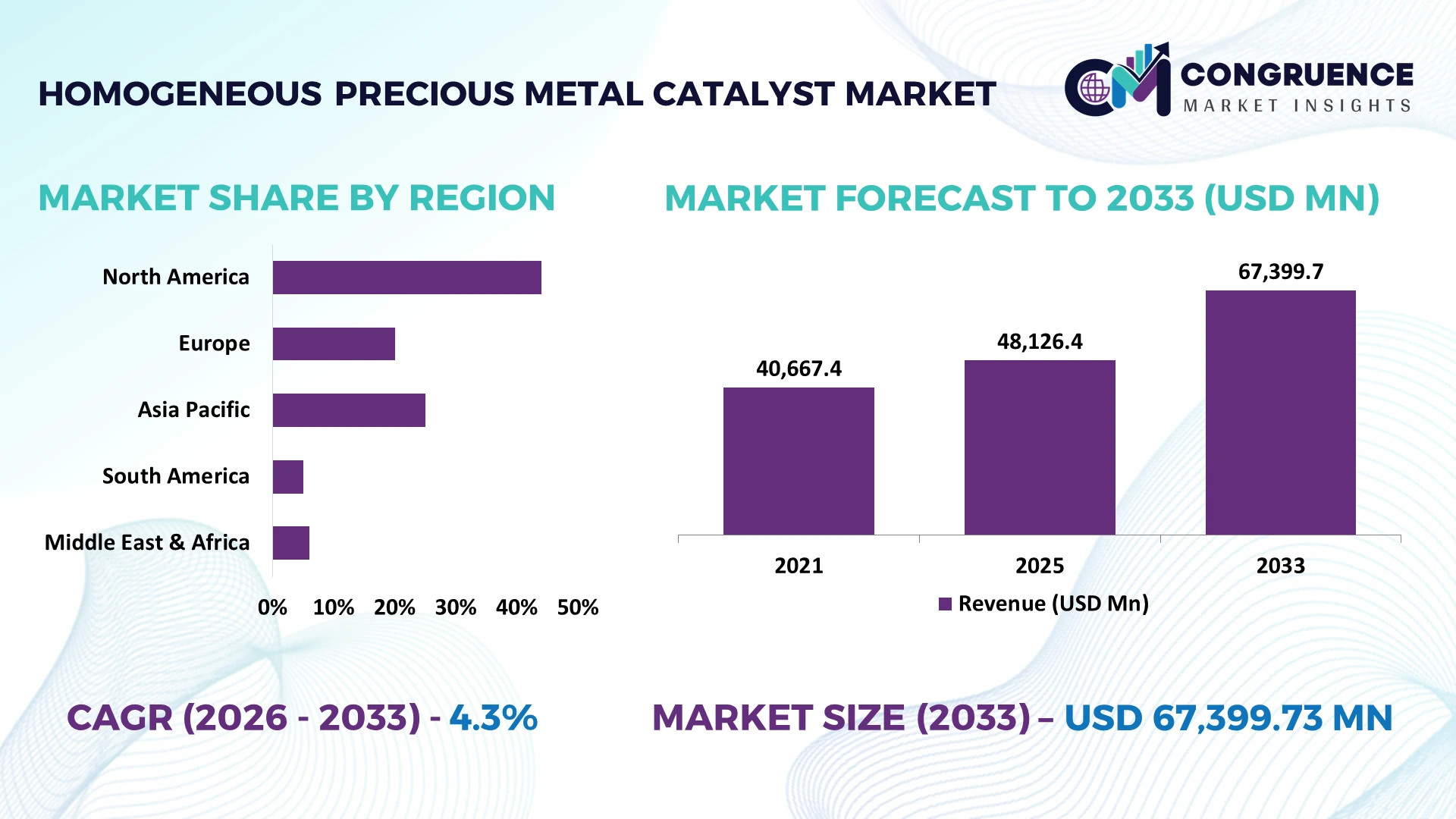
The Global Homogeneous Precious Metal Catalyst Market was valued at USD 48126.43 Million in 2025 and is anticipated to reach a value of USD 67399.73 Million by 2033 expanding at a CAGR of 4.3% between 2026 and 2033. Growth is anchored in high-selectivity pharmaceutical synthesis, hydroformylation, hydrogenation, carbonylation, and lower-metal-loading catalytic processes that reduce expensive palladium, rhodium, ruthenium, and iridium consumption.
China represents the largest country-level demand center, supported by more than 30% of global chemical manufacturing sales and its extensive pharmaceutical, specialty chemical, polymer, and refining base. Domestic chemical capacity expansion strengthens demand for soluble precious-metal complexes used in high-selectivity synthesis. Germany, by comparison, commands a smaller volume base but concentrates higher-value specialty and pharmaceutical chemistry. Meanwhile, geopolitical exposure remains significant because South Africa supplies more than 70% of mined platinum, reinforcing procurement sensitivity across platinum-group-metal catalyst chains.
Strategically, catalyst buyers must prioritize metal-efficiency, recovery economics, diversified sourcing, and application-specific ligand systems to protect margins against concentrated precious-metal supply.
Market Size & Growth: USD 48,126.43 million in 2025 advances to USD 67,399.73 million by 2033 at 4.3% CAGR, supported by selective synthesis and metal-efficient catalysis.
Top Growth Drivers: Pharmaceutical synthesis contributes approximately 35%, specialty chemicals about 25%, while petrochemical applications represent roughly 20% of addressable catalyst demand.
Short-Term Forecast: By 2028, optimized ligand-catalyst systems are expected to lower precious-metal loading by 10–20% in selected high-value reactions, improving process economics.
Emerging Technologies: AI-guided catalyst screening can evaluate thousands of ligand-metal combinations, while continuous-flow chemistry and immobilized homogeneous systems accelerate process optimization.
Regional Leaders: Asia-Pacific represents roughly USD 19.3 billion, Europe USD 13.5 billion, and North America USD 11.6 billion in 2025, with differing chemical and pharmaceutical adoption intensity.
End-User Trends: Pharmaceutical and fine-chemical production together accounts for approximately 45–50% of high-value homogeneous precious-metal catalyst consumption.
Pilot/Case Example: Continuous-flow catalytic projects can reduce reaction residence times by more than 50% versus conventional batch processing while improving thermal and reaction control.
Competitive Landscape: Johnson Matthey holds an estimated 15% position, competing with BASF, Evonik, Heraeus and Umicore across catalyst chemistry, precious-metal management and recycling.
Regulatory & ESG Impact: Precious-metal recovery systems can reclaim more than 95% of palladium and platinum from suitable industrial catalyst streams, reducing primary-metal procurement exposure.
Investment & Funding: Multi-billion-dollar global pharmaceutical and specialty-chemical capacity programs are directing catalyst investment toward localized supply, recycling partnerships and lower-loading formulations.
Innovation & Future Outlook: Advanced ligand design can improve catalytic selectivity beyond 95% in optimized reactions, shifting competition from metal quantity toward turnover efficiency and recoverability.
Homogeneous precious metal catalysts are gaining strategic importance in pharmaceuticals, fine chemicals, agrochemicals, polymers, and specialty intermediates where reaction selectivity directly influences yield and purification costs. Palladium cross-coupling, rhodium hydroformylation, ruthenium hydrogenation, and iridium-based transformations remain central technologies, while computational ligand screening and continuous-flow processing are accelerating formulation optimization. Modern catalytic systems can exceed 95% selectivity in optimized synthesis routes, reducing downstream separation requirements. Concentrated platinum-group-metal mining in South Africa and Russia is simultaneously pushing manufacturers toward catalyst recovery, lower metal loading, and closed-loop precious-metal management, setting up the market’s strategic priorities.
Homogeneous precious metal catalysts are becoming strategically important because pharmaceutical and specialty chemical producers increasingly compete on reaction yield, stereoselectivity, and process intensity rather than production volume alone. Supply-chain restructuring is reinforcing this shift: platinum-group-metal refining remains geographically concentrated, encouraging manufacturers to redesign synthesis routes around higher turnover numbers, metal recovery, and flexible ligand platforms. Catalyst selection is therefore moving upstream into process-development and procurement strategy.
Advanced asymmetric and ligand-engineered catalysts can achieve above 95% selectivity in optimized transformations, while legacy nonselective routes can require additional purification and generate 15–30% more process waste. Japan and Germany emphasize high-value pharmaceutical and fine-chemical applications, whereas China combines specialty synthesis with substantially larger chemical production scale. Through 2026–2028, continuous processing and computational catalyst screening should shorten candidate evaluation cycles by 20–40% in digitally integrated laboratories.
In pharmaceutical manufacturing, palladium-catalyzed coupling allows complex intermediates to be constructed with fewer synthetic operations, improving material utilization before scale-up. Producers are expanding catalyst-development partnerships, precious-metal leasing programs, and recovery networks while integrating computational chemistry into route design. Long-term advantage will belong to suppliers combining molecular-level catalyst performance with secure metal management and scalable process engineering.
Pharmaceutical and fine-chemical manufacturing is increasing demand for homogeneous catalysts because molecular selectivity directly determines yield, impurity burden, and downstream purification intensity. Active pharmaceutical ingredient manufacturing commonly targets purity above 99%, while optimized palladium, rhodium, and ruthenium systems can deliver reaction selectivity exceeding 95% and reduce unwanted by-products by 10–20% against less selective routes. India’s expanding API and contract-development manufacturing base is accelerating adoption of catalytic coupling and asymmetric synthesis for complex intermediates. Regulatory scrutiny of impurity profiles further increases the value of controlled reaction pathways. Catalyst companies are responding with application laboratories, custom ligand development, and pharmaceutical partnerships. The strategic advantage lies in reducing purification workload rather than simply accelerating reaction speed.
Structural dependence on geographically concentrated precious-metal production restricts cost predictability for catalyst manufacturers and chemical processors. South Africa supplies roughly 70% of mined platinum and more than 80% of rhodium, while Russia remains an important palladium producer, leaving procurement exposed to mine disruptions, sanctions, logistics constraints, and refining bottlenecks. Palladium prices have experienced swings exceeding 30% within individual annual periods, complicating catalyst inventory valuation and customer contracting. Unlike commodity reagents, high-purity catalyst manufacture also requires controlled metal specification and precursor availability. Suppliers are reducing exposure through multi-year metal agreements, customer metal accounts, secondary sourcing, and regional refining relationships. The key operational constraint is working-capital exposure: expensive metal held throughout fabrication and customer inventories directly affects margins even when catalyst consumption remains stable.
Closed-loop precious-metal management is emerging as a differentiated business model rather than a downstream waste-management activity. Specialized recovery processes can reclaim more than 95% of platinum, palladium, and rhodium from suitable catalyst-bearing streams, while recycled metal can carry substantially lower embedded emissions than primary mining. Germany’s established chemical clusters provide attractive conditions for integrating catalyst supply, spent-material collection, refining, and metal return within shorter industrial loops. Digital metal accounting and improved hydrometallurgical separation are expected to raise recovery transparency through 2026–2028, allowing customers to reduce replacement-metal purchases and inventory exposure. Catalyst suppliers are expanding refining partnerships, toll-recovery services, and metal leasing programs. The underexploited opportunity is lifecycle contracting, where suppliers capture value from catalyst formulation, recovery, and metal recirculation rather than one-time product sales.
Transferring homogeneous catalysis from laboratory optimization to commercial reactors remains technically demanding because mixing, heat transfer, catalyst poisoning, residual-metal specifications, and solvent behavior change with scale. A reaction delivering above 95% conversion at gram scale can lose 5–15 percentage points when mass-transfer conditions or feedstock impurities change during industrial scale-up. Pharmaceutical processes face an additional constraint: permitted residual palladium, platinum, rhodium, and related metals can fall into low parts-per-million ranges, requiring validated removal operations after synthesis. Switzerland and Germany’s high-value pharmaceutical manufacturing clusters consequently demand extensive process characterization before commercial deployment. Suppliers are investing in scale-up laboratories, inline analytical monitoring, impurity-tolerant ligands, and joint process-development teams. Sustainable competitiveness depends on reproducing laboratory selectivity reliably at plant scale without creating costly downstream metal-removal burdens.
Ligand Libraries Accelerate Catalyst Selection High-throughput experimentation is replacing sequential catalyst screening across pharmaceutical process laboratories. Automated platforms can evaluate hundreds of metal-ligand combinations per campaign, reducing optimization timelines by 30–50% and experimental material consumption by 20–40%. Companies are integrating robotics, design-of-experiments software, and reaction analytics to identify viable catalytic windows earlier, allowing development teams to reserve expensive scale-up resources for higher-probability candidates.
Continuous Reactors Gain Production Roles Fine-chemical manufacturers are transferring selected homogeneous reactions from batch vessels into continuous-flow systems. Flow configurations can cut residence times by more than 50%, reduce reactor inventories by 60–90%, and improve thermal control for highly exothermic chemistry. Companies are deploying modular reactors and inline spectroscopy, particularly for multipurpose plants, converting process intensification into faster changeovers and smaller production footprints.
Base-Metal Hybrid Strategies Advance High precious-metal prices are encouraging catalyst developers to combine low-loading precious metals with nickel, copper, iron, or photocatalytic pathways. Selected optimized systems have reduced precious-metal requirements by 50–90% while preserving commercially acceptable conversion. Rather than eliminating platinum-group metals, manufacturers are redesigning catalytic cycles around minimal active-metal concentrations, creating a non-obvious shift from metal substitution toward metal-use productivity.
Solvent Footprints Drive Route Redesign Pharmaceutical and specialty-chemical producers are scrutinizing solvent-intensive catalytic routes as environmental metrics become embedded in process selection. Solvents can represent 50–80% of process mass in pharmaceutical synthesis, making solvent reduction economically material. Development teams are adopting higher-concentration reactions, solvent recycling, aqueous-compatible catalysts, and telescoped processing, cutting waste generation while improving reactor utilization and reducing downstream solvent-handling requirements.
Palladium represents the leading type with an estimated 34% market share, supported by extensive use in carbon-carbon and carbon-heteroatom bond formation, established precursor availability, and compatibility with diverse ligand architectures. Its mature process knowledge makes palladium particularly important in pharmaceutical and fine-chemical synthesis. Platinum accounts for approximately 23%, retaining relevance in hydrogenation and specialized transformations. Rhodium remains critical where exceptional regioselectivity is required, particularly hydroformylation, while Ruthenium benefits from versatile hydrogen-transfer chemistry. Gold occupies a smaller specialized position in transformations exploiting its distinctive π-activation chemistry.
Iridium is the fastest-growing type as C-H activation, hydrogen borrowing, asymmetric transformations, and specialized hydrogenation broaden its synthetic utility. Its smaller availability increases emphasis on high turnover performance rather than bulk consumption. Catalyst developers are expanding proprietary Iridium ligand platforms while improving Ruthenium and Rhodium formulations for differentiated reaction pathways. Investment is therefore moving toward application-specific metal-ligand combinations, where catalyst productivity and reaction selectivity outweigh simple metal acquisition cost.
Hydrogenation represents the leading application with an estimated 29% share, reflecting broad deployment across chemical intermediates, pharmaceuticals, specialty molecules, and petrochemical processing. Homogeneous systems provide controllable chemoselectivity for substrates where conventional heterogeneous catalysts risk unwanted functional-group conversion. Hydroformylation remains an established industrial application, particularly for aldehyde and alcohol intermediates, while Carbonylation supports efficient carbonyl-containing product synthesis. Oxidation applications occupy a more selective position because catalyst stability and oxidant compatibility strongly influence commercial feasibility.
Asymmetric Synthesis is the fastest-growing application as drug and advanced intermediate manufacturers require increasingly precise stereochemical control. Optimized chiral catalyst systems can deliver enantiomeric excess above 99%, substantially reducing resolution requirements and loss of valuable material. Cross-Coupling is also strategically important for constructing complex molecular architectures, especially during medicinal and process chemistry development. Suppliers are expanding chiral ligand portfolios, screening services, and reaction-development partnerships, shifting investment toward intellectual-property-rich catalytic systems capable of delivering high selectivity with progressively lower catalyst loading.
Chemicals represent the leading end-user segment with an estimated 32% share, supported by large-scale requirements for intermediates, functional molecules, and catalytic transformations integrated into established production assets. Petrochemicals remain important for high-throughput carbonylation and hydroformylation processes, while Specialty Chemicals prioritize catalysts that enable differentiated molecular properties. Agrochemicals use homogeneous systems selectively for complex active ingredients, and Research Institutes remain essential early adopters for novel ligand-metal combinations before industrial transfer.
Fine Chemicals represent the fastest-growing end-user as producers increasingly manufacture lower-volume, higher-complexity molecules requiring tighter control of regioselectivity and stereochemistry. Contract manufacturing expansion is reinforcing this shift, with selected catalytic routes achieving above 95% product selectivity and lowering impurity formation by 10–20% versus less controlled synthesis. Pharmaceuticals remain a major high-value buyer because catalytic performance directly affects API route economics. Suppliers are responding with custom catalyst packages, technical support agreements, gram-to-commercial-scale supply programs, and collaborative process optimization rather than relying solely on standardized catalyst catalogs.
Asia-Pacific accounted for the largest market share at 40% in 2025 however, Asia-Pacific is expected to register the fastest growth, expanding at a CAGR of 5.2% between 2026 and 2033.
Pharmaceutical Process Chemistry Anchors High-Value Demand
North America accounts for approximately 24% of global demand, with consumption concentrated in pharmaceutical intermediates, specialty chemicals, advanced materials, and research-intensive synthesis. The region differentiates through sophisticated process-development infrastructure rather than commodity-scale catalyst utilization. U.S. pharmaceutical manufacturing investment has increasingly favored domestic API and advanced manufacturing capacity, strengthening requirements for reproducible palladium, ruthenium, and iridium catalyst systems. Extensive contract development and manufacturing infrastructure also accelerates transfer from laboratory synthesis to validated commercial processes. Catalyst suppliers are strengthening technical service capabilities, custom synthesis, and metal-management programs around major pharmaceutical clusters. Canada contributes through life sciences and specialty chemistry, while U.S. facilities remain the principal regional deployment centers for complex catalytic routes requiring stringent impurity control and documented process consistency.
United States Market Outlook: The United States combines extensive pharmaceutical R&D with large-scale specialty chemical infrastructure and more than 4,000 FDA-registered drug manufacturing establishments. Demand increasingly favors catalysts supplied with detailed impurity profiles, batch traceability, and scale-up support, giving technically integrated suppliers an advantage over vendors competing primarily through metal pricing.
Process Regulation Rewards High-Efficiency Chemistry
Europe represents approximately 28% of global demand and maintains a strong position in pharmaceutical synthesis, specialty chemistry, catalyst engineering, and high-purity precious-metal processing. Germany, Switzerland, Belgium, and the Netherlands anchor sophisticated chemical production networks where process efficiency and environmental performance directly influence route selection. European chemical producers face tighter industrial-emissions and waste-management requirements, strengthening investment in catalytic pathways that increase atom utilization and reduce energy-intensive separation. Established precious-metal refining infrastructure also supports integrated catalyst fabrication and customer metal-account services. German chemical parks provide shared utilities and interconnected production assets that shorten material movements between intermediate manufacturers and downstream processors. Suppliers are increasingly combining catalyst formulation with analytical support and process troubleshooting, converting technical service capability into a competitive differentiator within regulated manufacturing environments.
Germany Market Outlook: Germany hosts Europe’s largest chemical manufacturing base and several integrated chemical parks containing hundreds of interconnected production facilities. Its advantage lies in coupling specialty synthesis, engineering expertise, analytical infrastructure, and industrial-scale process development. Catalyst suppliers targeting German customers increasingly compete through reproducibility, technical documentation, rapid qualification, and compatibility with multipurpose production assets.
Chemical Manufacturing Scale Concentrates Catalyst Consumption
Asia-Pacific commands approximately 40% of global demand, supported by the world’s largest concentration of chemical production, pharmaceutical intermediates, electronics chemicals, agrochemicals, and contract manufacturing. China alone contributes more than 40% of worldwide chemical sales, creating substantial consumption opportunities for homogeneous catalytic systems deployed across large industrial value chains. India adds a differentiated manufacturing base centered on generic pharmaceuticals, APIs, crop-protection chemistry, and custom synthesis, while Japan and South Korea concentrate higher-value electronic and specialty materials. Expansion of multipurpose plants is increasing requirements for catalysts compatible with flexible production schedules and diverse feedstocks. Suppliers are establishing local technical centers, inventory hubs, and application-development partnerships to reduce qualification lead times and support customers shifting from laboratory chemistry toward commercial batches.
China Market Outlook: China combines unmatched chemical production scale with expanding domestic capabilities in high-purity intermediates and advanced materials. Thousands of industrial chemical enterprises operate across Jiangsu, Zhejiang, Shandong, and Guangdong. Local catalyst availability, shorter delivery cycles, and application engineering are becoming purchasing priorities as manufacturers reduce dependence on imported specialty catalytic systems and strengthen domestic supply resilience.
Specialty Processing Broadens Catalyst Requirements
South America represents approximately 4% of global demand, with Brazil accounting for the majority of regional consumption through chemicals, pharmaceuticals, agrochemicals, and petrochemical intermediates. Brazil’s large agricultural economy supports substantial crop-protection formulation and active-ingredient requirements, while its pharmaceutical manufacturing base generates additional demand for selective catalytic transformations. Argentina contributes pharmaceutical and specialty chemical production, although currency volatility and imported input dependence complicate procurement planning. Limited domestic production of sophisticated ligands and catalyst precursors leaves manufacturers dependent on international suppliers, extending replenishment cycles and increasing inventory requirements. Vendors are responding through Brazilian distribution partnerships, consignment inventories, technical representation, and regional metal-management arrangements. For customers, dependable catalyst availability often carries greater operational value than marginal differences in unit purchasing price.
Brazil Market Outlook: Brazil’s chemical industry ranks among the largest in the Southern Hemisphere, while its agricultural sector supports intensive demand for sophisticated crop-protection chemistry. Domestic manufacturers increasingly require catalytic technologies for complex intermediates but remain dependent on imported high-purity precursors. Suppliers with local inventories and Portuguese-language technical support can materially reduce procurement and qualification delays.
Feedstock Expansion Meets Precious-Metal Advantage
Middle East & Africa accounts for approximately 4% of global demand but combines two strategically different advantages: expanding Gulf chemical processing and Africa’s exceptional platinum-group-metal resource base. Saudi Arabia and the UAE are extending downstream chemical portfolios beyond conventional petrochemicals toward specialty intermediates and advanced materials, creating new requirements for selective catalytic processing. South Africa holds more than 70% of global platinum-group-metal reserves, positioning the region upstream of critical catalyst supply chains even though local homogeneous catalyst manufacturing remains comparatively limited. Gulf producers are building research partnerships and specialty-chemical capabilities around established industrial complexes, while African refiners focus on improving precious-metal beneficiation. The emerging strategic linkage is between resource availability, refining capability, and downstream catalyst formulation rather than simple expansion of catalyst consumption.
Saudi Arabia Market Outlook: Saudi Arabia is diversifying its chemical sector through downstream manufacturing clusters at Jubail and Yanbu, supported by integrated feedstock and utility infrastructure. Specialty chemical localization under industrial diversification programs creates an opening for advanced catalyst suppliers capable of supporting selective transformations, technology transfer, operator training, and consistent commercial-scale performance.
Johnson Matthey, BASF, Heraeus, Evonik, and Umicore compete across precious-metal sourcing, catalyst formulation, recovery, and technical services, with the top five controlling an estimated 48% of market activity. Johnson Matthey and Heraeus emphasize integrated metal management, while BASF and Evonik compete through application engineering and specialized catalytic chemistry. Suppliers achieving catalyst selectivity above 95% gain leverage in pharmaceutical and fine-chemical routes, while optimized formulations can reduce metal loading by 10–20%, materially influencing customer process economics. Competition is shifting from catalyst selling toward lifecycle management combining metal leasing, formulation, technical qualification, recovery, and refining. Companies are expanding application laboratories, customer development partnerships, and closed-loop metal services to deepen account retention. High-purity precursor access, proprietary ligand chemistry, qualification timelines, and working-capital requirements create formidable entry barriers. Winning requires consistent catalytic performance, secure metal access, rapid customization, scalable technical support, and economically credible recovery capability across commercial production cycles and geographies.
Johnson Matthey Plc
BASF SE
Heraeus Precious Metals GmbH & Co. KG
Evonik Industries AG
Umicore SA
Clariant AG
TANAKA Holdings Co., Ltd.
Strem Chemicals, Inc.
Vineeth Precious Catalysts Pvt. Ltd.
Hindustan Platinum Pvt. Ltd.
SACHEM, Inc.
Catalysts and Technologies, L.P.
KaiDa Technology Limited
Shaanxi Rock New Materials Co., Ltd.
Current catalyst technology is moving toward air-stable precatalysts, engineered phosphine architectures, and in-situ activation systems that simplify handling without sacrificing selectivity. DyadPalladate-type palladium precatalysts mask reactive phosphines in stable Pd(II) structures, reducing handling complexity by approximately 20% versus moisture-sensitive catalyst preparation. Commercial portfolios span dozens of metal-organic compounds, enabling manufacturers to match palladium, rhodium, ruthenium, iridium, platinum, or gold chemistry to specific transformations while reducing qualification failures.
Emerging platforms combine density-functional calculations, graph neural networks, and automated reaction analytics to predict ligand effects before physical synthesis. Machine-learning models can reduce experimental screening requirements by 30–50% while explainable models identify structural motifs governing enantioselectivity. Digital integration with electronic laboratory notebooks and process analytical technology transfers screening data directly into route development, benefiting pharmaceutical and fine-chemical producers facing compressed development schedules.
Disruptive technology through 2026–2028 will center on photoactivated precious-metal catalysis, electrochemically coupled transformations, and chemoenzymatic catalytic cascades. These approaches can eliminate one or more stoichiometric activation steps and cut reagent consumption by 15–30% in optimized routes. Compared with conventional trial-and-error catalyst development, computationally prioritized workflows can improve candidate-screening efficiency by roughly 40%. Suppliers combining predictive chemistry, stable precatalysts, and scalable analytical support gain a competitive advantage as customers demand rapid qualification.
January 2024 Heraeus Precious Metals detailed SabPhos, developed with Ludwig Maximilians University for difficult C-N coupling chemistry. Its palladium-dba implementation targeted transformations inaccessible previously, while related catalyst products reached kilogram-scale availability, strengthening commercial options for pharmaceutical and fine-chemical synthesis.
November 2024 Johnson Matthey specialists published a design-to-refine framework integrating homogeneous catalyst selection with downstream metal extraction. The approach targets API scale-up and earlier waste-stream planning, improving recovery economics by addressing valuable PGM losses before commercial process configuration is finalized.
March 2025 Johnson Matthey researchers advanced DyadPalladate precatalyst understanding for Suzuki-Miyaura and Buchwald-Hartwig coupling. The easily handled Pd(II) architecture contains two palladium centers and accommodates bulky phosphines, strengthening catalyst activation knowledge for scalable cross-coupling workflows requiring stable, application-flexible precursors.
October 2025 Hokkaido University researchers demonstrated virtual ligand-assisted screening for photoexcited palladium catalysis, reported across 12 journal pages. Computational ligand prioritization enabled development of alkyl-ketyl radical chemistry, validating digital reaction design as a faster pathway toward optimized homogeneous catalyst systems.
The report evaluates Platinum, Palladium, Rhodium, Ruthenium, Iridium, and Gold homogeneous catalysts across Hydrogenation, Oxidation, Carbonylation, Hydroformylation, Cross-Coupling, and Asymmetric Synthesis. End-user analysis covers Chemicals, Pharmaceuticals, Petrochemicals, Fine Chemicals, Specialty Chemicals, Agrochemicals, and Research Institutes. Geographic coverage spans North America, Europe, Asia-Pacific, South America, and Middle East & Africa, including Asia-Pacific’s approximately 40% market concentration and country-level manufacturing dynamics.
Technology assessment covers air-stable precatalysts, advanced ligand architectures, computational catalyst design, photoactivated catalysis, electrochemical transformations, and digital reaction optimization. Competitive analysis examines 10–14 influential suppliers alongside precious-metal access, catalyst customization, qualification capabilities, and process-support models. The 2026–2033 outlook tracks changing metal utilization, synthetic-route complexity, localized catalyst availability, and application-specific innovation, enabling investors and manufacturers to evaluate capacity priorities, geographic expansion, technology partnerships, competitive differentiation, and future portfolio direction.
| Report Attribute/Metric | Report Details |
|---|---|
Market Revenue in 2025 | USD 48126.43 Million |
Market Revenue in 2033 | USD 67399.73 Million |
CAGR (2026 - 2033) | 4.3% |
Base Year | 2025 |
Forecast Period | 2026 - 2033 |
Historic Period | 2021 - 2025 |
Segments Covered | By Type
By Application
By End-User
|
Key Report Deliverable | Revenue Forecast, Growth Trends, Market Dynamics, Segmental Overview, Regional and Country-wise Analysis, Competition Landscape |
Region Covered | North America, Europe, Asia-Pacific, South America, Middle East, Africa |
Key Players Analyzed | Johnson Matthey Plc, BASF SE, Heraeus Precious Metals GmbH & Co. KG, Evonik Industries AG, Umicore SA, Clariant AG, TANAKA Holdings Co., Ltd., Strem Chemicals, Inc., Vineeth Precious Catalysts Pvt. Ltd., Hindustan Platinum Pvt. Ltd., SACHEM, Inc., Catalysts and Technologies, L.P., KaiDa Technology Limited, Shaanxi Rock New Materials Co., Ltd. |
Customization & Pricing | Available on Request (10% Customization is Free) |




