
Reports
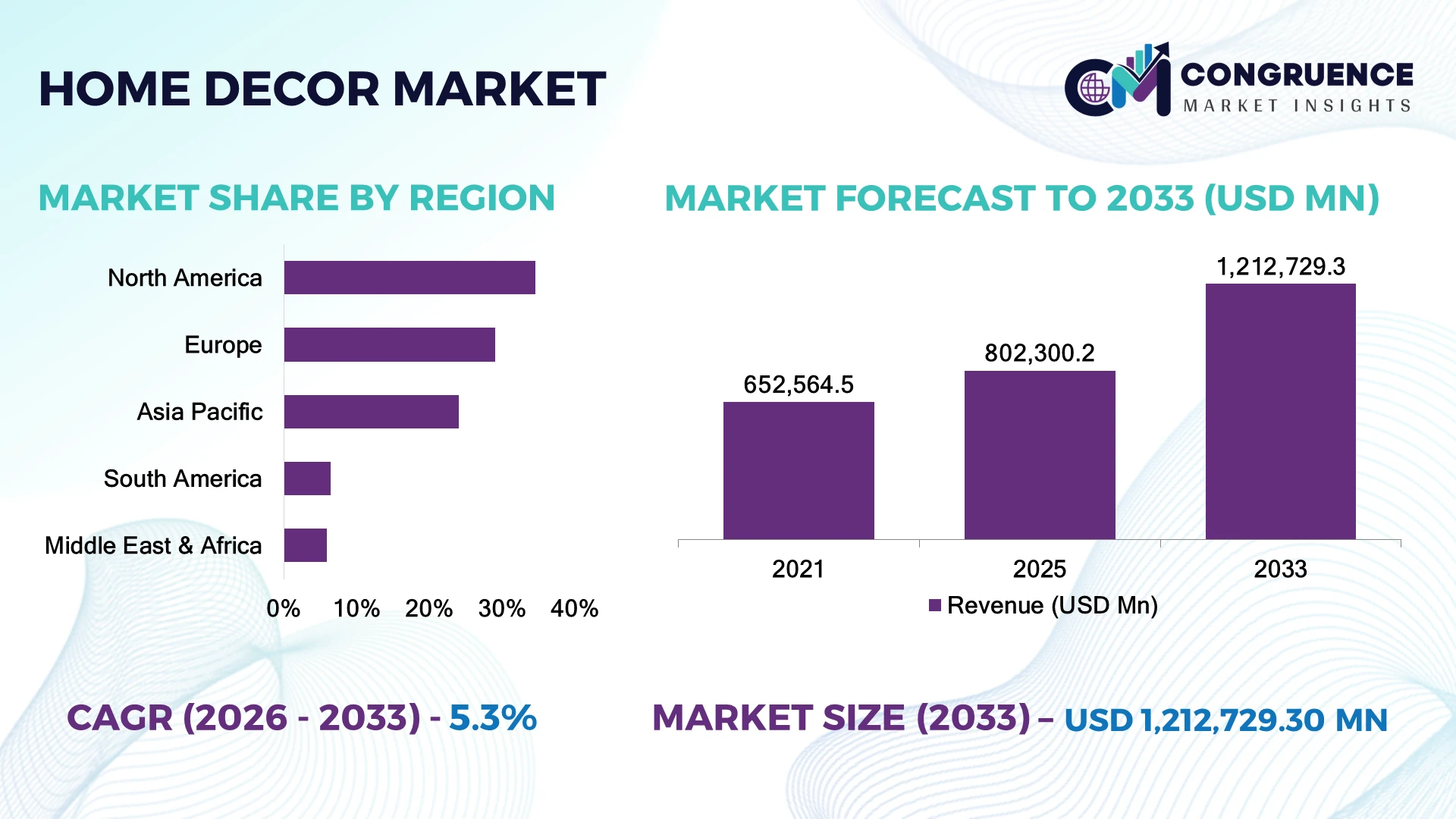
The Global Home Decor Market was valued at USD 802,300.2 Million in 2025 and is anticipated to reach a value of USD 1,212,729.3 Million by 2033 expanding at a CAGR of 5.3% between 2026 and 2033. Growth is being driven by e-commerce-led furniture and decor discovery, residential renovation activity, premiumization, and demand for sustainable materials and digitally personalized interiors.
The United States remains the dominant country market, supported by high household spending, remodeling activity, established home-furnishing retail, and advanced e-commerce penetration; online retail already represents more than 20% of U.S. retail sales. China combines manufacturing scale with rapidly expanding digital commerce, while India is growing from a smaller base as urban housing and organized retail accelerate. Geopolitical freight disruptions around the Red Sea continue influencing sourcing routes, inventory buffers, and landed costs.
Strategically, brands that combine localized sourcing, fast digital merchandising, and differentiated design will capture share more effectively than scale-only operators.
Market Size & Growth: USD 802.3 billion in 2025 to USD 1,212.7 billion by 2033 at a 5.3% CAGR, supported by renovation and digital retail.
Top Growth Drivers: E-commerce 24%, renovation 21%, premium decor 17%.
Short-Term Forecast: By 2028, digital-assisted merchandising can reduce inventory markdowns by 8–12%.
Emerging Technologies: AI visualization, 3D room planning, and AR shopping are targeting 10–15% higher conversion.
Regional Leaders: North America, Europe, and Asia-Pacific collectively represent more than 75% of global demand, with online purchasing accelerating.
Consumer/End-User Trends: Approximately 35% of younger urban consumers prioritize personalized or coordinated interior products.
Pilot/Case Example: 2026 virtual-room merchandising programs are targeting 12% lower product-return rates through improved visualization.
Competitive Landscape: IKEA leads the organized global segment, competing with Ashley, Williams-Sonoma, Wayfair, and Home24 across price, design, and omnichannel reach.
Regulatory & ESG Impact: Sustainable-material adoption is increasing by roughly 8–10% annually as retailers tighten responsible-sourcing requirements.
Investment & Funding: More than USD 5 billion is being directed toward retail technology, logistics, manufacturing modernization, and omnichannel expansion.
Innovation & Future Outlook: AI-generated designs, modular furnishings, recycled materials, and localized manufacturing are shifting competition toward speed, personalization, and supply-chain resilience.
The Home Decor Market is increasingly shaped by residential renovation, compact urban housing, premium accessories, and digitally enabled interior planning. Demand is strengthening for modular furniture, sustainable textiles, handcrafted finishes, smart lighting, and personalized decorative products, with digitally influenced purchases accounting for an estimated 30%+ of consumer discovery. Freight volatility and shifting import costs are encouraging retailers to diversify sourcing and hold inventory closer to major demand centers, setting the foundation for the strategic discussion.
The Home Decor Market is becoming strategically important because product differentiation is shifting from individual decorative items toward complete, digitally curated living environments. Retailers increasingly compete through visual discovery, rapid assortment changes, private-label development, and direct-to-consumer distribution. AI-powered room visualization can reduce product-selection friction by approximately 15%, while integrated inventory platforms improve replenishment accuracy by 10–12% compared with fragmented planning systems.
The regional competitive structure is also diverging. The United States emphasizes high-value remodeling, omnichannel retail, and premium design, while China prioritizes manufacturing integration and digital commerce scale. India is moving faster from fragmented offline purchasing toward organized retail and marketplace-led discovery, creating opportunities for localized assortments and value-focused brands.
Over the next 2–3 years, retailers are expected to increase AI-assisted merchandising, virtual room planning, automated fulfillment, and demand forecasting. A practical deployment model combines online visualization with localized fulfillment centers, allowing retailers to shorten delivery cycles and reduce excess inventory. Companies are redirecting investment toward private-label collections, regional warehouses, sustainable materials, and technology partnerships. Competitive advantage will increasingly depend on converting design data into faster assortment decisions, lower inventory risk, and highly personalized customer experiences.
AI-assisted discovery is becoming a measurable conversion lever for home decor, with 65% of recent furniture buyers expressing interest in AI-enabled shopping and 43% valuing personalized recommendations. Room visualization, 360-degree product views, and conversational discovery are reducing uncertainty around color, scale, and placement. In 2026, AI-attributed commerce is accelerating while brands restructure catalogs for machine-readable product discovery. Leading retailers are investing in recommendation engines, 3D visualization, and digital merchandising rather than simply expanding storefronts. The non-obvious advantage is faster assortment testing: digital visualization allows brands to validate design concepts before committing heavily to physical inventory. Companies that connect customer preference data with merchandising systems can shorten product-selection cycles and improve inventory allocation.
Home decor profitability remains exposed to import duties, freight volatility, and concentrated sourcing networks. In 2025, 87% of surveyed housewares businesses reported significant tariff impacts, while 90% canceled or delayed shipments and 62% increased retail prices. Furniture import disruptions also pushed major retailers toward higher inventory buffers, with average inventory reaching 76 days from 70 days previously. These pressures directly compress gross margins and increase working-capital requirements for bulky products. U.S. retailers are therefore diversifying procurement toward domestic and alternative Asian suppliers, renegotiating supplier pricing, and increasing regional inventory positioning. The sharper operational issue is not material availability alone but landed-cost predictability, making dual sourcing and flexible contracts increasingly important for margin protection.
Personalized, space-efficient decor presents an underdeveloped opportunity as urban households prioritize multifunctional interiors and digitally curated purchases. In India, online home decor expansion is increasingly linked to modular products, sustainable materials, and AI-enabled visualization, while 76% of urban furniture buyers show interest in AI-assisted shopping experiences. The next opportunity lies in connecting configuration engines with localized manufacturing: customers can select dimensions, finishes, and layouts while suppliers produce closer to demand centers. Brands are investing in modular collections, 3D configurators, artisan partnerships, and direct-to-consumer platforms. This model can reduce assortment complexity by 10–15% while supporting premium pricing through personalization. Companies that combine regional manufacturing with digital configuration can target smaller homes without carrying extensive finished-goods inventories.
The major execution challenge is integrating digital merchandising with physical inventory, manufacturing, and fulfillment networks. Furniture and decor e-commerce conversion remains only about 1.27%, while bulky-product delivery, fit uncertainty, and returns continue to constrain online economics. Although 38% of furniture buyers have used room-visualization tools and 45% have used 360-degree product views, adoption is uneven across smaller retailers. Companies must connect AI recommendations, product information management, warehouse systems, and supplier data without creating fragmented customer experiences. At least 10–15% improvement in inventory accuracy is becoming strategically important as assortments expand. Leading businesses are investing in unified commerce platforms, standardized product data, regional fulfillment, and supplier integration. The competitive risk is digital adoption without operational synchronization, which increases complexity instead of reducing it.
AI Shopping Moves Mainstream: AI is reshaping product discovery as 65% of recent furniture purchasers express interest in AI-assisted buying, while 43% value recommendation engines and 38% use room visualization. Retailers are restructuring product catalogs for AI discovery, conversational search, and personalized merchandising to improve conversion without proportionally expanding marketing spend.
Visualization Becomes Purchase Infrastructure: Digital visualization is shifting from an optional feature to a conversion tool, with 45% of furniture shoppers using 360-degree views and 38% using room-visualization technology. Leading retailers are expanding 3D catalogs and AR placement because spatial confidence directly affects high-consideration purchases, returns, and customer-service workload.
Sourcing Networks Are Diversifying: Tariff and freight volatility is forcing structural procurement changes. In 2025, 87% of surveyed housewares companies reported significant tariff impacts and 60% planned to shift manufacturing between countries. Retailers are increasing supplier diversification, regional production, and inventory buffers, making sourcing flexibility a competitive capability rather than a contingency measure.
Personalization Targets Smaller Spaces: Urban consumers are accelerating demand for modular, multifunctional, and customized decor, particularly across India’s major metropolitan markets. Digital configuration, localized production, and thematic collections are becoming integrated into merchandising workflows. Companies are reducing dependence on broad standardized assortments and using configurable products to improve space utilization while supporting higher-value purchases.
Decorative Accessories Lead, Personalized Pieces Gain Momentum
Decorative accessories are estimated to hold the leading position at approximately 31% of the global Home Decor Market, supported by broad product variety, lower ticket sizes, faster purchase cycles, and easy omnichannel distribution. Wall décor and soft furnishings follow at roughly 24% and 21%, respectively, benefiting from renovation-led styling and frequent room refreshes. Lighting and other specialized décor categories account for the remaining share and retain strategic importance through premiumization and design differentiation. Companies are expanding private-label collections, improving assortment localization, and using social-commerce data to identify fast-moving styles.
Personalized and modular décor represents the fastest-growing type, with adoption expanding around 9–11% as consumers seek coordinated interiors without committing to full-room renovations. Compared with standardized products, configurable pieces allow brands to test smaller design collections and reduce assortment risk. This shift is particularly relevant in urban India, China, and the United States, where compact living spaces strengthen demand for adaptable décor. Investment is therefore moving toward customization, digital visualization, and flexible manufacturing.
A 2025 Provoke Insights survey found that 65% of recent furniture purchasers were interested in using AI during the buying process, while 38% had used room-visualization tools, reinforcing the commercial value of digitally supported product selection.
Residential Interiors Remain the Core Demand Engine
Residential applications account for an estimated 58% of Home Decor Market demand, reflecting recurring spending on living rooms, bedrooms, kitchens, balconies, and seasonal refreshes. Demand is concentrated because households purchase across multiple décor categories, while commercial applications typically involve longer procurement cycles and project-based specifications. Hospitality represents approximately 18%, followed by offices and corporate spaces at around 13%, with retail and other applications comprising the balance. Companies serving residential buyers are prioritizing curated collections, direct-to-consumer channels, and faster replenishment to capture frequent smaller-ticket purchases.
Hospitality is the fastest-growing application, expanding adoption by approximately 9% as hotels, serviced apartments, and boutique properties increasingly use locally differentiated interiors to strengthen guest experience. Hospitality projects require greater customization and coordinated sourcing than residential purchases, creating stronger opportunities for design-to-delivery partnerships. Office demand remains selective, increasingly centered on collaborative spaces and employee-oriented environments. Retailers are responding with contract-decor teams, project-specific collections, and digital visualization capabilities, shifting competition from product availability toward execution speed and design consistency.
A 2025 survey of 9,000 U.S. consumers found that shoppers increasingly combine online inspiration with physical-store guidance, demonstrating the importance of connected digital and offline experiences for high-consideration home purchases.
Households Dominate While Hospitality Accelerates
Households represent the dominant end-user group, accounting for approximately 62% of Home Decor Market demand because purchases span multiple rooms, occasions, and replacement cycles. Residential buyers typically prioritize price, aesthetics, delivery, and personalization, whereas hospitality and commercial buyers emphasize consistency, durability, lead times, and project coordination. Interior designers and architects contribute an estimated 12% of demand influence through specification activity, while property developers, hospitality operators, and corporate buyers account for the remaining demand. Companies are segmenting assortments by lifestyle, income, room type, and design preference rather than relying on broad demographic targeting.
Hospitality operators and professional designers are the fastest-growing buyer groups, with combined procurement activity increasing around 9–10% as boutique hotels, serviced residences, and premium residential projects emphasize distinctive interiors. Professional buyers are more likely to require configurable products, coordinated finishes, and reliable batch availability, creating higher-value contract opportunities than individual household purchases. Companies are responding through trade programs, designer partnerships, project catalogs, volume pricing, and dedicated account teams. The strategic shift is toward ecosystem selling, where decor brands win through specification relationships before the consumer purchase stage.
A 2025 survey of 328 interior designers and architects across 70 countries found that 71% wanted easier visualization using real products and 62% wanted AI tools capable of translating generated concepts into real-world materials and products, highlighting growing professional demand for integrated design-to-product workflows.
North America accounted for the largest market share at 34.6% in 2025 however, Asia-Pacific is expected to register the fastest growth, expanding at a CAGR of 6.8% between 2026 and 2033.

Omnichannel remodeling is reshaping premium home-interior spending
North America maintains the strongest commercial position, supported by high household purchasing power, substantial remodeling expenditure, mature home-furnishing retail, and advanced e-commerce infrastructure. The United States represents approximately 87% of regional Home Decor Market demand, with spending concentrated across furniture, wall décor, lighting, textiles, and seasonal accessories. Digital channels influence more than 60% of furniture and décor purchase journeys, increasing the importance of visual merchandising, personalization, and inventory visibility. Canada contributes a smaller but strategically attractive market through premium interiors and sustainable product adoption. Retailers are expanding private-label collections, regional fulfillment capacity, AI-assisted room visualization, and direct-to-consumer channels. The competitive advantage is shifting toward retailers that synchronize digital discovery with rapid physical fulfillment and localized assortments.
United States Market Outlook:
The United States remains the principal North American market, supported by extensive remodeling activity, sophisticated retail infrastructure, strong logistics networks, and high digital-commerce penetration. Approximately 70% of home-furnishing discovery is digitally influenced, strengthening demand for visualization, personalized recommendations, and integrated inventory systems. Major metropolitan markets such as New York, Los Angeles, Dallas, and Miami sustain premium décor demand, while suburban remodeling supports volume categories. Retailers are prioritizing private labels, regional distribution, and faster delivery to protect margins and capture repeat purchases.
Sustainable design and compact living are reshaping assortments
Europe represents a mature Home Decor Market characterized by strong design heritage, sustainability requirements, renovation activity, and dense urban housing. Germany, the United Kingdom, France, Italy, and Spain account for the largest commercial pools, while Scandinavian markets exert disproportionate influence on sustainable and minimalist design. Approximately 45% of European consumers increasingly consider sustainability when purchasing household products, encouraging recycled materials, certified wood, and lower-impact textiles. EU environmental requirements are also increasing pressure on manufacturers to improve material traceability and product durability. Companies are responding with circular-design collections, recycled inputs, repairable products, and localized sourcing. The strategic opportunity lies in combining European design differentiation with scalable production and transparent material credentials.
Germany Market Outlook:
Germany is strategically important because of its large consumer base, advanced manufacturing ecosystem, strong furniture and home-improvement distribution, and high sustainability awareness. Approximately 50% of German consumers demonstrate meaningful interest in environmentally responsible household purchases, supporting demand for certified timber, recycled textiles, and durable décor. Major commercial centers including Berlin, Munich, Hamburg, and Frankfurt support premium interior spending, while established logistics infrastructure enables nationwide omnichannel distribution. Companies are emphasizing sustainable materials, functional design, and efficient fulfillment to defend margins.
Manufacturing scale is converging with digital-first interior commerce
Asia-Pacific is becoming the most important expansion arena as China, India, Japan, South Korea, and Southeast Asian economies combine urban housing growth with rapidly expanding digital retail. China contributes the region's largest manufacturing and consumer base, while India is accelerating from a fragmented market toward organized retail and online home-furnishing channels. Digital platforms influence more than 50% of urban décor discovery in leading markets, supporting AI visualization, social commerce, and personalized collections. Manufacturing clusters across China, Vietnam, and India provide sourcing flexibility and shorter product-development cycles. Companies are increasing local production, marketplace partnerships, modular product development, and regional fulfillment. The key advantage is the ability to combine low-cost manufacturing with rapidly localized design.
China Market Outlook:
China remains the region's strongest combination of manufacturing capacity, consumer scale, digital commerce penetration, and supply-chain integration. More than 1 billion internet users provide an extensive digital discovery base, while established manufacturing clusters in Guangdong, Zhejiang, Jiangsu, and Fujian support rapid product iteration. Urban consumers increasingly favor coordinated, space-efficient interiors and digitally discovered products. Companies are investing in direct-to-consumer platforms, AI-enabled visualization, flexible manufacturing, and localized collections to shorten design-to-market cycles and manage inventory more efficiently.
Brazilian urbanization is strengthening localized interior demand
South America is led by Brazil, which accounts for the largest share of regional Home Decor Market activity through its population scale, urban housing base, furniture manufacturing clusters, and established retail networks. Argentina, Colombia, Chile, and Peru provide additional demand, particularly in metropolitan residential and hospitality projects. Brazil's furniture industry includes more than 20,000 companies, creating a substantial domestic production ecosystem and reducing reliance on imported finished products for selected categories. E-commerce is becoming increasingly important for décor discovery, although logistics costs and currency volatility remain operational constraints. Companies are responding through localized sourcing, marketplace partnerships, smaller-format products, and regional fulfillment. The strongest opportunity lies in combining domestic manufacturing with digital merchandising to reduce imported inventory exposure.
Brazil Market Outlook:
Brazil is the region's most strategically significant market because of its large urban population, domestic furniture-manufacturing ecosystem, and broad retail distribution. Southern states such as Paraná, Santa Catarina, and Rio Grande do Sul form important furniture-production clusters, supporting localized sourcing and faster replenishment. Online home-product discovery is expanding rapidly, particularly among younger urban consumers, while premium buyers increasingly seek Brazilian craftsmanship and differentiated materials. Companies are strengthening marketplace presence, regional warehousing, and locally produced collections to manage currency exposure and improve delivery economics.
Luxury development and hospitality investment are upgrading décor demand
The Middle East & Africa market is increasingly shaped by premium residential development, hospitality construction, tourism infrastructure, and high-value interior projects. Saudi Arabia and the United Arab Emirates lead commercial activity, while South Africa provides the region's strongest established retail and manufacturing base. Saudi Arabia's large-scale urban development pipeline is generating demand for furniture, lighting, decorative surfaces, textiles, and customized interiors across residential and hospitality projects. Premium and luxury décor represents an estimated 30% of Gulf demand, substantially above many African markets. Companies are establishing local partnerships, expanding showroom networks, and developing project-based procurement capabilities. The competitive priority is shifting from mass distribution toward customization, reliable project execution, and premium material sourcing.
Saudi Arabia Market Outlook:
Saudi Arabia represents the region's strongest strategic opportunity because of large-scale urban development, hospitality investment, luxury residential projects, and rapid retail modernization. Riyadh, Jeddah, and the Red Sea development corridor are creating concentrated demand for premium furnishings and coordinated interior packages. The country's Vision 2030 investment program continues to accelerate hospitality and residential infrastructure, increasing requirements for customized décor and project-scale procurement. Companies are building local distribution relationships, expanding premium showrooms, and partnering with developers, architects, and hospitality operators to secure specification-led contracts.
IKEA competes with Wayfair and Amazon on scale, assortment, price, and digital reach, while Williams-Sonoma targets premium design and customization; Home Depot and Lowe’s compete through project-led retail and fulfillment. The top five players collectively command approximately 18% of organized home décor sales, leaving fragmentation. Price-led propositions influence roughly 45% of mass-market purchases, while digital discovery affects over 60% of buying journeys and sustainability criteria influence about 40% of European shoppers. Players are responding through private-label expansion, AI visualization, marketplace partnerships, vertical sourcing, localized fulfillment, and circular-product programs. IKEA’s 10% price reductions demonstrate scale-led pressure, while Wayfair and Home Depot are intensifying AI-enabled personalization. The competitive shift is moving from storefront breadth toward integrated data, design, inventory, and delivery control. Entry barriers remain high around supplier networks, brand recognition, logistics density, and customer acquisition economics. Winning requires differentiated design, reliable availability, fast fulfillment, and technology that converts inspiration into transactions.
IKEA
Wayfair Inc.
Williams-Sonoma, Inc.
Amazon
The Home Depot
Lowe’s Companies, Inc.
Target Corporation
Walmart Inc.
RH
TJX Companies, Inc.
Ashley Furniture Industries
Herman Miller
AI-driven visual merchandising is becoming core infrastructure for digital home décor. Generative design, image search, virtual room staging, and recommendation engines can reduce product-discovery time by 20–30%, while increasing engagement by 10–15%. Wayfair’s Muse and similar tools show adoption moving from pilot interfaces toward embedded shopping workflows.
Augmented reality and 3D visualization are improving purchase confidence by connecting catalog data with room dimensions, finishes, and furniture placement. Compared with static product photography, interactive visualization can reduce evaluation friction by roughly 15–25% and lower avoidable returns by 5–10%. Retailers with large digital catalogs benefit most because reusable digital twins support thousands of SKUs without proportional merchandising labor.
The next disruptive layer is agentic commerce integrated with inventory, fulfillment, pricing, and customer-service systems. AI assistants can convert natural-language design intent into coordinated product selections while real-time inventory prevents recommendations for unavailable items. Adoption will accelerate through 2026–2028 as retailers connect multimodal AI with ERP, CRM, and logistics systems. Cost leaders gain through automation; premium brands gain through personalization. Companies that integrate AI with operational data, rather than deploying isolated chatbots, will capture the strongest efficiency and conversion advantages. This strengthens assortment planning, dynamic pricing, and localized inventory allocation across omnichannel physical stores.
March 2025 The Home Depot launched Magic Apron, generative-AI assistance across millions of product pages, integrating product knowledge and project guidance. The deployment strengthens digital conversion and reduces discovery friction, accelerating technology-led competition in home improvement and décor. Source: homedepot.com (Home Depot Investor Relations)
February 2025 Wayfair introduced Muse, a generative-AI visual discovery tool enabling personalized home inspiration and product exploration. The platform deepens digital merchandising and differentiation through image-led discovery, positioning Wayfair against traditional retailers investing in highly personalized omnichannel experiences. Source: wayfair.com (About Us)
April 2025 Williams-Sonoma expanded its AERIN collaboration across Williams Sonoma, Williams Sonoma Home, Pottery Barn Kids and Pottery Barn Teen. The launch broadened premium lifestyle collections, strengthening design-led differentiation and cross-brand customer acquisition within its home-furnishings portfolio. Source: businesswire.com (Williams-Sonoma Investors)
January 2026 Ingka Group reported 60% zero-emission home deliveries and 95% renewable-electricity sourcing, while scaling its circular Buyback service. The shift reduces logistics emissions and strengthens IKEA’s sustainability positioning, linking delivery efficiency with circular retail economics and commitments. Source: ingka.com (Ingka Group)
The Home Decor Market Report evaluates the industry across product types, including furniture, lighting, textiles, wall décor, floor coverings, decorative accessories, and seasonal products, with analysis extending across residential, commercial, hospitality, and institutional applications. Coverage examines mass-market, premium, luxury, sustainable, customized, and digitally enabled décor categories, capturing emerging niches where design personalization and circularity are becoming commercially relevant.
The report provides country-level assessment across North America, Europe, Asia-Pacific, South America, and the Middle East & Africa, evaluating demand concentration, retail structures, manufacturing ecosystems, e-commerce penetration, supply-chain positioning, and technology adoption. Strategic analysis covers AI-powered visualization, augmented reality, 3D product configuration, digital merchandising, automated fulfillment, and circular retail models. The study supports investment planning, market-entry decisions, assortment strategy, expansion prioritization, competitive positioning, partnership evaluation, and technology investment decisions through 2033.
| Report Attribute/Metric | Report Details |
|---|---|
|
Market Revenue in 2025 |
USD 802,300.2 Million |
|
Market Revenue in 2033 |
USD 1,212,729.3 Million |
|
CAGR (2026 - 2033) |
5.3% |
|
Base Year |
2025 |
|
Forecast Period |
2026 - 2033 |
|
Historic Period |
2021 - 2025 |
|
Segments Covered |
By Type
By Application
By End-User
|
|
Key Report Deliverable |
Revenue Forecast, Growth Trends, Market Dynamics, Segmental Overview, Regional and Country-wise Analysis, Competition Landscape |
|
Region Covered |
North America, Europe, Asia-Pacific, South America, Middle East, Africa |
|
Key Players Analyzed |
IKEA, Wayfair Inc., Williams-Sonoma, Inc., Amazon, The Home Depot, Lowe’s Companies, Inc., Target Corporation, Walmart Inc., RH, TJX Companies, Inc., Ashley Furniture Industries, Herman Miller |
|
Customization & Pricing |
Available on Request (10% Customization is Free) |




