
Reports
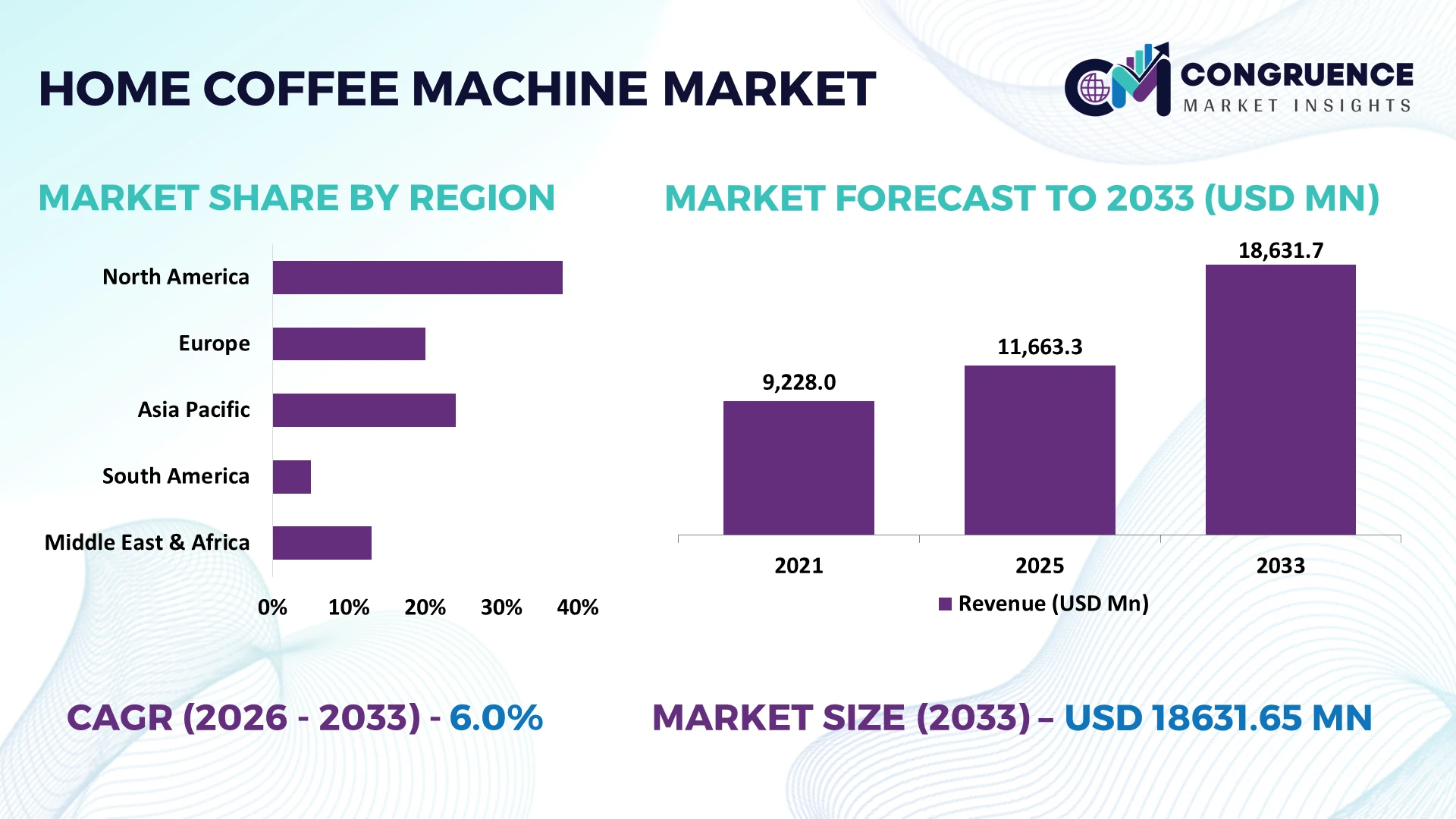
The Global Home Coffee Machine Market was valued at USD 11663.3 Million in 2025 and is anticipated to reach a value of USD 18631.65 Million by 2033 expanding at a CAGR of 6.03% between 2026 and 2033. Growth is driven by premium bean-to-cup automation, smart connectivity, energy-efficient brewing systems, and expanding at-home specialty coffee consumption supported by digital retail channels.
Germany remains a dominant manufacturing and consumption hub, accounting for approximately 22% of Europe's home coffee machine production, supported by advanced appliance engineering and sustained investments in automated household technologies. In comparison, Italy leads premium espresso machine innovation with over 35% of households regularly using espresso-style equipment. Ongoing European supply-chain diversification following Red Sea shipping disruptions has accelerated localized component sourcing and production resilience.
This competitive landscape favors manufacturers investing in premium automation, regional production flexibility, and connected appliance ecosystems.
Market Size & Growth: USD 11,663.3 million in 2025 reaching USD 18,631.65 million by 2033 at 6.03% CAGR, supported by smart brewing technology and premium household appliance upgrades.
Top Growth Drivers: Smart appliance adoption exceeds 28%, premium coffee consumption rises 18%, and online appliance sales expand 24%, strengthening global market momentum.
Short-Term Forecast: By 2028, automated brewing cycles improve efficiency by 20% while energy consumption declines by approximately 15% through optimized heating technologies.
Emerging Technologies: AI-assisted brewing, IoT connectivity, and precision temperature control improve beverage consistency by over 25% across advanced home coffee systems.
Regional Leaders: Europe exceeds USD 6.2 billion, North America surpasses USD 4.8 billion, and Asia-Pacific approaches USD 4.3 billion, driven by premium household adoption and regional manufacturing expansion.
Consumer Trends: Nearly 43% of urban consumers prefer premium home brewing solutions over frequent café purchases, increasing demand for multifunctional machines.
Pilot Example: In 2026, connected appliance deployments reduced maintenance requirements by 18% through predictive diagnostics and remote performance monitoring.
Competitive Landscape: Leading manufacturers collectively control approximately 46% of the global market, supported by De'Longhi, Philips, Breville, Jura, and Nespresso.
Regulatory & ESG Impact: Energy-efficiency standards reduce electricity consumption by up to 17%, accelerating adoption of sustainable appliance designs across developed markets.
Investment & Funding: More than USD 1.3 billion supports manufacturing expansion, automation, and strategic partnerships as companies diversify supply chains.
Innovation & Future Outlook: Advanced personalization, recyclable materials, and cloud-enabled maintenance strengthen product differentiation and reinforce long-term premium market positioning.
Home Coffee Machine Market demand continues to strengthen across premium households, compact urban residences, and connected smart-home environments. Manufacturers are introducing AI-assisted beverage personalization, quieter grinding systems, and recyclable capsule solutions, while over 30% of newly launched premium models feature app-enabled controls. Regional manufacturing diversification and component localization are improving operational resilience, setting the stage for broader strategic market expansion.
The Home Coffee Machine Market has become strategically important as premium home beverage preparation reshapes consumer spending and intensifies competition among appliance manufacturers. Companies are strengthening connected product ecosystems, subscription-based coffee services, and direct-to-consumer distribution while restructuring supply chains to reduce dependence on single-country component sourcing. Following global logistics disruptions, manufacturers have expanded dual-sourcing strategies and localized assembly to improve production continuity and inventory stability.
Modern bean-to-cup machines equipped with AI-assisted brewing profiles, IoT connectivity, and precision temperature control reduce brewing inconsistencies by approximately 25% while lowering energy consumption by nearly 15% compared with conventional semi-automatic systems. Germany continues to lead advanced appliance engineering and manufacturing efficiency, whereas China scales high-volume production with rapid smart-feature integration and shorter product development cycles. Over the next two to three years, connected home coffee appliances are expected to represent more than 35% of premium household installations, supported by increasing digital ecosystem adoption.
A leading deployment trend involves manufacturers integrating predictive maintenance applications with mobile platforms, reducing service visits and improving customer retention through remote diagnostics. Companies are expanding investments in recyclable materials, software-enabled product differentiation, and strategic component partnerships to enhance resilience. Businesses securing integrated technology platforms, localized manufacturing capabilities, and premium consumer experiences will strengthen competitive positioning and sustain long-term operational advantage.
Premium household coffee consumption is accelerating demand for intelligent brewing systems offering personalization, automation, and energy efficiency. More than 40% of premium home coffee machines introduced during the past two years include app-enabled controls, while automated brewing functions improve beverage consistency by nearly 25%. Germany continues investing in advanced household appliance engineering, encouraging component suppliers to expand local production capacity. This technology shift enables manufacturers to shorten development cycles and differentiate products beyond hardware specifications. In response, companies are increasing investments in AI-enabled brewing algorithms, premium grinder technologies, and strategic retail partnerships, creating stronger customer retention while expanding recurring revenue through accessory ecosystems and digital after-sales services.
Price fluctuations in electronic components, stainless steel, and precision pumps continue to pressure manufacturing economics. Component procurement costs have remained approximately 12% above pre-disruption averages, while shipping lead times for selected electronic modules still exceed historical levels by nearly 18%. China remains a critical supplier for electronic assemblies, exposing manufacturers to sourcing concentration risks and logistics disruptions. These structural constraints reduce production flexibility and compress operating margins, particularly for mid-range appliance manufacturers. Companies are mitigating exposure through supplier diversification, localized assembly operations, multi-year procurement contracts, and increased inventory planning to stabilize production schedules and improve operational resilience.
The strongest opportunity lies in combining intelligent brewing software with sustainable product design. More than 35% of premium buyers prioritize connected appliance features, while recyclable materials are being incorporated into over 20% of newly launched household appliance platforms. Japan is advancing compact high-efficiency brewing technologies that reduce standby energy consumption and improve long-term durability. Manufacturers are expanding R&D around adaptive beverage personalization, cloud-based maintenance platforms, and reusable capsule compatibility to strengthen customer loyalty. Strategic partnerships with coffee subscription providers and smart-home ecosystem developers are creating differentiated service models that extend product value beyond traditional hardware sales.
As home coffee machines evolve into connected consumer electronics, software reliability and interoperability have become critical execution priorities. Approximately 30% of smart appliance users expect seamless integration across multiple connected home platforms, while firmware update requirements have increased significantly with expanding digital functionality. Manufacturers in South Korea and Germany face growing pressure to maintain cybersecurity standards alongside continuous feature enhancements. Inconsistent software ecosystems and fragmented connectivity standards complicate product deployment and increase lifecycle support costs. Companies must strengthen cloud infrastructure, cybersecurity investment, cross-platform compatibility, and long-term software partnerships to preserve customer confidence and maintain sustainable competitive differentiation.
Smart Brewing Ecosystem Expansion Connected coffee machines are becoming central to premium product portfolios, with more than 38% of newly launched models supporting mobile applications and approximately 30% offering cloud-based firmware updates. Growing smart-home integration is accelerating deployment, while manufacturers in Germany are expanding software partnerships to improve remote diagnostics, reduce servicing requirements, and strengthen long-term customer engagement through connected appliance ecosystems.
Localized Manufacturing Strategies Supply-chain diversification continues following logistics disruptions and component sourcing challenges, prompting manufacturers to increase localized assembly by nearly 20% while reducing dependence on single-country suppliers. Production lead times have improved by approximately 15% through regional component procurement. Companies are restructuring supplier networks, automating assembly operations, and establishing dual-sourcing agreements to improve manufacturing resilience and inventory stability.
Premium Sustainability Design Focus Energy-efficiency standards and consumer sustainability preferences are reshaping product development, with over 28% of premium machines incorporating recycled plastics and standby power consumption declining by nearly 18% in advanced models. Manufacturers are redesigning product architectures, introducing recyclable packaging, and expanding reusable brewing systems to improve environmental performance while lowering operational costs throughout the product lifecycle.
Compact Premium Product Evolution Urban housing trends and premium home beverage preferences are increasing demand for compact multifunctional coffee machines. More than 34% of consumers now prioritize space-saving appliances, while integrated grinder adoption has increased by roughly 22%. Japanese and Italian manufacturers are responding through modular designs, quieter grinding systems, and automated milk technologies that improve convenience without expanding appliance footprints.
Bean-to-Cup Machines represent the leading segment with an estimated 31% market share, driven by fully automated operation, integrated grinding, and premium beverage consistency. Their ability to combine multiple brewing functions into one appliance reduces user effort while supporting higher consumer satisfaction. Espresso Machines remain highly competitive, particularly across Italy and Germany, where demand for café-style coffee continues to influence purchasing decisions. Drip Coffee Machines maintain strong adoption because of affordability and ease of maintenance, while Capsule Coffee Machines retain relevance through convenience-focused consumers seeking consistent brewing quality.
Bean-to-Cup Machines also represent the fastest-growing category as smart connectivity, automatic maintenance functions, and personalized brewing profiles gain traction among premium households. Capsule Coffee Machines continue evolving through recyclable capsule systems, while French Press Machines maintain niche demand among manual brewing enthusiasts despite representing a smaller market share. Approximately 42% of premium product launches now emphasize automation, and over 25% incorporate AI-assisted brewing optimization. Manufacturers are expanding premium portfolios, improving grinder technologies, and strengthening partnerships with coffee brands to differentiate performance and reinforce long-term customer retention.
Home Brewing remains the dominant application with approximately 47% market share, supported by routine daily coffee consumption, increasing appliance ownership, and expanding premium beverage preferences. Consumers continue replacing traditional manual preparation with automated systems offering programmable brewing, improved consistency, and lower preparation time. Espresso Preparation maintains strong demand among premium users seeking café-quality beverages, while Specialty Coffee applications continue expanding through customization features and advanced brewing precision.
Smart Coffee Brewing represents the fastest-growing application as connected appliances, AI-assisted beverage personalization, and mobile application integration become mainstream purchasing considerations. Nearly 36% of premium buyers prioritize connected brewing capabilities, while automated beverage customization has increased by approximately 24% over recent product generations. Cold Brew applications continue gaining popularity through dedicated brewing programs and temperature-controlled extraction systems. Manufacturers are strengthening software integration, expanding smart-home compatibility, and introducing subscription-based digital services that improve user engagement while creating differentiated customer experiences.
Households remain the dominant end-user segment, accounting for approximately 72% of global installations due to consistent daily beverage consumption, rising smart appliance adoption, and increasing preference for premium home experiences. Demand is supported by replacement purchases and upgrades to connected brewing systems offering automation and energy efficiency. Home Offices have strengthened their position as hybrid work arrangements continue encouraging investment in premium coffee equipment that improves convenience and workplace productivity within residential environments.
Home Offices represent the fastest-growing end-user category, with adoption expanding by approximately 26% as flexible work models become more established. Vacation Rentals increasingly deploy premium coffee machines to improve guest satisfaction and property differentiation, while Small Offices continue replacing traditional beverage equipment with compact automated systems that reduce maintenance requirements. Manufacturers are introducing tailored product bundles, subscription-based maintenance programs, and commercial-grade compact machines while strengthening partnerships with property management companies and office equipment distributors to capture evolving purchasing behavior.
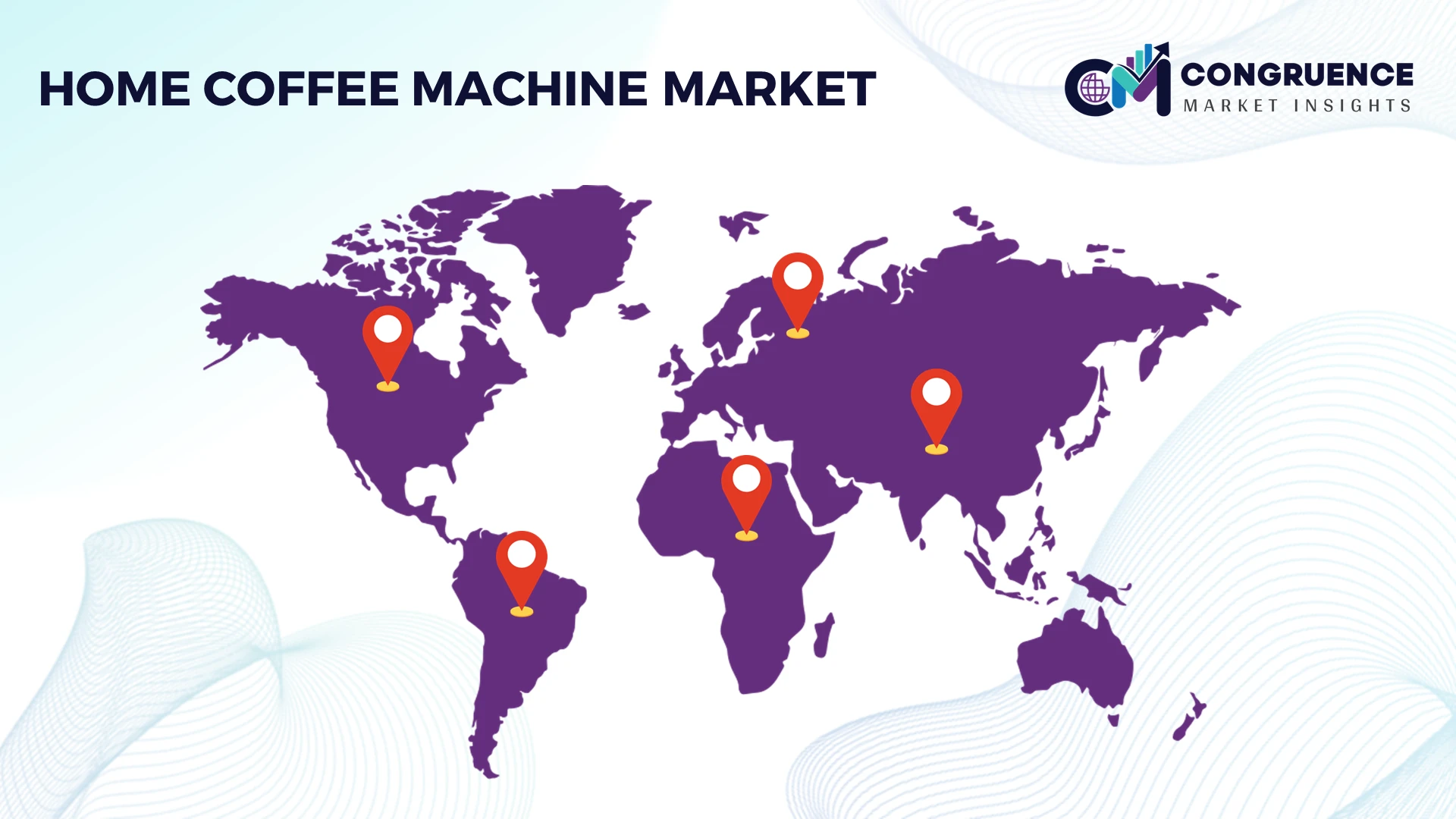
Europe accounted for the largest market share at 35.8% in 2025 however, Asia-Pacific is expected to register the fastest growth, expanding at a 7.4% CAGR between 2026 and 2033.
Premium Smart Appliance Adoption Accelerates Household Modernization
North America maintains a strong position in the Home Coffee Machine Market through high household appliance penetration, premium coffee consumption, and widespread deployment of connected home technologies. The region contributes approximately 28% of global demand, supported by established retail networks and direct-to-consumer sales channels. More than 40% of premium coffee machine purchases include Wi-Fi-enabled or app-connected features, reflecting rapid digital integration. Manufacturers continue expanding automated assembly and localized distribution capabilities to shorten delivery timelines while strengthening after-sales support. Strategic partnerships between appliance brands and specialty coffee providers are improving ecosystem value, encouraging recurring consumer engagement and product differentiation across the premium segment.
United States Market Outlook: The United States leads regional demand through high household ownership, mature e-commerce infrastructure, and strong consumer preference for premium kitchen appliances. Nearly 45% of premium home coffee machine purchases incorporate smart brewing functionality, while subscription-based coffee ecosystems continue expanding customer retention. Domestic distributors are investing in automated fulfillment centers, software-enabled maintenance services, and omnichannel retail strategies, enabling faster deployment and stronger customer lifetime value.
Engineering Excellence and Sustainability Shape Product Leadership
Europe remains the largest regional market, supported by advanced appliance manufacturing, established coffee culture, and strict energy-efficiency regulations. Germany, Italy, and Switzerland collectively represent a significant concentration of premium coffee machine production and technology development. Around 48% of newly introduced premium appliances incorporate enhanced energy-saving systems and recyclable materials to comply with evolving environmental standards. Manufacturers continue investing in localized production, precision engineering, and automation to strengthen operational efficiency while reducing supply-chain exposure. Product innovation increasingly focuses on intelligent brewing systems, quieter operation, and durable component design that supports premium market positioning.
Germany Market Outlook: Germany serves as Europe's manufacturing and engineering hub for premium home coffee machines through advanced industrial automation, component quality, and research capabilities. Approximately 22% of European coffee machine production is concentrated in Germany, supported by highly automated factories and specialized supplier networks. Companies continue expanding precision manufacturing capacity and digital production technologies, reinforcing export competitiveness while supporting premium appliance innovation.
Manufacturing Scale and Smart Consumer Adoption Expand Rapidly
Asia-Pacific is emerging as the fastest-expanding regional market due to expanding middle-income households, advanced manufacturing ecosystems, and accelerating adoption of premium home appliances. The region contributes approximately 27% of global production capacity, with China serving as the principal manufacturing base for global brands and private-label suppliers. Automated production lines have improved manufacturing efficiency by nearly 20%, supporting higher output and shorter product development cycles. Companies continue strengthening regional supply chains, expanding smart appliance portfolios, and increasing investment in localized product customization to address changing consumer preferences across urban markets.
China Market Outlook: China combines large-scale manufacturing capabilities with growing domestic demand for connected household appliances. More than 35% of exported home coffee machines from the region originate from Chinese production facilities, supported by integrated electronics and appliance supply chains. Manufacturers continue investing in robotic assembly, AI-enabled quality inspection, and localized smart technology development to strengthen both export competitiveness and domestic premium product adoption.
Premium Coffee Culture Supports Household Adoption
South America is strengthening its position through rising household coffee consumption, expanding urban retail infrastructure, and increasing availability of premium appliances. The region accounts for approximately 6% of global market demand, with Brazil representing the largest consumption and production base. Premium coffee machine deployment has increased by nearly 18% across urban households as consumers shift toward café-quality beverages prepared at home. Companies are expanding distributor partnerships, improving local servicing capabilities, and introducing mid-priced automated machines that balance affordability with advanced brewing performance despite import-related cost pressures.
Brazil Market Outlook: Brazil benefits from its globally recognized coffee industry, growing appliance retail sector, and expanding premium consumer segment. Domestic manufacturers and international brands are increasing localized assembly and strengthening distribution partnerships to reduce import dependency. Approximately 30% of premium household appliance sales now originate through digital retail platforms, improving nationwide accessibility while supporting broader adoption of automated coffee preparation equipment.
Hospitality Investment Drives Premium Appliance Expansion
The Middle East & Africa market is benefiting from expanding hospitality infrastructure, premium residential developments, and increasing consumer preference for high-quality home beverage preparation. The region contributes approximately 3% of global demand but continues improving deployment through premium retail expansion and smart-home adoption. Large residential and mixed-use developments are increasing demand for connected kitchen appliances, while premium appliance distributors are expanding service networks. Companies are strengthening regional partnerships and investing in localized customer support to improve operational reliability and product accessibility across key metropolitan markets.
United Arab Emirates Market Outlook: The United Arab Emirates leads regional adoption through premium residential projects, advanced retail infrastructure, and strong smart-home integration. More than 40% of premium kitchen appliance sales occur through organized retail and digital commerce platforms, supporting rapid deployment of connected coffee machines. International manufacturers continue expanding regional showrooms, service centers, and strategic distribution partnerships, positioning the country as a gateway for premium appliance expansion across the Middle East.
The Home Coffee Machine Market is led by De'Longhi, Breville, Philips, Jura, and Nespresso, which compete directly against regional appliance manufacturers and value-focused OEMs offering lower-cost alternatives. The top five players collectively control approximately 47% of the global market, reflecting moderate concentration with intense premium-segment rivalry. Competition centers on smart brewing technology, energy efficiency, and product differentiation rather than pricing alone. Connected models improve customer retention by nearly 22%, while automated manufacturing reduces production costs by around 15% and localized sourcing shortens delivery cycles by approximately 18%. Global leaders continue expanding through premium product launches, software integration, strategic coffee-brand partnerships, and selective vertical integration of key components. Regional manufacturers compete through localized distribution, affordable product portfolios, and rapid design adaptation. The competitive landscape is shifting toward intelligent connected ecosystems and resilient supply-chain control, increasing pressure on traditional hardware-focused brands. Strong engineering capability, digital services, manufacturing flexibility, and premium consumer experience now define successful market leadership.
De'Longhi S.p.A.
Breville Group Limited
Koninklijke Philips N.V.
Jura Elektroapparate AG
Nespresso S.A.
Melitta Group
Groupe SEB
Miele & Cie. KG
SMEG S.p.A.
Gaggia S.p.A.
La Marzocco S.r.l.
Keurig Dr Pepper Inc.
Current technology development is centered on AI-assisted brewing, IoT connectivity, and precision thermal management that deliver consistent beverage quality with lower operating costs. More than 38% of premium home coffee machines now feature app-based controls, while adaptive brewing software improves extraction consistency by approximately 25%. Manufacturers are integrating predictive maintenance, cloud diagnostics, and over-the-air firmware updates to reduce servicing requirements while strengthening long-term customer engagement. These technologies increasingly differentiate premium brands from price-driven competitors.
Emerging innovation focuses on intelligent bean recognition, automated grinder calibration, recyclable capsule compatibility, and energy-optimized heating systems. Compared with conventional semi-automatic machines, modern bean-to-cup platforms reduce preparation time by nearly 30% while lowering standby energy consumption by approximately 18%. Premium manufacturers benefit most because software capabilities, connected ecosystems, and personalized beverage profiles create stronger customer loyalty than hardware improvements alone. Deployment of modular electronics also simplifies maintenance and accelerates future feature upgrades.
Between 2026 and 2028, edge AI, digital twin testing, and advanced sensor fusion will become standard across premium product portfolios. Manufacturers are increasing investment in software development, cybersecurity, and interoperability with smart-home ecosystems as connected appliance adoption approaches 45% of premium installations. Companies acting early gain faster innovation cycles, improved operational efficiency, stronger recurring service opportunities, and sustainable competitive differentiation in an increasingly technology-driven Home Coffee Machine Market.
June 2025 De'Longhi introduced the La Specialista Touch and Dedica Duo espresso machines for the North American market, adding advanced hot and cold beverage capabilities while earning two 2025 international design awards. The launch strengthened its premium home coffee portfolio and product differentiation.
May 2025 De'Longhi launched the Rivelia Fully Automatic Espresso Machine featuring Bean Switch technology and personalized one-touch brewing. The system supports 16 beverage recipes, enabling greater customization and reinforcing the company's strategy to expand the premium bean-to-cup household segment.
March 2026 Versuni introduced the Philips Café Aromis in North America, expanding its fully automatic espresso portfolio with more than 50 customizable coffee recipes. The innovation strengthened premium smart-home positioning while enhancing consumer personalization and competitive differentiation. Source: (Versuni Newsroom)
April 2026 De'Longhi launched the PrimaDonna Aromatic featuring intelligent bean-to-cup adaptation, six bean profiles, four user profiles, and 38 hot and iced recipes. The innovation advanced AI-driven personalization, strengthening premium positioning and expanding connected home coffee experiences. Source: (De'Longhi)
The report provides comprehensive coverage of the Home Coffee Machine Market across equipment types, applications, end-user categories, and major geographic regions. It evaluates Drip Coffee Machines, Espresso Machines, Capsule Coffee Machines, Bean-to-Cup Machines, and French Press Machines while assessing demand across home brewing, specialty coffee, espresso preparation, cold brew, and smart coffee brewing. The analysis also examines purchasing patterns among households, home offices, vacation rentals, and small offices, with more than 40% of premium product launches emphasizing connected and automated brewing capabilities.
The study delivers detailed regional benchmarking across North America, Europe, Asia-Pacific, South America, and the Middle East & Africa, supported by competitive landscape assessment, technology evaluation, deployment trends, and strategic company profiling. It highlights emerging opportunities in AI-enabled brewing, IoT integration, sustainable materials, and localized manufacturing while providing actionable intelligence for investment planning, portfolio expansion, supply-chain optimization, competitive positioning, and long-term strategic decision-making throughout the 2026–2033 forecast period.
| Report Attribute/Metric | Report Details |
|---|---|
Market Revenue in 2025 | USD 11663.3 Million |
Market Revenue in 2033 | USD 18631.65 Million |
CAGR (2026 - 2033) | 6.03% |
Base Year | 2025 |
Forecast Period | 2026 - 2033 |
Historic Period | 2021 - 2025 |
Segments Covered | By Type
By Application
By End-User
|
Key Report Deliverable | Revenue Forecast, Growth Trends, Market Dynamics, Segmental Overview, Regional and Country-wise Analysis, Competition Landscape |
Region Covered | North America, Europe, Asia-Pacific, South America, Middle East, Africa |
Key Players Analyzed | De'Longhi S.p.A., Breville Group Limited, Koninklijke Philips N.V., Jura Elektroapparate AG, Nespresso S.A., Melitta Group, Groupe SEB, Miele & Cie. KG, SMEG S.p.A., Gaggia S.p.A., La Marzocco S.r.l., Keurig Dr Pepper Inc. |
Customization & Pricing | Available on Request (10% Customization is Free) |




