
Reports
The Global Hiring Software Market was valued at USD 2,845.0 Million in 2025 and is anticipated to reach a value of USD 4,980.4 Million by 2033 expanding at a CAGR of 7.25% between 2026 and 2033, according to an analysis by Congruence Market Insights. Growth is primarily driven by increasing enterprise demand for automated recruitment workflows and AI-driven talent analytics.
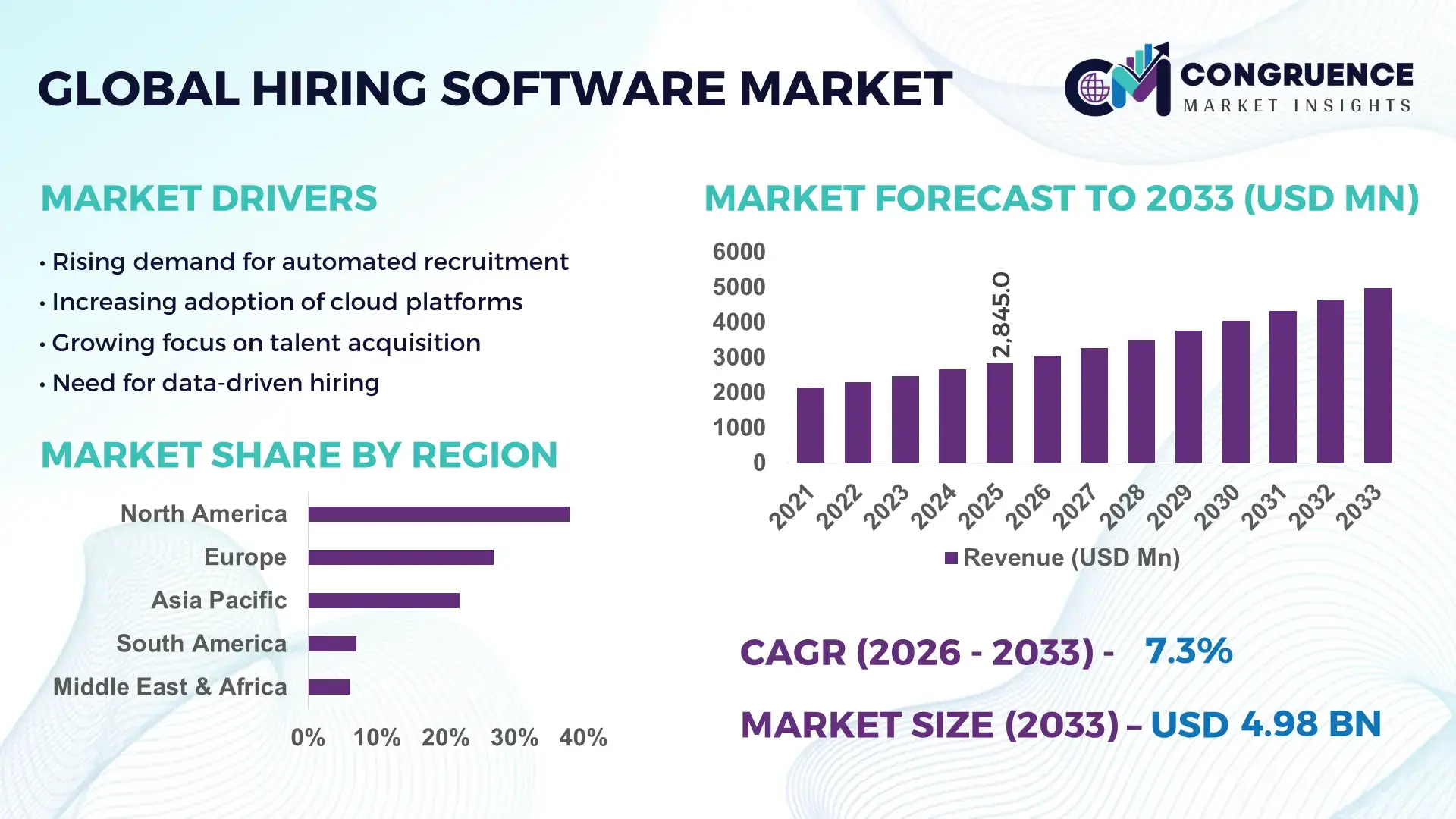
The United States dominates the Hiring Software Market with over 62% enterprise-level adoption across large organizations and mid-sized firms. More than 78% of Fortune 500 companies have implemented applicant tracking systems (ATS) integrated with AI-based screening tools. Investment in HR technology in the U.S. exceeded USD 12 billion annually, with over 35% directed toward hiring and talent acquisition platforms. Cloud-based hiring solutions account for nearly 70% of deployments, reflecting strong digital infrastructure. Additionally, over 55% of recruitment processes now leverage automation tools such as resume parsing and chatbot-based candidate engagement, improving hiring efficiency by up to 40%. The country also leads in innovation, with over 1,200 HR tech startups actively developing AI, predictive analytics, and skill-matching platforms.
Market Size & Growth: USD 2,845.0 Million in 2025, projected to reach USD 4,980.4 Million by 2033, expanding at 7.25% CAGR due to automation in recruitment processes.
Top Growth Drivers: AI adoption in HR (65%), recruitment process efficiency gains (45%), remote hiring demand (52%).
Short-Term Forecast: By 2028, hiring costs are expected to decline by 28% due to automation and AI integration.
Emerging Technologies: AI-powered candidate screening, predictive hiring analytics, NLP-based resume parsing tools.
Regional Leaders: North America (USD 2,050 Million by 2033, high enterprise digitization), Europe (USD 1,420 Million, compliance-driven adoption), Asia-Pacific (USD 1,250 Million, SME digital growth).
Consumer/End-User Trends: Over 68% of enterprises prefer cloud-based hiring platforms, while 48% rely on AI-driven candidate matching.
Pilot or Case Example: In 2025, a global tech firm reduced hiring cycle time by 35% using AI-enabled screening tools.
Competitive Landscape: Market leader holds ~18% share, followed by key players such as SAP, Oracle, Workday, ADP, and Cornerstone.
Regulatory & ESG Impact: GDPR compliance influences 72% of European hiring software deployments.
Investment & Funding Patterns: Over USD 8 billion invested globally in HR tech startups between 2023–2025.
Innovation & Future Outlook: Integration of generative AI and skill-based hiring platforms is expected to reshape recruitment strategies.
Hiring Software Market is witnessing rapid transformation across IT, BFSI, healthcare, and retail sectors, contributing nearly 65% of overall adoption. AI-enabled applicant tracking systems and cloud-based recruitment platforms are improving hiring accuracy by over 30%. Regulatory frameworks such as data privacy laws and ESG hiring mandates are shaping adoption, while Asia-Pacific shows strong growth with over 45% SME adoption. Future trends indicate increased use of generative AI and skill-based hiring models.
The Hiring Software Market holds strategic importance as organizations increasingly prioritize talent acquisition efficiency, workforce agility, and data-driven decision-making. Enterprises are leveraging AI-enabled hiring platforms to reduce recruitment timelines by up to 35% and improve candidate-job matching accuracy by nearly 50%. Modern recruitment technologies such as predictive analytics and machine learning-based screening tools are transforming traditional hiring practices. For instance, AI-driven recruitment systems deliver 40% improvement compared to manual resume screening processes, significantly enhancing recruiter productivity and candidate experience.
From a regional perspective, North America dominates in volume, while Asia-Pacific leads in adoption with over 58% of SMEs integrating cloud-based hiring platforms. The increasing shift toward remote and hybrid work models has accelerated global demand for scalable hiring solutions. By 2028, generative AI-based recruitment tools are expected to cut hiring cycle time by 30%, enabling faster onboarding and improved workforce planning.
Compliance and ESG considerations are also reshaping hiring strategies. Firms are committing to diversity hiring targets, achieving up to 25% improvement in inclusive recruitment metrics by 2027. Additionally, organizations are focusing on data security and privacy compliance, particularly in regions governed by strict regulations.
A micro-scenario highlights that in 2025, a leading U.S.-based enterprise achieved a 32% reduction in hiring costs through AI-driven recruitment automation. Looking ahead, the Hiring Software Market will continue to evolve as a critical pillar supporting digital transformation, regulatory compliance, and sustainable workforce growth strategies across industries.
The Hiring Software Market is influenced by rapid digital transformation across industries, increased demand for workforce optimization, and advancements in artificial intelligence technologies. Organizations are increasingly adopting automated hiring solutions to streamline recruitment processes, reduce manual intervention, and improve candidate experience. Over 70% of enterprises globally are investing in cloud-based HR solutions, with hiring software forming a core component of these ecosystems. The rise of remote and hybrid work models has further accelerated demand for digital hiring platforms capable of managing geographically dispersed talent pools. Additionally, integration of analytics tools allows organizations to track key performance indicators such as time-to-hire and cost-per-hire, improving operational efficiency. Growing emphasis on diversity, equity, and inclusion is also shaping hiring software capabilities, with nearly 45% of companies incorporating bias-detection tools into their recruitment systems.
The adoption of AI-powered recruitment tools is significantly accelerating the Hiring Software Market by enabling organizations to automate and optimize hiring workflows. AI-driven resume screening tools can process over 10,000 applications within minutes, reducing manual effort by nearly 60%. Chatbot-based candidate engagement systems are improving response rates by 45%, ensuring better communication throughout the hiring process. Additionally, predictive analytics tools help organizations identify high-quality candidates with up to 50% higher accuracy compared to traditional methods. Over 65% of enterprises are now integrating AI capabilities into their hiring platforms, reflecting strong demand for intelligent recruitment solutions. These tools also support diversity hiring initiatives by minimizing unconscious bias, with nearly 30% improvement in inclusive hiring metrics observed across large organizations.
Data privacy concerns and system integration challenges are key restraints affecting the Hiring Software Market. Hiring platforms often process sensitive candidate information, including personal and professional data, making them vulnerable to security breaches. Nearly 52% of organizations report concerns regarding data protection compliance, particularly in regions with stringent regulations. Additionally, integrating hiring software with existing HR systems and enterprise applications can be complex, with over 40% of companies experiencing delays during implementation. Legacy systems and lack of standardization further complicate integration processes, leading to increased operational costs and reduced efficiency. These challenges hinder adoption, especially among small and medium-sized enterprises with limited IT infrastructure.
The rise of remote hiring and access to global talent pools presents significant opportunities for the Hiring Software Market. Over 60% of organizations are expanding their recruitment strategies to include international candidates, increasing demand for scalable and cloud-based hiring solutions. Digital hiring platforms enable seamless collaboration across geographies, reducing hiring time by up to 35%. Additionally, remote hiring tools support virtual interviews, automated assessments, and real-time analytics, improving decision-making efficiency. Emerging markets in Asia-Pacific and Latin America are witnessing rapid adoption, with over 50% of SMEs investing in digital recruitment solutions. These trends create substantial growth opportunities for vendors offering innovative and flexible hiring software platforms.
Skill gaps and technology adoption barriers pose significant challenges to the Hiring Software Market. Despite growing demand for advanced hiring solutions, nearly 48% of organizations face difficulties in identifying skilled professionals capable of managing AI-driven recruitment tools. Lack of technical expertise and training limits the effective utilization of these platforms. Additionally, resistance to change among HR professionals slows adoption, with over 35% of organizations continuing to rely on traditional hiring methods. High initial implementation costs and limited awareness of advanced features further hinder adoption, particularly among small businesses. These challenges impact overall market growth and require targeted training and support initiatives to overcome.
• AI-driven recruitment automation reaching 70% enterprise adoption: Over 70% of large enterprises have implemented AI-powered hiring tools, enabling resume screening accuracy improvements of 50% and reducing hiring cycle time by 35%. Automated chatbots now handle nearly 60% of candidate queries, improving engagement rates significantly.
• Cloud-based hiring platforms dominating deployment models: Approximately 68% of organizations prefer cloud-based hiring software due to scalability and cost-efficiency benefits. Cloud deployments reduce infrastructure costs by 40% and enable remote hiring capabilities across multiple geographies.
• Rise of skill-based hiring models replacing traditional resumes: Around 55% of organizations are shifting toward skill-based hiring frameworks, focusing on competency assessments rather than educational qualifications. This approach has improved hiring quality by 30% and reduced employee turnover by 20%.
• Integration of analytics and predictive hiring tools: Nearly 62% of enterprises are using predictive analytics to improve hiring decisions, resulting in 45% better candidate-job fit. Data-driven hiring strategies are helping organizations reduce hiring costs by 25% while improving workforce productivity.
The Hiring Software Market is segmented based on type, application, and end-user, reflecting diverse adoption patterns across industries. Organizations are increasingly selecting solutions based on scalability, integration capabilities, and AI-driven features. Cloud-based hiring platforms dominate due to their flexibility and remote accessibility, while on-premise solutions remain relevant for industries requiring strict data control. Applications such as talent acquisition, workforce planning, and employee onboarding represent key demand areas, with talent acquisition accounting for the highest adoption levels. End-users span across IT, BFSI, healthcare, retail, and manufacturing sectors, with IT and BFSI contributing significantly due to high recruitment volumes and digital maturity. Increasing adoption among SMEs is also reshaping segmentation dynamics, particularly in emerging economies.
Cloud-based hiring software accounts for approximately 64% of total adoption, driven by its scalability, ease of deployment, and remote accessibility. On-premise solutions hold around 22% share, primarily used by large enterprises with strict data security requirements. Hybrid deployment models represent the remaining 14%, offering flexibility for organizations transitioning to cloud environments. Cloud-based solutions are also the fastest-growing segment, expanding at an estimated rate exceeding 9% annually due to increasing demand for remote hiring and digital transformation. Other niche types include AI-driven standalone recruitment tools and integrated HR suites, contributing a combined 20% share across specialized use cases. These solutions are gaining traction among enterprises seeking advanced analytics and automation capabilities.
Talent acquisition dominates the Hiring Software Market with a share of approximately 48%, driven by increasing recruitment needs across industries. Workforce planning accounts for around 27% of adoption, while onboarding solutions contribute nearly 15%. However, onboarding applications are growing fastest, with adoption rates expected to exceed 30% by 2033 due to increased focus on employee experience. Other applications such as candidate engagement and recruitment analytics hold a combined share of 10%, supporting advanced hiring strategies. In 2025, more than 42% of enterprises globally reported using hiring software for workforce planning, while over 60% of organizations adopted AI-based tools for talent acquisition processes.
The IT and telecom sector leads the Hiring Software Market with a share of approximately 34%, driven by high recruitment volumes and digital maturity. BFSI accounts for around 22%, while healthcare contributes nearly 16%. Retail and manufacturing sectors collectively hold a 28% share, reflecting growing adoption across diverse industries. The healthcare sector is the fastest-growing end-user segment, with adoption increasing at over 10% annually due to rising demand for skilled professionals. In 2025, more than 55% of IT companies reported using AI-driven hiring platforms, while 48% of BFSI organizations adopted digital recruitment tools to enhance efficiency.
North America accounted for the largest market share at 38% in 2025 however, Asia-Pacific is expected to register the fastest growth, expanding at a CAGR of 9.1% between 2026 and 2033.
Europe holds approximately 27% share, driven by strong regulatory compliance and digital hiring adoption. Asia-Pacific accounts for nearly 22% of the market, supported by rapid SME digitization and workforce expansion. South America contributes around 7%, while the Middle East & Africa holds approximately 6% share. Over 65% of enterprises in developed regions have implemented hiring software, compared to 40% in emerging markets. Increasing internet penetration and cloud adoption are driving growth across all regions, with Asia-Pacific witnessing over 50% SME adoption of hiring platforms.
North America holds approximately 38% market share, driven by high adoption across IT, healthcare, and BFSI sectors. Regulatory frameworks emphasizing data privacy and equal employment practices are influencing software development. Over 72% of enterprises use AI-driven hiring platforms, reflecting strong digital maturity. Companies like Workday are enhancing recruitment tools with predictive analytics and automation features. Consumer behavior shows higher adoption among large enterprises, particularly in healthcare and finance, where efficiency and compliance are critical.
Europe accounts for nearly 27% of the Hiring Software Market, with key markets including Germany, the UK, and France. GDPR regulations influence over 70% of hiring software deployments, driving demand for secure and compliant solutions. Adoption of AI-based hiring tools is increasing, particularly in large enterprises. Companies such as SAP are focusing on enhancing data security and analytics capabilities. Consumer behavior reflects strong preference for transparent and explainable AI solutions.
Asia-Pacific represents around 22% of the global market, with China, India, and Japan as key contributors. Rapid urbanization and workforce expansion are driving demand for hiring software. Over 50% of SMEs are adopting digital recruitment platforms, supported by government initiatives promoting digital transformation. Companies like Zoho are expanding cloud-based hiring solutions tailored for SMEs. Consumer behavior highlights strong growth in mobile-based hiring applications.
South America accounts for approximately 7% of the market, with Brazil and Argentina leading adoption. Increasing investment in digital infrastructure is driving demand for hiring software. Government initiatives supporting digital transformation are encouraging adoption among SMEs. Local companies are focusing on developing cost-effective solutions tailored to regional needs. Consumer behavior indicates growing preference for cloud-based platforms.
Middle East & Africa hold around 6% share, with UAE and South Africa as key markets. Demand is driven by sectors such as oil & gas, construction, and healthcare. Technological modernization initiatives are accelerating adoption of hiring software. Regional partnerships and government policies are supporting digital transformation. Consumer behavior reflects increasing adoption among large enterprises.
United States – 34% Market share: Driven by strong enterprise adoption and advanced HR technology ecosystem
China – 18% Market share: Supported by rapid digital transformation and growing SME adoption
The Hiring Software Market is moderately fragmented with over 120 active global and regional competitors. The top five companies collectively hold approximately 42% of the market share, indicating a competitive yet innovation-driven landscape. Key players are focusing on product innovation, AI integration, and strategic partnerships to strengthen their market positions.
Over 65% of companies have introduced AI-enabled features such as predictive analytics and automated candidate screening. Mergers and acquisitions are common, with more than 25 notable deals recorded between 2023 and 2025. Companies are also investing heavily in cloud-based platforms, with nearly 70% of new product launches focusing on SaaS models. Competitive differentiation is increasingly based on user experience, integration capabilities, and data security features.
Oracle
Workday
ADP
Cornerstone OnDemand
iCIMS
Greenhouse Software
Lever
BambooHR
SmartRecruiters
Jobvite
Zoho Recruit
ClearCompany
JazzHR
The Hiring Software Market is undergoing rapid technological transformation driven by advancements in artificial intelligence, machine learning, and cloud computing. AI-powered recruitment tools are enabling organizations to automate resume screening, candidate matching, and interview scheduling, improving efficiency by up to 40%. Natural language processing (NLP) technologies are being used to analyze candidate profiles and job descriptions, enhancing matching accuracy by over 50%. Predictive analytics tools are helping organizations forecast hiring needs and identify potential talent gaps, improving workforce planning.
Cloud-based platforms dominate the market, with over 68% adoption, enabling remote hiring and real-time collaboration. Integration with HR management systems and enterprise resource planning tools is also increasing, allowing seamless data exchange and improved decision-making. Emerging technologies such as generative AI and blockchain are expected to further enhance hiring processes by enabling automated job description creation and secure credential verification.
• In March 2026, iCIMS launched Frontline AI, a conversational hiring solution enabling 24/7 candidate engagement across SMS, WhatsApp, and web platforms. The platform delivered measurable outcomes, including up to 75% reduction in time-to-fill roles and 90% decrease in manual hiring tasks.
• In March 2026, SAP announced integration of SmartRecruiters with SAP SuccessFactors, embedding AI-driven hiring workflows and unified data architecture. The solution enables automated scheduling, intelligent candidate matching, and seamless HR integration, improving hiring decision accuracy and reducing administrative workload. Source: www.news.sap.com
• In July 2025, iCIMS introduced advanced AI capabilities in its summer release, including AI-powered candidate search assistants, SEO optimization tools, and multilingual career site enhancements, enabling recruiters to generate high-quality hiring content instantly and improve global candidate engagement.
• In August 2025, Workday announced the acquisition of Paradox, an AI-powered conversational recruiting platform that has facilitated over 189 million candidate interactions and achieved conversion rates exceeding 70%, strengthening Workday’s AI-driven hiring and candidate experience capabilities.
The Hiring Software Market Report provides a comprehensive analysis of key market segments, including types, applications, and end-users, offering detailed insights into adoption patterns and technological advancements. The report covers cloud-based, on-premise, and hybrid deployment models, highlighting their adoption across industries such as IT, BFSI, healthcare, retail, and manufacturing. It includes analysis of over 120 companies operating in the market, providing insights into competitive strategies, product innovations, and market positioning. The report also examines regional markets across North America, Europe, Asia-Pacific, South America, and the Middle East & Africa, covering more than 25 countries. Key focus areas include AI-driven recruitment technologies, predictive analytics, and cloud-based platforms, which are shaping the future of hiring processes.
Additionally, the report explores emerging trends such as skill-based hiring, diversity recruitment, and remote workforce management. With detailed segmentation and regional analysis, the report serves as a valuable resource for decision-makers seeking to understand market dynamics and identify growth opportunities.
| Report Attribute / Metric | Details |
|---|---|
| Market Revenue (2025) | USD 2,845.0 Million |
| Market Revenue (2033) | USD 4,980.4 Million |
| CAGR (2026–2033) | 7.25% |
| Base Year | 2025 |
| Forecast Period | 2026–2033 |
| Historic Period | 2021–2025 |
| Segments Covered |
By Type
By Application
By End-User Insights
|
| Key Report Deliverables | Revenue Forecast; Market Trends; Growth Drivers & Restraints; Technology Insights; Segmentation Analysis; Regional Insights; Competitive Landscape; Regulatory & ESG Overview; Recent Developments |
| Regions Covered | North America; Europe; Asia-Pacific; South America; Middle East & Africa |
| Key Players Analyzed | SAP; Oracle; Workday; ADP; Cornerstone OnDemand; iCIMS; Greenhouse Software; Lever; BambooHR; SmartRecruiters; Jobvite; Zoho Recruit; ClearCompany; JazzHR |
| Customization & Pricing | Available on Request (10% Customization Free) |




