
Reports
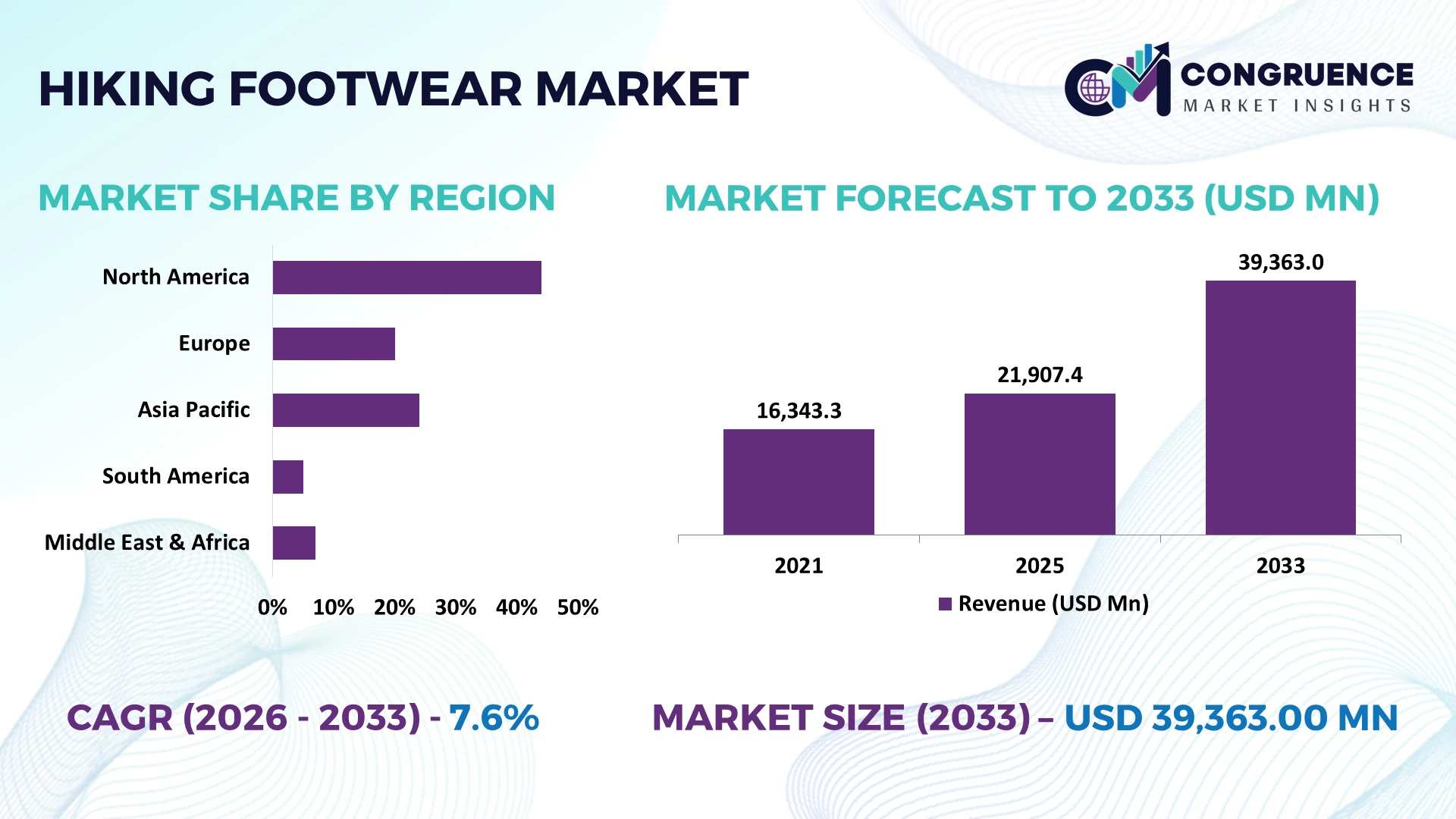
The Global Hiking Footwear Market was valued at USD 21907.36 Million in 2025 and is anticipated to reach a value of USD 39363 Million by 2033 expanding at a CAGR of 7.6% between 2026 and 2033. Growth is driven by rising hiking participation, lightweight trail-to-hike footwear adoption, waterproof membrane innovation, and increasing use of recycled performance materials.
The United States dominates hiking footwear consumption, supported by 63.4 million hiking participants and participation exceeding 20% of the population aged six and above. China remains the manufacturing center with approximately 54% of global footwear production, compared with about 12.5% for India. U.S.–China trade tensions are accelerating sourcing diversification toward Vietnam and India, while North American brands expand lightweight, waterproof, and high-traction footwear portfolios.
Strategically, manufacturers should defend premium U.S. distribution while expanding India and Vietnam sourcing and accelerating lightweight, durable, and technically differentiated hiking footwear platforms.
Market Size & Growth: USD 21.91 billion in 2025 is projected to reach USD 39.36 billion by 2033 at 7.6% CAGR, supported by technical footwear replacement and higher hiking participation.
Top Growth Drivers: Hiking participation contributes approximately 35% of growth momentum, lightweight performance upgrades 28%, and waterproof and sustainable material adoption 21%.
Short-Term Forecast: By 2028, advanced foam compounds, engineered uppers, and automated cutting are positioned to reduce footwear weight by 8–12% and manufacturing material waste by 5–8%.
Emerging Technologies: PEBA/EVA performance foams, 3D-engineered uppers, AI-assisted fit optimization, and advanced outsole compounds are improving cushioning, traction, durability, and weight efficiency.
Regional Leaders: North America is projected near USD 13.8 billion, Europe USD 11.8 billion, and Asia-Pacific USD 11.0 billion by 2033, supported by premiumization and specialist outdoor retail penetration.
Consumer/End-User Trends: U.S. hiking participation reached 63.4 million people, while approximately 16.7 million core hikers complete 13 or more outings annually, supporting stronger replacement demand.
Pilot/Case Example: In 2025, Salomon advanced its S/LAB technical mountain footwear platform following extensive alpine testing, emphasizing lower-weight construction, precision fit, and performance across demanding terrain.
Competitive Landscape: Leading technical brands account for approximately 35–40% of organized branded demand, with Salomon, Merrell, The North Face, Columbia, and adidas Terrex competing on traction, cushioning, waterproofing, and fit.
Regulatory & ESG Impact: European sustainability requirements are tightening footwear circularity, while major brands target approximately 50% recycled polyester usage across selected portfolios, accelerating material redesign and inventory controls.
Investment & Funding: Leading footwear groups are directing hundreds of millions of USD toward digital commerce, automated production, advanced materials, and Asian manufacturing diversification to strengthen global supply-chain resilience.
Innovation & Future Outlook: China represents approximately 54% of global footwear manufacturing versus India at 12.5% and Vietnam near 6.5%, reinforcing the strategic shift toward diversified Asian production networks.
The Hiking Footwear Market is shifting toward lightweight technical shoes, waterproof constructions, high-grip outsoles, and versatile trail-to-urban designs. U.S. hiking participation exceeding 20% strengthens performance-oriented replacement demand, while sourcing diversification toward India and Vietnam and tighter European circularity requirements are accelerating material innovation, manufacturing flexibility, and portfolio differentiation, establishing the foundation for strategic market assessment.
Hiking footwear is becoming strategically important as outdoor participation shifts from occasional recreation toward repeat, performance-oriented activity. U.S. hiking participation has surpassed 63 million people, creating deeper demand for lightweight cushioning, technical traction, and waterproof construction. Supply chains are simultaneously restructuring: China still accounts for more than half of global footwear production, while brands are increasing sourcing exposure to Vietnam and India to reduce concentration and tariff risks.
Product engineering is becoming a competitive differentiator. Modern PEBA/EVA midsoles and engineered textile uppers can lower finished footwear weight by roughly 10–15% versus conventional rubber-heavy constructions while maintaining cushioning and durability. North America leads premium technical consumption, whereas China dominates manufacturing scale and Vietnam specializes in export-oriented athletic footwear. Through 2028, digital fit tools, recycled textiles, and lighter high-energy-return foams will gain greater representation in premium collections.
Operationally, brands are combining trail-running technologies with hiking platforms to create lighter trail-to-hike products serving multiple use cases. Manufacturers are investing in automated cutting, material traceability, alternative Asian production hubs, and specialist outsole partnerships. Competitive advantage will increasingly depend on balancing technical performance, sourcing resilience, faster product cycles, and measurable material efficiency.
Hiking participation is creating a larger, more frequently purchasing consumer base, particularly in the United States, where more than 63 million people participate and hiking penetration exceeds 20% of the eligible population. Core hikers completing 13 or more outings annually represent roughly 26% of U.S. hiking participants, strengthening replacement demand for worn midsoles, outsoles, and waterproof constructions. Simultaneously, trail-running technologies are migrating into hiking footwear, with lightweight platforms reducing product weight by approximately 10–15% versus traditional leather-heavy boots. This performance shift encourages consumers to maintain separate footwear for day hiking, backpacking, and technical terrain. Brands are responding with expanded low-cut hiking ranges, proprietary cushioning systems, specialist rubber compounds, and direct-to-consumer fitting tools, turning participation frequency into higher-value product segmentation.
Hiking footwear remains exposed to concentrated Asian manufacturing and volatile technical-material costs. China accounts for approximately 54% of global footwear production, while Vietnam contributes around 6–7%, leaving brands dependent on a limited number of specialized manufacturing ecosystems for molded soles, waterproof laminates, and performance uppers. U.S. tariff exposure on Chinese imports further complicates landed-cost planning, while labor costs in established Asian footwear hubs have increased sourcing pressure. Technical hiking shoes also require multi-material assemblies that limit rapid supplier substitution compared with basic casual footwear. Companies are reducing concentration through dual-sourcing strategies spanning Vietnam, India, Indonesia, and China, alongside longer-term supplier contracts and material standardization. The operational priority is therefore not simply obtaining cheaper production, but establishing interchangeable capacity without compromising waterproofing, outsole adhesion, fit consistency, or delivery reliability.
Next-generation hiking footwear creates an opportunity to combine trail-running weight efficiency with hiking-specific protection, expanding addressable use cases beyond conventional trekking boots. India already represents approximately 12.5% of global footwear production, while Vietnam contributes around 6.5%, providing brands with scalable alternatives to China-centered sourcing. Advanced PEBA/EVA foams, engineered mesh, 3D-knit uppers, digital foot scanning, and optimized rubber geometries can reduce footwear weight by 10–15% while improving fit and energy management. A less obvious opportunity lies in modular platform engineering: manufacturers can reuse midsoles, lasts, and outsole architectures across hiking, approach, and trail products, reducing tooling complexity and accelerating launches. Through 2028, brands are positioned to expand R&D partnerships with compound suppliers, localize Asian production, integrate fit analytics, and build technically differentiated footwear ecosystems around terrain-specific consumer requirements.
Scaling technical hiking footwear while preserving durability, fit, traction, and waterproof performance remains a significant execution challenge. A modern hiking shoe can combine more than 20 individual components and multiple adhesives, foams, membranes, textiles, and rubber compounds, increasing manufacturing-control requirements compared with simpler footwear. Lightweight redesigns targeting 10–15% weight reductions can also create durability trade-offs when material thickness or reinforcement is reduced aggressively. European circularity requirements add another engineering pressure because multi-material bonded construction remains difficult to disassemble and recycle efficiently. Companies must therefore improve accelerated wear testing, digital prototyping, adhesive systems, material traceability, and supplier quality controls rather than pursuing weight reduction alone. Long-term competitiveness will depend on engineering platforms that deliver consistent field performance across factories while progressively reducing material complexity, production variability, and end-of-life environmental burden.
Trail-to-Hike Designs Gain Scale: Low-cut technical silhouettes are displacing heavier constructions for moderate terrain, with newer platforms cutting footwear weight by roughly 10–15% and some premium models moving below 400 grams per shoe. Brands are transferring high-energy-return foams, rocker geometries, and aggressive lugs from trail running into hiking collections. Faster product crossover broadens everyday usability and improves inventory productivity across specialist and direct channels.
Circular Design Moves Into Production: Footwear manufacturers are increasing recycled polyester, bio-based foams, and traceable upper materials, with several major brands targeting at least 50% recycled polyester across applicable product portfolios. EU ecodesign rules and restrictions on destroying unsold footwear are tightening inventory discipline. Companies are simplifying material combinations, improving product traceability, and restructuring procurement around lower-impact inputs, reducing overproduction exposure while preparing technical footwear for stricter circularity requirements.
Fit Technology Reshapes Selling: 3D foot scanning, AI-supported sizing, and digitally engineered lasts are moving deeper into premium footwear workflows. Digital measurement systems can capture millions of foot-data points, while optimized sizing processes target return reductions of 10–20% in high-return online categories. Retailers and brands are connecting scanning with recommendation engines and consumer profiles, turning fit accuracy into a conversion, inventory-allocation, and customer-retention tool rather than simply a comfort feature.
Sourcing Networks Become More Distributed: China still produces approximately 54% of global footwear, but India contributes around 12.5% and Vietnam 6.5%, creating meaningful alternative manufacturing capacity. Tariff uncertainty, logistics disruption, and buyer concentration limits are prompting brands to allocate tooling and supplier qualification across multiple countries. Manufacturers are expanding dual-source component programs and regional vendor networks, improving continuity while creating stronger negotiating leverage over lead times and production allocation.
Day Hiking Shoes account for approximately 38% of hiking footwear demand, supported by lightweight construction, lower technical barriers, broad retail availability, and suitability for short recreational outings. Their crossover into travel and everyday outdoor use improves production scalability and inventory turnover. Trail Hiking Shoes represent the fastest-expanding type, capturing approximately 24% of demand as consumers increasingly favor lighter platforms, responsive midsoles, and multidirectional traction over conventional boot constructions. Manufacturers are consequently transferring trail-running foam technologies and engineered uppers into hiking-specific designs.
Backpacking Boots remain strategically important for load-bearing journeys, while Mountaineering Boots occupy a smaller premium segment requiring insulation, stiffness, and crampon compatibility. Approach Shoes serve technical users needing climbing-derived grip and precise foothold control. Together, these specialist categories account for roughly 38% of demand but generate disproportionate opportunities for technical differentiation. Brands are concentrating investment on lighter boot architectures, proprietary rubber compounds, waterproof laminates, and platform sharing between day-hiking and trail-hiking lines to increase development efficiency.
Day Hiking represents approximately 40% of application demand, reflecting its low participation barrier, widespread trail accessibility, and compatibility with lightweight footwear. Frequent short-duration outings favor low-cut products offering cushioning, flexibility, and moderate protection rather than heavier boots. Trail Hiking is the fastest-expanding application and represents approximately 23% of demand, supported by crossover participation between hiking and trail running. Brands are responding with lighter midsoles, breathable engineered uppers, rock protection, and outsole geometries optimized for mixed surfaces.
Backpacking maintains established demand among consumers carrying heavier loads over multi-day routes, supporting structured boots and increased underfoot stability. Trekking remains important across countries with established long-distance tourism corridors, particularly Nepal and India, while Mountaineering generates lower volumes but requires highly specialized insulation, rigidity, weather protection, and crampon integration. Backpacking, Trekking, and Mountaineering collectively represent approximately 37% of application demand. Suppliers are increasingly differentiating product platforms by terrain intensity rather than simply boot height, improving assortment precision and reducing unnecessary material weight across less demanding applications.
Outdoor Enthusiasts account for approximately 67% of end-user demand because individual consumers drive replacement cycles, footwear specialization, and purchases across day hiking, trail hiking, trekking, and mountaineering. Higher-frequency participants increasingly maintain multiple footwear formats for different terrain conditions, strengthening premium product segmentation. Outdoor Retailers represent the fastest-evolving commercial buyer group, accounting for approximately 17% of market activity as specialist chains and digital sellers improve technical assortment, fit services, and omnichannel fulfillment.
Adventure Tour Operators, Hiking Clubs, and Trekking Guides form smaller but strategically valuable professional channels. Operators and guides influence footwear selection where safety, durability, grip, and climate suitability directly affect customer experience, while clubs provide concentrated access to recurring participants. These professional and community groups collectively represent roughly 16% of demand. Manufacturers are targeting them through guide programs, group pricing, product-testing partnerships, retailer education, and terrain-specific assortments. Outdoor retailers are also integrating digital fitting and technical consultation, converting expert service into a differentiation mechanism against generalized footwear channels.
North America accounted for the largest market share at 35% in 2025 however, Asia-Pacific is expected to register the fastest growth, expanding at a CAGR of 8.8% between 2026 and 2033.
High Participation Supports Premium Technical Footwear
North America represents approximately 35% of global hiking footwear demand, anchored by extensive trail infrastructure, high outdoor participation, and established specialist retail. U.S. hiking participation exceeds 63 million people, creating substantial demand for lightweight day-hiking shoes, waterproof boots, and trail-derived footwear. Product portfolios are shifting toward lower-weight constructions using engineered mesh, responsive foams, and advanced rubber compounds, while digital fitting improves specialist and direct-to-consumer selling. Canada adds demand through trekking, national-park tourism, and cold-weather applications requiring waterproof and insulated products. Retailers are increasingly organizing assortments by terrain, trip duration, and technical intensity rather than conventional boot categories. This improves inventory precision and gives performance-focused brands stronger opportunities to capture premium replacement purchases from frequent hikers.
United States Market Outlook: The United States combines large-scale outdoor participation, more than 150,000 miles of designated hiking trails, mature specialty retail, and strong direct-to-consumer penetration. Technical brands increasingly target the 16-million-plus frequent-hiker cohort with terrain-specific cushioning, traction, and waterproofing, making product specialization and fit accuracy important competitive levers.
Circularity Reshapes Technical Product Design
Europe accounts for approximately 30% of global hiking footwear demand, supported by established trekking cultures across Germany, France, Italy, Austria, Switzerland, and the Nordic countries. The Alpine ecosystem sustains demand for approach shoes, trekking boots, and mountaineering footwear, while lighter hiking silhouettes are gaining shelf space for recreational use. Regulation is becoming a material product-development factor: EU ecodesign requirements and restrictions on destroying unsold footwear increase pressure for durability, traceability, inventory discipline, and circular product architectures. Manufacturers are responding by reducing material complexity, increasing recycled textile content, and strengthening repairability programs. Specialist European brands also retain an advantage in technical lasts, alpine testing, and outsole engineering. Consequently, compliance capability is moving from a back-office requirement toward a competitive product-development asset.
Germany Market Outlook: Germany is strategically important because of its large outdoor consumer base, specialist retail network, domestic technical-footwear heritage, and proximity to Alpine hiking destinations. More than 200,000 kilometers of marked hiking routes support frequent recreational usage, while demanding consumers strengthen adoption of waterproof membranes, durable outsoles, repairable construction, and environmentally differentiated materials.
Manufacturing Scale Meets Expanding Domestic Demand
Asia-Pacific combines rising hiking participation with the world's largest footwear manufacturing ecosystem, giving the region strategic importance across both consumption and supply. It represents approximately 28% of hiking footwear demand while China alone produces more than half of global footwear units. Vietnam, India, and Indonesia are gaining sourcing allocations as international brands reduce factory concentration and establish multi-country production networks. Technical capabilities are advancing from basic assembly toward molded components, engineered uppers, performance foams, and specialist outsole manufacturing. Japan and South Korea add premium demand for lightweight technical products, while India's expanding outdoor community supports accessible day-hiking and trekking footwear. The operational advantage is increasingly ecosystem depth: brands can distribute material sourcing, tooling, assembly, and export production across multiple Asian hubs while preserving scale and shortening supplier qualification cycles.
China Market Outlook: China remains the region's critical manufacturing anchor, producing approximately 54% of global footwear. Dense supplier clusters provide access to molding, textiles, adhesives, tooling, and automated production capabilities. Domestic hiking participation and outdoor lifestyle consumption are also expanding, allowing international and Chinese brands to combine manufacturing scale with increasingly sophisticated local technical-footwear demand.
Adventure Tourism Strengthens Technical Demand
South America represents approximately 4% of global hiking footwear demand, but its product mix benefits from highly differentiated terrain across Patagonia, the Andes, Amazonian environments, and established trekking destinations. Chile and Argentina generate demand for technical trekking and mountaineering boots, while Brazil provides the largest scalable consumer base for recreational hiking footwear. Adventure-tourism operators and specialist retailers increasingly prioritize waterproof construction, outsole durability, and multi-surface traction because imported technical footwear must perform across wide climatic conditions. However, import duties, currency volatility, fragmented specialty distribution, and limited domestic production constrain assortment depth and replacement speed. Brands are responding through distributor partnerships, selective localization, and concentrated premium inventories in major urban and tourism hubs rather than pursuing broad undifferentiated retail coverage.
Brazil Market Outlook: Brazil offers the region's strongest consumer-scale opportunity, supported by a population exceeding 200 million and extensive national-park and ecotourism activity. Domestic footwear manufacturing capabilities provide opportunities for localized entry-level production, while premium hiking categories remain import-oriented. Successful brands increasingly combine local distribution expertise with climate-adapted breathable materials and aggressive wet-surface traction.
Tourism Infrastructure Broadens Technical Use Cases
Middle East & Africa accounts for approximately 3% of global hiking footwear demand, with market development concentrated around adventure tourism, mountain destinations, protected areas, and large-scale tourism infrastructure. Saudi Arabia is building hiking-oriented destinations around AlUla, Asir, and Red Sea tourism, while the UAE supports premium outdoor retail and destination-led recreation. South Africa provides an established hiking ecosystem spanning national parks, mountain routes, and adventure operators. Product requirements differ sharply from traditional Alpine footwear: heat management, breathable uppers, abrasion resistance, and dry-surface grip frequently outweigh heavy insulation. Infrastructure investment is therefore creating specialized product opportunities rather than simply replicating European demand. Brands are using local distributors, tourism partnerships, premium retail locations, and climate-specific assortments to establish demand without committing prematurely to broad physical-store networks.
Saudi Arabia Market Outlook: Saudi Arabia is emerging as a strategically important outdoor-tourism market under Vision 2030, with tourism development spanning AlUla, mountain destinations, and extensive new trail experiences. AlUla alone covers more than 22,000 square kilometers, creating opportunities for breathable technical footwear, guided-hiking equipment partnerships, and destination-specific retail linked to expanding adventure-tourism infrastructure.
The hiking footwear market pits global outdoor specialists Salomon, Merrell, Columbia, The North Face, and adidas against technical challengers such as La Sportiva, LOWA, and Scarpa. The top five brands collectively capture approximately 35–40% of organized branded demand, leaving substantial room for specialist positioning. Competition centers on traction, cushioning, waterproofing, fit, weight, and distribution reach; modern lightweight platforms deliver roughly 10–15% weight reductions, while digital fitting can lower size-related returns by 10–20%. Salomon and adidas increasingly transfer trail-running technologies into hiking platforms, while Merrell and Columbia leverage broad retail distribution and accessible price architecture. European specialists defend premium positions through alpine testing, technical lasts, and high-performance outsole systems. Supply-chain diversification toward Vietnam, India, and Indonesia is weakening dependence on Chinese assembly and improving sourcing flexibility. Proprietary compounds, brand credibility, specialist distribution, and field-tested performance remain significant entry barriers. Winning requires differentiated technical performance, reliable multi-country sourcing, precise consumer segmentation, and rapid product-cycle execution.
Salomon
Merrell
Columbia Sportswear
adidas
KEEN
La Sportiva
LOWA
Scarpa
Oboz Footwear
Tecnica
Hanwag
Mammut
ASICS
Deckers Outdoor Corporation
Current hiking footwear technology centers on lightweight EVA and PEBA-derived foams, engineered mesh uppers, waterproof membranes, and high-traction rubber compounds. Compared with traditional leather-heavy boots, modern low-cut technical designs can reduce finished weight by 10–15% while preserving stability and grip. Digital last engineering and automated cutting are also improving material utilization by roughly 5–8%, giving scaled brands faster development cycles and lower waste across multi-model platforms.
Emerging systems integrate 3D foot scanning, AI-assisted sizing, nitrogen-infused or supercritical foams, and computational outsole geometry. Digital fit tools can reduce size-related online returns by 10–20%, while advanced foams improve energy return and cushioning efficiency by around 8–15% versus conventional EVA formulations. Adoption is strongest in premium hiking and trail-hybrid ranges, where leading brands increasingly reuse trail-running technologies to accelerate lighter, more responsive product launches.
Disruptive development is shifting toward recyclable mono-material components, additive-manufactured midsoles, embedded material traceability, and digitally optimized footwear platforms. Between 2026 and 2028, wider deployment of automated knitting, data-driven fit libraries, and modular sole architectures should shorten prototyping cycles by 15–25% and reduce component complexity. Brands controlling proprietary compounds, fit data, and multi-country automated production will gain operational advantage; acting now secures faster innovation, lower inventory risk, and defensible differentiation.
March 2025 adidas TERREX launched the redesigned Skychaser GORE-TEX with LIGHTSTRIKE cushioning, Continental rubber, and waterproof protection, expanding one technical platform across hiking and everyday use and strengthening product versatility for consumers seeking performance without traditional boot bulk. Source: adidas.com
March 2025 Merrell launched SpeedARC Matis globally in Vent and GORE-TEX versions priced at £160 and £190, respectively, introducing its SpeedARC propulsion platform to fast hiking and extending technical performance footwear from trail use into everyday crossover demand. Source: outdoor-insight.co.uk
March 2025 The North Face expanded VECTIV 3.0 with four new footwear models combining stabilizing plates, DREAM nitrogen-TPU cushioning, and high-traction outsoles, broadening its performance platform and supporting faster consumer adoption of trail-derived technology across technical outdoor footwear. Source: forbes.com
January 2026 Salomon upgraded the X Ultra 5 hiking boot with a Matryx woven upper, GORE-TEX protection, deeper outsole lugs, and improved stitching; the 16-ounce design strengthens durability and traction while preserving lightweight positioning for demanding mountain hikers. Source: gearpatrol.com
The report evaluates the Hiking Footwear Market across Day Hiking Shoes, Backpacking Boots, Approach Shoes, Trail Hiking Shoes, and Mountaineering Boots, alongside applications in day hiking, backpacking, trail hiking, trekking, and mountaineering. End-user coverage spans outdoor enthusiasts, adventure tour operators, hiking clubs, trekking guides, and outdoor retailers, with analysis across North America, Europe, Asia-Pacific, South America, and Middle East & Africa.
Strategic coverage includes lightweight foam systems, waterproof membranes, engineered uppers, traction compounds, digital fitting, automated cutting, and emerging circular-design technologies. With day hiking representing roughly 40% of application demand and outdoor enthusiasts about 67% of end-user demand, the report identifies where product investment and channel expansion carry the strongest commercial relevance. It supports 2026–2033 decisions on sourcing diversification, technology partnerships, regional expansion, portfolio positioning, and competitive differentiation, including niche opportunities in trail-to-hike footwear and climate-specific technical designs.
| Report Attribute/Metric | Report Details |
|---|---|
Market Revenue in 2025 | USD 21907.36 Million |
Market Revenue in 2033 | USD 39363 Million |
CAGR (2026 - 2033) | 7.6% |
Base Year | 2025 |
Forecast Period | 2026 - 2033 |
Historic Period | 2021 - 2025 |
Segments Covered | By Type
By Application
By End-User
|
Key Report Deliverable | Revenue Forecast, Growth Trends, Market Dynamics, Segmental Overview, Regional and Country-wise Analysis, Competition Landscape |
Region Covered | North America, Europe, Asia-Pacific, South America, Middle East, Africa |
Key Players Analyzed | Salomon, Merrell, Columbia Sportswear, adidas, KEEN, La Sportiva, LOWA, Scarpa, Oboz Footwear, Tecnica, Hanwag, Mammut, ASICS, Deckers Outdoor Corporation |
Customization & Pricing | Available on Request (10% Customization is Free) |




