
Reports
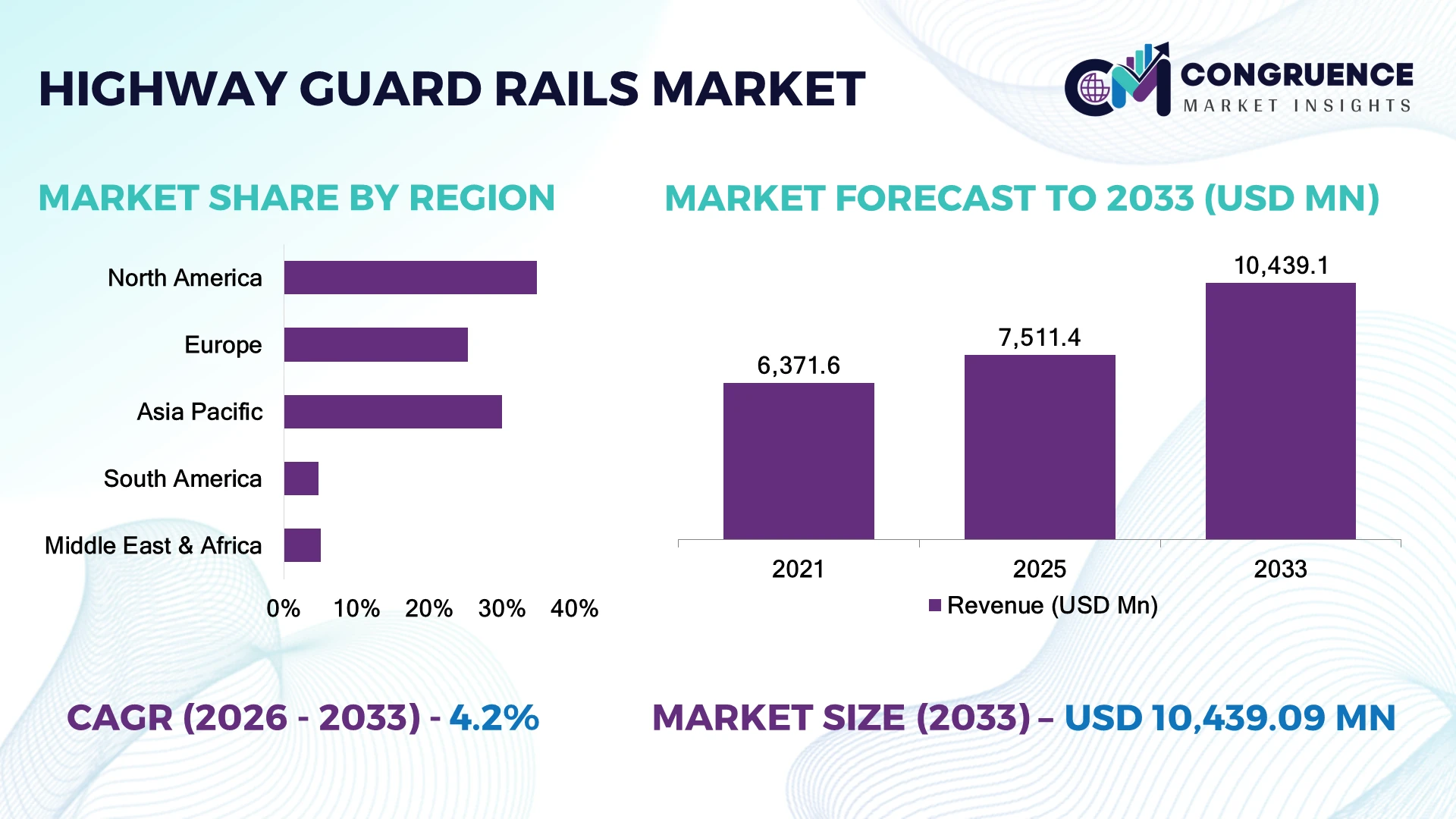
The Global Highway Guard Rails Market was valued at USD 7,511.4 Million in 2025 and is anticipated to reach a value of USD 10,439.1 Million by 2033 expanding at a CAGR of 4.2% between 2026 and 2033. Growth is driven by highway rehabilitation, median and roadside safety upgrades, replacement of aging barriers, and infrastructure programs requiring higher-performing crash-containment systems.
The United States represents the dominant national market, accounting for approximately 22% of global highway guard rail demand, supported by interstate rehabilitation, bridge approaches, rural highways, and roadside-safety programs. U.S. infrastructure investment under the Bipartisan Infrastructure Law continues to sustain project pipelines, while China combines large-scale expressway construction with domestic steel-processing capacity. Guard rail systems can contain and redirect vehicles while reducing roadside-impact severity, with high-tension and improved terminal systems delivering approximately 10–20% better installation or containment performance than legacy configurations.
Strategic implication: suppliers with certified crash performance, localized steel supply, and rapid project delivery are positioned to capture infrastructure-led replacement demand.
Market Size & Growth: USD 7,511.4 million in 2025 to USD 10,439.1 million by 2033 at 4.2% CAGR, supported by highway rehabilitation and roadside-safety modernization.
Top Growth Drivers: Highway rehabilitation 5–7%; median safety upgrades 4–6%; aging-barrier replacement 4–5%.
Short-Term Forecast: By 2028, automated fabrication and optimized galvanizing can improve production efficiency 8–12% and reduce material waste 3–6%.
Emerging Technologies: High-tension barriers, improved terminals, corrosion-resistant coatings, and digital installation monitoring are improving containment and lifecycle performance.
Regional Leaders: North America approaches USD 2.6 billion; Asia-Pacific exceeds USD 2.5 billion; Europe approaches USD 1.9 billion, with increasing deployment of higher-performance roadside systems.
Consumer/End-User Trends: Government highway agencies and infrastructure contractors represent roughly 70–75% of demand, prioritizing certified crash performance and lifecycle durability.
Pilot/Case Example: 2026 highway rehabilitation programs increasingly combine guard rails with improved terminals and delineation systems, targeting approximately 10–15% reductions in installation rework.
Competitive Landscape: Valmont Industries, Trinity Highway Products, Hill & Smith, ArcelorMittal, and Tata Steel compete through certified systems, steel integration, fabrication capacity, and project delivery.
Regulatory & ESG Impact: Hot-dip galvanizing can extend barrier service life by approximately 20–30% compared with inadequately protected steel, reducing replacement frequency and material consumption.
Investment & Funding: U.S. federal infrastructure programs continue directing billions of dollars toward highways and bridges, sustaining multi-year procurement pipelines for roadside safety hardware.
Innovation & Future Outlook: 2026–2028 priorities center on high-containment barriers, modular systems, recyclable steel, automated fabrication, digital asset tracking, and lower-maintenance roadside infrastructure.
The Highway Guard Rails Market covers W-beam, thrie-beam, cable, box-beam, and high-tension barrier systems used across medians, roadsides, bridges, ramps, and hazardous roadside zones. Galvanized steel remains dominant, while high-tension and improved terminal systems are gaining approximately 8–12% faster adoption in performance-sensitive projects. Highway agencies are increasingly linking barrier procurement with lifecycle durability, crash certification, and rapid installation requirements.
Highway guard rails are becoming a strategic infrastructure component because road agencies are shifting from basic roadside containment toward engineered safety systems with measurable crash performance, durability, and lifecycle economics. Replacement demand is particularly important as older barriers, terminals, and posts require modernization. The U.S. infrastructure investment cycle and China's continuing expressway development are maintaining large procurement pipelines, while European agencies emphasize safer roadside architecture and lower-maintenance infrastructure.
Technology is changing installation economics. Automated roll forming, precision punching, robotic welding, and optimized galvanizing can improve fabrication efficiency by approximately 8–12% compared with labor-intensive production while reducing material waste by 3–6%. North America emphasizes certified crash systems and rehabilitation, whereas Asia-Pacific combines new-road construction with large-scale steel manufacturing and rapid deployment.
Through 2026–2028, procurement is moving toward higher-containment barriers, modular components, improved terminals, corrosion-resistant coatings, and digital asset tracking. A practical shift is the use of pre-engineered barrier sections that reduce field fabrication and can shorten installation activities by approximately 10–15%. Manufacturers are therefore investing in automated production, regional warehouses, engineering partnerships, and certified product portfolios. Competitive advantage will increasingly depend on crash-performance validation, steel-cost control, installation speed, and lifecycle durability rather than hardware pricing alone.
Highway rehabilitation and roadside-safety modernization are accelerating replacement of aging W-beam, thrie-beam, and terminal systems, particularly across the United States. Government agencies increasingly specify crashworthy hardware, while MASH-compliant terminals are replacing legacy installations. FHWA guidance emphasizes proper selection, installation, and maintenance of roadside hardware, creating a specification-led replacement cycle. Approximately 5–7% annual growth in guardrail replacement demand is being supported by rehabilitation programs, while upgraded terminal and high-tension systems can improve installation efficiency by roughly 10–15%. Companies are responding through MASH-tested product development, regional fabrication capacity, and contractor training. The non-obvious opportunity is that replacement projects increasingly bundle terminals, transitions, and maintenance services, raising revenue per highway project beyond conventional rail supply.
Steel-intensive construction leaves guardrail manufacturers exposed to material-price volatility, galvanizing costs, and procurement requirements that can constrain margins. Steel and related components can represent roughly 50–65% of finished guardrail manufacturing cost, while galvanizing and fabrication add another 10–20% depending on specification and geometry. U.S. federally funded projects also impose domestic manufacturing requirements for covered steel products, limiting sourcing flexibility. Contractors consequently face 5–10% potential cost variation when steel procurement is poorly timed, particularly on long-duration infrastructure contracts. Manufacturers are mitigating exposure through indexed steel contracts, regional coil sourcing, inventory buffers, and automated fabrication. A key operational constraint is that cheaper imported material cannot always substitute for compliant domestic supply, making procurement strategy a competitive capability rather than merely a purchasing function.
Digital installation and asset-management systems create an underdeveloped opportunity beyond selling physical guardrail. Automated fabrication can improve throughput by approximately 8–12%, while digital field verification can reduce installation errors and rework by 10–15%. In the United States, FHWA increasingly emphasizes installation quality and in-service evaluation, strengthening demand for traceable hardware and documented maintenance. Manufacturers can combine QR/RFID identification, installation records, geospatial asset mapping, and inspection data to create lifecycle service models for state DOTs and contractors. India offers another opportunity as highway expansion increases demand for standardized roadside safety hardware. The strategic advantage is not simply faster installation: digitally traceable components can help agencies identify damaged terminals, schedule replacement earlier, and shift suppliers toward recurring inspection and maintenance contracts.
Guardrail manufacturers face increasing technical complexity as crash-test requirements, vehicle characteristics, installation tolerances, and field conditions evolve. MASH testing evaluates barriers under demanding impact conditions, including 100 km/h and 25-degree passenger-vehicle impacts for relevant longitudinal barrier tests. Product development can require 10–20% greater engineering and validation effort when new terminal geometries, transitions, and vehicle configurations are incorporated. FHWA also stresses that manufacturing consistency, installation, and maintenance are essential for hardware to perform as tested. Companies therefore need sustained crash-testing investment, tighter manufacturing tolerances, installer certification, and field-performance monitoring. The deeper challenge is scalability: a product that passes laboratory testing still requires disciplined replication across thousands of field installations, making quality assurance a long-term competitive differentiator.
MASH Compliance Reshapes Product Portfolios MASH-tested terminals are increasingly replacing legacy roadside hardware, with new eligibility decisions continuing to enter the U.S. market. FHWA issued multiple MASH eligibility letters in July 2025, including new terminal systems. Manufacturers are therefore reallocating engineering budgets toward tested terminals, crash cushions, and transition systems rather than commodity rail alone.
Terminal Innovation Gains Procurement Priority End terminals are receiving greater engineering attention as agencies focus on real-world impact conditions. Modern designs target installation consistency, shallow-angle impacts, and easier maintenance, while terminal-related product development can increase testing activity by 10–20%. Companies are responding with flared, tensioned, and redesigned terminal platforms that expand the value of each guardrail installation.
Installation Quality Becomes Commercial Differentiator Field installation is increasingly treated as part of system performance rather than a separate contractor task. Proper training, credentialing, and maintenance can reduce installation-related rework by roughly 10–15%, while digital inspection tools can shorten verification workflows by 10–20%. Suppliers are consequently developing installer training, documentation, and field-support programs alongside hardware. FHWA explicitly emphasizes capable installation and maintenance personnel.
Corrosion Management Drives Specification Changes Agencies are paying closer attention to coating performance, joint corrosion, and exposure conditions rather than treating galvanized steel as a uniform solution. FHWA notes that aggressive environments can accelerate corrosion and cause section loss at w-beam overlaps and inside box-beam barriers. Manufacturers are responding with improved coatings, thicker sections, inspection protocols, and application-specific material recommendations, potentially extending maintenance intervals by 10–20%.
W-beam guardrails account for approximately 62–66% of global highway guard rail demand, reflecting standardized geometry, broad crash-testing availability, manufacturing scalability, and compatibility with existing roadside infrastructure. Their relatively low fabrication complexity and extensive contractor familiarity keep them dominant across highway rehabilitation and new-build projects in the United States, China, and India. Thrie-beam systems represent roughly 15–18%, supported by higher containment requirements and bridge-transition applications, while box-beam and cable barriers collectively account for about 17–21%. Companies continue to optimize roll-forming, galvanizing, and modular connection systems to reduce fabrication and installation costs by approximately 5–10%.
High-tension cable barriers represent the fastest-changing type, with adoption expanding around 8–10% as agencies seek flexible containment for wide medians and high-speed corridors. Their ability to accommodate dynamic impacts with lower material intensity creates a distinct advantage where conventional rigid systems require extensive foundations. Manufacturers are therefore investing in higher-tension configurations, improved anchors, and hybrid barrier designs. The strategic shift is toward application-specific barrier selection rather than replacing W-beam universally, allowing suppliers to protect their mature volumes while expanding premium containment portfolios.
FHWA states that MASH-compliant roadside hardware is the current performance framework for new installations, while its 2026 eligibility database includes newly tested longitudinal barrier systems, reinforcing the shift toward certified, application-specific designs.
Roadside barriers represent approximately 52–56% of highway guard rail demand, making them the leading application because they protect motorists from slopes, fixed objects, drainage structures, and roadside hazards across both controlled-access and rural highways. Median barriers account for roughly 22–26%, while bridge approaches and bridge-edge protection contribute approximately 12–15%. Work-zone and specialized applications represent the balance. Roadside installations remain highly standardized, but replacement specifications increasingly incorporate crashworthy terminals, transitions, and corrosion requirements. Companies are responding with modular assemblies and pre-engineered components that can reduce field installation activity by approximately 10–15% and simplify replacement procurement.
Median barriers are the fastest-growing application, expanding around 7–9% as traffic volumes, narrower controlled-access medians, and cross-median crash concerns increase demand. The operational shift is particularly relevant in the United States, where high-speed divided highways with narrow medians require engineered separation systems rather than conventional roadside protection. Bridge approaches and specialized transition zones are also gaining importance because they require higher containment and tighter geometry. Suppliers are therefore developing integrated barrier-terminal-transition packages, increasing system-level value and reducing compatibility problems between separately sourced components.
FHWA guidance identifies median barriers as a proven safety countermeasure and notes that AASHTO guidance recommends consideration on high-speed controlled-access roads with medians of 30 feet or less and traffic above 20,000 vehicles per day.
Government transportation agencies account for approximately 58–62% of highway guard rail demand because state, national, and local road authorities control specifications, rehabilitation programs, safety standards, and long-term maintenance requirements. Infrastructure contractors represent around 27–31%, purchasing systems for project execution and increasingly influencing supplier selection through installation productivity and scheduling requirements. Toll-road operators and private infrastructure owners contribute roughly 8–12%. Government procurement remains specification-driven, with approximately 10–20% of project value increasingly influenced by terminal configuration, crash testing, corrosion protection, and installation documentation rather than rail material alone. Companies are consequently building relationships with DOTs, engineering consultants, and approved contractors while expanding regional inventories.
Infrastructure contractors are the fastest-growing end-user group, with demand increasing around 7–10% as highway rehabilitation becomes more project-intensive and contractors seek shorter installation windows. Their procurement priorities differ from government agencies: standardized kits, predictable delivery, labor efficiency, and technical support increasingly influence purchasing. Manufacturers are responding through distributor networks, prefabricated sections, installer training, and project-specific engineering. Toll operators and private road owners remain smaller but strategically attractive because they emphasize lifecycle maintenance and asset condition. The non-obvious shift is that suppliers increasingly compete for contractor influence before formal government procurement, making installation support and engineering assistance important commercial differentiators.
FHWA states that transportation facility owners, including state agencies, are responsible for decisions regarding roadside safety hardware, while its guardrail resources emphasize inspection, maintenance, and installation practices—reinforcing the central role of public infrastructure owners in lifecycle procurement.
North America accounted for the largest market share at 34.8% in 2025 however, Asia-Pacific is expected to register the fastest growth, expanding at a CAGR of 5.5% between 2026 and 2033.

Federal safety funding reinforces replacement-led demand
North America represents approximately 34.8% of global highway guard rail demand, supported by extensive interstate networks, mature roadside-safety specifications, and recurring rehabilitation requirements. The United States remains the primary demand center, with the IIJA providing approximately $350 billion for federal highway programs through FY2026, including $3.246 billion in FY2026 Highway Safety Improvement Program contract authority. Demand is shifting from basic W-beam replacement toward MASH-compliant terminals, transitions, and higher-containment systems. Canada contributes through provincial highway rehabilitation and winter-exposure requirements. Manufacturers are expanding regional inventories, certified product portfolios, and contractor training. The commercial implication is that compliance documentation and installation support increasingly influence procurement alongside steel pricing.
United States Market Outlook: The United States dominates North American consumption because of its extensive interstate and state highway infrastructure and specification-driven procurement. FHWA's FY2026 National Highway Performance Program carries $30.784 billion in contract authority, supporting continued investment in highway condition and performance. Suppliers are consequently prioritizing DOT approvals, MASH-tested terminals, domestic steel sourcing, and rapid project fulfillment.
Modernization emphasizes containment and durability
Europe contributes approximately 25.3% of global highway guard rail demand, with Germany, France, Italy, Spain, and the United Kingdom representing major procurement centers. Mature motorway infrastructure creates a replacement-heavy market, while road modernization increasingly favors higher-containment barriers, improved terminals, and corrosion-resistant systems. Germany's dense Autobahn network supports consistent demand for standardized roadside hardware, whereas southern European markets combine rehabilitation with new corridor construction. Suppliers are increasingly integrating galvanized or enhanced-coated steel with modular components to reduce maintenance intervention by approximately 10–20%. Environmental requirements and embodied-carbon considerations are also encouraging longer service life and optimized steel usage. Manufacturers are responding through localized fabrication, standardized component platforms, and engineering partnerships with road contractors.
Germany Market Outlook: Germany remains a strategically important European market because of its extensive Autobahn network and continuous rehabilitation requirements. High-speed traffic conditions increase the importance of containment performance, transition design, and reliable terminals. Suppliers with established certification, engineering capabilities, and domestic manufacturing relationships are positioned to participate in motorway modernization while differentiating through durable coatings and installation-efficient assemblies.
Expressway scale strengthens manufacturing integration
Asia-Pacific represents approximately 30.0% of global highway guard rail demand and has the strongest combination of highway construction, rehabilitation, and steel-manufacturing capacity. China is the principal demand center: its expressway network reached about 191,000 km by the end of 2024, while transport fixed-asset investment during 2021–2024 totaled 15.2 trillion yuan. India is another significant growth market, with its National Highway network reaching 146,145 km in 2024 and four-lane-and-above sections reaching 48,422 km. Local steel availability supports competitive fabrication, while contractors increasingly favor standardized, prefabricated systems. Companies are expanding production near major highway corridors and integrating galvanizing, roll-forming, and component assembly to shorten delivery cycles.
China Market Outlook: China provides the region's largest manufacturing and deployment base, supported by its extensive expressway system and integrated steel-processing ecosystem. The country had approximately 190,000 km of expressways by the end of 2024, creating substantial recurring requirements for roadside barriers, median protection, terminals, and replacement hardware. Manufacturers can leverage domestic steel supply and high-volume fabrication to compete on cost and delivery speed.
Concession-led modernization unlocks safety upgrades
South America accounts for approximately 4.8% of global highway guard rail demand, with Brazil representing the principal procurement market. Highway concessions are becoming an important mechanism for upgrading barriers, terminals, bridges, and roadside infrastructure because concessionaires operate under defined performance and maintenance obligations. Brazil's federal highway concession pipeline includes projects spanning thousands of kilometers, while the 2026 program identifies 35 new projects with a combined investment and operating portfolio of R$396 billion over four years. Demand is strongest along freight corridors connecting agricultural and industrial centers, although uneven pavement quality and project execution can delay barrier deployment. Manufacturers are responding through local fabrication, distributor partnerships, and project-specific engineering. The opportunity increasingly lies in supplying complete safety packages rather than standalone rail.
Brazil Market Outlook: Brazil dominates regional demand because of its large road freight network, extensive concession structure, and active highway modernization pipeline. The BR-381/MG/SP Fernão Dias concession covers 569 km and includes 108 km of additional lanes alongside multiple safety and access improvements. Such projects create sustained requirements for roadside barriers, transitions, terminals, and replacement components. Suppliers with local production and concessionaire relationships can improve delivery reliability.
Megaprojects drive premium roadside protection
Middle East & Africa represents approximately 5.1% of global highway guard rail demand, with Saudi Arabia, the United Arab Emirates, South Africa, and selected Gulf infrastructure corridors accounting for substantial procurement. Saudi Arabia's road modernization and major development corridors favor high-performance barriers, median systems, bridge protection, and corrosion-resistant components suited to high temperatures and abrasive environments. Demand is increasingly tied to new expressways, logistics corridors, airports, and urban expansion rather than routine rural replacement alone. Premium systems can command approximately 10–15% higher project value where higher containment and specialized terminals are specified. Suppliers are responding through regional warehousing, engineering partnerships, and localized installation support. The strategic differentiator is increasingly environmental durability: coating selection and maintenance planning matter substantially where heat, dust, and intensive traffic accelerate asset deterioration.
Saudi Arabia Market Outlook: Saudi Arabia is the region's most strategically significant market because road infrastructure is closely linked to logistics, urban development, tourism, and major economic-development projects. High-speed corridors require consistent roadside containment and terminal performance, while desert exposure increases emphasis on coating durability and inspection. International suppliers are increasingly partnering with local contractors and distributors to meet project timelines and strengthen after-sales maintenance capabilities.
Valmont, Valtir, Hill & Smith, Lindsay, and Gregory compete in certified roadside barriers, terminals, crash cushions, and temporary protection, while Saferoad and Asian steel fabricators challenge them on cost and regional delivery. The top five are estimated to hold about 42% combined share. Competition centers on crash performance, steel economics, installation speed, certification, and supply reliability; automated roll forming can improve fabrication efficiency 8–12%, while modular systems can reduce installation activity 10–15%. Valmont is expanding infrastructure capacity and MASH-tested barrier portfolios, Hill & Smith partnered with Gregory to bundle attenuators with guardrails, and steel producers are integrating higher-strength grades and corrosion-resistant coatings. The competitive shift is toward complete safety systems, lifecycle durability, and application-specific engineering rather than commodity W-beam supply. Entry barriers include crash testing, regulatory eligibility, manufacturing consistency, and DOT relationships. Winning requires certified performance, localized inventory, rapid installation support, and vertically controlled steel, coating, engineering, and field-service capabilities. (Hill & Smith)
Valmont Industries, Inc.
Valtir, LLC
Hill & Smith Holdings PLC
Lindsay Corporation
Gregory Industries, Inc.
Saferoad Group
DELTABLOC International GmbH
VOLKMANN & ROSSBACH GmbH
Shindo Industry Co., Ltd.
Nippon Steel Metal Products Co., Ltd.
Marcegaglia Buildtech S.r.l.
Armtec Defense Products
ArcelorMittal
Tata Steel Limited
MASH-compliant crash testing is now the core technology filter for new barriers, terminals, and transitions. High-strength steel, Z-post geometries, and optimized connections can reduce component mass 5–10% while maintaining containment performance. Valmont’s Ezy-Guard systems eliminate blocking pieces and use fewer components, supporting faster installation. Adoption is strongest in U.S. DOT procurement and newer Indian highway projects.
Digital fabrication and inspection are moving guardrail production beyond conventional roll forming. Automated forming, laser measurement, and machine-vision checks can improve dimensional consistency 1–2% and reduce rework 2–4%. QR/RFID asset identification can accelerate inspection and replacement workflows by 5–10%, particularly for large highway inventories. Suppliers with integrated fabrication, galvanizing, and field-service networks gain tighter quality control and shorter fulfillment cycles across decentralized project locations and emergency replacement requirements.
Next-generation barriers combine high-strength steel, advanced coatings, cable systems, and digitally traceable components. ArcelorMittal’s Magnelis-based barrier work targets substantially longer corrosion life than conventional hot-dip galvanizing, while high-tension cable systems require engineered anchors and soil-structure design. By 2026–2028, lifecycle-focused specifications should favor suppliers able to integrate material engineering, crash validation, installation data, and maintenance planning. Technology leadership will increasingly reward companies that reduce steel intensity, inspection frequency, and roadside disruption simultaneously while preserving certified crash performance.
November 2025 Hill & Smith partnered with Gregory Industries to bundle Smart Cushion and SmartPod attenuators with Gregory guardrail systems. The integrated offer expands one-stop roadside safety procurement, combining barrier and impact-attenuation hardware for contractors and DOT projects. Source: hillandsmith.com (Hill & Smith)
April 2026 ArcelorMittal and Brackmore advanced a Magnelis-coated road-barrier system across UK national highways infrastructure. The solution can last up to three times longer than conventional hot-dip products, targeting lower maintenance, fewer replacements, and reduced lifecycle carbon emissions. Source: arcelormittal.com (industry.arcelormittal.com)
December 2025 Queensland Transport and Main Roads listed Safe Direction’s RAMSHIELD transition with MASH TL-1 through TL-6 acceptance. The approval expands qualified transition options across containment levels and strengthens deployment potential for constrained Australian roadside safety infrastructure projects. Source: tmr.qld.gov.au (Department of Transport and Main Roads)
February 2025 Valmont disclosed infrastructure-focused capacity expansion and efficiency investment as part of its capital-allocation strategy. Approximately 50% of operating cash flow was earmarked for high-return growth opportunities, supporting manufacturing output, innovation, and customer responsiveness across infrastructure markets. Source: valmont.com (Valmont Industries, Inc.)
The Highway Guard Rails Market Report evaluates demand across W-beam, thrie-beam, cable, and box-beam systems, with coverage spanning roadside protection, median barriers, bridge approaches, and specialized applications. End-user analysis distinguishes government transportation agencies, infrastructure contractors, toll-road operators, and private infrastructure owners, capturing specification-driven procurement, replacement cycles, and project-based purchasing behavior.
Regional coverage includes North America, Europe, Asia-Pacific, South America, and Middle East & Africa, with country-level assessment of the United States, Germany, China, India, Brazil, and Saudi Arabia. The report examines MASH-compliant hardware, high-tension barriers, corrosion-resistant coatings, automated fabrication, digital asset tracking, and modular installation systems. With government agencies representing roughly 58–62% of purchasing demand and W-beam systems around 62–66% of type demand, the analysis supports capacity planning, geographic expansion, product prioritization, competitive positioning, supplier strategy, and investment decisions through 2033.
| Report Attribute/Metric | Report Details |
|---|---|
|
Market Revenue in 2025 |
USD 7,511.4 Million |
|
Market Revenue in 2033 |
USD 10,439.1 Million |
|
CAGR (2026 - 2033) |
4.2% |
|
Base Year |
2025 |
|
Forecast Period |
2026 - 2033 |
|
Historic Period |
2021 - 2025 |
|
Segments Covered |
By Type
By Application
By End-User
|
|
Key Report Deliverable |
Revenue Forecast, Growth Trends, Market Dynamics, Segmental Overview, Regional and Country-wise Analysis, Competition Landscape |
|
Region Covered |
North America, Europe, Asia-Pacific, South America, Middle East, Africa |
|
Key Players Analyzed |
Valmont Industries, Inc., Valtir, LLC, Hill & Smith Holdings PLC, Lindsay Corporation, Gregory Industries, Inc., Saferoad Group, DELTABLOC International GmbH, VOLKMANN & ROSSBACH GmbH, Shindo Industry Co., Ltd., Nippon Steel Metal Products Co., Ltd., Marcegaglia Buildtech S.r.l., Armtec Defense Products, ArcelorMittal, Tata Steel Limited |
|
Customization & Pricing |
Available on Request (10% Customization is Free) |




