
Reports
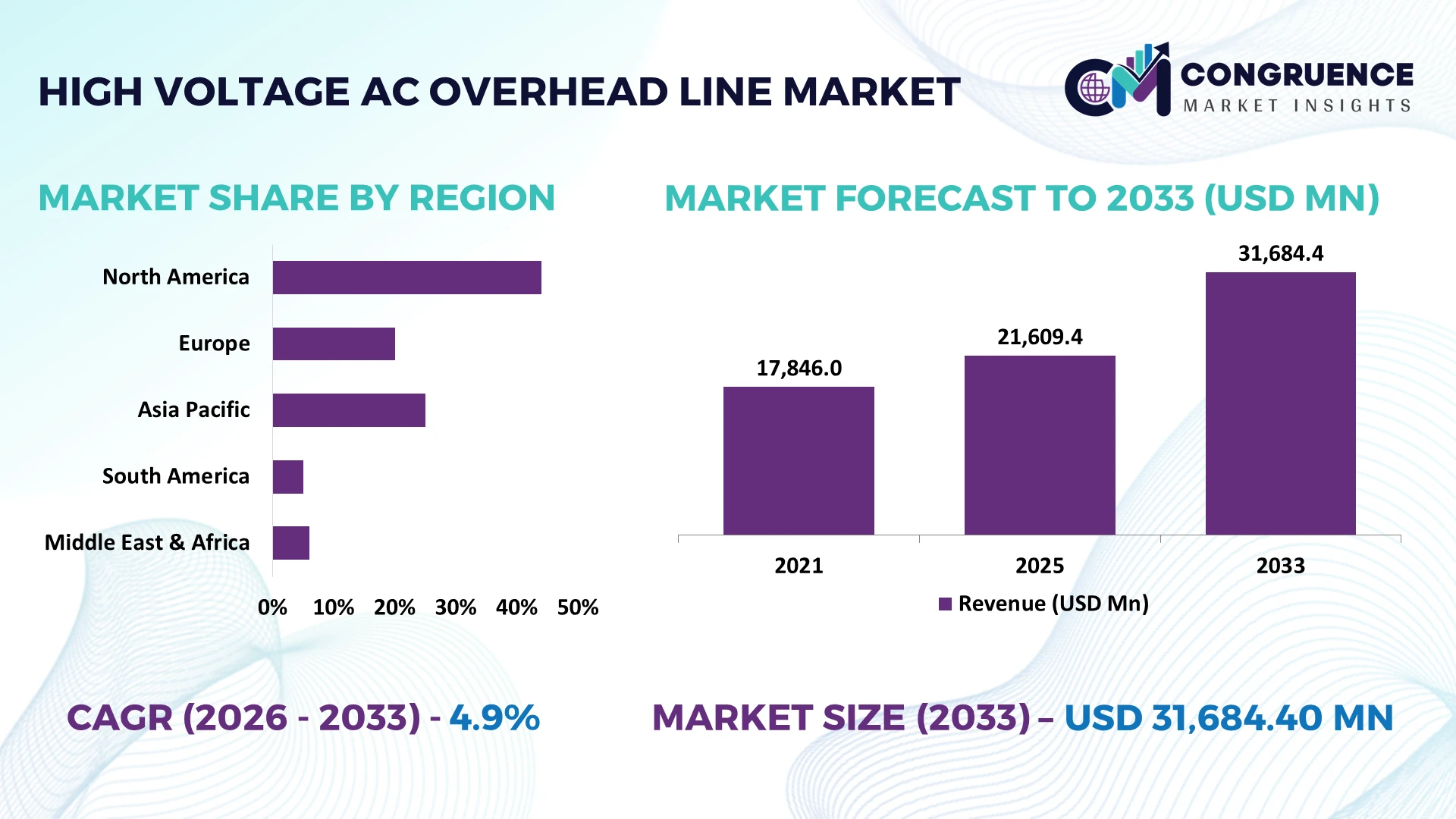
The Global High Voltage AC Overhead Line Market was valued at USD 21609.4 Million in 2025 and is anticipated to reach a value of USD 31684.4 Million by 2033 expanding at a CAGR of 4.9% between 2026 and 2033. Growth is driven by renewable energy grid integration, replacement of aging transmission infrastructure, expansion of extra-high-voltage networks, and deployment of high-capacity conductors.
China dominates high voltage AC overhead transmission infrastructure, supported by its extensive 500 kV and 750 kV networks and large-scale renewable energy integration. China's renewable electricity capacity exceeded 1,800 GW in 2024, reinforcing investment in long-distance transmission corridors connecting western generation centers with eastern industrial demand. India provides a contrasting expansion opportunity through its 400 kV and 765 kV transmission systems, supported by national grid modernization programs. Advanced aluminum alloy conductors, digital substations, and automated line monitoring increasingly influence procurement priorities across both countries.
Strategically, transmission equipment manufacturers should prioritize high-capacity conductor systems, grid modernization contracts, and renewable energy evacuation infrastructure to strengthen competitive positioning.
Market Size & Growth: Valued at USD 21609.4 Million in 2025, projected to USD 31684.4 Million by 2033 at 4.9% CAGR, driven by grid modernization and renewable integration.
Top Growth Drivers: Renewable energy transmission expansion, aging infrastructure replacement programs, and data center electricity demand growth at 24% CAGR through 2030.
Short-Term Forecast: By 2027, dynamic line rating technology expands capacity on existing lines by up to 20%, reducing new-build requirements and accelerating grid utilization.
Emerging Technologies: High-temperature low-sag conductors, AI-enabled asset monitoring, and dynamic line rating systems reshaping transmission capacity management.
Regional Leaders: Asia-Pacific at USD 10.7 billion and 49.75% share, North America at USD 2.0 billion with reconductoring focus, and Europe driven by offshore wind connections.
Consumer/End-User Trends: Land power transmission commands 85% of deployment; offshore transmission represents fastest-growing application as European offshore wind expands.
Pilot/Case Example: LineVision deployed dynamic line rating technology on over 275 kilometers of UK National Grid overhead lines in June 2025, increasing capacity without new construction.
Competitive Landscape: Prysmian leads with 12% share; Southwire, Apar Industries, ZTT, Nexans, and Sumitomo Electric comprise top five at 30% combined share.
Regulatory & ESG Impact: EU Carbon Border Adjustment Mechanism and permitting timelines of 5–15 years for new grid infrastructure constrain deployment velocity.
Investment & Funding: Global grid investment projected to reach USD 970 billion annually by 2050; Nexans developed recycled low-carbon aluminum conductors with Trimet in 2024.
Innovation & Future Outlook: High-conductivity low-loss conductors and composite-core designs gain traction; reconductoring market expands as permitting delays make new lines impractical.
The High Voltage AC Overhead Line Market is increasingly shaped by utility investment in renewable energy evacuation, interregional electricity transmission, and replacement of aging overhead conductors. High-temperature low-sag conductors offer opportunities to increase transmission capacity by 20–40% in suitable existing corridors, reducing dependence on new rights-of-way. Recent innovation focuses on composite-core materials, drone-based inspection, and real-time thermal monitoring. India's Green Energy Corridor program illustrates the operational importance of connecting renewable generation clusters with high-demand electricity networks. These developments are reshaping transmission procurement strategies and establishing new priorities for infrastructure investment and competitive differentiation.
High voltage AC overhead transmission infrastructure is becoming strategically essential as electricity systems transition toward geographically dispersed renewable generation, industrial electrification, and interconnected power networks. Utilities increasingly prioritize transmission capacity optimization over conventional network expansion, particularly where land acquisition restricts new corridors. India's National Electricity Plan targets approximately 191,000 circuit kilometers of additional transmission lines during 2022–2032, creating substantial opportunities for conductor manufacturers, tower suppliers, and engineering contractors. Grid modernization is consequently shifting procurement toward higher-capacity equipment and digitally monitored infrastructure.
Advanced high-temperature low-sag conductors can deliver 20–40% greater power transfer capacity than conventional ACSR conductors under suitable operating conditions, improving asset utilization without extensive tower replacement. China emphasizes large-scale transmission corridors connecting renewable generation centers with manufacturing clusters, while Germany prioritizes network reinforcement and integration of variable renewable electricity. Dynamic line rating technologies further improve operational flexibility by adjusting transmission limits according to actual weather conditions rather than fixed thermal assumptions.
During 2026–2028, utilities will increasingly integrate automated inspection, condition monitoring, and predictive maintenance into transmission operations. India's Green Energy Corridor developments demonstrate how coordinated network investment supports renewable electricity evacuation. Manufacturers are strengthening utility partnerships, expanding specialized conductor production, and developing digital monitoring capabilities. Competitive advantage increasingly depends on delivering higher transmission capacity through existing infrastructure while controlling installation complexity and lifecycle maintenance expenditure.
Rapid renewable energy deployment is accelerating investment in high voltage AC overhead lines connecting generation facilities with industrial consumption centers. Global renewable electricity capacity increased approximately 15% during 2024, intensifying requirements for transmission reinforcement and grid flexibility. India's renewable integration strategy prioritizes 400 kV and 765 kV networks, while solar and wind installations increasingly require dedicated evacuation corridors. Transmission losses, which vary by voltage and network conditions, create additional incentives for higher-voltage infrastructure and optimized conductor selection. Equipment manufacturers are expanding production of aluminum alloy conductors, transmission towers, and specialized insulators. Utilities are simultaneously strengthening engineering partnerships to reduce interconnection bottlenecks and improve renewable project commissioning schedules.
High voltage AC overhead line projects face substantial cost exposure from aluminum, steel, copper, and specialized electrical components. Aluminum typically represents more than 50% of the metallic mass in conventional aluminum conductor steel-reinforced configurations, making conductor procurement sensitive to metal price fluctuations. Import tariffs, electricity-intensive smelting operations, and concentrated upstream processing further complicate supply planning. In India, right-of-way compensation and tower foundation requirements increase project-specific capital commitments, particularly near densely populated industrial corridors. Manufacturers are responding through indexed supply contracts, domestic conductor production, and diversified metal procurement. Long-term utility agreements increasingly incorporate material price adjustment mechanisms, protecting supplier margins while improving purchasing predictability and reducing exposure to short-term commodity market disruptions.
Advanced reconductoring creates opportunities to increase electricity transfer capacity without constructing entirely new transmission corridors. Composite-core and high-temperature conductor technologies can provide 30–50% additional capacity in suitable retrofit applications, depending on thermal limits and structural conditions. Dynamic line rating systems can unlock approximately 10–30% additional operational capacity when favorable weather conditions permit higher conductor loading. In the United States, transmission modernization initiatives increasingly emphasize grid-enhancing technologies and existing corridor utilization. Manufacturers are developing lightweight conductor materials, automated thermal monitoring, and sensor-integrated line management platforms. Partnerships between utilities, conductor suppliers, and grid software developers create opportunities for integrated equipment and monitoring contracts, improving project economics and reducing infrastructure permitting requirements.
Integrating advanced high voltage AC overhead infrastructure into existing electricity networks creates technical challenges involving protection coordination, conductor thermal behavior, and system stability. Transmission infrastructure commonly operates across 220 kV, 400 kV, and 765 kV configurations, requiring voltage-specific insulation, clearance, and protection engineering. Higher conductor operating temperatures can increase thermal loading capability but also intensify connector performance and maintenance requirements. In China, extensive long-distance transmission networks require coordinated protection systems and real-time fault detection across geographically dispersed assets. Utilities must strengthen workforce capabilities in digital diagnostics, electromagnetic modeling, and automated asset inspection. Manufacturers are investing in standardized testing, advanced insulation technologies, and utility training partnerships to improve operational consistency and equipment reliability.
• Factory Prefabrication Reshapes Transmission Construction: Transmission contractors are shifting toward prefabricated tower components, automated steel fabrication, and digitally coordinated construction schedules. Standardized lattice tower assemblies reduce site fabrication requirements, while 400 kV and 765 kV projects increasingly use modular erection practices. Indian engineering companies are expanding automated galvanizing and fabrication facilities to improve dimensional consistency, reduce field rework, and accelerate commissioning across geographically dispersed transmission packages.
• Climate Resilience Changes Equipment Specifications: Utilities are tightening conductor clearance, wind-loading, and corrosion-resistance requirements as extreme weather increases network vulnerability. Coastal installations require specialized protective coatings, while high-temperature operating environments influence insulator and hardware selection. Australian transmission operators are emphasizing bushfire resilience and vegetation management. Equipment suppliers are responding with improved fittings, weather-resistant materials, and condition-based inspection procedures that reduce exposure to climate-related outages.
• Digital Engineering Accelerates Project Delivery: LiDAR surveys, geographic information systems, and three-dimensional tower modeling are replacing fragmented route-design workflows. Drone-based corridor mapping supports centimeter-level survey outputs, while digital clearance verification improves engineering accuracy. Transmission engineering contractors are integrating design software with procurement and construction planning, reducing survey duplication and enabling earlier identification of foundation, terrain, and access constraints before mobilization.
• Localized Manufacturing Strengthens Supply Continuity: Transmission equipment manufacturers are reorganizing sourcing around domestic tower steel, insulators, and conductor accessories. India's production ecosystem supports 220 kV through 765 kV equipment requirements, while localized qualification reduces dependence on overseas component deliveries. Suppliers are expanding vendor certification, automated quality testing, and regional assembly partnerships, improving tender responsiveness and limiting schedule disruption from international logistics volatility.
The 400 kV Lines segment represents a major portion of high voltage AC overhead transmission investment because it combines substantial electricity transfer capability with established utility engineering standards. This voltage class supports bulk power movement between generation centers, substations, and industrial consumption clusters without the higher insulation and tower-clearance requirements associated with 765 kV infrastructure. India's transmission network demonstrates the importance of 400 kV corridors for grid reinforcement and interregional electricity exchange. The 220 kV Lines segment remains important for regional transmission connectivity, while 132 kV Lines provide established interfaces between higher-voltage networks and downstream electricity infrastructure.
The 765 kV Lines segment is positioned for particularly strong expansion as utilities prioritize high-capacity electricity evacuation across longer distances. Compared with 400 kV systems, 765 kV infrastructure supports substantially greater power transfer under appropriately engineered network configurations. Single-Circuit Lines remain relevant where corridor requirements permit independent circuit routing, whereas Double-Circuit Lines improve transmission density within constrained rights-of-way. Manufacturers are expanding extra-high-voltage insulator production, tower engineering capabilities, and conductor configurations to address changing procurement specifications.
Power Transmission represents the principal application of high voltage AC overhead lines, supported by extensive utility networks carrying bulk electricity between generation facilities and major load centers. The International Energy Agency estimates that global electricity consumption will increase by approximately 4% annually through 2027, strengthening the requirement for reliable transmission infrastructure. Grid Interconnection supports network synchronization and power exchange between interconnected systems, while Regional Power Distribution relies on high voltage infrastructure to supply downstream substations and expanding industrial districts. Utilities are prioritizing transmission reinforcement where growing electricity consumption places pressure on existing network capacity.
Renewable Energy Integration is emerging as the fastest-expanding application, driven by the increasing geographical separation between clean energy generation and consumption. Long-Distance Transmission remains critical for connecting remote power plants with metropolitan electricity markets, particularly across China's western generation provinces. Cross-Border Power Transfer is gaining strategic importance through interconnected European electricity systems and international energy cooperation. Equipment manufacturers are adapting conductor configurations, transmission engineering services, and grid connection solutions to accommodate increasingly complex power flow requirements.
Electric Utilities constitute the dominant end-user category in the High Voltage AC Overhead Line Market because they operate extensive transmission assets and undertake recurring network reinforcement, replacement, and capacity expansion programs. Transmission System Operators represent another major procurement group, particularly in countries where transmission ownership and system operations are institutionally separated. India's electricity transmission development illustrates this procurement concentration, with the national network targeted to expand from approximately 509,000 circuit kilometers in June 2026 to 648,000 circuit kilometers by 2032. These infrastructure commitments create sustained demand for transmission conductors, towers, insulators, and engineering services.
Renewable Energy Developers represent a rapidly expanding customer group as utility-scale solar and wind projects require dedicated high voltage connections. Power Generation Companies continue investing in generation evacuation infrastructure, while Government Power Agencies influence procurement through national electrification and transmission planning programs. Industrial Power Consumers increasingly require reliable high-capacity connections for manufacturing complexes, mining operations, and energy-intensive processing facilities. Suppliers are strengthening framework agreements, customizing conductor specifications, and developing integrated engineering partnerships to address differing operational requirements and procurement cycles.
Asia-Pacific accounted for the largest market share at an estimated 45% in 2025 however, Asia-Pacific is expected to register the fastest growth, expanding at a CAGR of 5.8% between 2026 and 2033.
Grid Reliability Investments and Transmission Corridor Modernization
North America represents a significant market for high voltage AC overhead lines, supported by transmission asset replacement, industrial electrification, and electricity network reliability requirements. The United States dominates regional procurement through 230 kV, 345 kV, 500 kV, and 765 kV transmission infrastructure. The U.S. Department of Energy's National Transmission Needs Study identified the requirement to approximately double existing regional transmission capacity by 2035 under certain electricity system scenarios. Canada contributes through hydroelectric transmission corridors, particularly in Quebec, Manitoba, and British Columbia, where generation facilities are geographically separated from consumption centers. Utilities are increasingly adopting advanced line inspection, upgraded insulation systems, and automated protection technologies. Transmission contractors are strengthening engineering partnerships and domestic equipment sourcing to address construction workforce limitations and improve project delivery consistency.
United States Market Outlook: The United States leads North American transmission investment through large utility networks and expanding electricity requirements from data centers and advanced manufacturing facilities. The Federal Energy Regulatory Commission's Order No. 1920 strengthens long-term transmission planning over a minimum 20-year horizon. American Electric Power, Duke Energy, and other utilities are prioritizing network reinforcement, transmission asset replacement, and grid reliability improvements, supporting demand for specialized conductors and high-voltage equipment.
Cross-Border Grid Integration and Transmission Infrastructure Reinforcement
Europe's high voltage AC overhead line market is shaped by electricity market integration, renewable generation variability, and increasingly stringent network reliability requirements. Germany, France, Spain, and the United Kingdom represent important transmission infrastructure markets, with established 220 kV and 400 kV systems supporting industrial electricity consumption. The European Commission's electricity grid action framework identifies approximately EUR 584 billion in grid investment requirements through 2030, reflecting the scale of infrastructure modernization. Transmission system operators are strengthening cross-border connections, upgrading existing corridors, and incorporating digital monitoring into overhead line operations. Environmental permitting and public opposition to new overhead corridors influence project configuration, particularly in densely populated areas. Equipment manufacturers are responding through improved conductor designs, compact tower configurations, and engineering partnerships that optimize transmission capacity within established infrastructure boundaries.
Germany Market Outlook: Germany remains strategically important through its Energiewende-driven electricity infrastructure transformation and concentration of industrial demand in Bavaria, Baden-Württemberg, and North Rhine-Westphalia. Transmission operators including TenneT Germany, Amprion, 50Hertz, and TransnetBW are coordinating extensive grid reinforcement programs. Germany's 2030 renewable electricity objective of at least 80% of gross electricity consumption strengthens requirements for high-capacity transmission connections, advanced grid management, and reliable integration of geographically dispersed generation assets.
Large-Scale Transmission Deployment and Manufacturing Concentration
Asia-Pacific leads global high voltage AC overhead line infrastructure development through extensive transmission construction, equipment manufacturing, and industrial electricity network expansion. China dominates regional deployment with established 500 kV and 750 kV transmission networks connecting major generation centers with manufacturing-intensive provinces. India represents another major infrastructure market through its extensive 400 kV and 765 kV systems, supported by transmission development associated with renewable energy integration. Japan and South Korea emphasize network resilience, specialized conductor technologies, and efficient utilization of constrained transmission corridors. The region benefits from established manufacturing capabilities for aluminum conductors, lattice towers, insulators, and electrical hardware. Companies including KEC International, Apar Industries, and regional engineering contractors are expanding production capabilities and strengthening utility partnerships to capture large-scale transmission equipment procurement opportunities.
China Market Outlook: China maintains a leading position through extensive high-voltage infrastructure, integrated electrical equipment manufacturing, and centralized transmission planning. State Grid Corporation of China and China Southern Power Grid oversee substantial network development across industrial and renewable generation provinces. China's installed renewable power capacity exceeded 1,800 GW in 2024, strengthening requirements for coordinated electricity evacuation infrastructure. Domestic manufacturers benefit from established conductor production, transmission tower fabrication, and high-voltage equipment testing capabilities.
Renewable Generation Corridors and Grid Connectivity Expansion
South America's high voltage AC overhead line market is primarily influenced by hydroelectric generation, renewable electricity development, and the geographical separation between power production and industrial consumption centers. Brazil dominates regional transmission infrastructure through extensive 230 kV, 345 kV, 500 kV, and 750 kV networks. Chile is strengthening transmission connections between northern solar generation facilities and central electricity demand centers, while Argentina requires network reinforcement to improve power delivery across industrial and resource-producing provinces. Brazil's electricity regulator ANEEL continues organizing transmission concession auctions covering substations and extensive overhead line construction packages. Large transmission distances, challenging terrain, and environmental licensing requirements influence project economics. Engineering companies are increasingly emphasizing standardized tower construction, local material procurement, and integrated project execution to improve delivery efficiency.
Brazil Market Outlook: Brazil represents the region's principal transmission infrastructure market, supported by extensive hydroelectric resources and increasing wind and solar electricity generation. The country's National Interconnected System connects major electricity consumption centers across geographically dispersed regions. Transmission concessionaires including ISA Energia Brasil, Taesa, and Eletrobras operate substantial network assets. Brazil's 2024 transmission auctions reinforced investment activity, creating procurement opportunities for conductor manufacturers, steel tower suppliers, and high-voltage engineering contractors.
National Grid Expansion and Industrial Electrification Programs
The Middle East & Africa market is shaped by national electricity infrastructure programs, industrial diversification, and the development of interconnected transmission networks. Saudi Arabia and the United Arab Emirates are investing in high-voltage grid infrastructure to support expanding industrial zones, renewable electricity projects, and new urban developments. Saudi Arabia's transmission system includes extensive 380 kV infrastructure connecting generation facilities with major consumption centers. South Africa prioritizes transmission expansion to address network constraints limiting renewable generation connections, while Egypt is strengthening electricity infrastructure supporting industrial development and regional power interconnections. The region presents distinct procurement requirements involving desert operating conditions, high ambient temperatures, and geographically dispersed infrastructure. Equipment suppliers are expanding localized assembly capabilities, utility partnerships, and specialized insulation solutions suited to demanding environmental conditions.
Saudi Arabia Market Outlook: Saudi Arabia represents a major transmission investment market through Saudi Electricity Company's infrastructure programs and Saudi Power Procurement Company's renewable energy initiatives. The Kingdom targets approximately 50% renewable electricity generation by 2030, requiring substantial integration of solar and wind facilities into its transmission system. High-temperature conductor performance, desert-resistant insulation, and reliable long-distance power transfer are central procurement considerations. Local manufacturing partnerships are strengthening equipment availability and supporting national industrial localization objectives.
The global High Voltage AC Overhead Line Market features competition between established transmission equipment manufacturers, engineering contractors, and specialized conductor suppliers. Prysmian, Nexans, and Sumitomo Electric compete through advanced conductor technologies, while KEC International, Apar Industries, and regional manufacturers emphasize project execution, manufacturing scale, and procurement efficiency. Competition centers on conductor performance, tower fabrication costs, delivery schedules, and utility qualification requirements. Advanced conductor technologies offering 20–40% higher transmission capacity strengthen premium product positioning, while automated fabrication improves manufacturing consistency and material utilization. Companies are expanding domestic production, securing aluminum supply agreements, and partnering with transmission utilities for integrated infrastructure projects. The competitive landscape is shifting toward localized supply chains, digitally monitored transmission assets, and specialized high-temperature conductors. Stringent electrical testing, engineering certification, and utility procurement approvals restrict market entry. Sustained competitiveness requires manufacturing integration, reliable project delivery, differentiated conductor performance, and established utility relationships across major transmission infrastructure markets.
Prysmian Group
Nexans
Southwire Company
Apar Industries
ZTT International
Sumitomo Electric Industries
CTC Global
Sterlite Power
KEC International
Kalpataru Projects International
Lamifil
Midal Cables
General Cable
Riyadh Cables Group
Current high voltage AC overhead transmission technology increasingly combines aluminum conductor steel reinforced systems, polymer insulators, and automated condition monitoring. Advanced high temperature low sag conductors offer 20–40% greater transfer capacity than conventional ACSR configurations under suitable operating conditions. Utilities are integrating drone inspections, thermal imaging, and digital fault localization to improve maintenance precision. These technologies strengthen existing corridor utilization while reducing reliance on additional transmission tower construction and lengthy land acquisition procedures.
Emerging technologies include composite core conductors, dynamic line rating, and distributed fiber optic sensing. Weather responsive dynamic ratings can unlock 10–30% additional transmission capacity during favorable operating conditions compared with fixed seasonal ratings. Composite core designs reduce thermal sag and improve conductor performance at elevated temperatures. Digital monitoring platforms integrate meteorological measurements, conductor temperature, and grid dispatch systems, enabling operators to optimize electricity transfer without compromising clearance requirements or equipment reliability.
Between 2026 and 2028, transmission technology investment will increasingly prioritize sensor integrated infrastructure, robotic inspection, and predictive asset analytics. Manufacturers offering integrated conductor hardware and monitoring solutions gain advantages over conventional equipment suppliers. Utilities adopting interoperable digital platforms can accelerate fault identification, improve maintenance scheduling, and strengthen transmission reliability across increasingly complex interconnected electricity networks.
• December 2025 – KEC International secured transmission and distribution contracts involving a 765 kV overhead transmission line and associated substation infrastructure in India. The contracts strengthen its extra-high-voltage engineering portfolio and expand private-sector participation in renewable electricity evacuation infrastructure projects. Source: kecrpg.com.
• May 2025 – Prysmian announced collaboration with Gulf Cooperation Council Interconnection Authority to deploy E3X coated conductors on a 400 kV Kuwait–Saudi Arabia transmission line. The technology offers up to 20% additional capacity, strengthening cross-border transmission efficiency and conductor competitiveness. Source: prysmian.com.
• June 2026 – National Grid appointed five delivery partners under its Electricity Transmission Partnership to upgrade over 1,000 kilometers of overhead lines across England and Wales. The reconductoring program increases existing corridor utilization while strengthening grid connections and supply-chain delivery coordination. Source: nationalgrid.com.
• July 2025 – APAR Industries reported completing its first 400 kV reconductoring project for Maharashtra State Electricity Transmission Company, installing approximately 102 circuit kilometers of advanced conductors. The upgrade doubled transmission capacity, strengthening Mumbai's electricity reliability and industrial power infrastructure. Source: apar.com.
The High Voltage AC Overhead Line Market Report examines transmission infrastructure developments across 132 kV, 220 kV, 400 kV, and 765 kV lines, including single-circuit and double-circuit configurations. Application coverage encompasses power transmission, grid interconnection, renewable energy integration, long-distance transmission, regional power distribution, and cross-border electricity transfer. End-user analysis evaluates electric utilities, transmission system operators, generation companies, renewable developers, government power agencies, and industrial electricity consumers, highlighting procurement priorities and deployment requirements.
Regional coverage includes North America, Europe, Asia-Pacific, South America, and the Middle East & Africa, emphasizing country-specific infrastructure programs and manufacturing capabilities. Technology assessment covers advanced conductors, dynamic line rating, automated inspection, and digital asset monitoring. The 2026–2033 outlook supports investment planning, supplier evaluation, production expansion, competitive benchmarking, and identification of emerging transmission modernization opportunities.
| Report Attribute/Metric | Report Details |
|---|---|
Market Revenue in 2025 | USD 21609.4 Million |
Market Revenue in 2033 | USD 31684.4 Million |
CAGR (2026 - 2033) | 4.9% |
Base Year | 2025 |
Forecast Period | 2026 - 2033 |
Historic Period | 2021 - 2025 |
Segments Covered | By Type
By Application
By End-User
|
Key Report Deliverable | Revenue Forecast, Growth Trends, Market Dynamics, Segmental Overview, Regional and Country-wise Analysis, Competition Landscape |
Region Covered | North America, Europe, Asia-Pacific, South America, Middle East, Africa |
Key Players Analyzed | Prysmian Group, Nexans, Southwire Company, Apar Industries, ZTT International, Sumitomo Electric Industries, CTC Global, Sterlite Power, KEC International, Kalpataru Projects International, Lamifil, Midal Cables, General Cable, Riyadh Cables Group |
Customization & Pricing | Available on Request (10% Customization is Free) |




