
Reports
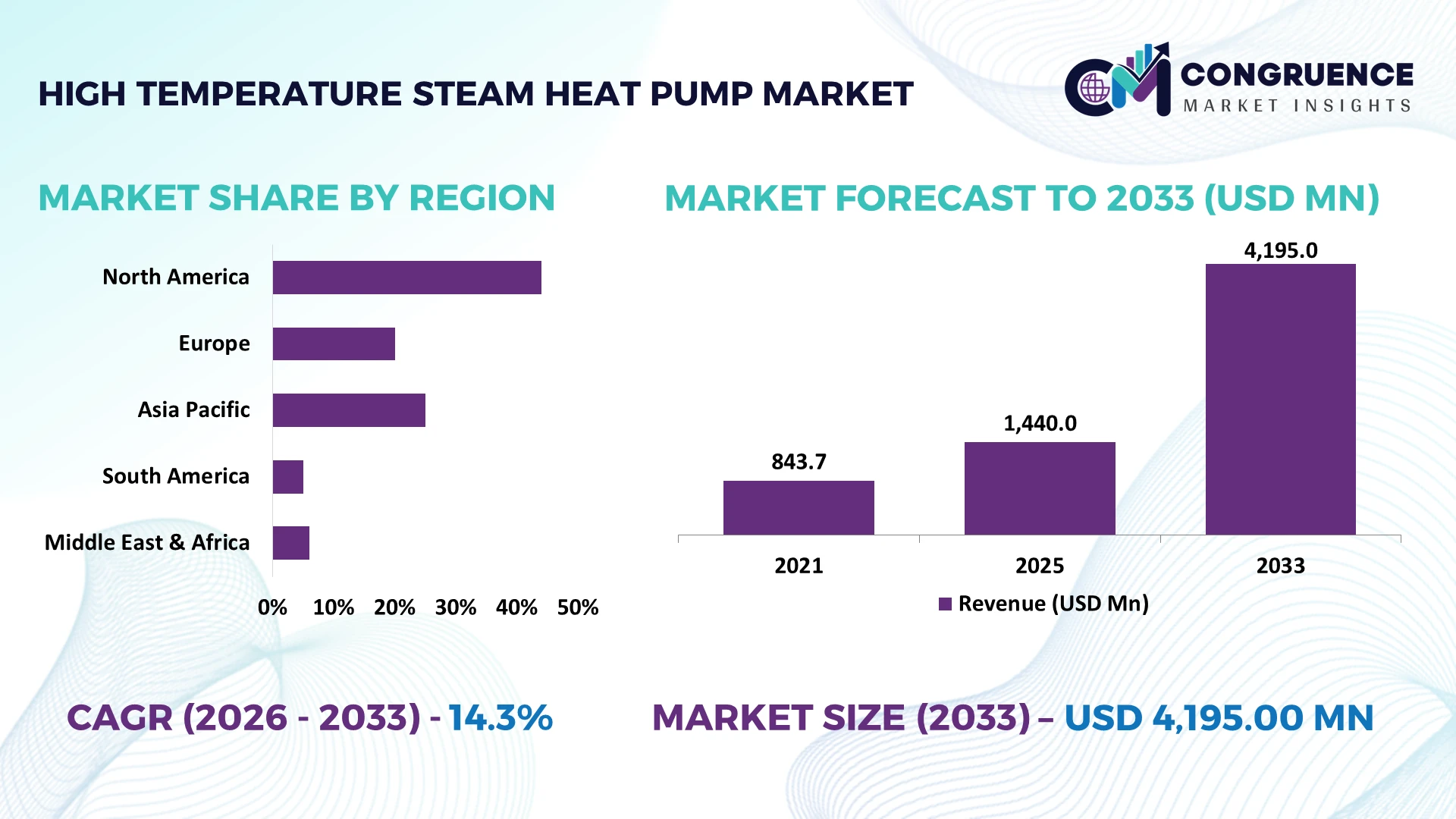
The Global High-Temperature Steam Heat Pump Market was valued at USD 1440 Million in 2025 and is anticipated to reach a value of USD 4195 Million by 2033 expanding at a CAGR of 14.3% between 2026 and 2033. Growth is driven by industrial steam electrification, recovery of waste heat from manufacturing processes, advances in high temperature compressors, and replacement of fossil fuel boilers in food processing, chemicals, pulp and paper, and pharmaceutical production.
China represents a strategically dominant industrial opportunity, supported by its extensive manufacturing infrastructure and process heating requirements. The country accounted for approximately 32% of global manufacturing value added in 2023, compared with the United States at approximately 16%. China's industrial sector consumes more than 60% of national energy, creating substantial opportunities for waste heat recovery. Government backed industrial efficiency programs and domestic compressor manufacturing support deployment of advanced heat pumps delivering temperatures above 120°C across chemical processing, textiles, and food manufacturing facilities.
Strategically, manufacturers should prioritize China's industrial electrification programs and European steam decarbonization projects, targeting systems delivering 120°C to 200°C process heat with coefficients of performance above 2.5.
Market Size & Growth: USD 1,440 million in 2025, reaching USD 4,195 million by 2033 at 14.3% CAGR, supported by industrial steam electrification.
Top Growth Drivers: Indicative demand contributions include industrial decarbonization at 40%, waste heat recovery at 35%, and boiler electrification at 25%.
Short Term Forecast: By 2028, advanced steam heat pump installations target 20% lower process heating energy consumption through improved heat recovery integration.
Emerging Technologies: Three innovations include high temperature screw compressors, natural refrigerants, and AI optimized steam generation controls supporting industrial temperatures above 150°C.
Regional Leaders: Indicative 2033 allocations place Asia Pacific at USD 1,761.9 million, Europe at USD 1,258.5 million, and North America at USD 839 million, reflecting industrial electrification and manufacturing modernization.
Consumer / End User Trends: Industrial facilities increasingly evaluate heat pumps delivering 120°C to 200°C steam, replacing conventional fossil fuel heating in suitable processes.
Pilot / Case Example: In 2024, industrial steam heat pump demonstrations achieved coefficients of performance exceeding 3.0 under favorable waste heat recovery conditions.
Competitive Landscape: MAN Energy Solutions, GEA Group, Johnson Controls, Siemens Energy, and Mitsubishi Heavy Industries compete across industrial heat pump and steam generation technologies.
Regulatory & ESG Impact: The European Union targets at least 55% net greenhouse gas emissions reduction by 2030, strengthening incentives for industrial heat electrification.
Investment & Funding: The EU Innovation Fund has allocated billions of euros to clean technology projects, supporting industrial electrification and advanced thermal systems.
Innovation & Future Outlook: Next generation systems target steam temperatures approaching 200°C, modular capacity expansion, and integrated waste heat recovery for industrial facilities.
The High-Temperature Steam Heat Pump Market is transitioning toward integrated industrial thermal systems that combine waste heat recovery, advanced compression technology, and automated steam generation. Food processing, chemical manufacturing, pulp and paper production, and pharmaceutical facilities represent priority applications because continuous thermal loads create opportunities for fossil fuel displacement. Advanced systems operating at coefficients of performance between 2.5 and 4.0 can deliver approximately 60% to 75% lower purchased energy input than direct electric resistance heating under comparable conditions. European industrial decarbonization policies and expanding Asian manufacturing capabilities are accelerating technology qualification, creating strategic opportunities for equipment suppliers and industrial energy service providers.
High temperature steam heat pumps are becoming strategically important as industrial manufacturers seek alternatives to fossil fuel boilers while improving energy productivity and controlling process heating costs. Industrial heat accounts for approximately two thirds of industrial energy consumption, creating substantial opportunities for electrified steam generation. European industrial decarbonization policies are accelerating equipment modernization, while advanced compressor manufacturing is enabling steam temperatures exceeding 150°C. Equipment suppliers are strengthening partnerships with industrial engineering companies to integrate waste heat recovery into existing production infrastructure.
Compared with conventional electric resistance boilers operating near 100% conversion efficiency, steam heat pumps achieving a coefficient of performance of 3.0 require approximately 67% less electricity for equivalent useful heat delivery. China benefits from extensive industrial manufacturing capacity, while Germany emphasizes efficient process heating and industrial emissions reduction. Between 2026 and 2028, deployment priorities will increasingly favor modular steam generation, natural refrigerants, and automated thermal load management, particularly in facilities operating continuous production processes.
A practical application involves recovering waste heat from food processing operations and upgrading it into usable steam for cleaning, drying, and sterilization. GEA, Johnson Controls, and Mitsubishi Heavy Industries are developing advanced industrial heating solutions and strengthening application engineering capabilities. Competitive advantage depends on reliable steam output, integration flexibility, and measurable operating cost reductions.
Industrial decarbonization and rising demand for efficient process heating are accelerating adoption of high temperature steam heat pumps. Industrial heat represents approximately 66% of industrial energy consumption, while heat pumps operating at a coefficient of performance of 3.0 can reduce electricity requirements by approximately 67% compared with direct resistance heating. Germany's industrial energy transition is encouraging manufacturers to replace fossil fuel steam generation with electrified thermal systems. Food processing, chemical production, and pulp manufacturing facilities offer substantial waste heat recovery potential. GEA, Johnson Controls, and MAN Energy Solutions are strengthening compressor technologies and industrial integration capabilities. Manufacturers prioritizing continuous thermal loads can improve equipment utilization and establish stronger economic justification for electrified steam generation investments.
High installation costs and unfavorable electricity pricing constrain adoption of industrial steam heat pumps across energy intensive manufacturing facilities. Steam heat pumps typically require customized compressors, heat exchangers, electrical infrastructure, and process integration engineering, increasing initial project expenditure. At a coefficient of performance of 2.5, electricity consumption remains approximately 40% of delivered thermal energy, making operating economics sensitive to electricity tariffs. A 20% increase in electricity prices directly raises electricity expenditure by 20% when consumption remains unchanged. In Germany, industrial electricity and natural gas price differences influence equipment investment decisions. Manufacturers are responding through modular equipment configurations, long term electricity procurement agreements, and engineering partnerships that reduce installation complexity and improve project financial performance.
Emerging compressor technologies and integrated waste heat recovery systems are creating opportunities for industrial steam generation above 150°C. Heat pumps achieving coefficients of performance between 2.5 and 4.0 can reduce electricity consumption by approximately 60% to 75% compared with resistance heating under comparable conditions. China's chemical manufacturing and food processing industries provide extensive opportunities for recovering low grade thermal energy from production processes. Advanced steam compression, natural refrigerants, and automated heat recovery controls are expanding equipment applicability. Manufacturers are investing in high temperature compressor development, modular thermal systems, and industrial engineering partnerships. Integrating steam heat pumps with existing condensate recovery networks offers an additional efficiency advantage by reducing required temperature lift and improving overall system performance.
Integrating high temperature steam heat pumps into continuous industrial production creates engineering challenges involving variable thermal loads, steam pressure stability, and compressor reliability. Steam generation at 150°C requires approximately 4.8 bar absolute saturation pressure, while operation near 180°C requires approximately 10 bar absolute, increasing equipment design requirements. Industrial facilities operating across multiple production shifts demand consistent steam quality despite changing process conditions. In Japan, precision manufacturing and food processing facilities require reliable integration with established steam distribution networks. Equipment manufacturers must strengthen compressor durability, automated pressure control, thermal storage integration, and predictive maintenance capabilities. Competitive differentiation depends on maintaining dependable steam delivery while minimizing production interruptions, operational complexity, and long term maintenance requirements.
Natural Refrigerant Systems Gain Commercial Traction: European manufacturers are advancing steam heat pump designs using water and other natural refrigerants to address F gas restrictions. Water has a global warming potential of 0, while carbon dioxide has a reference value of 1. GEA and specialized compressor developers are refining refrigerant compatibility, sealing systems, and thermal controls to improve regulatory compliance and equipment serviceability.
Standardized Steam Modules Simplify Factory Integration: Equipment suppliers are introducing packaged steam generation systems to reduce engineering customization and installation complexity. Modular configurations increasingly target steam temperatures between 120°C and 160°C, with industrial capacities ranging from hundreds of kilowatts to several megawatts. Japanese manufacturers are strengthening factory assembled equipment designs, enabling standardized commissioning, predictable maintenance requirements, and faster integration with existing industrial steam networks.
Digital Performance Verification Reshapes Equipment Contracts: Industrial customers are increasingly specifying measured thermal output and electricity consumption within equipment acceptance procedures. Steam heat pump installations operating at coefficients of performance between 2.5 and 3.5 deliver approximately 2.5 to 3.5 units of thermal energy per electricity unit consumed. Johnson Controls and industrial automation providers are integrating digital metering, operational dashboards, and remote diagnostics to strengthen performance accountability.
Industrial Heat Storage Gains Operational Importance: Manufacturers are combining thermal storage with electrified steam systems to manage fluctuating electricity prices and production schedules. Water based storage systems can retain useful heat across temperature ranges exceeding 50°C, while steam accumulators support short duration process demand fluctuations. German industrial engineering companies are integrating storage controls with heat pump operation, improving load flexibility and reducing dependence on immediate electricity consumption during expensive tariff periods.
Mechanical Vapor Compression represents the leading technology category, with an indicative 38% market share, supported by established compressor engineering, scalable industrial equipment designs, and compatibility with continuous process heating. These systems recover thermal energy through vapor compression and deliver upgraded heat at temperatures suitable for industrial applications. Steam Compression Heat Pumps remain important for facilities requiring direct steam production and integration with existing distribution networks. Absorption Heat Pumps serve applications where suitable thermal driving energy is available, offering an alternative to electrically driven compression. Mechanical compression systems achieving coefficients of performance between 2.5 and 4.0 provide substantial energy advantages over direct electric resistance heating.
High-Lift Heat Pumps represent the fastest expanding category, supported by increasing requirements for upgrading lower temperature industrial waste heat into high temperature process energy. Hybrid Heat Pumps combine complementary heating technologies to accommodate variable operating conditions and demanding temperature requirements. Advanced systems targeting steam temperatures approaching 200°C require specialized compressors, refrigerants, and thermal management components. GEA, Johnson Controls, and MAN Energy Solutions are strengthening high temperature equipment development and industrial integration capabilities. Investment priorities increasingly favor modular configurations, improved compressor reliability, and flexible thermal performance across diverse manufacturing applications.
Industrial Process Heating represents the leading application, accounting for an indicative 34% market share, supported by continuous thermal requirements across manufacturing operations. Industrial facilities use steam and high temperature heat for chemical processing, sterilization, material treatment, and production equipment operation. Steam Generation represents a closely related application where heat pumps directly replace or supplement conventional boiler capacity. Waste Heat Recovery captures thermal energy from exhaust streams, cooling systems, and process discharge, improving overall facility energy utilization. Process Water Heating remains important for manufacturing operations requiring controlled temperatures, while Industrial Drying supports moisture removal in temperature sensitive production environments. Systems operating at coefficients of performance between 2.5 and 4.0 provide measurable electricity savings compared with resistance heating.
Steam Generation represents the fastest expanding application as manufacturers seek direct integration with established steam distribution infrastructure. Advanced equipment producing steam above 150°C is expanding the range of industrial processes suitable for electrification. District Heating provides additional opportunities where centralized thermal networks require higher supply temperatures. Equipment suppliers are developing packaged steam generation modules, integrated heat exchangers, and automated process controls. Procurement increasingly emphasizes dependable thermal output, temperature stability, and compatibility with existing manufacturing operations.
Chemical and Petrochemical industries represent the leading end user category, with an indicative 30% market share, supported by extensive requirements for process steam, thermal separation, and continuous chemical production. Industrial facilities require dependable heating across multiple temperature levels, making integrated steam heat pumps relevant for recovering and upgrading available process heat. Food and Beverage manufacturers maintain substantial demand through sterilization, evaporation, cleaning, and drying operations. Pulp and Paper facilities offer opportunities for thermal recovery from production processes, while Textile Manufacturing requires controlled heating for washing, dyeing, and drying. Advanced heat pumps delivering temperatures above 150°C are expanding compatibility with industrial steam requirements.
Food and Beverage represents the fastest expanding end user category, supported by repeatable thermal loads and opportunities to integrate steam heat pumps into existing processing infrastructure. Pharmaceutical manufacturers prioritize precise temperature control and dependable steam quality, while Metal Processing facilities require specialized solutions for suitable lower temperature heating operations. Equipment manufacturers are strengthening application engineering, modular product configurations, and industrial partnerships. Systems achieving coefficients of performance around 3.0 provide approximately 67% lower electricity consumption than direct resistance heating, supporting attractive operating economics where suitable waste heat is available.
Asia Pacific accounted for the largest market share at an estimated 42% in 2025 however, Asia Pacific is expected to register the fastest growth, expanding at a CAGR of approximately 16.2% between 2026 and 2033.
Industrial Steam Electrification Reshapes Manufacturing Energy Procurement
North America represents an estimated 20% of the global high temperature steam heat pump market, supported by industrial energy efficiency investments and increasing interest in electrified process heating. The United States dominates regional opportunities through chemical manufacturing, food processing, pulp production, and pharmaceutical facilities. Canada contributes through established industrial heat pump engineering capabilities and electricity intensive manufacturing operations. The United States Department of Energy identifies industrial process heating as a major component of manufacturing energy consumption, creating substantial opportunities for thermal electrification. Steam heat pumps achieving coefficients of performance between 2.5 and 4.0 provide approximately 60% to 75% lower electricity consumption than direct resistance heating. Equipment suppliers are strengthening application engineering partnerships and developing modular steam generation solutions. Regional procurement increasingly emphasizes electricity tariff optimization, dependable steam output, and compatibility with existing manufacturing infrastructure.
United States Market Outlook: The United States benefits from extensive industrial production capacity, established engineering contractors, and federal programs supporting industrial decarbonization. The Department of Energy's Industrial Demonstrations Program supports projects addressing emissions intensive manufacturing processes. Industrial facilities in Texas, Louisiana, and the Midwest offer significant opportunities for recovering thermal energy from chemical production and food processing operations. Manufacturers are prioritizing industrial heat pump integration, automated process controls, and performance verification.
Industrial Decarbonization Policies Accelerate Steam Technology Deployment
Europe accounts for an estimated 30% of the global market, supported by industrial emissions regulations, advanced compressor manufacturing, and established thermal engineering capabilities. Germany, Denmark, Austria, and the Netherlands concentrate technology development and industrial demonstration activity. European manufacturers are advancing high temperature steam heat pumps for chemical processing, food production, and district energy applications. The European Union's climate framework targets at least 55% net greenhouse gas emissions reduction by 2030, strengthening industrial electrification priorities. GEA, MAN Energy Solutions, and specialized equipment developers are advancing high temperature compression technologies and integrated waste heat recovery solutions. Regional buyers increasingly evaluate refrigerant environmental performance, compressor efficiency, and compatibility with established steam distribution systems. Natural refrigerants and modular equipment designs are becoming important procurement differentiators as industrial operators seek reliable alternatives to fossil fuel boilers.
Germany Market Outlook: Germany maintains strong capabilities in industrial compressor engineering, thermal equipment manufacturing, and process automation. Chemical production clusters in North Rhine Westphalia and Ludwigshafen provide opportunities for integrating heat recovery into continuous manufacturing operations. Industrial energy efficiency programs encourage equipment modernization, while domestic manufacturers develop steam heat pump systems operating above 150°C. Engineering partnerships and established industrial service networks strengthen deployment capabilities.
Manufacturing Concentration Accelerates Advanced Thermal Equipment Adoption
Asia Pacific leads the global market with an estimated 42% share, supported by extensive industrial manufacturing capacity and increasing investment in efficient process heating. China dominates regional demand through chemical production, textile manufacturing, food processing, and industrial equipment manufacturing. Japan maintains advanced compressor engineering capabilities, while South Korea contributes through industrial thermal technology development and precision manufacturing. China's industrial sector accounts for more than 60% of national energy consumption, creating substantial opportunities for waste heat recovery and steam electrification. Regional manufacturers are advancing high temperature compressors, automated thermal controls, and integrated steam generation equipment. Industrial procurement increasingly emphasizes localized manufacturing, reliable component availability, and installation flexibility. Suppliers capable of delivering modular systems with steam temperatures exceeding 150°C are positioned to capture demand from industrial modernization projects.
China Market Outlook: China benefits from extensive manufacturing infrastructure, domestic compressor production, and industrial energy efficiency initiatives. The country accounted for approximately 32% of global manufacturing value added in 2023, highlighting its industrial scale. Chemical manufacturing, textile production, and food processing facilities offer substantial opportunities for upgrading recovered thermal energy into useful steam. Domestic equipment manufacturers are strengthening high temperature compression technology, system automation, and localized industrial service capabilities.
Agroindustrial Processing Creates Targeted Thermal Electrification Opportunities
South America represents an estimated 4% of the global market, with demand concentrated in food processing, pulp production, chemical manufacturing, and agricultural commodity processing. Brazil dominates regional opportunities through its established industrial base and extensive renewable electricity resources. Chile contributes through industrial modernization and process efficiency initiatives, while Argentina maintains opportunities in food production and chemical processing. Brazil generated approximately 89% of its electricity from renewable sources in 2023, providing a favorable electricity supply profile for industrial heat electrification. Industrial steam heat pumps can support food drying, evaporation, and cleaning processes where recoverable thermal energy is available. However, equipment import dependence, specialized engineering requirements, and financing constraints influence deployment economics. Suppliers are responding through local technical partnerships, modular equipment configurations, and industrial energy service agreements.
Brazil Market Outlook: Brazil maintains strong industrial opportunities through sugar processing, food manufacturing, pulp production, and chemical industries. São Paulo and southern manufacturing clusters provide concentrated demand for thermal equipment modernization. Industrial operators are evaluating steam heat pumps alongside biomass boilers and conventional thermal systems. Equipment suppliers are emphasizing process integration, dependable maintenance support, and energy efficiency improvements to strengthen adoption in facilities with continuous steam requirements.
Industrial Diversification Strengthens Advanced Process Heating Investment
The Middle East and Africa represent an estimated 4% of the global market, supported by industrial diversification, manufacturing infrastructure development, and increasing interest in efficient thermal technologies. Saudi Arabia and the United Arab Emirates lead industrial modernization initiatives, while South Africa provides opportunities through established chemical processing and manufacturing operations. Regional demand concentrates on industrial steam generation, process water heating, and thermal energy recovery. Saudi Arabia's Vision 2030 industrial transformation program is expanding manufacturing capacity and encouraging investment in advanced production technologies. Steam heat pumps operating at coefficients of performance above 3.0 offer potential electricity savings exceeding 66% compared with direct resistance heating. Equipment suppliers are strengthening engineering partnerships and evaluating applications where industrial waste heat availability supports dependable operation. Regional deployment depends on electricity pricing, cooling infrastructure, and technical service capabilities.
Saudi Arabia Market Outlook: Saudi Arabia benefits from large scale industrial infrastructure, petrochemical manufacturing, and expanding domestic equipment production initiatives. Jubail and Yanbu industrial cities provide concentrated opportunities for process heat optimization and steam system modernization. Industrial operators are evaluating advanced thermal technologies alongside established fuel based heating systems. Equipment suppliers are prioritizing high temperature compressor reliability, industrial integration services, and partnerships supporting localized maintenance and technical capabilities.
The high temperature steam heat pump market features competition between industrial equipment specialists GEA, MAN Energy Solutions, and Mitsubishi Heavy Industries and diversified thermal technology providers Johnson Controls and Siemens Energy. These companies collectively represent an indicative 40% market share, reflecting competition across compressors, integrated steam systems, and industrial engineering services. Established manufacturers emphasize reliability and installed service networks, while specialized developers compete through higher temperature capabilities and customized thermal integration. Systems achieving coefficients of performance around 3.0 reduce electricity consumption approximately 67% compared with resistance heating, strengthening efficiency differentiation. Advanced compressors targeting 150°C to 200°C steam expand industrial application coverage. Companies are investing in modular systems, natural refrigerants, engineering partnerships, and localized technical support. Competition is shifting toward integrated performance guarantees rather than equipment specifications alone. Specialized compressor manufacturing, industrial qualification requirements, and integration expertise create entry barriers. Winning requires verified thermal performance, dependable service capabilities, and competitive lifecycle operating economics.
GEA Group AG
MAN Energy Solutions SE
Johnson Controls International plc
Mitsubishi Heavy Industries, Ltd.
Siemens Energy AG
Mayekawa Mfg. Co., Ltd.
Kobe Steel, Ltd.
Fuji Electric Co., Ltd.
Danfoss A/S
Carrier Global Corporation
Ochsner Wärmepumpen GmbH
SPH Sustainable Process Heat GmbH
Heaten AS
Oilon Group Oy
Current industrial steam heat pumps use mechanical vapor compression, multistage compressors, and industrial heat exchangers to upgrade recovered thermal energy. Systems operating at coefficients of performance between 2.5 and 4.0 consume approximately 60% to 75% less electricity than resistance heating. Deployment concentrates on continuous industrial processes where stable waste heat streams support reliable thermal output. GEA and Johnson Controls benefit from established compressor engineering and industrial service capabilities.
Emerging technologies include water refrigerant compression, advanced impeller designs, and automated thermal optimization. Water offers zero direct global warming potential, while variable speed compressors improve part load efficiency by matching electrical consumption to process requirements. Compared with conventional electric boilers, a steam heat pump achieving a coefficient of performance of 3.0 delivers approximately 67% electricity savings. Manufacturers are integrating digital monitoring and predictive maintenance to improve equipment availability.
Between 2026 and 2028, high lift compression, modular steam generation, and thermal storage integration will expand industrial applications. Equipment targeting temperatures above 180°C requires advanced materials and precise pressure control. Chemical and food processing operators gain operational advantages through reduced fuel dependence and improved energy flexibility. Suppliers combining reliable steam delivery, integrated controls, and validated thermal performance will strengthen procurement competitiveness.
December 2024: MAN Energy Solutions formalized its partnership with Vicinity Energy to supply a 35 MW industrial steam heat pump for Boston's Kendall Station. The project will recover Charles River heat to support district steam decarbonization and reduce fossil fuel dependence. Source: man-es.com.
March 2025: The International Institute of Refrigeration reported GEA's deployment at Belgium's Tiense Suiker refinery. Its 4 MW pentane heat pump generates steam at 139°C, enabling industrial waste heat recovery and projected annual emissions reductions of 3,000 to 3,500 tonnes. Source: iifiir.org.
August 2025: Triveni Turbines unveiled India's first domestically developed carbon dioxide heat pump, engineered with the Indian Institute of Science. Delivering temperatures up to 122°C and a reported coefficient of performance of 6, the technology advances efficient industrial heating. Source: triveniturbines.com.
February 2026: Turboden, part of Mitsubishi Heavy Industries, commissioned a steam producing heat pump at delfort's Finnish paper mill. The 12 MW thermal installation produces superheated steam, with reported operating efficiency 10% above its guaranteed level, demonstrating industrial scalability. Source: coolingpost.com.
The High-Temperature Steam Heat Pump Market Report evaluates five technology categories: Mechanical Vapor Compression, Steam Compression Heat Pumps, Absorption Heat Pumps, Hybrid Heat Pumps, and High Lift Heat Pumps. Application coverage includes Industrial Process Heating, Steam Generation, Waste Heat Recovery, Industrial Drying, District Heating, and Process Water Heating. End user analysis examines Chemical and Petrochemical, Food and Beverage, Pulp and Paper, Textile Manufacturing, Pharmaceutical, and Metal Processing industries, distinguishing established applications from emerging deployment opportunities.
Regional analysis covers North America, Europe, Asia Pacific, South America, and the Middle East and Africa, examining industrial infrastructure, technology adoption, and investment conditions. The report profiles 14 market participants and evaluates advanced compressors, natural refrigerants, modular steam systems, and digital controls, supporting equipment procurement, manufacturing expansion, competitive positioning, and investment planning through 2033.
| Report Attribute/Metric | Report Details |
|---|---|
Market Revenue in 2025 | USD 1440 Million |
Market Revenue in 2033 | USD 4195 Million |
CAGR (2026 - 2033) | 14.3% |
Base Year | 2025 |
Forecast Period | 2026 - 2033 |
Historic Period | 2021 - 2025 |
Segments Covered | By Type
By Application
By End-User
|
Key Report Deliverable | Revenue Forecast, Growth Trends, Market Dynamics, Segmental Overview, Regional and Country-wise Analysis, Competition Landscape |
Region Covered | North America, Europe, Asia-Pacific, South America, Middle East, Africa |
Key Players Analyzed | GEA Group AG, MAN Energy Solutions SE, Johnson Controls International plc, Mitsubishi Heavy Industries, Ltd., Siemens Energy AG, Mayekawa Mfg. Co., Ltd., Kobe Steel, Ltd., Fuji Electric Co., Ltd., Danfoss A/S, Carrier Global Corporation, Ochsner Wärmepumpen GmbH, SPH Sustainable Process Heat GmbH, Heaten AS, Oilon Group Oy |
Customization & Pricing | Available on Request (10% Customization is Free) |




